Planet-Planet Secular Migration Predicts a Stellar Obliquity-Period Anti-Correlation
Pith reviewed 2026-06-26 15:26 UTC · model grok-4.3
The pith
Secular planet-planet migration produces an obliquity-period anti-correlation for hot Jupiters.
A machine-rendered reading of the paper's core claim, the machinery that carries it, and where it could break.
Core claim
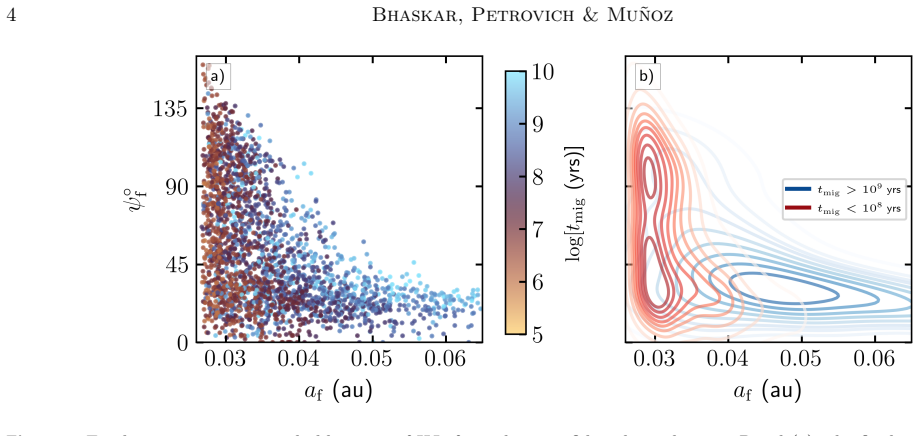
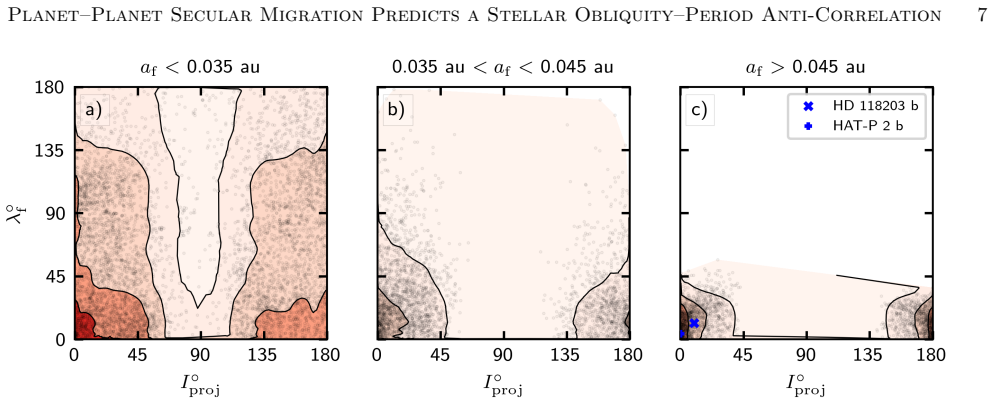
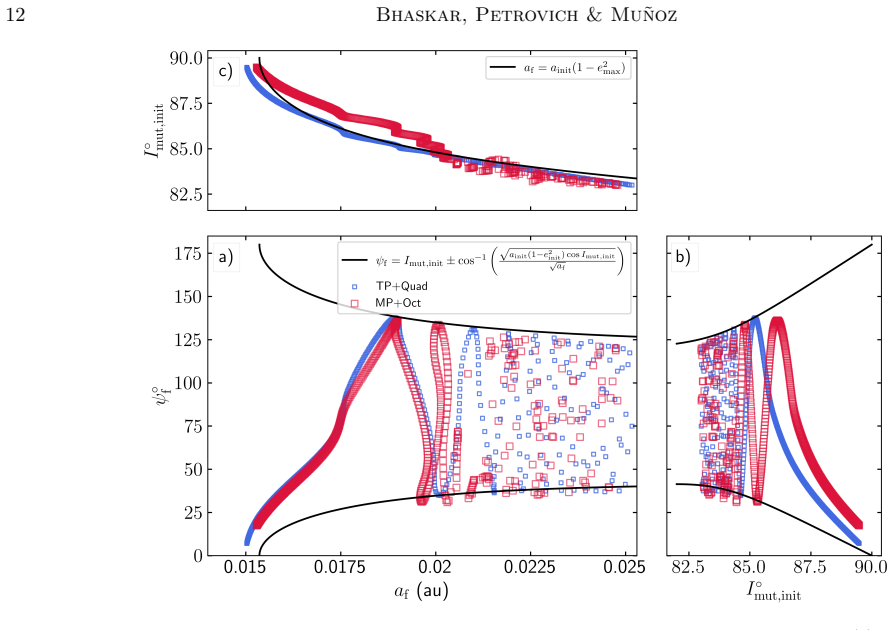
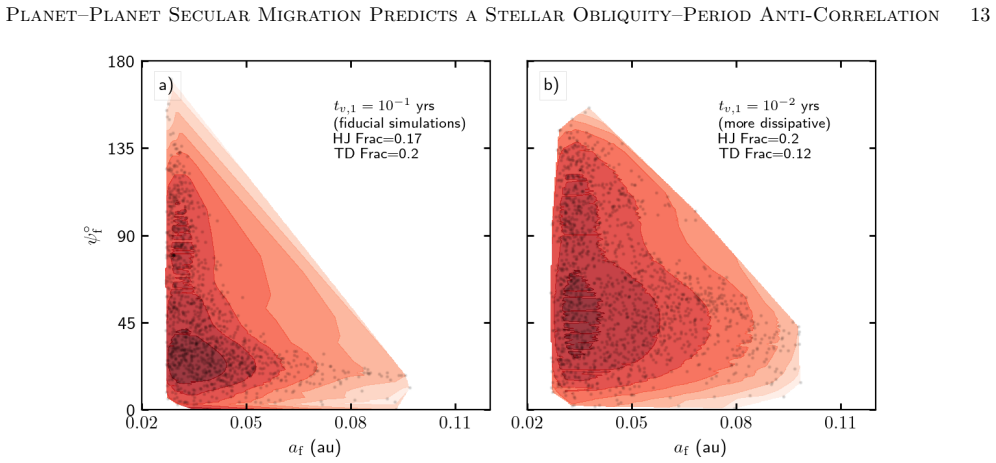
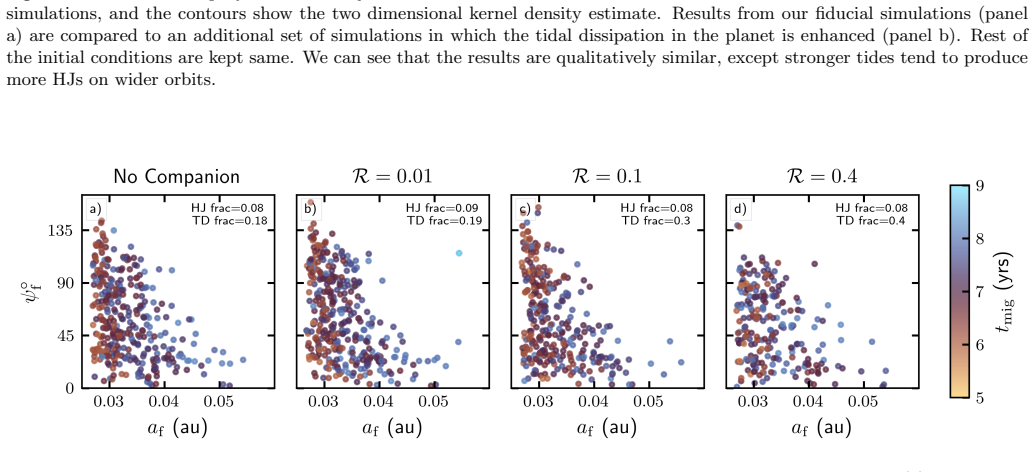
In N-body simulations, the shortest-period hot Jupiters are produced by the von Zeipel-Lidov-Kozai mechanism driven by highly inclined companions, resulting in a broad range of final stellar obliquities, while the longest-period hot Jupiters are produced over longer timescales by coplanar high-eccentricity migration, which preserves low obliquities.
What carries the argument
Secular high-eccentricity migration driven by a distant planetary companion, operating through two channels: von Zeipel-Lidov-Kozai from inclined orbits versus coplanar migration.
If this is right
- Intermediate-period hot Jupiters display a moderate range of obliquities as the two channels overlap.
- Shortest-period hot Jupiters should have distant companions with broadly distributed mutual inclinations.
- Companions of longer-period hot Jupiters should reside in nearly coplanar orbits.
Where Pith is reading between the lines
- Gaia astrometry of companion inclinations offers a direct test of the two-channel picture.
- The same secular process may shape obliquity distributions in other classes of close-in planets.
Load-bearing premise
The observed obliquity-period trend cannot be explained by tidal dissipation in the star.
What would settle it
Measurement of the mutual inclinations of distant companions, which should be broadly distributed for short-period hot Jupiters and nearly coplanar for long-period ones.
Figures
read the original abstract
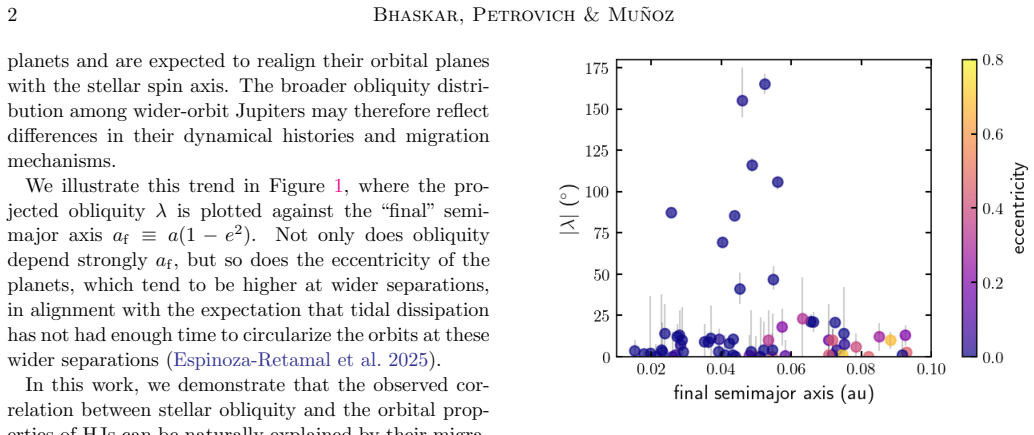
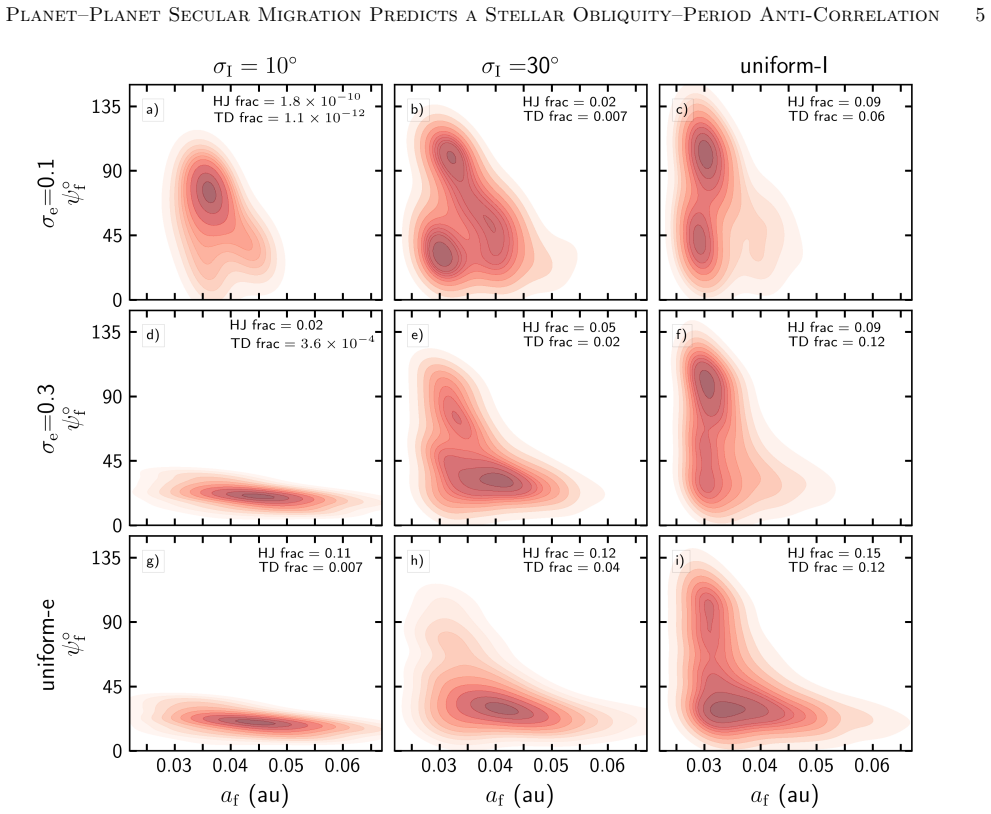
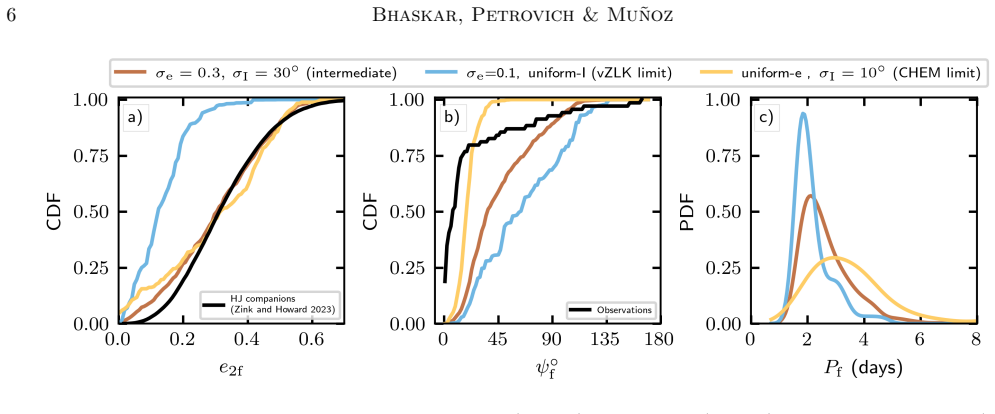
Stellar obliquities provide a fossil record of hot Jupiter (HJ) migration. An emerging observational trend in single-star systems is that strongly misaligned HJs are largely confined to short orbital periods, while longer-period HJs are preferentially aligned. This pattern cannot be explained by tidal dissipation in the star and may instead preserve clues to the migration pathway. We show that secular high-eccentricity migration driven by a distant planetary companion naturally produces such an obliquity--period correlation. In our simulations, the shortest-period HJs tend to be produced by the von Zeipel--Lidov--Kozai mechanism driven by highly inclined companions, which results in a broad range of final stellar obliquities. The longest-period HJs, on the other hand, are produced over longer timescales by coplanar high-eccentricity migration, which preserves low obliquities. The transition between these two limits is not abrupt, with intermediate-period HJs displaying a moderate range of obliquities. According to this interpretation, we predict that the shortest-period HJs should have distant planetary companions with broadly distributed mutual inclinations, whereas the companions of longer-period HJs should reside in nearly coplanar orbits. Upcoming Gaia astrometric constraints will provide a key test of this picture.
Editorial analysis
A structured set of objections, weighed in public.
Referee Report
Summary. The manuscript claims that N-body simulations of planet-planet secular high-eccentricity migration naturally reproduce the observed stellar obliquity–orbital period anti-correlation among hot Jupiters in single-star systems. Short-period HJs arise primarily via the von Zeipel–Lidov–Kozai mechanism driven by inclined outer companions and exhibit a broad range of final obliquities, while longer-period HJs form via coplanar high-eccentricity migration that preserves low obliquities; the transition is gradual. The work predicts that short-period HJs should have broadly inclined distant companions while longer-period HJs should have nearly coplanar ones, testable with Gaia astrometry.
Significance. If the simulation results hold, the paper supplies a dynamical mechanism that accounts for the trend without invoking stellar tidal dissipation and generates concrete, falsifiable predictions about companion mutual inclinations. The isolation of two distinct secular channels and the explicit link to an observable anti-correlation constitute a substantive contribution to the migration debate.
major comments (3)
- [§3] §3 (Simulation Setup): the manuscript does not specify the initial semi-major axis and eccentricity distributions, the number of realizations per channel, the integrator timestep, or whether general relativity and stellar tides are included; without these parameters it is impossible to verify that the reported obliquity–period separation is not an artifact of the chosen initial conditions or neglected physics.
- [§4.2] §4.2 (Obliquity–Period Distributions): the transition between the vZLK and coplanar regimes is described qualitatively; the central claim would be strengthened by reporting a quantitative statistic (e.g., Spearman rank correlation or binned median obliquity vs. period) together with bootstrap uncertainties rather than visual inspection of scatter plots alone.
- [§5] §5 (Predictions): the statement that Gaia will provide a key test is not accompanied by a forward-modelled distribution of mutual inclinations or an estimate of the astrometric precision required to distinguish the two populations; this leaves the falsifiability claim unquantified.
minor comments (2)
- [Abstract, §1] The abstract and §1 use both “correlation” and “anti-correlation” interchangeably; consistent terminology would improve clarity.
- [Figure captions] Figure captions should explicitly state the number of simulated systems shown and whether error bars represent 1σ or interquartile ranges.
Simulated Author's Rebuttal
We appreciate the referee's thorough review and positive evaluation of our work. Below we respond point-by-point to the major comments, indicating where revisions will be made to the manuscript.
read point-by-point responses
-
Referee: [§3] §3 (Simulation Setup): the manuscript does not specify the initial semi-major axis and eccentricity distributions, the number of realizations per channel, the integrator timestep, or whether general relativity and stellar tides are included; without these parameters it is impossible to verify that the reported obliquity–period separation is not an artifact of the chosen initial conditions or neglected physics.
Authors: We agree that these simulation parameters must be clearly specified to allow verification of the results. In the revised manuscript, we will expand §3 to explicitly detail the initial semi-major axis and eccentricity distributions, the number of realizations per channel, the integrator timestep, and whether general relativity and stellar tides are included. revision: yes
-
Referee: [§4.2] §4.2 (Obliquity–Period Distributions): the transition between the vZLK and coplanar regimes is described qualitatively; the central claim would be strengthened by reporting a quantitative statistic (e.g., Spearman rank correlation or binned median obliquity vs. period) together with bootstrap uncertainties rather than visual inspection of scatter plots alone.
Authors: We acknowledge that providing a quantitative statistic would strengthen the presentation of the obliquity–period anti-correlation. We will add the Spearman rank correlation coefficient and binned median obliquities with bootstrap uncertainties to the revised §4.2. revision: yes
-
Referee: [§5] §5 (Predictions): the statement that Gaia will provide a key test is not accompanied by a forward-modelled distribution of mutual inclinations or an estimate of the astrometric precision required to distinguish the two populations; this leaves the falsifiability claim unquantified.
Authors: We agree that quantifying the Gaia test would make the prediction more concrete. In the revision, we will include a forward-modelled distribution of mutual inclinations and an estimate of the required astrometric precision to distinguish the populations in the updated §5. revision: yes
Circularity Check
No significant circularity
full rationale
The paper's central claim is that N-body simulations of secular high-eccentricity migration (von Zeipel-Lidov-Kozai vs. coplanar channels) produce the observed obliquity-period anti-correlation as an emergent output. No evidence appears of fitting parameters to the target trend, self-defining the result via the inputs, or relying on load-bearing self-citations whose content reduces to the present claim. The derivation is presented as independent dynamical modeling whose predictions (e.g., companion inclination distributions) are testable externally. This is the normal case of a simulation-based prediction without circular reduction.
Axiom & Free-Parameter Ledger
axioms (1)
- domain assumption The observed obliquity-period trend is real and cannot be produced by tidal dissipation alone.
Reference graph
Works this paper leans on
-
[1]
The Disk Substructures at High Angular Resolution Project (DSHARP). I. Motivation, Sample, Calibration, and Overview. , keywords =. doi:10.3847/2041-8213/aaf741 , archivePrefix =. 1812.04040 , primaryClass =
work page internal anchor Pith review Pith/arXiv arXiv doi:10.3847/2041-8213/aaf741 2041
-
[2]
Secular Evolution of Hierarchical Planetary Systems
Secular Evolution of Hierarchical Planetary Systems. , keywords =. doi:10.1086/375857 , archivePrefix =. astro-ph/0304454 , primaryClass =
work page internal anchor Pith review Pith/arXiv arXiv doi:10.1086/375857
-
[3]
Formation of inner planets in the presence of a Cold Jupiter: orbital evolution and relative velocities of planetesimals. arXiv e-prints , keywords =. doi:10.48550/arXiv.2308.14347 , archivePrefix =. 2308.14347 , primaryClass =
-
[4]
Accretion discs in astrophysics. , keywords =. doi:10.1146/annurev.aa.19.090181.001033 , adsurl =
-
[5]
Secular Evolution Driven by Massive Eccentric Disks/Rings: An Apsidally Aligned Case
Secular Evolution Driven by Massive Eccentric Disks/Rings: An Apsidally Aligned Case. , keywords =. doi:10.3847/1538-4357/aad3ba , archivePrefix =. 1809.02625 , primaryClass =
work page internal anchor Pith review Pith/arXiv arXiv doi:10.3847/1538-4357/aad3ba
-
[6]
The California Legacy Survey. III. On the Shoulders of (Some) Giants: The Relationship between Inner Small Planets and Outer Massive Planets. , keywords =. doi:10.3847/1538-4365/ac7230 , archivePrefix =. 2112.03399 , primaryClass =
-
[7]
Pericenter precession induced by a circumstellar disk on the orbit of massive bodies: comparison between analytical predictions and numerical results. , keywords =. doi:10.1051/0004-6361/201527610 , adsurl =
-
[8]
Celestial Mechanics and Dynamical Astronomy , keywords =
Secular resonance sweeping and orbital excitation in decaying disks. Celestial Mechanics and Dynamical Astronomy , keywords =. doi:10.1007/s10569-019-9942-0 , archivePrefix =. 1912.09118 , primaryClass =
-
[9]
Formation of Gaps in Self-gravitating Debris Disks by Secular Resonance in a Single-planet System. I. A Simplified Model. , keywords =. doi:10.3847/1538-4357/abda46 , archivePrefix =. 2010.15617 , primaryClass =
-
[10]
Celestial Mechanics and Dynamical Astronomy , keywords =
Secular Resonances in the Primitive Solar Nebula. Celestial Mechanics and Dynamical Astronomy , keywords =. doi:10.1007/BF00048587 , adsurl =
-
[11]
An Observational Perspective of Transitional Disks
An Observational Perspective of Transitional Disks. Protostars and Planets VI , year = 2014, editor =. doi:10.2458/azu_uapress_9780816531240-ch022 , archivePrefix =. 1402.7103 , primaryClass =
work page internal anchor Pith review Pith/arXiv arXiv doi:10.2458/azu_uapress_9780816531240-ch022 2014
-
[12]
Wind-driven Accretion in Protoplanetary Disks. II. Radial Dependence and Global Picture. , keywords =. doi:10.1088/0004-637X/772/2/96 , archivePrefix =. 1305.7232 , primaryClass =
work page internal anchor Pith review Pith/arXiv arXiv doi:10.1088/0004-637x/772/2/96
-
[13]
Homogeneous studies of transiting extrasolar planets - IV. Thirty systems with space-based light curves. , archivePrefix = "arXiv", eprint =. doi:10.1111/j.1365-2966.2011.19399.x , adsurl =
-
[15]
Angular momentum evolution of young low-mass stars and brown dwarfs: observations and theory
Angular Momentum Evolution of Young Low-Mass Stars and Brown Dwarfs: Observations and Theory. Protostars and Planets VI , year = 2014, editor =. doi:10.2458/azu_uapress_9780816531240-ch019 , archivePrefix =. 1309.7851 , primaryClass =
work page internal anchor Pith review Pith/arXiv arXiv doi:10.2458/azu_uapress_9780816531240-ch019 2014
-
[16]
Magnetic braking of T Tauri stars
Magnetic braking of T Tauri stars. , keywords =. doi:10.1093/mnras/280.2.458 , archivePrefix =. astro-ph/9512018 , primaryClass =
work page internal anchor Pith review Pith/arXiv arXiv doi:10.1093/mnras/280.2.458
-
[17]
Sean M. Andrews and D. J. Wilner and A. M. Hughes and Chunhua Qi and C. P. Dullemond , title =. doi:10.1088/0004-637x/723/2/1241 , url =
-
[18]
Benjamin J. Fulton and Lee J. Rosenthal and Lea A. Hirsch and Howard Isaacson and Andrew W. Howard and Cayla M. Dedrick and Ilya A. Sherstyuk and Sarah C. Blunt and Erik A. Petigura and Heather A. Knutson and Aida Behmard and Ashley Chontos and Justin R. Crepp and Ian J. M. Crossfield and Paul A. Dalba and Debra A. Fischer and Gregory W. Henry and Stephen...
-
[19]
Revisiting the pre-main-sequence evolution of stars. I. Importance of accretion efficiency and deuterium abundance. , keywords =. doi:10.1051/0004-6361/201628260 , archivePrefix =. 1702.07901 , primaryClass =
work page internal anchor Pith review Pith/arXiv arXiv doi:10.1051/0004-6361/201628260
-
[20]
Magnetic Origins of the Stellar Mass-Obliquity Correlation in Planetary Systems
Magnetic Origins of the Stellar Mass-Obliquity Correlation in Planetary Systems. , keywords =. 2015. doi:10.1088/0004-637X/811/2/82 , archivePrefix =. 1508.02365 , primaryClass =
work page internal anchor Pith review Pith/arXiv arXiv doi:10.1088/0004-637x/811/2/82 2015
-
[21]
Star-Disc-Binary Interactions in Protoplanetary Disc Systems and Primordial Spin-Orbit Misalignments
Star-disc-binary interactions in protoplanetary disc systems and primordial spin-orbit misalignments. , keywords =. 2014. doi:10.1093/mnras/stu485 , archivePrefix =. 1402.1907 , primaryClass =
work page internal anchor Pith review Pith/arXiv arXiv doi:10.1093/mnras/stu485 2014
-
[22]
A Mechanism of Exciting Planetary Inclination and Eccentricity through a Residual Gas Disk
Mechanism for Exciting Planetary Inclination and Eccentricity through a Residual Gas Disk. , keywords =. 2013. doi:10.1088/0004-637X/769/1/26 , archivePrefix =. 1303.6736 , primaryClass =
work page internal anchor Pith review Pith/arXiv arXiv doi:10.1088/0004-637x/769/1/26 2013
-
[23]
Eccentricity pumping of a planet on an inclined orbit by a disc. , keywords =. 2010. doi:10.1111/j.1365-2966.2010.16295.x , archivePrefix =. 1001.0657 , primaryClass =
-
[25]
Mass constraint for a planet in a protoplanetary disk from the gap width
Mass constraint for a planet in a protoplanetary disk from the gap width. , keywords =. 2016. doi:10.1093/pasj/psw037 , archivePrefix =. 1603.03853 , primaryClass =
work page internal anchor Pith review Pith/arXiv arXiv doi:10.1093/pasj/psw037 2016
-
[26]
An introduction to the study of stellar structure. 1939
1939
-
[27]
, archivePrefix = "arXiv", eprint =
The Gravitational Interaction between Planets on Inclined Orbits and Protoplanetary Disks As the Origin of Primordial Spin-Orbit Misalignments. , archivePrefix = "arXiv", eprint =. doi:10.3847/1538-3881/153/2/60 , adsurl =
-
[28]
, archivePrefix = "arXiv", eprint =
Inclined massive planets in a protoplanetary disc: gap opening, disc breaking, and observational signatures. , archivePrefix = "arXiv", eprint =. doi:10.1093/mnras/sty3358 , adsurl =
-
[32]
, archivePrefix = "arXiv", eprint =
Hiding Planets behind a Big Friend: Mutual Inclinations of Multi-planet Systems with External Companions. , archivePrefix = "arXiv", eprint =. doi:10.3847/1538-3881/153/1/42 , adsurl =
-
[33]
Science , archivePrefix = "arXiv", eprint =
Stellar Spin-Orbit Misalignment in a Multiplanet System. Science , archivePrefix = "arXiv", eprint =. doi:10.1126/science.1242066 , adsurl =
-
[34]
Celestial Mechanics , keywords =
A Second Fundamental Model for Resonance. Celestial Mechanics , keywords =. doi:10.1007/BF01234306 , adsurl =
-
[35]
Secular transport during disk dispersal: the case of Kepler-419
Secular Transport during Disk Dispersal: The Case of Kepler-419. , keywords =. doi:10.3847/1538-3881/aaeed9 , archivePrefix =. 1809.03510 , primaryClass =
work page internal anchor Pith review Pith/arXiv arXiv doi:10.3847/1538-3881/aaeed9
-
[36]
Why do Earth satellites stay up?
Why do Earth satellites stay up?. American Journal of Physics , keywords =. doi:10.1119/1.4874853 , archivePrefix =. 1309.5244 , primaryClass =
work page internal anchor Pith review Pith/arXiv arXiv doi:10.1119/1.4874853
-
[37]
Reducing the probability of capture into resonance. , keywords =. doi:10.1111/j.1365-2966.2005.09826.x , archivePrefix =. astro-ph/0507477 , primaryClass =
-
[38]
Migration Timescale Thresholds for Resonant Capture in the Plutino Problem. , keywords =. doi:10.1086/318880 , adsurl =
-
[39]
Celestial Mechanics , keywords =
A Simple Derivation of Capture Probabilities for the J+1:J and J+2:J Orbit-Orbit Resonance Problems. Celestial Mechanics , keywords =. doi:10.1007/BF01231120 , adsurl =
-
[40]
arXiv e-prints , keywords =
Exponential growth of eccentricity in secular theory. arXiv e-prints , keywords =
-
[41]
, archivePrefix = "arXiv", eprint =
Outer-planet scattering can gently tilt an inner planetary system. , archivePrefix = "arXiv", eprint =. doi:10.1093/mnras/stw2180 , adsurl =
-
[43]
Spin-Orbit Alignment of the Pictoris Planetary System. , keywords =. doi:10.3847/2041-8213/ab9d27 , archivePrefix =. 2006.10784 , primaryClass =
-
[44]
Shadows cast by a warp in the HD 142527 protoplanetary disk
Shadows Cast by a Warp in the HD 142527 Protoplanetary Disk. , keywords =. doi:10.1088/2041-8205/798/2/L44 , archivePrefix =. 1412.4632 , primaryClass =
work page internal anchor Pith review Pith/arXiv arXiv doi:10.1088/2041-8205/798/2/l44 2041
-
[45]
Dust-depleted Inner Disks in a Large Sample of Transition Disks through Long-baseline ALMA Observations. , keywords =. doi:10.3847/1538-4357/ab7b63 , archivePrefix =. 2003.00079 , primaryClass =
-
[46]
Kepler-108: A Mutually Inclined Giant Planet System
Kepler-108: A Mutually Inclined Giant Planet System. , keywords =. doi:10.3847/1538-3881/153/1/45 , archivePrefix =. 1606.04485 , primaryClass =
work page internal anchor Pith review Pith/arXiv arXiv doi:10.3847/1538-3881/153/1/45
-
[47]
Evidence for a high mutual inclination between the cold Jupiter and transiting super Earth orbiting Men. , keywords =. doi:10.1093/mnras/staa2033 , archivePrefix =. 2007.01871 , primaryClass =
-
[48]
, year = 2012, month = nov, volume =
A primordial origin for misalignments between stellar spin axes and planetary orbits. , year = 2012, month = nov, volume =. doi:10.1038/nature11560 , adsurl =
-
[49]
HAT-P-11: Discovery of a Second Planet and a Clue to Understanding Exoplanet Obliquities
HAT-P-11: Discovery of a Second Planet and a Clue to Understanding Exoplanet Obliquities. , keywords =. doi:10.3847/1538-3881/aabfec , archivePrefix =. 1805.09352 , primaryClass =
work page internal anchor Pith review Pith/arXiv arXiv doi:10.3847/1538-3881/aabfec
-
[50]
Why do warm Neptunes present nonzero eccentricity?. , keywords =. doi:10.1051/0004-6361/201936967 , archivePrefix =. 2005.02700 , primaryClass =
-
[52]
Planets Near Mean-Motion Resonances
Planets near Mean-motion Resonances. , keywords =. doi:10.1088/0004-637X/770/1/24 , archivePrefix =. 1211.5603 , primaryClass =
work page internal anchor Pith review Pith/arXiv arXiv doi:10.1088/0004-637x/770/1/24
-
[53]
Solar System Dynamics
-
[54]
, year = 1968, month = apr, volume = 73, pages =
Dynamical evolution of triple stars. , year = 1968, month = apr, volume = 73, pages =. doi:10.1086/110614 , adsurl =
-
[55]
, year = 1966, month = sep, volume =
Quasi-periodic Solutions for the three-body problem. , year = 1966, month = sep, volume =. doi:10.1086/109964 , adsurl =
-
[56]
In Situ Formation and Dynamical Evolution of Hot Jupiter Systems
In Situ Formation and Dynamical Evolution of Hot Jupiter Systems. , keywords =. doi:10.3847/0004-637X/829/2/114 , archivePrefix =. 1511.09157 , primaryClass =
work page internal anchor Pith review Pith/arXiv arXiv doi:10.3847/0004-637x/829/2/114
-
[57]
, year = 1962, month = nov, volume =
Secular perturbations of asteroids with high inclination and eccentricity. , year = 1962, month = nov, volume =. doi:10.1086/108790 , adsurl =
-
[58]
, year = 1962, month = oct, volume =
The evolution of orbits of artificial satellites of planets under the action of gravitational perturbations of external bodies. , year = 1962, month = oct, volume =. doi:10.1016/0032-0633(62)90129-0 , adsurl =
-
[60]
, year = 1939, month = mar, volume =
Apsidal motion in binary stars. , year = 1939, month = mar, volume =. doi:10.1093/mnras/99.5.451 , adsurl =
-
[61]
Equilibrium, Stability and Orbital Evolution of Close Binary Systems
Equilibrium, Stability, and Orbital Evolution of Close Binary Systems. , keywords =. doi:10.1086/173812 , archivePrefix =. astro-ph/9307032 , primaryClass =
work page internal anchor Pith review Pith/arXiv arXiv doi:10.1086/173812
-
[62]
Gravity-darkening exponents and apsidal-motion constants for pre-main-sequence models. , keywords =. doi:10.1051/0004-6361/201218881 , adsurl =
-
[63]
Hints for a Turnover at the Snow Line in the Giant Planet Occurrence Rate
Hints for a Turnover at the Snow Line in the Giant Planet Occurrence Rate. , keywords =. doi:10.3847/1538-4357/ab0300 , archivePrefix =. 1812.05569 , primaryClass =
work page internal anchor Pith review Pith/arXiv arXiv doi:10.3847/1538-4357/ab0300
-
[64]
Constraints on the dynamical history of a multi-planet system
Nearly polar orbit of the sub-Neptune HD 3167 c. Constraints on the dynamical history of a multi-planet system. , keywords =. doi:10.1051/0004-6361/201935944 , adsurl =
-
[65]
The Dispersal of Planet-forming discs: Theory confronts Observations
The dispersal of planet-forming discs: theory confronts observations. Royal Society Open Science , keywords =. doi:10.1098/rsos.170114 , archivePrefix =. 1704.00214 , primaryClass =
work page internal anchor Pith review Pith/arXiv arXiv doi:10.1098/rsos.170114
-
[66]
The inner regions of protoplanetary disks
The Inner Regions of Protoplanetary Disks. , keywords =. doi:10.1146/annurev-astro-081309-130932 , archivePrefix =. 1006.3485 , primaryClass =
work page internal anchor Pith review Pith/arXiv arXiv doi:10.1146/annurev-astro-081309-130932
-
[67]
arXiv e-prints , keywords =
A precise architecture characterization of the Men planetary system. arXiv e-prints , keywords =
-
[68]
arXiv e-prints , keywords =
A significant mutual inclination between the planets within the Mensae system. arXiv e-prints , keywords =
-
[69]
3D Radiation Non-ideal Magnetohydrodynamical Simulations Of The Inner Rim In Protoplanetary Disks
3D Radiation Nonideal Magnetohydrodynamical Simulations of the Inner Rim in Protoplanetary Disks. , keywords =. doi:10.3847/1538-4357/835/2/230 , archivePrefix =. 1612.02740 , primaryClass =
work page internal anchor Pith review Pith/arXiv arXiv doi:10.3847/1538-4357/835/2/230
-
[70]
The Last Gasp of Gas Giant Planet Formation: A Spitzer Study of the 5 Myr-old Cluster NGC 2362
The Last Gasp of Gas Giant Planet Formation: A Spitzer Study of the 5 Myr Old Cluster NGC 2362. , keywords =. doi:10.1088/0004-637X/698/1/1 , archivePrefix =. 0903.2666 , primaryClass =
work page internal anchor Pith review Pith/arXiv arXiv doi:10.1088/0004-637x/698/1/1
-
[71]
New evolutionary models for pre-main sequence and main sequence low-mass stars down to the hydrogen-burning limit. , keywords =. doi:10.1051/0004-6361/201425481 , archivePrefix =. 1503.04107 , primaryClass =
work page internal anchor Pith review Pith/arXiv arXiv doi:10.1051/0004-6361/201425481
-
[72]
Detecting the spin-orbit misalignment of the super-Earth 55 Cnc e
Detecting the spin-orbit misalignment of the super-Earth 55 Cancri e. , keywords =. doi:10.1051/0004-6361/201424266 , archivePrefix =. 1406.6813 , primaryClass =
work page internal anchor Pith review Pith/arXiv arXiv doi:10.1051/0004-6361/201424266
-
[73]
Orbital misalignment of the Neptune-mass exoplanet GJ 436b with the spin of its cool star
Orbital misalignment of the Neptune-mass exoplanet GJ 436b with the spin of its cool star. , keywords =. doi:10.1038/nature24677 , archivePrefix =. 1712.06638 , primaryClass =
work page internal anchor Pith review Pith/arXiv arXiv doi:10.1038/nature24677
-
[74]
Rossiter-McLaughlin Observations of 55 Cnc e
Rossiter-McLaughlin Observations of 55 Cnc e. , keywords =. doi:10.1088/2041-8205/792/2/L31 , archivePrefix =. 1408.2007 , primaryClass =
work page internal anchor Pith review Pith/arXiv arXiv doi:10.1088/2041-8205/792/2/l31 2041
-
[75]
Satellite dynamics on the Laplace surface
Satellite Dynamics on the Laplace Surface. , keywords =. doi:10.1088/0004-6256/137/3/3706 , archivePrefix =. 0809.0237 , primaryClass =
work page internal anchor Pith review Pith/arXiv arXiv doi:10.1088/0004-6256/137/3/3706
-
[76]
arXiv e-prints , keywords =
The Habitable-zone Planet Finder Reveals A High Mass and a Low Obliquity for the Young Neptune K2-25b. arXiv e-prints , keywords =
-
[78]
Secular resonances and the origin of eccentricities of Mars and the asteroids. , keywords =. doi:10.1016/0019-1035(80)90160-8 , adsurl =
-
[79]
Scanning secular resonance theory
Solar nebula dispersal and the stability of the planetary system I. Scanning secular resonance theory. , keywords =. doi:10.1016/0019-1035(81)90169-X , adsurl =
-
[80]
Secular Resonance, Solar Spin Down, and the Orbit of Mercury. , keywords =. doi:10.1016/0019-1035(76)90117-2 , adsurl =
-
[81]
Stephen J. Kortenkamp and George W. Wetherill and Satoshi Inaba , title =. Science , volume =. 2001 , doi =. https://www.science.org/doi/pdf/10.1126/science.1062391 , abstract =
-
[82]
Evolution of spin direction of accreting magnetic protostars and spin-orbit misalignment in exoplanetary systems. , keywords =. doi:10.1111/j.1365-2966.2010.18127.x , archivePrefix =. 1008.3148 , primaryClass =
-
[83]
Planet formation in discs with inclined binary companions: can primordial spin-orbit misalignment be produced?. , keywords =. doi:10.1093/mnras/sty1075 , archivePrefix =. 1711.03138 , primaryClass =
work page internal anchor Pith review Pith/arXiv arXiv doi:10.1093/mnras/sty1075
-
[84]
HAT-P-11b: A Super-Neptune Planet Transiting a Bright K Star in the Kepler Field
HAT-P-11b: A Super-Neptune Planet Transiting a Bright K Star in the Kepler Field. , keywords =. doi:10.1088/0004-637X/710/2/1724 , archivePrefix =. 0901.0282 , primaryClass =
work page internal anchor Pith review Pith/arXiv arXiv doi:10.1088/0004-637x/710/2/1724
-
[85]
The Occurrence and Architecture of Exoplanetary Systems
The Occurrence and Architecture of Exoplanetary Systems. , keywords =. doi:10.1146/annurev-astro-082214-122246 , archivePrefix =. 1410.4199 , primaryClass =
work page internal anchor Pith review Pith/arXiv arXiv doi:10.1146/annurev-astro-082214-122246
-
[86]
arXiv e-prints , keywords =
Orbital misalignment of the super-Earth Men c with the spin of its star. arXiv e-prints , keywords =
-
[87]
The Disk Population of the Upper Scorpius Association
The Disk Population of the Upper Scorpius Association. , keywords =. doi:10.1088/0004-637X/758/1/31 , archivePrefix =. 1209.5433 , primaryClass =
work page internal anchor Pith review Pith/arXiv arXiv doi:10.1088/0004-637x/758/1/31
-
[88]
Hidden planetary friends: on the stability of two-planet systems in the presence of a distant, inclined companion. , keywords =. doi:10.1093/mnras/sty2830 , archivePrefix =. 1802.00447 , primaryClass =
work page internal anchor Pith review Pith/arXiv arXiv doi:10.1093/mnras/sty2830
-
[89]
Exoplanetary Spin-Orbit Alignment: Results from the Ensemble of Rossiter-McLaughlin Observations
Exoplanetary Spin-Orbit Alignment: Results from the Ensemble of Rossiter-McLaughlin Observations. , keywords =. doi:10.1088/0004-637X/696/2/1230 , archivePrefix =. 0902.0737 , primaryClass =
work page internal anchor Pith review Pith/arXiv arXiv doi:10.1088/0004-637x/696/2/1230
discussion (0)
Sign in with ORCID, Apple, or X to comment. Anyone can read and Pith papers without signing in.