Systematic Polarization Errors from Parallactic-Angle Dependent Leakage in Pseudo-Circular Feeds
Pith reviewed 2026-06-28 15:59 UTC · model grok-4.3
The pith
Amplitude and phase errors in quadrature hybrids create a parallactic-angle-dependent leakage in pseudo-circular feeds.
A machine-rendered reading of the paper's core claim, the machinery that carries it, and where it could break.
Core claim
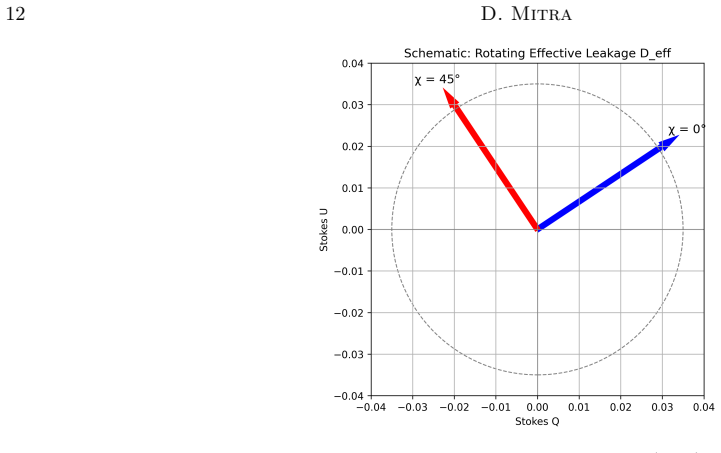
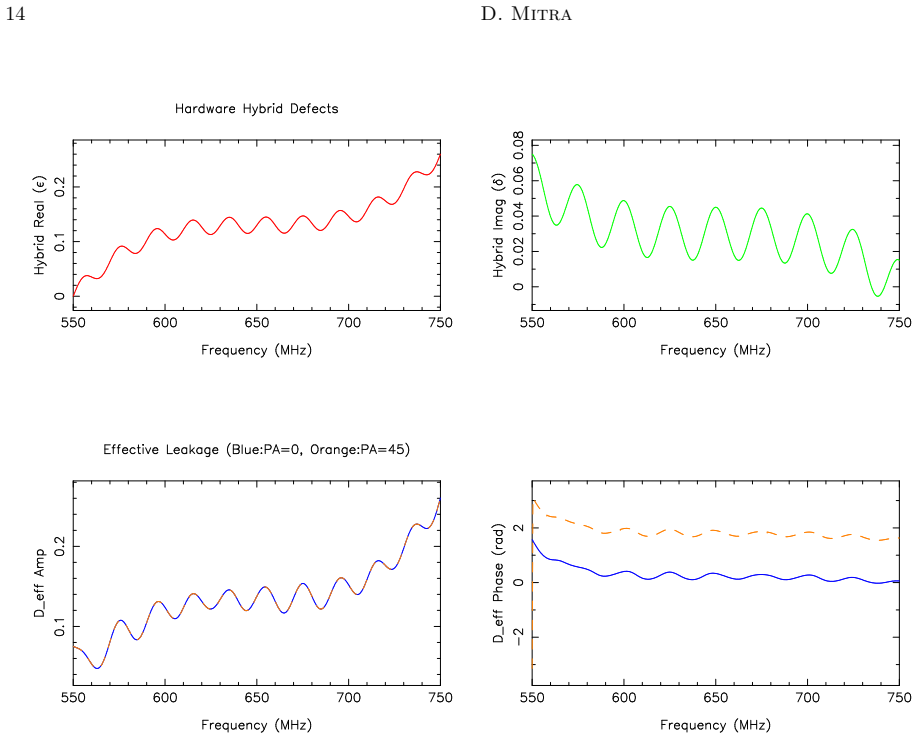
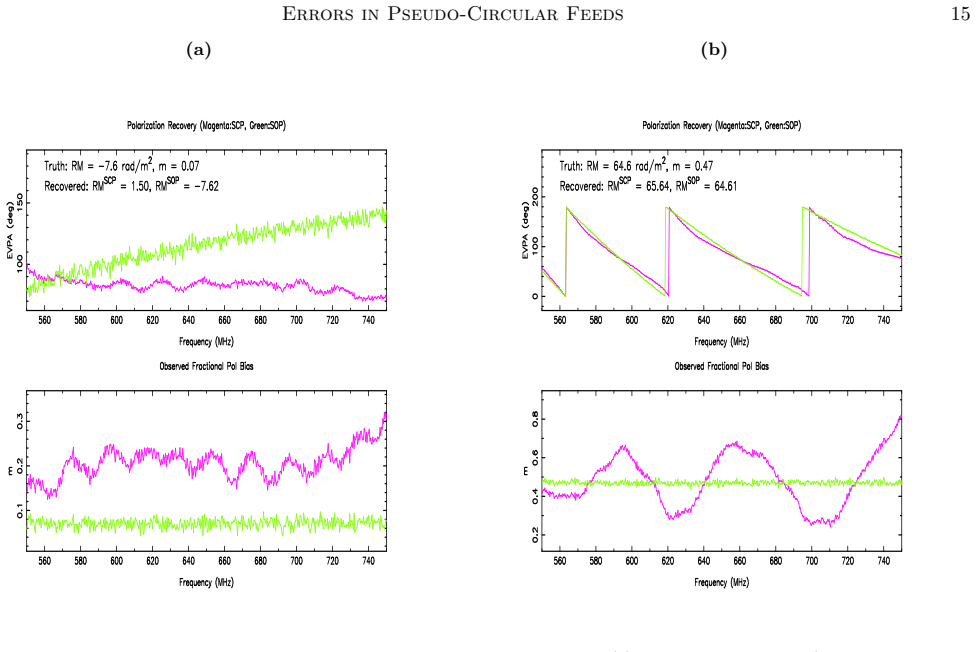
Amplitude and phase errors in the hybrid H(ν) introduce a non-commutative interaction with parallactic rotation R(χ), such that H(ν)R(χ) ≠ R(χ)H(ν) leading to a time-dependent effective leakage term that rotates in the Stokes (Q,U) plane. This effect causes systematic distortions in polarization angle and introduces frequency-dependent biases that can mimic or corrupt Faraday rotation measurements. We derive a first-order analytic model for this leakage and demonstrate that it manifests as a deterministic, geometrically modulated error proportional to total intensity. To mitigate this effect, we introduce a Static Offset Pre-correction (SOP) method that operates in the antenna frame, inverti
What carries the argument
The non-commutativity of the hybrid response matrix H(ν) with the parallactic rotation matrix R(χ), which converts static hybrid errors into a time-varying leakage term in the Stokes plane.
If this is right
- The leakage appears as a deterministic error proportional to total intensity.
- It produces systematic distortions in measured polarization angle.
- Frequency-dependent biases can mimic or corrupt Faraday rotation measurements.
- The SOP method removes the non-commutative error in the Jones domain before it projects into the sky frame.
Where Pith is reading between the lines
- The same non-commutativity may appear in any instrumental chain that combines a fixed response matrix with a time-varying rotation matrix.
- Wideband polarimetry surveys may need this pre-correction to reach the precision required for Faraday tomography.
- The model can be tested directly by tracking the apparent polarization of unpolarized calibrators over hour-angle tracks.
Load-bearing premise
The hybrid response H(ν) is a fixed frequency-dependent matrix whose only imperfections are static amplitude and phase errors in the antenna frame, with no other time-varying instrumental effects considered.
What would settle it
Observe a bright unpolarized source across a wide range of parallactic angles and check whether the apparent linear polarization rotates in the Q-U plane exactly as predicted by the non-commutative model but not by any static-leakage model.
Figures
read the original abstract
Wideband radio interferometers increasingly rely on analog quadrature hybrids to synthesize circular polarization from linear feeds. These systems are typically calibrated under the assumption that instrumental polarization leakage can be represented as a static complex offset, independent of parallactic angle. In this work, we demonstrate that this assumption breaks down in the presence of realistic hybrid imperfections. We show that amplitude and phase errors in the hybrid $\mathbf{H}(\nu)$ introduce a non-commutative interaction with parallactic rotation $\mathbf{R}(\chi)$, such that [$\mathbf{H}(\nu)\mathbf{R}(\chi) \neq \mathbf{R}(\chi)\mathbf{H}(\nu)$] leading to a time-dependent effective leakage term that rotates in the Stokes $(Q,U)$ plane. This effect causes systematic distortions in polarization angle and introduces frequency-dependent biases that can mimic or corrupt Faraday rotation measurements. We derive a first-order analytic model for this leakage and demonstrate that it manifests as a deterministic, geometrically modulated error proportional to total intensity. To mitigate this effect, we introduce a Static Offset Pre-correction (SOP) method that operates in the antenna frame, inverting the hybrid response prior to parallactic de-rotation. Unlike conventional calibration approaches, SOP removes the non-commutative error in the Jones domain, preventing its projection into the sky frame. Our results show that hybrid-induced leakage is not merely a calibration artifact but a fundamental systematic error that must be addressed to achieve high-fidelity wideband polarimetry.
Editorial analysis
A structured set of objections, weighed in public.
Referee Report
Summary. The paper claims that amplitude and phase errors in analog quadrature hybrids H(ν) used to synthesize circular polarization introduce a non-commutative interaction with parallactic rotation R(χ), such that H(ν)R(χ) ≠ R(χ)H(ν). This produces a time-dependent effective leakage term that rotates in the Stokes (Q,U) plane, causing systematic distortions in polarization angle and frequency-dependent biases that can affect Faraday rotation measurements. A first-order analytic model for the leakage (proportional to total intensity) is derived, and a Static Offset Pre-correction (SOP) method is proposed that inverts the hybrid response in the antenna frame prior to de-rotation to remove the error.
Significance. If the result holds, the work identifies a deterministic, geometrically modulated systematic in wideband polarimetry with pseudo-circular feeds that arises directly from matrix non-commutativity rather than from ad-hoc assumptions. The algebraic, parameter-free character of the derivation is a clear strength, as is the targeted SOP correction operating in the Jones domain. This could meaningfully improve the fidelity of polarization angle and Faraday rotation measurements for instruments relying on such hybrids.
minor comments (3)
- The abstract refers to derivation of a first-order analytic model but does not display the leading terms or the explicit leakage expression; adding the key equation would aid immediate comprehension.
- No quantitative comparison (e.g., before/after SOP residuals on simulated visibilities) is described to demonstrate the magnitude of the correction relative to conventional static-leakage calibration.
- The manuscript would benefit from additional references to existing literature on hybrid-based circular feeds and their calibration in radio interferometry.
Simulated Author's Rebuttal
We thank the referee for their positive assessment of the manuscript, accurate summary of the non-commutative leakage effect arising from hybrid imperfections H(ν) and parallactic rotation R(χ), and recommendation for minor revision. No specific major comments were provided in the report.
Circularity Check
No significant circularity; derivation is algebraic identity
full rationale
The paper derives its central claim directly from the non-commutativity of matrix multiplication between the hybrid response H(ν) and parallactic rotation R(χ), which is a standard algebraic property independent of any fitted parameters or prior self-citations. The first-order analytic model for time-dependent leakage and the SOP correction follow as direct consequences of this identity applied to the Jones matrix chain, without any step that renames a fit as a prediction or imports uniqueness via author-overlapping citations. The scope is limited to static hybrid errors by definition, but this does not create a self-referential loop; the result remains externally falsifiable against observed polarization angle distortions in wideband data.
Axiom & Free-Parameter Ledger
axioms (1)
- domain assumption Instrumental polarization leakage is represented using Jones matrices for the hybrid H(ν) and parallactic rotation R(χ)
Reference graph
Works this paper leans on
-
[1]
Brentjens, M. A., & de Bruyn, A. G. 2005, A&A, 441, 1217, doi: 10.1051/0004-6311:20052990
-
[2]
Burn, B. J. 1966, MNRAS, 133, 67, doi: 10.1093/mnras/133.1.67
-
[3]
Gardner, F. F., & Whiteoak, J. B. 1966, ARA&A, 4, 245, doi: 10.1146/annurev.aa.04.090166.001333
-
[4]
Gupta, Y., Ajithkumar, B., Kale, H. S., et al. 2017, Current Science, 113, 707, doi: 10.18520/cs/v113/i04/707-714
-
[5]
P., Bregman, J
Hamaker, J. P., Bregman, J. D., & Sault, R. J. 1996, A&AS, 117, 137
1996
-
[6]
Heald, G., Mao, S. A., Vacca, V., et al. 2020, Galaxies, 8, 53, doi: 10.3390/galaxies8030053
-
[7]
J., Thompson, A
Napier, P. J., Thompson, A. R., & Ekers, R. D. 1983, Proceedings of the IEEE, 71, 1295
1983
-
[8]
A., Chandler, C
Perley, R. A., Chandler, C. J., Butler, B. J., & Wrobel, J. M. 2011, ApJL, 739, L1
2011
-
[9]
Pozar, D. M. 2011, Microwave Engineering, 4th edn. (John Wiley & Sons)
2011
-
[10]
J., Hamaker, J
Sault, R. J., Hamaker, J. P., & Bregman, J. D. 1996, A&AS, 117, 149
1996
-
[11]
J., Killeen, N
Sault, R. J., Killeen, N. E. B., & Kesteven, M. J. 1991, A&A, 248, 679
1991
-
[12]
K., et al
Swarup, G., Ananthakrishnan, S., Kapahi, V. K., et al. 1991, Current Science, 60, 95
1991
-
[13]
Thompson, A. R., Moran, J. M., & Swenson, George W., J. 2017, Interferometry and Synthesis in Radio Astronomy, 3rd Edition (Springer International Publishing), doi: 10.1007/978-3-319-44431-4
-
[14]
2012, Journal of Astronomical History and Heritage, 15, 76
Wielebinski, R. 2012, Journal of Astronomical History and Heritage, 15, 76
2012
-
[15]
E., Ferris, R
Wilson, W. E., Ferris, R. H., Axtens, P., & et al. 2011, MNRAS, 416, 832
2011
discussion (0)
Sign in with ORCID, Apple, or X to comment. Anyone can read and Pith papers without signing in.