REVIEW 4 major objections 5 minor 57 references
Exploiting Global Camera Network Constraints for Unsupervised Video Person Re-identification
T0 review · 4 major / 5 minor · reviewed 2026-08-14 · deepseek-v4-flash
Pith's one-line read Enforcing loop and transitive consistency across the camera network lets unsupervised video person re-identification produce reliable pseudo-labels and beat one-shot supervised baselines on standard benchmarks without identity labels.
desk verdict An integrated unsupervised video re-id pipeline whose end-to-end gains are real, but whose cleanest mechanism evidence is idealized and whose consistency guarantee is softer than advertised. read the letter →
The pith
A machine-rendered reading of the paper's core claim, the machinery that carries it, and where it could break.
The reading
What carries the argument
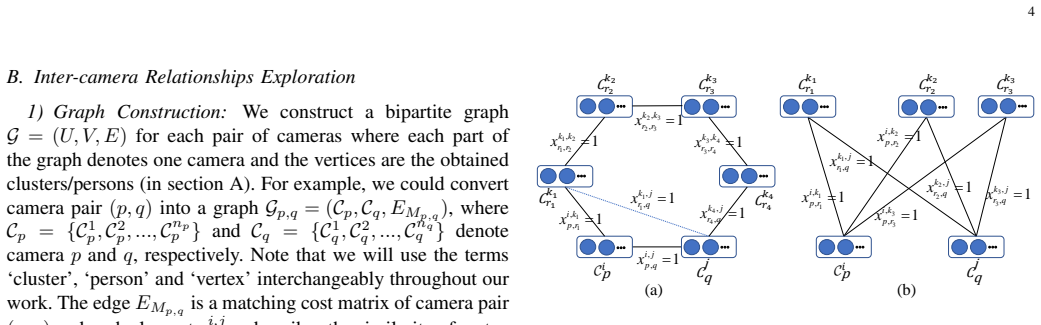
The key machinery is the reliability score $RLT^{i,j}_{p,q}$ for cross-camera matches, defined as the direct assignment plus the number of transitive two-hop paths through every intermediate camera. It operationalizes the global network constraints of loop consistency and transitive inference, which the paper links to a prior proof that triplet-wise consistency guarantees consistency on longer cycles. The consistent matches are then used to train pairwise log-logistic metric models (MLAPG), and the iterative updating alternates between mining consistent matches and refining these metrics.
What would settle it
The claim would be falsified if, on a camera network with at least three cameras, the precision of matches selected by $RLT>1$ were no higher than the precision of the raw Hungarian assignment matrix computed with the same features.
Extended reading notes
Core claim
The central discovery is that a simple reliability score, counting direct matches plus agreements along length-two paths through intermediate cameras, can separate trustworthy cross-camera matches from the false positives that pairwise assignment algorithms like the Hungarian method inevitably produce. The paper defines $RLT^{i,j}_{p,q} = x^{i,j}_{p,q} + \sum_r \sum_k x^{i,k}_{p,r} x^{k,j}_{r,q}$ and keeps matches with $RLT > \theta$. With $\theta=1$, cross-camera label estimation precision rises from 59.5% to 72.3% on MARS under perfect intra-camera clusters, and after iterative metric learning the final recognition performance reaches 65.3% rank-1 / 41.2% mAP on MARS and 76.5% / 68.7% on DukeMTMC-VideoReID, all without identity labels.
Load-bearing premise
The load-bearing premise is that the pre-trained feature embedding is already strong enough that, before any metric learning, the first-neighbor links within a camera and the cross-camera distances for the same identity are generally reliable, because if the initial features are poor, the Hungarian assignment matrices are mostly noise and the consistency filter cannot create correct matches from them.
Editorial extensions
If this is right
- The method reaches 65.3% rank-1 and 41.2% mAP on MARS and 76.5% rank-1 and 68.7% mAP on DukeMTMC-VideoReID using no identity labels.
- Adding global camera network constraints raises the precision of cross-camera label estimation from 59.5% to 72.3% on MARS, showing that higher-order network structure filters false matches.
- Training a separate metric model per camera pair outperforms a single global metric model, with gains of 1.8% rank-1 and 1.5% mAP on DukeMTMC-VideoReID.
- The method works with both deep CNN features and hand-crafted LOMO features, improving rank-1 accuracy from 20.4% to 29.2% on MARS with LOMO features over iterations.
- The iterative training converges quickly, ending by the 4th iteration on MARS with CNN features, making the progressive learning practical.
Reading between the lines
- The same consistency-filtering principle could transfer to other cross-view label estimation problems, such as multi-camera tracking or cross-camera detection association, where pairwise matching contradictions also arise.
- The paper's reliance on a strong pre-trained feature extractor suggests that an end-to-end version that jointly trains the feature encoder with the consistency objective could compound the reported gains; the paper itself notes this direction only as future work.
- Because the threshold $\theta$ trades match quantity for precision, an adaptive threshold based on the distribution of $RLT$ scores across camera pairs might generalize better to networks with very different camera overlap ratios than the fixed $\theta=1$ used in the experiments.
- The ablation results imply that consistency filtering, rather than iterative metric learning alone, is the main driver of the improvement, since the precision gain appears already at the label-estimation stage before metric updates.
Signed reviews
Editorial analysis
A structured set of objections, weighed in public.
Referee Report
Summary. The paper proposes a fully unsupervised video person re-identification framework, CCM, that adds global camera network constraints to cross-camera matching. The method first clusters tracklets within each camera using first-neighbor relations, then constructs bipartite assignment problems for each camera pair, and filters the resulting matches with a reliability score RLT based on loop consistency and transitive inference across intermediate cameras. The retained matches are used as pseudo-labels to train pairwise log-logistic metric models, and the process is iterated. Experiments on MARS and DukeMTMC-VideoReID report rank-1 accuracy of 65.3%/41.2% mAP on MARS and 76.5%/68.7% mAP on Duke, compared against unsupervised baselines and one-shot methods, with ablations showing contribution from both cross-view matching and the global constraints.
Significance. If the reported gains are robust, the paper makes a useful contribution by showing that global network consistency—appearing in earlier supervised or semi-supervised re-id works—can be applied in a fully unsupervised setting to improve pseudo-label reliability. The work is clearly positioned against BUC and CCE and includes several controlled ablations. The idea of using transitive and loop constraints for label estimation is simple and potentially generalizable. However, the central mechanism (that global constraints improve match precision) is currently evaluated under idealized intra-camera clustering, the consistency guarantee is weaker than claimed, and the reliability threshold is tuned on test sets; these issues must be resolved before the contribution is fully convincing.
major comments (4)
- [Section IV-B, Table II] The precision/recall/F1 results for cross-view matching with and without global network constraints are computed under the assumption that perfect intra-camera clustering is available ('we assume that in each camera, we can group all samples with the same identity together'). The actual first-neighbor clustering used in the pipeline only groups 70.9% of same-identity samples correctly, as stated in Section IV-B. Thus Table II measures the effect of GNC on idealized cluster inputs, not on the real clustering output, and the claimed precision gains (12.8% on MARS, 29.2% on Duke) do not directly quantify the mechanism under the actual operating conditions. Please report precision/recall/F1 for the cross-view matching step when the first-neighbor clustering is used, or provide a sensitivity analysis showing how the gains degrade with realistic clustering noise.
- [Section III-C, Eqs. (8)-(9)] The 'consistency' enforced by the RLT score is local, not global. A pair (C_i^p, C_j^q) is retained if either the direct assignment is 1 or there exists a single intermediate camera r with x^{i,k}_{p,r} x^{k,j}_{r,q}=1. Two erroneous direct matches (C_i^p, C_k^r) and (C_k^r, C_j^q) can therefore make a false pair (C_i^p,C_j^q) appear consistent. The selected set of assignments is not constrained to be non-contradictory across the whole camera network; a vertex may be matched to different vertices through different paths. The claims in the Introduction and Section III-C that the matches come 'with a guarantee of consistency' are stronger than what Eqs. (8)-(9) enforce. Please state the exact consistency property (e.g., triangle-consistent, path-consistent) and reconcile the wording with the actual constraint, or add additional constraints that enforce global consistency.
- [Section IV-C, Table III] The reliability threshold θ is selected on the test sets. Table III reports results for θ=0,1,2 on both datasets, and the paper then reports all results for θ=1 as the chosen setting without defining a validation procedure. Selecting hyperparameters on the test set can inflate reported performance and makes the comparison to other methods less clean. Please either split each dataset into training/validation/test subsets for θ selection, or justify treating θ as a fixed, pre-specified value and report the sensitivity across a wider range of θ values on a validation split.
- [Section IV-A and Table VI] On DukeMTMC-VideoReID, the implementation details state that 'we conduct cross-view matching directly without intra-camera clustering as the number of samples captured by each camera is small.' This means the units being matched on Duke are individual tracklets, whereas on MARS the units are clusters. The two datasets therefore undergo different preprocessing, which affects the assignment problem size and the amount of noise in the matching step. The substantial gains reported on Duke in Table VII (from 69.2 to 76.5 rank-1) are not directly comparable to the MARS results under the same protocol. Please clarify what exactly is treated as a cluster/person on Duke, and report results with the same intra-camera clustering protocol on both datasets, or explicitly motivate why the different protocols are appropriate and show their effect on the final recognition numbers.
minor comments (5)
- [Section III-A, Eq. (1)] The definition of the adjacency matrix would be easier to follow if k1_i were explicitly defined as the index of the first neighbor of sample i before presenting the three conditions in Eq. (1), rather than only stating it inline in the text.
- [Section IV-B] The sentence 'It may be noted that this assumption just works in this subsection' is awkward and should be rephrased, for example to 'This assumption is used only for the label-estimation evaluation in this subsection.'
- [Figure 4] The figure reports 'The number of matched pairs' but the units are not entirely clear; the caption should state whether the counts are averaged over camera pairs, aggregated over all pairs, and what 'Ground-truth pairs' means (e.g., number of identity-intersection pairs).
- [Section IV-F, Tables V and VI] In Table V, the proposed method appears twice (once with LOMO and once with deep CNN features); the caption should explicitly list both variants, and the same convention should be kept in the text when referring to 'OURS'.
- [Abstract and Section IV-F] The abstract's statement of 'even 2.5% over one-shot supervision-based methods' should specify which one-shot method is meant and in what setting, since different one-shot baselines (EUG, Progressive Learning, TCPL) are listed in Table V and give different margins.
Circularity Check
No significant circularity; the pipeline is a self-training label-refinement loop and its reported gains are validated on external benchmarks.
full rationale
The paper's derivation chain is a pseudo-label estimation and metric-learning loop rather than a constructional identity. Section III defines the reliability score RLT in Eq. (8) from the current assignment matrices X, Eq. (9) keeps pairs with RLT > θ, and Eqs. (10)-(11) train per-camera-pair metrics on those selected pairs, after which X is recomputed with the updated metric. This is self-referential in a data-flow sense, but it is not circular in the prohibited sense: the selected matches are not identical by construction to a fitted parameter, and the input assignment matrices and the filtered output are different objects linked by a thresholded redundancy test across multiple cameras. The central claims are measured by final rank-1/mAP on held-out MARS and DukeMTMC-VideoReID against external unsupervised and one-shot methods, with an ablation in Table VII showing the contribution of global network constraints. The 'guarantee of consistency' language imports a sufficiency result from prior same-author work [27], [28], but that cited result is a parameter-free graph-theoretic statement about loop consistency and does not itself contain the present paper's re-id predictions or fitted values; under the review rules it counts as independent support rather than load-bearing circularity. The Table II label-estimation experiment assumes perfect intra-camera clustering (Section IV-B), which is an idealized evaluation and a limitation, but it does not make the derivation circular. No step was found in which a predicted quantity reduces by construction to its own input or to a self-citation chain.
Assumptions & free parameters
free parameters (1)
- reliability threshold theta =
1 (best among 0, 1, 2 in Table III)
assumptions (4)
- domain assumption A pre-trained unsupervised feature embedding model (BUC [18]) supplies adequate representations before any metric learning.
- domain assumption First-neighbor relations within a camera group most samples of the same identity.
- domain assumption Pairwise Hungarian assignment solutions can be combined and filtered into globally consistent matches.
- domain assumption Minimum-distance across tracklets (Eq. 2) is a valid cluster-to-cluster similarity.
Cite this review
Pith. "Pith review of Exploiting Global Camera Network Constraints for Unsupervised Video Person Re-identification." pith.science (2026). https://pith.science/paper/EUMXB24X
@misc{pith2026190810486,
  author       = {Pith},
  title        = {Pith review of: Exploiting Global Camera Network Constraints for Unsupervised Video Person Re-identification},
  year         = {2026},
  howpublished = {\url{https://pith.science/paper/EUMXB24X}},
  note         = {Machine review of arXiv:1908.10486}
}
read the original abstract
Many unsupervised approaches have been proposed recently for the video-based re-identification problem since annotations of samples across cameras are time-consuming. However, higher-order relationships across the entire camera network are ignored by these methods, leading to contradictory outputs when matching results from different camera pairs are combined. In this paper, we address the problem of unsupervised video-based re-identification by proposing a consistent cross-view matching (CCM) framework, in which global camera network constraints are exploited to guarantee the matched pairs are with consistency. Specifically, we first propose to utilize the first neighbor of each sample to discover relations among samples and find the groups in each camera. Additionally, a cross-view matching strategy followed by global camera network constraints is proposed to explore the matching relationships across the entire camera network. Finally, we learn metric models for camera pairs progressively by alternatively mining consistent cross-view matching pairs and updating metric models using these obtained matches. Rigorous experiments on two widely-used benchmarks for video re-identification demonstrate the superiority of the proposed method over current state-of-the-art unsupervised methods; for example, on the MARS dataset, our method achieves an improvement of 4.2\% over unsupervised methods, and even 2.5\% over one-shot supervision-based methods for rank-1 accuracy.
Figures


Figures from the paper (3 more)


Reference graph
Works this paper leans on
-
[1]
Camera networks: The acquisition and analysis of videos over wide areas,
A. K. Roy-Chowdhury and B. Song, “Camera networks: The acquisition and analysis of videos over wide areas,” Synthesis Lectures on Computer Vision, vol. 3, no. 1, pp. 1–133, 2012
work page 2012
-
[2]
Deep learning for person re-identification: A survey and outlook,
M. Ye, J. Shen, G. Lin, T. Xiang, L. Shao, and S. C. H. Hoi, “Deep learning for person re-identification: A survey and outlook,” arXiv preprint arXiv:2001.04193, 2020. 10
arXiv 2001
-
[3]
Spatial-temporal attention-aware learning for video-based person re-identification,
G. Chen, J. Lu, M. Yang, and J. Zhou, “Spatial-temporal attention-aware learning for video-based person re-identification,” IEEE Transactions on Image Processing, vol. 28, no. 9, pp. 4192–4205, 2019
work page 2019
-
[4]
Y . Rao, J. Lu, and J. Zhou, “Learning discriminative aggregation network for video-based face recognition and person re-identification,” International Journal of Computer Vision , vol. 127, no. 6-7, pp. 701– 718, 2019
work page 2019
-
[5]
Robust anchor embedding for unsupervised video person re-identification in the wild,
M. Ye, X. Lan, and P. C. Yuen, “Robust anchor embedding for unsupervised video person re-identification in the wild,” in Proceedings of European Conference on Computer Vision , 2018, pp. 170–186
work page 2018
-
[6]
Dynamic graph co- matching for unsupervised video-based person re-identification,
M. Ye, J. Li, A. J. Ma, L. Zheng, and P. C. Yuen, “Dynamic graph co- matching for unsupervised video-based person re-identification,” IEEE Transactions on Image Processing, vol. 28, no. 6, pp. 2976–2990, 2019
work page 2019
-
[7]
Global-local temporal representations for video person re-identification,
J. Li, J. Wang, Q. Tian, W. Gao, and S. Zhang, “Global-local temporal representations for video person re-identification,” in Proceedings of the IEEE International Conference on Computer Vision , 2019, pp. 3958– 3967
work page 2019
-
[8]
D. Ouyang, J. Shao, Y . Zhang, Y . Yang, and H. T. Shen, “Video-based person re-identification via self-paced learning and deep reinforcement learning framework,” in Proceedings of ACM International Conference on Multimedia, 2018, pp. 1562–1570
work page 2018
Show all 57 references
-
[9]
Purifynet: A robust person re-identification model with noisy labels,
M. Ye and P. C. Yuen, “Purifynet: A robust person re-identification model with noisy labels,” IEEE Transactions on Information Forensics and Security, vol. 15, pp. 2655–2666, 2020
2020
-
[10]
Deep association learning for unsu- pervised video person re-identification,
Y . Chen, X. Zhu, and S. Gong, “Deep association learning for unsu- pervised video person re-identification,” in Proceedings of the British Machine Vision Conference, 2018
2018
-
[11]
Hierarchical temporal modeling with mutual distance matching for video based person re- identification,
P. Li, P. Panb, P. Liuc, M. Xu, and Y . Yang, “Hierarchical temporal modeling with mutual distance matching for video based person re- identification,” IEEE Transactions on Circuits and Systems for Video Technology, 2020
2020
-
[12]
Dynamic label graph matching for unsupervised video re-identification,
M. Ye, A. J. Ma, L. Zheng, J. Li, and P. C. Yuen, “Dynamic label graph matching for unsupervised video re-identification,” in Proceedings of the IEEE International Conference on Computer Vision , 2017, pp. 5142– 5150
2017
-
[13]
Video-based person re- identification using unsupervised tracklet matching,
C. Riachy, F. Khelifi, and A. Bouridane, “Video-based person re- identification using unsupervised tracklet matching,” IEEE Access , vol. 7, pp. 20 596–20 606, 2019
2019
-
[14]
Tracklet self-supervised learning for un- supervised person re-identification
G. Wu, X. Zhu, and S. Gong, “Tracklet self-supervised learning for un- supervised person re-identification.” in Proceedings of AAAI Conference on Artificial Intelligence , 2020, pp. 12 362–12 369
2020
-
[15]
Cross-modality person re- identification via modality-aware collaborative ensemble learning,
M. Ye, X. Lan, Q. Leng, and J. Shen, “Cross-modality person re- identification via modality-aware collaborative ensemble learning,”IEEE Transactions on Image Processing (TIP) , 2020
2020
-
[16]
Learning person re-identification models from videos with weak supervision,
X. Wang, S. Paul, D. S. Raychaudhuri, M. Liu, Y . Wang, A. K. Roy- Chowdhury et al., “Learning person re-identification models from videos with weak supervision,” arXiv preprint arXiv:2007.10631 , 2020
2007 arXiv
-
[17]
Augmentation invariant and instance spreading feature for softmax embedding,
M. Ye, J. Shen, X. Zhang, P. C. Yuen, and S.-F. Chang, “Augmentation invariant and instance spreading feature for softmax embedding,” IEEE TPAMI, 2020
2020
-
[18]
A bottom-up clustering approach to unsupervised person re-identification,
Y . Lin, X. Dong, L. Zheng, Y . Yan, and Y . Yang, “A bottom-up clustering approach to unsupervised person re-identification,” in Proceedings of the AAAI Conference on Artificial Intelligence , 2019, pp. 8738–8745
2019
-
[19]
Unsupervised person re- identification: Clustering and fine-tuning,
H. Fan, L. Zheng, C. Yan, and Y . Yang, “Unsupervised person re- identification: Clustering and fine-tuning,” ACM Transactions on Mul- timedia Computing, Communications, and Applications , vol. 14, no. 4, pp. 83:1–83:18, 2018
2018
-
[20]
Unsupervised person re-identification by soft multilabel learning,
H.-X. Yu, W.-S. Zheng, A. Wu, X. Guo, S. Gong, and J.-H. Lai, “Unsupervised person re-identification by soft multilabel learning,” in Proceedings of the IEEE Conference on Computer Vision and Pattern Recognition, 2019, pp. 2148–2157
2019
-
[21]
Self- similarity grouping: A simple unsupervised cross domain adaptation approach for person re-identification,
Y . Fu, Y . Wei, G. Wang, Y . Zhou, H. Shi, and T. S. Huang, “Self- similarity grouping: A simple unsupervised cross domain adaptation approach for person re-identification,” in Proceedings of the IEEE International Conference on Computer Vision , 2019, pp. 6112–6121
2019
-
[22]
Self-training with progressive augmentation for unsupervised cross-domain person re-identification,
X. Zhang, J. Cao, C. Shen, and M. You, “Self-training with progressive augmentation for unsupervised cross-domain person re-identification,” in Proceedings of the IEEE International Conference on Computer Vision , 2019, pp. 8222–8231
2019
-
[23]
Prism: Person reidentification via struc- tured matching,
Z. Zhang and V . Saligrama, “Prism: Person reidentification via struc- tured matching,” IEEE Transactions on Circuits and Systems for Video Technology, vol. 27, no. 3, pp. 499–512, 2016
2016
-
[24]
Fully unsupervised learning of camera link models for tracking humans across nonoverlapping cameras,
C.-T. Chu and J.-N. Hwang, “Fully unsupervised learning of camera link models for tracking humans across nonoverlapping cameras,” IEEE Transactions on Circuits and Systems for Video Technology , vol. 24, no. 6, pp. 979–994, 2014
2014
-
[25]
Unsupervised person re-identification via softened similarity learning,
Y . Lin, L. Xie, Y . Wu, C. Yan, and Q. Tian, “Unsupervised person re-identification via softened similarity learning,” in Proceedings of the IEEE/CVF Conference on Computer Vision and Pattern Recognition , 2020, pp. 3390–3399
2020
-
[26]
Consistent-aware deep learn- ing for person re-identification in a camera network,
J. Lin, L. Ren, J. Lu, J. Feng, and J. Zhou, “Consistent-aware deep learn- ing for person re-identification in a camera network,” in Proceedings of the IEEE Conference on Computer Vision and Pattern Recognition , 2017, pp. 5771–5780
2017
-
[27]
Consistent re- identification in a camera network,
A. Das, A. Chakraborty, and A. K. Roy-Chowdhury, “Consistent re- identification in a camera network,” in Proceedings of European Con- ference on Computer Vision , 2014, pp. 330–345
2014
-
[28]
Network consistent data association,
A. Chakraborty, A. Das, and A. K. Roy-Chowdhury, “Network consistent data association,” IEEE Transactions on Pattern Analysis and Machine Intelligence, vol. 38, no. 9, pp. 1859–1871, 2015
2015
-
[29]
Efficient parameter-free clustering using first neighbor relations,
S. Sarfraz, V . Sharma, and R. Stiefelhagen, “Efficient parameter-free clustering using first neighbor relations,” in Proceedings of the IEEE Conference on Computer Vision and Pattern Recognition , 2019, pp. 8934–8943
2019
-
[30]
Unsupervised person re-identification via cross-camera similarity exploration,
Y . Lin, Y . Wu, C. Yan, M. Xu, and Y . Yang, “Unsupervised person re-identification via cross-camera similarity exploration,” IEEE Trans- actions on Image Processing , vol. 29, pp. 5481–5490, 2020
2020
-
[31]
Joint detection and identification feature learning for person search,
T. Xiao, S. Li, B. Wang, L. Lin, and X. Wang, “Joint detection and identification feature learning for person search,” in Proceedings of the IEEE Conference on Computer Vision and Pattern Recognition , 2017, pp. 3415–3424
2017
-
[32]
Stepwise metric promotion for unsu- pervised video person re-identification,
Z. Liu, D. Wang, and H. Lu, “Stepwise metric promotion for unsu- pervised video person re-identification,” in Proceedings of the IEEE International Conference on Computer Vision , 2017, pp. 2429–2438
2017
-
[33]
Unsupervised person re-identification by deep learning tracklet association,
M. Li, X. Zhu, and S. Gong, “Unsupervised person re-identification by deep learning tracklet association,” in Proceedings of the European Conference on Computer Vision , 2018, pp. 737–753
2018
-
[34]
Camera style adaptation for person re-identification,
Z. Zhong, L. Zheng, Z. Zheng, S. Li, and Y . Yang, “Camera style adaptation for person re-identification,” in Proceedings of the IEEE Conference on Computer Vision and Pattern Recognition , 2018, pp. 5157–5166
2018
-
[35]
Image- image domain adaptation with preserved self-similarity and domain- dissimilarity for person re-identification,
W. Deng, L. Zheng, Q. Ye, G. Kang, Y . Yang, and J. Jiao, “Image- image domain adaptation with preserved self-similarity and domain- dissimilarity for person re-identification,” in Proceedings of the IEEE Conference on Computer Vision and Pattern Recognition, 2018, pp. 994– 1003
2018
-
[36]
Shape matching and object recognition using low distortion correspondences,
A. C. Berg, T. L. Berg, and J. Malik, “Shape matching and object recognition using low distortion correspondences,” in Proceedings of IEEE Conference on Computer Vision and Pattern Recognition . IEEE, 2005, pp. 26–33
2005
-
[37]
Multi-graph matching via affinity optimization with graduated consistency regulariza- tion,
J. Yan, M. Cho, H. Zha, X. Yang, and S. M. Chu, “Multi-graph matching via affinity optimization with graduated consistency regulariza- tion,” IEEE Transactions on Pattern Analysis and Machine Intelligence , vol. 38, no. 6, pp. 1228–1242, 2015
2015
-
[38]
Pairwise matching through max-weight bipartite belief propagation,
Z. Zhang, Q. Shi, J. McAuley, W. Wei, Y . Zhang, and A. Van Den Hengel, “Pairwise matching through max-weight bipartite belief propagation,” in Proceedings of the IEEE Conference on Computer Vision and Pattern Recognition , 2016, pp. 1202–1210
2016
-
[39]
Unsupervised graph association for person re-identification,
J. Wu, Y . Yang, H. Liu, S. Liao, Z. Lei, and S. Z. Li, “Unsupervised graph association for person re-identification,” in Proceedings of the IEEE International Conference on Computer Vision , 2019, pp. 8321– 8330
2019
-
[40]
Exploiting transitivity for learning person re-identification models on a budget,
S. Roy, S. Paul, N. E. Young, and A. K. Roy-Chowdhury, “Exploiting transitivity for learning person re-identification models on a budget,” in Proceedings of the IEEE Conference on Computer Vision and Pattern Recognition, 2018, pp. 7064–7072
2018
-
[41]
The hungarian method for the assignment problem,
H. W. Kuhn, “The hungarian method for the assignment problem,” Naval Research Logistics Quarterly , vol. 2, no. 1-2, pp. 83–97, 1955
1955
-
[42]
Efficient psd constrained asymmetric metric learning for person re-identification,
S. Liao and S. Z. Li, “Efficient psd constrained asymmetric metric learning for person re-identification,” in Proceedings of the IEEE In- ternational Conference on Computer Vision , 2015, pp. 3685–3693
2015
-
[43]
On the convergence of graph matching: Graduated assignment revisited,
Y . Tian, J. Yan, H. Zhang, Y . Zhang, X. Yang, and H. Zha, “On the convergence of graph matching: Graduated assignment revisited,” in Proceedings of European Conference on Computer Vision , 2012, pp. 821–835
2012
-
[44]
A fast iterative shrinkage-thresholding algo- rithm for linear inverse problems,
A. Beck and M. Teboulle, “A fast iterative shrinkage-thresholding algo- rithm for linear inverse problems,” SIAM Journal on Imaging Sciences , vol. 2, no. 1, pp. 183–202, 2009
2009
-
[45]
Mars: A video benchmark for large-scale person re-identification,
L. Zheng, Z. Bie, Y . Sun, J. Wang, C. Su, S. Wang, and Q. Tian, “Mars: A video benchmark for large-scale person re-identification,” in Proceedings of European Conference on Computer Vision , 2016, pp. 868–884. 11
2016
-
[46]
Exploit the unknown gradually: One-shot video-based person re-identification by stepwise learning,
Y . Wu, Y . Lin, X. Dong, Y . Yan, W. Ouyang, and Y . Yang, “Exploit the unknown gradually: One-shot video-based person re-identification by stepwise learning,” in Proceedings of the IEEE Conference on Computer Vision and Pattern Recognition , 2018, pp. 5177–5186
2018
-
[47]
Performance measures and a data set for multi-target, multi-camera tracking,
E. Ristani, F. Solera, R. Zou, R. Cucchiara, and C. Tomasi, “Performance measures and a data set for multi-target, multi-camera tracking,” in Proceedings of European Conference on Computer Vision , 2016, pp. 17–35
2016
-
[48]
Person re-identification by local maximal occurrence representation and metric learning,
S. Liao, Y . Hu, X. Zhu, and S. Z. Li, “Person re-identification by local maximal occurrence representation and metric learning,” in Proceedings of the IEEE Conference on Computer Vision and Pattern Recognition , 2015, pp. 2197–2206
2015
-
[49]
Principal component analysis,
S. Wold, K. Esbensen, and P. Geladi, “Principal component analysis,” Chemometrics and Intelligent Laboratory Systems , vol. 2, no. 1-3, pp. 37–52, 1987
1987
-
[50]
A density-based algorithm for discovering clusters in large spatial databases with noise
M. Ester, H.-P. Kriegel, J. Sander, X. Xu et al. , “A density-based algorithm for discovering clusters in large spatial databases with noise.” in Proceedings of International Conference on Knowledge Discovery and Data Mining , vol. 96, no. 34, 1996, pp. 226–231
1996
-
[51]
Density-based clustering based on hierarchical density estimates,
R. J. Campello, D. Moulavi, and J. Sander, “Density-based clustering based on hierarchical density estimates,” in Proceedings of Pacific-Asia Conference on Knowledge Discovery and Data Mining , 2013, pp. 160– 172
2013
-
[52]
Hierarchical density estimates for data clustering, visualization, and outlier detection,
R. J. Campello, D. Moulavi, A. Zimek, and J. Sander, “Hierarchical density estimates for data clustering, visualization, and outlier detection,” ACM Transactions on Knowledge Discovery from Data , vol. 10, no. 1, pp. 1–51, 2015
2015
-
[53]
Person re-identification by unsupervised 𝓁1 graph learning,
E. Kodirov, T. Xiang, Z. Fu, and S. Gong, “Person re-identification by unsupervised 𝓁1 graph learning,” in Proceedings of European Confer- ence on Computer Vision , 2016, pp. 178–195
2016
-
[54]
Unsupervised data association for met- ric learning in the context of multi-shot person re-identification,
F. M. Khan and F. Bremond, “Unsupervised data association for met- ric learning in the context of multi-shot person re-identification,” in Proceedings of IEEE International Conference on Advanced Video and Signal Based Surveillance , 2016, pp. 256–262
2016
-
[55]
Unsupervised tracklet person re- identification,
M. Li, X. Zhu, and S. Gong, “Unsupervised tracklet person re- identification,” IEEE Transactions on Pattern Analysis and Machine Intelligence, vol. 42, no. 7, pp. 1770–1782, 2019
2019
-
[56]
Progressive learning for person re-identification with one example,
Y . Wu, Y . Lin, X. Dong, Y . Yan, W. Bian, and Y . Yang, “Progressive learning for person re-identification with one example,” IEEE Transac- tions on Image Processing , vol. 28, no. 6, pp. 2872–2881, 2019
2019
-
[57]
Exploiting temporal coherence for self-supervised one-shot video re-identification,
D. S. Raychaudhuri and A. K. Roy-Chowdhury, “Exploiting temporal coherence for self-supervised one-shot video re-identification,” arXiv preprint arXiv:2007.11064, 2020. Xueping Wang is currently pursuing the Ph.D. degree with the College of Electrical and Infor- mation Engineer...
2007 arXiv
Reviewed August 14, 2026 · model on record in the stance chip above.
Discussion (0). Continue with ORCID to comment.