REVIEW 4 major objections 5 minor 87 references
Microscopic calculation of inelastic proton scattering off $^{18}$O, $^{10}$Be, $^{12}$Be, and $^{16}$C for study of neutron excitation in neutron-rich nuclei
T0 review · 4 major / 5 minor · reviewed 2026-08-14 · deepseek-v4-flash
Pith's one-line read Inelastic proton scattering off $^{12}$Be and $^{16}$C, computed with a parameter-free microscopic folding model, supports neutron-dominated $2^+_1$ excitations with $M_n/M_p\approx 2$ and $\approx 3$, and implies that standard analyses…
desk verdict A careful no-free-parameter folding study that supports neutron-dominated 2+ excitations in 12Be and 16C and warns that Bernstein-type analyses can underestimate Mn when the neutron transition density has an outer tail; the warning is plausible but rests on AMD radial shapes that the limited-angle data do not independently validate. read the letter →
The pith
A machine-rendered reading of the paper's core claim, the machinery that carries it, and where it could break.
The reading
What carries the argument
The load-bearing object is the system- and energy-dependent sensitivity ratio $b_n^{(p,p')}/b_p^{(p,p')}$, extracted from the linearized relation $\sigma(p,p') = \left| a_n M_n + a_p M_p \right|^2$. The paper obtains the coefficients $a_n$ and $a_p$ by repeating the coupled-channel calculation with the neutron (or proton) transition density scaled by a common factor, then reads off the ratio that controls how strongly the measured cross section constrains the neutron transition matrix element. The argument also depends on the radial shapes of the AMD transition densities: in $^{12}$Be and $^{16}$C, $\rho_n^{\mathrm{tr}}(r)$ is not proportional to $\rho_p^{\mathrm{tr}}(r)$ but has additional amplitude around $r\approx 3$ fm and beyond, which contributes to $M_n$ while contributing only weakly to the cross section.
What would settle it
Compute the $2^+_1$ transition densities of $^{12}$Be and $^{16}$C with an ab initio method using chiral $NN+3N$ interactions; if the resulting neutron transition density lacks the pronounced outer-region amplitude relative to the proton part, or if folding those densities with the Melbourne interaction fails to reproduce the measured inelastic cross sections, the claim that $M_n/M_p\approx 2$ and $\approx 3$ and that Bernstein analyses undershoot $M_n$ would be undermined. Alternatively, a new measurement of the inelastic proton cross section for $^{16}$C at $E\approx 50$ MeV/u extending past $\theta_{\mathrm{cm}}\approx 30^{\circ}$ could discriminate between the AMD and collective-model densities because their predicted peak heights differ.
Extended reading notes
Core claim
The central discovery is that the measured inelastic proton scattering cross sections to the $2^+_1$ states of $^{12}$Be and $^{16}$C are reproduced by a microscopic coupled-channel calculation that folds the Melbourne $g$-matrix interaction with AMD transition densities, and the agreement supports neutron-to-proton transition matrix element ratios $M_n/M_p\approx 2$ and $\approx 3$ in these nuclei. By artificially scaling the neutron or proton transition density and recomputing the cross sections, the paper derives the sensitivity ratio $b_n^{(p,p')}/b_p^{(p,p')}$ and finds it is about 0.3 smaller than the standard value for $^{12}$Be and $^{16}$C, i.e., the cross section is about 15% less sensitive to $M_n$ than assumed in the Bernstein prescription. Because the AMD neutron transition densities in these nuclei have a large-amplitude outer tail that contributes strongly to $M_n$ but only weakly to the scattering cross section, the authors conclude that a Bernstein-style analysis using collective-model transition densities with $\rho_n^{\mathrm{tr}}(r)\propto \rho_p^{\mathrm{tr}}(r)$ would undershoot the neutron matrix element for such exotic systems.
Load-bearing premise
The load-bearing premise is that the AMD calculation gives the correct radial shape of the neutron and proton transition densities, especially the outer-region amplitude of the neutron transition density in $^{12}$Be and $^{16}$C; if that radial shape is wrong, the conclusion that Bernstein analyses undershoot $M_n$ does not follow even if the cross sections are reproduced.
Editorial extensions
If this is right
- For $^{12}$Be and $^{16}$C, the data are consistent with neutron-dominated $2^+_1$ transitions, $M_n/M_p\approx 2$ and $\approx 3$, reinforcing the picture that the $N=8$ magic number is broken and $sd$-shell neutrons drive the excitation.
- Bernstein-prescription analyses of inelastic proton data on such neutron-rich nuclei would systematically underestimate $M_n$; e.g., the earlier extraction $B^{(n)}_{\lambda=2}=17$ fm$^4$ for $^{12}$Be lies far below the microscopic value $51.1$ fm$^4$.
- The parameter-free microscopic folding model can serve as a cross-check for inverse-kinematics reaction analyses of unstable nuclei, avoiding part of the optical-potential uncertainty.
- Higher-quality differential cross-section data, especially beyond the first peak, can distinguish the AMD transition density from collective-model forms and directly test the predicted reduction in sensitivity to $M_n$.
Reading between the lines
- The same decoupling between a large outer neutron transition tail and a modest cross-section contribution should occur in other neutron-rich nuclei where valence neutrons occupy radially extended orbits while protons are shell-closed, such as $^{14}$Be or $^{20}$C; testing those cases would show whether the effect is generic.
- The calculated energy dependence of $b_n/b_p$ (decreasing with energy) could be exploited: if one extracts $M_n$ from data at two beam energies using the Bernstein prescription and the values disagree, that disagreement would be a direct signature of the radial-shape effect reported here.
- The paper's sensitivity analysis uses cross sections integrated over the measured angular range; examining specific momentum-transfer windows may show even stronger deviations, so reanalyzing existing data bin-by-bin could sharpen the test without new experiments.
Signed reviews
Editorial analysis
A structured set of objections, weighed in public.
Referee Report
Summary. The paper presents microscopic coupled-channel (MCC) calculations of elastic and inelastic proton scattering to the 2_1^+ states of 18O, 10Be, 12Be, and 16C. The proton-nucleus potentials are obtained by single-folding the Melbourne g-matrix NN interaction with matter and transition densities from antisymmetrized molecular dynamics (AMD), with the Brieva-Rook localization for the exchange terms. The method is first tested on 12C and 16O, then applied to the neutron-rich systems. The calculations are compared with independent data at several incident energies, including inverse-kinematics data for the unstable nuclei. The authors report reasonable reproduction of the cross sections, interpret this as support for the AMD neutron transition densities in 12Be and 16C with Mn/Mp ~ 2 and ~ 3, and analyze the sensitivity of the inelastic cross section to Mn and Mp. They conclude that the outer-tail amplitude of the neutron transition density contributes strongly to Mn but weakly to the cross section, so that Bernstein-type phenomenological analyses may underestimate Mn for such exotic systems.
Significance. The paper is a solid application of a well-established, essentially parameter-free folding reaction model to a set of physically interesting neutron-rich nuclei. The use of microscopic AMD transition densities as inputs, without fitting the scattering data, is a genuine strength, and the comparisons with elastic and inelastic data at multiple energies are informative. If the main quantitative conclusion survives scrutiny, the proposed reduction of the effective b_n/b_p sensitivity for 12Be and 16C would be a useful correction to standard analyses of inelastic hadron scattering from exotic nuclei. However, the central new claim is more fragile than the cross-section reproduction: it depends on the assumed radial shape of the AMD transition densities, on the choice of B(E2) normalization for 16C, and on a prior model ambiguity noted by the authors themselves for 12Be.
major comments (4)
- [Sec. IV C, Table II, Fig. 12 (16C)] For 16C, the paper adopts the B(E2) value 2.6(9) fm^4 from Ref. [76] and states that the original AMD densities reproduce the experimental B(E2). However, Table II also lists B(E2)=4.15(73) fm^4 from Ref. [13], which is about two standard deviations larger. Since the proton transition density enters the folding potential and sets the overall normalization of the inelastic cross section, and since the claimed Mn/Mp ~ 3 depends on the relative proton and neutron strengths, the analysis should be repeated with the alternative B(E2) normalization, or at least the resulting changes in the cross sections and in the inferred Mn/Mp should be quantified.
- [Sec. IV D, Eq. (5), Fig. 13] The central new result, that b_n^{p,p'}/b_p^{p,p'} is reduced by about 15% for 12Be and 16C and that Bernstein-type analyses undershoot Mn, is derived under the explicit assumption that the AMD calculation gives the correct r-dependence of rho_n^tr and rho_p^tr. The inelastic data for 12Be and 16C cover only theta_lab up to about 4.7 and 3.6 degrees, respectively (Figs. 11b and 12b), so they constrain mainly the first diffraction maximum and do not independently validate the outer tail of rho_n^tr that dominates Mn. The robustness of the 15% reduction should be tested, for example by varying the tail amplitude of rho_n^tr while preserving Mn, or by repeating the exercise with an independent structure model. Without such a test, the undershoot conclusion remains plausible but not fully established by the data shown.
- [Sec. IV C, paragraph on 12Be neutron transition] The statement that the good reproduction of the inelastic cross sections supports the reliability of the adopted AMD neutron transition density, and hence Mn/Mp ~ 2 for 12Be, is weakened by the authors' own citation of Ref. [11]: an earlier MCC calculation using the same AMD densities favored B(n)_lambda=2 = 37 fm^4, whereas the default AMD value used here is 51.1 fm^4. Both calculations appear to describe the data. A quantitative comparison, for example a chi-square analysis or an estimated band of allowed Mn values, is needed before the 12Be data can be said to select the AMD value.
- [Sec. IV D, Eq. (5)] The procedure for extracting the coefficients a_n and a_p is not described in sufficient detail to be reproduced. The text states only that overall factors of rho_n^tr and rho_p^tr are changed and that 'integrated cross sections' are used to reduce the coefficients; it does not specify the angular range or integration used, how the two coefficients are disentangled, or how the complex nature of the reaction amplitudes is handled. Since Eq. (5) is the basis of Fig. 13 and of the final sensitivity claim, these details should be provided.
minor comments (5)
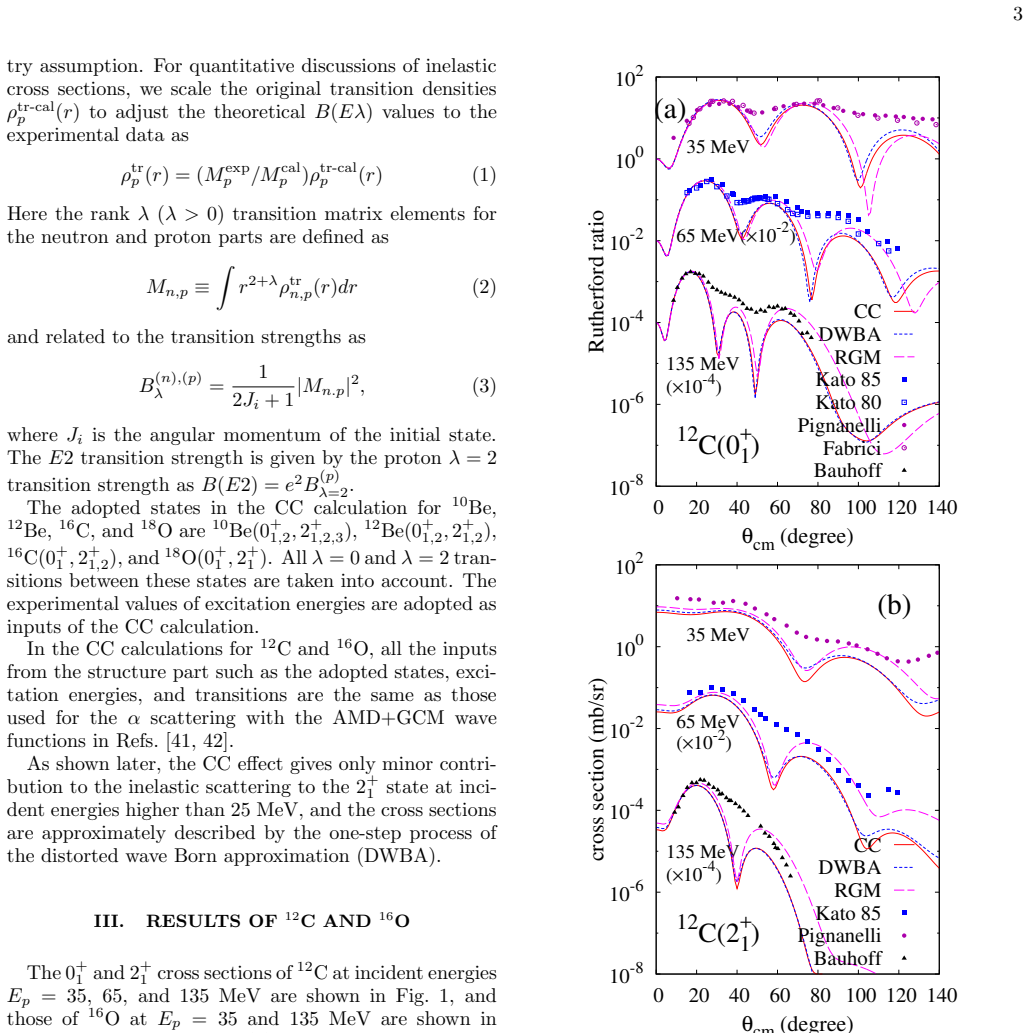
- [Fig. 1 caption and Sec. III] The caption uses 'AMG+GCM' where 'AMD+GCM' is intended; the same typo appears in the text of Sec. III.
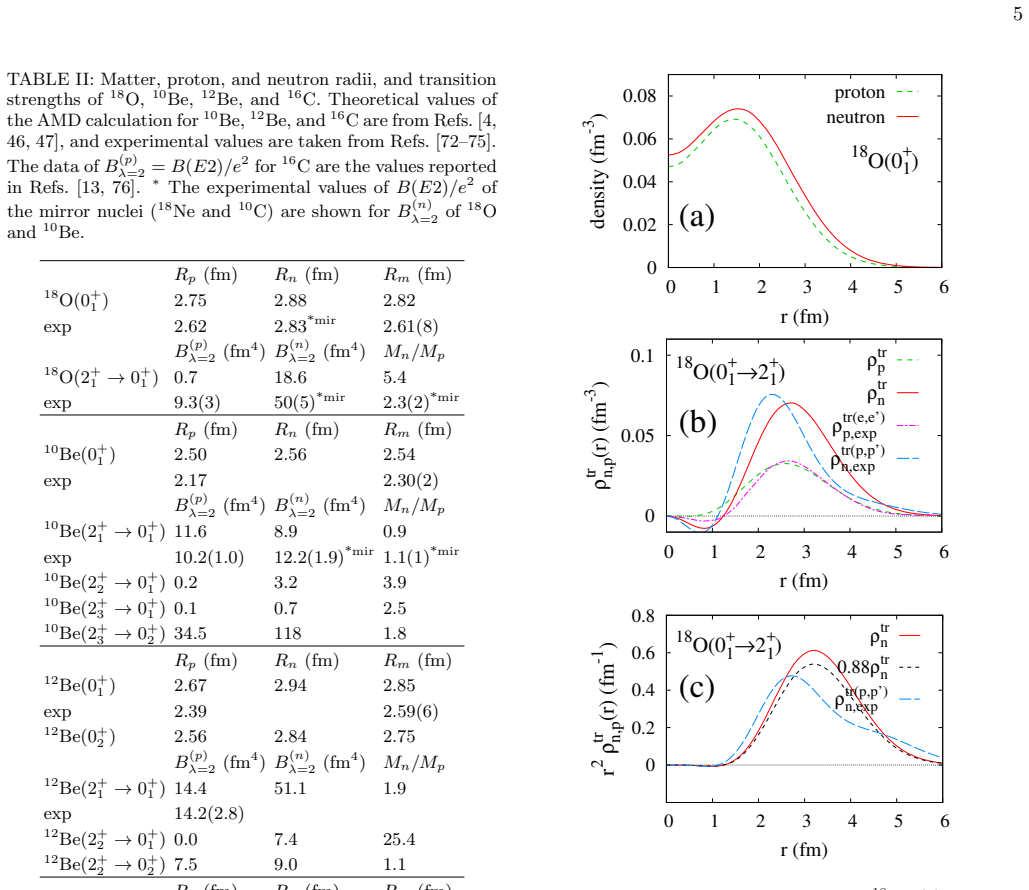
- [Sec. IV B] The scaling factor M_p^{exp}(18Ne)/M_n^{cal} is quoted as 1.72, but the Table II central values give sqrt(50/18.6) = 1.64. Please clarify which value of B(n) was used for the scaling.
- [Fig. 3 caption] The phrase 'reduced from the (p,p') scattering' should read 'deduced from' or 'extracted from'.
- [Sec. IV C, Table II] The text says the scaling factors for 10Be are 'listed in Table II', but the table lists B values rather than the ratios M_p^{exp}/M_p^{cal} and M_n^{exp}/M_n^{cal}; including the explicit scaling factors would improve reproducibility.
- [References] Reference [34] is missing the beginning of the article title, and some author names in the reference list appear corrupted (e.g., 'Forssn' and 'Navrtil' in Ref. [15]).
Circularity Check
No significant circularity: the cross-section comparisons use AMD transition densities as fixed inputs against independent scattering data, and the Sec. IV D sensitivity analysis is explicitly conditional on an assumed radial shape.
full rationale
The paper's central derivation is not circular. The AMD matter and transition densities are structure-model inputs taken from prior published calculations (Refs. [4,46,47]) and are not fitted to the inelastic proton-scattering data used for validation. Equation (1) rescales the proton transition density to the experimental B(E2), and for 10Be/18O the neutron density is normalized to mirror B(E2) values, but these normalizations are inputs; the calculated cross sections are subsequently compared with external data and could in principle fail. The statement in Sec. IV C that reproduction of the inelastic cross sections supports the adopted neutron transition densities is an inference from agreement with independent data, not an identity. The Sec. IV D sensitivity analysis explicitly assumes ('Here we assume that the AMD calculation gives correct r dependence of rho_n^tr(r) and rho_p^tr(r)') the radial shapes, and then derives smaller b_n/b_p values; this is a conditional model implication, clearly labeled as an assumption, and not a hidden re-import of the conclusion. The limitation that the 12Be and 16C data cover only a narrow forward angular range and that the neutron radial tail is not directly constrained is a correctness and validation concern, not circularity. Self-citations to earlier AMD and CC works supply the structure input, but the central check against scattering data is independent of those citations, so no load-bearing self-citation chain is present.
Assumptions & free parameters
free parameters (3)
- Proton transition density scaling factor for 18O, M_p^exp/M_p^cal =
3.88
- Neutron transition density scaling factor for 18O, M_p^exp(18Ne)/M_n^cal =
1.72
- Proton and neutron transition density scaling factors for 10Be =
Not quoted; derived from ratios in Table II
assumptions (5)
- standard math Kerman-McManus-Thaler multiple scattering theory with resummation factors A/(A-1)
- domain assumption Melbourne g-matrix effective NN interaction from the Bonn-B potential is valid for the considered energies
- domain assumption Brieva-Rook localization of exchange terms is valid in this energy range
- domain assumption AMD and AMD+GCM wave functions give the correct radial dependence of ground and transition densities, including the outer neutron tail in 12Be and 16C
- domain assumption Mirror symmetry relates 18O/18Ne and 10Be/10C transition strengths
Cite this review
Pith. "Pith review of Microscopic calculation of inelastic proton scattering off $^{18}$O, $^{10}$Be, $^{12}$Be, and $^{16}$C for study of neutron excitation in neutron-rich nuclei." pith.science (2026). https://pith.science/paper/EUYF2JNF
@misc{pith2026190803293,
  author       = {Pith},
  title        = {Pith review of: Microscopic calculation of inelastic proton scattering off $^18$O, $^10$Be, $^12$Be, and $^16$C for study of neutron excitation in neutron-rich nuclei},
  year         = {2026},
  howpublished = {\url{https://pith.science/paper/EUYF2JNF}},
  note         = {Machine review of arXiv:1908.03293}
}
abstract
The microscopic coupled-channel calculation of inelastic proton scattering is performed for the study of neutron excitations in $2^+_1$ states of $^{18}$O, $^{10}$Be, $^{12}$Be, and $^{16}$C. Proton-nucleus potentials in the coupled-channel calculation are microscopically derived by folding the Melbourne $g$-matrix $NN$ interaction with matter and transition densities of target nuclei obtained by the structure model calculation of antisymmetrized molecular dynamics. The calculated result reasonably reproduces the elastic and inelastic proton scattering cross sections, and supports the dominant contribution of neutron in the $2^+_1$ excitation of $^{12}$Be and $^{16}$C as well as $^{18}$O. Sensitivity of the inelastic scattering cross sections to the neutron transition density is discussed. The exotic feature of the neutron transition density with the amplitude in the outer region in $^{12}$Be and $^{16}$C is focused.
Figures
Figures from the paper (8 more)


Reference graph
Works this paper leans on
-
[76]
H. J. Ong et al. , Phys. Rev. C 78, 014308 (2008)
work page 2008
- [13]
- [11]
-
[1]
A. M. Bernstein, V. R. Brown and V. A. Madsen, Phys. Lett. 103B, 255 (1981)
1981
-
[2]
Kanada-En’yo and H
Y. Kanada-En’yo and H. Horiuchi, Phys. Rev. C55, 2860 (1997)
1997
-
[3]
Iwasaki et al
H. Iwasaki et al. , Phys. Lett. B 481, 7 (2000)
2000
-
[4]
Kanada-En’yo, Phys
Y. Kanada-En’yo, Phys. Rev. C 71, 014310 (2005)
2005
-
[5]
Kanada-En’yo, Phys
Y. Kanada-En’yo, Phys. Rev. C 71, 014303 (2005)
2005
Show all 87 references
-
[6]
Sagawa, X
H. Sagawa, X. R. Zhou, X. Z. Zhang and T. Suzuki, Phys. Rev. C 70, 054316 (2004)
2004
-
[7]
Jouanne et al
C. Jouanne et al. , Phys. Rev. C 72, 014308 (2005)
2005
-
[8]
Takashina, Y
M. Takashina, Y. Kanada-En’yo and Y. Sakuragi, Phys. Rev. C 71, 054602 (2005)
2005
-
[9]
H. J. Ong et al. , Phys. Rev. C 73, 024610 (2006)
2006
-
[10]
T. J. Burvenich, W. Greiner, L. Guo, P. Klupfel and P. G. Reinhard, J. Phys. G 35, 025103 (2008)
2008
-
[12]
Elekes, N
Z. Elekes, N. Aoi, Z. Dombradi, Z. Fulop, T. Motobayashi and H. Sakurai, Phys. Rev. C 78, 027301 (2008)
2008
-
[14]
J. M. Yao, J. Meng, P. Ring, Z. X. Li, Z. P. Li and K. Hagino, Phys. Rev. C 84, 024306 (2011)
2011
-
[15]
Forssn, R
C. Forssn, R. Roth and P. Navrtil, J. Phys. G 40, 055105 (2013)
2013
-
[16]
A. M. Bernstein, V. R. Brown and V. A. Madsen, Phys. Lett. 71B, 48 (1977)
1977
-
[17]
Iversen et al
S. Iversen et al. , Phys. Rev. Lett. 40, 17 (1978)
1978
-
[18]
Grabmayr, J
P. Grabmayr, J. Rapaport and R. W. Finlay, Nucl. Phys. A 350, 167 (1980)
1980
-
[19]
Kelly et al
J. Kelly et al. , Phys. Lett. 169B, 157 (1986)
1986
-
[20]
A. M. Bernstein, V. R. Brown and V. A. Madsen, Phys. Rev. Lett. 42, 425 (1979)
1979
-
[21]
Khan et al
E. Khan et al. , Phys. Lett. B 490, 45 (2000)
2000
-
[22]
J. K. Jewell et al. , Phys. Lett. B 454, 181 (1999)
1999
-
[23]
Khan et al
E. Khan et al. , Nucl. Phys. A 694, 103 (2001)
2001
-
[24]
Scheit et al
H. Scheit et al. , Phys. Rev. C 63, 014604 (2000)
2000
-
[25]
Becheva et al
E. Becheva et al. , Phys. Rev. Lett. 96, 012501 (2006)
2006
-
[26]
C. M. Campbell et al. , Phys. Lett. B 652, 169 (2007)
2007
-
[27]
Elekes et al
Z. Elekes et al. , Phys. Rev. C 79, 011302(R) (2009)
2009
-
[28]
Aoi et al
N. Aoi et al. , Phys. Lett. B 692, 302 (2010). 12
2010
-
[29]
Michimasa et al
S. Michimasa et al. , Phys. Rev. C 89, 054307 (2014)
2014
-
[30]
L. A. Riley et al. , Phys. Rev. C 90, 011305(R) (2014)
2014
-
[31]
Corsi et al
A. Corsi et al. , Phys. Lett. B 743, 451 (2015)
2015
-
[32]
M. L. Corts et al., Phys. Rev. C 97, no. 4, 044315 (2018)
2018
-
[33]
K. Amos, P. J. Dortmans, H. V. von Geramb, S. Karataglidis, and J. Raynal, Adv. Nucl. Phys. 25, 275 (2000)
2000
-
[34]
Karataglidis, Y
S. Karataglidis, Y. J. Kim and K. Amos, light mass exotic nuclei,” Nucl. Phys. A 793, 40 (2007) doi:10.1016/j.nuclphysa.2007.06.006
2007 doi
-
[35]
Minomo, K
K. Minomo, K. Ogata, M. Kohno, Y. R. Shimizu and M. Yahiro, J. Phys. G 37, 085011 (2010)
2010
-
[36]
Toyokawa, K
M. Toyokawa, K. Minomo, and M. Yahiro, Phys. Rev. C 88, 054602 (2013)
2013
-
[37]
Toyokawa, M
M. Toyokawa, M. Yahiro, T. Matsumoto, K. Minomo, K. Ogata and M. Kohno, Phys. Rev. C 92, no. 2, 024618 (2015) Erratum: [Phys. Rev. C 96, 059905(E) (2017)]
2015
- [38]
-
[39]
Egashira, K
K. Egashira, K. Minomo, M. Toyokawa, T. Matsumoto and M. Yahiro, Phys. Rev. C 89, 064611 (2014)
2014
-
[40]
Minomo and K
K. Minomo and K. Ogata, Phys. Rev. C 93, 051601(R) (2016)
2016
-
[41]
Kanada-En’yo and K
Y. Kanada-En’yo and K. Ogata, Phys. Rev. C 99, no. 6, 064601 (2019)
2019
-
[42]
Kanada-En’yo and K
Y. Kanada-En’yo and K. Ogata, Phys. Rev. C 99, no. 6, 064608 (2019)
2019
-
[43]
Kanada-En’yo, H
Y. Kanada-En’yo, H. Horiuchi and A. Ono, Phys. Rev. C 52, 628 (1995)
1995
-
[44]
Kanada-En’yo and H
Y. Kanada-En’yo and H. Horiuchi, Phys. Rev. C 52, 647 (1995)
1995
-
[45]
Kanada-En’yo, M
Y. Kanada-En’yo, M. Kimura and A. Ono, PTEP 2012 01A202 (2012)
2012
-
[46]
Kanada-En’yo, H
Y. Kanada-En’yo, H. Horiuchi and A. Dote, Phys. Rev. C 60, 064304 (1999)
1999
-
[47]
Kanada-En’yo and H
Y. Kanada-En’yo and H. Horiuchi, Phys. Rev. C 68, 014319 (2003). [nucl-th/0301059]
2003 arXiv
-
[48]
Kanada-En’yo and Y
Y. Kanada-En’yo and Y. Shikata, Phys. Rev. C 100, 014301 (2019)
2019
-
[49]
Machleidt, K
R. Machleidt, K. Holinde, and Ch. Elster, Phys. Reports 149, 1 (1987)
1987
-
[50]
F. A. Brieva and J. R. Rook, Nucl. Phys. A 291, 299 (1977)
1977
-
[51]
F. A. Brieva and J. R. Rook, Nucl. Phys. A 291, 317 (1977)
1977
-
[52]
F. A. Brieva and J. R. Rook, Nucl. Phys. A 297, 206 (1978)
1978
-
[53]
Haider, Syed Rafi, J
W. Haider, Syed Rafi, J. R. Rook, and Y. K. Gambhir, Phys. Rev. C 93, 054615 (2016)
2016
-
[54]
Hagino, T
K. Hagino, T. Takehi, and N. Takigawa, Phys. Rev. C 74, 037601 (2006)
2006
-
[55]
Kamimura, Nucl
M. Kamimura, Nucl. Phys. A 351, 456 (1981)
1981
-
[56]
J. P. Jeukenne, A. Lejeune and C. Mahaux, Phys. Rev. C 16, 80 (1977)
1977
-
[57]
Matsumoto, D
T. Matsumoto, D. Ichinkhorloo, Y. Hirabayashi, K. Kat¯ o, and S. Chiba, Phys. Rev. C83, 064611 (2011)
2011
-
[58]
Ichinkhorloo, Y
D. Ichinkhorloo, Y. Hirabayashi, K. Kat¯ o, M. Aikawa, T. Matsumoto, and S. Chiba, Phys. Rev. C 86, 064604 (2012)
2012
-
[59]
H. Guo, Y. Watanabe, T. Matsumoto, K. Nagaoka, K. Ogata, and M. Yahiro, Phys. Rev. C 99, 034602 (2019)
2019
- [60]
-
[61]
Kanada-En’yo, Phys
Y. Kanada-En’yo, Phys. Rev. Lett. 81, 5291 (1998)
1998
-
[62]
Kanada-En’yo, Prog
Y. Kanada-En’yo, Prog. Theor. Phys. 117, 655 (2007) Erratum: [Prog. Theor. Phys. 121, 895 (2009)]
2007
-
[63]
Kanada-En’yo, Phys
Y. Kanada-En’yo, Phys. Rev. C 93, 054307 (2016)
2016
-
[64]
Kanada-En’yo, Phys
Y. Kanada-En’yo, Phys. Rev. C 96, no. 3, 034306 (2017)
2017
-
[65]
Fabrici, S
E. Fabrici, S. Micheletti, M. Pignanelli, F. G. Resmini, R. De Leo, G. D’Erasmo and A. Pantaleo, Phys. Rev. C 21, 844 (1980)
1980
-
[66]
Pignanelli, S
M. Pignanelli, S. Micheletti, R. De Leo, S. Brandenburg and M. N. Harakeh, Phys. Rev. C 33, 40 (1986)
1986
-
[67]
Bauhoff et al
W. Bauhoff et al. , Nucl. Phys. A 410, 180 (1983)
1983
-
[68]
Kato et al
S. Kato et al. , Phys. Rev. C 31, 1616 (1985)
1985
-
[69]
Kato et al
S. Kato et al. , Nuclear Instruments and Methods 169, 589 (1980)
1980
-
[70]
Kelly et al
J. Kelly et al. , Phys. Rev. Lett. 45, 2012 (1980)
1980
-
[71]
Ohnuma et al
H. Ohnuma et al. , Nucl. Phys. A 514, 273 (1990)
1990
-
[72]
D. R. Tilley, H. R. Weller and C. M. Cheves, Nucl. Phys. A 564, 1 (1993)
1993
-
[73]
D. R. Tilley, H. R. Weller, C. M. Cheves and R. M. Chasteler, Nucl. Phys. A 595, 1 (1995)
1995
-
[74]
D. R. Tilley, J. H. Kelley, J. L. Godwin, D. J. Millener, J. E. Purcell, C. G. Sheu and H. R. Weller, Nucl. Phys. A 745, 155 (2004)
2004
-
[75]
J. H. Kelley, J. E. Purcell and C. G. Sheu, Nucl. Phys. A 968, 71 (2017)
2017
-
[77]
B. E. Norum et al. , Phys. Rev. C 25, 1778 (1982)
1982
-
[78]
J. L. Escudie, R. Lombard, M. Pignanelli, F. Resmini and A. Tarrats, Phys. Rev. C 10, 1645 (1974) Erratum: [Phys. Rev. C 11, 639 (1975)]
1974
-
[79]
M. D. Cortina-Gil et al. , Phys. Lett. B 401, 9 (1997)
1997
-
[80]
A. A. Korsheninnikov et al., Phys. Lett. B343, 53 (1995)
1995
-
[81]
Grassi et al
L. Grassi et al. , J. Phys. Conf. Ser. 381, 012088 (2012)
2012
-
[82]
Suzuki and T
T. Suzuki and T. Otsuka, Phys. Rev. C 56, 847 (1997)
1997
-
[83]
Navin et al
A. Navin et al. , Phys. Rev. Lett. 85, 266 (2000)
2000
-
[84]
S. D. Pain et al. , Phys. Rev. Lett. 96, 032502 (2006)
2006
-
[85]
Imai et al
N. Imai et al. , Phys. Lett. B 673, 179 (2009)
2009
-
[86]
Meharchand et al
R. Meharchand et al. , Phys. Rev. Lett. 108, 122501 (2012)
2012
-
[87]
A. K. Kerman, H. McManus, and R. M. Thaler, Ann. Phys. 8, 551 (1959). 13 100 101 102 103 104 0 1 2 3 4 5 6 (a)10Be(2+ 1) cross section (mb/sr) θ lab (degree) CC:60 MeV/u DWBA Exp:59.2 MeV/u 100 101 102 103 104 0 1 2 3 4 5 6 (b)12Be(2+ 1) cross section (mb/sr) θ lab (degree) CC...
1959
Reviewed August 14, 2026 · model on record in the stance chip above.
Discussion (0). Continue with ORCID to comment.