REVIEW 3 major objections 4 minor 30 references
Disentangle magnon magnetoresistance from anisotropic and spin Hall magnetoresistance in NiFe/Pt bilayers
T0 review · 3 major / 4 minor · reviewed 2026-08-14 · deepseek-v4-flash
Pith's one-line read The nonlinear resistance in NiFe/Pt bilayers separates into anisotropic/spin-Hall and magnon terms with different field laws, and their competition reverses the sign of the sin3φ component at a specific field.
desk verdict Worth a careful referee: the sin3φ sign reversal is real and systematic, but the MMR attribution rests on an assumed angular form the authors themselves concede needs first principles. read the letter →
The pith
A machine-rendered reading of the paper's core claim, the machinery that carries it, and where it could break.
The reading
What carries the argument
The load-bearing object is the four-element Wheatstone bridge configured so that adjacent elements carry opposite current directions, which converts any current-odd nonlinear resistance into a dc bridge voltage with no lock-in averaging. Combined with a minimal phenomenological model, it yields the central identities Eqs. (4)–(5): $\Delta R_\varphi=A/H_{\rm ex}+B/(H_{\rm ex}+H_m)+\Delta r_0 j$ and $\Delta R_{3\varphi}=A/H_{\rm ex}+C/(H_{\rm ex}+H_m)$. The argument that carries the paper is that the different field laws ($1/H_{\rm ex}$ versus $1/(H_{\rm ex}+H_m)$) and the opposite sign of $C$ relative to $A$ let the two physical sources be disentangled and predict the sign reversal of the sin3φ term.
What would settle it
Measure the angular-dependent nonlinear resistance in a ferromagnet/heavy-metal bilayer whose heavy metal has zero spin Hall angle, or with an insulating spacer that blocks interfacial spin transparency: if the $1/(H_{\rm ex}+H_m)$ terms $B$ and $C$ and the opposite-sign sin3φ component still appear, the assignment to SHE-driven magnon excitation is wrong. Alternatively, a first-principles calculation of the magnon-induced resistivity's angular dependence could confirm or rule out the $\sin\varphi_m\cos^2\varphi_m$ ansatz.
Extended reading notes
Core claim
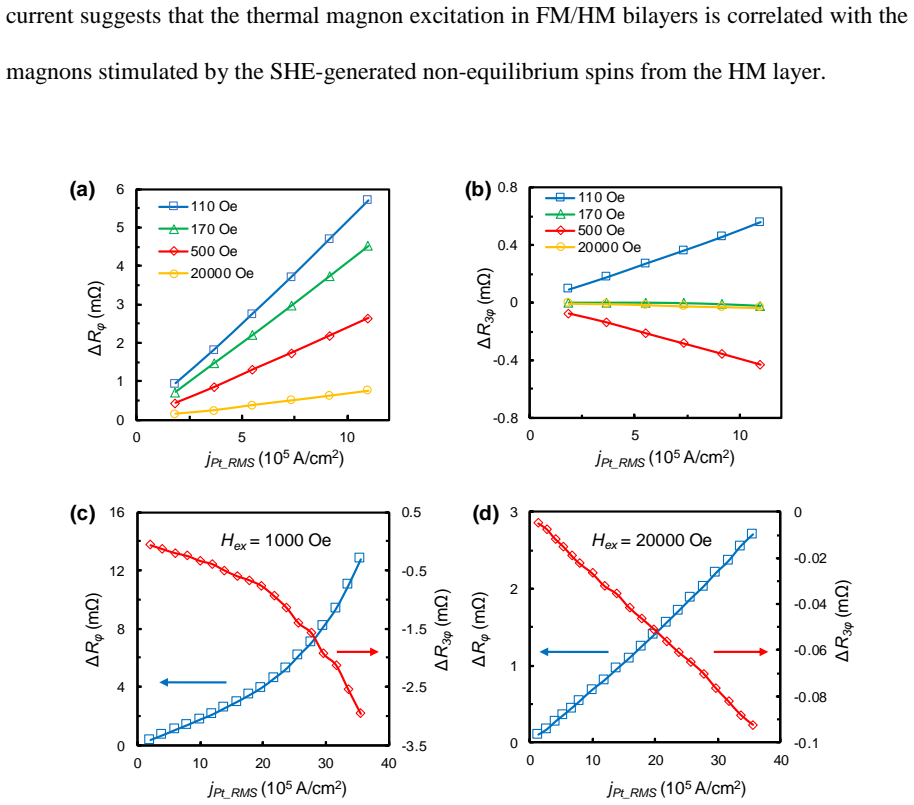
The paper's central claim is that the intermediate-field nonlinear resistance of NiFe/Pt (and NiFe/Ta) bilayers decomposes as $\Delta R_\varphi = A/H_{\rm ex} + B/(H_{\rm ex}+H_m) + \Delta r_0 j$ and $\Delta R_{3\varphi} = A/H_{\rm ex} + C/(H_{\rm ex}+H_m)$, where the $A$ terms come from anisotropic and spin Hall magnetoresistance and the $B$ and $C$ terms from magnon magnetoresistance. The key empirical findings are that $B$ and $C$ scale with current density, grow steeply between 200 and 300 K, reverse sign when Pt is replaced by Ta, and scale with $1/(H_{\rm ex}+H_m)$ rather than the power law $H_{\rm ex}^{-p}$ proposed earlier. The opposite signs of $C$ and $A$ produce a sign reversal of the sin3φ component at a magnetic field around 170 Oe for the main sample, a reversal the paper says has not been reported before.
Load-bearing premise
The load-bearing premise is that the magnon magnetoresistance has the assumed angular structure—magnon excitation efficiency proportional to $\sin\varphi_m$ plus a spin-flip correction proportional to $\sin\varphi_m\cos^2\varphi_m$ with opposite sign—since that ansatz, not a derivation, is what produces the sin3φ component and the sign reversal.
Editorial extensions
If this is right
- Any second-harmonic, bridge, or lock-in measurement of spin-charge interconversion in ferromagnet/heavy-metal bilayers must subtract magnon terms; otherwise extracted spin Hall or spin-orbit-torque efficiencies are offset, and the offset changes with field and temperature.
- At high external field the $B$ and $C$ magnon terms vanish as $1/(H_{\rm ex}+H_m)$, so high-field characterization suppresses magnon contamination and recovers the pure AMR/SMR response.
- The sign reversal field of the sin3φ component is a direct, background-free indicator of where magnon resistance equals the second-order AMR/SMR, so it can be used to compare samples with different thicknesses or heavy-metal materials.
- Because $H_m$ tracks the saturation magnetization in the data, the same measurement protocol can report on magnetization-related internal fields in ultrathin ferromagnets while separately monitoring the magnon contribution.
Reading between the lines
- The sinφ and sin3φ angular shapes of the magnon terms are an assumed ansatz, not a derivation; if a first-principles calculation produced a different angular structure, the extracted $B$ and $C$ values would need reinterpreting, though the $1/(H_{\rm ex}+H_m)$ field law might survive.
- The same bridge protocol could be applied to other materials where a current-odd nonlinear resistance encodes a spin texture, for example antiferromagnets or chiral magnets, where no equivalent separation scheme exists yet.
- The steep rise of $B$ and $C$ between 200 and 300 K suggests thermally populated magnons dominate the magnon magnetoresistance; extending the measurement below 50 K, where the magnon population freezes out, would give a sharp test of the magnon assignment.
Signed reviews
Editorial analysis
A structured set of objections, weighed in public.
Referee Report
Summary. The paper reports angular-dependent second-harmonic (nonlinear) magnetoresistance measurements on NiFe/Pt and NiFe/Ta bilayers using a Wheatstone bridge. The authors decompose the nonlinear resistance into sinφ and sin3φ angular components and propose a phenomenological model (Eqs. (4)-(5)) in which the sinφ and sin3φ amplitudes contain an AMR/SMR contribution scaling as 1/Hex and a magnon magnetoresistance (MMR) contribution scaling as 1/(Hex+Hm), with Hm an internal field proportional to magnetization. Fitting this model to data as a function of field, temperature, current density, and heavy-metal thickness, they observe a sign reversal of the sin3φ component at a field of about 170 Oe, which they attribute to competition between the AMR/SMR and MMR terms. The claims include the first disentanglement of MMR from AMR/SMR and the first report of the sign reversal.
Significance. If the model is correct, the work provides an experimentally grounded method for separating magnon-induced magnetoresistance from AMR/SMR and USMR in heavy-metal/ferromagnet bilayers, which would be valuable for characterizing spin-charge interconversion. The bridge technique is shown to yield low-noise, reproducible harmonic data without post-processing, and the temperature dependence (small B,C at 50 K, strong growth toward 300 K) and the opposite signs for Pt and Ta are consistent with a magnon origin and spin Hall origin, respectively. However, the central angular form of the MMR is conjectured rather than derived, and the key field dependence is supported by fits with several free parameters; these issues limit the current strength of the disentanglement claim.
major comments (3)
- [Section III, Eqs. (4)-(5)] The sin3φ component of the magnon magnetoresistance is introduced by conjecture rather than derivation: the text states "we may conjecture that, in addition to the sinφ term, there is another MMR related term which is proportional to sinφ cos2φ" and Section VI.F concedes that "first principles studies are required to unveil the true origin of the sin φ and sin 3φ terms." Because this angular ansatz is what creates the sin3φ signature in the model, the sign reversal of ΔR3φ is not an independent confirmation of the model; it is a consequence of fitting A and C with opposite signs in Eq. (5). The authors should provide a microscopic justification for the angular form or, at minimum, demonstrate a quantitative prediction (e.g., the field or thickness at which the sign reverses) that was not used to determine the fit parameters.
- [Section IV.A, Fig. 2(e)] The evidence favoring 1/(Hex+Hm) over Hex^{-p} is based on visual inspection of Fig. 2(e) without quantitative metrics. The 1/(Hex+Hm) model has an additional free parameter Hm, while the power-law fits use fixed exponents p=0.4, 0.6, 0.8; no residuals, chi-squared values, or confidence intervals are reported. Since Hm is extracted from the same fits and is not independently measured, the correlation of Hm with Ms in Fig. 2(f) does not by itself validate the functional form. Please provide a formal model comparison (e.g., AIC or chi-square per degree of freedom) and, if possible, an independent determination of Hm.
- [Section IV.A, Figs. 2(a)-(d)] The harmonic decomposition ΔR(φ)=ΔRφ sinφ + ΔR3φ sin3φ is assumed to be complete, but the paper does not report the residuals of the fits or the amplitudes of neglected harmonics such as sin5φ. The sign reversal of ΔR3φ occurs at small amplitudes (around 0.1 mΩ in Fig. 2(b)), so a systematic higher-harmonic contamination or baseline offset could mimic or mask the effect. Please show residual plots and a fit that includes the next allowed harmonic to demonstrate that the extracted ΔR3φ is robust.
minor comments (4)
- [Fig. 5(a)] The legend in Fig. 5(a) contains the text "fits Eq. (6)", but the manuscript uses Eqs. (4) and (5); Eq. (6) is not defined anywhere in the text.
- [Section IV.E] The sentence "A for NiFe/Ta is significantly smaller than that of NiFe/Ta" should read "...smaller than that of NiFe/Pt."
- [Section III] The phrase "angel-dependent magnon-excitation" should be "angle-dependent magnon-excitation."
- [References] Reference [2] cites an arXiv preprint (arXiv:1801.09636) for a review of spin-orbit torques; a published version would be preferable if available.
Circularity Check
The sin3φ MMR term is introduced by conjecture rather than derivation, and the sign reversal of ΔR3φ is forced by fitted opposite signs in Eq. (5), making the central explanation partially circular.
-
fitted input called prediction
[Section III (paragraph starting 'The magnon excitation efficiency...') and Eqs. (3)-(5)]
"Therefore, we may conjecture that, in addition to the sin φ_m term, there is another MMR related term which is proportional to sin φ_m cos^2 φ_m, or alternatively, it may be written in the form of (sin φ_m + sin 3φ_m)/4. ... Therefore, the sign of sin φ_m cos^2 φ_m term should be opposite to that of the sin φ_m term."
The sin3φ MMR component and its sign relative to the sinφ term are introduced by conjecture, not derived. Eq. (5) then writes ΔR3φ = A/Hex + C/(Hex+Hm); with fitted C = -433 mΩ·Oe opposite in sign to fitted A = 130 mΩ·Oe, the model necessarily produces a sign change in ΔR3φ. The abstract's claim that 'competition between different types of magnetoresistances leads to a sign reversal' is therefore a restatement of the assumed opposite sign plus the fitted values, not an independent prediction. The paper itself concedes in Section VI.F that 'first principles studies are required to unveil the true origin of the sin φ and sin 3φ terms of the MMR.'
-
fitted input called prediction
[Section IV.A, discussion of Fig. 2(b)]
"The opposite sign of the first and second terms in Eq. (5) well explains the sign reversal for ΔR3φ as the external field increases."
The 'opposite sign' is not independently derived; it is the sign of the fitted parameter C. Setting Eq. (5) to zero gives Hex = -A Hm/(A+C) ≈ 171 Oe for the fitted values A = 130 mΩ·Oe, C = -433 mΩ·Oe, and Hm = 400 Oe, exactly the observed reversal near 170 Oe. The explanation therefore reduces to the fitted parameters, so the observed sign reversal is not an independent test of the model. Furthermore, Hm is also a free parameter, so no externally fixed input pins the zero crossing.
full rationale
The mathematical reduction from Eqs. (1)-(3) is self-contained, and the bridge technique is supported by the authors' earlier methodological papers, but those self-citations are not load-bearing for the MMR physics. The load-bearing circularity is in the treatment of the magnon magnetoresistance: the sin3φ term is conjectured via sinφ cos^2φ, the 1/(Hex+Hm) field dependence is imposed from bulk-material references, and Hm, A, B, and C are all free parameters in the fits. The 'sign reversal of sin3φ' is presented as a new result and is explained by Eq. (5), yet the explanation is forced by the fitted opposite signs of A and C and by the fitted Hm. Some independent support does exist: B and C grow much more strongly with temperature than A, and the extracted Hm scales approximately linearly with Ms across NiFe thicknesses. These correlations give partial credence to the MMR identification, which is why the circularity is only partial rather than total. However, the central phenomenological claim that the sin3φ term contains a real MMR component with sign opposite to AMR/SMR rests on an angular ansatz that the paper does not derive, and the sign-reversal prediction reduces by construction to the fitted parameters.
Assumptions & free parameters
free parameters (5)
- A (second-order AMR/SMR prefactor) =
130 mΩ·Oe (NiFe(1.8)/Pt(2), j_RMS=5.5e5 A/cm2); 256 mΩ·Oe (same, 1.1e6 A/cm2); -2.86 mΩ·Oe (NiFe(1.8)/Ta(3))
- B (MMR sinφ prefactor) =
637 mΩ·Oe (Pt, 5.5e5); 1300 mΩ·Oe (Pt, 1.1e6); -334.3 mΩ·Oe (Ta)
- C (MMR sin3φ prefactor) =
-433 mΩ·Oe (Pt, 5.5e5); -850 mΩ·Oe (Pt, 1.1e6); 180 mΩ·Oe (Ta)
- Hm (internal field parameter) =
400 Oe for NiFe(1.8)/Pt(2); extracted for NiFe thicknesses 1.8, 2, 3, 5 nm
- Δr0 j_Pt0 (field-independent USMR/thermoelectric offset) =
0.36 mΩ at 5.5e5 A/cm2; 0.72 mΩ at 1.1e6 A/cm2
assumptions (6)
- standard math Trigonometric identity: sinφ cos^2φ = (sinφ + sin3φ)/4.
- domain assumption For Hex > 50 Oe, the magnetization is aligned with the external field so φ_m ≈ φ.
- domain assumption MMR field dependence follows 1/(Hex+Hm), with Hm proportional to saturation magnetization.
- ad hoc to paper Magnon excitation efficiency is proportional to sinφ_m, and MMR has an additional sinφ_m cos^2φ_m term with opposite sign.
- domain assumption SOT-induced angle shift is Δφ_m ≈ h_FL^SH cosφ_m/Hex with h_FL^SH = α j.
- domain assumption The same coefficient A appears in both ΔR_φ and ΔR_3φ.
Cite this review
Pith. "Pith review of Disentangle magnon magnetoresistance from anisotropic and spin Hall magnetoresistance in NiFe/Pt bilayers." pith.science (2026). https://pith.science/paper/EVDX6W5Z
@misc{pith2026190809571,
  author       = {Pith},
  title        = {Pith review of: Disentangle magnon magnetoresistance from anisotropic and spin Hall magnetoresistance in NiFe/Pt bilayers},
  year         = {2026},
  howpublished = {\url{https://pith.science/paper/EVDX6W5Z}},
  note         = {Machine review of arXiv:1908.09571}
}
read the original abstract
We conducted a systematic angular dependence study of nonlinear magnetoresistance in NiFe/Pt bilayers at variable temperature and field using the Wheatstone bridge method. We successfully disentangled magnon magnetoresistance from other types of magnetoresistances based on their different temperature and field dependences. Both the spin Hall/anisotropic and magnon magnetoresistances contain sine phi and sine 3 phi components with phi the angle between current and magnetization, but they exhibit different field and temperature dependence. The competition between different types of magnetoresistances leads to a sign reversal of sine 3 phi component at a specific magnetic field, which was not reported previously. The phenomenological model developed is able to account for the experimental results for both NiFe/Pt and NiFe/Ta samples with different layer thicknesses. Our results demonstrate the importance of disentangling different types of magnetoresistances when characterizing the charge-spin interconversion process in magnetic heterostructures.
Figures

Reference graph
Works this paper leans on
-
[1]
T. Wang, J. Q. Xiao, and X. Fan, SPIN 07, 1740013 (2017)
work page 2017
-
[2]
A. Manchon, I. M. Miron, T. Jungwirth, J. Sinova, J. Zelezný, A. Thiaville, K. Garello, and P. Gambardella, e-print arXiv:1801.09636 (2018)
arXiv 2018
- [3]
- [4]
- [5]
-
[6]
Hoffmann, IEEE Trans
A. Hoffmann, IEEE Trans. Magn. 49, 5172 (2013)
2013
-
[7]
Y. A. Bychkov and É. I. Rashba, JETP Lett. 39, 78 (1984)
work page 1984
-
[8]
V. M. Edelstein, Solid State Commun. 73, 233 (1990)
work page 1990
Show all 30 references
-
[9]
J. R. Sánchez, L. Vila, G. Desfonds, S. Gambarelli, J. Attané, J. De Teresa, C. Magén, and A. Fert, Nat. Commun. 4, 2944 (2013)
2013
-
[10]
I. M. Miron, K. Garello, G. Gaudin, P. J. Zermatten, M. V. Costache, S. Auffret, S. Bandiera, B. Rodmacq, A. Schuhl et al., Nature 476, 189 (2011)
2011
-
[11]
Liu, C.-F
L. Liu, C.-F. Pai, Y. Li, H. Tseng, D. Ralph, and R. Buhrman, Science 336, 555 (2012)
2012
-
[12]
G. Yu, P. Upadhyaya, Y. Fan, J. G. Alzate, W. Jiang, K. L. Wong, S. Takei, S. A. Bender, L. T. Chang et al., Nat. Nanotechnol. 9, 548 (2014)
2014
-
[13]
Nakayama, M
H. Nakayama, M. Althammer, Y. T. Chen, K. Uchida, Y. Kajiwara, D. Kikuchi, T. Ohtani, S. Geprägs, M. Opel et al., Phys. Rev. Lett. 110, 206601 (2013)
2013
-
[14]
J. Kim, P. Sheng, S. Takahashi, S. Mitani, and M. Hayashi, Phys. Rev. Lett. 116, 097201 (2016)
2016
-
[15]
S. S. L. Zhang, G. Vignale, and S. Zhang, Phys. Rev. B 92, 024412 (2015)
2015
-
[16]
Y.-T. Chen, S. Takahashi, H. Nakayama, M. Althammer, S. T. B. Goennenwein, E. Saitoh, and G. E. W. Bauer, Phys. Rev. B 87, 144411 (2013)
2013
-
[17]
C. O. Avci, K. Garello, A. Ghosh, M. Gabureac, S. F. Alvarado, and P. Gambardella, Nat. Phys. 11, 570 (2015)
2015
-
[18]
Yasuda, A
K. Yasuda, A. Tsukazaki, R. Yoshimi, K. S. Takahashi, M. Kawasaki, and Y. Tokura, Phys. Rev. Lett. 117, 127202 (2016)
2016
-
[19]
T. Li, S. Kim, S.-J. Lee, S.-W. Lee, T. Koyama, D. Chiba, T. Moriyama, K.-J. Lee, K.-J. Kim et al., Appl. Phys. Express 10, 073001 (2017)
2017
-
[20]
C. O. Avci, J. Mendil, G. S. D. Beach, and P. Gambardella, Phys. Rev. Lett. 121, 087207 (2018). 22
2018
-
[21]
I. V. Borisenko, V. E. Demidov, S. Urazhdin, A. B. Rinkevich, and S. O. Demokritov, Appl. Phys. Lett. 113, 062403 (2018)
2018
-
[22]
W. P. Sterk, D. Peerlings, and R. A. Duine, Phys. Rev. B 99, 064438 (2019)
2019
-
[23]
Y. Xu, Y. Yang, Z. Luo, B. Xu, and Y. Wu, J. Appl. Phys. 122, 193904 (2017)
2017
-
[24]
Y. Xu, Y. Yang, M. Zhang, Z. Luo, and Y. Wu, Advanced Materials Technologies 3, 1800073 (2018)
2018
-
[25]
Z. Luo, Q. Zhang, Y. Xu, Y. Yang, X. Zhang, and Y. Wu, Phys. Rev. Appl. 11, 064021 (2019)
2019
-
[26]
Y. Yang, Y. Xu, H. Xie, B. Xu, and Y. Wu, Appl. Phys. Lett. 111, 032402 (2017)
2017
-
[27]
Fert and I
A. Fert and I. Campbell, Le Journal de Physique Colloques 32, C1 (1971)
1971
-
[28]
Raquet, M
B. Raquet, M. Viret, E. Sondergard, O. Cespedes, and R. Mamy, Phys. Rev. B 66, 024433 (2002)
2002
-
[29]
A. P. Mihai, J. P. Attané, A. Marty, P. Warin, and Y. Samson, Phys. Rev. B 77, 060401 (2008)
2008
-
[30]
G. R. Taylor, A. Isin, and R. V. Coleman, Phys. Rev. 165, 621 (1968)
1968
Reviewed August 14, 2026 · model on record in the stance chip above.
Discussion (0). Continue with ORCID to comment.