REVIEW 4 major objections 5 minor 27 references
Adapting Vision Foundation Models with Cascaded Semantics
T0 review · 4 major / 5 minor · reviewed 2026-08-08 · deepseek-v4-flash
Pith's one-line read This paper claims that anchoring random visual prompts with hand-crafted image priors and cascaded self-attention maps improves downstream accuracy while tuning only 0.74% of ViT parameters.
desk verdict Solid, well-scoped VPT extension whose headline comparison has a real and visible optimizer confound; the paper's own ablations support the components, but C1 needs a same-optimizer rerun before it is clean. read the letter →
The pith
A machine-rendered reading of the paper's core claim, the machinery that carries it, and where it could break.
The reading
What carries the argument
The central object is the cascaded semantic prompt: an input-space hard prompt formed by concatenating color histogram, Gabor texture, and Sobel shape descriptors with a learnable random prompt, and a feature-space prompt formed by concatenating each layer's self-attention map and random prompt with the previous layer's prompt and attention map via a skip connection. The cascade is what carries the argument: it makes each layer's prompt inherit accumulated semantics, and the paper's ablation shows removing the skip connection ('w/o K') is the single largest drop on every VTAB-1k split.
What would settle it
Run the method with the hand-crafted color/texture/shape priors replaced by fixed random tensors of the same shape and dimensionality; if the VTAB-1k mean stays at 76.30%, the semantic content of the priors is not what drives the gain.
Extended reading notes
Core claim
The paper's central claim is that the weakness of visual prompt tuning is not the number of learnable parameters but their semantic emptiness. Randomly initialized prompts are replaced by prompts anchored to two complementary priors: hand-crafted fundamental image statistics (color, texture, shape) that are fixed, non-learnable, and human-understandable, and self-attention maps that are instance-aware and computed from each image's own features. Cascading these priors across transformer layers — alongside the existing random learnable tokens — yields better feature–region alignment, higher label correlation in deep layers, and the reported gains of 90.20% on FGVC, 91.7% on HTA, and 76.30% mean on VTAB-1k with 0.74% tuned parameters. The paper also claims the method transfers to Swin and that, under the evaluated base-to-novel protocol, visual semantic prompts slightly exceed text-conditioned prompts.
Load-bearing premise
The central claim assumes that the accuracy gap over VPT and SA2VP comes from the semantic prompts themselves, rather than from the different optimizer AdamW and fixed learning rate used in the paper's setup.
Editorial extensions
If this is right
- With 0.74% tuned parameters, the method improves aggregate accuracy over the compared PEFT baselines across FGVC, HTA, and VTAB-1k, and transfers from ViT to Swin, implying the semantic anchors generalize across backbones.
- Removing any single prior (color, texture, shape, or self-attention) lowers accuracy, and removing the skip connection hurts most, implying cascading is the decisive component.
- Representation metrics (IoU, GradCAM, t-SNE, and mutual information) show better feature–region alignment and label correlation, implying the gains correspond to more localized, separable features and not only to accuracy scores.
- Under the CoOp/MaPLe base-to-novel protocol, semantic visual prompts slightly exceed text-conditioned prompts, implying visual priors can substitute for text context in this setting.
- Efficiency stays close to VPT: training time within 0.3 seconds per epoch, memory within 0.1 GB, inference within 2 ms per image, and prior extraction can be pre-computed with zero GPU training overhead.
- The fixed hand-crafted priors are chosen over learnable equivalents because learnable extractors of the same receptive field do not improve accuracy while spending parameter budget.
Reading between the lines
- The paper leaves unexplored whether the cascade, rather than the semantic content, is the main driver: since the skip-connection ablation accounts for the largest single accuracy drop, a control with fixed random per-image tokens of the same shape would determine whether the specific color/texture/shape statistics matter.
- Because the priors are cheap and model-free, the same anchoring recipe could be applied to other modalities — temporal histograms for video or depth histograms for 3D data — with the cascade unchanged.
- The paper's own failure analysis predicts that counting and 3D-pose tasks will remain weak spots for fixed appearance priors, suggesting the next step is learnable or geometric priors rather than more hand-crafted ones.
Editorial analysis
A structured set of objections, weighed in public.
Referee Report
Summary. The paper proposes Cascaded Semantic Prompting, augmenting VPT-Deep with fixed hand-crafted input priors (HSV color histogram, Gabor texture, Sobel shape), instance-aware self-attention-map prompts in feature space, skip-connection cascading across layers, and a small re-weighting adapter before the classification head. The authors claim that with only 0.74% tuned parameters the method improves aggregate accuracy over the compared PEFT baselines on FGVC, HTA, and VTAB-1k, transfers from ViT to Swin, and remains close to VPT in training cost and memory. The paper also reports controlled ablations, representation-level analyses (IoU, GradCAM, t-SNE, mutual information), a base-to-novel comparison with MaPLe-style text prompts, and an extensive appendix covering baseline configurations, per-dataset results, seed statistics, and failure cases.
Significance. If the headline comparison is accepted, this is a modest but consistent advance in visual prompt tuning: the idea of anchoring randomly initialized visual prompts with fixed, interpretable image priors is clean and practically useful. The manuscript is unusually complete in its empirical reporting: Table 5 gives systematic single- and cumulative-component ablations, Table 14 reports three-seed means and standard deviations, Fig. 7 tests operator sensitivity, Table 6 measures end-to-end efficiency including CPU preprocessing, and Appendix L gives a candid failure-case analysis on structured tasks. These strengths are real and should be credited. However, the central comparison is currently confounded by a change of optimizer and schedule relative to the cited baselines, and one table contains duplicated numbers, so the main claim needs additional controlled experiments before the paper can be accepted as-is.
major comments (4)
- [Sec. J.6, Table 13, Table 5, Table 1] The paper's headline comparison does not isolate the semantic-prior contribution from the optimizer change. The proposed method uses AdamW (lr 1e-3, wd 1e-4, cosine, 100 epochs) while VPT and VFPT use SGD with per-task hyperparameter grids, and most Table 1 baselines are cited from original papers. Table 5's 'Baseline (None)' row, which removes all proposed components and should approximate prompt-only VPT-Deep under the proposed pipeline, scores 75.80 on VTAB-1k Natural, 2.68 points below the cited VPT-D number of 78.48 in Table 1. This unexplained gap is as large as several of the reported component gains, so claim C1's attribution of the aggregate improvement to semantic priors is not cleanly supported. Please rerun VPT, VFPT, and SA2VP under the AdamW schedule (or otherwise control the optimizer) and report the comparison; the current Table 14 reruns only SA2VP.
- [Table 2 / Sec. 3.2] Table 2 lists identical accuracies for Bias and VPT-deep (76.78 / 83.33 / 51.85), which cannot both be correct as reported; the surrounding text also states 86.23% for Specialized while the table shows 86.83%. These discrepancies undermine the Swin-transfer leg of claim C1 and need to be corrected or explained before the Swin results can be assessed.
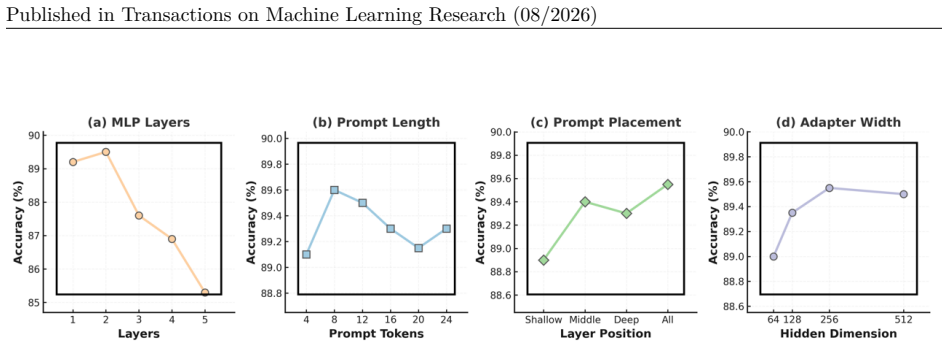
- [Table 13 / Fig. 3(c) / Sec. 2.3] The main configuration is not fully pinned down. Table 13 says 'Layers with prompt: all 12', but Fig. 3(c) reports that targeted prompt placement outperforms indiscriminate/all-layer injection, and Sec. 2.3 defines feature prompts only for layers 2..N. Please state explicitly whether the final method prompts all 12 layers or a targeted subset, and how Fig. 3(c) was obtained; this is needed for reproducibility and for interpreting the skip-connection ablation in Table 5.
- [Sec. K / Table 14] Statistical robustness is reported only for the proposed method, SA2VP, and VFPT; the other Table 1 baselines are cited values, so the comparison mixes protocols. The three-seed table should either include all compared methods under the same protocol or clearly mark which numbers are not directly comparable.
minor comments (5)
- [Sec. 3.1] The text says the HTA benchmark includes 10 datasets, but only nine are enumerated (CIFAR10, CIFAR100, DTD, CUB-200, NABirds, Oxford Flowers, Food101, GTSRB, SVHN); please add the missing dataset or correct the count.
- [Sec. 2.1] The sentence 'The colors and indicate trainable and frozen parameters' has missing symbols in the rendered text; please fix the formatting so the notation is explicit.
- [Sec. 2.6] The phrase 'All experiments are conducted exclusively' is unclear; it should likely read 'separately' or 'independently'.
- [Table 1 / Sec. J.2] The LoRA row in Table 1 lists Tuned/Total as '—' even though Sec. J.2 and Table 6 give a value of about 0.34%; please fill in the entry for completeness.
- [Sec. 3.2, Table 3] The 'Comparison with Text Prompt' experiment does not specify whether the text branch of MaPLe is retained in the 'Ours' row; please clarify the exact architecture used so the comparison is unambiguous.
Circularity Check
No significant circularity: the central accuracy claims are empirical comparisons on external benchmarks, and self-citations are not load-bearing.
full rationale
The central claims C1 and C2 are empirical accuracy comparisons and controlled ablations on external benchmarks (FGVC, HTA, VTAB-1k, CoOp suite) against cited prior methods. The proposed prompts are defined by the paper (Eqs. 1 and 3), but their benefit is established by measured test-set accuracy and component-removal experiments (Table 5), not by construction from the equations. No parameter is fitted to a benchmark and then reported as a prediction of that same benchmark; per-dataset hyperparameters are selected on official validation splits, which is standard and not circular. The representation-level analyses (IoU, GradCAM, t-SNE, MINE, cosine similarity) are presented as post-hoc evidence with an explicit caveat that they 'do not constitute a complete mechanistic explanation' (Sec. 3.3); they are measurements rather than predictions derived from the model. Self-citations (e.g., Xiao et al. 2026e taxonomy; Han et al. 2024 trend observations) appear in related work and general observations, but the method's central premise and evaluation do not rest on any self-cited uniqueness theorem or forbidden alternative. The AdamW-vs-SGD difference from VPT/VFPT baselines is a genuine control concern: Sec. J.6 states 'We use AdamW because it converges faster than the SGD recipe of VPT/VFPT in our setup and reaches comparable final accuracy' without reporting a same-optimizer rerun of those baselines. Similarly, the Table 3 semantic-vs-text comparison differs from MaPLe in multiple architectural respects. These are correctness and attribution risks, not circular reductions: the reported gains are not defined in terms of the baseline numbers, and no equation reduces to its own input. Accordingly, no circular step can be exhibited under the required standard.
Assumptions & free parameters
free parameters (3)
- prompt length per layer =
per-task grid {5,10,50,100,200} selected on validation
- batch size =
64 or 128 per task
- re-weighting adapter hidden width =
256
assumptions (3)
- domain assumption Visual prompt tuning with a frozen backbone is a valid parameter-efficient adaptation paradigm.
- domain assumption Hand-crafted low-level features (color, texture, shape) are complementary to deep ViT features and do not harm performance.
- domain assumption MINE provides reliable estimates of I(X;T) and I(T;Y) for the information-bottleneck analysis.
Cite this review
Pith. "Pith review of Adapting Vision Foundation Models with Cascaded Semantics." pith.science (2026). https://pith.science/paper/EVPN33PB
@misc{pith2026260805393,
  author       = {Pith},
  title        = {Pith review of: Adapting Vision Foundation Models with Cascaded Semantics},
  year         = {2026},
  howpublished = {\url{https://pith.science/paper/EVPN33PB}},
  note         = {Machine review of arXiv:2608.05393}
}
read the original abstract
Prompt tuning, a leading parameter-efficient adaptation paradigm in NLP, has recently been extended to computer vision. Visual prompt tuning (VPT) adapts pre-trained vision transformers (ViTs) by updating a small set of additional prompt parameters. However, existing visual prompts are randomly initialized and do not exploit prior knowledge, such as instructions in NLP. We address this gap by injecting two complementary semantic priors into VPT. Fundamental image priors, including color, texture, and shape, are extracted with classical hand-crafted operators and injected into the input space, while self-attention maps provide instance-aware semantics in the feature space. We further propose a cascaded scheme that integrates both priors throughout ViT adaptation. Experiments on 34 challenging image classification datasets demonstrate superior downstream adaptation while tuning only 0.74% of ViT parameters. Project page: https://xixiaouab.github.io/Cascaded-Semantics/.
Figures


Figures from the paper (5 more)


Reference graph
Works this paper leans on
-
[1]
Information Orthogonality:Deep features extracted from networks like ResNet are conceptually homogeneous to the semantic features already learned by the ViT backbone itself (i.e., high-level abstractions). Adding them creates information redundancy. In contrast, our hand-crafted operators explicitly capture low-level statistics—such as high-frequency grad...
work page 2018
-
[2]
Domain Robustness:Deep feature extractors (e.g., ImageNet-trained ResNet) often suffer from domain shift when applied to specialized downstream tasks (e.g., medical or satellite imagery in VTAB-1k). Hand-crafted priors, however, rely on fundamental signal processing principles (e.g., edge gradients, color distribution) that are domain-agnostic and univers...
work page 2026
-
[3]
Strict Efficiency:The core philosophy of PEFT is to adapt large models with minimal resource overhead. Utilizing a secondary deep network as a prior extractor, even if frozen, requires storing and computing over millions of additional parameters (e.g.,∼11M for ResNet-18), contradicting the lightweight nature of our task. In comparison, our hand-crafted op...
-
[4]
Densely connected convolutional networks
1, 2, 7, 11, 22, 24 Gao Huang, Zhuang Liu, Laurens Van Der Maaten, and Kilian Q Weinberger. Densely connected convolutional networks. InProceedings of the IEEE Conference on Computer Vision and Pattern Recognition (CVPR), pp. 4700–4708, 2017. 3, 4 Mingzhen Huang, Jingru Zhang, Xiaodan Liang, and Hao Wang. Dam-vp: Adaptive meta-learning for visual prompt t...
arXiv 2017
-
[6]
6, 32 Xiaowen Ma, Zhenkai Wu, Jiatong Pan, Kai Zheng, Rongrong Lian, Wangyu Wu, Zhenhua Huang, Yun Chen, Renxiang Guan, Rong Fu, Simon Fong, and Wei Zhang. CDMask: Change customized mask architecture for change detection.IEEE Transactions on Geoscience and Remote Sensing, 64:5619919, 2026. doi: 10.1109/TGRS.2026.3687455. URLhttps://ieeexplore.ieee.org/doc...
arXiv 2026
-
[10]
The caltech-ucsd birds-200-2011 dataset
25, 26 Catherine Wah, Steve Branson, Peter Welinder, Pietro Perona, and Serge Belongie. The caltech-ucsd birds-200-2011 dataset. InCalifornia Institute of Technology, 2011. URL https://authors.library. caltech.edu/records/cvm3y-5hh21. 6 Taowen Wang, Yiyang Liu, James Chenhao Liang, Junhan Zhao, Yiming Cui, Yuning Mao, Shaoliang Nie, Jiahao Liu, Fuli Feng,...
arXiv 2011
-
[11]
doi: 10.52202/079017-0180. 2, 6, 7, 10, 31, 32, 33 Xiaohua Zhai, Joan Puigcerver, Alexander Kolesnikov, Pierre Ruyssen, Carlos Riquelme, Mario Lucic, Josip Djolonga, Andre Susano Pinto, Maxim Neumann, Alexey Dosovitskiy, Lucas Beyer, Olivier Bachem, Michael Tschannen, Marcin Michalski, Olivier Bousquet, Sylvain Gelly, and Neil Houlsby. A large-scale study...
-
[15]
Color Prior: Histogram Statistics. Color is one of the most expressive and invariant visual cues, robust to rotation and scaling (Swain & Ballard, 1991). We compute the color histogram features as follows: • Color Space:We utilize the HSV (Hue, Saturation, Value) color space, which decouples chromatic information (Hue/Saturation) from intensity (Value), p...
work page 1991
Show all 27 references
-
[16]
Texture analysis is crucial for distinguishing materials and repetitive patterns
Texture Prior: Gabor Filters. Texture analysis is crucial for distinguishing materials and repetitive patterns. We adoptGabor filters(Man- junath & Ma, 1996), which are biologically inspired by the receptive fields of simple cells in the mammalian visual cortex (V1). • Impleme...
1996
-
[17]
texture bias
Shape Prior: Sobel Operator. Shape and edge information provide structural constraints that are often complementary to texture (Geirhos et al., 2018). We employ theSobel operator(Kanopoulos et al., 1988) to extract gradient information. • Implementation:We compute the discrete...
2018
-
[18]
Removing any single component results in an information void that the randomized prompts alone may struggle to fill (as evidenced in Table 5 of the main text)
Completeness:The combination ofColor(spectral),Texture(spatial-frequency), andShape (structural/spatial) covers the three fundamental pillars of low-level computer vision. Removing any single component results in an information void that the randomized prompts alone may strugg...
-
[19]
hard prompt
Interpretability & Stability:Unlike learnable priors (e.g., CNN adapters), these hand-crafted operators are deterministic and theoretically well-understood. Using standard operators like Sobel and Gabor ensures that the injected “hard prompt” provides stable, domain-invariant ...
2002
-
[21]
Cluttered backgrounds (about54%of the gain on CUB-200).The target bird occupies less than30%of the frame against a busy background. The Sobel shape prior gives sharper object 32 Published in Transactions on Machine Learning Research (08/2026) Table 13: Hyperparameter settings ...
2026
-
[22]
per-task grid
on VTAB-1k and FGVC with ViT-B/16. “per-task grid” means the value is chosen on the official validation split of each dataset. “–” means not applicable. Hyperparameter VPT (Jia et al., 2022) VFPT (Zeng et al., 2024) Ours Backbone and data Backbone ViT-B/16 ViT-B/16 ViT-B/16 Pr...
2022
-
[23]
The HSV color histogram and Gabor texture priors give extra cues that the random-prompt baseline cannot recover
Low color contrast (about27%of the gain).The bird’s plumage has a similar color to the background (e.g., grey or brown birds against bark). The HSV color histogram and Gabor texture priors give extra cues that the random-prompt baseline cannot recover
-
[24]
Extra Params
Confusable subspecies (about19%of the gain).Two species differ only in a small structural feature (e.g., beak curvature, wing-bar pattern). The self-attention prompt cascaded from earlier layers keeps these fine-grained cues, which would otherwise be smoothed out in deeper lay...
2026
-
[25]
No useful gradient signal at the operator level.The downstream loss is on classification, several layers away from the operator. The operator is shadowed by the rest of the learnable parameters, so 34 Published in Transactions on Machine Learning Research (08/2026) a few thous...
2026
-
[26]
Domain shift.The operators see input images from the downstream dataset only (often small in VTAB-1k, with∼800 training samples). Learnable extractors trained on that little data tend to drift toward the dominant statistics of the small training set and lose the domain-invaria...
-
[27]
Spending it on re-learning a Sobel filter is wasteful when the fixed Sobel filter already does the job at zero parameter cost
PEFT budget.The whole point of the PEFT setting is that the per-task parameter budget is small. Spending it on re-learning a Sobel filter is wasteful when the fixed Sobel filter already does the job at zero parameter cost. We therefore keep fixed Sobel/Gabor in the main method...
-
[1991]
Indexing via color histograms
2, 3, 5, 29 17 Published in Transactions on Machine Learning Research (08/2026) Michael J Swain and Dana H Ballard. Indexing via color histograms. InActive perception and robot vision, pp. 261–273. Springer, 1992. 2, 11 Zhou Tianyu, Miao Zhenjiang, and Zhang Jianhu. Combining ...
2026
-
[2008]
6 Timo Ojala, Matti Pietikainen, and Topi Maenpaa. Multiresolution gray-scale and rotation invariant texture classification with local binary patterns.IEEE Transactions on Pattern Analysis and Machine Intelligence, 24(7):971–987, 2002. 11, 30 Oyebade K Oyedotun, Kassem Al Isma...
2002 arXiv
-
[2009]
Qlora: Efficient finetuning of quantized llms.Advances in neural information processing systems, 36:10088–10115, 2023
6 13 Published in Transactions on Machine Learning Research (08/2026) Tim Dettmers, Artidoro Pagnoni, Ari Holtzman, and Luke Zettlemoyer. Qlora: Efficient finetuning of quantized llms.Advances in neural information processing systems, 36:10088–10115, 2023. 22 Wei Dong, Dawei Y...
2026 arXiv
-
[2017]
Imagenet-trained cnns are biased towards texture; increasing shape bias improves accuracy and robustness
6 Robert Geirhos, Patricia Rubisch, Claudio Michaelis, Matthias Bethge, Felix A Wichmann, and Wieland Brendel. Imagenet-trained cnns are biased towards texture; increasing shape bias improves accuracy and robustness. InInternational conference on learning representations, 2018...
2018 arXiv
-
[2018]
11 Naftali Tishby and Noga Zaslavsky
doi: 10.1109/icsp.2018.8652428. 11 Naftali Tishby and Noga Zaslavsky. Deep learning and the information bottleneck principle. In2015 ieee information theory workshop (itw), pp. 1–5. IEEE, 2015. doi: 10.1109/itw.2015.7133169. 10 Naftali Tishby, Fernando C. Pereira, and William ...
2018
-
[2022]
Improved baselines with momentum contrastive learning.arXiv preprint arXiv:2003.04297, 2020
2, 6, 7, 11, 22, 24 Xinlei Chen, Haoqi Fan, Ross Girshick, and Kaiming He. Improved baselines with momentum contrastive learning.arXiv preprint arXiv:2003.04297, 2020. 7 Yunseon Choi, Sungtae Kim, and Kee-Eung Kim. Hard prompts made interpretable: Sparse entropy regularization...
2003 arXiv
-
[2023]
Fundamental Image Priors
can be considered as future directions. Finally, as a prompt tuning paradigm, the upper bound of performance is inevitably tied to the quality and pre-training domain of the underlying frozen backbone. I.2 Future Work Building on these observations, future research could explo...
2022
-
[2024]
Prefix-tuning: Optimizing continuous prompts for generation.arXiv preprint arXiv:2101.00190, 2021
22 Xiang Lisa Li and Percy Liang. Prefix-tuning: Optimizing continuous prompts for generation.arXiv preprint arXiv:2101.00190, 2021. 1, 2, 22 Yanshu Li, Jiaqian Li, Kuai Yu, Xi Xiao, Dongfang Liu, Tianyang Wang, and Ruixiang Tang. Personalize your large vision-language models ...
2021 arXiv
Reviewed August 8, 2026 · model on record in the stance chip above.
Discussion (0). Continue with ORCID to comment.