Ten Years of the Stochastic Resonance Model of Tinnitus: From Phantom Perception to Adaptive Sensory Optimization
Pith reviewed 2026-06-26 22:03 UTC · model grok-4.3
The pith
The stochastic resonance model reframes tinnitus as a side effect of the brain adaptively increasing neural noise to restore signal detection after hearing loss.
A machine-rendered reading of the paper's core claim, the machinery that carries it, and where it could break.
Core claim
The stochastic resonance model posits that following hearing loss the auditory system adaptively upregulates internally generated neural noise to restore information transmission, with tinnitus emerging as a side effect when this noise crosses perceptual thresholds; computational models, clinical analyses, and animal experiments have converged on predictions such as improved near-threshold detectability under matched noise and frequency-specific phantom percepts.
What carries the argument
Stochastic resonance, the process in which added noise enhances detection of subthreshold signals in nonlinear systems, here applied to upregulated spontaneous activity in the auditory pathway after hearing loss.
If this is right
- Near-threshold signals become more detectable when internal noise is upregulated to match specific conditions.
- Phantom percepts should appear at frequencies corresponding to the regions of hearing loss.
- Spectrally matched near-threshold noise stimulation offers a route to therapeutic intervention.
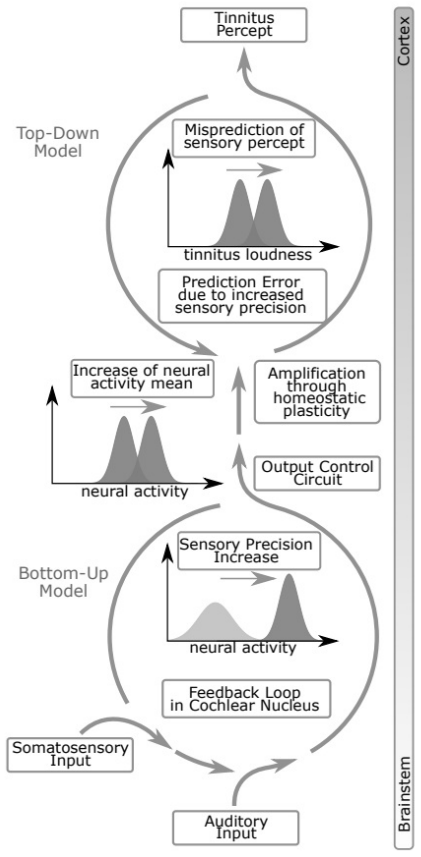
- The model combines with central gain, homeostatic plasticity, and predictive coding to explain broader auditory phantom phenomena.
Where Pith is reading between the lines
- The same optimization logic may extend to phantom perceptions in other sensory modalities where noise could aid threshold detection.
- Interventions that broadly suppress neural noise might impair signal detection performance in some contexts.
- Cross-modal plasticity effects could be tested by checking whether noise upregulation in one modality influences detection thresholds in another.
Load-bearing premise
That computational modeling, clinical analyses, and animal experiments have provided converging support for the model's key predictions of improved detectability and frequency-specific percepts.
What would settle it
A controlled test showing that adding spectrally matched near-threshold noise fails to improve weak-signal detection in individuals with tinnitus or that phantom percept frequencies do not align with regions of measured hearing loss.
Figures
read the original abstract
Subjective tinnitus - the perception of sound in the absence of an external acoustic stimulus - remains one of the most debated phenomena in auditory neuroscience. In 2016, the stochastic resonance (SR) model was introduced as an alternative account of tinnitus-related neuronal hyperactivity, proposing that internally generated neural noise is adaptively upregulated to restore information transmission after hearing loss. Rather than interpreting increased spontaneous activity as maladaptive, the model reframed it as a functional mechanism that enhances signal detection near sensory thresholds, with tinnitus emerging as a side effect of adaptive sensory optimization. Over the past decade, this framework has evolved from a phenomenological hypothesis into a broader neurocomputational theory linking information theory, adaptive signal detection, multichannel auditory processing, and cross-modal plasticity. Computational modeling, large-scale clinical analyses, and animal experiments have provided converging support for key predictions, including improved detectability under specific noise conditions and frequency-specific phantom percepts. The framework has also inspired a therapeutic approach based on spectrally matched near-threshold noise stimulation and has recently been integrated into a unified account of auditory phantom perception that combines stochastic resonance, central gain, homeostatic plasticity, and predictive coding. This review provides a chronological overview of the development of the stochastic resonance model, summarizes major theoretical and empirical advances, and outlines future directions for mechanistic validation and clinical translation. By redefining tinnitus as a consequence of adaptive sensory computation, the model shifts the conceptual focus from pathological dysfunction toward principles of information optimization in neural systems.
Editorial analysis
A structured set of objections, weighed in public.
Referee Report
Summary. The manuscript is a review tracing the ten-year development of the stochastic resonance (SR) model of tinnitus, introduced in 2016. It reframes tinnitus-related neuronal hyperactivity as an adaptive upregulation of internal noise to restore information transmission after hearing loss, with tinnitus as a side effect of sensory optimization. The paper provides a chronological overview of theoretical evolution into a broader neurocomputational framework integrating information theory, multichannel processing, and cross-modal plasticity; summarizes support from computational modeling, clinical analyses, and animal experiments for predictions such as improved near-threshold detectability under matched noise and frequency-specific phantom percepts; discusses a therapeutic approach using spectrally matched near-threshold noise; and outlines integration with central gain, homeostatic plasticity, and predictive coding, along with future directions.
Significance. If the summarized empirical supports hold under independent scrutiny, the review could meaningfully advance the field by shifting focus from maladaptive pathology to principles of adaptive information optimization in neural systems, with implications for noise-based therapies and unified accounts of auditory phantom perception. The work explicitly credits computational modeling and cross-framework integration as strengths in the SR account.
major comments (2)
- [Abstract] Abstract: the assertion that 'computational modeling, large-scale clinical analyses, and animal experiments have provided converging support for key predictions, including improved detectability under specific noise conditions and frequency-specific phantom percepts' supplies no specific datasets, methods, error bars, or quantitative effect sizes, preventing assessment of whether the cited evidence isolates the adaptive SR mechanism or remains compatible with non-SR accounts such as central gain.
- [Empirical advances (as described in abstract and skeptic note)] The review summarizes supports chronologically but does not re-derive model equations, re-analyze primary datasets, or quantify variance explained by the SR account versus alternatives (central gain, homeostatic plasticity), which is load-bearing for the central claim of converging empirical support.
Simulated Author's Rebuttal
We thank the referee for their thoughtful and constructive comments on our review manuscript. We address each major comment point by point below.
read point-by-point responses
-
Referee: [Abstract] Abstract: the assertion that 'computational modeling, large-scale clinical analyses, and animal experiments have provided converging support for key predictions, including improved detectability under specific noise conditions and frequency-specific phantom percepts' supplies no specific datasets, methods, error bars, or quantitative effect sizes, preventing assessment of whether the cited evidence isolates the adaptive SR mechanism or remains compatible with non-SR accounts such as central gain.
Authors: We agree that the abstract is a high-level summary and does not include specific datasets, methods, or quantitative details such as effect sizes. As this is a review article, the abstract outlines the scope and conclusions rather than replicating primary data. The manuscript body provides chronological summaries of the cited computational modeling, clinical analyses, and animal experiments, with references to the original publications where datasets, methods, and quantitative results are reported. To address the concern, we will partially revise the abstract to include citations to key supporting studies, enabling readers to access the quantitative details directly. revision: partial
-
Referee: [Empirical advances (as described in abstract and skeptic note)] The review summarizes supports chronologically but does not re-derive model equations, re-analyze primary datasets, or quantify variance explained by the SR account versus alternatives (central gain, homeostatic plasticity), which is load-bearing for the central claim of converging empirical support.
Authors: The manuscript is a review tracing the ten-year development of the SR model and is not structured as an original research paper. It therefore summarizes existing literature chronologically without re-deriving equations or re-analyzing primary datasets, which remain in the cited source publications. The claim of converging support is presented as a synthesis of findings from those works rather than a new quantitative meta-analysis or variance partitioning. We do not perform such comparisons here, as they would constitute a distinct study. The discussion of integration with central gain, homeostatic plasticity, and predictive coding is qualitative, as described in the relevant sections. We do not plan revisions to add these analyses, as they fall outside the review's stated scope. revision: no
Circularity Check
No circularity in derivation chain; review summarizes external developments without self-referential reduction
full rationale
The paper is a chronological review summarizing the evolution of the SR model, its predictions, and cited supporting studies from computational, clinical, and animal work. No derivation equations, fitted parameters, or first-principles results are presented that reduce to the paper's own inputs by construction. Claims of converging support are asserted via citations rather than re-derived here; self-citation is present but does not bear the load of a mathematical or predictive equivalence that collapses the central claim. The review format does not invoke uniqueness theorems from prior self-work or smuggle ansatzes; it remains a narrative overview whose validity can be assessed against the cited primary sources independently.
Axiom & Free-Parameter Ledger
axioms (1)
- domain assumption Internally generated neural noise is adaptively upregulated to restore information transmission after hearing loss.
Reference graph
Works this paper leans on
-
[1]
Neuron , volume=
Neuroscience-inspired artificial intelligence , author=. Neuron , volume=. 2017 , publisher=
2017
-
[2]
Nature neuroscience , volume=
Cognitive computational neuroscience , author=. Nature neuroscience , volume=. 2018 , publisher=
2018
-
[3]
Frontiers in Behavioral Neuroscience , volume=
Open (G) PIAS: An open-source solution for the construction of a high-precision acoustic startle response setup for tinnitus screening and threshold estimation in rodents , author=. Frontiers in Behavioral Neuroscience , volume=. 2019 , publisher=
2019
-
[4]
Frontiers in neuroscience , volume=
Objective estimation of sensory thresholds based on neurophysiological parameters , author=. Frontiers in neuroscience , volume=. 2019 , publisher=
2019
-
[5]
Frontiers in Neuroscience , pages=
Spectrally matched near-threshold noise for subjective tinnitus loudness attenuation based on stochastic resonance , author=. Frontiers in Neuroscience , pages=. 2022 , publisher=
2022
-
[6]
PLoS computational biology , volume=
Could a neuroscientist understand a microprocessor? , author=. PLoS computational biology , volume=. 2017 , publisher=
2017
-
[7]
bioRxiv , year=
Analysis and Visualization of Sleep Stages based on Deep Neural Networks , author=. bioRxiv , year=
-
[8]
Frontiers in human neuroscience , volume=
Analysis of multichannel EEG patterns during human sleep: a novel approach , author=. Frontiers in human neuroscience , volume=. 2018 , publisher=
2018
-
[9]
Scientific reports , volume=
Adaptive stochastic resonance for unknown and variable input signals , author=. Scientific reports , volume=. 2017 , publisher=
2017
-
[10]
Scientific reports , volume=
A statistical method for analyzing and comparing spatiotemporal cortical activation patterns , author=. Scientific reports , volume=. 2018 , publisher=
2018
-
[11]
Frontiers in Computational Neuroscience , volume=
Analysis of structure and dynamics in three-neuron motifs , author=. Frontiers in Computational Neuroscience , volume=. 2019 , publisher=
2019
-
[12]
Frontiers in computational neuroscience , volume=
Recurrence Resonance” in Three-Neuron Motifs , author=. Frontiers in computational neuroscience , volume=. 2019 , publisher=
2019
-
[13]
arXiv preprint arXiv:1811.01753 , year=
How deep is deep enough?--Quantifying class separability in the hidden layers of deep neural networks , author=. arXiv preprint arXiv:1811.01753 , year=
-
[14]
PloS one , volume=
Weight statistics controls dynamics in recurrent neural networks , author=. PloS one , volume=. 2019 , publisher=
2019
-
[15]
bioRxiv , year=
Intrinsic noise improves speech recognition in a computational model of the auditory pathway , author=. bioRxiv , year=
-
[16]
Journal of Neuroscience , volume=
Tinnitus with a normal audiogram: physiological evidence for hidden hearing loss and computational model , author=. Journal of Neuroscience , volume=. 2011 , publisher=
2011
-
[17]
PloS one , volume=
Reversible induction of phantom auditory sensations through simulated unilateral hearing loss , author=. PloS one , volume=. 2012 , publisher=
2012
-
[18]
Neuroscience , volume=
Loudness modulation after transient and permanent hearing loss: implications for tinnitus and hyperacusis , author=. Neuroscience , volume=. 2014 , publisher=
2014
-
[19]
, author=
The Stochastic Resonance model of auditory perception: A unified explanation of tinnitus development, Zwicker tone illusion, and residual inhibition. , author=. bioRxiv , year=
-
[20]
Neural Networks , year=
Sparsity through evolutionary pruning prevents neuronal networks from overfitting , author=. Neural Networks , year=
-
[21]
Scientific reports , volume=
Simulated transient hearing loss improves auditory sensitivity , author=. Scientific reports , volume=. 2021 , publisher=
2021
-
[22]
NeuroImage , volume=
The history of the future of the Bayesian brain , author=. NeuroImage , volume=. 2012 , publisher=
2012
-
[23]
Hearing research , volume=
Active listening , author=. Hearing research , volume=. 2021 , publisher=
2021
-
[24]
Hearing research , volume=
Auditory enhancement at the absolute threshold of hearing and its relationship to the Zwicker tone , author=. Hearing research , volume=. 1996 , publisher=
1996
-
[25]
Nature reviews neuroscience , volume=
The free-energy principle: a unified brain theory? , author=. Nature reviews neuroscience , volume=. 2010 , publisher=
2010
-
[26]
Frontiers in neuroscience , volume=
Cross-modal stochastic resonance as a universal principle to enhance sensory processing , author=. Frontiers in neuroscience , volume=. 2018 , publisher=
2018
-
[27]
Frontiers in neuroscience , volume=
Stochastic resonance controlled upregulation of internal noise after hearing loss as a putative cause of tinnitus-related neuronal hyperactivity , author=. Frontiers in neuroscience , volume=. 2016 , publisher=
2016
-
[28]
Frontiers in behavioral neuroscience , volume=
A new statistical approach for the evaluation of gap-prepulse inhibition of the acoustic startle reflex (GPIAS) for tinnitus assessment , author=. Frontiers in behavioral neuroscience , volume=. 2017 , publisher=
2017
-
[29]
European Journal of Neuroscience , volume=
Tinnitus development is associated with synaptopathy of inner hair cells in Mongolian gerbils , author=. European Journal of Neuroscience , volume=. 2021 , publisher=
2021
-
[30]
Progress in brain research , volume=
The Stochastic Resonance model of auditory perception: A unified explanation of tinnitus development, Zwicker tone illusion, and residual inhibition , author=. Progress in brain research , volume=. 2021 , publisher=
2021
-
[31]
Frontiers in neurology , volume=
Analysis of audiometric differences of patients with and without tinnitus in a large clinical database , author=. Frontiers in neurology , volume=. 2017 , publisher=
2017
-
[32]
Journal of the Association for Research in Otolaryngology , volume=
Too Blind to See the Elephant? Why Neuroscientists Ought to Be Interested in Tinnitus , author=. Journal of the Association for Research in Otolaryngology , volume=. 2021 , publisher=
2021
-
[33]
Neural Networks , volume=
Quantifying the separability of data classes in neural networks , author=. Neural Networks , volume=. 2021 , publisher=
2021
-
[34]
HNO , volume=
Models of tinnitus development: From cochlea to cortex , author=. HNO , volume=
-
[35]
Reduktion der Tinnituslautst
Schilling, A and Krauss, P and Hannemann, R and Schulze, H and Tziridis, K , journal=. Reduktion der Tinnituslautst
-
[36]
Neurobiology of sleep and circadian rhythms , volume=
Analysis and visualization of sleep stages based on deep neural networks , author=. Neurobiology of sleep and circadian rhythms , volume=. 2021 , publisher=
2021
-
[37]
Communications Biology , volume=
Sleep as a random walk: a super-statistical analysis of EEG data across sleep stages , author=. Communications Biology , volume=. 2021 , publisher=
2021
-
[38]
Language, Cognition and Neuroscience , volume=
Analysis of continuous neuronal activity evoked by natural speech with computational corpus linguistics methods , author=. Language, Cognition and Neuroscience , volume=. 2021 , publisher=
2021
-
[39]
Brain , volume=
Predictive coding and stochastic resonance as fundamental principles of auditory phantom perception , author=. Brain , volume=. 2023 , publisher=
2023
-
[40]
Cognitive Neurodynamics , volume=
Coincidence detection and integration behavior in spiking neural networks , author=. Cognitive Neurodynamics , volume=. 2024 , publisher=
2024
-
[41]
Journal of Neurophysiology , volume=
The Bayesian brain: world models and conscious dimensions of auditory phantom perception , author=. Journal of Neurophysiology , volume=. 2024 , publisher=
2024
-
[42]
Frontiers in Complex Systems , volume=
Recurrence resonance-noise-enhanced dynamics in recurrent neural networks , author=. Frontiers in Complex Systems , volume=. 2024 , publisher=
2024
-
[43]
BMC neuroscience , volume=
Tinnitus is associated with increased extracellular matrix density in the auditory cortex of Mongolian gerbils , author=. BMC neuroscience , volume=. 2024 , publisher=
2024
-
[44]
Brain Sciences , volume=
Phase II Clinical Study on Low-Intensity-Noise Tinnitus Suppression (LINTS) for Tinnitus Treatment , author=. Brain Sciences , volume=. 2025 , publisher=
2025
-
[45]
Otolaryngologic Clinics of North America , volume=
Tinnitus: an epidemiologic perspective , author=. Otolaryngologic Clinics of North America , volume=. 2020 , publisher=
2020
-
[46]
Auditory Neuroscience , volume=
Increases in spontaneous activity in the dorsal cochlear nucleus following exposure to high intensity sound: a possible neural correlate of tinnitus , author=. Auditory Neuroscience , volume=
-
[47]
Hearing research , volume=
Spontaneous activity in the inferior colliculus of CBA/J mice after manipulations that induce tinnitus , author=. Hearing research , volume=. 2006 , publisher=
2006
-
[48]
Hearing research , volume=
Changes in spontaneous neural activity immediately after an acoustic trauma: implications for neural correlates of tinnitus , author=. Hearing research , volume=. 2003 , publisher=
2003
-
[49]
Journal of the Association for Research in Otolaryngology , volume=
Effects of unilateral acoustic trauma on tinnitus-related spontaneous activity in the inferior colliculus , author=. Journal of the Association for Research in Otolaryngology , volume=. 2014 , publisher=
2014
-
[50]
Frontiers in neurology , volume=
Central gain control in tinnitus and hyperacusis , author=. Frontiers in neurology , volume=. 2014 , publisher=
2014
-
[51]
Neuroscience , volume=
Overview: Hearing loss, tinnitus, hyperacusis, and the role of central gain , author=. Neuroscience , volume=. 2019 , publisher=
2019
-
[52]
Proceedings of the National Academy of Sciences , volume=
Homeostatic plasticity drives tinnitus perception in an animal model , author=. Proceedings of the National Academy of Sciences , volume=. 2011 , publisher=
2011
-
[53]
Current opinion in neurobiology , volume=
The temporal paradox of Hebbian learning and homeostatic plasticity , author=. Current opinion in neurobiology , volume=. 2017 , publisher=
2017
-
[54]
Trends in neurosciences , volume=
An integrative tinnitus model based on sensory precision , author=. Trends in neurosciences , volume=. 2016 , publisher=
2016
-
[55]
Neuroscience & Biobehavioral Reviews , volume=
Prediction and perception: Insights for (and from) tinnitus , author=. Neuroscience & Biobehavioral Reviews , volume=. 2019 , publisher=
2019
-
[56]
Textbook of Tinnitus , pages=
The Bayesian Brain and Tinnitus , author=. Textbook of Tinnitus , pages=. 2024 , publisher=
2024
-
[57]
Progress in brain research , volume=
Neural mechanisms underlying somatic tinnitus , author=. Progress in brain research , volume=. 2007 , publisher=
2007
-
[58]
American journal of audiology , volume=
The association between tinnitus and posttraumatic stress disorder , author=. American journal of audiology , volume=
-
[59]
Ear, Nose & Throat Journal , volume=
Transient auditory dysfunction: a description and study of prevalence , author=. Ear, Nose & Throat Journal , volume=. 2013 , publisher=
2013
-
[60]
Negative afterimage
“Negative afterimage” in hearing , author=. The Journal of the Acoustical Society of America , volume=. 1964 , publisher=
1964
-
[61]
The Journal of the Acoustical Society of America , volume=
Illusory percepts from auditory adaptation , author=. The Journal of the Acoustical Society of America , volume=. 2007 , publisher=
2007
-
[62]
Frontiers in Aging Neuroscience , volume=
Tinnitus is associated with improved cognitive performance and speech perception--can stochastic resonance explain? , author=. Frontiers in Aging Neuroscience , volume=. 2022 , publisher=
2022
-
[63]
Hearing research , volume=
An active loudness model suggesting tinnitus as increased central noise and hyperacusis as increased nonlinear gain , author=. Hearing research , volume=. 2013 , publisher=
2013
-
[64]
Current opinion in physiology , volume=
Tinnitus and hyperacusis: central noise, gain and variance , author=. Current opinion in physiology , volume=. 2020 , publisher=
2020
-
[65]
Journal of Physics A: mathematical and general , volume=
The mechanism of stochastic resonance , author=. Journal of Physics A: mathematical and general , volume=
-
[66]
Reviews of modern physics , volume=
Stochastic resonance , author=. Reviews of modern physics , volume=. 1998 , publisher=
1998
-
[67]
Hearing research , volume=
Somatosensory influence on the cochlear nucleus and beyond , author=. Hearing research , volume=. 2006 , publisher=
2006
-
[68]
European Journal of Neuroscience , volume=
Multisensory integration in the dorsal cochlear nucleus: unit responses to acoustic and trigeminal ganglion stimulation , author=. European Journal of Neuroscience , volume=. 2005 , publisher=
2005
-
[69]
Journal of Clinical Medicine , volume=
Association between hyperacusis and tinnitus , author=. Journal of Clinical Medicine , volume=. 2020 , publisher=
2020
-
[70]
Frontiers in Neuroscience , volume=
Intrinsic noise improves speech recognition in a computational model of the auditory pathway , author=. Frontiers in Neuroscience , volume=. 2022 , publisher=
2022
-
[71]
Frontiers in Neuroscience , volume=
Tinnitus is associated with improved cognitive performance in non-hispanic elderly with hearing loss , author=. Frontiers in Neuroscience , volume=. 2021 , publisher=
2021
-
[72]
PloS one , volume=
Relationship between audiometric slope and tinnitus pitch in tinnitus patients: insights into the mechanisms of tinnitus generation , author=. PloS one , volume=. 2012 , publisher=
2012
-
[73]
Brain research , volume=
Human hearing enhanced by noise , author=. Brain research , volume=. 2000 , publisher=
2000
-
[74]
Clinical neurophysiology , volume=
Stochastic resonance and sensory information processing: a tutorial and review of application , author=. Clinical neurophysiology , volume=. 2004 , publisher=
2004
-
[75]
Journal of Neuroscience , volume=
Stochastic resonance within the somatosensory system: effects of noise on evoked field potentials elicited by tactile stimuli , author=. Journal of Neuroscience , volume=. 2003 , publisher=
2003
-
[76]
Scientific reports , volume=
Stochastic resonance improves vision in the severely impaired , author=. Scientific reports , volume=. 2017 , publisher=
2017
discussion (0)
Sign in with ORCID, Apple, or X to comment. Anyone can read and Pith papers without signing in.