REVIEW 3 major objections 5 minor 116 references
ViUniT: Visual Unit Tests for More Robust Visual Programming
T0 review · 3 major / 5 minor · reviewed 2026-08-11 · deepseek-v4-flash
Pith's one-line read Visual unit tests generated as image/answer pairs catch programs that are right for the wrong reasons, improving accuracy by 11.4%.
desk verdict A genuinely new way to check visual programs with synthetic unit tests, showing consistent accuracy gains, but the unit-test oracle's ~25% error rate needs a sensitivity analysis before I'd fully trust it. read the letter →
The pith
A machine-rendered reading of the paper's core claim, the machinery that carries it, and where it could break.
The reading
What carries the argument
The load-bearing object is the visual unit test suite $\mathcal{T} = \{(M(c_i), y_i)\}$, where $c_i$ is an LLM-written caption, $y_i$ is the expected answer the LLM attaches to it, and $M$ is a text-to-image diffusion model that renders the caption. The coverage sampler $\sigma$ keeps at least one test for every answer value in the candidate pool, then greedily adds captions whose embeddings are farthest from the already chosen ones, so the suite spans both output types and visual inputs. The scorer $S(p)$ averages per-test outcomes $h(\hat{y}_i, y_i)$, with penalties for runtime and compilation errors, and this averaged score is the single mechanism behind program selection, refusal, re-prompting, and reward computation.
What would settle it
Take a sample of generated unit tests, have humans correct the expected answers, and re-run best-program selection on the same candidate programs; if the 11.4% accuracy advantage over the baseline disappears or reverses when the oracle is clean, then the reported gains come from the LLM-and-diffusion oracle's particular errors rather than from logical verification.
Extended reading notes
Core claim
The paper claims that the dominant failure mode of visual programming — correct answers produced by incorrect programs — can be detected by executing candidate programs on synthetic tests before they ever see the real image. A unit test is a generated image plus the expected answer to the query; the tests are produced without any human labels by having a language model write captions and answers, sampling for coverage, and rendering images with a diffusion model. Running each candidate program on these tests produces a score, and the highest-scoring program is the one the paper argues is most likely to be right for the right reasons. Across three benchmarks, this selection rule improves frozen-LLM accuracy by 11.4%, lets 7B open-source models outperform gpt-4o-mini by 7.7 points, and cuts the fraction of programs that are correct for the wrong reasons by 40%.
Load-bearing premise
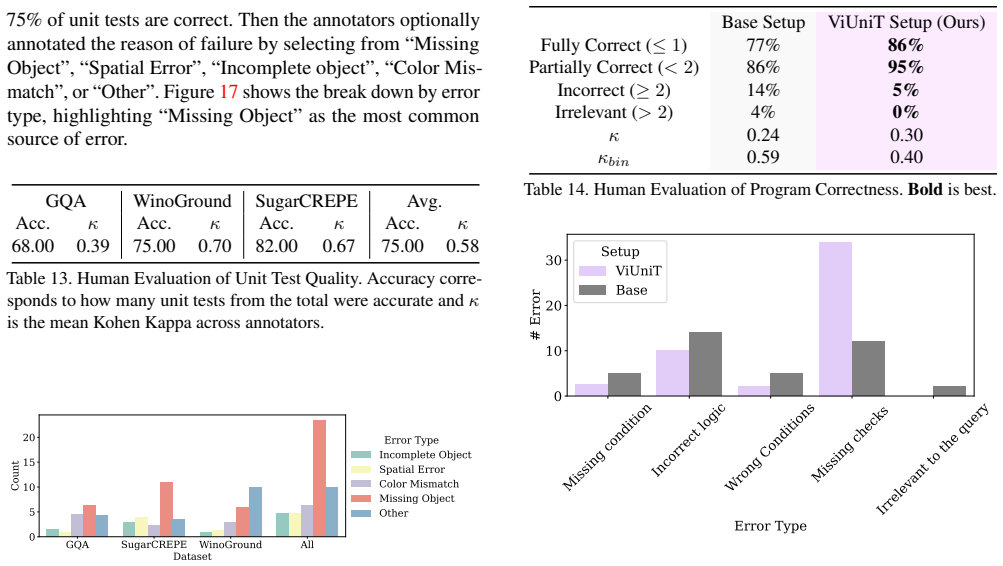
The load-bearing premise is that a synthetic image with an LLM-written expected answer is a reliable oracle for whether a program will answer correctly on real images; the paper's own human evaluation puts unit-test accuracy at only 75%, so roughly a quarter of the scoring signal is wrong.
Editorial extensions
If this is right
- Frozen-LLM accuracy on GQA, Winoground, and SugarCREPE rises by 11.4 percentage points over the single-program baseline when the best of five programs is chosen by unit-test scores.
- The same scoring signal, used as an unsupervised RL reward, outperforms a supervised correctness reward by 1.3 points on average and lowers program error rates for both 7B generators.
- Re-prompting with unit-test feedback beats re-prompting with error traces by 7.5 points on average, and threshold-based refusal reaches up to 0.8 F1 in declining to answer with weak programs.
- Human evaluation of selected GQA programs shows fully-correct programs rising from 77% to 86% and completely incorrect programs falling from 14% to 5%.
- Coverage sampling by answer-then-input and query-only unit-test generation are the configurations the paper identifies as most effective, giving a concrete recipe for future visual-programming systems.
Reading between the lines
- Because the unit-test oracle is only 75% accurate by the paper's own human evaluation, the reported gains likely understate what a cleaner test generator could achieve; adding a verification step that filters captions and expected answers through a vision-language model or a second LLM is a direct extension.
- Because the reward signal needs no ground-truth labels, the same recipe could transfer to other settings where programs operate on images — robotics instructions, document layout reasoning, or GUI automation — as long as tests can be rendered and expected answers checked automatically.
- The paper's finding that implementation-independent unit tests work better in high-resource settings mirrors classical software-testing doctrine; in practice, users should avoid over-fitting tests to one candidate program.
- Diffusion artifacts, especially spatial relations, are the most plausible failure source; the layout-conditioned diffusion advantage for spatial questions suggests that controlling object positions in generated test images is the direction to harden the oracle.
Editorial analysis
A structured set of objections, weighed in public.
Referee Report
Summary. The paper proposes ViUniT, a framework that automatically generates visual unit tests—synthetic images paired with expected answers—to score candidate visual programs produced by an LLM. Unit tests are created by prompting an LLM for image captions and expected answers, selecting a diverse subset via a coverage sampler, and rendering images with text-to-image diffusion models. The unit-test score S(p) (Eq. 6) is then used for four applications: best-program selection, answer refusal, re-prompting, and an unsupervised RL reward. Experiments on GQA, Winoground, and SugarCREPE with CodeLlama-7B and CodeGemma-7B report average gains of 11.4 accuracy points over the base one-program setup, and 7.7 points over gpt-4o-mini, with a claimed 40% reduction in programs that are correct for the wrong reasons.
Significance. If the results hold, the paper offers a practical, unsupervised way to improve visual program synthesis without training labels: unit-test-based selection consistently helps across two program generators and three datasets, and the RL reward outperforms a supervised correctness reward. The paper deserves credit for a broad ablation of unit-test generation strategies (number of tests, sampling methods, image generators, error penalties, aggregators), for openly reporting human evaluations of both unit-test quality and program correctness, and for testing generalization of the RL policy to VQAv2 and OK-VQA. However, the significance is tempered by the paper's own evidence that the unit-test oracle is only about 75% correct (68% on GQA) with low annotator agreement, and by several internal inconsistencies in reported motivation and ablation numbers.
major comments (3)
- [§1 and Appendix H.2] The motivating statistic is internally inconsistent. The abstract and §1 state that when models answer correctly they produce incorrect programs 33% of the time, and that a human evaluation of 100 CodeLlama-7B programs on GQA found only 33% correct. Appendix H.2 (Table 14) reports for the same base setup 77% 'Fully Correct (≤1)', 86% 'Partially Correct (<2)', and only 14% 'Incorrect (≥2)'. These numbers cannot both be true under the rubric described. Please reconcile the two statistics, report the exact rubric (including the overlap between 'Fully Correct' and 'Partially Correct'), and state the sample size per setup in the H.2 evaluation.
- [Appendix H.1, Eq. (6), and §3.4] The unit-test oracle is the only scoring signal for all four applications, but its quality is reported as 75% correct overall and 68% on GQA, with mean Cohen's κ = 0.58 (0.39 on GQA). Because the expected answers and synthetic images are generated without grounding, a non-negligible fraction of tests is wrong, and the errors may be systematic (e.g., 'Missing Object' dominates in Fig. 17). The paper should demonstrate that program ranking is robust to oracle noise: for example, report ViUniT accuracy after excluding unit tests flagged as incorrect by annotators, add random label noise to the expected answers and measure accuracy degradation, and show that selected programs in Table 1 do not simply match synthetic-image artifacts. Without such an analysis, the claimed gains could partly reflect selection on faulty tests rather than improved program correctness.
- [Appendix H.2 and §7] The program-correctness human evaluation supporting the 'reduces right-for-wrong-reasons by 40%' claim is reported with very low inter-annotator agreement (κ = 0.24 for base and κ = 0.30 for ViUniT; κ_bin = 0.59 and 0.40), and the manuscript does not state how many programs were annotated per setup. The 86% versus 77% difference is small relative to this disagreement. Please provide per-annotator score distributions, the exact rubric, and agreement measures for the correctness categories.
minor comments (5)
- [§4.1 and Appendix A] Section 4.1 states testing on 502 GQA balanced-val examples and training on 1022 balanced-train examples, while Appendix A reverses these labels. Please correct the Appendix.
- [F.3.2, Table 8] The text says a second re-prompting iteration yields a slight drop, but Table 8's averages increase for both models (CodeLlama 48.74→49.01, CodeGemma 47.38→47.49). Please correct the claim or clarify which numbers are meant.
- [§3.2.2, Algorithm 1] The 'Coverage by Answer' step is only well-defined when the number of distinct answers is at most K; if |Y| > K, Algorithm 1 would select more than K tests. Please state the intended behavior when K is smaller than the number of answers.
- [§5, Figure 6] The final configuration uses query-only unit tests, but Figures 1 and 3 and Section 3.2.1 define ψ(q,p) with the program as input. Please clarify in the main text that query-only is the final choice and that implementation-conditioned tests are an ablation.
- [§3.3, Eq. (5), and §3.4] The individual scorer h returns negative penalties for compilation and runtime errors, so S(p) in Eq. (6) can be negative; Equation (10) then uses S(p) as a reward. Please specify how negative scores are handled in the RL reward and in the θ threshold.
Circularity Check
No significant circularity: ViUniT's unit tests are an independent proxy, not a fitted target; the 75%-correct oracle caveat is a validity risk, not a derivation-level circularity.
full rationale
I found no equation-level circularity. The final unit-test configuration is query-only (Section 5, Figure 6: "disregarding implementation details proves significantly more effective"), so the tests are not generated from the program being scored. Expected answers come from a separate LLM (Meta-Llama-3-8B-Instruct) via caption/answer generation (Sections 3.2.1, D.1), and images come from diffusion models (Section 3.2.3); no constant is fitted to benchmark labels. Equations 5-6 define S(p) as a unit-test proxy, and Equation 6 is used to approximate Equation 1; the reported accuracy is measured against held-out ground truth, not against S(p), so selection does not make the target equal to the proxy. The RL reward (Equation 10) is likewise an optimization signal evaluated against external labels. Hyperparameters (K, theta, eps, sampling method, image generator) are tuned on small development subsets (Section 5), not on test labels. The only self-citations ([28], [37]) appear in related-work and API-model lists and are not load-bearing for the central claim. Appendix H.1/Table 13 shows only 75% of unit tests are correct, and Limitations I.1 concedes the method "does not provide a formal guarantee of logical correctness"; these are validity/robustness concerns about the oracle, not evidence that a prediction reduces by construction to a fitted input. I therefore score at most 2 for minor non-load-bearing self-citation, with no circular steps.
Assumptions & free parameters
free parameters (4)
- error penalty epsilon =
0.1
- pass threshold theta =
0.7 for refusal/reprompting, 0.8 for RL
- number of unit tests K =
5
- number of candidate programs N =
5
assumptions (5)
- domain assumption Synthetic images generated by diffusion models faithfully reflect the caption and the expected answer for the query
- domain assumption LLM-generated captions and expected answers provide a correct oracle for unit tests
- ad hoc to paper Coverage of caption embeddings approximates coverage of visual inputs
- ad hoc to paper Goodhart's-law regret bound applies to the proxy unit-test reward
- domain assumption The ImagePatch execution engine behaves on synthetic images as on real images
Cite this review
Pith. "Pith review of ViUniT: Visual Unit Tests for More Robust Visual Programming." pith.science (2026). https://pith.science/paper/EVZ6QCZX
@misc{pith2026241208859,
  author       = {Pith},
  title        = {Pith review of: ViUniT: Visual Unit Tests for More Robust Visual Programming},
  year         = {2026},
  howpublished = {\url{https://pith.science/paper/EVZ6QCZX}},
  note         = {Machine review of arXiv:2412.08859}
}
read the original abstract
Programming based approaches to reasoning tasks have substantially expanded the types of questions models can answer about visual scenes. Yet on benchmark visual reasoning data, when models answer correctly, they produce incorrect programs 33% of the time. These models are often right for the wrong reasons and risk unexpected failures on new data. Unit tests play a foundational role in ensuring code correctness and could be used to repair such failures. We propose Visual Unit Testing (ViUniT), a framework to improve the reliability of visual programs by automatically generating unit tests. In our framework, a unit test is represented as a novel image and answer pair meant to verify the logical correctness of a program produced for a given query. Our method leverages a language model to create unit tests in the form of image descriptions and expected answers and image synthesis to produce corresponding images. We conduct a comprehensive analysis of what constitutes an effective visual unit test suite, exploring unit test generation, sampling strategies, image generation methods, and varying the number of programs and unit tests. Additionally, we introduce four applications of visual unit tests: best program selection, answer refusal, re-prompting, and unsupervised reward formulations for reinforcement learning. Experiments with two models across three datasets in visual question answering and image-text matching demonstrate that ViUniT improves model performance by 11.4%. Notably, it enables 7B open-source models to outperform gpt-4o-mini by an average of 7.7% and reduces the occurrence of programs that are correct for the wrong reasons by 40%.
Figures


Figures from the paper (13 more)




Reference graph
Works this paper leans on
-
[1]
Josh Achiam, Steven Adler, Sandhini Agarwal, Lama Ahmad, Ilge Akkaya, Florencia Leoni Aleman, Diogo Almeida, Janko Altenschmidt, Sam Altman, Shyamal Anadkat, et al. Gpt-4 technical report. arXiv preprint arXiv:2303.08774, 2023. 2, 6
arXiv 2023
-
[2]
A3test: Assertion-augmented automated test case gen- eration
Saranya Alagarsamy, Chakkrit Tantithamthavorn, and Aldeida Aleti. A3test: Assertion-augmented automated test case gen- eration. Information and Software Technology, 176:107565,
-
[3]
Rohan Anil, Andrew M Dai, Orhan Firat, Melvin John- son, Dmitry Lepikhin, Alexandre Passos, Siamak Shakeri, Emanuel Taropa, Paige Bailey, Zhifeng Chen, et al. Palm 2 technical report. arXiv preprint arXiv:2305.10403, 2023. 2
arXiv 2023
-
[4]
Language models are few-shot learners
Tom Brown, Benjamin Mann, Nick Ryder, Melanie Sub- biah, Jared D Kaplan, Prafulla Dhariwal, Arvind Neelakantan, Pranav Shyam, Girish Sastry, Amanda Askell, et al. Language models are few-shot learners. Advances in neural information processing systems, 33:1877–1901, 2020. 2
1901
-
[5]
Codet: Code gen- eration with generated tests
Bei Chen, Fengji Zhang, Anh Nguyen, Daoguang Zan, Zeqi Lin, Jian-Guang Lou, and Weizhu Chen. Codet: Code gen- eration with generated tests. In The Eleventh International Conference on Learning Representations, 2023. 1, 3
2023
-
[6]
InstructBLIP: Towards general-purpose vision-language models with instruction tuning
Wenliang Dai, Junnan Li, Dongxu Li, Anthony Tiong, Junqi Zhao, Weisheng Wang, Boyang Li, Pascale Fung, and Steven Hoi. InstructBLIP: Towards general-purpose vision-language models with instruction tuning. In Thirty-seventh Conference on Neural Information Processing Systems, 2023. 3
2023
-
[7]
StepCoder: Improving code generation with reinforcement learning from compiler feedback
Shihan Dou, Yan Liu, Haoxiang Jia, Enyu Zhou, Limao Xiong, Junjie Shan, Caishuang Huang, Xiao Wang, Xiao- ran Fan, Zhiheng Xi, Yuhao Zhou, Tao Ji, Rui Zheng, Qi Zhang, Tao Gui, and Xuanjing Huang. StepCoder: Improving code generation with reinforcement learning from compiler feedback. In Proceedings of the 62nd Annual Meeting of the Association for Comput...
2024
-
[8]
Abhimanyu Dubey, Abhinav Jauhri, Abhinav Pandey, Ab- hishek Kadian, Ahmad Al-Dahle, Aiesha Letman, Akhil Mathur, Alan Schelten, Amy Yang, Angela Fan, et al. The llama 3 herd of models. arXiv preprint arXiv:2407.21783,
Show all 116 references
-
[9]
Clova: A closed-loop visual assistant with tool usage and update
Zhi Gao, Yuntao Du, Xintong Zhang, Xiaojian Ma, Wenjuan Han, Song-Chun Zhu, and Qing Li. Clova: A closed-loop visual assistant with tool usage and update. Conference on Computer Vision and Pattern Recognition (CVPR), 2024. 2
2024
-
[10]
Recursive visual programming
Jiaxin Ge, Sanjay Subramanian, Baifeng Shi, Roei Herzig, and Trevor Darrell. Recursive visual programming. In Euro- pean Conference on Computer Vision, pages 1–18. Springer,
-
[11]
Making the v in vqa matter: Elevating the role of image understanding in visual question answering
Yash Goyal, Tejas Khot, Douglas Summers-Stay, Dhruv Batra, and Devi Parikh. Making the v in vqa matter: Elevating the role of image understanding in visual question answering. In Proceedings of the IEEE conference on computer vision and pattern recognition, pages 6904–6913, 2017. 17
2017
-
[12]
An initial investigation of chatgpt unit test generation capability
Vitor Guilherme and Auri Vincenzi. An initial investigation of chatgpt unit test generation capability. In Proceedings of the 8th Brazilian Symposium on Systematic and Automated Software Testing, pages 15–24, 2023. 1, 3
2023
-
[13]
Deepseek-coder: When the large language model meets programming–the rise of code intelligence
Daya Guo, Qihao Zhu, Dejian Yang, Zhenda Xie, Kai Dong, Wentao Zhang, Guanting Chen, Xiao Bi, Yu Wu, YK Li, et al. Deepseek-coder: When the large language model meets programming–the rise of code intelligence. arXiv preprint arXiv:2401.14196, 2024. 2
2024 arXiv
-
[14]
Visual program- ming: Compositional visual reasoning without training
Tanmay Gupta and Aniruddha Kembhavi. Visual program- ming: Compositional visual reasoning without training. In Proceedings of the IEEE/CVF Conference on Computer Vi- sion and Pattern Recognition, pages 14953–14962, 2023. 1, 2, 6
2023
-
[15]
Image translation as diffusion visual programmers
Cheng Han, James Chenhao Liang, Qifan Wang, MAJID RABBANI, Sohail Dianat, Raghuveer Rao, Ying Nian Wu, and Dongfang Liu. Image translation as diffusion visual programmers. In The Twelfth International Conference on Learning Representations. 1, 2
-
[16]
Cogagent: A visual language model for gui agents
Wenyi Hong, Weihan Wang, Qingsong Lv, Jiazheng Xu, Wen- meng Yu, Junhui Ji, Yan Wang, Zihan Wang, Yuxiao Dong, Ming Ding, et al. Cogagent: A visual language model for gui agents. In Proceedings of the IEEE/CVF Conference on Com- puter Vision and Pattern Recognition, pages 14281–14290,
-
[17]
Sugarcrepe: Fixing hackable benchmarks for vision-language compositionality
Cheng-Yu Hsieh, Jieyu Zhang, Zixian Ma, Aniruddha Kem- bhavi, and Ranjay Krishna. Sugarcrepe: Fixing hackable benchmarks for vision-language compositionality. Advances in neural information processing systems, 36, 2024. 6, 12
2024
-
[18]
LoRA: Low-rank adaptation of large language models
Edward J Hu, yelong shen, Phillip Wallis, Zeyuan Allen- Zhu, Yuanzhi Li, Shean Wang, Lu Wang, and Weizhu Chen. LoRA: Low-rank adaptation of large language models. In International Conference on Learning Representations, 2022. 6
2022
-
[19]
Visual program distillation: Distilling tools and programmatic reasoning into vision-language models
Yushi Hu, Otilia Stretcu, Chun-Ta Lu, Krishnamurthy Viswanathan, Kenji Hata, Enming Luo, Ranjay Krishna, and Ariel Fuxman. Visual program distillation: Distilling tools and programmatic reasoning into vision-language models. In Proceedings of the IEEE/CVF Conference on Compute...
2024
-
[20]
Gqa: A new dataset for real-world visual reasoning and compositional question answering
Drew A Hudson and Christopher D Manning. Gqa: A new dataset for real-world visual reasoning and compositional question answering. In Proceedings of the IEEE/CVF con- ference on computer vision and pattern recognition , pages 6700–6709, 2019. 1, 6, 12
2019
-
[21]
Mistral 7b
Albert Q Jiang, Alexandre Sablayrolles, Arthur Mensch, Chris Bamford, Devendra Singh Chaplot, Diego de las Casas, Flo- rian Bressand, Gianna Lengyel, Guillaume Lample, Lucile Saulnier, et al. Mistral 7b. arXiv preprint arXiv:2310.06825,
-
[22]
Goodhart’s law in reinforcement learning
Jacek Karwowski, Oliver Hayman, Xingjian Bai, Klaus Kiendlhofer, Charlie Griffin, and Joar Max Viktor Skalse. Goodhart’s law in reinforcement learning. In The Twelfth International Conference on Learning Representations. 5
-
[23]
Self-training large language models for improved visual program synthesis with visual reinforce- ment
Zaid Khan, Vijay Kumar BG, Samuel Schulter, Yun Fu, and Manmohan Chandraker. Self-training large language models for improved visual program synthesis with visual reinforce- ment. In Proceedings of the IEEE/CVF Conference on Com- puter Vision and Pattern Recognition, pages 143...
-
[24]
Unit Testing Principles, Practices, and Patterns
Vladimir Khorikov. Unit Testing Principles, Practices, and Patterns. Simon and Schuster, 2020. 4
2020
-
[25]
PropTest: Automatic property testing for improved visual programming
Jaywon Koo, Ziyan Yang, Paola Cascante-Bonilla, Baishakhi Ray, and Vicente Ordonez. PropTest: Automatic property testing for improved visual programming. In Findings of the Association for Computational Linguistics: EMNLP 2024 , pages 8241–8256, Miami, Florida, USA, 2024. Asso...
2024
-
[26]
Efficient memory management for large lan- guage model serving with pagedattention
Woosuk Kwon, Zhuohan Li, Siyuan Zhuang, Ying Sheng, Lianmin Zheng, Cody Hao Yu, Joseph Gonzalez, Hao Zhang, and Ion Stoica. Efficient memory management for large lan- guage model serving with pagedattention. In Proceedings of the 29th Symposium on Operating Systems Principles,...
2023
-
[27]
CodeRL: Mastering code gen- eration through pretrained models and deep reinforcement learning
Hung Le, Yue Wang, Akhilesh Deepak Gotmare, Silvio Savarese, and Steven Hoi. CodeRL: Mastering code gen- eration through pretrained models and deep reinforcement learning. In Advances in Neural Information Processing Sys- tems, 2022. 2, 3
2022
-
[28]
Blip- 2: Bootstrapping language-image pre-training with frozen image encoders and large language models
Junnan Li, Dongxu Li, Silvio Savarese, and Steven Hoi. Blip- 2: Bootstrapping language-image pre-training with frozen image encoders and large language models. In International conference on machine learning, pages 19730–19742. PMLR,
-
[29]
Synthesize step-by-step: Tools templates and llms as data generators for reasoning-based chart vqa
Zhuowan Li, Bhavan Jasani, Peng Tang, and Shabnam Ghadar. Synthesize step-by-step: Tools templates and llms as data generators for reasoning-based chart vqa. In Proceedings of the IEEE/CVF Conference on Computer Vision and Pattern Recognition, pages 13613–13623, 2024. 1, 2
2024
-
[30]
LLM- grounded diffusion: Enhancing prompt understanding of text- to-image diffusion models with large language models.Trans- actions on Machine Learning Research, 2024
Long Lian, Boyi Li, Adam Yala, and Trevor Darrell. LLM- grounded diffusion: Enhancing prompt understanding of text- to-image diffusion models with large language models.Trans- actions on Machine Learning Research, 2024. Featured Cer- tification. 5
2024
-
[31]
Visual instruction tuning
Haotian Liu, Chunyuan Li, Qingyang Wu, and Yong Jae Lee. Visual instruction tuning. Advances in neural information processing systems, 36, 2024. 3
2024
-
[32]
Grounding dino: Marrying dino with grounded pre-training for open-set object detection
Shilong Liu, Zhaoyang Zeng, Tianhe Ren, Feng Li, Hao Zhang, Jie Yang, Chunyuan Li, Jianwei Yang, Hang Su, Jun Zhu, et al. Grounding dino: Marrying dino with grounded pre-training for open-set object detection. In European Con- ference on Computer Vision. Springer, 2024. 6, 12
2024
-
[33]
The flan collection: Designing data and methods for effective instruction tuning
Shayne Longpre, Le Hou, Tu Vu, Albert Webson, Hyung Won Chung, Yi Tay, Denny Zhou, Quoc V Le, Barret Zoph, Jason Wei, et al. The flan collection: Designing data and methods for effective instruction tuning. In International Conference on Machine Learning, pages 22631–22648. PM...
2023
-
[34]
Chameleon: Plug-and-play compositional reasoning with large language models
Pan Lu, Baolin Peng, Hao Cheng, Michel Galley, Kai-Wei Chang, Ying Nian Wu, Song-Chun Zhu, and Jianfeng Gao. Chameleon: Plug-and-play compositional reasoning with large language models. Advances in Neural Information Processing Systems, 36, 2024. 2
2024
-
[35]
Ok-vqa: A visual question answering benchmark requiring external knowledge
Kenneth Marino, Mohammad Rastegari, Ali Farhadi, and Roozbeh Mottaghi. Ok-vqa: A visual question answering benchmark requiring external knowledge. In Proceedings of the IEEE/cvf conference on computer vision and pattern recognition, pages 3195–3204, 2019. 17
2019
-
[36]
Xgen-7b technical report
Erik Nijkamp, Tian Xie, Hiroaki Hayashi, Bo Pang, Congying Xia, Chen Xing, Jesse Vig, Semih Yavuz, Philippe Laban, Ben Krause, et al. Xgen-7b technical report. arXiv preprint arXiv:2309.03450, 2023. 2
2023 arXiv
-
[37]
X-instructblip: A framework for aligning x-modal instruction-aware representations to llms and emergent cross-modal reasoning
Artemis Panagopoulou, Le Xue, Ning Yu, Junnan Li, Dongxu Li, Shafiq Joty, Ran Xu, Silvio Savarese, Caiming Xiong, and Juan Carlos Niebles. X-instructblip: A framework for aligning x-modal instruction-aware representations to llms and emergent cross-modal reasoning. In Proceedi...
2024
-
[38]
SDXL: Improving latent diffusion models for high-resolution image synthesis
Dustin Podell, Zion English, Kyle Lacey, Andreas Blattmann, Tim Dockhorn, Jonas M¨uller, Joe Penna, and Robin Rombach. SDXL: Improving latent diffusion models for high-resolution image synthesis. In The Twelfth International Conference on Learning Representations, 2024. 5
2024
-
[39]
Learning transferable visual models from natural language supervi- sion
Alec Radford, Jong Wook Kim, Chris Hallacy, Aditya Ramesh, Gabriel Goh, Sandhini Agarwal, Girish Sastry, Amanda Askell, Pamela Mishkin, Jack Clark, et al. Learning transferable visual models from natural language supervi- sion. In International conference on machine learning, ...
2021
-
[40]
High-resolution image synthesis with latent diffusion models
Robin Rombach, Andreas Blattmann, Dominik Lorenz, Patrick Esser, and Bj ¨orn Ommer. High-resolution image synthesis with latent diffusion models. In Proceedings of the IEEE/CVF Conference on Computer Vision and Pattern Recognition (CVPR), pages 10684–10695, 2022. 3, 5
2022
-
[41]
Code llama: Open foundation models for code
Baptiste Roziere, Jonas Gehring, Fabian Gloeckle, Sten Sootla, Itai Gat, Xiaoqing Ellen Tan, Yossi Adi, Jingyu Liu, Tal Remez, J´er´emy Rapin, et al. Code llama: Open foundation models for code. arXiv preprint arXiv:2308.12950, 2023. 1, 2, 6
2023 arXiv
-
[42]
Toolformer: Lan- guage models can teach themselves to use tools
Timo Schick, Jane Dwivedi-Yu, Roberto Dess `ı, Roberta Raileanu, Maria Lomeli, Eric Hambro, Luke Zettlemoyer, Nicola Cancedda, and Thomas Scialom. Toolformer: Lan- guage models can teach themselves to use tools. Advances in Neural Information Processing Systems, 36, 2024. 2
2024
-
[43]
Squinting at vqa models: Introspecting vqa models with sub-questions
Ramprasaath R Selvaraju, Purva Tendulkar, Devi Parikh, Eric Horvitz, Marco Tulio Ribeiro, Besmira Nushi, and Ece Ka- mar. Squinting at vqa models: Introspecting vqa models with sub-questions. In Proceedings of the IEEE/CVF Conference on Computer Vision and Pattern Recognition,...
2020
-
[44]
Pangu-coder2: Boosting large lan- guage models for code with ranking feedback
Bo Shen, Jiaxin Zhang, Taihong Chen, Daoguang Zan, Bing Geng, An Fu, Muhan Zeng, Ailun Yu, Jichuan Ji, Jingyang Zhao, et al. Pangu-coder2: Boosting large lan- guage models for code with ranking feedback. arXiv preprint arXiv:2307.14936, 2023. 3
2023 arXiv
-
[45]
Execution-based code generation using deep reinforcement learning
Parshin Shojaee, Aneesh Jain, Sindhu Tipirneni, and Chan- dan K Reddy. Execution-based code generation using deep reinforcement learning. Transactions on Machine Learning Research. 3
-
[46]
Ex- ploring the effectiveness of large language models in gener- ating unit tests
Mohammed Latif Siddiq, Joanna Santos, Ridwanul Hasan Tanvir, Noshin Ulfat, FA Rifat, and V Carvalho Lopes. Ex- ploring the effectiveness of large language models in gener- ating unit tests. arXiv preprint arXiv:2305.00418, 2023. 1, 3
2023 arXiv
-
[47]
10 Towards vqa models that can read
Amanpreet Singh, Vivek Natarajan, Meet Shah, Yu Jiang, Xin- lei Chen, Dhruv Batra, Devi Parikh, and Marcus Rohrbach. 10 Towards vqa models that can read. In Proceedings of the IEEE/CVF conference on computer vision and pattern recog- nition, pages 8317–8326, 2019. 2
2019
-
[48]
Towards truly zero-shot compositional visual reasoning with llms as programmers
Aleksandar Stani ´c, Sergi Caelles, and Michael Tschannen. Towards truly zero-shot compositional visual reasoning with llms as programmers. Transactions on Machine Learning Research. 1, 3
-
[49]
Vipergpt: Vi- sual inference via python execution for reasoning
D´ıdac Sur´ıs, Sachit Menon, and Carl V ondrick. Vipergpt: Vi- sual inference via python execution for reasoning. InProceed- ings of the IEEE/CVF International Conference on Computer Vision, pages 11888–11898, 2023. 1, 2, 6, 12
2023
-
[50]
Tdd without tears: Towards test case generation from requirements through deep rein- forcement learning
Wannita Takerngsaksiri, Rujikorn Charakorn, Chakkrit Tan- tithamthavorn, and Yuan-Fang Li. Tdd without tears: Towards test case generation from requirements through deep rein- forcement learning. arXiv preprint arXiv:2401.07576, 2024. 1, 3
2024 arXiv
-
[51]
Codegemma: Open code models based on gemma
CodeGemma Team. Codegemma: Open code models based on gemma. arXiv preprint arXiv:2406.11409, 2024. 2, 6
2024 arXiv
-
[52]
Winoground: Probing vision and language models for visio- linguistic compositionality
Tristan Thrush, Ryan Jiang, Max Bartolo, Amanpreet Singh, Adina Williams, Douwe Kiela, and Candace Ross. Winoground: Probing vision and language models for visio- linguistic compositionality. In 2022 IEEE/CVF Conference on Computer Vision and Pattern Recognition (CVPR), pages ...
2022
-
[53]
Llama: Open and efficient foundation language models.arXiv preprint arXiv:2302.13971, 2023
Hugo Touvron, Thibaut Lavril, Gautier Izacard, Xavier Mar- tinet, Marie-Anne Lachaux, Timoth ´ee Lacroix, Baptiste Rozi`ere, Naman Goyal, Eric Hambro, Faisal Azhar, et al. Llama: Open and efficient foundation language models.arXiv preprint arXiv:2302.13971, 2023. 2
2023 arXiv
-
[54]
Llama 2: Open foundation and fine-tuned chat models
Hugo Touvron, Louis Martin, Kevin Stone, Peter Albert, Am- jad Almahairi, Yasmine Babaei, Nikolay Bashlykov, Soumya Batra, Prajjwal Bhargava, Shruti Bhosale, et al. Llama 2: Open foundation and fine-tuned chat models. arXiv preprint arXiv:2307.09288, 2023. 2
2023 arXiv
-
[55]
Adacoder: Adaptive prompt compression for programmatic visual question answering
Mahiro Ukai, Shuhei Kurita, Atsushi Hashimoto, Yoshitaka Ushiku, and Nakamasa Inoue. Adacoder: Adaptive prompt compression for programmatic visual question answering. In Proceedings of the 32nd ACM International Conference on Multimedia, pages 9234–9243, 2024. 2
2024
-
[56]
Minilm: Deep self-attention distillation for task-agnostic compression of pre-trained transformers
Wenhui Wang, Furu Wei, Li Dong, Hangbo Bao, Nan Yang, and Ming Zhou. Minilm: Deep self-attention distillation for task-agnostic compression of pre-trained transformers. Advances in Neural Information Processing Systems, 33:5776– 5788, 2020. 6
2020
-
[57]
Editable scene simulation for autonomous driving via collaborative llm- agents
Yuxi Wei, Zi Wang, Yifan Lu, Chenxin Xu, Changxing Liu, Hao Zhao, Siheng Chen, and Yanfeng Wang. Editable scene simulation for autonomous driving via collaborative llm- agents. In Proceedings of the IEEE/CVF Conference on Com- puter Vision and Pattern Recognition, pages 15077–15087,
-
[58]
An empirical study of gpt-3 for few-shot knowledge-based vqa
Zhengyuan Yang, Zhe Gan, Jianfeng Wang, Xiaowei Hu, Yumao Lu, Zicheng Liu, and Lijuan Wang. An empirical study of gpt-3 for few-shot knowledge-based vqa. In Proceedings of the AAAI conference on artificial intelligence, pages 3081– 3089, 2022
2022
-
[59]
two humans and one wheel
Zhengyuan Yang, Linjie Li, Jianfeng Wang, Kevin Lin, Ehsan Azarnasab, Faisal Ahmed, Zicheng Liu, Ce Liu, Michael Zeng, and Lijuan Wang. Mm-react: Prompting chat- gpt for multimodal reasoning and action. arXiv preprint arXiv:2303.11381, 2023. 2 11 A. Data The three compositiona...
2023 arXiv
-
[66]
A modern living room featuring sleek furniture and devoid of any pets
Image Caption: "A modern living room featuring sleek furniture and devoid of any pets" Answer: no Query: Is there a red truck or bus in the image? Tests:
-
[69]
A large blue semi-truck cruising down an interstate highway
Image Caption: "A large blue semi-truck cruising down an interstate highway" Answer: no 33
-
[73]
Several bright yellow school buses parked in a row at a local school
Image Caption: "Several bright yellow school buses parked in a row at a local school" Answer: no Query: What color is the largest car in the image? Tests:
-
[77]
A scene with a green public bus next to a smaller blue pickup at an intersection
Image Caption: "A scene with a green public bus next to a smaller blue pickup at an intersection" Answer: green Query: Is the vase to the left or right of the center? Tests:
-
[80]
A ceramic vase centrally placed on a round table surrounded by chairs
Image Caption: "A ceramic vase centrally placed on a round table surrounded by chairs" Answer: center Query: What is the highest object in the image? Tests:
-
[86]
A figure standing on the peak of a grassy hill under a blue sky
Image Caption: "A figure standing on the peak of a grassy hill under a blue sky" Answer: person Query: INSERT_QUERY_HERE Tests: Listing 7. ITM Unit Test Generation In Context Examples Query: Is the drawing of a tree on the hill, and a river that flows at the bottom of the hill? Tests:
-
[87]
A solitary tree stands atop a gentle hill, with a flowing river winding below it
Image Caption: "A solitary tree stands atop a gentle hill, with a flowing river winding below it." Answer: yes
-
[88]
A tree on a grassy hill under a clear sky
Image Caption: "A tree on a grassy hill under a clear sky." Answer: no
-
[89]
A river meandering through a dense forest of tall trees
Image Caption: "A river meandering through a dense forest of tall trees." Answer: no
-
[90]
A panoramic view of rolling hills in the desert, with a river at the bottom
Image Caption: "A panoramic view of rolling hills in the desert, with a river at the bottom." Answer: no
-
[91]
A vast plain with a river running through fields of wildflowers
Image Caption: "A vast plain with a river running through fields of wildflowers." Answer: no
-
[92]
A hill with multiple trees and a river flowing nearby
Image Caption: Image Caption: "A hill with multiple trees and a river flowing nearby." Answer: yes Query: Is the drawing of an airplane flying in the sky, and birds flying below it? Tests:
-
[93]
An airplane soars through the sky, with a flock of birds flying beneath it
Image Caption: "An airplane soars through the sky, with a flock of birds flying beneath it." Answer: yes
-
[94]
Birds flying over a tranquil lake under a clear sky
Image Caption: "Birds flying over a tranquil lake under a clear sky." Answer: no
-
[95]
An airplane performing aerobatic maneuvers, with birds flying above it
Image Caption: "An airplane performing aerobatic maneuvers, with birds flying above it." Answer: no
-
[96]
An airplane floating in the sea with birds flying above it
Image Caption: "An airplane floating in the sea with birds flying above it." Answer: Yes
-
[97]
An airplane in a clear sky
Image Caption: "An airplane in a clear sky" Answer: no Query: Is the drawing of a girl holding an umbrella in the rain? Tests:
-
[98]
A girl holding an umbrella walks through a rainy street
Image Caption: "A girl holding an umbrella walks through a rainy street." Answer: yes
-
[99]
A girl holds an umbrella under a bright sun in the park
Image Caption: "A girl holds an umbrella under a bright sun in the park." Answer: no
-
[100]
A girl stands in the rain wearing a colorful raincoat and holding flowers
Image Caption: "A girl stands in the rain wearing a colorful raincoat and holding flowers." Answer: no
-
[101]
A girl walks her dog while holding an umbrella on a rainy day
Image Caption: "A girl walks her dog while holding an umbrella on a rainy day." Answer: yes Query: Is the drawing of a person sitting at a desk with a computer monitor in front of them? Tests:
-
[102]
A person sitting at a desk, writing in a notebook with a lamp beside them
Image Caption: "A person sitting at a desk, writing in a notebook with a lamp beside them." Answer: no
-
[104]
Someone sitting at a desk cluttered with papers and a computer monitor
Image Caption: "Someone sitting at a desk cluttered with papers and a computer monitor." Answer: yes
-
[105]
A person with a big computer screen in the background
Image Caption: "A person with a big computer screen in the background" Answer: no Query: Is the drawing of a man riding a bicycle, and a dog running beside him? Tests:
-
[106]
A man cycling alone on a mountain trail surrounded by trees
Image Caption: "A man cycling alone on a mountain trail surrounded by trees." Answer: no 34
-
[107]
A man rides a bicycle along the beach, his dog running beside him
Image Caption: "A man rides a bicycle along the beach, his dog running beside him." Answer: yes
-
[108]
A bicycle and a dog
Image Caption: "A bicycle and a dog" Answer: no
-
[109]
A dog next to a car
Image Caption: "A dog next to a car" Answer: no
-
[110]
A man walking his dog
Image Caption: "A man walking his dog" Answer: no
-
[111]
A man rides a bicycle down a sunny street with a dog running beside him
Image Caption: "A man rides a bicycle down a sunny street with a dog running beside him." Answer: yes Query: INSERT_QUERY_HERE Tests: Listing 8. VQA Unit Test Generation with Implementation In-Context Examples # Query: Is there a cat or dog in the image? def execute_command(im...
-
[112]
A grey tabby cat peacefully napping on a plush sofa
Image Caption: "A grey tabby cat peacefully napping on a plush sofa" Answer: yes
-
[113]
A lively golden retriever bounding across a grassy field in the park
Image Caption: "A lively golden retriever bounding across a grassy field in the park" Answer: yes
-
[114]
Twin Siamese cats playfully swatting at a bright yellow ball
Image Caption: "Twin Siamese cats playfully swatting at a bright yellow ball" Answer: yes
-
[115]
A cluster of wild horses trotting along the sandy shores of a sunlit beach
Image Caption: "A cluster of wild horses trotting along the sandy shores of a sunlit beach" Answer: no
-
[116]
An orange cat and a black Labrador playfully tugging on a rope toy
Image Caption: "An orange cat and a black Labrador playfully tugging on a rope toy" Answer: yes
-
[117]
A modern living room featuring sleek furniture and devoid of any pets
Image Caption: "A modern living room featuring sleek furniture and devoid of any pets" Answer: no # Query: Is there a red truck or bus in the image? def execute_command(image) -> str: image_patch = ImagePatch(image) trucks = image_patch.find("truck") buses = image_patch.find("...
-
[118]
A vibrant red Ford pickup parked beside a country road
Image Caption: "A vibrant red Ford pickup parked beside a country road" Answer: yes
-
[119]
A red double-decker bus navigating through a busy downtown street
Image Caption: "A red double-decker bus navigating through a busy downtown street" Answer: yes
-
[120]
A large blue semi-truck cruising down an interstate highway
Image Caption: "A large blue semi-truck cruising down an interstate highway" Answer: no
-
[121]
A quiet suburban street devoid of any large vehicles like buses or trucks
Image Caption: "A quiet suburban street devoid of any large vehicles like buses or trucks" Answer: no
-
[122]
A shiny red Ferrari speeding on a professional race track
Image Caption: "A shiny red Ferrari speeding on a professional race track" Answer: no
-
[123]
An array of red delivery trucks lined up in a distribution center parking lot
Image Caption: "An array of red delivery trucks lined up in a distribution center parking lot" Answer: yes
-
[124]
Several bright yellow school buses parked in a row at a local school
Image Caption: "Several bright yellow school buses parked in a row at a local school" Answer: no # Query: What color is the largest car in the image? def execute_command(image) -> str: image_patch = ImagePatch(image) car_patches = image_patch.find("car") if not car_patches: re...
-
[125]
A large blue Ford pickup truck driving on a busy highway
Image Caption: "A large blue Ford pickup truck driving on a busy highway" Answer: blue
-
[126]
A city street empty of any large vehicles like buses or trucks
Image Caption: "A city street empty of any large vehicles like buses or trucks" Answer: no answer
-
[127]
A row of green food trucks serving lunch in an urban park
Image Caption: "A row of green food trucks serving lunch in an urban park" Answer: green
-
[128]
A scene with a green public bus next to a smaller blue pickup at an intersection
Image Caption: "A scene with a green public bus next to a smaller blue pickup at an intersection" Answer: green # Query: Is the vase to the left or right of the center? def execute_command(image) -> str: image_patch = ImagePatch(image) vase_patches = image_patch.find("vase") i...
-
[129]
A delicate porcelain vase positioned on the right end of a mahogany dining table
Image Caption: "A delicate porcelain vase positioned on the right end of a mahogany dining table" Answer: right
-
[130]
A tall glass vase sitting on the left side of a neatly made bed in a sunlit room
Image Caption: "A tall glass vase sitting on the left side of a neatly made bed in a sunlit room" Answer: left
-
[131]
A ceramic vase centrally placed on a round table surrounded by chairs
Image Caption: "A ceramic vase centrally placed on a round table surrounded by chairs" Answer: center # Query: What is the highest object in the image? def execute_command(image) -> str: image_patch = ImagePatch(image) possible_objects = ["car", "tree", "building", "person", "...
-
[132]
A massive skyscraper dominating the skyline among lower city buildings
Image Caption: "A massive skyscraper dominating the skyline among lower city buildings" Answer: skyscraper
-
[133]
A lone oak tree surpassing the height of the cottage it stands next to
Image Caption: "A lone oak tree surpassing the height of the cottage it stands next to" Answer: tree
-
[134]
Colorful balloons drifting above the treetops in a clear sky
Image Caption: "Colorful balloons drifting above the treetops in a clear sky" Answer: balloons
-
[135]
A commercial jet flying high above the city’s tallest skyscrapers
Image Caption: "A commercial jet flying high above the city’s tallest skyscrapers" Answer: plane
-
[136]
A majestic eagle soaring high above a vast canyon landscape
Image Caption: "A majestic eagle soaring high above a vast canyon landscape" Answer: eagle
-
[137]
A figure standing on the peak of a grassy hill under a blue sky
Image Caption: "A figure standing on the peak of a grassy hill under a blue sky" Answer: person Create test cases for the specified query and program using the format provided in the examples. The test cases should consist of image captions and answers to the query. The answer...
-
[2024]
1, 3, 5, 6, 12, 17 9
Reviewed August 11, 2026 · model on record in the stance chip above.
Discussion (0). Continue with ORCID to comment.