REVIEW 4 major objections 6 minor 23 references
Exact islands scenario for CFT systems and critical ratios in higher geometry
T0 review · 4 major / 6 minor · reviewed 2026-08-16 · deepseek-v4-flash
Pith's one-line read For strip-shaped CFT_d systems with d>2, the paper derives an exact island entropy that resums all subleading 'iceberg' corrections, so the post-critical bath entropy obeys $S[B]=S(l)+S(2a)-S_{\mathrm{island}}$.
desk verdict The paper's 'exact island' formula for d>2 rests on an unproved mutual-information identity that likely fails in standard RT setups, so the island results are conditional at best; the critical-ratio algebra is neat but secondary. read the letter →
The pith
A machine-rendered reading of the paper's core claim, the machinery that carries it, and where it could break.
The reading
What carries the argument
The mechanism is the decomposition $S[B]=2S(b)-I(B:B)$, paired with the assumed mutual-information identity $I(B:B)=2S(2a+b)-S(l)-S(2a)$, where $S(x)$ is the holographic strip entropy of eq. (24). In the post-critical regime this identity is rearranged into $S[B]=S(l)+S(2a)-S_{\mathrm{island}}$. The resummation itself is carried by the finite geometric-series identity $1-(1+2s)^{-n}=2s\sum_{\alpha=1}^{n}(1+2s)^{-\alpha}$, which for $n=d-2$ converts the infinite iceberg expansion into one term proportional to $b^{2-d}$ and fixes the island boundary at $z=\bar b$. This machinery is what turns a perturbative expansion into an exact statement.
What would settle it
Compute the full bath-pair entropy $S[B]$ holographically for a CFT_3 strip with fixed total length $l$ and all bath sizes $b$, including connected RT surfaces; check whether the maximum occurs at the predicted $x_c\simeq0.88$ and whether $S[B]=S(l)+S(2a)-S_{\mathrm{island}}(a,b)$ holds past the maximum. A mismatch in either check, or the same test in CFT_4 with $x_c\simeq0.96$, would falsify the exact-island claim.
Extended reading notes
Core claim
On the paper's own terms, the claim is that for CFT_d strip systems with d>2, beyond the critical bath size the entanglement entropy of the symmetric two-part bath is exactly $$S[B]=S(l)+S(2a)-S_{\mathrm{island}}(a,b),$$ with $S_{\mathrm{island}} = \frac{L^{d-1}V^{(d-2)}}{(d-2)G_{d+1}}\,2^{d-2} b_0^{d-1} b^{2-d}(1-(1+2s)^{2-d})$ and $s=a/b$. This island term is positive, UV-finite, and encodes the resummed effect of all iceberg configurations, with its boundary located at the exact holographic coordinate $z=\bar b$ fixed by $1/\bar b^{d-1}=b^{1-d}\sum_{\alpha=1}^{d-2}(1+2s)^{-\alpha}$. The paper further establishes the post-critical identity $S[B]-S[A]=S_l-S_{\mathrm{island}}$ and the critical-ratio equation $1/x^{d-1}-1/(1+x)^{d-1}=1$, whose $d=2$ solution is the golden ratio and whose higher-dimensional solutions approach $1$.
Load-bearing premise
The load-bearing premise is that the mutual-information identity $I(B:B)=2S(2a+b)-S(l)-S(2a)$, exact for two intervals in two-dimensional CFT, continues to hold for CFT_d strip systems with $d>2$; the paper states this 'would be true at least for strip systems cases', but if it fails, the critical equation, the exact island formula, and the entropy-difference identity all collapse.
Editorial extensions
If this is right
- The falling branch of the bath-entropy Page curve becomes an exact algebraic statement: once $b$ exceeds the critical value, $S[B]$ is fully determined by $S(l)+S(2a)-S_{\mathrm{island}}$.
- The critical size ratio in $d$ dimensions satisfies $1/x^{d-1}-1/(1+x)^{d-1}=1$; for $d=2$ this is the golden ratio, for $d=3$ about $0.88$, for $d=4$ about $0.96$, approaching $1$ as $d$ grows.
- For far-separated bath strips, mutual information obeys $I(B_1:B_2)\propto b_1 b_2/D^d$ and is strictly positive for any finite separation.
- After the crossover, changes in the entropy difference $S[B]-S[A]$ are compensated one-to-one by the exact island entropy: $S[B]-S[A]=S_l-S_{\mathrm{island}}$.
- When the central system shrinks to the Kaluza-Klein scale, bath entropy becomes discrete, with jumps indexed by the number $n$ of strips exchanged.
Reading between the lines
- My inference: the geometric-series resummation is special to strip geometries; for spherical or disk-shaped subsystems the bath is connected and the same closed-form island location should not be expected.
- My inference: a direct numerical test of the assumed identity (26) in free CFT_3 or CFT_4 would be decisive; the first discrepancy, if any, should appear at subleading order in the island expansion.
- My inference: the critical equation has the form 'product equals difference' for $x^{d-1}$ and $(1+x)^{d-1}$; one could look for these algebraic numbers as extrema of other information measures, such as tripartite information, in the same geometry.
- My inference: the claim that $I(B:B)$ never vanishes implies a lower bound on residual correlation at any finite separation; this could be tested in a lattice simulation by measuring mutual information as a function of $D$ at fixed $b$.
Signed reviews
Editorial analysis
A structured set of objections, weighed in public.
Referee Report
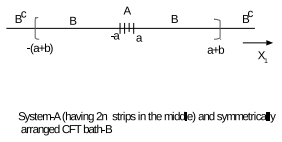
Summary. The paper considers a symmetric arrangement of two identical strip-shaped bath systems B on either side of a central system A in a CFT_d, with fixed total width l = 2a + 2b, and studies the bath entanglement entropy S[B] as a function of b. It claims that for d > 2 the bath entropy reaches a maximum at a 'critical ratio' satisfying a generalized Fibonacci-type equation (28), and that beyond this critical point the entropy can be written exactly as S[B] = S(l) + S(2a) - S_island(a,b), where S_island is a positive definite closed-form 'exact island' contribution (32) that resums all subleading 'iceberg' terms. It further claims an exact island location z = \bar b (37), a mutual-information law I(B:B) \propto b^2/D^d that never vanishes for finite systems (27), a post-critical identity S[B]-S[A] = S_l - S_island (52), and a discrete entropy spectrum when system-A approaches the Kaluza-Klein scale (Section 5). The central technical input is the mutual-information identity I(B:B) = 2S(2a+b) - S(l) - S(2a) in Eq. (26), which the paper assumes in footnote 7 for strip systems.
Significance. If Eq. (26) were correct, the paper would provide an unusually simple and explicit 'exact island' resummation in higher-dimensional CFTs, together with a family of generalized golden-ratio conditions and a concrete prediction for the mutual information of separated strips. The manuscript is transparent about its main assumption (footnote 7), states all algebraic steps explicitly, and supports its claims with detailed formulas and plots; the derivations from (26) to (32) and (52) are elementary and checkable. However, the significance is entirely conditional on (26), and the paper itself concedes that this identity is assumed rather than derived for d > 2. Because the subsequent exact-island results are algebraic consequences of (26), the central claim stands or falls on that identity, which the paper does not justify with a valid argument.
major comments (4)
- [Section 3, Eq. (26) and footnote 7] Equation (26), I(B:B) = 2S(2a+b) - S(l) - S(2a), is load-bearing: the critical equation (28), the exact island formula (32), the island location (37), and the identity (52) all follow algebraically from it once S(x) is given by the strip entropy (24). The manuscript's only defense is the statement in footnote 7 that the expression 'would be true at least for strip systems cases, as these can be reduced to 2-dim by compactification.' That reduction is not demonstrated and is doubtful: the strip entropy (24) has an area-law divergence V/\epsilon^{d-2} and a power-law finite term, whereas a compactified 2d CFT has logarithmic entropy and would produce Kaluza-Klein towers rather than the same theory. Since the paper presents no derivation of (26), all of the exact-island claims inherit a substantial unsupported premise.
- [Section 3, Eqs. (24)-(27) versus standard RT phase structure] Equation (26) appears to be inconsistent with the standard Ryu-Takayanagi phase structure for two disjoint strips in AdS_{d+1} with d > 2. For b \ll a, the disconnected RT surfaces anchored on the two individual strips give S[B] \approx 2S(b), so the mutual information is exponentially small in the holographic large-N limit and zero at the classical extremal-surface level, because connected surfaces have larger area and are not the minimum. In contrast, Eq. (26) combined with Eq. (24) yields the positive leading mutual information I(B:B) \simeq I_0 b^2/(2a)^d stated in Eq. (27). The paper does not explain how connected RT surfaces can dominate over disconnected ones when the separation 2a is much larger than the strip width b, and no minimality argument is given for (26). This is not merely a missing proof but a concrete conflict with the RT prescription on which the paper relies.
- [Section 6, Eq. (52)] The post-critical identity S[B] - S[A] = S_l - S_island is presented as an important result, but it is tautological. Equation (31) already defines S[B] as S(l) + S(2a) - S_island(a,b), and since S[A] = S(2a) is used throughout, Eq. (52) is obtained by simply subtracting S(2a) from both sides of (31). It therefore contains no independent physical content beyond the definition of S_island as the residual required to make (31) hold. The statement that 'changes in (S[B]-S[A]) would have to be compensated precisely by the islands entropy only' is a restatement of (31), not a new constraint. A genuine physical prediction would require an independent derivation of S_island from gravity or from a microscopic calculation, which is not provided.
- [Section 4 and Appendix A, Eqs. (38), (42), (54)] The gravitational interpretation of the exact island is selected by parameter choices rather than derived. The dictionary relating the CFT size a to the dilaton boundary value Φ_0 and the compactification radius R, e.g. a = πRΦ_0/(2^2 L b_0^2) in (38) and a = πRΦ_0/(2^2 L b_0^3) in (42), is introduced with coefficients chosen to match the algebraic expression (36). The appendix explicitly states that 'one may have to tune final relations with factors of 2 and π.' Because Φ_0 and R are free parameters and the numerical factors are adjustable, the claim that the island term (36) is the gravitational entropy of a boundary at z = \bar b is an interpretation imposed by matching, not a prediction derived from the setup. This weakens the claim that the island location (37) and (39) have independent geometric significance.
minor comments (6)
- [Throughout] The text contains numerous typographical spacing errors, including 'CF Td', 'syst em-A', and 'e-Print:' in references; these should be corrected.
- [Figures 3-10] The figures lack axis labels and units in most cases; for example, Figure 7 shows 'b0' on the horizontal axis but the text uses b as the variable, and the vertical axis is not described as S_bath until some later figures. Please clarify the plotted quantities and parameters.
- [Eq. (40)] The recurrence C_n = 2C_{n-1} + 1 with C_{-n} = 0 is confusingly stated; the range of n and the definition of C_0 should be made explicit, and the claim that 'C_0 = 1, C_{-n}=0' should be reconciled with the recurrence for n=0.
- [Section 5] The notation for the multi-strip entropy is inconsistent: Eq. (47) writes S[A]_{2n-strips}, while Eq. (50) labels the same quantity S[A]_{2n-strips} but the text refers to 'assembly of 2n narrow strips' and separately to 'n strips'. Please clarify whether n denotes the number of strips or half-strips.
- [Eq. (33)] The text says the inequality S(l) - |S[B]-S[A]| \geq 0 'turns into exact equality given by (31)', but (31) is not an equality involving S[A]; the logical connection between the inequality and the exact island formula should be spelled out.
- [References] Reference [20] appears not to be cited in the text; please check the citation list for completeness.
Circularity Check
The exact island formula and the post-critical identity (52) are algebraic restatements of the assumed mutual-information identity (26), not independent island calculations.
-
self definitional
[Section 4, equations (31)-(32), with inputs (24)-(26)]
"It is observed that beyond the critical point of the bath entropy, i.e. for sufficiently large bath pairs, it is always possible to rewrite the entropy (25) in following manner S[B] = S(l) + S(2a) − Sisland(a, b) (31) The last island term is exactly given by [eq. (32)]"
Inserting (25) and the assumed identity (26), S[B] = 2S(b) − I(B:B) = S(l) + S(2a) + 2S(b) − 2S(2a+b). With the strip formula (24), 2S(b) − 2S(2a+b) equals exactly minus the quoted RHS of (32). Thus S_island is the algebraic remainder that makes (31) hold by construction; no independent QES minimization or island extremization is performed. Equations (36)-(39) merely rewrite this remainder as Φ0/bar b^{d−1}, defining the 'island location' bar b through that rewrite, with constants matched afterward ('one may have to tune final relations with factors of 2 and π'). The exact-island claim therefore reduces to the assumed formula (26).
-
self definitional
[Section 6 (Summary and discussion), equation (52)]
"Since exact island contributions can be known we could write an identity involving equality of differences S[B] − S[A] = Sl − Sisland (52) whenever the bath system-B is sufficiently larger than system-A."
Throughout the paper S[A] is the entropy of the central system-A of width 2a, i.e., S[A] = S(2a). Equation (31) already states S[B] = S(l) + S(2a) − S_island. Subtracting S(2a) = S[A] from both sides gives S[B] − S[A] = S(l) − S_island verbatim. The identity (52) is therefore a restatement of the defining decomposition (31), carrying no additional independent content.
full rationale
The critical-ratio equation (28) and the mutual-information fall-off in (27) are genuine algebraic consequences of the explicit entropy formulas, assuming the mutual-information expression (26). They are not circular by themselves, although they inherit the paper's admitted assumption in footnote 7 ('We have assumed that I(B:B) expression is correct for CFT_d with d>2'); that is a correctness risk rather than a circularity. The circular core is the 'exact island scenario': eq. (32) is obtained by substituting (25)-(26) into the strip formula (24), so the exact island is the residual required to write S[B] in the form S(l)+S(2a)−S_island. The later identification of this residual with gravitational entropy of an island boundary at z=bar b is a parameter-matched rewriting, not a derivation from an independent extremization. Likewise (52) is eq. (31) with S[A]=S(2a). I did not raise the score further for the author's self-citations ([15],[16]): they supply vocabulary and a hybrid-construction context, but the algebraic identities stand on the equations quoted above, and there is no imported uniqueness theorem or machine-checked external result at stake. Score 6: some predictions reduce by construction, while the critical-ratio and MI sections retain independent algebraic content.
Assumptions & free parameters
free parameters (2)
- Phi0 (near-AdS dilaton boundary value) =
set via a equiv pi R Phi0/(2^2 L b0^2) in d=3 and analogous relations in d=4 (eqs 38, 42); Appendix A gives Phi0 = L…
- compactification radius R =
free scale used via a approx 2 pi R in the KK section
assumptions (5)
- standard math Ryu-Takayanagi strip entropy formula S(x) in eq (24) is taken from refs [18,19,21].
- domain assumption The total size l=2a+2b is fixed and conservation gives da/dt=-db/dt during any exchange between A and B.
- ad hoc to paper I(B:B)=2S(2a+b)-S(l)-S(2a) holds for CFT_d strips with d>2 (eq 26).
- ad hoc to paper Hybrid gravity dictionary: a ~ pi R Phi0/(L b0^(d-1)) and G_d=G_(d+1)/(2 pi R), with numerical factors to be tuned.
- ad hoc to paper When a approaches the KK scale, system-A is treated as n narrow strips wrapped on S1 with a ~ pi R n Phi0/(2 b0^2 L), n integer.
invented entities (2)
-
exact island boundary at z=bar b in near-AdS_d bulk
-
near-AdS_d (NAdS_d) hybrid gravity region replacing small system-A
Cite this review
Pith. "Pith review of Exact islands scenario for CFT systems and critical ratios in higher geometry." pith.science (2026). https://pith.science/paper/EWV6NALA
@misc{pith2026250501247,
  author       = {Pith},
  title        = {Pith review of: Exact islands scenario for CFT systems and critical ratios in higher geometry},
  year         = {2026},
  howpublished = {\url{https://pith.science/paper/EWV6NALA}},
  note         = {Machine review of arXiv:2505.01247}
}
abstract
We study $CFT_d$ systems which are in contact with each other and symmetrically arranged. The system-B is treated as bath that surrounds system-A in the middle. Our focus is to learn how the entanglement entropy of a bath pair system changes as a function of its size. The total size of systems A and B taken together is kept fixed in this process. It is found that for strip shaped systems the bath entropy becomes maximum when respective system sizes follow Fibonacci type critical ratio condition. Beyond critical point when bath size increases the bath entropy starts decreasing, where island and icebergs entropies play important role. Interestingly entire effect of icebergs can be resummed giving rise to 'exact island' scenario for $CFT_d$ with $d>2$. Post criticality we also find important identity involving entropy differences $S[B]-S[A]=S_l-S_{island}$ where island contribution is exact. The mutual information of far separated bath pair follows specific law $I(B:B) \propto {b^2\over (Distance)^d}$. It never vanishes for finite systems. Once system-A size approaches to Kaluza-Klein scale the bath entropy becomes discretized. In summary knowing island corrections is vital for large bath entanglement entropy.
Figures


Figures from the paper (9 more)



Reference graph
Works this paper leans on
-
[1]
J. Maldacena, Adv. Theor. Math. Phys. 2, 231 (1998) arXiv:9711200[hep-th]; S. Gubser, I. Klebanov and A.M. Polyakov, Phys. lett. B 428, 105 (1 998) arXiv:9802109[hep-th]; E. Witten, Adv. Theor. Math. Phys. 2, 253 (1998) arXiv:9802150[hep-th]
work page 1998
-
[2]
Average entropy of a subsystem
D. N. Page, “Average entropy of a subsystem”, Phys. Rev. Le tt. 71 (1993) 1291–1294, [gr-qc/9305007]
arXiv 1993
-
[3]
A. Almheiri, R. Mahajan and J. Maldacena, “Islands outside the ho rizon”, arXiv:1910.11077[hep-th]. 25
arXiv 1910
-
[4]
Replica s and the black hole interior
G. Penington, S. H. Shenker, D. Stanford and Z. Yang, “Replica s and the black hole interior”, arXiv:1911.11977[hep-th]; A. Almheiri, T. Hartman, J. Maldacena, E. Shaghoulian and A. Tajdini, “Replica Wormholes and the Entropy of Hawking Radiation”, JHEP05 (2020) 013, arXiv:1911.12333
arXiv 2020
-
[5]
H. Geng and A. Karch, JHEP 09 (2020) 121, e-Print:2006.02438 [h ep-th]; Hao Geng, Replica Wormholes and Entanglement Islands in the Karch-Randall Br aneworld, arXiv:2405.14872
arXiv 2020
-
[6]
Geoffrey Penington, Entanglement Wedge Reconstruction and t he Information Para- dox, arXiv:1905.08255. V. Chandrasekaran, G. Penington and E. Witten, Large N algebras and generalized entropy arXiv:2209.10454,
arXiv 1905
-
[7]
N. Engelhardt and A. C. Wall, Quantum Extremal Surfaces: Holog raphic Entangle- ment Entropy beyond the Classical Regime arXiv:1408.3203, JHEP01 (2015) 073. A. Almheiri, N. Engelhardt, D. Marolf and H. Maxfield, The entropy of bulk quan- tum fields and the entanglement wedge of an evaporating black hole, JHEP12 (2019) 063, arXiv:1905.08762
arXiv 2015
-
[8]
Lessons from the Information Paradox
S. Raju, “Lessons from the Information Paradox”, arXiv:2012 .05770
work page 2012
Show all 23 references
-
[9]
Susskind, arXiv:1810.11563[hep-th]; Fortschr
L. Susskind, arXiv:1810.11563[hep-th]; Fortschr. Phys. 64 (2016) 24; D. Stanford and L. Susskind, Phys. Rev. D90 (2014) 126007
2016 arXiv
-
[10]
Brown , D.A
A.R. Brown , D.A. Robert, L. Susskind, B. Swingle, and Y. Zhao, P hys. Rev. Lett 116 (2016) 191301; A.R. Brown , D.A. Robert, L. Susskind, B. Swing le, and Y. Zhao, Phys. Rev. Lett 93 (2016) 086006
2016
-
[11]
Bernamonti et.al, Phys
A. Bernamonti et.al, Phys. Rev. Lett. 123 (2019) 081601
2019
-
[12]
Hashimoto, N
K. Hashimoto, N. Iizuka, and S. Sugishita, Phys. Rev D96 (2017 ) 126001; K. Hashimoto, N. Iizuka, and S. Sugishita, arXiv:1805.04226[hep-th]
2017 arXiv
-
[13]
Jackiw, ”Lower Dimensional Gravity”, Nucl
R. Jackiw, ”Lower Dimensional Gravity”, Nucl. Phys. B252, 343 (1985)
1985
-
[14]
Teitelboim, ” Gravitational and Hamiltonian Structure in Two Sp ace-Time Di- mensions”, Phys
C. Teitelboim, ” Gravitational and Hamiltonian Structure in Two Sp ace-Time Di- mensions”, Phys. Lett. 126B, 41 (1983)
1983
-
[15]
Singh, ”Islands and Icebergs may contribute nothing to the Page curve”, e-Print: 2210.13970 [hep-th]
H. Singh, ”Islands and Icebergs may contribute nothing to the Page curve”, e-Print: 2210.13970 [hep-th]. 26
-
[16]
Singh, ”Kaluza-Klein discreteness of the entropy: Symmetr ical bath and CFT subsystem”, e-Print: 2407.13447 [hep-th] Nucl
H. Singh, ”Kaluza-Klein discreteness of the entropy: Symmetr ical bath and CFT subsystem”, e-Print: 2407.13447 [hep-th] Nucl. Phys. B1015 (2025) 116913; https://doi.org/10.1016/j.nuclphysb.2025.116913
2025 arXiv
-
[17]
Calabrese, J
P. Calabrese, J. Cardy, and E. Tonni, ”Entanglement entropy of two disjoint in- tervals in conformal field theory”, arXiv:0905.2069; H. Casini and M . Huerta, ”Re- marks on the entanglement entropy for disconnected regions”, J HEP 0903 (2009) 048 [arXiv:0812.1773]
2009 arXiv
-
[18]
Ryu and T
S. Ryu and T. Takayanagi, Phys. Rev. Lett. 86 (2006) 181602, arXiv:0603001[hep-th]; S. Ryu and T. Takayanagi, ”Aspects of Holographic Entanglement Entropy”, JHEP 0608 (2006) 045, arXiv:0605073[hep-th]
2006
-
[19]
Hubeny, M
V. Hubeny, M. Rangamani and T. Takayanagi, JHEP 0707 (2007 ) 062, arXiv: 0705.0016 [hep-th]
2007 arXiv
-
[20]
Jyotirmoy Bhattacharya, Masahiro Nozaki, Tadashi Takayan agi, and Tomonori Uga- jin Phys. Rev. Lett. 110, 091602
-
[21]
Mishra and H
R. Mishra and H. Singh, JHEP 10 (2015) 129, e-Print:1507.03836 [hep-th]; S. Maulik and H. Singh, JHEP 04 (2021) 065, e-Print: 2012.09530 [hep-th]
2015 arXiv
-
[22]
Entanglement Inequalities
H. Araki and E. Lieb, “Entanglement Inequalities”, Comm. Math . Phys. 18 (1970) 160170
1970
-
[23]
Quantum Corre ctions to holographic entanglement entropy
T. Faulkner, A. Lewkowycz and J. Maldacena, “Quantum Corre ctions to holographic entanglement entropy”, arXiv:1307.2892. 27
Reviewed August 16, 2026 · model on record in the stance chip above.
Discussion (0). Continue with ORCID to comment.