REVIEW 3 major objections 6 minor 26 references
Estimating properties of a homogeneous bounded soil using machine learning models
T0 review · 3 major / 6 minor · reviewed 2026-08-07 · deepseek-v4-flash
Pith's one-line read This paper claims that support vector machines and neural networks recover soil diffusivity and hydraulic conductivity from moisture time series with near-perfect accuracy, outperforming tree-based and instance-based regressors.
desk verdict Solid synthetic ML benchmark with a careful pipeline; the near-perfect R2 reflects the smooth Fokas forward map, not field skill, and the title overclaims. read the letter →
The pith
A machine-rendered reading of the paper's core claim, the machinery that carries it, and where it could break.
The reading
What carries the argument
The load-bearing object is the integral representation (2), the Fokas-method solution of the advection-diffusion initial-boundary value problem (1) for water content $\theta(x,t)$; this is what turns a pair $(K,D)$ into a 30-dimensional vector of moisture values at depths $L/4$, $L/2$, $3L/4$ and ten time steps. The machine learning models then learn the inverse map from those moisture vectors back to $(K,D)$. The Fokas construction matters because it evaluates the direct problem cheaply for thousands of parameter pairs, which is what makes the supervised training set possible.
What would settle it
Run a controlled laboratory column of length $L=140$ cm with independently measured $K$ and $D$, record moisture at $x=L/4, L/2, 3L/4$ at the same ten time steps, and apply the trained SVM and NN regressors: if their $R^2$ on these real measurements drops substantially below the reported values, or if their errors are comparable to those of iterative inverse solvers, the transferability claim is false.
Extended reading notes
Core claim
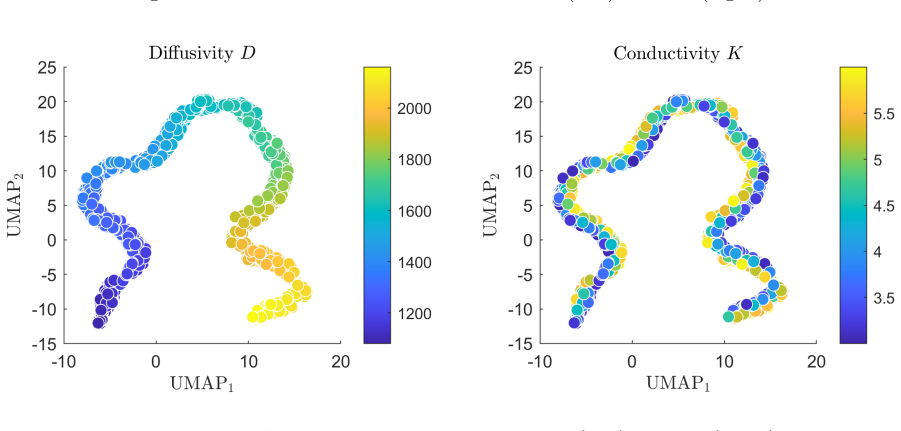
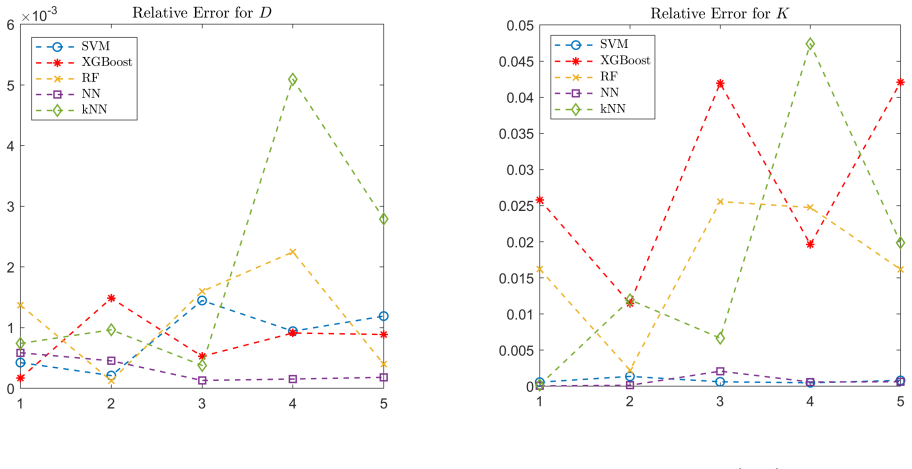
On the paper's own terms, the discovery is that the inverse map from moisture measurements to soil parameters is learnable with near-perfect fidelity: on the full exact dataset both SVM and NN achieve $R^2 = 1.0000$ for $D$ and effectively perfect scores for $K$ (SVM 1.0000, NN 0.9999), with NN reaching the smallest errors for $D$ (MSE 0.5293, MAE 0.5640 in the paper's units) and SVM reaching essentially zero error for $K$ (MAE 0.0042). The paper further claims that $D$ is systematically easier to predict than $K$; that 2% and 5% Gaussian noise in the test set inflates errors for all models but leaves SVM and NN as the most stable, while XGBoost collapses for $K$ ($R^2$ down to 0.5541 at 2% noise); and that reducing the dataset from 2000 to 500 samples, or from 30 features to the five most important ones, barely hurts SVM and NN. Feature analysis singles out moisture measured at $x=L/4$ at late times as the most informative input across models.
Load-bearing premise
The simulated moisture data, generated by numerically evaluating the Fokas-method solution of a linear infiltration equation with constant $K$ and $D$, are assumed to represent real water-content measurements in a homogeneous bounded soil well enough that near-perfect test accuracy carries over to the field; the paper itself notes synthetic data cannot capture full field complexity and heterogeneity.
Editorial extensions
If this is right
- If the claim holds, field estimation of $D$ and $K$ becomes a one-shot regression call from roughly ten to thirty moisture readings, with no iterative PDE solver needed at prediction time.
- Sensor campaigns can be shortened: measurements near the surface at early-to-mid times carry most of the signal, so a single probe around $x=L/4$ sampled hourly may suffice for $D$.
- Applications should treat $K$ as the harder target: with noise or limited data, conductivity predictions carry substantially more uncertainty than diffusivity predictions.
- A 500-sample synthetic training set is enough for near-optimal SVM and NN performance, lowering the data-generation cost for similar inverse problems.
- Tree-based models (XGBoost, random forest) are not the right default for this problem, since they degrade sharply under input noise.
Reading between the lines
- The near-perfect scores probably reflect the smoothness of the map from synthetic moisture features to $(K,D)$ in a constant-coefficient linear PDE; real heterogeneous field soils add variability that these numbers do not bound, so field accuracy may be much lower.
- The same Fokas-based data generator could be used to pre-train models that are later fine-tuned on a small set of field measurements, a hybrid strategy the paper leaves implicit.
- The top-ranked feature $\Theta_{1,10}$ suggests a concrete experiment: train the models with that single sensor deleted and measure how much accuracy drops, which would test whether one depth-time pair really carries most of the information.
- At 5% noise the ranking shifts, with $k$NN becoming comparable to SVM for $K$; this suggests model choice may depend on the expected noise regime and should be re-examined on real data.
Editorial analysis
A structured set of objections, weighed in public.
Referee Report
Summary. The paper addresses the inverse problem of estimating hydraulic conductivity K and water diffusivity D from water-content observations in a homogeneous bounded soil. Training and test data are generated synthetically by numerically evaluating the Fokas-method integral solution (Eq. 2) for randomly drawn (K, D) pairs. Five machine learning regressors (SVM, XGBoost, Random Forest, Neural Network, kNN) are compared under full, noisy, and limited data conditions, together with feature-importance analysis and PCA/UMAP dimensionality reduction. The reported results show SVM and NN achieving near-perfect R^2 and the lowest errors for both target parameters, and the conclusions identify these two models as the most reliable for the inverse modeling task.
Significance. If the central claim were established for real soils, the paper would provide a useful practical recipe for sensor placement and model choice in soil-property estimation. The manuscript has genuine strengths: preprocessing is carefully separated so that scaling parameters are learned only from the training set; 5-fold cross-validation is used for model selection; noise is added only to the test set to probe generalization; and the feature-importance analysis gives actionable insight into which measurement locations and times matter most. However, the entire benchmark is closed-loop: all data come from the authors' own Fokas-method forward model with constant K and D, and the paper itself acknowledges in Section 1 that synthetic data cannot capture the full complexity of field conditions. The near-perfect accuracies reported in Tables 6-7 may therefore reflect interpolation within a smooth parametric family rather than a transferable skill for real field data.
major comments (3)
- [Section 1, Section 4.1, Conclusions] The central claim that SVM and NN are 'the most reliable models for this inverse modeling task' is not established for actual soil-property estimation. Both training and test data are produced by numerically evaluating the same Fokas-method solution (Eq. 2), with constant K and D and simplified boundary conditions, and the paper explicitly concedes in Section 1 that simulated data fail to capture the full complexity and heterogeneity of field conditions. The near-perfect R^2 scores in Tables 6-7 may reflect the smoothness and low effective dimensionality of the map from 30 moisture measurements to (K, D) within this parametric family, not robustness to real-world conditions. Please either validate the models on independent field or laboratory data, or restrict the abstract and conclusion claims explicitly to the synthetic benchmark and present the study as a controlled methodological comparison.
- [Section 4.1, Tables 6-7 and 10-11] All point estimates of MSE and MAE are based on a single 10% test split, and no confidence intervals or repeated random splits are provided. The cross-validation results in Tables 10-11 report standard deviations of 0.0000 for several models, which appears to be an artifact of rounding rather than a meaningful zero variability. Please report uncertainty estimates from repeated train/test splits or bootstrap resampling, and give the cross-validation standard deviations with enough significant digits to be interpretable. Without this, the claim that SVM and NN 'consistently' outperform the other models is not statistically supported.
- [Section 4.4, Eq. (4)] The noise study adds Gaussian noise only to the test set, while the models are trained on exact, noise-free data, as stated in Section 2.1. This design tests robustness to unseen distortions but does not reproduce realistic conditions in which calibration errors and sensor noise also contaminate training data. The conclusion that SVM and NN are the 'most stable' models under noise should be tempered, or the experiments should be supplemented with a condition in which noise is also added to the training set (e.g., noise augmentation). The current design cannot distinguish between a model that is intrinsically robust to noise and one that simply benefits from being trained on a noise-free idealization of the same forward model.
minor comments (6)
- [Section 2.1] The diffusivity D is first generated in cm^2/sec and then reported in cm^2/h (1080-2160 cm^2/h). State the conversion factor explicitly in the text to avoid unit confusion.
- [Table 7] The SVM row for K reports MSE = 0.0000 while MAE = 0.0042; reporting more significant digits would make the metrics internally consistent and more informative.
- [Section 4.4, Tables 17 and 19] Relative change percentages computed against zero or near-zero baselines (e.g., '+∞%' for SVM in Table 17) are not meaningful; report the absolute error values alongside the relative changes.
- [Section 4.4] There are typos in the text: 'oven thousand' should be 'over thousand' and 'seams' should be 'seems'.
- [Section 3.2 and Section 4.3.3] The hyperparameter grid for GridSearchCV and the UMAP settings (e.g., n_neighbors, min_dist, metric) are not reported, which limits reproducibility. Please include these details.
- [Tables 10 and 11] The standard deviation values of 0.0000 for several models are likely due to rounding to four decimal places; reporting additional decimal places would clarify whether the cross-validation variability is truly negligible.
Circularity Check
No significant circularity: the ML inverse mapping is learned from generic supervised training, not derived from the forward equations; the self-cited Fokas solution is independent support, and the synthetic-data limitation is an external-validity caveat, not a circular reduction.
full rationale
The derivation chain is not circular. The soil-moisture data are generated by numerically evaluating the Fokas-method solution (2) of the linear IBVP (1), with K and D drawn randomly from stated ranges. This forward map is the input generator, not a fitted parameter of any ML model. The ML models are trained on (feature, label) pairs produced by this generator under a standard 80/10/10 split with 5-fold cross-validation, and hyperparameters are selected by grid search on validation data only. No test label is used to fit the models or to post-select the reported metrics. The predicted outputs K and D are not defined in terms of the input moisture features; they are learned generic regressions, so the near-perfect R2 values in Tables 6-7 are empirical fits to a smooth deterministic family, not quantities forced by construction from the inputs. The self-citation [2] supplies the forward solution, but that solution is a parameter-free analytical result for the stated PDE with stated boundary and initial data, and the paper notes it has been validated against established approximate analytical solutions; it does not assume the ML ranking or the inverse mapping. The acknowledged limitation that synthetic data "fail to capture the full complexity and heterogeneity of field conditions" (Section 1) is an external-validity caveat, not a circular reduction. The closed synthetic-data loop means the benchmark measures inversion skill within the Fokas-generated family, but no equation is equivalent to its own input and no fitted parameter is renamed as a prediction. Thus no significant circularity; score 0.
Assumptions & free parameters
free parameters (14)
- SVR regularization c =
1000
- SVR kernel coefficient gamma =
0.01
- SVR epsilon =
0.01
- NN hidden layer sizes =
[128, 64, 32]
- NN L2 regularization =
2e-4
- NN learning rate =
0.0001
- XGBoost max_depth =
7
- XGBoost learning_rate =
0.2
- XGBoost number of estimators =
300
- RF max_depth =
20
- kNN number of neighbors =
3
- Data generation K range =
[3, 6] cm/h
- Data generation D range =
[1080, 2160] cm2/h
- Noise levels =
2%, 5%
assumptions (4)
- domain assumption The integral representation (2), derived via the Fokas method in [2], gives the correct solution to the IBVP (1).
- domain assumption The linear advection-diffusion PDE (1) with constant K and D is an adequate model for vertical infiltration in a homogeneous bounded soil under flooding.
- domain assumption The boundary and initial conditions (theta0=0.03, theta1=0.3 cm3/cm3) and the parameter ranges K in [3,6] cm/h and D in [1080,2160] cm2/h are representative of field conditions.
- domain assumption Gaussian noise with sigma = delta * sigma_Theta models realistic measurement error in soil moisture sensors.
Cite this review
Pith. "Pith review of Estimating properties of a homogeneous bounded soil using machine learning models." pith.science (2026). https://pith.science/paper/EX72M6J7
@misc{pith2026250604256,
  author       = {Pith},
  title        = {Pith review of: Estimating properties of a homogeneous bounded soil using machine learning models},
  year         = {2026},
  howpublished = {\url{https://pith.science/paper/EX72M6J7}},
  note         = {Machine review of arXiv:2506.04256}
}
abstract
This work focuses on estimating soil properties from water moisture measurements. We consider simulated data generated by solving the initial-boundary value problem governing vertical infiltration in a homogeneous, bounded soil profile, with the usage of the Fokas method. To address the parameter identification problem, which is formulated as a two-output regression task, we explore various machine learning models. The performance of each model is assessed under different data conditions: full, noisy, and limited. Overall, the prediction of diffusivity $D$ tends to be more accurate than that of hydraulic conductivity $K.$ Among the models considered, Support Vector Machines (SVMs) and Neural Networks (NNs) demonstrate the highest robustness, achieving near-perfect accuracy and minimal errors.
Figures


Figures from the paper (12 more)


Reference graph
Works this paper leans on
- [1]
-
[2]
I. Argyrokastritis, K. Kalimeris, and L. Mindrinos , An analytical solution for vertical infiltration in homogeneous bounded profiles , European Journal of Soil Science, 75 (2024), p. e13547
work page 2024
-
[3]
E. Chlouveraki, N. Katsenios, A. Efthimiadou, E. Lazarou, K. Kounani, E. Papakonstantinou, D. Vlachakis, A. Kasimati, I. Zafeiriou, B. Espejo-Garcia, and S. Fountas , Estimation of soil properties using hyperspectral imaging and machine learning , Smart Agricultural Technology, 10 (2025), p. 100790
work page 2025
-
[4]
F. A. Diaz-Gonzalez, J. Vuelvas, C. A. Correa, V. E. Vallejo, and D. Patino , Machine learning and remote sensing techniques applied to estimate soil indicators--review , Ecological Indicators, 135 (2022), p. 108517
work page 2022
-
[5]
A. S. Fokas , A unified transform method for solving linear and certain nonlinear pdes , Proceedings of the Royal Society of London. Series A: Mathematical, Physical and Engineering Sciences, 453 (1997), pp. 1411--1443
work page 1997
-
[6]
G. Forkuor, O. K. L. Hounkpatin, G. Welp, and M. Thiel , High resolution mapping of soil properties using remote sensing variables in south-western burkina faso: a comparison of machine learning and multiple linear regression models , PloS one, 12 (2017), p. e0170478
work page 2017
-
[7]
I. J. Goodfellow, Y. Bengio, and A. C. Courville , Deep Learning. Adaptive computation and machine learning , MIT Press, New York, 2016
work page 2016
-
[8]
L. Guellouz, B. Askri, J. Jaffr \'e , and R. Bouhlila , Estimation of the soil hydraulic properties from field data by solving an inverse problem , Scientific Reports, 10 (2020), p. 9359
work page 2020
Show all 26 references
-
[9]
Hastie, R
T. Hastie, R. Tibshirani, and J. Friedman , Elements of Statistical Learning: Data Mining, Inference and Prediction , Springer, New York, 2nd ed., 2001
2001
-
[10]
Heaton, S
J. Heaton, S. McElwee, J. Fraley, and J. Cannady , Early stabilizing feature importance for tensorflow deep neural networks , in 2017 International Joint Conference on Neural Networks (IJCNN), 2017, pp. 4618--4624
2017
-
[11]
I. T. Jolliffe , Principal Component Analysis , Springer, New York, 2002
2002
-
[12]
Kerkides, A
P. Kerkides, A. Poulovassilis, I. Argyrokastritis, and S. Elmaloglou , Comparative evaluation of analytic solutions in predicting soil moisture profiles in vertical one-dimensional infiltration under ponded and constant flux boundary conditions , Water Resources Management, 11...
1997
-
[13]
Khanal, J
S. Khanal, J. Fulton, A. Klopfenstein, N. Douridas, and S. Shearer , Integration of high resolution remotely sensed data and machine learning techniques for spatial prediction of soil properties and corn yield , Computers and electronics in agriculture, 153 (2018), pp. 213--225
2018
-
[14]
M. H. Kutner, C. J. Nachtsheim, J. Neter, and W. Li , Applied Linear Statistical Models , McGraw-Hill/Irwin, Boston, MA, 5th ed., 2005
2005
-
[15]
Le Bourgeois, C
O. Le Bourgeois, C. Bouvier, P. Brunet, and P.-A. Ayral , Inverse modeling of soil water content to estimate the hydraulic properties of a shallow soil and the associated weathered bedrock , Journal of Hydrology, 541 (2016), pp. 116--126
2016
-
[16]
McInnes, J
L. McInnes, J. Healy, and J. Melville , Umap: Uniform manifold approximation and projection for dimension reduction , arXiv preprint arXiv:1802.03426, (2018)
2018 arXiv
-
[17]
Moghadas and A
D. Moghadas and A. Badorreck , Machine learning to estimate soil moisture from geophysical measurements of electrical conductivity , Near Surface Geophysics, 17 (2019), pp. 181--195
2019
-
[18]
Padarian, B
J. Padarian, B. Minasny, and A. B. McBratney , Using deep learning to predict soil properties from regional spectral data , Geoderma Regional, 16 (2019), p. e00198
2019
-
[19]
Pallikarakis, A
N. Pallikarakis, A. Kalogeropoulos, and N. L. Tsitsas , Exploring the inverse line-source scattering problem in dielectric cylinders with deep neural networks , Physica Scripta, 99 (2024), p. 116013
2024
-
[20]
Pallikarakis and A
N. Pallikarakis and A. Ntargaras , Application of machine learning regression models to inverse eigenvalue problems , Comput. Math. Appl., 154 (2024), pp. 162--174
2024
-
[21]
W. J. Rawls, D. L. Brakensiek, and K. E. Saxtonn , Estimation of soil water properties , Transactions of the ASAE, 25 (1982), pp. 1316--1320
1982
-
[22]
Ritter, F
A. Ritter, F. Hupet, R. Mu \ n oz-Carpena, S. Lambot, and M. Vanclooster , Using inverse methods for estimating soil hydraulic properties from field data as an alternative to direct methods , Agricultural Water Management, 59 (2003), pp. 77--96
2003
-
[23]
B. C. Si and R. G. Kachanoski , Estimating soil hydraulic properties during constant flux infiltration inverse procedures , Soil Science Society of America Journal, 64 (2000), pp. 439--449
2000
-
[24]
Simunek and M
J. Simunek and M. T. Van Genuchten , Estimating unsaturated soil hydraulic properties from tension disc infiltrometer data by numerical inversion , Water Resources Research, 32 (1996), pp. 2683--2696
1996
-
[25]
B. B. Trangmar, R. S. Yost, and G. Uehara , Application of geostatistics to spatial studies of soil properties , Advances in agronomy, 38 (1986), pp. 45--94
1986
-
[26]
Zeraatpisheh, S
M. Zeraatpisheh, S. Ayoubi, A. Jafari, S. Tajik, and P. Finke , Digital mapping of soil properties using multiple machine learning in a semi-arid region, central iran , Geoderma, 338 (2019), pp. 445--452
2019
Reviewed August 7, 2026 · model on record in the stance chip above.
Discussion (0). Sign in to comment.