REVIEW 2 major objections 2 minor 44 references
Unbiased estimation of squared concentration in the Fisher-von Mises-Langevin distribution and the impossibility of unbiased concentration
T0 review · 2 major / 2 minor · reviewed 2026-06-28 · grok-4.3
Pith's one-line read Unbiased estimation of the concentration parameter is impossible for the Fisher-von Mises-Langevin distribution, but unbiased estimation of its square, the intensity, is possible via U-statistics.
desk verdict The paper proves unbiased estimation of concentration κ is impossible under the vMF model but constructs explicit U-statistic estimators for κ² and demonstrates them on real data. read the letter →
The pith
A machine-rendered reading of the paper's core claim, the machinery that carries it, and where it could break.
The reading
What carries the argument
The intensity, defined as the square of the concentration parameter, whose unbiased estimators are given by partial-sum U-statistics.
What would settle it
An explicit estimator whose expectation equals the concentration parameter for every sample size and every value of the parameter.
Extended reading notes
Core claim
Unbiased estimation of the concentration parameter is impossible. Reparameterizing the Fisher-von Mises-Langevin distribution in terms of the squared concentration (termed intensity) makes unbiased estimation feasible, and the paper supplies almost-unbiased estimators constructed as partial-sum U-statistics.
Load-bearing premise
Unbiasedness is defined in the usual expectation sense for any estimator of the concentration parameter under the Fisher-von Mises-Langevin model.
Editorial analysis
A structured set of objections, weighed in public.
Referee Report
Summary. The paper claims that unbiased estimation of the concentration parameter κ in the Fisher-von Mises-Langevin (FvML) distribution is impossible under the standard definition of unbiasedness. It introduces an alternative parameterization via the squared concentration (termed intensity, κ²), shows that unbiased estimation of this intensity is possible, and constructs (almost) unbiased estimators using partial-sum U-statistics. These are demonstrated on synthetic data, New York taxi trip data, and spherical word embeddings.
Significance. If the impossibility result and the U-statistic construction hold, the work clarifies a basic limitation in directional statistics (analogous to precision estimation for Gaussians) and supplies a constructive, parameter-free alternative via standard U-statistic theory. The explicit construction for the intensity, rather than a purely existential claim, is a strength that supports practical use in applications involving directional data.
major comments (2)
- [Section on impossibility result (likely §2 or §3)] The impossibility claim for unbiased estimation of κ relies on the standard definition E[estimator] = κ for all κ; the manuscript should explicitly state the estimator class (e.g., all measurable functions of the sample or a restricted subclass) and any regularity conditions (support, moments) under which the negative result is proved, as these determine whether the claim is load-bearing.
- [Section constructing the U-statistic estimators (likely §4)] For the intensity estimators, the precise meaning of '(almost) unbiased' must be defined (e.g., exact unbiasedness for finite n via U-statistic properties, or asymptotic unbiasedness); without this, it is unclear whether the partial-sum U-statistic achieves E[estimator] = κ² exactly or only in the limit.
minor comments (2)
- [Abstract] The abstract contains a typo: 'fruther' should be 'further'.
- [Introduction and parameterization section] Notation for the intensity parameter should be introduced consistently (e.g., always as I = κ²) to avoid confusion with the original concentration κ.
Simulated Author's Rebuttal
We thank the referee for the careful review and the recommendation for minor revision. The comments highlight areas where additional precision will strengthen the presentation of both the impossibility result and the U-statistic construction. We address each major comment below.
read point-by-point responses
-
Referee: The impossibility claim for unbiased estimation of κ relies on the standard definition E[estimator] = κ for all κ; the manuscript should explicitly state the estimator class (e.g., all measurable functions of the sample or a restricted subclass) and any regularity conditions (support, moments) under which the negative result is proved, as these determine whether the claim is load-bearing.
Authors: We agree that the scope of the impossibility result should be stated explicitly. The negative result holds for the class of all measurable functions of the i.i.d. sample that possess finite expectation, under the standard conditions that the observations lie on the unit sphere and are drawn from the FvML family (which has full support for any κ > 0). We will insert a precise statement of the estimator class and regularity conditions at the start of the impossibility section. revision: yes
-
Referee: For the intensity estimators, the precise meaning of '(almost) unbiased' must be defined (e.g., exact unbiasedness for finite n via U-statistic properties, or asymptotic unbiasedness); without this, it is unclear whether the partial-sum U-statistic achieves E[estimator] = κ² exactly or only in the limit.
Authors: We accept that the parenthetical qualifier requires an explicit definition. The complete (non-partial) U-statistic is exactly unbiased for κ² for any finite n by standard U-statistic theory; the partial-sum version is introduced for computational tractability and is asymptotically unbiased as the number of summands grows. We will add a dedicated paragraph in the U-statistic section that defines 'almost unbiased' in these terms and distinguishes the exact and approximate cases. revision: yes
Circularity Check
No significant circularity
full rationale
The central claims rest on a standard impossibility proof for unbiased estimation of κ (under the usual E[estimator]=κ definition) and a constructive U-statistic estimator for κ² whose unbiasedness follows from the general theory of U-statistics, not from any redefinition or fitting of the target quantity itself. No load-bearing self-citation, ansatz smuggling, or reduction of a claimed prediction to its own inputs appears in the stated results or abstract. The derivation chain is therefore self-contained against external mathematical benchmarks.
Assumptions & free parameters
assumptions (1)
- domain assumption Standard definition of unbiased estimator under the Fisher-von Mises-Langevin model
invented entities (1)
-
intensity (squared concentration)
Cite this review
Pith. "Pith review of Unbiased estimation of squared concentration in the Fisher-von Mises-Langevin distribution and the impossibility of unbiased concentration." pith.science (2026). https://pith.science/paper/EXTGHEPS
@misc{pith2026260604267,
  author       = {Pith},
  title        = {Pith review of: Unbiased estimation of squared concentration in the Fisher-von Mises-Langevin distribution and the impossibility of unbiased concentration},
  year         = {2026},
  howpublished = {\url{https://pith.science/paper/EXTGHEPS}},
  note         = {Machine review of arXiv:2606.04267}
}
read the original abstract
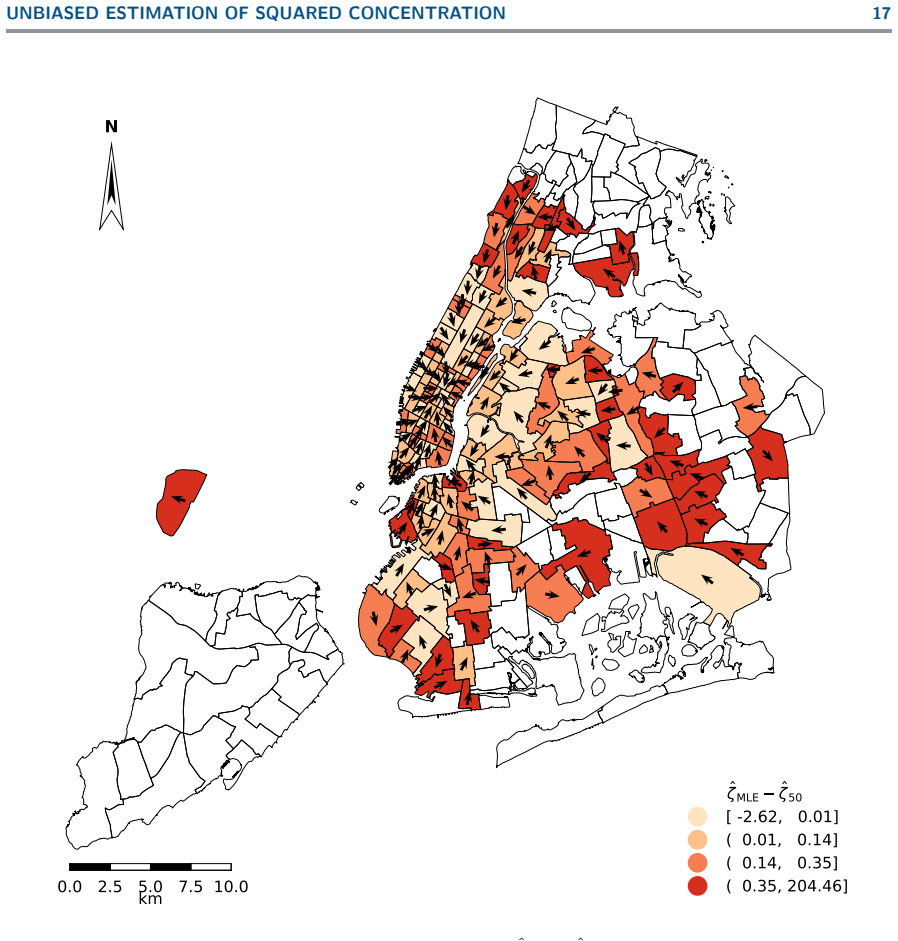
The estimation of concentration parameter in Fisher-von Mises-Langevin distribution is the directional statistics analogue of the estimation of the precision matrix for the Gaussian distribution. In this work we show that unbiased estimation of this parameter is impossible. With this realization in hand, we provide an alternative parameterization of the Fisher-von Mises-Langevin distribution in terms of the squared concentration, which we term the intensity. We fruther show that unbiased estimation of thereof is possible, and provide (almost) unbiased estimators thereof in terms of a partial sum U-statistic. We showcase our new estimator on synthetic data, New York taxi trip data, and on spherical word embeddings.
Figures


Reference graph
Works this paper leans on
-
[1]
1922 , publisher=
A treatise on the theory of Bessel functions , author=. 1922 , publisher=
1922
-
[2]
NIST Digital Library of Mathematical Functions
-
[3]
1948 , publisher=
Handbook of mathematical functions with formulas, graphs, and mathematical tables , author=. 1948 , publisher=
1948
-
[4]
2009 , publisher=
Directional statistics , author=. 2009 , publisher=
2009
-
[5]
The American Mathematical Monthly , volume=
Lagrange inversion formula by induction , author=. The American Mathematical Monthly , volume=. 2023 , publisher=
2023
-
[6]
Australian Journal of Statistics , volume=
Cumulants and partition lattices 1 , author=. Australian Journal of Statistics , volume=. 1983 , publisher=
1983
-
[7]
2018 , publisher=
Tensor methods in statistics: Monographs on statistics and applied probability , author=. 2018 , publisher=
2018
-
[8]
On the foundations of combinatorial theory: I
Rota, Gian-Carlo , booktitle=. On the foundations of combinatorial theory: I. Theory of M. 1964 , publisher=
1964
Show all 44 references
-
[9]
Cambridge studies in advanced mathematics , year=
Enumerative combinatorics volume 1 second edition , author=. Cambridge studies in advanced mathematics , year=
-
[10]
Statistics and Computing , volume=
A new method for fast computing unbiased estimators of cumulants , author=. Statistics and Computing , volume=. 2009 , publisher=
2009
-
[11]
Clustering on the unit hypersphere using von
Banerjee, Arindam and Dhillon, Inderjit S and Ghosh, Joydeep and Sra, Suvrit , journal=. Clustering on the unit hypersphere using von
-
[12]
A short note on parameter approximation for von
Sra, Suvrit , journal=. A short note on parameter approximation for von. 2012 , publisher=
2012
-
[13]
Best, D. J. and Fisher, N. I. , journal=. The bias of the maximum likelihood estimators of the von. 1981 , publisher=
1981
-
[14]
Parameter estimation for von
Tanabe, Akira and Fukumizu, Kenji and Oba, Shigeyuki and Takenouchi, Takashi and Ishii, Shin , journal=. Parameter estimation for von. 2007 , publisher=
2007
-
[15]
1983 , publisher=
Statistics on Spheres , author=. 1983 , publisher=
1983
-
[16]
The Annals of Mathematical Statistics , volume=
A class of statistics with asymptotically normal distribution , author=. The Annals of Mathematical Statistics , volume=. 1948 , publisher=
1948
-
[17]
Proceedings of the royal society of London
Dispersion on a sphere , author=. Proceedings of the royal society of London. Series A. Mathematical and physical sciences , volume=. 1953 , publisher=
1953
-
[18]
Advances in Neural Information Processing Systems , volume =
Spherical Text Embedding , author =. Advances in Neural Information Processing Systems , volume =
-
[19]
Lang, Ken , booktitle =
-
[20]
Machine Learning , volume =
Concept Decompositions for Large Sparse Text Data Using Clustering , author =. Machine Learning , volume =. 2001 , publisher =
2001
-
[21]
1969 , publisher =
Geometric Measure Theory , author =. 1969 , publisher =
1969
-
[22]
1987 , publisher =
Real and Complex Analysis , author =. 1987 , publisher =
1987
-
[23]
2016 , publisher =
A Course in Abstract Harmonic Analysis , author =. 2016 , publisher =
2016
-
[24]
1973 , publisher=
Linear Statistical Inference and Its Applications , author=. 1973 , publisher=
1973
-
[25]
1998 , publisher=
Theory of point estimation , author=. 1998 , publisher=
1998
-
[26]
1986 , publisher =
Fundamentals of Statistical Exponential Families, with Applications in Statistical Decision Theory , author =. 1986 , publisher =
1986
-
[27]
2012 , howpublished =
2012
-
[28]
Taxi and Limousine Commission Trip Record Data , author=
-
[29]
2002 , edition=
A primer of real analytic functions , author=. 2002 , edition=
2002
-
[30]
2018 , edition=
Introduction to Riemannian Manifolds , author=. 2018 , edition=
2018
-
[31]
Fast Python sampler for the von
Pinz. Fast Python sampler for the von. 2023 , journal=
2023
-
[32]
Navigation , volume=
A survey of attitude representations , author=. Navigation , volume=
-
[33]
ISPRS International Journal of Geo-Information , volume=
A Sensor-Based Simulation Method for Spatiotemporal Event Detection , author=. ISPRS International Journal of Geo-Information , volume=. 2024 , publisher=
2024
-
[34]
Annals of GIS , volume=
Comparative analysis of human mobility patterns: utilizing taxi and mobile (SafeGraph) data to investigate neighbourhood-scale mobility in New York City , author=. Annals of GIS , volume=. 2025 , publisher=
2025
-
[35]
Big Earth Data , volume=
An entropy-based measurement for understanding origin-destination trip distributions: a case study of New York City taxis , author=. Big Earth Data , volume=. 2024 , publisher=
2024
-
[36]
Computational urban science , volume=
A novel big data approach to measure and visualize urban accessibility , author=. Computational urban science , volume=. 2021 , publisher=
2021
-
[37]
Journal of Multivariate Analysis , volume=
The multivariate Watson distribution: Maximum-likelihood estimation and other aspects , author=. Journal of Multivariate Analysis , volume=. 2013 , publisher=
2013
-
[38]
2017 , publisher=
Modern directional statistics , author=. 2017 , publisher=
2017
-
[39]
Test , volume=
Recent advances in directional statistics , author=. Test , volume=. 2021 , publisher=
2021
-
[40]
arXiv preprint arXiv:2605.03105 , year=
Pose Tracking with a Foundation Pose Model and an Ensemble Directional Kalman Filter , author=. arXiv preprint arXiv:2605.03105 , year=
-
[41]
A multiplicative residual approach to attitude
Zanetti, Renato , journal=. A multiplicative residual approach to attitude. 2009 , publisher=
2009
-
[42]
Journal of Guidance, Control, and Dynamics , volume=
Fully multiplicative unscented kalman filter for attitude estimation , author=. Journal of Guidance, Control, and Dynamics , volume=. 2018 , publisher=
2018
-
[43]
Journal of Statistical Software , volume=
Directional statistics and filtering using libDirectional , author=. Journal of Statistical Software , volume=
-
[44]
Unscented
Kurz, Gerhard and Gilitschenski, Igor and Hanebeck, Uwe D , journal=. Unscented. 2016 , publisher=
2016
Reviewed June 28, 2026 · model on record in the stance chip above.
Discussion (0). Continue with ORCID to comment.