REVIEW 4 major objections 6 minor 38 references
Eunomia: A Permissionless Parallel Chain Protocol Based on Logical Clock
T0 review · 4 major / 6 minor · reviewed 2026-08-14 · deepseek-v4-flash
Pith's one-line read Eunomia claims that a virtual logical clock computed from the block graph can order blocks across parallel chains without a dedicated synchronization chain, and that UTXO sharding removes cross-chain double spends.
desk verdict Eunomia is a genuine new combination—logical-clock ordering with UTXO sharding—but its main security proof hinges on an unproven independence assumption that the paper itself admits. read the letter →
The pith
A machine-rendered reading of the paper's core claim, the machinery that carries it, and where it could break.
The reading
What carries the argument
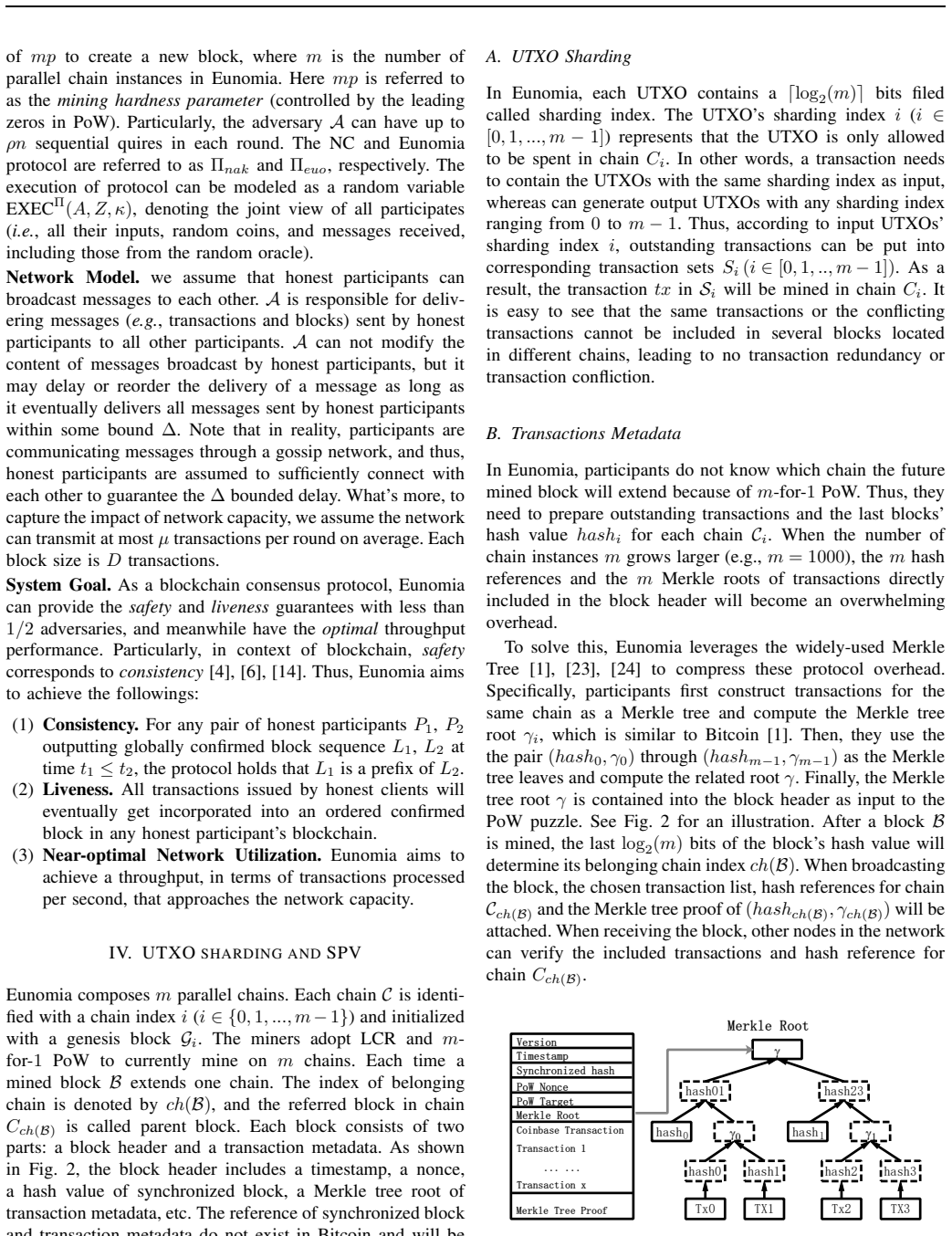
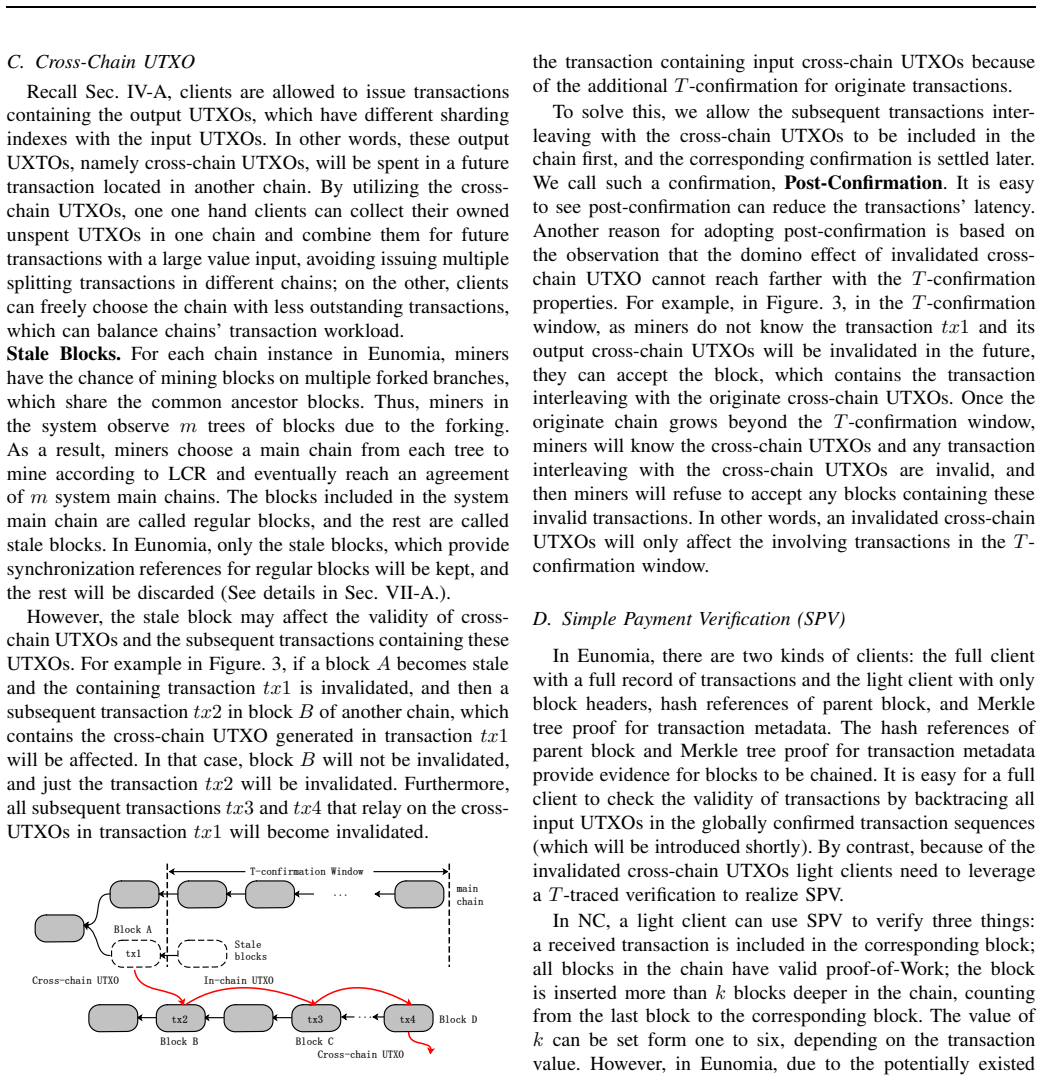
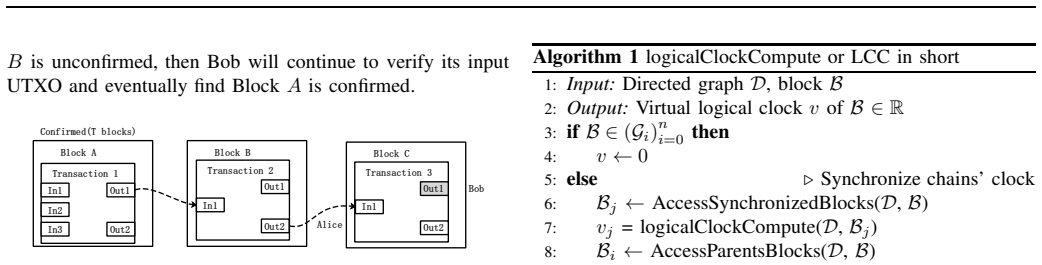
The load-bearing object is the virtual logical clock computed by Algorithm 1 (logicalClockCompute): for each new block, the clock is the synchronized block's clock plus one, with an invalid value returned if the parent clock is larger. The synchronized block is the block with the largest clock among the m main chains, referenced in the new block's header, so the m chains exchange timing information in a fully distributed way and no chain acts as a unique clock. The second mechanism is fine-grained UTXO sharding: each UTXO carries a sharding index naming the only chain where it can be spent, which removes cross-chain double spending and limits the backtrace a light client needs to a T-block confirmation window.
What would settle it
Run the protocol with two chains and a small confirmation depth, and let the adversary delay every synchronized block until just after the next block referencing it is mined. If an honest miner's block can then be rejected because its parent clock exceeds the synchronized clock—or if one honest node's globally confirmed sequence is not a prefix of another's—the independence assumption fails. This can be checked in a discrete-event simulation before deployment.
Extended reading notes
Core claim
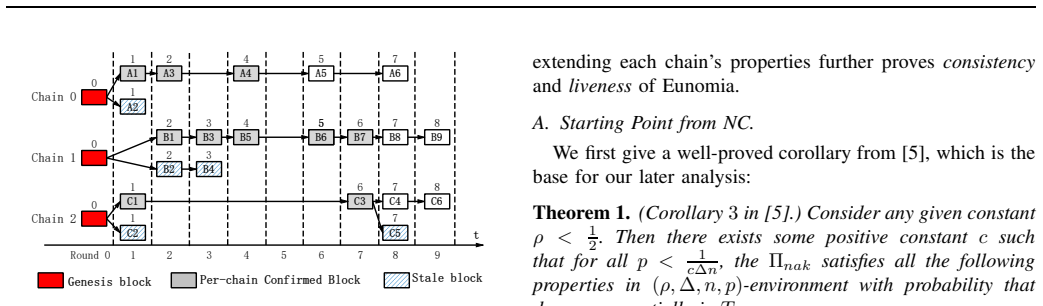
The central claim is that block ordering in a parallel chain is an event-ordering problem, and a virtual logical clock—a counter derived from the block graph rather than wall-clock time—solves it without a dedicated synchronization chain or extra ordering blocks. Each block receives a clock equal to the clock of a synchronized block, the last block with the largest clock among the m chains, plus one, provided the parent block's clock does not exceed the synchronized clock; otherwise the block is invalid. Blocks across chains are globally ordered by the pair (clock, chain index), and only per-chain confirmed blocks with clock below the synchronized bar enter the globally confirmed sequence. The paper also claims that tagging each UTXO with a sharding index restricts any output to be spent in one specific chain, so conflicting transactions cannot appear in separate chains, and light clients can verify payments by backtracing inputs within a T-block window. Together these mechanisms are claimed to yield consistency, liveness, and throughput approaching the network capacity while tolerating less than 1/2 adversarial computing power.
Load-bearing premise
The argument assumes each of the m chains behaves exactly like one independent proof-of-work chain, even though a block's validity depends on a synchronized block from another chain; the report asserts this independence but leaves the cross-chain dependency unproved.
Editorial extensions
If this is right
- Throughput scales roughly with the number m of parallel chains, because every chain mines and confirms blocks concurrently and ordering does not wait on a single chain.
- No special synchronization chain or attachment block is needed; the ordering information rides inside ordinary block headers, so protocol overhead stays low.
- The ordering respects block causality: a block cannot be ordered before blocks it references, avoiding the inverted-order attack vector of pre-defined sequences.
- A rational miner has an economic incentive to reference the true largest-clock synchronized block, since deviating can produce a rejected block.
- Light clients need only headers plus a T-block backtrace to detect invalidated cross-chain UTXOs, making SPV feasible in the parallel setting.
Reading between the lines
- The paper does not push this further, but the same clock rule could be applied to DAG-based ledgers if a tie-break policy is added for blocks with multiple parents.
- This suggests a concrete stress test: delay synchronized-block delivery in a simulation and measure whether any chain's growth rate drops; a drop would contradict the assumed independence of chains.
- One observable design cost is that cross-chain UTXO spends wait through the T-block window, so an implementation should measure whether this erases the parallelism latency gain for cross-chain payments.
- The incentive argument implies a rational attacker would mine on low-clock ancestor blocks to suppress global confirmation; quantifying the economic break-even point would make the 1/2 bound more precise.
Signed reviews
Editorial analysis
A structured set of objections, weighed in public.
Referee Report
Summary. The paper proposes Eunomia, a permissionless parallel-chain protocol based on m independent Nakamoto Consensus chains, m-for-1 PoW, a virtual logical clock for global block ordering, and fine-grained UTXO sharding. The central claims are that Eunomia satisfies consistency and liveness under less than 1/2 adversarial computation power and approaches the network bandwidth limit, while also being SPV-friendly. The security argument in Sec. VI proceeds by first lifting known Nakamoto Consensus properties to each chain (Lemma 1) and then combining per-chain properties to prove global consistency, growth, and quality (Lemmas 2–4). The paper also presents an informal incentive argument in Sec. V-D intended to deter denial-of-ordering attacks.
Significance. If the main theorem were established, the result would be significant: it would show that a parallel-chain protocol can achieve near-optimal throughput without a dedicated synchronization chain or additional ordering blocks, while preserving the simple security analysis of Nakamoto Consensus and providing SPV support. The paper also makes a useful design point by connecting logical clocks in distributed systems to block ordering. However, the central proof depends on an independence assumption that the paper itself acknowledges is violated, and the supporting lemmas are only sketched. The contribution is therefore not currently substantiated by the provided analysis.
major comments (4)
- [Sec. VI-A, Lemma 1] The proof of Lemma 1 asserts that each chain Ci of Eunomia runs 'in the same way' as a single Nakamoto chain and therefore inherits the properties of Theorem 1. This is not justified under Algorithm 1. In lines 6–14 of Algorithm 1, a newly mined block is valid only if its parent clock vi does not exceed the clock vj of the referenced synchronized block; otherwise its clock is set to -1 and the block is rejected. Because the synchronized block is normally the largest-clock block among all chains, the validity of a block on chain Ci depends on the timely availability and relative clock value of blocks on other chains. An adversary controlling message delivery can delay synchronized blocks from fast chains, causing otherwise valid honest PoW solutions to be rejected and lowering the honest block-generation rate below p. The paper itself concedes this in Sec. VII-A: 'each chain's block generation cannot be viewed as independent with each other anymore, which deviates from the design goal and makes the analysis complicated.' The following sentence asserts without proof that relaying synchronized blocks keeps the chains independent. Lemma 1 is therefore not established, and the subsequent lift of consistency, chain-growth, and chain-quality to Eunomia is unsupported.
- [Sec. VI-B, Lemma 3] The proof of Lemma 3 does not establish the claimed 4T/pn bound for global confirmation. It argues that by time t1 = t0 + 2T/pn each chain has at least T blocks attached, and that by the chain-quality property 'there must have one block of honest participants which synchronizes its belonging chain to the value x', where x is the largest virtual clock among the last per-chain confirmed blocks at time t0. This is a non sequitur: chain-quality only guarantees a fraction of honest blocks in a window; it does not guarantee that any of them references the particular synchronized block with clock x. Moreover, the proof uses the undefined term 'partially confirmed' when moving from t1 to t2, and it only addresses the single clock x rather than all per-chain confirmed blocks at t0. A formal argument deriving the confirmation delay from the stated growth and quality properties is missing and is load-bearing for liveness.
- [Sec. VI-B, Lemma 4] The proof of Lemma 4 is only a sketch and does not derive the L-growth and L-quality statements. It states that each chain has at least γT blocks becoming newly 'partially-confirmed' from t0 to t1 = t0 + γ·2T/pn and then invokes 'Lemma 4' to conclude the proof; the correct reference should be Lemma 3, and even with that replacement the argument does not quantify how the global sequence grows by m·γ·T blocks per (γ+2)·2T/pn rounds. The notions 'partially-confirmed' and 'per-chain confirmed' are not formally defined in the proof, and the relationship between per-chain growth, the global ordering rule (Sec. V-C), and the global sequence length is not shown. Since Theorem 2's liveness claim rests on these lemmas, the main theorem is not proven.
- [Sec. V-D] The incentive-compatibility claim against denial-of-ordering attacks is informal. The text argues that a miner who chooses a non-maximal synchronized block will either produce invalid blocks or blocks that do not extend the longest chain, and therefore 'will suffer from economic loss.' No utility model, adversary strategy space, or equilibrium notion is defined, and no formal statement connects this argument to the protocol's security properties. As this is presented as a distinct contribution (denial-of-ordering resistance), it should be stated as a theorem with a proof or explicitly labeled as a heuristic discussion.
minor comments (6)
- [Sec. VI-B, Theorem 2] In the paragraph after Theorem 2, the text says 'Theorem 1 shows that the globally confirmed block sequence L satisfies...' but it should refer to Theorem 2; Theorem 1 is the external Nakamoto Consensus corollary and does not mention L.
- [Algorithm 1] The input/output notation is inconsistent: the output is declared as a real number v ∈ R, but the algorithm returns integer clock values and -1. The genesis condition 'B ∈ (Gi)^n_i=0' uses n where m is intended, and the indexing should be over the m genesis blocks.
- [Sec. V-C] The notation for the synchronized bar is written as min^m_{i=0}{vi} and later as min^{m−1}_{i=0}; the bounds should be made consistent, and the global ordering rule needs a precise definition of how blocks with equal clocks are ordered beyond 'tie breaking of i'.
- [Sec. IV-D] The SPV verification procedure for light clients is described only by example. The 'T-traced verification' is not specified as an algorithm, and no proof is given that a light client can detect invalid cross-chain UTXO references with only block headers and Merkle proofs.
- [Sec. VII-A] The sentence 'It is hard for the node to invoke Algorithm 1' is unclear; the subsequent discussion of storing synchronized-block headers and Merkle proofs should be stated as a precise storage and verification rule rather than an informal remark.
- [Sec. II-C] The claim that a vector clock 'cannot exploit its advantage' in forked branches is not explained; a sentence justifying this would help the reader understand why logical clocks are chosen over vector clocks.
Circularity Check
No circularity: Eunomia's ordering and UTXO-sharding rules are design choices, and the security proof lifts external Nakamoto-consensus theorems without self-citation or fitted parameters.
full rationale
The derivation chain in Eunomia is not circular. The protocol's virtual logical clock is a defined algorithmic rule, not a quantity fitted to the target consistency/liveness properties; the global block order is constructed from that clock and then analyzed. The security argument rests on Theorem 1, imported externally from Pass et al. [5], and Lemma 1 attempts to connect each Eunomia chain to that external Nakamoto-consensus baseline. There are no fitted parameters renamed as predictions, no self-citations, no uniqueness theorem imported from the authors' prior work, and no ansatz smuggled in through the authors' own earlier papers. The one notable weakness is Sec. VII-A's explicit admission that cross-chain synchronized-block dependencies mean 'each chain's block generation cannot be viewed as independent with each other anymore, which deviates from the design goal and makes the analysis complicated.' That is a real proof gap or unsupported independence assumption, but it is a correctness/soundness concern, not circularity: the paper does not define the per-chain Nakamoto properties in terms of the global-order output, nor does it reduce the target theorem to its own assumptions by construction. The UTXO sharding rule also solves transaction conflicts by definitional design, but that is the protocol mechanism itself, not a claimed prediction derived from the same mechanism. Overall, the paper is self-contained against external benchmarks and merits a non-circularity finding.
Assumptions & free parameters
assumptions (6)
- domain assumption Random oracle model for the PoW hash function
- domain assumption Bounded-delay asynchronous network, all messages delivered within Δ
- domain assumption Adversarial computational power is bounded by ρ < 1/2
- domain assumption Nakamoto consensus satisfies consistency, chain-growth, and chain-quality (Corollary 3 in [5])
- domain assumption UTXO model with unspent transaction outputs
- domain assumption The last log2(m) bits of a block's hash are uniformly distributed, so each chain receives blocks with equal probability
Cite this review
Pith. "Pith review of Eunomia: A Permissionless Parallel Chain Protocol Based on Logical Clock." pith.science (2026). https://pith.science/paper/EXV2DYQ7
@misc{pith2026190807567,
  author       = {Pith},
  title        = {Pith review of: Eunomia: A Permissionless Parallel Chain Protocol Based on Logical Clock},
  year         = {2026},
  howpublished = {\url{https://pith.science/paper/EXV2DYQ7}},
  note         = {Machine review of arXiv:1908.07567}
}
read the original abstract
The emerging parallel chain protocols represent a breakthrough to address the scalability of blockchain. By composing multiple parallel chain instances, the whole systems' throughput can approach the network capacity. How to coordinate different chains' blocks and to construct them into a global ordering is critical to the performance of parallel chain protocol. However, the existed solutions use either the global synchronization clock with the single-chain bottleneck or pre-defined ordering sequences with distortion of blocks' causality to order blocks. In addition, the prior ordering methods rely on that honest participants faithfully follow the ordering protocol, but remain silent for any denial of ordering (DoR) attack. On the other hand, the conflicting transactions included into the global block sequence will make Simple Payment Verification (SPV) difficult. Clients usually need to store a full record of transactions to distinguish the conflictions and tell whether transactions are confirmed. However, the requirement for a full record will greatly hinder blockchains' application, especially for mobile scenarios. In this technical report, we propose Eunomia, which leverages logical clock and fine-grained UTXO sharding to realize a simple, efficient, secure and permissionless parallel chain protocol. By observing the characteristics of the parallel chain, we find the blocks ordering issue in parallel chain has many similarities with the event ordering in the distributed system. Eunomia thus adopts "virtual" logical clock, which is optimized to have the minimum protocol overhead and runs in a distributed way. In addition, Eunomia combines the mining incentive with block ordering, providing incentive compatibility against DoR attack. What's more, the fine-grained UTXO sharding does well solve the conflicting transactions in parallel chain and is shown to be SPV-friendly.
Figures

Figures from the paper (2 more)
Reference graph
Works this paper leans on
-
[1]
Bitcoin: A peer-to-peer electronic cash s ystem,
S. Nakamoto, “Bitcoin: A peer-to-peer electronic cash s ystem,” W orking Paper, 2008
work page 2008
-
[2]
mapofcoins, “Map of coins: Btc map,” 2018. [Online]. Ava ilable: http://mapofcoins.com/bitcoin
work page 2018
-
[3]
Lay down the common metrics: Eva luating proof-of-work consensus protocols’ security,
R. Zhang and B. Preneel, “Lay down the common metrics: Eva luating proof-of-work consensus protocols’ security,” in Proceedings of the 40th IEEE Symposium on Security and Privacy , ser. S&P . IEEE, 2019. 9
work page 2019
-
[4]
The Bitcoin Back bone Protocol: Analysis and Applications,
J. Garay, A. Kiayias, and N. Leonardos, “The Bitcoin Back bone Protocol: Analysis and Applications,” in Advances in Cryptology - EUROCRYPT 2015, E. Oswald and M. Fischlin, Eds. Springer Berlin Heidelberg, 2015, pp. 281–310
work page 2015
-
[5]
Analysis of the Blockc hain Protocol in Asynchronous Networks,
R. Pass, L. Seeman, and A. Shelat, “Analysis of the Blockc hain Protocol in Asynchronous Networks,” in Advances in Cryptology – EUROCRYPT 2017, J.-S. Coron and J. B. Nielsen, Eds. Springer International Publishing, 2017, pp. 643–673
work page 2017
-
[6]
The Bitcoin Back bone Pro- tocol with Chains of V ariable Difficulty,
J. Garay, A. Kiayias, and N. Leonardos, “The Bitcoin Back bone Pro- tocol with Chains of V ariable Difficulty,” in Advances in Cryptology – CRYPTO 2017 , J. Katz and H. Shacham, Eds. Cham: Springer International Publishing, 2017, pp. 291–323
work page 2017
-
[7]
A Better Method t o Analyze Blockchain Consistency,
L. Kiffer, R. Rajaraman, and A. Shelat, “A Better Method t o Analyze Blockchain Consistency,” in Proceedings of the 2018 ACM SIGSAC Conference on Computer and Communications Security , ser. CCS ’18. New Y ork, NY , USA: ACM, 2018, pp. 729–744
work page 2018
-
[8]
R. Zhang and B. Preneel, “On the necessity of a prescribed block validity consensus: Analyzing bitcoin unlimited mining protocol,” in Proceed- ings of the 13th International Conference on Emerging Netwo rking EXperiments and Technologies , ser. CoNEXT ’17. New Y ork, NY , USA: ACM, 2017, pp. 108–119
work page 2017
Show all 38 references
-
[9]
Bitc oin- ng: A scalable blockchain protocol,
I. Eyal, A. E. Gencer, E. G. Sirer, and R. V . Renesse, “Bitc oin- ng: A scalable blockchain protocol,” in 13th USENIX Symposium on Networked Systems Design and Implementation (NSDI 16) . Santa Clara, CA: USENIX Association, 2016, pp. 45–59
2016
-
[10]
Spectre: A fast and scalable cryptocurrency protocol,
Y . Sompolinsky, Y . Lewenberg, and A. Zohar, “Spectre: A fast and scalable cryptocurrency protocol,” IACR Cryptology ePrint Archive , vol. 2016, p. 1159, 2016
2016
-
[11]
Secure high-rate transac tion processing in bitcoin,
Y . Sompolinsky and A. Zohar, “Secure high-rate transac tion processing in bitcoin,” in Financial Cryptography and Data Security . Berlin, Heidelberg: Springer Berlin Heidelberg, 2015, pp. 507–527
2015
-
[12]
Parallel chains: Improving throughput and latency of blockchain protocols via paralle l composi- tion,
M. Fitzi, P . Gazi, A. Kiayias, and A. Russell, “Parallel chains: Improving throughput and latency of blockchain protocols via paralle l composi- tion,” Cryptology ePrint Archive, Report 2018/1119 , 2018
2018
-
[13]
Decon- structing the blockchain to approach physical limits,
V . Bagaria, S. Kannan, D. Tse, G. Fanti, and P . Viswanath , “Decon- structing the blockchain to approach physical limits,” arXiv preprint arXiv:1810.08092, 2018
2018 arXiv
-
[14]
Ohie: Blockcha in scaling made simple,
H. Y u, I. Nikolic, R. Hou, and P . Saxena, “Ohie: Blockcha in scaling made simple,” in Proceedings of the 41th IEEE Symposium on Security and Privacy , ser. S&P . SAN FRANCISCO, CA, USA: IEEE, 2020
2020
-
[15]
Time, Clocks, and the Ordering of Events in a Distributed System,
L. Lamport, “Time, Clocks, and the Ordering of Events in a Distributed System,” Commun. ACM , vol. 21, no. 7, pp. 558–565, 1978
1978
-
[16]
Timestamps in message-passing systems th at preserve the partial ordering,
C. J. Fidge, “Timestamps in message-passing systems th at preserve the partial ordering,” Proc. of the 11th Australian Computer Science Conference (ACSC’88) , pp. 56–66, Feb. 1987
1987
-
[17]
Virtual time and global states of distributed systems,
F. Mattern et al., “Virtual time and global states of distributed systems,” Proc. W orkshop on Parallel and Distributed Algorithms , pp. 215–226, 1988
1988
-
[18]
Omniledger: A secure, scale-out, decentralized l edger via sharding,
E. Kokoris-Kogias, P . Jovanovic, L. Gasser, N. Gailly, E. Syta, and B. Ford, “Omniledger: A secure, scale-out, decentralized l edger via sharding,” in 2018 IEEE Symposium on Security and Privacy (SP) , May 2018, pp. 583–598
2018
-
[19]
A secure sharding protocol for open blockchains,
L. Luu, V . Narayanan, C. Zheng, K. Baweja, S. Gilbert, an d P . Saxena, “A secure sharding protocol for open blockchains,” in Proceedings of the 2016 ACM SIGSAC Conference on Computer and Communicatio ns Security, ser. CCS ’16. New Y ork, NY , USA: ACM, 2016, pp. 17–30
2016
-
[20]
A next-generation smart contract and decentralized application platform,
V . Buterin et al. , “A next-generation smart contract and decentralized application platform,” white paper , 2014. [Online]. Available: https://github.com/ethereum/wiki/wiki/White-Paper
2014
-
[21]
A. S. Tanenbaum and M. van Steen, Distributed Systems: Principles and Paradigms. Upper Saddle River, NJ: Pearson Prentice Hall, 2007
2007
-
[22]
Rethinking large-scale consensus,
R. Pass and E. Shi, “Rethinking large-scale consensus, ” in 2017 IEEE 30th Computer Security F oundations Symposium (CSF) , Aug 2017, pp. 115–129
2017
-
[23]
Protocols for public key cryptosystems,
R. C. Merkle, “Protocols for public key cryptosystems, ” in 1980 IEEE Symposium on Security and Privacy , April 1980, pp. 122–122
1980
-
[24]
Secure names for bit-stri ngs,
S. Haber and W. S. Stornetta, “Secure names for bit-stri ngs,” in Pro- ceedings of the 4th ACM Conference on Computer and Communica tions Security, ser. CCS ’97. New Y ork, NY , USA: ACM, 1997, pp. 28–35
1997
-
[25]
Majority is not enough: Bitcoin mining is vulnerable,
I. Eyal and E. G. Sirer, “Majority is not enough: Bitcoin mining is vulnerable,” Commun. ACM , vol. 61, no. 7, pp. 95–102, Jun. 2018
2018
-
[26]
Optimal selfish mining strategies in Bitcoin,
A. Sapirshtein, Y . Sompolinsky, and A. Zohar, “Optimal selfish mining strategies in Bitcoin,” in International Conference on Financial Cryp- tography and Data Security . Berlin, Heidelberg: Springer, 2016, pp. 515–532
2016
-
[27]
On the security and performance of proof of wo rk blockchains,
A. Gervais, G. O. Karame, K. W¨ ust, V . Glykantzis, H. Rit zdorf, and S. Capkun, “On the security and performance of proof of wo rk blockchains,” in Proceedings of the 2016 ACM SIGSAC Conference on Computer and Communications Security, ser. CCS ’16. Vienna, Austria: ACM, 2016...
2016
-
[28]
Bitcoin unlimited faq,
T. B. U. C. Organization., “Bitcoin unlimited faq,” 201 9. [Online]. Available: https://www.bitcoinunlimited.info/faq
-
[29]
Enhancing bitcoin security and performance with strong co nsistency via collective signing,
E. K. Kogias, P . Jovanovic, N. Gailly, I. Khoffi, L. Gasse r, and B. Ford, “Enhancing bitcoin security and performance with strong co nsistency via collective signing,” in 25th USENIX Security Symposium (USENIX Security 16) . Austin, TX: USENIX Association, 2016, pp. 279–296
2016
-
[30]
Rapidchain: Sc aling blockchain via full sharding,
M. Zamani, M. Movahedi, and M. Raykova, “Rapidchain: Sc aling blockchain via full sharding,” in Proceedings of the 2018 ACM SIGSAC Conference on Computer and Communications Security , ser. CCS ’18. New Y ork, NY , USA: ACM, 2018, pp. 931–948
2018
-
[31]
Hybrid Consensus: Efficient Consens us in the Permissionless Model,
R. Pass and E. Shi, “Hybrid Consensus: Efficient Consens us in the Permissionless Model,” in 31st International Symposium on Distributed Computing (DISC 2017) , ser. Leibniz International Proceedings in Informatics (LIPIcs), vol. 91. Dagstuhl, Germany: Schloss Dagstuhl– Leibniz...
2017
-
[32]
Practical byzantine fault tol erance,
M. Castro and B. Liskov, “Practical byzantine fault tol erance,” in Proceedings of the Third Symposium on Operating Systems Des ign and Implementation , ser. OSDI ’99. Berkeley, CA, USA: USENIX Association, 1999, pp. 173–186
1999
-
[33]
Phantom: A scalable block dag protocol
Y . Sompolinsky and A. Zohar, “Phantom: A scalable block dag protocol.” IACR Cryptology ePrint Archive , vol. 2018, p. 104, 2018
2018
-
[34]
Scaling n akamoto consensus to thousands of transactions per second,
C. Li, P . Li, D. Zhou, W. Xu, F. Long, and A. Y ao, “Scaling n akamoto consensus to thousands of transactions per second,” arXiv preprint arXiv:1805.03870, 2018
2018 arXiv
-
[35]
Chainweb: A proof-of-work parallel-c hain architecture for massive throughput,
S. and Popejoy, “Chainweb: A proof-of-work parallel-c hain architecture for massive throughput,” 2018. [Online]. Ava ilable: https://kadena.io/docs/chainweb-v15.pdf
2018
-
[36]
Chainweb pro- tocol security calculations,
M. Quaintance and W. Martino, “Chainweb pro- tocol security calculations,” 2018. [Online]. Available: https://kadena.io/docs/chainweb calculations v7.pdf
2018
-
[37]
Monoxide: Scale out Blockchains wi th Asyn- chronous Consensus Zones,
J. Wang and H. Wang, “Monoxide: Scale out Blockchains wi th Asyn- chronous Consensus Zones,” in 16th {USENIX} Symposium on Net- worked Systems Design and Implementation ( {NSDI} 19). Boston, MA: {USENIX} Association, 2019, pp. 95–112
2019
-
[38]
The hon ey badger of bft protocols,
A. Miller, Y . Xia, K. Croman, E. Shi, and D. Song, “The hon ey badger of bft protocols,” in Proceedings of the 2016 ACM SIGSAC Conference on Computer and Communications Security , ser. CCS ’16. New Y ork, NY , USA: ACM, 2016, pp. 31–42. 10
2016
Reviewed August 14, 2026 · model on record in the stance chip above.
Discussion (0). Continue with ORCID to comment.