Systematic Spectral Distortion from Digital Whitening in Radio Telescopes and Implications for 21 cm Cosmology
Pith reviewed 2026-05-08 15:35 UTC · model grok-4.3
The pith
Digital whitening of radio signals followed by re-quantization introduces systematic spectral distortions at levels problematic for 21 cm cosmology.
A machine-rendered reading of the paper's core claim, the machinery that carries it, and where it could break.
Core claim
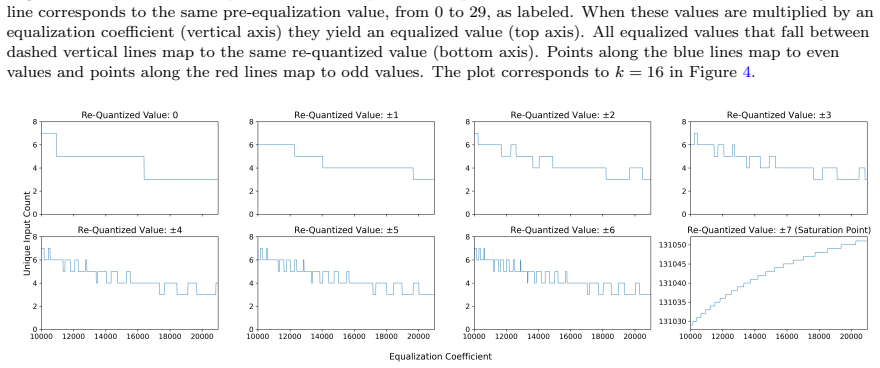
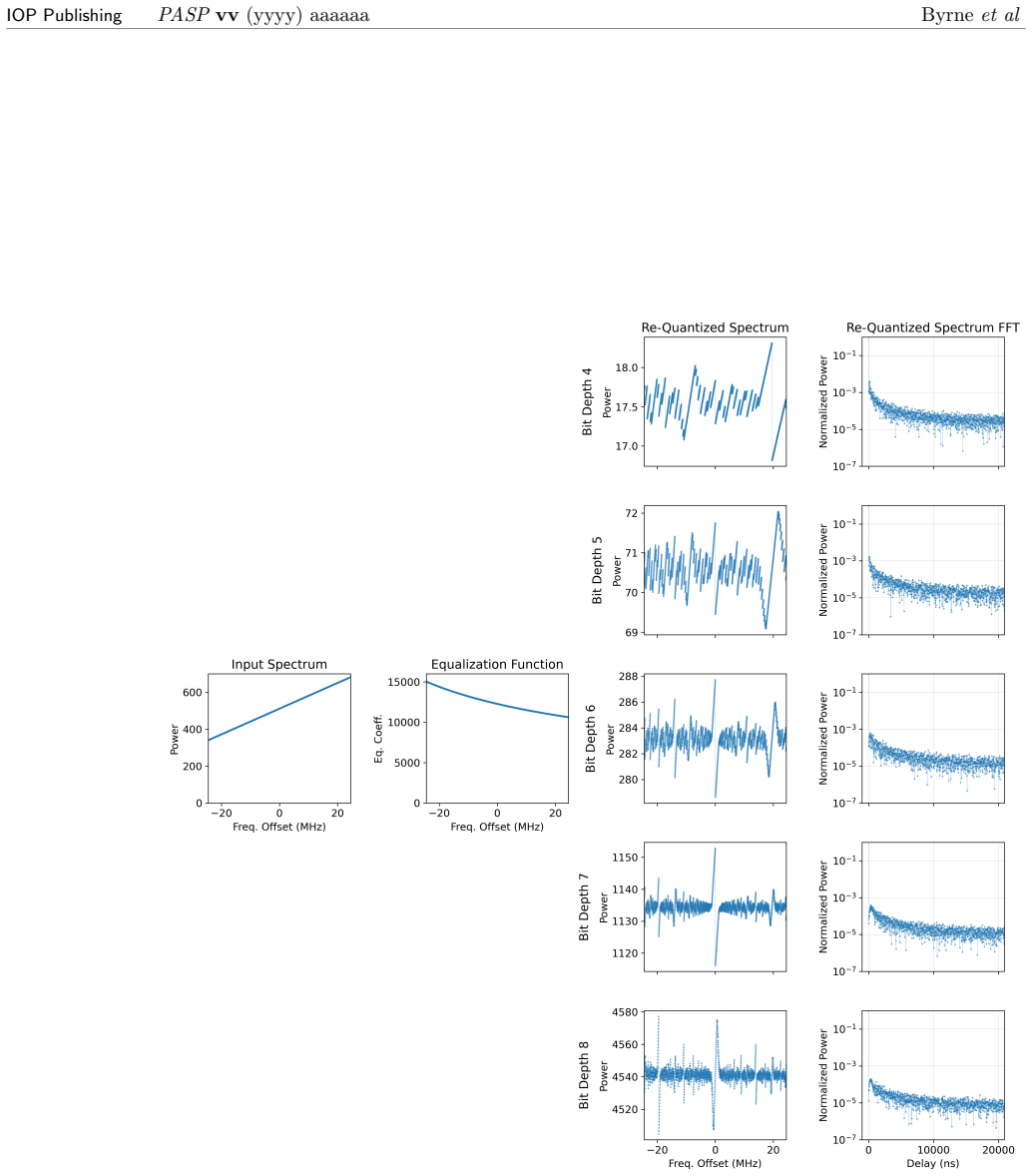
The central claim is that the whitening-plus-re-quantization sequence, routinely used to enable efficient low-bit processing of wideband radio signals, creates a systematic distortion in the telescope's gain-versus-frequency response. This distortion is visible in OVRO-LWA observations and reproduced in simulations; it reaches levels that compromise the spectral precision required for 21 cm cosmology while remaining small enough for most other applications.
What carries the argument
The whitening-plus-re-quantization sequence, which flattens signal power across frequency to fit within a limited number of bits and then re-quantizes the channelized data.
If this is right
- Precision spectral experiments such as 21 cm cosmology must either correct for or avoid the whitening-induced distortion in their data pipelines.
- Choosing a different gain distribution along the analog and digital signal path can substantially reduce the size of the distortion.
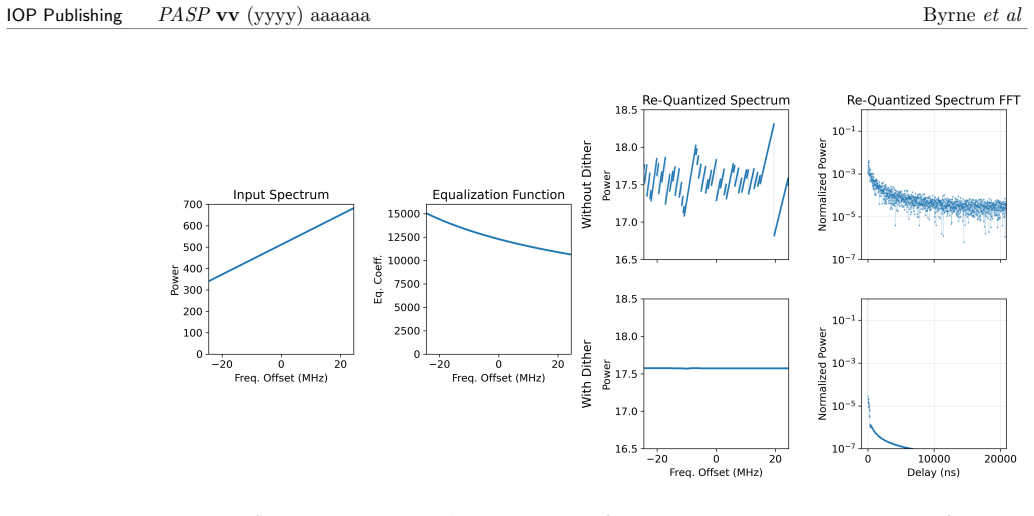
- Adding dithering noise before the re-quantization step further suppresses the systematic error.
- Any telescope using similar wideband digital processing may carry unrecognized spectral artifacts that affect faint-signal science.
- Calibration strategies that assume a smooth instrumental response will need to incorporate this effect to reach the required accuracy.
Where Pith is reading between the lines
- The same processing sequence could introduce comparable artifacts in other radio-astronomy domains that rely on accurate broad-band spectra, such as fast radio burst studies or spectral-line surveys.
- Future instrument designs could embed dithering hardware at the re-quantization stage to eliminate the distortion at the source rather than correcting it later.
- The effect may interact with existing calibration models, suggesting that joint fitting of whitening parameters with other instrumental terms could improve overall data fidelity.
Load-bearing premise
The distortion measured in OVRO-LWA data and simulations is caused specifically by the whitening and re-quantization steps rather than by unrelated instrumental or environmental effects.
What would settle it
High-precision spectral measurements taken with the whitening step deliberately disabled or bypassed, compared directly against the same observations processed through the standard whitening-plus-re-quantization chain, would show whether the distortion disappears.
Figures






read the original abstract
We identify a systematic distortion of the gain-vs.-frequency function of radio telescopes caused by digital flattening ("whitening") of the signal's spectrum followed by re-quantization, a common pair of processes in the signal processing of modern telescopes. Wide-bandwidth telescopes often have a large variation of signal power over frequency. Flattening of the spectrum allows samples of the channelized signal to be represented in a small number of bits, allowing efficient downstream processing. However, we show that this produces subtle systematic error in the measured spectra. We explore this effect in data from the Owens Valley Radio Observatory's Long Wavelength Array (OVRO-LWA) and through detailed semi-analytic simulations. Although the effect can be small so that it has heretofore been unrecognized, we demonstrate that it produces distortion of the spectrum at a level that is problematic for some science, in particular 21 cm cosmology. Finally, we explore mitigation strategies, showing that the effect can be substantially reduced by careful choice of the gain distribution along the signal path or by incorporating dithering in the re-quantization step.
Editorial analysis
A structured set of objections, weighed in public.
Referee Report
Summary. The paper claims that digital whitening (spectral flattening) followed by re-quantization, a common processing step in wide-bandwidth radio telescopes, introduces a subtle but systematic distortion in the measured gain-vs-frequency response. This is demonstrated via OVRO-LWA observations and semi-analytic simulations; the distortion is shown to reach levels problematic for 21 cm cosmology, and mitigation via gain distribution choices or dithering is explored.
Significance. If the attribution holds, the result is significant for precision 21 cm cosmology because it identifies a previously unrecognized instrumental systematic capable of producing spectral structure at levels that can contaminate the cosmological signal. The combination of real telescope data with semi-analytic modeling and the explicit discussion of mitigations constitute a practical contribution to instrument design and data analysis in the field.
major comments (2)
- [§4] §4 (OVRO-LWA data analysis): the observed spectral distortion is attributed to the whitening-plus-re-quantization sequence, yet the manuscript does not present a control dataset acquired with whitening bypassed under otherwise identical conditions; without this isolation, contributions from analog front-end variations, calibration residuals, or environmental effects cannot be ruled out at the required level.
- [§3] §3 (semi-analytic simulations): the model is constructed to embed the whitening and re-quantization steps, so agreement with the OVRO-LWA data demonstrates consistency but does not independently falsify alternative origins; an explicit quantitative error budget comparing predicted versus observed distortion amplitudes (including residual mismatch after mitigation) is needed to establish the mechanism as load-bearing.
minor comments (2)
- Figure captions and axis labels should explicitly state the distortion amplitude in units directly comparable to the expected 21 cm signal (e.g., mK or fractional power) to aid readers in assessing impact.
- The abstract states the effect 'can be small so that it has heretofore been unrecognized'; a brief literature search or citation to prior 21 cm analyses that may have been affected would strengthen context.
Simulated Author's Rebuttal
We thank the referee for their careful and constructive review of our manuscript. The comments highlight important aspects of evidence presentation that we address point by point below. We have revised the manuscript accordingly where feasible.
read point-by-point responses
-
Referee: [§4] §4 (OVRO-LWA data analysis): the observed spectral distortion is attributed to the whitening-plus-re-quantization sequence, yet the manuscript does not present a control dataset acquired with whitening bypassed under otherwise identical conditions; without this isolation, contributions from analog front-end variations, calibration residuals, or environmental effects cannot be ruled out at the required level.
Authors: We agree that a direct control dataset with whitening disabled would offer the cleanest isolation. However, the OVRO-LWA digital signal processing chain is hard-wired to apply whitening as a standard step for dynamic-range management, and obtaining an otherwise identical control dataset would require non-trivial hardware reconfiguration that was not available during the observations. The semi-analytic simulations isolate the whitening-plus-re-quantization sequence by design and reproduce both the amplitude and spectral shape of the observed distortion. In the revised manuscript we will expand §4 with a dedicated discussion of alternative origins (analog gain ripples, calibration residuals, and environmental effects), showing that none reproduce the specific frequency-dependent structure seen in the data at the observed level. revision: partial
-
Referee: [§3] §3 (semi-analytic simulations): the model is constructed to embed the whitening and re-quantization steps, so agreement with the OVRO-LWA data demonstrates consistency but does not independently falsify alternative origins; an explicit quantitative error budget comparing predicted versus observed distortion amplitudes (including residual mismatch after mitigation) is needed to establish the mechanism as load-bearing.
Authors: We accept that a quantitative error budget is required to strengthen the attribution. The revised manuscript will add this analysis to §3, reporting (i) the distortion amplitude predicted by the semi-analytic model, (ii) the amplitude measured in the OVRO-LWA data, (iii) the residual mismatch after each mitigation strategy, and (iv) a direct comparison of how well alternative mechanisms (e.g., analog front-end variations) would match the observed frequency dependence. This will include numerical metrics such as amplitude ratios and goodness-of-fit measures to demonstrate that the whitening model provides the best quantitative description. revision: yes
Circularity Check
No circularity; empirical demonstration and simulations are independent of the target claim
full rationale
The paper identifies a spectral distortion mechanism via direct OVRO-LWA observations and semi-analytic modeling of the whitening-plus-re-quantization chain. No step reduces a claimed prediction or first-principles result to its own inputs by definition, fitted parameter, or self-citation chain. The simulations implement the physical model under test rather than presupposing the measured distortion; comparison to real data therefore constitutes external validation, not tautology. The central attribution is presented as an empirical finding open to alternative explanations, with no load-bearing uniqueness theorem or ansatz imported from prior author work. This is the normal case of a self-contained instrumental analysis.
Axiom & Free-Parameter Ledger
axioms (1)
- domain assumption Wide-bandwidth radio telescopes commonly flatten the signal spectrum before re-quantization to enable efficient low-bit sampling.
discussion (0)
Sign in with ORCID, Apple, or X to comment. Anyone can read and Pith papers without signing in.