Nature of HD 251108: an RS CVn binary with a long-term evolving spot
Pith reviewed 2026-05-25 03:07 UTC · model grok-4.3
The pith
Radial velocity variations in HD 251108 arise from both starspot distortions and orbital motion of a giant with an M-dwarf companion.
A machine-rendered reading of the paper's core claim, the machinery that carries it, and where it could break.
Core claim
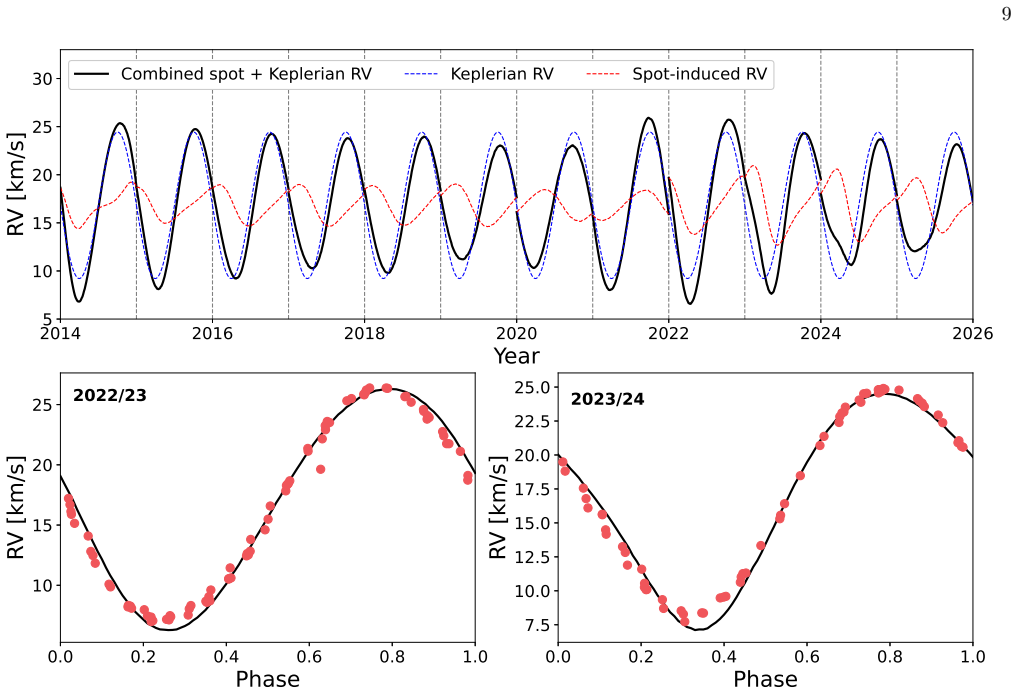
The authors conclude that the observed radial velocity variations in HD 251108 result from both the distortions caused by an evolving starspot on the K-giant primary and the Keplerian orbital motion around a possible M-dwarf companion of approximately 0.25 solar masses. The spot is shown to have migrated from low latitudes to the pole between 2014 and 2020 before receding.
What carries the argument
The large evolving starspot fitted to the long-term light curves, whose migration and size changes explain both photometric variability and part of the radial velocity signal.
If this is right
- The amplitude and shape changes in the light curve are driven by the spot's evolution and poleward migration.
- The radial velocity signal contains a component from spot-induced line profile distortions in addition to the orbital motion.
- A low-mass M-dwarf companion is detectable once the activity contribution is modeled.
- Stellar magnetic activity produces a notable effect on radial velocity measurements in active RS CVn binaries.
Where Pith is reading between the lines
- Similar spot-induced RV signals could lead to false positives in companion searches around other active giants.
- Continued monitoring might reveal whether the spot migration pattern repeats on a longer cycle.
- The separation method could be applied to other RS CVn systems where activity and orbit signals overlap.
Load-bearing premise
The 12-year photometric modulation can be fully explained by the evolution and migration of a single large spot whose parameters are uniquely determined by light-curve fitting.
What would settle it
Detection of multiple spots or a spot configuration inconsistent with the fitted light-curve model through Doppler imaging would falsify the single-spot interpretation.
Figures


read the original abstract
Recently, the Lobster Eye Imager for Astronomy (LEIA) detected the longest-lasting and most energetic stellar X-ray flare event from HD 251108. In this work, we re-determined the atmospheric parameters of HD 251108 using three spectroscopic observations obtained with the 2.4 m Lijiang Telescope. Combined with the stellar radius derived from spectral energy distribution fitting, we found that HD 251108 contains a K-type giant with a mass of approximately 1.3 $M_{\odot}$. Long-term photometric monitoring over 12 years reveals a modulation suggestive of a stellar activity cycle, but inconclusive given the limited time span to date. Light curve fitting indicates that the variations in both amplitude and shape are primarily driven by the evolution of a large spot. The fitting further indicates that the spot migrated from low latitudes toward the pole between 2014 and 2020, and began to recede from the pole after 2022. Using spot parameters from light curve fitting, we found that the observed radial velocity variations arise from both the spot-induced distortions and the Keplerian orbital motion of the giant star. Additionally, we detect a possible M-dwarf companion with a mass of approximately 0.25 $M_{\odot}$. Our finding suggests a notable effect on the radial velocity caused by stellar magnetic activity.
Editorial analysis
A structured set of objections, weighed in public.
Referee Report
Summary. The paper claims that HD 251108 is an RS CVn binary consisting of a ~1.3 M⊙ K-type giant and a possible ~0.25 M⊙ M-dwarf companion. Long-term (12-year) photometry is interpreted as arising from the evolution and poleward migration of a single large spot, with the observed RV variations decomposed into spot-induced distortions plus Keplerian orbital motion using the fitted spot parameters from the light curves.
Significance. If the single-spot photometric model is shown to be unique and the RV subtraction robust, the result would illustrate the magnitude of activity-induced RV signals in RS CVn systems and add a low-mass companion detection to the sample of active binaries. The work also provides a concrete example of using multi-year photometry to track spot migration, but the limited RV sampling and absence of model-validation tests limit its immediate utility for activity mitigation in exoplanet searches.
major comments (3)
- [Abstract / light-curve fitting] Abstract and light-curve fitting paragraph: the claim that photometric variations 'are primarily driven by the evolution of a large spot' whose latitude, size, and contrast are recoverable from the data is presented without reported parameter uncertainties, χ² values, or explicit comparison to multi-spot or fixed-latitude alternatives; these parameters are subsequently used to compute and subtract the activity RV component, rendering the uniqueness assumption load-bearing for the companion-mass result.
- [RV analysis] RV analysis paragraph: the decomposition of the three available RV epochs into spot-induced plus Keplerian signals yields a ~0.25 M⊙ companion, yet no sensitivity tests, covariance between spot and orbital parameters, or independent constraint on orbital period are provided; any residual mismatch in the adopted spot model is therefore absorbed into the orbital solution.
- [Spectroscopic analysis] Atmospheric parameters and mass determination: the primary mass of ~1.3 M⊙ is obtained from three spectra plus SED radius, but the manuscript supplies neither formal error bars on Teff, log g, or [Fe/H] nor a comparison to evolutionary tracks, directly affecting the derived companion mass.
minor comments (1)
- [Abstract] The abstract describes the 12-year modulation as 'suggestive' and 'inconclusive' yet draws firm conclusions on spot migration and companion mass without qualifying the data limitations in the same paragraph.
Simulated Author's Rebuttal
We thank the referee for the constructive report. We address each major comment below and will revise the manuscript to add the requested statistical details, tests, and comparisons.
read point-by-point responses
-
Referee: [Abstract / light-curve fitting] Abstract and light-curve fitting paragraph: the claim that photometric variations 'are primarily driven by the evolution of a large spot' whose latitude, size, and contrast are recoverable from the data is presented without reported parameter uncertainties, χ² values, or explicit comparison to multi-spot or fixed-latitude alternatives; these parameters are subsequently used to compute and subtract the activity RV component, rendering the uniqueness assumption load-bearing for the companion-mass result.
Authors: We agree that uncertainties, χ² values, and model comparisons were not reported. In revision we will include best-fit spot parameters with uncertainties, χ² for the adopted model, and direct comparisons to multi-spot and fixed-latitude alternatives to demonstrate that the single evolving spot is preferred. This will support the subsequent use of these parameters for RV decomposition. revision: yes
-
Referee: [RV analysis] RV analysis paragraph: the decomposition of the three available RV epochs into spot-induced plus Keplerian signals yields a ~0.25 M⊙ companion, yet no sensitivity tests, covariance between spot and orbital parameters, or independent constraint on orbital period are provided; any residual mismatch in the adopted spot model is therefore absorbed into the orbital solution.
Authors: Only three RV epochs are available, which is a data limitation we will state more explicitly. We will add sensitivity tests by varying spot parameters within uncertainties and examining effects on the orbital solution, plus a discussion of parameter covariance. The photometric modulation period provides the only available constraint on the activity-related timescale; we will emphasize that the companion mass is tentative and that additional RV data would be required for a fully independent period. revision: partial
-
Referee: [Spectroscopic analysis] Atmospheric parameters and mass determination: the primary mass of ~1.3 M⊙ is obtained from three spectra plus SED radius, but the manuscript supplies neither formal error bars on Teff, log g, or [Fe/H] nor a comparison to evolutionary tracks, directly affecting the derived companion mass.
Authors: We will add formal uncertainties on Teff, log g, and [Fe/H] from the spectroscopic fits. We will also include a comparison of the derived parameters to evolutionary tracks to justify the ~1.3 M⊙ mass and propagate uncertainties to the companion mass. revision: yes
Circularity Check
No circularity; standard two-dataset modeling with independent RV constraints
full rationale
The paper fits spot parameters (latitude, size, contrast, migration) exclusively to the 12-year photometric time series, then incorporates those fixed parameters into a joint model of the three available RV epochs as spot-induced distortion plus Keplerian orbit. The orbital elements (including the claimed 0.25 M⊙ companion) are therefore constrained by the RV measurements themselves rather than being algebraically or statistically forced by the photometric fit. No self-citation chain, uniqueness theorem, or redefinition of a fitted quantity as a prediction appears in the abstract or described derivation. The separation is an assumption-dependent modeling choice, not a definitional reduction.
Axiom & Free-Parameter Ledger
free parameters (3)
- spot latitude, size, and contrast
- stellar mass ~1.3 M_sun
- companion mass ~0.25 M_sun
axioms (2)
- domain assumption Photometric variations are produced by a single evolving starspot on a rotating giant
- standard math Standard stellar evolution and atmosphere models apply to the K-giant primary
Reference graph
Works this paper leans on
-
[1]
Amado, P. J., Cutispoto, G., Lanza, A. F., & Rodon` o, M. 2001, in Astronomical Society of the Pacific Conference
work page 2001
-
[2]
2019, A&A, 628, A94, doi: 10.1051/0004-6361/201935765
Anders, F., Khalatyan, A., Chiappini, C., et al. 2019, A&A, 628, A94, doi: 10.1051/0004-6361/201935765
-
[3]
Demleitner, M., & Andrae, R. 2021, AJ, 161, 147, doi: 10.3847/1538-3881/abd806
work page internal anchor Pith review doi:10.3847/1538-3881/abd806 2021
-
[4]
Berdyugina, S. V. 2005, Living Reviews in Solar Physics, 2, 8, doi: 10.12942/lrsp-2005-8
-
[5]
1938, Astronomische Nachrichten, 264, 361, doi: 10.1002/asna.19372642202 —
Biermann, L. 1938, Astronomische Nachrichten, 264, 361, doi: 10.1002/asna.19372642202 —. 1948, ZA, 25, 135
-
[6]
Boller, T., Freyberg, M. J., Tr¨ umper, J., et al. 2016, A&A, 588, A103, doi: 10.1051/0004-6361/201525648
-
[7]
Chen, B. Q., Huang, Y., Yuan, H. B., et al. 2019, MNRAS, 483, 4277, doi: 10.1093/mnras/sty3341
-
[8]
2011, A&A, 529, A75, doi: 10.1051/0004-6361/201116451
Claret, A., & Bloemen, S. 2011, A&A, 529, A75, doi: 10.1051/0004-6361/201116451
-
[9]
E., Kochoska, A., Hey, D., et al
Conroy, K. E., Kochoska, A., Hey, D., et al. 2020, ApJS, 250, 34, doi: 10.3847/1538-4365/abb4e2
-
[10]
2025, A&A, 697, A201, doi: 10.1051/0004-6361/202553825 Gaia Collaboration, Brown, A
Fuhrmeister, B., Mittag, M., Czesla, S., et al. 2025, A&A, 697, A201, doi: 10.1051/0004-6361/202553825 Gaia Collaboration, Brown, A. G. A., Vallenari, A., et al. 2021, A&A, 649, A1, doi: 10.1051/0004-6361/202039657
-
[11]
2007, A&A, 464, 1101, doi: 10.1051/0004-6361:20066751 G¨ unther, H
Gondoin, P. 2007, A&A, 464, 1101, doi: 10.1051/0004-6361:20066751 G¨ unther, H. M., Pasham, D., Binks, A., et al. 2024, ApJ, 977, 6, doi: 10.3847/1538-4357/ad8b2c
-
[12]
Hackman, T., Pelt, J., Mantere, M. J., et al. 2013, A&A, 553, A40, doi: 10.1051/0004-6361/201220690
-
[13]
Horvat, M., Conroy, K. E., Pablo, H., et al. 2018, ApJS, 237, 26, doi: 10.3847/1538-4365/aacd0f
-
[14]
Hutchinson, B. 2025, ApJ, 984, 58, doi: 10.3847/1538-4357/adc2fa
-
[15]
Ibanoglu, C., Keskin, V., Akan, M. C., Evren, S., & Tunca, Z. 1994, A&A, 281, 811
work page 1994
-
[16]
Kiraga, M. 2012, AcA, 62, 67, doi: 10.48550/arXiv.1204.3825
work page internal anchor Pith review Pith/arXiv arXiv doi:10.48550/arxiv.1204.3825 2012
-
[17]
2025, ApJ, 980, 268, doi: 10.3847/1538-4357/ada698
Mao, X., Liu, H.-Y., Wang, S., et al. 2025, ApJ, 980, 268, doi: 10.3847/1538-4357/ada698
-
[18]
2024, A&A, 682, A34, doi: 10.1051/0004-6361/202347165
Merloni, A., Lamer, G., Liu, T., et al. 2024, A&A, 682, A34, doi: 10.1051/0004-6361/202347165
work page internal anchor Pith review doi:10.1051/0004-6361/202347165 2024
-
[19]
2011, Astronomische Nachrichten, 332, 866, doi: 10.1002/asna.201111592
Morgenthaler, A., Petit, P., Morin, J., et al. 2011, Astronomische Nachrichten, 332, 866, doi: 10.1002/asna.201111592
-
[20]
Morton, T. D. 2015, isochrones: Stellar model grid package. http://ascl.net/1503.010
work page 2015
-
[21]
1997, A&A, 321, 811 Ol´ ah, K., Strassmeier, K
Olah, K., K˝ ov´ ari, Z., Bartus, J., et al. 1997, A&A, 321, 811 Ol´ ah, K., Strassmeier, K. G., & Granzer, T. 2002, Astronomische Nachrichten, 323, 453, doi: 10.1002/1521-3994(200210)323:5⟨453:: AID-ASNA453⟩3.0.CO;2-Y Ol´ ah, K., Seli, B., Haris, A., et al. 2025, A&A, 698, A150, doi: 10.1051/0004-6361/202553772 11 ¨Ozdarcan, O., Carroll, T. A., K¨ unstle...
-
[22]
Henry, G. W. 2010, Astronomische Nachrichten, 331, 794, doi: 10.1002/asna.201011413
-
[23]
2021, A&A, 647, A1, doi: 10.1051/0004-6361/202039313
Predehl, P., Andritschke, R., Arefiev, V., et al. 2021, A&A, 647, A1, doi: 10.1051/0004-6361/202039313
-
[24]
Press, W. H., & Rybicki, G. B. 1989, ApJ, 338, 277, doi: 10.1086/167197 Prˇ sa, A., Conroy, K. E., Horvat, M., et al. 2016, ApJS, 227, 29, doi: 10.3847/1538-4365/227/2/29 Rib´ arik, G., Ol´ ah, K., & Strassmeier, K. G. 2003, Astronomische Nachrichten, 324, 202, doi: 10.1002/asna.200310088
-
[25]
Strassmeier, K. G. 1999, A&A, 347, 225 —. 2009, A&A Rv, 17, 251, doi: 10.1007/s00159-009-0020-6
- [26]
-
[27]
Strassmeier, K. G., Hall, D. S., Fekel, F. C., & Scheck, M. 1993, A&AS, 100, 173
work page 1993
- [28]
-
[29]
Vogt, S. S., Hatzes, A. P., Misch, A. A., & K¨ urster, M. 1999, ApJS, 121, 547, doi: 10.1086/313195
-
[30]
2019, Research in Astronomy and Astrophysics, 19, 149, doi: 10.1088/1674-4527/19/10/149
Wang, C.-J., Bai, J.-M., Fan, Y.-F., et al. 2019, Research in Astronomy and Astrophysics, 19, 149, doi: 10.1088/1674-4527/19/10/149
-
[31]
2020, ApJ, 902, 114, doi: 10.3847/1538-4357/abb66d
Wang, S., Bai, Y., He, L., & Liu, J. 2020, ApJ, 902, 114, doi: 10.3847/1538-4357/abb66d
-
[32]
2024, ApJ, 963, 160, doi: 10.3847/1538-4357/ad1e64 12Zhao et al
Zhao, X., Wang, S., Li, X., et al. 2024, ApJ, 963, 160, doi: 10.3847/1538-4357/ad1e64 12Zhao et al. T able A.3.RV measurements for HD 251108 from the TIGRE telescope. BJD RV Uncertainty SNR BJD RV Uncertainty SNR (day) (km/s) (km/s) (day) (km/s) (km/s) 2459895.80302 8.10 0.23 55.9 2459977.69901 14.09 0.22 88.5 2459896.79183 7.36 0.24 50.4 2459980.70399 7....
discussion (0)
Sign in with ORCID, Apple, or X to comment. Anyone can read and Pith papers without signing in.