Bias-Preserving Gates and Quantum Error Correction With Dual-Rail Cat Codes
Pith reviewed 2026-07-02 11:57 UTC · model grok-4.3
The pith
The dual-rail cat code combines cat and dual-rail encodings to support bias-preserving logical gates using only beam-splitter interactions while enabling deterministic photon-loss correction.
A machine-rendered reading of the paper's core claim, the machinery that carries it, and where it could break.
Core claim
The dual-rail cat code is formed by concatenating an inner cat code with an outer dual-rail structure. This yields a bosonic encoding that inherits bias-tailored error correction from the cat code and converts photon-loss errors into detectable erasures via the dual-rail layer. A universal gate set is built from beam-splitter interactions alone, with every logical operation preserving the erasure-biased noise. The code supports deterministic erasure detection and correction, produces no relative geometric phases in gates, and allows syndrome extraction to run simultaneously with stabilization.
What carries the argument
The dual-rail cat code (DRCC), a concatenation of an inner cat code and an outer dual-rail encoding, which transmits bias preservation and erasure detection through the logical operations.
If this is right
- Universal logical gates are realized using only beam-splitter interactions.
- All logical operations preserve the erasure-biased noise structure.
- Deterministic single-photon-loss correction is achieved by further concatenation with an outer repetition code.
- No relative geometric phases appear during the gate operations.
- Syndrome extraction proceeds simultaneously without interrupting stabilization.
Where Pith is reading between the lines
- The construction could be paired with other outer codes to reach higher logical distances while retaining the bias.
- Bias preservation may reduce the number of physical resources needed for fault tolerance on hardware that already favors erasure errors.
- Direct tests of the beam-splitter gates in a photonic or circuit-QED platform could check whether new error channels remain suppressed.
Load-bearing premise
That concatenating the inner cat code with the outer dual-rail structure inherits the advantages of both without introducing new dominant error channels or breaking the bias-preserving property of the gates.
What would settle it
An observation of a relative geometric phase arising during beam-splitter gate operations on dual-rail cat code states would show the phase-absence claim is incorrect.
Figures
read the original abstract
Scalable fault-tolerant quantum computation requires quantum error-correcting codes that simultaneously support universal logical operations, suppress hardware-specific noise, and enable efficient handling of photon-loss errors. Bosonic encodings such as the dual-rail and cat codes each offer attractive features but also exhibit important limitations when used in isolation. The dual-rail code enables efficient single-photon-loss detection by converting leakage out of the computational subspace induced by photon-loss errors into an erasure error. In contrast, the cat code provides a resource-efficient, bias-tailored error-correction scheme with bias-preserving logical gate operations. Here, we introduce the dual-rail cat code (DRCC), a concatenated bosonic encoding that combines an inner cat code with an outer dual-rail structure, thereby inheriting and enhancing the advantages of both constituent codes. We analyse the error-correction properties of the DRCC and propose a deterministic single-photon-loss correction protocol by concatenating it with an outer repetition code. Exploiting the code's intrinsic noise bias, we construct a universal set of logical gates using only beam-splitter interactions and demonstrate that all logical operations preserve the erasure-biased noise structure. The DRCC offers several distinctive advantages, including the absence of relative geometric phases during gate operations, deterministic erasure detection and correction, and simultaneous syndrome extraction without interrupting stabilisation. These features make the DRCC a promising bosonic code for hardware-efficient, bias-preserving, and erasure-resilient fault-tolerant quantum computation.
Editorial analysis
A structured set of objections, weighed in public.
Referee Report
Summary. The manuscript introduces the dual-rail cat code (DRCC), a concatenated bosonic encoding that places an inner cat code inside an outer dual-rail structure. It claims to analyze the resulting error-correction properties, propose a deterministic single-photon-loss correction protocol obtained by further concatenation with an outer repetition code, construct a universal gate set realized solely with beam-splitter interactions that preserves the erasure-biased noise structure, and identify distinctive operational advantages including the absence of relative geometric phases, deterministic erasure detection, and simultaneous syndrome extraction without interrupting stabilization.
Significance. If the explicit constructions and error-channel analysis hold, the DRCC would constitute a concrete bosonic-code architecture that simultaneously achieves bias preservation, hardware-efficient photon-loss handling, and erasure resilience. Such a combination addresses two central obstacles to scalable bosonic fault tolerance and could therefore influence subsequent experimental and theoretical work on concatenated bosonic encodings.
major comments (2)
- [Abstract] Abstract and main text: the central claim that concatenation 'inherits and enhances the advantages of both constituent codes' without introducing new dominant error channels is stated without any derivation of the effective logical error channel, any explicit beam-splitter gate Hamiltonians, or any threshold calculation; the load-bearing assertion that bias preservation survives concatenation therefore cannot be verified from the supplied material.
- [Abstract] The deterministic single-photon-loss correction protocol obtained by concatenating the DRCC with an outer repetition code is described only at the level of the abstract; no syndrome-extraction circuit, no repetition-code stabilizer measurements, and no analysis of the resulting logical error rate appear, leaving the claim of 'deterministic erasure detection and correction' unsubstantiated.
minor comments (1)
- The acronym DRCC is introduced in the abstract but the title uses the plural 'Dual-Rail Cat Codes'; consistent nomenclature should be adopted throughout.
Simulated Author's Rebuttal
We thank the referee for their thoughtful review and for highlighting areas where additional detail would strengthen the presentation. We address each major comment below and will revise the manuscript accordingly to make the supporting derivations and circuits explicit.
read point-by-point responses
-
Referee: [Abstract] Abstract and main text: the central claim that concatenation 'inherits and enhances the advantages of both constituent codes' without introducing new dominant error channels is stated without any derivation of the effective logical error channel, any explicit beam-splitter gate Hamiltonians, or any threshold calculation; the load-bearing assertion that bias preservation survives concatenation therefore cannot be verified from the supplied material.
Authors: We agree that the abstract and introductory claims would benefit from explicit supporting derivations. The manuscript contains an analysis of the DRCC error-correction properties and constructs the universal gate set via beam-splitter interactions while showing preservation of the erasure-biased structure. To make bias preservation after concatenation fully verifiable, we will add a new subsection deriving the effective logical error channel and providing the explicit beam-splitter Hamiltonians. No numerical threshold calculation is performed in the present work, which focuses on code construction and gate design rather than full fault-tolerance thresholds; we will state this scope limitation clearly in the revision. revision: yes
-
Referee: [Abstract] The deterministic single-photon-loss correction protocol obtained by concatenating the DRCC with an outer repetition code is described only at the level of the abstract; no syndrome-extraction circuit, no repetition-code stabilizer measurements, and no analysis of the resulting logical error rate appear, leaving the claim of 'deterministic erasure detection and correction' unsubstantiated.
Authors: We acknowledge that the protocol is introduced at a high level. The manuscript proposes the outer repetition-code concatenation for deterministic correction, but the explicit circuit, stabilizer measurements, and logical-error-rate analysis are not yet included. We will add a dedicated section containing the syndrome-extraction circuit, the repetition-code stabilizers, and a brief analysis of the resulting logical error rate to substantiate the deterministic erasure detection and correction claim. revision: yes
Circularity Check
No significant circularity; derivation self-contained on abstract inspection
full rationale
The abstract presents a proposal for the dual-rail cat code (DRCC) as a concatenated bosonic encoding, followed by direct analysis of its error-correction properties, a deterministic photon-loss correction protocol, and construction of bias-preserving logical gates via beam-splitter interactions. No equations, fitted parameters, or self-citations are referenced. Claims rest on explicit construction and analysis of the new code rather than reduction to prior fitted quantities or self-referential definitions. The central assertions (inheritance of advantages without new dominant channels, bias preservation) are presented as outcomes of the proposed structure itself, with no load-bearing steps that collapse by construction to inputs. This is the expected honest non-finding for a proposal paper whose full derivations have not yet been shown to contain the enumerated circular patterns.
Axiom & Free-Parameter Ledger
invented entities (1)
-
dual-rail cat code (DRCC)
no independent evidence
Reference graph
Works this paper leans on
-
[1]
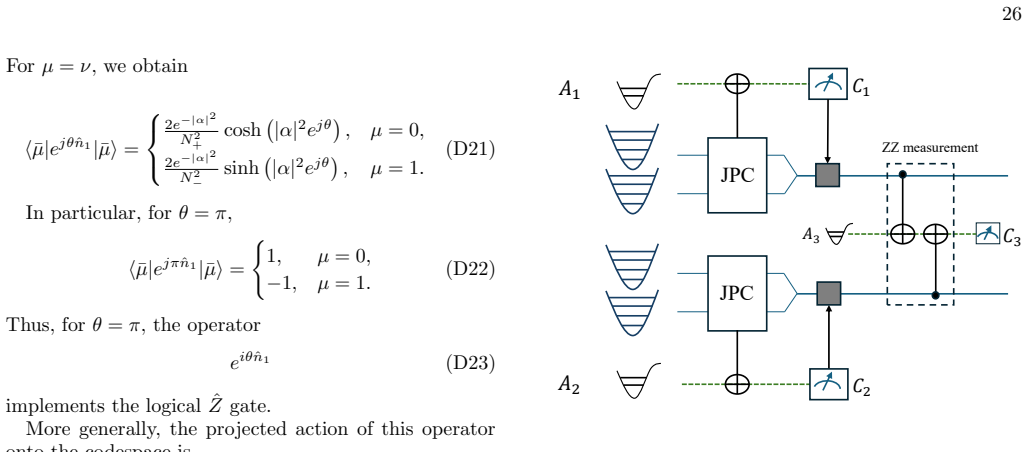
Joint parity check For the syndrome detection of leakage errors with the standard dual-rail code, Ref.[20] uses a joint parity check scheme with an auxiliary (transmon) qubit and the fol- lowing unitary operation: ˆUPC = ˆI⊗ |g⟩⟨g|+e −jπ(ˆn1+ˆn2) ⊗ |e⟩⟨e|.(77) However, using this unitary would require stopping the stabilisation, even if we consider the di...
-
[2]
11 Following Ref
Computational basis measurement To complete the discussion on the universal control of DRCC-1 qubits, we discuss measurements in the compu- tational (Z) basis, denoted byM Z. 11 Following Ref. [48], we first consider the resonator- assisted interaction Hamiltonian ˆH r MZ = J 2 (ˆn1 −ˆn2)(ˆar + ˆa† r),(81) where ˆar is the annihilation operator of the aux...
-
[3]
Hence, the code in Eq.(84) approximately satisfies the KL condition for all first-order photon-loss errors
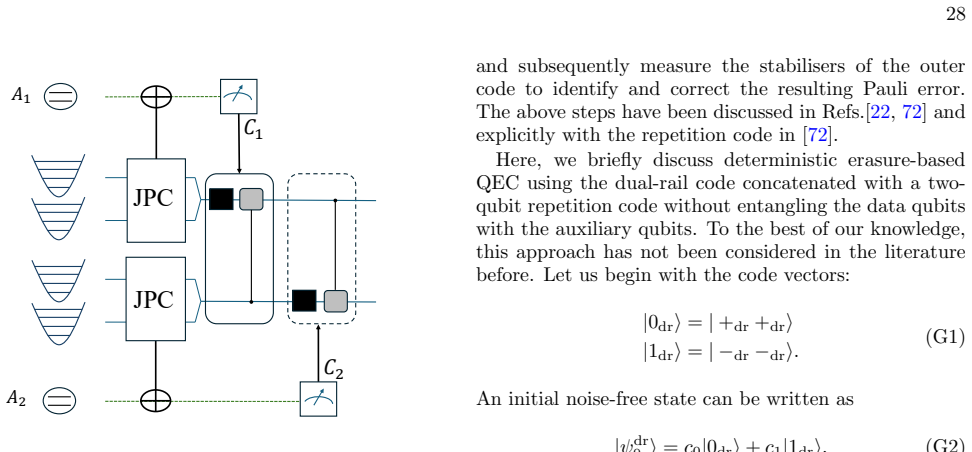
Similarly, one can verify that ˆ¯P2ˆa† i ˆaj ˆ¯P2 = 0 for all i̸=j. Hence, the code in Eq.(84) approximately satisfies the KL condition for all first-order photon-loss errors. Consequently, the DRCC-1 concatenated with the two- qubit repetition code corrects all first-order photon-loss errors in the largeαregime. We now focus on a simplified QEC protocol ...
-
[4]
The KL conditions can be studied using the same first-order photon-loss and first-order dephasing opera- tors considered for the DRCC-1. With the first-order photon loss and dephasing operators and for the BS an- gleδ=ϕ=π/4, we obtain the following relations ˆP4ˆa† 1ˆa1 ˆP4 = ˆP4( ˆU † BSˆa† 1ˆa1 ˆUBS) ˆP4 = 1 2 ˆP4(ˆa† 1 + ˆa† 2)(ˆa1 + ˆa2) ˆP4 = 1 2(⟨ˆn...
-
[5]
Gottesman, A
D. Gottesman, A. Kitaev, and J. Preskill, Encoding a qubit in an oscillator, Phys. Rev. A64, 012310 (2001)
2001
- [6]
-
[7]
S. Puri, L. St-Jean, J. A. Gross, A. Grimm, N. E. Frattini, P. S. Iyer, A. Krishna, S. Touzard, L. Jiang, A. Blais, S. T. Flammia, and S. M. Girvin, Bias- preserving gates with stabilized cat qubits, Science Ad- vances6, 10.1126/sciadv.aay5901 (2020)
-
[8]
D. K. Tuckett, S. D. Bartlett, and S. T. Flammia, Ul- trahigh Error Threshold for Surface Codes with Biased Noise, Physical Review Letters120, 050505 (2018)
2018
-
[9]
J. P. Bonilla Ataides, D. K. Tuckett, S. D. Bartlett, S. T. Flammia, and B. J. Brown, The XZZX surface code, Na- ture Communications12, 2172 (2021)
2021
-
[10]
Srivastava, A
B. Srivastava, A. Frisk Kockum, and M. Granath, The XYZ2 hexagonal stabilizer code, Quantum6, 698 (2022)
2022
-
[11]
A. Dua, A. Kubica, L. Jiang, S. T. Flammia, and M. J. Gullans, Clifford-deformed surface codes, PRX Quantum 5, 010347 (2024)
2024
-
[12]
Denys and A
A. Denys and A. Leverrier, Quantum error-correcting codes with a covariant encoding, Phys. Rev. Lett.133, 240603 (2024)
2024
-
[13]
Hillmann and F
T. Hillmann and F. Quijandr´ ıa, Quantum error cor- rection with dissipatively stabilized squeezed-cat qubits, Physical Review A107, 032423 (2023)
2023
-
[14]
Q. Xu, G. Zheng, Y.-X. Wang, P. Zoller, A. A. Clerk, and L. Jiang, Autonomous quantum error correction and fault-tolerant quantum computation with squeezed cat qubits, npj Quantum Information9, 78 (2023)
2023
-
[15]
Mirrahimi, Z
M. Mirrahimi, Z. Leghtas, V. V. Albert, S. Touzard, R. J. Schoelkopf, L. Jiang, and M. H. Devoret, Dynamically protected cat-qubits: a new paradigm for universal quan- tum computation, New Journal of Physics16, 045014 (2014)
2014
-
[16]
Guillaud and M
J. Guillaud and M. Mirrahimi, Repetition cat qubits for fault-tolerant quantum computation, Phys. Rev. X9, 041053 (2019)
2019
-
[17]
Puttermanet al., Hardware-efficient quantum error correction via concatenated bosonic qubits, Nature638, 927–934 (2025)
H. Puttermanet al., Hardware-efficient quantum error correction via concatenated bosonic qubits, Nature638, 927–934 (2025)
2025
-
[18]
A. Kruckenhauser, M. Yuan, H. Zheng, M. Mamaev, P. Zeng, X. Mao, Q. Xu, T. V. Zache, L. Jiang, R. van Bi- jnen, and P. Zoller, Dark spin-cat states as biased qubits, Physical Review Letters135, 10.1103/w9zh-jwsx (2025)
-
[19]
I. L. Chuang and Y. Yamamoto, Simple quantum com- puter, Physical Review A52, 3489–3496 (1995)
1995
- [20]
-
[21]
Knill, R
E. Knill, R. Laflamme, and G. J. Milburn, A scheme for efficient quantum computation with linear optics, Nature 409, 46 (2001)
2001
-
[22]
Knill, Bounds on the probability of success of postse- lected nonlinear sign shifts implemented with linear op- tics, Physical Review A68, 064303 (2003)
E. Knill, Bounds on the probability of success of postse- lected nonlinear sign shifts implemented with linear op- tics, Physical Review A68, 064303 (2003)
2003
-
[23]
Kubica, A
A. Kubica, A. Haim, Y. Vaknin, H. Levine, F. Brand˜ ao, and A. Retzker, Erasure qubits: Overcoming the t 1 limit in superconducting circuits, Physical Review X13, 041022 (2023)
2023
-
[24]
J. D. Teoh, P. Winkel, H. K. Babla, B. J. Chap- man, J. Claes, S. J. de Graaf, J. W. O. Garmon, W. D. Kalfus, Y. Lu, A. Maiti, K. Sahay, N. Thakur, T. Tsunoda, S. H. Xue, L. Frunzio, S. M. Girvin, S. Puri, and R. J. Schoelkopf, Dual-rail encoding with superconducting cavities, Proceedings of the Na- tional Academy of Sciences120, e2221736120 (2023), https...
-
[25]
S. Gu, A. Retzker, and A. Kubica, Fault-tolerant quan- tum architectures based on erasure qubits, Phys. Rev. Res.7, 013249 (2025)
2025
-
[26]
Chang, S
K. Chang, S. Singh, J. Claes, K. Sahay, J. Teoh, and S. Puri, Surface code with imperfect erasure checks, PRX Quantum6, 040355 (2025)
2025
-
[27]
Bias-preserving and error- detectable entangling operations in a superconduct- ing dual-rail system
N. Mehta, J. D. Teoh, T. Noh, A. Agrawal, A. Ander- son, B. Birdsall, A. Brahmbhatt, W. Byrd, M. Cacioppo, A. Cabrera,et al., Bias-preserving and error-detectable entangling operations in a superconducting dual-rail sys- tem, arXiv preprint arXiv:2503.10935 (2025)
-
[28]
R. G. Ahmed, A. Udupa, and G. Ferrini, Multimode ro- tationally symmetric bosonic codes from group-theoretic construction, Physical Review Research8, 10.1103/xt48- fxt5 (2026)
- [29]
-
[30]
V. G. Matsos, C. H. Valahu, T. Navickas, A. D. Rao, M. J. Millican, X. C. Kolesnikow, M. J. Biercuk, and T. R. Tan, Robust and deterministic preparation of bosonic logical states in a trapped ion, Phys. Rev. Lett. 133, 050602 (2024)
2024
-
[31]
Wang, D.-Y
J. Wang, D.-Y. Huang, X.-L. Zhou, Z.-M. Shen, S.-J. He, Q.-Y. Huang, Y.-J. Liu, C.-F. Li, and G.-C. Guo, Ultra- fast high-fidelity state readout of single neutral atom, Phys. Rev. Lett.134, 240802 (2025)
2025
-
[32]
L. H. Bohnmann, D. F. Locher, J. Zeiher, and M. M¨ uller, Bosonic quantum error correction with neu- tral atoms in optical dipole traps, Physical Review A 111, 10.1103/physreva.111.022432 (2025)
-
[33]
V. V. Albert, S. O. Mundhada, A. Grimm, S. Touzard, M. H. Devoret, and L. Jiang, Pair-cat codes: autonomous error-correction with low-order nonlinearity, Quantum Science and Technology4, 035007 (2019)
2019
- [34]
-
[35]
A. L. Grimsmo, J. Combes, and B. Q. Baragiola, Quan- tum computing with rotation-symmetric bosonic codes, Physical Review X10, 011058 (2020)
2020
-
[36]
Y. Zeng, F. Quijandr´ ıa, C. Gneiting, and F. Nori, Quan- tum error correction with superpositions of squeezed fock states (2025), arXiv:2510.04209 [quant-ph]
work page internal anchor Pith review Pith/arXiv arXiv 2025
-
[37]
D. J. Brod and M. Oszmaniec, Classical simulation of linear optics subject to nonuniform losses, Quantum4, 267 (2020)
2020
-
[38]
M. Papiˇ c, A. Auer, and I. de Vega, Fast estimation of physical error contributions of quantum gates, arXiv preprint arXiv:2305.08916 (2023)
-
[39]
Knill, R
E. Knill, R. Laflamme, and L. Viola, Theory of quantum error correction for general noise, Phys. Rev. Lett.84, 2525 (2000)
2000
-
[40]
M. A. Nielsen and I. L. Chuang,Quantum Computation and Quantum Information(Cambridge University Press, 2000)
2000
-
[41]
D. P. DiVincenzo, The physical implementation of quan- tum computation, Fortschritte der Physik48, 771–783 (2000)
2000
-
[42]
Zanardi and L
P. Zanardi and L. Campos Venuti, Coherent quantum dy- namics in steady-state manifolds of strongly dissipative systems, Phys. Rev. Lett.113, 240406 (2014). 22
2014
-
[43]
Facchi and S
P. Facchi and S. Pascazio, Quantum zeno subspaces, Phys. Rev. Lett.89, 080401 (2002)
2002
-
[44]
V. V. Albert, B. Bradlyn, M. Fraas, and L. Jiang, Geom- etry and response of lindbladians, Phys. Rev. X6, 041031 (2016)
2016
-
[45]
Arenz, D
C. Arenz, D. Burgarth, P. Facchi, V. Giovannetti, H. Nakazato, S. Pascazio, and K. Yuasa, Universal con- trol induced by noise, Phys. Rev. A93, 062308 (2016)
2016
-
[46]
M. Yuan, Q. Xu, and L. Jiang, Construction of bias- preserving operations for pair-cat codes, Physical Review A106, 10.1103/physreva.106.062422 (2022)
-
[47]
These states are distinct from the logical states of DRCC-1
Another class of solutions is obtained by choosingC 00 = C11 = 0, which leads to |ξ⟩= X n hkn|2n,2n+ 1⟩, C 01 ̸= 0, C 10 = 0, X n hkn|2n+ 1,2n⟩, C 01 = 0, C 10 ̸= 0, (116) where ˆHkn = α4k √ (2n)!(2n+1)! . These states are distinct from the logical states of DRCC-1. Apart from one cav- ity containing even numbers, the other has odd num- bers of ph...
-
[48]
M. Khanahmadi and K. Mølmer, Environment-assisted generation of non-gaussian wavepacket quantum states (2025), arXiv:2504.04513 [quant-ph]
-
[49]
Gerry and P
C. Gerry and P. Knight,Introductory Quantum Optics (Cambridge University Press, 2004)
2004
- [50]
-
[51]
V. V. Albert, C. Shu, S. Krastanov, C. Shen, R.-B. Liu, Z.-B. Yang, R. J. Schoelkopf, M. Mirrahimi, M. H. De- voret, and L. Jiang, Holonomic quantum control with continuous variable systems, Physical Review Letters 116, 10.1103/physrevlett.116.140502 (2016)
- [52]
-
[53]
A. P. Lund, T. C. Ralph, and H. L. Haselgrove, Fault- tolerant linear optical quantum computing with small- amplitude coherent states, Phys. Rev. Lett.100, 030503 (2008)
2008
-
[54]
A. P. Lund, T. C. Ralph, and H. L. Haselgrove, Fault- tolerant linear optical quantum computing with small- amplitude coherent states, Physical Review Letters100, 10.1103/physrevlett.100.030503 (2008)
-
[55]
A. Messinger, V. Torggler, B. Klaver, M. Fellner, and W. Lechner, Fault-tolerant quantum computing with the parity code and biased-noise qubits, Physical Review Ap- plied23, 10.1103/physrevapplied.23.044032 (2025)
- [56]
-
[57]
Gouzien, D
E. Gouzien, D. Ruiz, F.-M. Le R´ egent, J. Guillaud, and N. Sangouard, Performance analysis of a repetition cat code architecture: Computing 256-bit elliptic curve log- arithm in 9 hours with 126 133 cat qubits, Phys. Rev. Lett.131, 040602 (2023)
2023
-
[58]
Zheng, W
G. Zheng, W. He, G. Lee, and L. Jiang, Near-optimal performance of quantum error correction codes, Physical Review Letters132, 250602 (2024)
2024
-
[59]
Tsunoda, J
T. Tsunoda, J. D. Teoh, W. D. Kalfus, S. J. de Graaf, B. J. Chapman, J. C. Curtis, N. Thakur, S. M. Girvin, and R. J. Schoelkopf, Error-detectable bosonic entan- gling gates with a noisy ancilla, PRX Quantum4, 020354 (2023)
2023
-
[60]
A. S. Fletcher, P. W. Shor, and M. Z. Win, Channel- adapted quantum error correction for the amplitude damping channel, IEEE Transactions on Information Theory54, 5705 (2008)
2008
-
[61]
H. K. Ng and P. Mandayam, Simple approach to approx- imate quantum error correction based on the transpose channel, Phys. Rev. A81, 062342 (2010)
2010
-
[62]
Barnum and E
H. Barnum and E. Knill, Reversing quantum dynamics with near-optimal quantum and classical fidelity, Journal of Mathematical Physics43, 2097 (2002)
2097
- [63]
- [64]
-
[65]
Biswas, G
D. Biswas, G. M. Vaidya, and P. Mandayam, Noise- adapted recovery circuits for quantum error correction, Phys. Rev. Res.6, 043034 (2024)
2024
-
[66]
D. Biswas and P. Mandayam, Universal syndrome-based recovery for noise-adapted quantum error correction (2025), arXiv:2510.08719 [quant-ph]
-
[67]
Anonymous, Petz recovery maps of single-qubit decoher- ence channels in an ion trap quantum processor, Physical Review A 10.1103/7f8x-n2np (2025)
-
[68]
G. Singh, R. S. Sahani, V. Jagadish, L. Lautenbacher, N. K. Bernardes, and K. Dorai, Realizing the petz recov- ery map on an nmr quantum processor, Physical Review A113, 10.1103/xd6k-swv7 (2026)
-
[69]
M. A. Nielsen, The entanglement fidelity and quantum error correction (1996), arXiv:quant-ph/9606012 [quant- ph]
work page internal anchor Pith review Pith/arXiv arXiv 1996
-
[70]
Universal Quantum Computing with Arbitrary Continuous-Variable Encoding
H.-K. Lau and M. B. Plenio, Universal Quantum Com- puting with Arbitrary Continuous-Variable Encoding, Phys. Rev. Lett.117, 100501 (2016), arXiv:1605.09278 [quant-ph]
work page internal anchor Pith review Pith/arXiv arXiv 2016
-
[71]
Y. Ouyang, Avoiding coherent errors with rotated con- catenated stabilizer codes, npj Quantum Information7, 10.1038/s41534-021-00429-8 (2021)
-
[72]
V. V. Albert, K. Noh, K. Duivenvoorden, D. J. Young, R. T. Brierley, P. Reinhold, C. Vuillot, L. Li, C. Shen, S. M. Girvin, B. M. Terhal, and L. Jiang, Performance and structure of single-mode bosonic codes, Phys. Rev. A97, 032346 (2018)
2018
-
[73]
A. Soro and A. F. Kockum, Chiral quantum optics with giant atoms, Physical Review A105, 10.1103/phys- reva.105.023712 (2022)
-
[74]
P. Shanahan and D. Ruiz, Elevator codes: Concatena- tion for resource-efficient quantum memory under biased noise (2026), arXiv:2601.10786 [quant-ph]
-
[75]
Blasiak, K
P. Blasiak, K. Penson, and A. Solomon, The boson nor- mal ordering problem and generalized bell numbers, An- nals of Combinatorics7, 127 (2003)
2003
-
[76]
cos2 δ N− N+ 2 sin2 δ N+ N− 2# |α|2, (A4) ⟨1L|ˆn1|1L⟩=
J. D. Chadwick, M. H. Teo, J. Viszlai, W. Yang, and F. T. Chong, Erasure minesweeper: exploring hybrid- 23 erasure surface code architectures for efficient quantum error correction (2025), arXiv:2505.00066 [quant-ph]. Appendix A: DRCC-1 with beam-splitted modes against pure dephasing errors The BS operation ˆUBS commutes with photon loss errors, resulting...
-
[77]
(32)–(35)
Photon loss The Knill–Laflamme (KL) conditions for single-photon loss are given in Eqs. (32)–(35). More generally, for an ℓ-th order photon loss acting on thei-th mode, one finds ˆ¯Pˆaℓ i ˆ¯P∝ ( 0, ℓodd, ˆ¯P, ℓeven. (B1) We now consider joint photon-loss processes acting on both cavities. Forℓ-th order loss in mode 1 andk-th order loss in mode 2, we obtai...
-
[78]
Dephasing We have seen, by analysing the KL condition for first- order dephasing in either cavity, that dephasing errors induce a logical ˆZerror in the DRCC-1 qubit. To analyse higher-order dephasing processes, we use the following identity ˆnℓ = ℓX p=1 S(ℓ, p)ˆa†pˆap,(B4) where S(ℓ, p) = 1 p! pX k=0 (−1)p+k p k kℓ (B5) are the Stirling numbers of the se...
-
[79]
We begin by proving the following lemma
LogicalY We show that the operator ˆG− 12 generates the logical gate ˆXL for evenNand the logical gatei ˆYL for oddN in the multimode RSB code. We begin by proving the following lemma. 25 Lemma 1.For the operator ˆG− 12, the following relation holds: ejπ ˆG− 12/2ˆa† i e−jπ ˆG− 12/2 = (−1)iˆa† i+1.(D1) Proof.Using the Baker–Campbell–Hausdorff (BCH) for- mu...
-
[80]
In particular, we revisit the gate con- struction introduced in Ref
Logical ˆZ We now discuss an alternative implementation of the logical ˆZL gate and its extension to arbitrary rotational symmetry orderN. In particular, we revisit the gate con- struction introduced in Ref. [24], but with a code vector that excludes the beam splitter. Lemma 2.For a two-mode RSB code with arbitrary ro- tational symmetry orderN, the logica...
discussion (0)
Sign in with ORCID, Apple, or X to comment. Anyone can read and Pith papers without signing in.