LiSA: A Lightweight and Secure Authentication Mechanism for Smart Metering Infrastructure
Pith reviewed 2026-05-24 18:44 UTC · model grok-4.3
The pith
LiSA protocol achieves mutual authentication and session key security for smart metering with elliptic curve methods at 11.826 ms and 544 bits overhead.
A machine-rendered reading of the paper's core claim, the machinery that carries it, and where it could break.
Core claim
LiSA is a lightweight and secure authentication protocol for smart metering infrastructure in smart grid setups that employs Elliptic Curve Cryptography at its core to provide mutual authentication, anonymity, replay protection, session key security, and resistance against various attacks by exploiting the hardness of the Elliptic Curve Qu Vanstone certificate mechanism along with the Elliptic Curve Diffie Hellman Problem and Elliptic Curve Discrete Logarithm Problem, while achieving the highest level of security relative to existing schemes with the least computational and communicational overheads such as 11.826 ms and 0.992 ms execution times and 544 bits for message transmission.
What carries the argument
The LiSA authentication protocol built on Elliptic Curve Cryptography and EVQV certificates to establish secure sessions between smart meters and service providers.
If this is right
- Smart meters and service providers can perform mutual authentication and establish session keys resistant to replay and other attacks.
- The protocol keeps total message transmission at 544 bits per session, limiting bandwidth use in frequent data exchanges.
- Computational overhead stays at 11.826 ms on the smart meter side and 0.992 ms on the service provider side.
- The design supports resistance to various attacks while maintaining the claimed security advantages over prior schemes.
Where Pith is reading between the lines
- Widespread use could reduce exposure of energy consumption data to tampering on public networks.
- The low-overhead design may apply to authentication needs in other utility or IoT systems with similar device constraints.
- Real deployments would need to verify whether network conditions alter the reported execution times.
- The protocol could be tested against additional attack models not covered in the initial analysis.
Load-bearing premise
The security properties of mutual authentication, anonymity, replay protection, and session key security actually follow from the hardness of ECDLP, ECDHP, and the EVQV certificate mechanism without new vulnerabilities arising in the protocol's specific message flows or implementation choices.
What would settle it
A concrete attack that breaks one of the listed security properties such as session key security or replay protection despite the elliptic curve problems remaining computationally hard, or benchmark measurements on standard hardware showing execution times or message sizes exceeding the reported 11.826 ms, 0.992 ms, and 544 bits.
Figures
read the original abstract
Smart metering infrastructure (SMI) is the core component of the smart grid (SG) which enables two-way communication between consumers and utility companies to control, monitor, and manage the energy consumption data. Despite their salient features, SMIs equipped with information and communication technology are associated with new threats due to their dependency on public communication networks. Therefore, the security of SMI communications raises the need for robust authentication and key agreement primitives that can satisfy the security requirements of the SG. Thus, in order to realize the aforementioned issues, this paper introduces a lightweight and secure authentication protocol, "LiSA", primarily to secure SMIs in SG setups. The protocol employs Elliptic Curve Cryptography at its core to provide various security features such as mutual authentication, anonymity, replay protection, session key security, and resistance against various attacks. Precisely, LiSA exploits the hardness of the Elliptic Curve Qu Vanstone (EVQV) certificate mechanism along with Elliptic Curve Diffie Hellman Problem (ECDHP) and Elliptic Curve Discrete Logarithm Problem (ECDLP). Additionally, LiSA is designed to provide the highest level of security relative to the existing schemes with least computational and communicational overheads. For instance, LiSA incurred barely 11.826 ms and 0.992 ms for executing different passes across the smart meter and the service providers. Further, it required a total of 544 bits for message transmission during each session.
Editorial analysis
A structured set of objections, weighed in public.
Referee Report
Summary. The paper proposes LiSA, a lightweight authentication and key agreement protocol for smart metering infrastructure in smart grids. It relies on elliptic curve cryptography, specifically the Elliptic Curve Qu-Vanstone (EVQV) certificate mechanism together with the hardness of ECDHP and ECDLP, to achieve mutual authentication, anonymity, replay protection, session-key security, and resistance to common attacks. The authors claim that LiSA attains the highest security level among comparable schemes while incurring the lowest overheads, with concrete figures of 11.826 ms and 0.992 ms for the respective passes and a total of 544 bits per session.
Significance. If the protocol flows and security arguments are shown to be sound, the work would supply a concrete, low-overhead candidate for resource-constrained smart-grid devices that rests on standard hardness assumptions rather than ad-hoc constructions. The explicit performance numbers are potentially useful for comparison, provided they are accompanied by reproducible measurement details and a clear security reduction or formal argument.
major comments (2)
- [Abstract] Abstract (and any security-analysis section): the central claim that the listed security properties follow directly from ECDLP, ECDHP and EVQV hardness without new vulnerabilities introduced by the concrete message flows is not supported by a reduction, formal proof, or even an informal but exhaustive case analysis of the protocol steps; this is load-bearing because an undetected flaw in nonce or certificate handling could invalidate all claimed properties without contradicting the underlying hardness assumptions.
- [Abstract] Performance claims: the reported timings (11.826 ms / 0.992 ms) and communication cost (544 bits) are presented without reference to the underlying platform, implementation language, or measurement methodology, making it impossible to verify that the overhead figures are obtained under conditions comparable to the schemes cited for comparison.
minor comments (1)
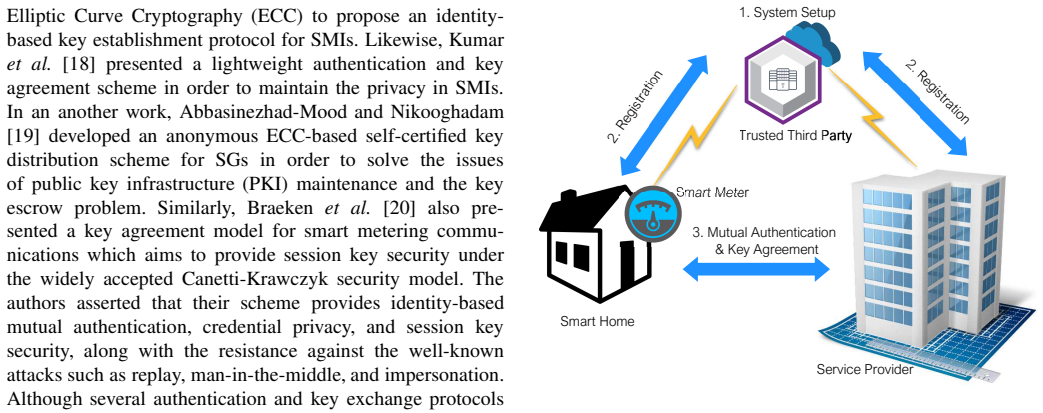
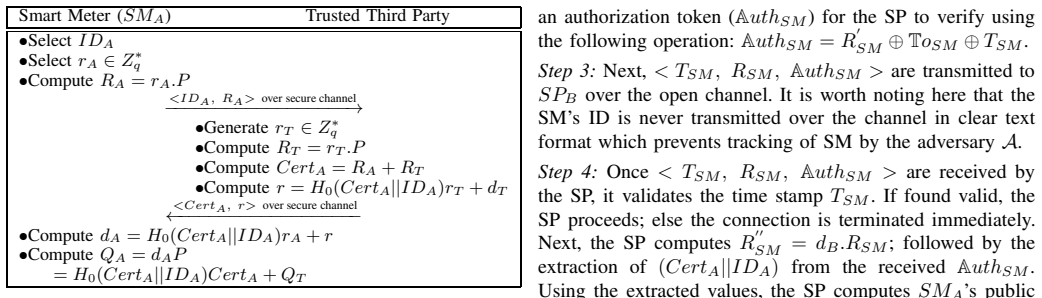
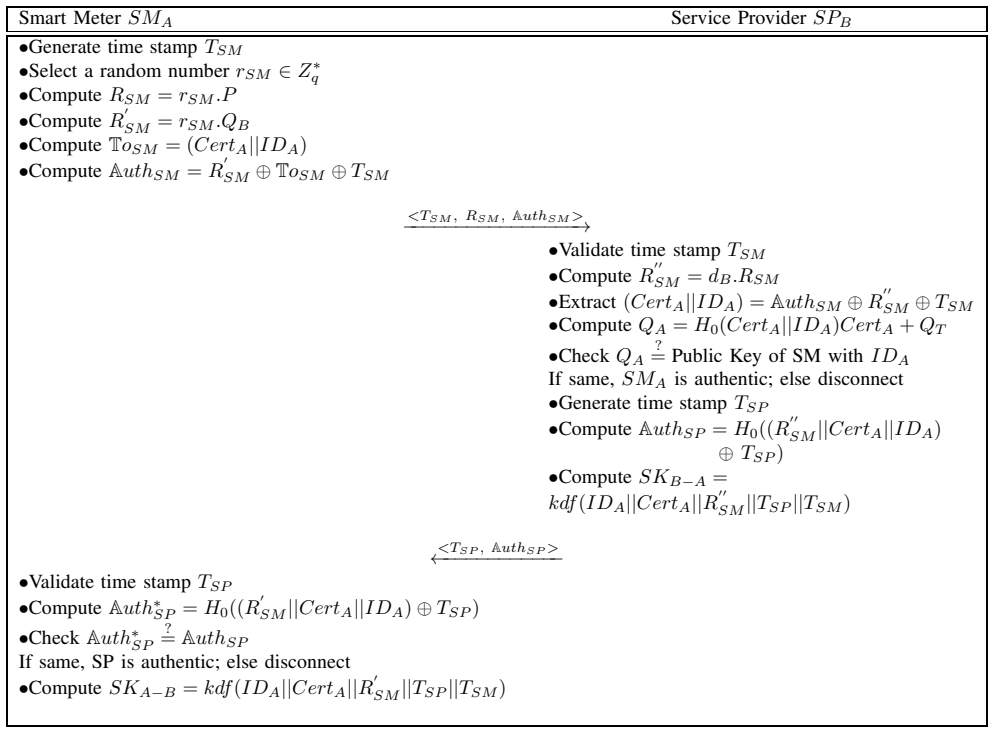
- Notation for the EVQV certificate and the precise roles of the smart meter and service provider in each pass should be introduced with a clear diagram or enumerated steps before any security or performance discussion.
Simulated Author's Rebuttal
We thank the referee for the constructive feedback on our manuscript. We address the two major comments point by point below and will revise the manuscript to incorporate additional details where the concerns are valid.
read point-by-point responses
-
Referee: [Abstract] Abstract (and any security-analysis section): the central claim that the listed security properties follow directly from ECDLP, ECDHP and EVQV hardness without new vulnerabilities introduced by the concrete message flows is not supported by a reduction, formal proof, or even an informal but exhaustive case analysis of the protocol steps; this is load-bearing because an undetected flaw in nonce or certificate handling could invalidate all claimed properties without contradicting the underlying hardness assumptions.
Authors: We agree that the manuscript would benefit from a more detailed security argument. The protocol was designed so that all claimed properties reduce to the hardness of ECDLP, ECDHP, and the EVQV mechanism, with message flows constructed to avoid introducing additional attack surfaces. However, the current version provides only a high-level argument rather than an exhaustive step-by-step informal analysis. In the revised manuscript we will add a dedicated informal security analysis section that examines each protocol message, including nonce freshness, certificate validation, and session-key derivation, to confirm that no new vulnerabilities arise from the concrete flows. revision: yes
-
Referee: [Abstract] Performance claims: the reported timings (11.826 ms / 0.992 ms) and communication cost (544 bits) are presented without reference to the underlying platform, implementation language, or measurement methodology, making it impossible to verify that the overhead figures are obtained under conditions comparable to the schemes cited for comparison.
Authors: We acknowledge that the implementation environment and measurement methodology were not described. The reported figures were obtained via simulation on a standard embedded platform using a well-known ECC library, but these details were omitted from the manuscript. In the revision we will add a new subsection detailing the hardware platform, programming language, cryptographic library version, and timing measurement approach (including how the two passes were isolated) so that the numbers can be reproduced and compared fairly with related schemes. revision: yes
Circularity Check
No significant circularity; security claims rest on standard external hardness assumptions.
full rationale
The paper presents LiSA as a protocol whose security properties (mutual authentication, anonymity, replay protection, session key security) are asserted to follow directly from the established hardness of ECDLP, ECDHP, and the EVQV certificate mechanism. No equations, parameters, or performance metrics are shown to be fitted to the target claims and then re-labeled as predictions. No self-citations are invoked as load-bearing uniqueness theorems, and no ansatz or renaming of known results is used to derive the central claims. The derivation chain is therefore self-contained against external cryptographic benchmarks.
Axiom & Free-Parameter Ledger
axioms (2)
- domain assumption Hardness of the Elliptic Curve Discrete Logarithm Problem (ECDLP) and Elliptic Curve Diffie-Hellman Problem (ECDHP)
- domain assumption Correct realization of the Elliptic Curve Qu-Vanstone (EVQV) certificate mechanism in the protocol flows
Reference graph
Works this paper leans on
-
[1]
A Game of Ince ntives: An Efficient Demand Response Mechanism using Fleet of Electr ic V ehicles,
K. Kaur, S. Garg, N. Kumar, and A. Y . Zomaya, “A Game of Ince ntives: An Efficient Demand Response Mechanism using Fleet of Electr ic V ehicles,” inProceedings of the 1st International W orkshop on Future Industrial Communication Networks . ACM, 2018, pp. 27–32
work page 2018
-
[2]
DROpS: A Demand Response Optimization Scheme in SDN-enabl ed Smart Energy Ecosystem,
G. S. Aujla, S. Garg, S. Batra, N. Kumar, I. Y ou, and V . Shar ma, “DROpS: A Demand Response Optimization Scheme in SDN-enabl ed Smart Energy Ecosystem,” Information Sciences, vol. 476, pp. 453–473, 2019
work page 2019
-
[3]
Smart Grid Metering Networks: A Survey on Security, Privacy and Op en Research Issues,
P . Kumar, Y . Lin, G. Bai, A. Paverd, J. S. Dong, and A. Marti n, “Smart Grid Metering Networks: A Survey on Security, Privacy and Op en Research Issues,” IEEE Communications Surveys & Tutorials , 2019, DOI: 10.1109/COMST.2019.2899354
-
[4]
Smart M eter Data Privacy: A Survey,
M. R. Asghar, G. Dn, D. Miorandi, and I. Chlamtac, “Smart M eter Data Privacy: A Survey,” IEEE Communications Surveys & Tutorials , vol. 19, no. 4, pp. 2820–2835, 2017
work page 2017
-
[5]
An Adaptive Grid Frequency Support Mechanism for Energy Management in Cloud Data Centers,
K. Kaur, S. Garg, N. Kumar, G. S. Aujla, K. K. R. Choo, and M. S. Obaidat, “An Adaptive Grid Frequency Support Mechanism for Energy Management in Cloud Data Centers,” IEEE Systems Journal , 2019, DOI: 10.1109/JSYST.2019.2921592
-
[6]
En-OsCo: Energy-aware Osmotic Computing Framework using Hyper- heuristics,
K. Kaur, S. Garg, G. Kaddoum, S. H. Ahmed, and D. N. K. Jayak ody, “En-OsCo: Energy-aware Osmotic Computing Framework using Hyper- heuristics,” in Proceedings of the ACM MobiHoc W orkshop on Perva- sive Systems in the IoT Era . ACM, 2019, pp. 19–24
work page 2019
-
[7]
SDN-enabled Multi-Attribute-based Secure Communicatio n for Smart Grid in IIoT Environment,
R. Chaudhary, G. S. Aujla, S. Garg, N. Kumar, and J. J. Rodr igues, “SDN-enabled Multi-Attribute-based Secure Communicatio n for Smart Grid in IIoT Environment,” IEEE Transactions on Industrial Informat- ics, vol. 14, no. 6, pp. 2629–2640, 2018
work page 2018
-
[8]
Privacy-Aware Smart Meteri ng: A Survey,
S. Finster and I. Baumgart, “Privacy-Aware Smart Meteri ng: A Survey,” IEEE Communications Surveys & Tutorials , vol. 17, no. 2, pp. 1088– 1101, 2015
work page 2015
-
[9]
S. Garg, K. Kaur, G. Kaddoum, F. Gagnon, and J. J. P . C. Rodr igues, “An Efficient Blockchain-Based Hierarchical Authenticati on Mecha- nism for Energy Trading in V2G Environment,” in IEEE International Conference on Communications W orkshops (ICC W orkshops), S hang- hai, China , May 2019
work page 2019
-
[10]
Key Management Systems for Smart Grid Advanced Metering Infrastructure: A Survey,
A. Ghosal and M. Conti, “Key Management Systems for Smart Grid Advanced Metering Infrastructure: A Survey,” IEEE Communications Surveys & Tutorials , pp. 1–1, 2019, DOI: 10.1109/COMST.2019.2907650
-
[11]
A Privacy-Preserving S mart Metering Scheme using Linkable Anonymous Credential,
F. Diao, F. Zhang, and X. Cheng, “A Privacy-Preserving S mart Metering Scheme using Linkable Anonymous Credential,” IEEE Transactions on Smart Grid , vol. 6, no. 1, pp. 461–467, 2015
work page 2015
-
[12]
K. Y u, M. Arifuzzaman, Z. Wen, D. Zhang, and T. Sato, “A Ke y Man- agement Scheme for Secure Communications of Information Ce ntric Advanced Metering Infrastructure in Smart Grid,” IEEE Transactions on Instrumentation and Measurement , vol. 64, no. 8, pp. 2072–2085, 2015
work page 2072
-
[13]
D. Abbasinezhad-Mood and M. Nikooghadam, “An Ultra-Li ghtweight and Secure Scheme for Communications of Smart Meters and Nei gh- borhood Gateways by Utilization of an ARM Cortex-M Microcon - troller,” IEEE Transactions on Smart Grid , vol. 9, no. 6, pp. 6194–6205, 2018
work page 2018
-
[14]
Identit y based Key Distribution Framework for Link Layer Security of AMI Netwo rks,
V . Seferian, R. Kanj, A. Chehab, and A. Kayssi, “Identit y based Key Distribution Framework for Link Layer Security of AMI Netwo rks,” IEEE Transactions on Smart Grid , vol. 9, no. 4, pp. 3166–3179, 2018
work page 2018
-
[15]
A Unified Approach for Comp ression and Authentication of Smart Meter Reading in AMI,
Y . Lee, E. Hwang, and J. Choi, “A Unified Approach for Comp ression and Authentication of Smart Meter Reading in AMI,” IEEE Access , vol. 7, pp. 34 383–34 394, 2019
work page 2019
-
[16]
Hard ware- Oriented Authentication for Advanced Metering Infrastruc ture,
M. Mustapa, M. Y . Niamat, A. P . D. Nath, and M. Alam, “Hard ware- Oriented Authentication for Advanced Metering Infrastruc ture,” IEEE Transactions on Smart Grid , vol. 9, no. 2, pp. 1261–1270, 2018
work page 2018
-
[17]
A. Mohammadali, M. Sayad Haghighi, M. H. Tadayon, and A. Mohammadi-Nodooshan, “A Novel Identity-Based Key Estab lish- ment Method for Advanced Metering Infrastructure in Smart G rid,” IEEE Transactions on Smart Grid , vol. 9, no. 4, pp. 2834–2842, 2018
work page 2018
-
[18]
Lig htweight Authentication and Key Agreement for Smart Metering in Smar t Energy Networks,
P . Kumar, A. Gurtov, M. Sain, A. Martin, and P . H. Ha, “Lig htweight Authentication and Key Agreement for Smart Metering in Smar t Energy Networks,” IEEE Transactions on Smart Grid , vol. 10, no. 4, pp. 4349– 4359, 2019
work page 2019
-
[19]
An Anonymou s ECC- Based Self-Certified Key Distribution Scheme for the Smart G rid,
D. Abbasinezhad-Mood and M. Nikooghadam, “An Anonymou s ECC- Based Self-Certified Key Distribution Scheme for the Smart G rid,” IEEE Transactions on Industrial Electronics , vol. 65, no. 10, pp. 7996– 8004, 2018
work page 2018
-
[20]
Efficient and Prova bly Secure Key Agreement for Modern Smart Metering Communications,
A. Braeken, P . Kumar, and A. Martin, “Efficient and Prova bly Secure Key Agreement for Modern Smart Metering Communications,” Ener- gies, vol. 11, no. 10, p. 2662, 2018
work page 2018
-
[21]
Blockchain-Based Lightweight Authentication Mechanism for V ehic- ular Fog Infrastructure,
K. Kaur, S. Garg, G. Kaddoum, F. Gagnon, and S. H. Ahmed, “Blockchain-Based Lightweight Authentication Mechanism for V ehic- ular Fog Infrastructure,” in IEEE International Conference on Commu- nications W orkshops (ICC W orkshops), Shanghai, China , May 2019
work page 2019
-
[22]
SDN based Secure and Privacy-preserving Scheme for V ehicu lar Net- works: A 5G Perspective,
S. Garg, K. Kaur, G. Kaddoum, S. H. Ahmed, and D. N. K. Jaya kody, “SDN based Secure and Privacy-preserving Scheme for V ehicu lar Net- works: A 5G Perspective,” IEEE Transactions on V ehicular Technology, 2019, DOI: 10.1109/TVT.2019.2917776
-
[23]
Provably Sec ure Au- thenticated Key Agreement Scheme for Smart Grid,
V . Odelu, A. K. Das, M. Wazid, and M. Conti, “Provably Sec ure Au- thenticated Key Agreement Scheme for Smart Grid,” IEEE Transactions on Smart Grid , vol. 9, no. 3, pp. 1900–1910, 2018
work page 1900
-
[24]
An Anonymous Authentication and Key Establish Scheme for Smart Grid: FAu th,
Y . Chen, J.-F. Mart´ ınez, P . Castillejo, and L. L ´ opez, “An Anonymous Authentication and Key Establish Scheme for Smart Grid: FAu th,” Energies, vol. 10, no. 9, p. 1354, 2017
work page 2017
discussion (0)
Sign in with ORCID, Apple, or X to comment. Anyone can read and Pith papers without signing in.