Poincar\'e asymptotic expansion in black hole theory
Pith reviewed 2026-06-28 13:20 UTC · model grok-4.3
The pith
Poincaré asymptotic expansions give radial solutions at black hole spacelike infinity to any desired accuracy.
A machine-rendered reading of the paper's core claim, the machinery that carries it, and where it could break.
Core claim
Exploiting the principal tensor in Petrov-D metrics to separate variables, the radial component of field equations in black hole backgrounds admits a Poincaré asymptotic expansion at spacelike infinity. This expansion supplies a systematic procedure for obtaining solutions to any prescribed accuracy in a region previously accessible only by approximation, and it supplies improved input for quasinormal-mode frequencies.
What carries the argument
The Poincaré asymptotic series for the separated radial function at spacelike infinity, made possible by the principal tensor.
If this is right
- The radial wave function near spacelike infinity can be written as an explicit series whose coefficients are computable to any order.
- Quasinormal-mode frequencies receive systematic corrections from the higher-order terms of the expansion.
- The same procedure applies to any field whose equation separates in a Petrov-D background.
- Analysis of the irregular singular point at spacelike infinity becomes a routine, order-by-order calculation rather than an ad-hoc approximation.
Where Pith is reading between the lines
- The method could be tested first on the exactly solvable Schwarzschild or Kerr cases, where independent numerical or known analytic data exist for comparison.
- If the series can be matched to other asymptotic regions, it would connect near-horizon and far-field behaviors within a single analytic framework.
- The same expansion technique might extend to slowly rotating or perturbed metrics if an approximate principal tensor can be identified.
Load-bearing premise
The principal tensor exists in Petrov-D metrics and allows separation of variables that isolates the radial equation.
What would settle it
Truncating the derived series at a given order and comparing the resulting approximate solution against high-precision numerical integration of the same radial equation at large but finite radii would confirm or refute whether the series reproduces the true radial behavior.
Figures
read the original abstract
In studying the dynamics of fields in black hole theory, the method of separation of variables makes it possible to isolate the radial part of the full solution in many important physical cases. This is possible thanks to the existence of the principal tensor in Petrov-D metrics. We first review this mathematical result in order to introduce several cases where it is possible to study the radial solution via the Poincar\'e asymptotic series expansion, a tool exploited in recent work by the authors in order to investigate the behaviour of the field at spacelike infinity, a point in the neighbourhood of which only approximate solutions are computable by virtue of its irregular nature. We obtain a series which can be computed to any degree of accuracy, allowing for a deeper analysis of this challenging spacetime region. An application to quasinormal modes is eventually provided.
Editorial analysis
A structured set of objections, weighed in public.
Referee Report
Summary. The manuscript reviews the principal tensor in Petrov type D metrics that permits separation of variables for field equations around black holes. It then constructs Poincaré asymptotic expansions for the radial solutions near the irregular singular point at spacelike infinity, asserts that the resulting series is computable to arbitrary accuracy, and applies the construction to quasinormal modes.
Significance. A controlled asymptotic representation at spacelike infinity would be a useful addition to the analytical toolkit for black-hole perturbations, especially if it supplies explicit coefficient recurrences or remainder bounds that permit reliable truncation for quasinormal-mode calculations.
major comments (2)
- [Abstract] Abstract: the central claim that the series 'can be computed to any degree of accuracy' is load-bearing for the stated significance and the QNM application, yet Poincaré expansions about irregular singular points are typically divergent. The manuscript must supply, in the section deriving the expansion, either a convergence proof in a suitable sector, explicit remainder estimates, or a Borel-summability argument; without this the claim remains unsecured.
- [Section on the asymptotic expansion] Section presenting the radial asymptotic series: the absence of an explicit recurrence relation for the coefficients or an error bound prevents verification that the formal term-by-term construction actually yields controllable accuracy rather than an optimally truncated divergent series.
minor comments (2)
- [Abstract] The abstract would be clearer if it named the specific Petrov-D metrics and field types (scalar, electromagnetic, gravitational) to which the expansion is applied.
- Notation for the principal tensor and the separated radial equation should be introduced with a brief reminder of the separation constants to aid readers unfamiliar with the earlier literature.
Simulated Author's Rebuttal
We thank the referee for the careful reading and the constructive comments on our manuscript. We address the major points below and will revise the text accordingly.
read point-by-point responses
-
Referee: [Abstract] Abstract: the central claim that the series 'can be computed to any degree of accuracy' is load-bearing for the stated significance and the QNM application, yet Poincaré expansions about irregular singular points are typically divergent. The manuscript must supply, in the section deriving the expansion, either a convergence proof in a suitable sector, explicit remainder estimates, or a Borel-summability argument; without this the claim remains unsecured.
Authors: We agree that the wording in the abstract overstates the result. The manuscript constructs a formal Poincaré asymptotic series whose coefficients are determined recursively from the radial ODE; any finite number of terms can therefore be computed explicitly. No convergence proof, remainder bound, or summability argument is supplied. In the revised version we will change the abstract to state that the series is asymptotic and that coefficients are computable to any finite order, and we will add a brief remark in the derivation section clarifying its formal asymptotic character. revision: yes
-
Referee: [Section on the asymptotic expansion] Section presenting the radial asymptotic series: the absence of an explicit recurrence relation for the coefficients or an error bound prevents verification that the formal term-by-term construction actually yields controllable accuracy rather than an optimally truncated divergent series.
Authors: The derivation proceeds by substituting the formal series into the radial equation and equating like powers of the large radial coordinate, which in principle yields a recurrence. The manuscript does not write the recurrence explicitly nor supply an error estimate. We will include the explicit recurrence relation in the revised section so that the coefficient computation can be verified directly. revision: yes
Circularity Check
No circularity detected; derivation is self-contained
full rationale
The paper reviews the existence of the principal tensor enabling separation of variables in Petrov-D metrics, then applies the standard Poincaré asymptotic series method to the radial equation at spacelike infinity. No equations, fitted parameters, or self-definitions are exhibited that reduce the claimed series or its 'computable to any degree of accuracy' property to the inputs by construction. The reference to 'recent work by the authors' is a citation to prior application of the same formal method, not a load-bearing premise that collapses the present result into a self-citation chain. The derivation remains an independent formal term-by-term construction whose validity can be assessed against external properties of asymptotic expansions at irregular singular points.
Axiom & Free-Parameter Ledger
axioms (1)
- domain assumption Existence of the principal tensor in Petrov-D metrics that allows separation of variables to isolate the radial part
Reference graph
Works this paper leans on
-
[1]
Analysis of the leading term The leading term of our solution forR (−)(r) is given by neglecting the interpolating series in Eq. (26). It reads explicitly as R(−)(r)≃ 1− i√ 2 µ2r2 +λ 2 r2 −2M r+Q 2 +a 2 1 4 e i 2 arctan( µr λ )e−r √ µ2−ω2 r [2ω2M+ωeQ−M µ2]√ µ2−ω2 . The qualitative behaviour is dictated by the piece p µ2 −ω 2: when|ω|> µ, the last two term...
-
[2]
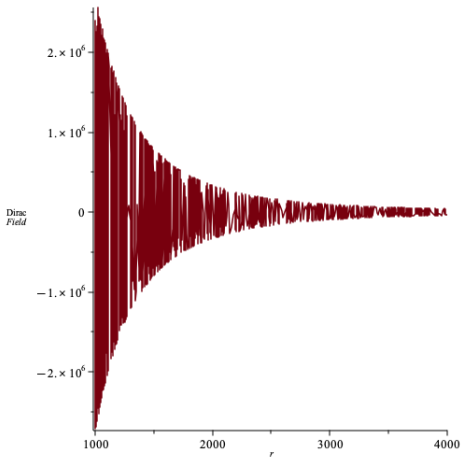
A plot of the solution By considering Eq. (26) withN= 1 and the following values for the parameters (corre- sponding to a non-extremal Kerr-Newman black hole) M= 100, Q= 5, a= 30, e= 10, µ= 3, m= 10, λ≃1, ω= 5,(127) we obtain the plot in Fig. 3 for the real part of the field (the one for the imaginary part is very similar), showing damped oscillations at ...
-
[3]
(127), makes it possible for us to compute the total solution of the Dirac equation over the whole spectrum
Full spectrum analysis The leading order of our solution, given by Eq. (127), makes it possible for us to compute the total solution of the Dirac equation over the whole spectrum. Even if the angular part is more involved with respect to the scalar case (see Ref. [46]), the method remains the same: we can expand the angular part in powers ofa, treating th...
-
[4]
(129), we obtain from Eq
The angular equation Thanks to the factorization ansatz given in Eq. (129), we obtain from Eq. (128) the angular one, which can be written as an eigenvalue problem (S1 +S 2)S(s)(θ) =−λ s lm(aω)S(s) lm (θ) (130) for the two differential operators S1 = 1 sinθ d dθ sinθ d dθ − m2 +s 2 + 2mscosθ sin2 θ , S2 =a2ω2 cos2 θ−2aωscosθ. (131) The eigenvalue problem ...
-
[5]
Hawking and G.F.R
S.W. Hawking and G.F.R. Ellis,The Large Scale Structure of Space-Time(Cambridge Uni- versity Press, Cambridge, 1973)
1973
-
[6]
Chandrasekhar,The Mathematical Theory of Black Holes(Oxford University Press, Oxford, 1984)
S. Chandrasekhar,The Mathematical Theory of Black Holes(Oxford University Press, Oxford, 1984)
1984
-
[7]
Wald, Gedanken experiments to destroy a black hole,Ann
R.M. Wald, Gedanken experiments to destroy a black hole,Ann. Phys. (N.Y.)82, 548-556 (1974)
1974
-
[8]
Jang and R.M
P.S. Jang and R.M. Wald, The positive energy conjecture and the cosmic censor hypothesis, J. Math. Phys.18, 41-44 (1977)
1977
-
[9]
Hawking, M.J
S.W. Hawking, M.J. Perry and A. Strominger, Soft hair on black holes,Phys. Rev. Lett.116, 231301 (2016)
2016
-
[10]
Persides, Global properties of radial wave functions in Schwarzschild’s space-time
S. Persides, Global properties of radial wave functions in Schwarzschild’s space-time. I: The regular singular point,Commun. Math. Phys.48, 165-189 (1976)
1976
-
[11]
Persides, Global properties of radial wave functions in Schwarzschild’s space-time
S. Persides, Global properties of radial wave functions in Schwarzschild’s space-time. II: The irregular singular point,Commun. Math. Phys.50, 229-239 (1976)
1976
-
[12]
Frolov, P
V.P. Frolov, P. Krtous and D. Kubiznak, Black holes, hidden symmetries, and complete inte- grability,Living Rev. Rel.20, 6 (2017)
2017
-
[13]
Esposito and M
G. Esposito and M. Refuto, New perspectives on the irregular singular point of the wave equation for a massive scalar field in Schwarzschild space-time,Symmetry17, 922 (2025)
2025
-
[14]
Hamaide and T
L. Hamaide and T. Torres, Black hole information recovery from gravitational waves,Class. Quantum Grav.40, 085018 (2023)
2023
-
[15]
Ronveaux and F.M
A. Ronveaux and F.M. Arscott (eds.),Heun’s Differential Equations(Clarendon Press, Oxford, 1995)
1995
-
[16]
Poincar´ e, Sur les ´ equations lin´ eaires aux diff´ erentielles ordinaires et aux diff´ erences finies, Am
H. Poincar´ e, Sur les ´ equations lin´ eaires aux diff´ erentielles ordinaires et aux diff´ erences finies, Am. J. Math.7, 203-258 (1885)
-
[17]
Poincar´ e, Sur les int´ egrales irreguli` eres des ´ eequations lin´ eaires,Acta Math.8, 295-344 (1886)
H. Poincar´ e, Sur les int´ egrales irreguli` eres des ´ eequations lin´ eaires,Acta Math.8, 295-344 (1886)
-
[18]
Dieudonn´ e,Calcul Infinit´ esimal(Hermann, Paris, 1980)
J. Dieudonn´ e,Calcul Infinit´ esimal(Hermann, Paris, 1980)
1980
-
[19]
Di Grezia, G
E. Di Grezia, G. Esposito, and P. Vitale, Self-dual road to noncommutative gravity with twist: 47 A new analysis,Phys. Rev. D89, 064039 (2014)
2014
-
[20]
Wilczynski,Projective Differential Geometry of Curves and Ruled Surfaces(Teubner, Leipzig, 1906)
E.J. Wilczynski,Projective Differential Geometry of Curves and Ruled Surfaces(Teubner, Leipzig, 1906)
1906
-
[21]
Esposito,From Ordinary to Partial Differential Equations, Unitext Series106(Springer Nature, Cham, 2017)
G. Esposito,From Ordinary to Partial Differential Equations, Unitext Series106(Springer Nature, Cham, 2017)
2017
-
[22]
Schwarzschild, ¨Uber das gravitationsfeld eines massenpunktes nach dei einsteinschen the- orie,Sitz
K. Schwarzschild, ¨Uber das gravitationsfeld eines massenpunktes nach dei einsteinschen the- orie,Sitz. K. Preuss. Akad. Wiss.189-196 (1916)
1916
-
[23]
Reissner, ¨Uber dir eigengravitation des elektrischen feldes nach der einsteinschen theorie, Ann
H. Reissner, ¨Uber dir eigengravitation des elektrischen feldes nach der einsteinschen theorie, Ann. der Physik355, 106-120 (1916)
1916
-
[24]
Nordstr¨ om, On the energy of the gravitation field in Einstein’s theory,K
G. Nordstr¨ om, On the energy of the gravitation field in Einstein’s theory,K. Ned. Akad. Wet. Proc. Ser. B Phys. Sci.20, 1238-1245 (1918)
1918
-
[25]
Kerr, Gravitational field of a spinning mass as an example of algebraically special metrics, Phys
R.P. Kerr, Gravitational field of a spinning mass as an example of algebraically special metrics, Phys. Rev. Lett.11, 237 (1963)
1963
-
[26]
Newman, E
E.T. Newman, E. Couch, K. Chinnapared, A. Exton, A. Prakash, and R. Torrence, Metric of a rotating, charged mass,J. Math. Phys.6, 918-919 (1965)
1965
-
[27]
Mazur, Proof of uniqueness of the Kerr-Newman black hole solution,J
P.O. Mazur, Proof of uniqueness of the Kerr-Newman black hole solution,J. Phys. A Math. Gen.15, 3173 (1982)
1982
-
[28]
Carter, Global structure of the Kerr family of gravitational fields,Phys
B. Carter, Global structure of the Kerr family of gravitational fields,Phys. Rev.174, 1559 (1968)
1968
-
[29]
Wald, Electromagnetic fields and massive bodies,Phys
R.M. Wald, Electromagnetic fields and massive bodies,Phys. Rev. D6, 1476 (1972)
1972
-
[30]
Newman and A.I
E.T. Newman and A.I. Janis, Note on the Kerr spinning-particle metric,J. Math. Phys.6, 915-917 (1965)
1965
-
[31]
Kerr and A
R.P. Kerr and A. Schild, Some algebraically degenerate solutions of Einstein’s gravitational field equations, inProceedings of Symposia in Applied Mathematics17, 199-209, Am. Math. Soc. (1965)
1965
-
[32]
Debney, R.P
G.C. Debney, R.P. Kerr, and A. Schild, Solutions of the Einstein and Einstein-Maxwell equa- tions,J. Math. Phys.10, 1842-1854 (1969)
1969
-
[33]
T. Adamo and E.T. Newman, The Kerr-Newman metric: a review, arXiv:1410.6626 (2014)
Pith/arXiv arXiv 2014
-
[34]
Boyer and R.W
R.H. Boyer and R.W. Lindquist, Maximal analytic extension of the Kerr metric,J. Math. Phys.8, 265-281 (1967)
1967
-
[35]
Wald,General Relativity(University of Chicago Press, Chicago, 1984)
R.M. Wald,General Relativity(University of Chicago Press, Chicago, 1984). 48
1984
-
[36]
Kerr and A
R.P. Kerr and A. Schild, Republication of: A new class of vacuum solutions of the Einstein field equations,Gen. Relativ. Gravit.41, 2485-2499 (2009)
2009
-
[37]
Lynden-Bell, Electromagnetic magic: The relativistically rotating disk,Phys
D. Lynden-Bell, Electromagnetic magic: The relativistically rotating disk,Phys. Rev. D70, 105017 (2004)
2004
-
[38]
Kaiser, Distributional sources for Newman’s holomorphic Coulomb field,J
G. Kaiser, Distributional sources for Newman’s holomorphic Coulomb field,J. Phys. A Math. Gen.37, 8735 (2004)
2004
-
[39]
Teukolsky, The Kerr metric,Class
S.A. Teukolsky, The Kerr metric,Class. Quantum Grav.32, 124006 (2015)
2015
-
[40]
Benone, L.C
C.L. Benone, L.C. Crispino, C. Herdeiro, and E. Radu, Kerr-Newman scalar clouds,Phys. Rev. D90, 104024 (2014)
2014
-
[41]
Furuhashi and Y
H. Furuhashi and Y. Nambu, Instability of massive scalar fields in Kerr-Newman spacetime, Prog. Theor. Phys.112, 983-995 (2004)
2004
-
[42]
Bateman and A
H. Bateman and A. Erd´ elyi,Higher Transcendental Functions. II(McGraw-Hill, New York, 1953). [39]NIST Digital Library of Mathematical Functions. https://dlmf.nist.gov/, Release 1.2.4 of 2025- 03-15. Edited by F.W.J. Olver, A.B. Olde Daalhuis, D.W. Lozier, B.I. Schneider, R.F. Boisvert, C.W. Clark, B.R. Miller, B.V. Saunders, H.S. Cohl, and M.A. McClain
1953
-
[43]
Vieira, V.B
H.S. Vieira, V.B. Bezerra, and C.R. Muniz, Exact solutions of the Klein-Gordon equation in the Kerr-Newman background and Hawking radiation,Ann. Phys. (N.Y.)350, 14-28 (2014)
2014
-
[44]
Vieira, V.B
H.S. Vieira, V.B. Bezerra, and C.R. Muniz, Instability of the charged massive scalar field on the Kerr-Newman black hole spacetime,Eur. Phys. J. C82, 932 (2022)
2022
-
[45]
Rowan and G
D.J. Rowan and G. Stephenson, The Klein-Gordon equation in a Kerr-Newman background space,J. Phys. A Math. Gen.10, 15 (1977)
1977
-
[46]
Chandrasekhar, The solution of Dirac’s equation in Kerr geometry,Proc
S. Chandrasekhar, The solution of Dirac’s equation in Kerr geometry,Proc. R. Soc. Lond. A 349, 571-575 (1976)
1976
-
[47]
Page, Dirac equation around a charged, rotating black hole,Phys
D.N. Page, Dirac equation around a charged, rotating black hole,Phys. Rev. D14, 1509-1510 (1976)
1976
-
[48]
Dariescu, M.A
C. Dariescu, M.A. Dariescu, and C. Stelea, Dirac equation on the Kerr-Newman spacetime and Heun functions,Adv. H. En. Phys.2021, 5512735 (2021)
2021
-
[49]
Kraniotis, The massive Dirac equation in the Kerr-Newman-de Sitter and Kerr-Newman black hole spacetimes,J
G.V. Kraniotis, The massive Dirac equation in the Kerr-Newman-de Sitter and Kerr-Newman black hole spacetimes,J. Phys. Comm.3, 035026 (2019)
2019
-
[50]
Teukolsky, Rotating black holes: Separable wave equations for gravitational and electro- 49 magnetic perturbations,Phys
S.A. Teukolsky, Rotating black holes: Separable wave equations for gravitational and electro- 49 magnetic perturbations,Phys. Rev. Lett.29, 1114-1118 (1972)
1972
-
[51]
Teukolsky, Perturbations of a rotating black hole
S.A. Teukolsky, Perturbations of a rotating black hole. I. Fundamental equations for gravita- tional, electromagnetic, and neutrino-field perturbations,Ap. J.185, 635-648 (1973)
1973
-
[52]
Press and S.A
W.H. Press and S.A. Teukolsky, Perturbations of a rotating black hole. II. Dynamical stability of the Kerr metric,Ap. J.185, 649-674 (1973)
1973
-
[53]
Chen, X.-H
C.-Y. Chen, X.-H. Wang, Y. You, D.-S. Sun, F.-L. Lu and S.-H. Dong, Exact solutions to the angular Teukolsky equation withs̸= 0,Commun. Theor. Phys.74, 115001 (2022)
2022
-
[54]
E. Berti, V. Cardoso and A. O. Starinets, Quasinormal modes of black holes and black branes, Class. Quant. Grav.26, 163001 (2009), doi:10.1088/0264-9381/26/16/163001
-
[55]
G. Comp` ere and A. Fiorucci, Advanced Lectures on General Relativity, arXiv:1801.07064 [hep-th] (2018)
Pith/arXiv arXiv 2018
-
[56]
Leaver, An analytic representation for the quasi-normal modes of Kerr black holes,Proc
E.W. Leaver, An analytic representation for the quasi-normal modes of Kerr black holes,Proc. Roy. Soc. Lond. A402, 285–298 (1985)
1985
-
[57]
E. Berti and V. Cardoso, Quasinormal ringing of Kerr black holes. I. The Excitation factors, Phys. Rev. D74, 104020 (2006), doi:10.1103/PhysRevD.74.104020
-
[58]
Y. Decanini and A. Folacci, Regge poles of the Schwarzschild black hole: A WKB approach, Phys. Rev. D81, 024031 (2010), doi:10.1103/PhysRevD.81.024031. 50
discussion (0)
Sign in with ORCID, Apple, or X to comment. Anyone can read and Pith papers without signing in.