Operation Mpemba effect: Breakdown of resource-Markovianity of free dynamics
Pith reviewed 2026-06-27 16:18 UTC · model grok-4.3
The pith
The Mpemba effect in resource theories occurs when relaxation breaks resource-Markovianity.
A machine-rendered reading of the paper's core claim, the machinery that carries it, and where it could break.
Core claim
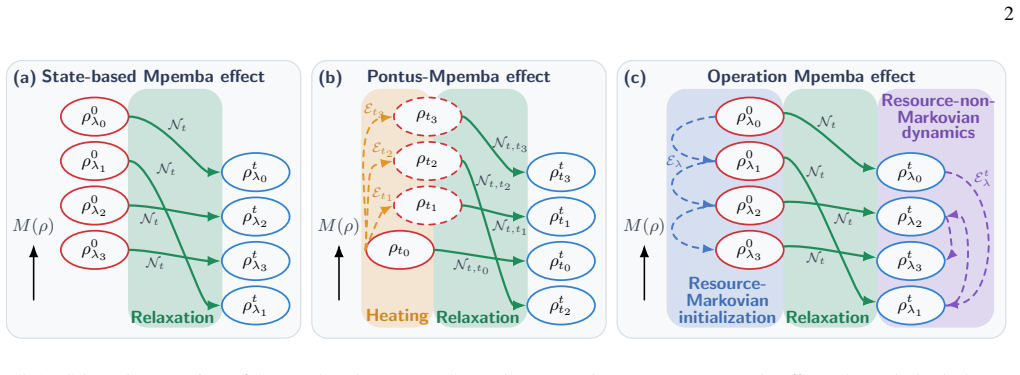
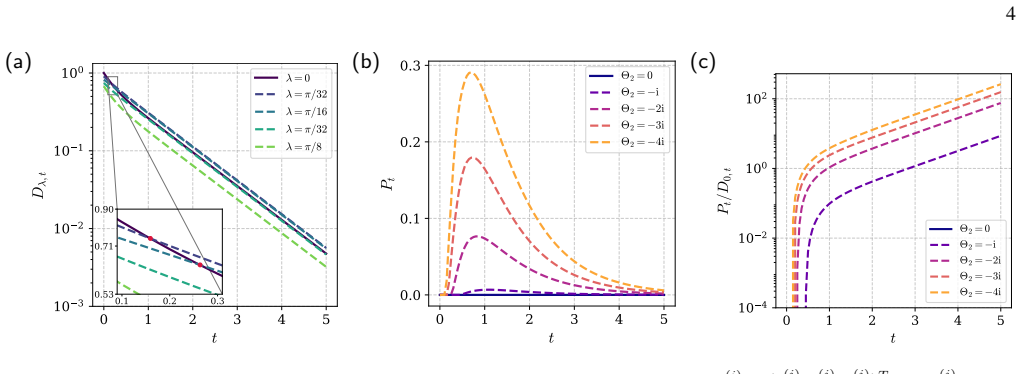
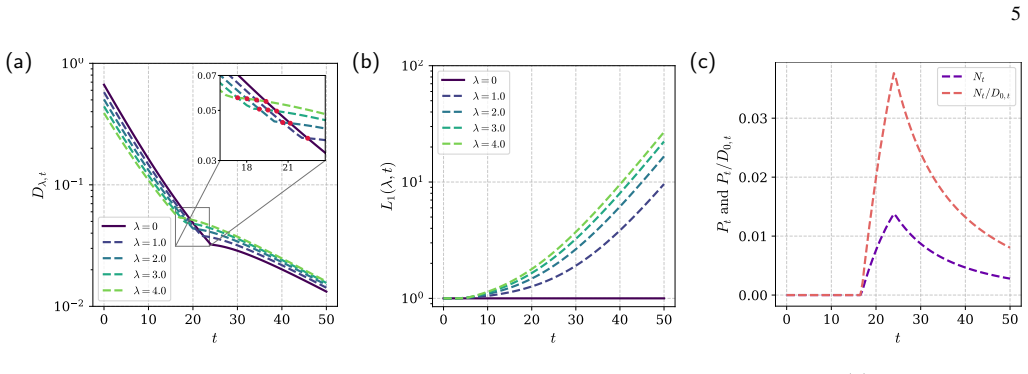
Resource-Markovianity is the property that free dynamics preserve the resource ordering of states under time evolution. The resource Mpemba effect is defined as the breaking of this property by a relaxation operation. The definition is measure-independent and supplies quantitative characterizations via resource-non-Markovianity measures. It is illustrated for the distinguishability resource, which recovers the usual quantum Markovianity link, and for the thermomajorization resource from an operational viewpoint.
What carries the argument
resource-Markovianity: the extension of quantum Markovianity to a resource theory such that relaxation operations can break the property and thereby produce the Mpemba effect.
If this is right
- Resource Mpemba effects become identifiable without selecting any particular resource measure or distance.
- Quantitative strength of the effect can be read off from existing or new measures of resource-non-Markovianity.
- The same operational test applies uniformly across any resource theory once the free operations and resource ordering are fixed.
- The distinguishability case recovers the known connection between Mpemba and ordinary non-Markovianity.
Where Pith is reading between the lines
- The same test could be applied to other resources such as coherence or asymmetry once their free operations are specified.
- If the classical limit of resource-Markovianity reduces to ordinary Markovianity, the framework would also cover classical Mpemba effects.
- Laboratory checks would consist of preparing two resource-ordered states, applying the same relaxation channel, and verifying whether the farther state relaxes faster exactly when the channel breaks the Markovian property.
Load-bearing premise
The new notion of resource-Markovianity is a faithful extension of ordinary quantum Markovianity that correctly registers Mpemba phenomenology when it is broken by relaxation.
What would settle it
A concrete relaxation operation that breaks resource-Markovianity yet produces no Mpemba speedup, or produces a speedup while preserving resource-Markovianity, would falsify the claimed equivalence.
Figures
read the original abstract
The Mpemba effect refers to faster relaxation of states that are initially farther from equilibrium, yet its characterization is often tied to a chosen distance or resource measure. We introduce resource-Markovianity, an extended concept of quantum Markovianity to quantum resource theories, and formulate the resource Mpemba effect operationally as the breaking of resource-Markovianity by a relaxation operation. This yields a measure-independent operational characterization of resource Mpemba effects in general resource theories, together with quantitative characterizations based on resource-non-Markovianity measures. We illustrate the framework with the Mpemba effect for distinguishability of states, due to its relation to quantum Markovianity, and with the thermomajorization Mpemba effect from an operational perspective. These results reveal a deep interplay between quantum resources, non-Markovianity, and the Mpemba effect.
Editorial analysis
A structured set of objections, weighed in public.
Referee Report
Summary. The paper introduces 'resource-Markovianity' as an extension of quantum Markovianity to quantum resource theories. It operationally defines the resource Mpemba effect as the breakdown of resource-Markovianity under relaxation operations. This is claimed to yield a measure-independent characterization of resource Mpemba effects across general resource theories, along with quantitative characterizations via resource-non-Markovianity measures. Illustrations are provided for the distinguishability Mpemba effect (linked to standard Markovianity) and the thermomajorization Mpemba effect.
Significance. If the central definition of resource-Markovianity is shown to be independent of any specific resource measure or monotone while faithfully capturing Mpemba phenomenology, the work would provide a valuable operational unification of resource theories with non-Markovianity and the Mpemba effect. The approach could enable new quantitative tools and cross-theory comparisons without measure dependence.
major comments (2)
- [Definition of resource-Markovianity (post-abstract, likely §2)] The definition of resource-Markovianity (introduced in the main text following the abstract) must be examined for implicit dependence on a resource monotone, distance, or specific free-set encoding; if present, this would contradict the measure-independent claim in the abstract and strongest_claim paragraph, as ordinary Markovianity is map-based while the extension appears to require additional structure for 'breakdown' under relaxation.
- [Illustrations section (distinguishability and thermomajorization examples)] The illustrations (distinguishability and thermomajorization) do not establish generality for arbitrary resource theories; the measure-independence assertion requires explicit proof that the operational definition avoids reduction to a chosen monotone, which is not demonstrated by the provided examples alone.
Simulated Author's Rebuttal
We thank the referee for their careful reading and constructive comments. We address the major comments point by point below, clarifying the operational and measure-independent nature of the definition while planning targeted revisions for added explicitness.
read point-by-point responses
-
Referee: [Definition of resource-Markovianity (post-abstract, likely §2)] The definition of resource-Markovianity (introduced in the main text following the abstract) must be examined for implicit dependence on a resource monotone, distance, or specific free-set encoding; if present, this would contradict the measure-independent claim in the abstract and strongest_claim paragraph, as ordinary Markovianity is map-based while the extension appears to require additional structure for 'breakdown' under relaxation.
Authors: Resource-Markovianity is defined strictly in terms of the free operations and the convex set of free states within a given resource theory, without reference to any monotone, distance, or numerical encoding. The notion of breakdown under relaxation is operational and map-based, extending the standard divisibility or divisibility-like criteria of quantum Markovianity to the resource-theoretic setting. No additional structure beyond the resource theory axioms is invoked. We will add an explicit remark and short proof sketch in §2 to make this independence from monotes fully transparent. revision: yes
-
Referee: [Illustrations section (distinguishability and thermomajorization examples)] The illustrations (distinguishability and thermomajorization) do not establish generality for arbitrary resource theories; the measure-independence assertion requires explicit proof that the operational definition avoids reduction to a chosen monotone, which is not demonstrated by the provided examples alone.
Authors: The two illustrations are intended only as concrete applications; the measure-independence and generality follow directly from the definition, which is formulated for an arbitrary resource theory and does not invoke or reduce to any specific monotone. To address the request for explicit demonstration, we will insert a general proposition (with proof) immediately after the definition showing that the resource Mpemba effect, as operationally defined, is independent of the choice of resource monotone. revision: yes
Circularity Check
No significant circularity detected
full rationale
The paper introduces resource-Markovianity as a conceptual extension of standard quantum Markovianity into resource theories and defines the operational resource Mpemba effect via breakdown of that property under relaxation. The abstract presents this as yielding a measure-independent characterization, with examples in distinguishability and thermomajorization. No equations, definitions, or self-citations appear in the provided text that reduce the new notion to a fitted parameter, a prior result by the same authors, or an ansatz smuggled via citation. The central claim therefore rests on an independently stated definition rather than on any of the enumerated circular patterns.
Axiom & Free-Parameter Ledger
invented entities (1)
-
resource-Markovianity
no independent evidence
Reference graph
Works this paper leans on
-
[1]
In particular, for the discrete parameter λi (i= 1,2,
Otherwise, the operations are resource-non-Markovian, ifN(K λ)>0. In particular, for the discrete parameter λi (i= 1,2, . . .), denoting[x] + = max{x,0}, the measure is N(K) = max ρ X i M(K λi+1(ρ))−M(K λi(ρ)) + .(5) Operation Mpemba effect—With the notion of resource- Markovianity, we formulate the Mpemba effect from an oper- ational viewpoint. Given a s...
-
[2]
E. B. Mpemba and D. G. Osborne, Cool?, Physics Education4, 172 (1969)
1969
-
[3]
H. C. Burridge and P. F. Linden, Questioning the Mpemba ef- fect: Hot water does not cool more quickly than cold, Scientific Reports6, 37665 (2016)
2016
-
[4]
Bechhoefer, A
J. Bechhoefer, A. Kumar, and R. Ch ´etrite, A fresh understand- ing of the Mpemba effect, Nature Reviews Physics3, 534 (2021)
2021
-
[5]
Lu and O
Z. Lu and O. Raz, Nonequilibrium thermodynamics of the Markovian Mpemba effect and its inverse, Proceedings of the National Academy of Sciences114, 5083 (2017)
2017
-
[6]
Klich, O
I. Klich, O. Raz, O. Hirschberg, and M. Vucelja, Mpemba index and anomalous relaxation, Phys. Rev. X9, 021060 (2019)
2019
-
[7]
Ib ´anez, C
M. Ib ´anez, C. Dieball, A. Lasanta, A. Godec, and R. A. Rica, Heating and cooling are fundamentally asymmetric and evolve along distinct pathways, Nature Physics20, 135 (2024)
2024
-
[8]
Van Vu and H
T. Van Vu and H. Hayakawa, Thermomajorization Mpemba ef- fect, Phys. Rev. Lett.134, 107101 (2025)
2025
-
[9]
Lasanta, F
A. Lasanta, F. Vega Reyes, A. Prados, and A. Santos, When the hotter cools more quickly: Mpemba effect in granular fluids, Phys. Rev. Lett.119, 148001 (2017)
2017
-
[10]
Torrente, M
A. Torrente, M. A. L ´opez-Casta˜no, A. Lasanta, F. V . Reyes, A. Prados, and A. Santos, Large mpemba-like effect in a gas of inelastic rough hard spheres, Phys. Rev. E99, 060901 (2019)
2019
-
[11]
Santos and A
A. Santos and A. Prados, Mpemba effect in molecular gases under nonlinear drag, Physics of Fluids32(2020)
2020
-
[12]
Meg ´ıas, A
A. Meg ´ıas, A. Santos, and A. Prados, Thermal versus entropic Mpemba effect in molecular gases with nonlinear drag, Phys. Rev. E105, 054140 (2022)
2022
-
[13]
Baity-Jesi, E
M. Baity-Jesi, E. Calore, A. Cruz, L. A. Fernandez, J. M. Gil-Narvi´on, A. Gordillo-Guerrero, D. I ˜niguez, A. Lasanta, A. Maiorano, E. Marinari,et al., The Mpemba effect in spin glasses is a persistent memory effect, Proceedings of the Na- tional Academy of Sciences116, 15350 (2019)
2019
-
[14]
Kumar and J
A. Kumar and J. Bechhoefer, Exponentially faster cooling in a colloidal system, Nature584, 64 (2020)
2020
-
[15]
Kumar, R
A. Kumar, R. Ch ´etrite, and J. Bechhoefer, Anomalous heating in a colloidal system, Proceedings of the National Academy of Sciences119, e2118484119 (2022)
2022
-
[16]
F. J. Schwarzendahl and H. L ¨owen, Anomalous cooling and overcooling of active colloids, Phys. Rev. Lett.129, 138002 (2022)
2022
-
[17]
G. Teza, R. Yaacoby, and O. Raz, Relaxation shortcuts through boundary coupling, Phys. Rev. Lett.131, 017101 (2023)
2023
-
[18]
I. G.-A. Pemart ´ın, E. Momp ´o, A. Lasanta, V . Mart ´ın-Mayor, and J. Salas, Shortcuts of freely relaxing systems using equilib- rium physical observables, Phys. Rev. Lett.132, 117102 (2024)
2024
-
[19]
F. Ares, P. Calabrese, and S. Murciano, The quantum Mpemba effects, Nature Reviews Physics7, 451 (2025)
2025
-
[20]
Nava and M
A. Nava and M. Fabrizio, Lindblad dissipative dynamics in the presence of phase coexistence, Phys. Rev. B100, 125102 (2019)
2019
-
[21]
Carollo, A
F. Carollo, A. Lasanta, and I. Lesanovsky, Exponentially accel- erated approach to stationarity in markovian open quantum sys- tems through the Mpemba effect, Phys. Rev. Lett.127, 060401 (2021)
2021
-
[22]
Kochsiek, F
S. Kochsiek, F. Carollo, and I. Lesanovsky, Accelerating the ap- proach of dissipative quantum spin systems towards stationarity through global spin rotations, Phys. Rev. A106, 012207 (2022)
2022
-
[23]
F. Ares, S. Murciano, and P. Calabrese, Entanglement asymme- try as a probe of symmetry breaking, Nature Communications 14, 2036 (2023)
2036
-
[24]
A. K. Chatterjee, S. Takada, and H. Hayakawa, Quantum Mpemba effect in a quantum dot with reservoirs, Phys. Rev. Lett.131, 080402 (2023)
2023
-
[25]
Rylands, K
C. Rylands, K. Klobas, F. Ares, P. Calabrese, S. Murciano, and B. Bertini, Microscopic origin of the quantum Mpemba effect in integrable systems, Phys. Rev. Lett.133, 010401 (2024)
2024
-
[26]
L. K. Joshi, J. Franke, A. Rath, F. Ares, S. Murciano, F. Kranzl, R. Blatt, P. Zoller, B. Vermersch, P. Calabrese, C. F. Roos, and M. K. Joshi, Observing the quantum Mpemba effect in quantum simulations, Phys. Rev. Lett.133, 010402 (2024)
2024
-
[27]
Aharony Shapira, Y
S. Aharony Shapira, Y . Shapira, J. Markov, G. Teza, N. Ak- erman, O. Raz, and R. Ozeri, Inverse Mpemba effect demon- strated on a single trapped ion qubit, Phys. Rev. Lett.133, 010403 (2024)
2024
-
[28]
Nava and R
A. Nava and R. Egger, Mpemba effects in open nonequilibrium quantum systems, Phys. Rev. Lett.133, 136302 (2024)
2024
-
[29]
Murciano, F
S. Murciano, F. Ares, I. Klich, and P. Calabrese, Entanglement asymmetry and quantum Mpemba effect in the xy spin chain, Journal of Statistical Mechanics: Theory and Experiment2024, 013103 (2024)
2024
-
[30]
Liu, H.-K
S. Liu, H.-K. Zhang, S. Yin, and S.-X. Zhang, Symmetry restoration and quantum Mpemba effect in symmetric random circuits, Phys. Rev. Lett.133, 140405 (2024)
2024
-
[31]
F. Ares, V . Vitale, and S. Murciano, Quantum Mpemba effect in free-fermionic mixed states, Phys. Rev. B111, 104312 (2025)
2025
-
[32]
Zatsarynna, A
K. Zatsarynna, A. Nava, R. Egger, and A. Zazunov, Green’s function approach to josephson dot dynamics and application to quantum Mpemba effects, Phys. Rev. B111, 104506 (2025)
2025
-
[33]
Y . Su, F. Qi, and G. Jin, Mpemba effect caused by anomalous heat conduction in a quantum dot system, Phys. Rev. B111, 125404 (2025)
2025
-
[34]
Wang and J
X. Wang and J. Wang, Mpemba effects in nonequilibrium open quantum systems, Phys. Rev. Res.6, 033330 (2024)
2024
-
[35]
D. J. Strachan, A. Purkayastha, and S. R. Clark, Non-markovian quantum Mpemba effect, Phys. Rev. Lett.134, 220403 (2025)
2025
-
[36]
Turkeshi, P
X. Turkeshi, P. Calabrese, and A. De Luca, Quantum Mpemba effect in random circuits, Phys. Rev. Lett.135, 040403 (2025)
2025
-
[37]
A. M. Lacerda, L. P. Bettmann, and J. Goold, Information ge- ometry of transitions between quantum nonequilibrium steady states, Phys. Rev. E112, L022101 (2025)
2025
-
[38]
Yu, T.-R
Y .-H. Yu, T.-R. Jin, L. Zhang, K. Xu, and H. Fan, Tuning the quantum Mpemba effect in an isolated system by initial-state engineering, Phys. Rev. B112, 094315 (2025)
2025
-
[39]
Observation and Modulation of the Quantum Mpemba Effect on a Superconducting Quantum Processor
Y . Xu, C.-P. Fang, B.-J. Chen, M.-C. Wang, Z.-Y . Ge, Y .-H. Shi, Y . Liu, C.-L. Deng, K. Zhao, Z.-H. Liu,et al., Observation and modulation of the quantum Mpemba effect on a superconduct- ing quantum processor, arXiv:2508.07707 (2025)
work page internal anchor Pith review Pith/arXiv arXiv 2025
-
[40]
F. Ares, S. Murciano, E. Vernier, and P. Calabrese, Lack of sym- metry restoration after a quantum quench: An entanglement asymmetry study, SciPost Physics15, 089 (2023)
2023
-
[41]
Rylands, E
C. Rylands, E. Vernier, and P. Calabrese, Dynamical symmetry restoration in the heisenberg spin chain, Journal of Statistical Mechanics: Theory and Experiment2024, 123102 (2024)
2024
-
[42]
Chalas, F
K. Chalas, F. Ares, C. Rylands, and P. Calabrese, Multiple 7 crossings during dynamical symmetry restoration and implica- tions for the quantum Mpemba effect, Journal of Statistical Me- chanics: Theory and Experiment2024, 103101 (2024)
2024
-
[43]
Summer, M
A. Summer, M. Moroder, L. P. Bettmann, X. Turkeshi, I. Mar- vian, and J. Goold, Resource-theoretical unification of Mpemba effects: Classical and quantum, Phys. Rev. X16, 011065 (2026)
2026
- [44]
-
[45]
Biswas, V
A. Biswas, V . V . Prasad, and R. Rajesh, Mpemba effect in driven granular gases: Role of distance measures, Phys. Rev. E108, 024902 (2023)
2023
-
[46]
Nava and R
A. Nava and R. Egger, Pontus-Mpemba effects, Phys. Rev. Lett. 135, 140404 (2025)
2025
-
[47]
Sagawa,Entropy, divergence, and majorization in classical and quantum thermodynamics, V ol
T. Sagawa,Entropy, divergence, and majorization in classical and quantum thermodynamics, V ol. 16 (Springer Nature, Sin- gapore, 2022)
2022
-
[48]
Hayashi and H
M. Hayashi and H. Yamasaki, The generalized quantum stein’s lemma and the second law of quantum resource theories, Nature Physics , 1 (2025)
2025
-
[49]
F. G. S. L. Brand ˜ao and G. Gour, Reversible framework for quantum resource theories, Phys. Rev. Lett.115, 070503 (2015)
2015
-
[50]
Breuer, E.-M
H.-P. Breuer, E.-M. Laine, and J. Piilo, Measure for the degree of non-markovian behavior of quantum processes in open sys- tems, Phys. Rev. Lett.103, 210401 (2009)
2009
-
[51]
M. M. Wolf and J. I. Cirac, Dividing quantum channels, Com- munications in Mathematical Physics279, 147 (2008)
2008
-
[52]
Rivas, S
A. Rivas, S. F. Huelga, and M. B. Plenio, Entanglement and non-markovianity of quantum evolutions, Phys. Rev. Lett.105, 050403 (2010)
2010
-
[53]
Rivas, S
´A. Rivas, S. F. Huelga, and M. B. Plenio, Quantum non- markovianity: characterization, quantification and detection, Reports on Progress in Physics77, 094001 (2014)
2014
-
[54]
Breuer, E.-M
H.-P. Breuer, E.-M. Laine, J. Piilo, and B. Vacchini, Collo- quium: Non-markovian dynamics in open quantum systems, Rev. Mod. Phys.88, 021002 (2016)
2016
-
[55]
Fuchs and J
C. Fuchs and J. van de Graaf, Cryptographic distinguishability measures for quantum-mechanical states, IEEE Transactions on Information Theory45, 1216 (1999)
1999
-
[56]
Shibata, Y
F. Shibata, Y . Takahashi, and N. Hashitsume, A generalized stochastic Liouville equation. Non-Markovian versus memo- ryless master equations, Journal of Statistical Physics17, 171 (1977)
1977
-
[57]
Operation Mpemba effect: Breakdown of resource-Markovianity of free dynamics
S. Chaturvedi and F. Shibata, Time-convolutionless projection operator formalism for elimination of fast variables. Applica- tions to Brownian motion, Zeitschrift f ¨ur Physik B Condensed Matter35, 297 (1979). 1 Supplemental Material for “Operation Mpemba effect: Breakdown of resource-Markovianity of free dynamics” Tian-Ren Jin1,2, Yu-Ran Zhang3, and Heng...
1979
discussion (0)
Sign in with ORCID, Apple, or X to comment. Anyone can read and Pith papers without signing in.