Disentangling Latent Risk Pathways via Bayesian Hypergraph Inference
Pith reviewed 2026-06-27 23:06 UTC · model grok-4.3
The pith
Bayesian hypergraph inference models latent disease pathways modulated by risk factors using EHR data.
A machine-rendered reading of the paper's core claim, the machinery that carries it, and where it could break.
Core claim
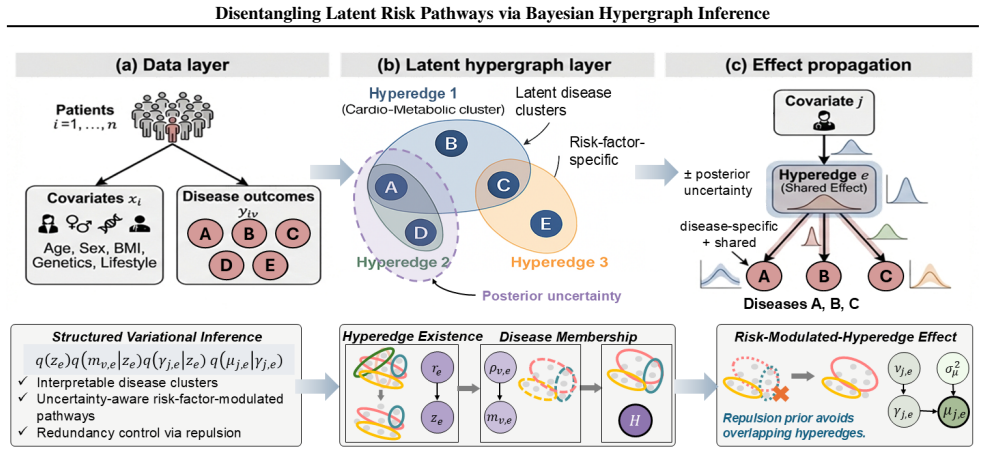
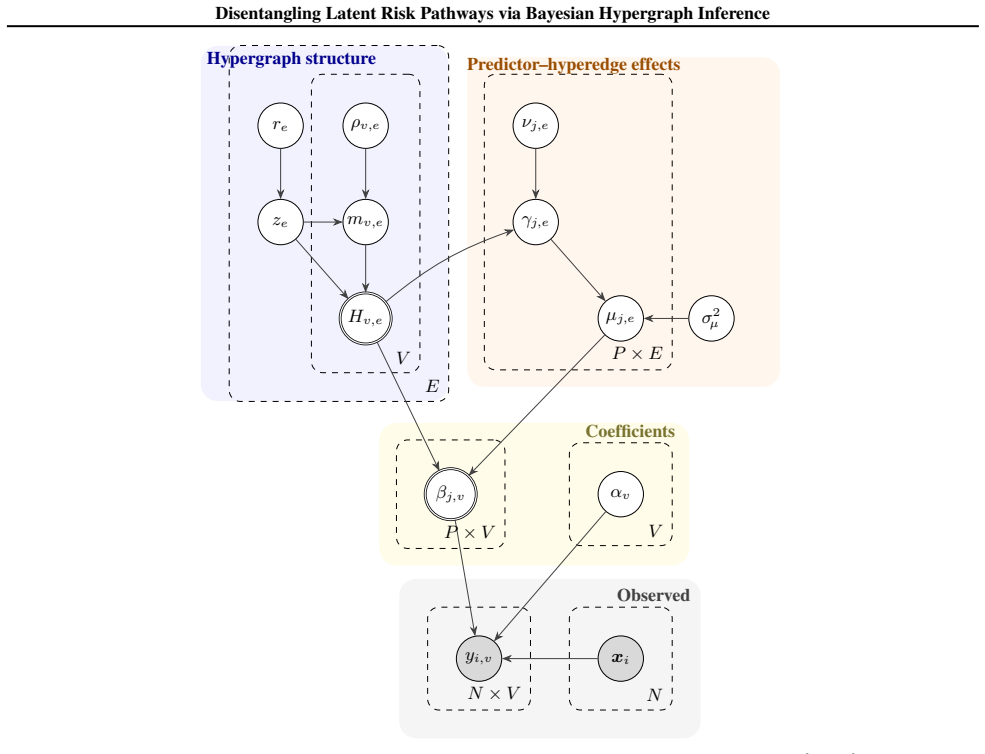
The Bayesian hypergraph inference framework reframes multi-disease modeling around latent, risk-factor-modulated disease pathways. Risk factors act on hyperedges, which are latent disease subsets with shared risk patterns, allowing diseases to participate in multiple distinct pathways and enabling interpretable, higher-order structure beyond pairwise associations. A repulsion prior encourages parsimonious and identifiable structure, while posterior inference provides calibrated uncertainty over both disease groupings and risk-factor influence.
What carries the argument
Bayesian hypergraph inference framework with repulsion prior and structured variational inference, where hyperedges represent latent disease subsets modulated by risk factors.
If this is right
- Diseases participate in multiple pathways, enabling higher-order structure beyond pairwise associations.
- Improved estimation for rare diseases through shared pathway information.
- Calibrated posterior uncertainty over disease groupings and risk-factor effects.
- Scalable inference on large EHR datasets via structured variational methods.
- Stable and interpretable pathway structure on both simulated and real data.
Where Pith is reading between the lines
- The approach could generalize to other multi-outcome settings with shared latent factors, such as species co-occurrence in ecology.
- One could test whether the inferred pathways recover known biological or clinical groupings when applied to independent cohorts.
- The repulsion prior might offer advantages in identifiability for other Bayesian network models with overlapping groups.
Load-bearing premise
The repulsion prior combined with the structured variational inference will yield parsimonious, identifiable hyperedge structures on real EHR data without extensive post-hoc tuning.
What would settle it
If the model applied to UK Biobank data produces hyperedges whose risk factor associations do not match established medical knowledge or if uncertainty calibration fails in cross-validation for rare outcomes.
Figures
read the original abstract
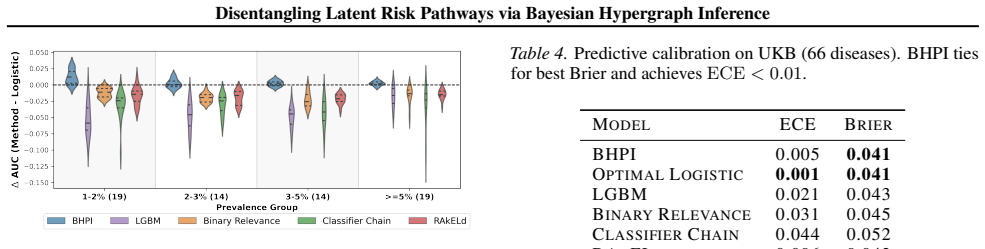
Electronic health records (EHR) pose large-scale multi-disease modeling problems in which many outcomes are rare and strongly influenced by shared risk factors. While modern approaches achieve strong predictive performance, they often treat diseases independently or rely on black-box architectures, offering limited insight into how risk factors organize disease risk and little principled uncertainty quantification. We introduce a Bayesian hypergraph inference framework that reframes multi-disease modeling around latent, risk-factor-modulated disease pathways. Risk factors act on hyperedges, latent disease subsets with shared risk patterns, allowing diseases to participate in multiple distinct pathways and enabling interpretable, higher-order structure beyond pairwise associations. A repulsion prior encourages parsimonious and identifiable structure, while posterior inference provides calibrated uncertainty over both disease groupings and risk-factor influence. To enable scalable inference on large EHR datasets, we develop a structured variational inference algorithm that preserves logical dependencies among hyperedge existence, disease membership, and pathway-level effects. Experiments on simulated data and UK Biobank demonstrate stable and interpretable disease pathway structure, well-calibrated uncertainty, improved estimation for rare diseases, and competitive predictive performance.
Editorial analysis
A structured set of objections, weighed in public.
Referee Report
Summary. The manuscript introduces a Bayesian hypergraph inference framework for multi-disease modeling from EHR data. Risk factors modulate latent hyperedges representing subsets of diseases with shared risk patterns; diseases may belong to multiple hyperedges. A repulsion prior is used to encourage parsimonious and identifiable structure, while a structured variational inference procedure is developed to perform scalable posterior inference that preserves logical dependencies among hyperedge existence, disease membership, and pathway effects. Experiments on simulated data and UK Biobank are reported to demonstrate interpretable pathway recovery, well-calibrated uncertainty, improved estimation for rare diseases, and competitive predictive performance.
Significance. If the central claims hold, the work would offer a meaningful advance over independent-disease or black-box models by supplying higher-order, interpretable latent structure together with principled uncertainty quantification, which is especially relevant for rare outcomes in large cohorts. The structured variational inference algorithm that preserves logical dependencies among the discrete and continuous components of the model is a clear technical strength.
major comments (2)
- [Inference and Experiments sections] The central claim that the repulsion prior together with the structured variational inference produces parsimonious, identifiable hyperedge structure on real EHR data without extensive post-hoc tuning is load-bearing for the interpretability and uncertainty-calibration assertions, yet the manuscript provides no sensitivity analysis on repulsion strength, no explicit identifiability argument, and no diagnostic checks for label-switching or degeneracy when the number of latent pathways is treated as unknown.
- [Experiments section] No validation of the variational approximation against exact inference (or against a gold-standard sampler on smaller instances) is reported, and the manuscript does not specify how rare-disease improvements were quantified or whether data splits were pre-specified; these omissions make it impossible to assess whether the reported gains for rare outcomes are robust.
minor comments (2)
- [Model section] Notation for hyperedge membership indicators and pathway-level effects should be introduced with an explicit table or diagram early in the model section to improve readability.
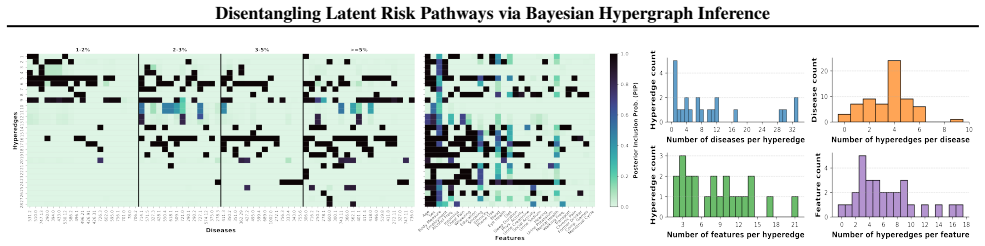
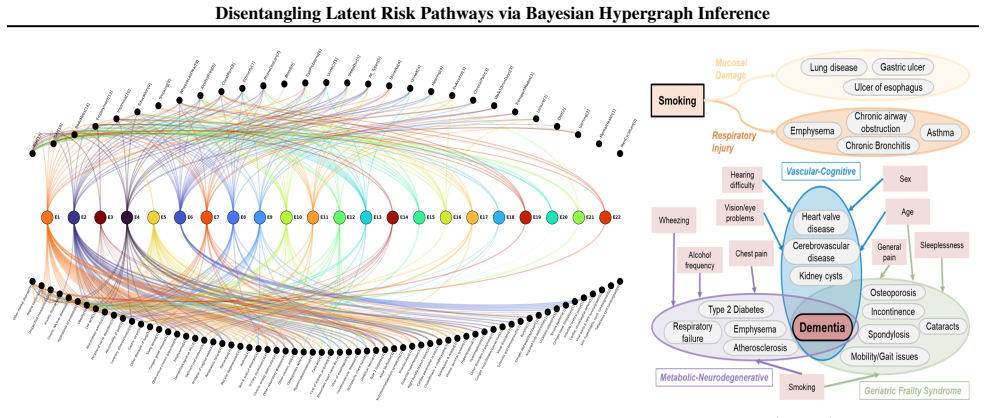
- The abstract states that the method yields 'stable and interpretable disease pathway structure' on UK Biobank; concrete examples of recovered hyperedges together with their associated risk factors would strengthen the presentation.
Simulated Author's Rebuttal
We thank the referee for their detailed and constructive comments on our manuscript. We address each of the major comments below and indicate the revisions we will make to strengthen the paper.
read point-by-point responses
-
Referee: [Inference and Experiments sections] The central claim that the repulsion prior together with the structured variational inference produces parsimonious, identifiable hyperedge structure on real EHR data without extensive post-hoc tuning is load-bearing for the interpretability and uncertainty-calibration assertions, yet the manuscript provides no sensitivity analysis on repulsion strength, no explicit identifiability argument, and no diagnostic checks for label-switching or degeneracy when the number of latent pathways is treated as unknown.
Authors: We agree that these elements would provide stronger support for our claims. In the revised manuscript, we will add a sensitivity analysis section examining the effect of varying the repulsion prior strength on the inferred number of hyperedges and their stability. We will also include a brief discussion of identifiability, highlighting how the repulsion prior mitigates label-switching by encouraging distinct hyperedge structures. Additionally, we will report diagnostic checks, such as posterior similarity matrices or trace plots for hyperedge assignments, in the supplementary material to assess degeneracy. These changes will be made in the Inference and Experiments sections. revision: yes
-
Referee: [Experiments section] No validation of the variational approximation against exact inference (or against a gold-standard sampler on smaller instances) is reported, and the manuscript does not specify how rare-disease improvements were quantified or whether data splits were pre-specified; these omissions make it impossible to assess whether the reported gains for rare outcomes are robust.
Authors: We acknowledge the importance of these validations for assessing the reliability of our results. We will include a new subsection in the Experiments section comparing the structured variational inference to MCMC sampling on smaller simulated datasets where exact inference is feasible. We will also clarify the quantification of rare-disease improvements by specifying the performance metrics (e.g., precision-recall AUC stratified by disease prevalence) and confirm that all data splits were pre-specified prior to analysis, as per the UK Biobank data access protocol described in the methods. These additions will allow readers to better evaluate the robustness of the reported gains. revision: yes
Circularity Check
No circularity: generative model with external validation on simulated and UK Biobank data
full rationale
The paper defines a new Bayesian hypergraph model with a repulsion prior and structured variational inference, then evaluates it on simulated data and UK Biobank for pathway recovery, uncertainty calibration, and predictive performance. No equations or claims reduce the reported predictions or identifiability results to quantities fitted on the same target data by construction, nor do any load-bearing steps rely on self-citation chains or imported uniqueness theorems. The framework is presented as generative and externally benchmarked rather than self-referential.
Axiom & Free-Parameter Ledger
free parameters (2)
- repulsion prior strength
- variational family parameters
axioms (2)
- domain assumption The data-generating process can be represented as risk factors modulating a collection of latent hyperedges (disease subsets).
- standard math Standard Bayesian posterior inference is well-defined for the hypergraph model.
invented entities (1)
-
latent hyperedges (risk-factor-modulated disease pathways)
no independent evidence
Reference graph
Works this paper leans on
-
[1]
The lancet , volume=
Global burden of 87 risk factors in 204 countries and territories, 1990--2019: a systematic analysis for the Global Burden of Disease Study 2019 , author=. The lancet , volume=. 2020 , publisher=
1990
-
[2]
Bayesian inference for logistic models using P
Polson, Nicholas G and Scott, James G and Windle, Jesse , journal=. Bayesian inference for logistic models using P. 2013 , publisher=
2013
-
[3]
2006 , publisher=
Pattern recognition and machine learning , author=. 2006 , publisher=
2006
-
[4]
Journal of Machine Learning Research , author =
Bayesian. Journal of Machine Learning Research , author =. 2020 , keywords =
2020
-
[5]
Biometrical Journal , author =
Multivariate frailty models for two types of recurrent events with a dependent terminal event:. Biometrical Journal , author =. 2013 , note =. doi:10.1002/bimj.201200196 , abstract =
-
[6]
Statistical Methods in Medical Research , author =
Joint analysis of recurrence and termination:. Statistical Methods in Medical Research , author =. 2021 , note =. doi:10.1177/0962280220962522 , abstract =
-
[7]
Nature Communications , author =
Inferring multimodal latent topics from electronic health records , volume =. Nature Communications , author =. 2020 , note =. doi:10.1038/s41467-020-16378-3 , abstract =
-
[8]
Journal of Biomedical Informatics , author =
Unsupervised machine learning for the discovery of latent disease clusters and patient subgroups using electronic health records , volume =. Journal of Biomedical Informatics , author =. 2020 , keywords =. doi:10.1016/j.jbi.2019.103364 , abstract =
-
[9]
Journal of Biomedical Informatics , author =. 2024 , keywords =. doi:10.1016/j.jbi.2024.104638 , abstract =
-
[10]
Supervised
Mcauliffe, Jon and Blei, David , year =. Supervised. Advances in
-
[11]
Psychological Methods , author =
Supervised latent. Psychological Methods , author =. 2023 , pages =. doi:10.1037/met0000541 , language =
-
[12]
Probabilistic. Marketing Science , author =. 2018 , note =. doi:10.1287/mksc.2018.1113 , abstract =
-
[13]
Song, Ziyang and Toral, Xavier Sumba and Xu, Yixin and Liu, Aihua and Guo, Liming and Powell, Guido and Verma, Aman and Buckeridge, David and Marelli, Ariane and Li, Yue , month = aug, year =. Supervised multi-specialist topic model with applications on large-scale electronic health record data , isbn =. Proceedings of the 12th. doi:10.1145/3459930.346954...
-
[14]
Statistics in medicine , author =
Bayesian. Statistics in medicine , author =. 2014 , pmid =. doi:10.1002/sim.5964 , abstract =
-
[15]
Statistical methods in medical research , author =
Bayesian analysis of multi-type recurrent events and dependent termination with nonparametric covariate functions , volume =. Statistical methods in medical research , author =. 2017 , pmid =. doi:10.1177/0962280215613378 , abstract =
-
[16]
Journal of Computational and Graphical Statistics , author =
A. Journal of Computational and Graphical Statistics , author =. 2020 , note =. doi:10.1080/10618600.2019.1686988 , abstract =
-
[17]
Accelerated. Biometrics , author =. 2014 , pmid =. doi:10.1111/biom.12163 , abstract =
-
[18]
Statistics in medicine , author =
A. Statistics in medicine , author =. 2016 , pmid =. doi:10.1002/sim.7030 , abstract =
-
[19]
Journal of Data Science , author =
Bayesian. Journal of Data Science , author =. 2025 , note =. doi:10.6339/25-JDS1182 , abstract =
-
[20]
Joint modeling of recurrent events and survival: a. Biostatistics , author =. 2020 , keywords =. doi:10.1093/biostatistics/kxy026 , abstract =
-
[21]
doi: 10.1080/01621459.2016.1211016
Joint. Journal of the American Statistical Association , author =. 2017 , pmid =. doi:10.1080/01621459.2016.1173557 , abstract =
-
[22]
IEEE Transactions on Pattern Analysis and Machine Intelligence , author =
Advances in. IEEE Transactions on Pattern Analysis and Machine Intelligence , author =. 2019 , keywords =. doi:10.1109/TPAMI.2018.2889774 , abstract =
-
[23]
Advances in Neural Information Processing Systems , volume=
Amortized variational inference for simple hierarchical models , author=. Advances in Neural Information Processing Systems , volume=
-
[24]
Journal of the American Statistical Association , volume=
Variational inference: A review for statisticians , author=. Journal of the American Statistical Association , volume=. 2017 , publisher=
2017
-
[25]
Proceedings of the 5th International Conference on Learning Representations (ICLR) , year=
Categorical Reparameterization with Gumbel-Softmax , author=. Proceedings of the 5th International Conference on Learning Representations (ICLR) , year=
-
[26]
Journal of the American Statistical Association , volume =
Variational. Journal of the American Statistical Association , author =. 2022 , note =. doi:10.1080/01621459.2020.1847121 , number =
-
[27]
Variational. Bioinformatics , author =. 2022 , keywords =. doi:10.1093/bioinformatics/btac416 , abstract =
-
[28]
Bai, Jincheng and Song, Qifan and Cheng, Guang , month = nov, year =. Efficient. doi:10.48550/arXiv.2011.07439 , abstract =
-
[29]
Statistics in Medicine , author =
A shared-parameter continuous-time hidden. Statistics in Medicine , author =. 2019 , note =. doi:10.1002/sim.7994 , abstract =
-
[30]
Statistics in Medicine , author =
Applications of continuous time hidden. Statistics in Medicine , author =. 2003 , note =. doi:10.1002/sim.1270 , abstract =
-
[31]
A. Journal of the American Statistical Association , author =. 2020 , note =. doi:10.1080/01621459.2019.1594831 , abstract =
-
[32]
The Annals of Applied Statistics , author =
Multistate capture–recapture models for irregularly sampled data , volume =. The Annals of Applied Statistics , author =. 2022 , note =. doi:10.1214/21-AOAS1528 , abstract =
-
[33]
Journal of the American Statistical Association , volume =
Recurrent. Journal of the American Statistical Association , author =. 2021 , pmid =. doi:10.1080/01621459.2020.1801447 , abstract =
-
[34]
The Annals of Applied Statistics , author =
Bayesian hidden. The Annals of Applied Statistics , author =. 2024 , note =. doi:10.1214/24-AOAS1922 , abstract =
-
[35]
Journal of the Royal Statistical Society Series B: Statistical Methodology , author =
Semiparametric. Journal of the Royal Statistical Society Series B: Statistical Methodology , author =. 2022 , keywords =. doi:10.1111/rssb.12499 , abstract =
-
[36]
Modeling longitudinal dynamics of comorbidities , isbn =
Maag, Basil and Feuerriegel, Stefan and Kraus, Mathias and Saar-Tsechansky, Maytal and Züger, Thomas , month = apr, year =. Modeling longitudinal dynamics of comorbidities , isbn =. Proceedings of the. doi:10.1145/3450439.3451871 , abstract =
-
[37]
Efficient
Liu, Yu-Ying and Li, Shuang and Li, Fuxin and Song, Le and Rehg, James M , year =. Efficient. Advances in
-
[38]
Combining. Biometrics , author =. 2023 , keywords =. doi:10.1111/biom.13865 , abstract =
-
[39]
Journal of Multivariate Analysis , author =
Continuous time hidden. Journal of Multivariate Analysis , author =. 2020 , keywords =. doi:10.1016/j.jmva.2020.104646 , abstract =
-
[40]
Statistics in Medicine , author =
Markov-modulated marked. Statistics in Medicine , author =. 2023 , note =. doi:10.1002/sim.9832 , abstract =
-
[41]
Bayesian. Biometrics , author =. 2021 , keywords =. doi:10.1111/biom.13261 , abstract =
-
[42]
A joint model for multistate disease processes and random informative observation times, with applications to electronic medical records data , volume =. Biometrics , author =. 2015 , pmid =. doi:10.1111/biom.12252 , abstract =
-
[43]
doi:10.24963/ijcai.2021/353 , abstract =
Huang, Jing and Yang, Jie , month = aug, year =. doi:10.24963/ijcai.2021/353 , abstract =
-
[44]
Journal of the American Statistical Association , year =
Cohesion and. Journal of the American Statistical Association , author =. 2024 , note =. doi:10.1080/01621459.2023.2191821 , abstract =
-
[45]
Bayesian. Journal of the American Statistical Association , author =. 2020 , note =. doi:10.1080/01621459.2018.1537918 , abstract =
-
[46]
Journal of the Royal Statistical Society Series B: Statistical Methodology , author =
Repulsion, chaos, and equilibrium in mixture models , volume =. Journal of the Royal Statistical Society Series B: Statistical Methodology , author =. 2025 , keywords =. doi:10.1093/jrsssb/qkae096 , abstract =
-
[47]
Advances in Data Analysis and Classification , author =
Model-based clustering for random hypergraphs , volume =. Advances in Data Analysis and Classification , author =. 2022 , keywords =. doi:10.1007/s11634-021-00454-7 , abstract =
-
[48]
The Lancet , volume=
Epidemiology of multimorbidity and implications for health care, research, and medical education: a cross-sectional study , author=. The Lancet , volume=. 2012 , publisher=
2012
-
[49]
Proceedings of the National Academy of Sciences , volume=
The human disease network , author=. Proceedings of the National Academy of Sciences , volume=. 2007 , publisher=
2007
-
[50]
Nature Reviews Genetics , volume=
Network medicine: a network-based approach to human disease , author=. Nature Reviews Genetics , volume=. 2011 , publisher=
2011
-
[51]
A Dynamic Network Approach for the Study of Human , volume =
Blumm, Nicholas and Barabasi, Albert-Laszlo and Christakis, Nicholas , year =. A Dynamic Network Approach for the Study of Human , volume =. PLoS computational biology , doi =
-
[52]
Science , volume=
Uncovering disease-disease relationships through the incomplete interactome , author=. Science , volume=. 2015 , publisher=
2015
-
[53]
Scientific reports , volume=
Deep patient: an unsupervised representation to predict the future of patients from the electronic health records , author=. Scientific reports , volume=. 2016 , publisher=
2016
-
[54]
Machine learning for healthcare conference , pages=
Doctor ai: Predicting clinical events via recurrent neural networks , author=. Machine learning for healthcare conference , pages=. 2016 , organization=
2016
-
[55]
NPJ digital medicine , volume=
Scalable and accurate deep learning with electronic health records , author=. NPJ digital medicine , volume=. 2018 , publisher=
2018
-
[56]
Technometrics , volume=
Ridge regression: Biased estimation for nonorthogonal problems , author=. Technometrics , volume=. 1970 , publisher=
1970
-
[57]
Journal of the Royal Statistical Society Series B: Statistical Methodology , volume=
Regression shrinkage and selection via the lasso , author=. Journal of the Royal Statistical Society Series B: Statistical Methodology , volume=. 1996 , publisher=
1996
-
[58]
Journal of the Royal Statistical Society: Series B (Statistical Methodology) , volume=
Regularization and variable selection via the elastic net , author=. Journal of the Royal Statistical Society: Series B (Statistical Methodology) , volume=. 2005 , publisher=
2005
-
[59]
Political Analysis , year=
Logistic Regression in Rare Events Data , author=. Political Analysis , year=
-
[60]
Biometrika , volume=
Bias reduction of maximum likelihood estimates , author=. Biometrika , volume=. 1993 , publisher=
1993
-
[61]
Statistics in medicine , volume=
A solution to the problem of separation in logistic regression , author=. Statistics in medicine , volume=. 2002 , publisher=
2002
-
[62]
A weakly informative default prior distribution for logistic and other regression models , volume =
Gelman, Andrew and Jakulin, Aleks and Pittau, Maria Grazia and Su, Yu-Sung , year =. A weakly informative default prior distribution for logistic and other regression models , volume =. The Annals of Applied Statistics , doi =
-
[63]
Machine Learning , volume=
Multitask learning , author=. Machine Learning , volume=. 1997 , publisher=
1997
-
[64]
Proceedings of the tenth ACM SIGKDD international conference on Knowledge discovery and data mining , pages=
Regularized multi--task learning , author=. Proceedings of the tenth ACM SIGKDD international conference on Knowledge discovery and data mining , pages=
-
[65]
Machine Learning , volume=
Convex multi-task feature learning , author=. Machine Learning , volume=. 2008 , publisher=
2008
-
[66]
Advances in neural information processing systems , volume=
Multi-task Gaussian process prediction , author=. Advances in neural information processing systems , volume=
-
[67]
Scientific data , volume=
Multitask learning and benchmarking with clinical time series data , author=. Scientific data , volume=. 2019 , publisher=
2019
-
[68]
International Journal of Data Warehousing and Mining , volume=
Multi-label classification: An overview , author=. International Journal of Data Warehousing and Mining , volume=. 2007 , publisher=
2007
-
[69]
Machine Learning , volume=
Classifier chains for multi-label classification , author=. Machine Learning , volume=. 2011 , publisher=
2011
-
[70]
IEEE Transactions on Knowledge and Data Engineering , volume=
A review on multi-label learning algorithms , author=. IEEE Transactions on Knowledge and Data Engineering , volume=. 2014 , publisher=
2014
-
[71]
Journal of Machine Learning Research , volume=
Latent Dirichlet allocation , author=. Journal of Machine Learning Research , volume=
-
[72]
Advances in neural information processing systems , volume=
Correlated topic models , author=. Advances in neural information processing systems , volume=. 2006 , publisher=
2006
-
[73]
Pachinko allocation:
Li, Wei and McCallum, Andrew , booktitle=. Pachinko allocation:
-
[74]
Advances in neural information processing systems , volume=
Learning with hypergraphs: Clustering, classification, and embedding , author=. Advances in neural information processing systems , volume=
-
[75]
Proceedings of the AAAI conference on artificial intelligence , volume=
Hypergraph neural networks , author=. Proceedings of the AAAI conference on artificial intelligence , volume=
-
[76]
Advances in neural information processing systems , volume=
Hypergcn: A new method for training graph convolutional networks on hypergraphs , author=. Advances in neural information processing systems , volume=
-
[77]
Hypergraph Transformers for
Xu, Ran and Ali, Mohammed K and Ho, Joyce C and Yang, Carl , journal=. Hypergraph Transformers for
-
[78]
Bycroft, Clare and Freeman, Colin and Petkova, Desislava and Band, Gavin and Elliott, Lloyd T and Sharp, Kevin and Motyer, Allan and Vukcevic, Damjan and Delaneau, Olivier and O’Connell, Jared and others , journal=. The. 2018 , publisher=
2018
-
[79]
Nature Reviews Disease Primers , volume=
Multimorbidity , author=. Nature Reviews Disease Primers , volume=. 2022 , doi=
2022
-
[80]
The Lancet , volume=
Global burden of 87 risk factors in 204 countries and territories, 1990--2019: a systematic analysis for the Global Burden of Disease Study 2019 , author=. The Lancet , volume=. 2020 , publisher=
1990
discussion (0)
Sign in with ORCID, Apple, or X to comment. Anyone can read and Pith papers without signing in.