REVIEW 3 major objections 5 minor 51 references
Faddeev calculations on lambda hypertriton with potentials from Gel'fand-Levitan-Marchenko theory
T0 review · 3 major / 5 minor · reviewed 2026-08-14 · deepseek-v4-flash
Pith's one-line read A Differential Faddeev calculation with Gel'fand-Levitan-Marchenko lambda-nucleon potentials places the hypertriton ground state at -2.462 MeV, inside the experimental range.
desk verdict First application of GLM inverse-scattering Lambda-N potentials to the hypertriton, with a clean numerical convergence but an interpretation that needs separation energies before the agreement with experiment carries weight. read the letter →
The pith
A machine-rendered reading of the paper's core claim, the machinery that carries it, and where it could break.
The reading
What carries the argument
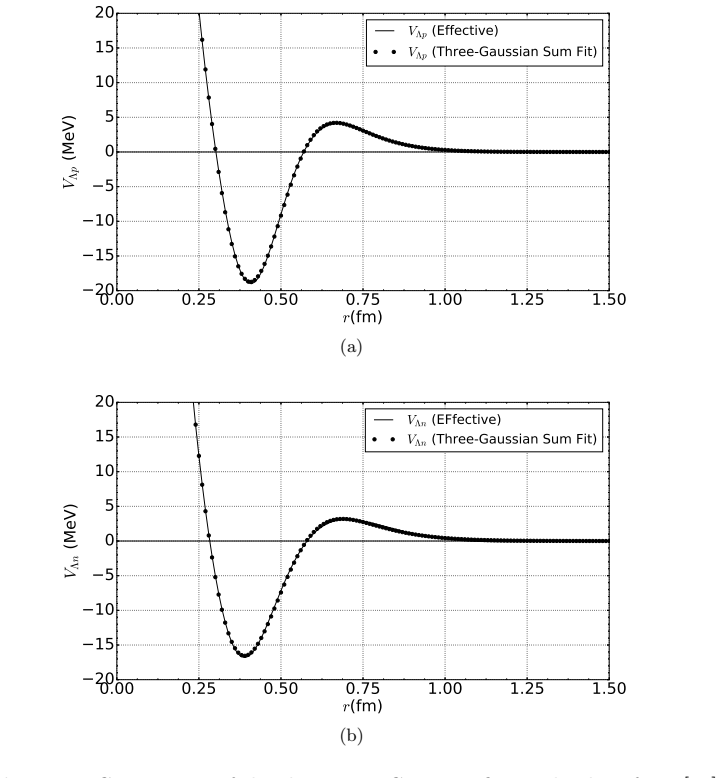
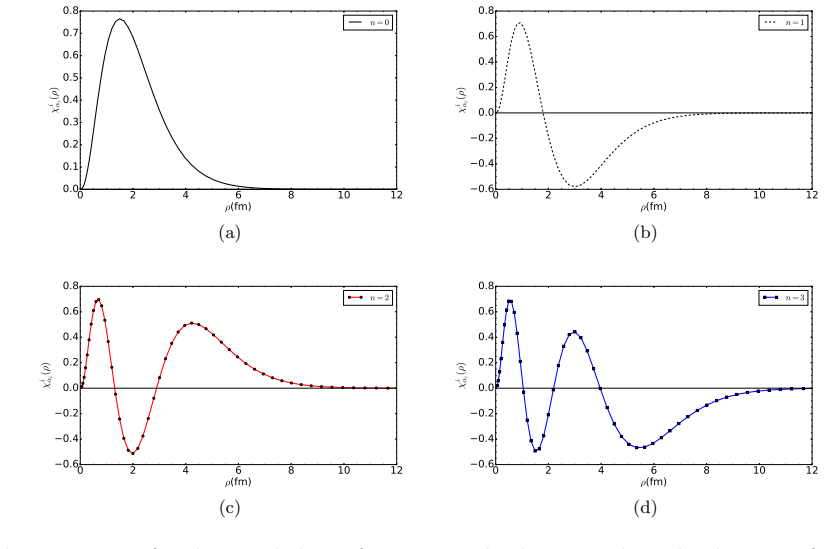
The carrying object is the GLM-YN0 lambda-nucleon potential: a local potential restored from theoretical sub-threshold scattering phases through Gel'fand-Levitan-Marchenko inverse-scattering theory and then fitted as a sum of three Gaussians, with a spin average of one quarter singlet and three quarters triplet. It is what the calculation is testing. The instrument is a system of coupled hyperradial equations derived from the Differential Faddeev Equations in hyperspherical variables, expanded on normalized associated Laguerre polynomials and solved as an eigenvalue problem; the Malfliet-Tjon V potential supplies the neutron-proton input. This arrangement isolates the lambda-nucleon potentials as the only variable being assessed for their few-body consequences.
What would settle it
Recompute the same three-body system after adding a coupled $\lambda$-$\sigma$ conversion channel to the inverse-scattering potentials; if the resulting $J^{\pi}=1/2^+$ energy moves outside roughly -2.2 to -2.7 MeV, or the radius changes by more than a femtometer, the missing channel is controlling the reported agreement.
Extended reading notes
Core claim
The central result is a numerical one: a $J^{\pi}=1/2^+$ $\lambda$ hypertriton bound state appears at -2.462 MeV with a root-mean-square matter radius of 7.00 fm when the $\lambda$-nucleon interactions are the GLM-YN0 potentials and the neutron-proton interaction is the spin-averaged Malfliet-Tjon V potential. The GLM-YN0 potentials are three-Gaussian fits, carrying a one-quarter singlet to three-quarters triplet spin average, to sub-threshold $\lambda$-proton and $\lambda$-neutron phases restored through Gel'fand-Levitan-Marchenko theory. The computed energy sits inside the spread of the two quoted experimental values, -2.35 ± 0.05 MeV and -2.47 ± 0.31 MeV, and the radius is larger than earlier theoretical values, which the authors attribute to the deuteron underbinding of the Malfliet-Tjon V force. The paper presents these numbers as evidence that inverse-scattering theory can act as a complement to meson-exchange and chiral effective field theory in constructing hyperon-nucleon potentials.
Load-bearing premise
The whole calculation stands on the assumption that a spin-averaged three-Gaussian fit to lambda-nucleon scattering phases is a faithful enough lambda-nucleon force even without the lambda-sigma conversion channel; if that missing channel materially reshapes the interaction, the -2.462 MeV agreement with experiment is accidental rather than predictive.
Editorial extensions
If this is right
- The GLM-YN0 potentials produce a bound hypertriton in the experimentally observed energy range, which is what any viable lambda-nucleon input should do.
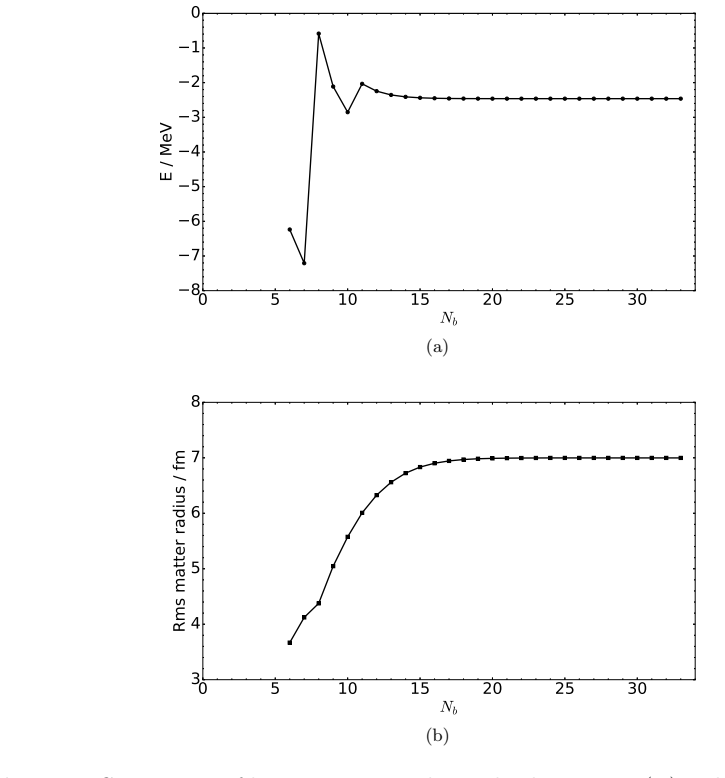
- The binding energy and radius stabilize as the model space grows, so the -2.462 MeV result is not an artifact of a small basis.
- Because the Malfliet-Tjon V potential underbinds the deuteron, the reported matter radius is inflated; radius comparisons with more complete nucleon-nucleon forces require caution.
- The absence of lambda-sigma conversion limits where these potentials can be trusted; the paper recommends against using them for heavy hypernuclei.
- The calculation supports the program of using inverse-scattering theory as a complement to meson-exchange and chiral effective field theory in few-body hypernuclear studies, including future tests of charge symmetry breaking.
Reading between the lines
- A direct next step would be to add a coupled lambda-sigma channel to the same inverse-scattering construction; the size of the resulting binding-energy shift would show whether the missing coupling is the main source of the agreement with experiment.
- Because the lambda-proton force is stronger than the lambda-neutron force in these potentials, the difference could be tested against the charge-symmetry-breaking separation energies of the A=4 lambda hypernuclei without changing the method.
- Extracting the low-energy scattering lengths and effective ranges from the GLM-YN0 fits would give a cheap, independent check of whether the three-Gaussian form preserves the sub-threshold phase information.
Signed reviews
Editorial analysis
A structured set of objections, weighed in public.
Referee Report
Summary. The paper reports a three-body calculation of the hypertriton ground state using the Differential Faddeev Equations in hyperspherical coordinates. The Lambda-proton and Lambda-neutron interactions are spin-averaged central potentials obtained from Gel'fand-Levitan-Marchenko inverse scattering theory and represented as three-Gaussian fits (GLM-YN0), while the neutron-proton interaction is the spin-averaged Malfliet-Tjon V potential. The calculation yields a J^pi=1/2+ bound state at -2.462 MeV with r.m.s. matter radius 7.00 fm, with convergence in model-space size shown in Table 3 and Figure 2. The binding energy is compared with experiment and with several modern hyperon-nucleon potential calculations in Table 4.
Significance. If the interpretive concern about cancellation is resolved, this is the first application of inverse-scattering-derived hyperon-nucleon potentials to a few-body hypernucleus, and it demonstrates that the standard hyperspherical Faddeev machinery handles these potentials smoothly. The convergence study in Table 3 is a genuine and useful check, and the authors are explicit about the omission of Lambda-Sigma conversion. However, the significance as a test of the GLM-YN0 potentials is limited by the absence of subsystem observables (deuteron binding and Lambda separation energy) and by the use of a purely central, spin-averaged np force.
major comments (3)
- [Section 4, Table 4] The central comparison to experiment is not yet convincing because the calculation uses the spin-averaged MT-V np potential, which the paper itself states underbinds the deuteron (Section 4, discussion of the 7.00 fm radius). The total binding energy of -2.462 MeV may therefore result from a cancellation between an underbound np subsystem and a correspondingly too-strong Lambda-N interaction. Since no deuteron binding energy with the same MT-V model and no Lambda separation energy are reported, the reader cannot judge whether S_Lambda is physically reasonable (approximately 0.13 MeV experimentally) or substantially larger. Please report B_d and S_Lambda, and ideally repeat the calculation with a more realistic NN potential, or restrict the claim to a numerical demonstration rather than an accuracy test of GLM-YN0.
- [Section 3, Table 1] The Gaussian fit parameters are not presented in a usable form: several sigma_i values are listed as negative (e.g., -0.3932 fm for Lambda-p and -0.5469 fm for Lambda-n), and V_2 for Lambda-p is 8.106e+07 MeV, which is many orders of magnitude larger than the potential strength shown in Figure 1. It is unclear whether Equation (8) is meant to use sigma_i^2 with |sigma_i|, whether the signs are typographical, and whether the two large-V Gaussians with negative mu_i lie outside the plotted range but still affect the three-body computation. Please correct the definitions, provide the fitted potential in a reproducible form, and give a quantitative measure of the fit quality (e.g., chi^2) or compare the scattering phase shifts with the original data.
- [Section 3, paragraph on Lambda-Sigma conversion] The authors acknowledge that the GLM-YN0 potentials contain no Lambda-Sigma conversion, but they do not assess the possible impact of this omission on the hypertriton binding energy. Since Lambda-Sigma coupling is known to contribute substantially to the Lambda-N interaction in modern potentials, the good agreement with experiment in Table 4 may be coincidental. A quantitative estimate of the expected size of this effect, or a discussion of why it should be small for the hypertriton, is needed to support the interpretation that this is a meaningful test of the GLM-YN0 potentials.
minor comments (5)
- [Figure 1] The label 'EFfective' in panel (b) contains a typo and should read 'Effective'.
- [Section 4, quantum-number notation] The notation (K_i, S_xi, l_xi, l_yi) is used without defining S_xi; please define this channel quantum number explicitly.
- [Table 1] The caption says uncertainties are indicated for mu_i and sigma_i, but no uncertainties are given for the V_i parameters; please add them or state that they were not estimated.
- [Section 2, Equation (5)] The index alpha_i is used before its meaning is explained; consider defining the coupling-scheme abbreviation immediately after Equation (5).
- [Table 3] The convergence is reported to 0.1 keV at N_b=32, but the table is truncated at N_b=32; it would be helpful to state explicitly the criterion used to declare convergence or to show that larger N_b does not change the energy.
Circularity Check
No significant circularity: the GLM-YN0 potentials are prior inputs, and the hypertriton binding energy is a genuine three-body output not used to construct them.
full rationale
The derivation chain is: theoretical scattering phases from [20] are inverted with Gel'fand-Levitan-Marchenko theory to produce lambda-nucleon effective potentials; those potentials are fit with three Gaussians; the spin-averaged GLM-YN0 potentials are combined with a standard Malfliet-Tjon V neutron-proton potential; and the Differential Faddeev equations are solved for the hypertriton ground state. The claimed result, -2.462 MeV binding energy and 7.00 fm matter radius, is not a fit parameter in any part of this chain. The Gaussian parameters of Table 1 are fitted to the effective potentials from [20], not to the hypertriton energy. The paper does cite the authors' own prior work [20] for the potentials, which is a normal and necessary dependency, but the target observable was not used as input to that prior inversion. The three-body calculation itself is a self-contained eigenvalue problem with fixed input potentials and no adjustable parameter directed at reproducing -2.462 MeV. The comparison with other potentials in Table 4 is a benchmark, not a construction. The paper also acknowledges the missing lambda-sigma conversion and the MT-V underbinding of the deuteron; those are physical validity concerns, not circularity. The convergence study with increasing model space further indicates the reported energy is a numerical result of the given Hamiltonian rather than a re-statement of the inputs. Therefore no step in the claimed derivation reduces by construction to its own input, and no fitting or self-citation chain forces the predicted binding energy.
Assumptions & free parameters
free parameters (3)
- Gaussian fit parameters V_i, mu_i, sigma_i for Lambda-p potential =
Table 1: e.g. V1=45.88 MeV, mu1=0.1148 fm, sigma1=-0.3932 fm; V2=8.106e7 MeV, mu2=-1.193 fm, sigma2=0.3575 fm…
- Gaussian fit parameters V_i, mu_i, sigma_i for Lambda-n potential =
Table 1: V1=186.9 MeV, mu1=-0.3476 fm, sigma1=-0.5469 fm; V2=6.74e4 MeV, mu2=-0.383 fm, sigma2=0.191 fm; V3=-52.14…
- Spin-averaging weights 1/4 singlet, 3/4 triplet =
1/4 and 3/4
assumptions (4)
- ad hoc to paper The lambda-nucleon potentials can be represented by a sum of three Gaussians with the parameters in Table 1.
- domain assumption The Faddeev expansion truncated at Kmax=8, Sxmax=1, lxmax=2, lymax=2 yields convergent binding energy and radius.
- domain assumption The Malfliet-Tjon V potential provides an adequate neutron-proton interaction for the hypertriton calculation.
- domain assumption The theoretical scattering phase shifts from [20], from which the lambda-nucleon potentials are restored, are correct.
invented entities (1)
-
GLM-YN0 lambda-nucleon potentials
Cite this review
Pith. "Pith review of Faddeev calculations on lambda hypertriton with potentials from Gel'fand-Levitan-Marchenko theory." pith.science (2026). https://pith.science/paper/EZM3UNNO
@misc{pith2026190806813,
  author       = {Pith},
  title        = {Pith review of: Faddeev calculations on lambda hypertriton with potentials from Gel'fand-Levitan-Marchenko theory},
  year         = {2026},
  howpublished = {\url{https://pith.science/paper/EZM3UNNO}},
  note         = {Machine review of arXiv:1908.06813}
}
abstract
Effective lambda-proton and lambda-neutron potentials, restored from theoretical scattering phases through Gel'fand-Levitan-Marchenko theory, are tested on a lambda hypertriton through three-body calculations. The lambda hypertriton is treated as a three-body system consisting of lambda-proton, lambda-neutron and proton-neutron subsystems. Binding energy and root-mean-square radius are computed for the ground state of lambda hypertriton ($J^{\pi}=1/2^+$). In coordinate space, the dynamics of the system is described using a set of coupled hyperradial equations obtained from the Differential Faddeev Equations. By solving the eigenvalue problem derived from this set of coupled hyperradial equations, the binding energy and root-mean-square matter radius computed are found to be -2.462 MeV and 7.00 fm, respectively. The potentials are also shown to display a satisfactory convergence behaviour.
Figures
Reference graph
Works this paper leans on
-
[1]
Davis D H 2005 Nuclear Physics A 754 3 – 13 proceedings of the Eighth International Conference on Hypernuclear and Strange Particle Physics
work page 2005
-
[2]
Dalitz R H 2005 Nuclear Physics A 754 14 – 24 proceedings of the Eighth International Conference o n Hypernuclear and Strange Particle Physics
work page 2005
-
[3]
de Swart J J, Nagels M M, Rijken T A and Verhoeven P A 1971 Springer Tracts in Modern Physics vol 60 ed H¨ ohler G (Berlin, Heidelberg: Springer Berlin Heidelbe rg) pp 138–203
work page 1971
-
[4]
de Swart J J, Klomp R A M M, Rentmeester M C M and Rijken T A 199 6 Few-Body Problems in Physics ’95: In memoriam Professor Paul Urban ed Guardiola R (Vienna: Springer Vienna) pp 438–447
-
[5]
Rijken T A 1993 Few-Body Problems in Physics ’93, Supplementum 7. Proceedi ngs of the XIVth European Conference on Few-Body Problems in Physics ed Bakker B L G and van Dantzig R (Wien: Springer Verlag) pp 1–12
work page 1993
-
[6]
Rijken T A 2001 Nuclear Physics A 691 322 – 328 proc. 7th Int. Conf. on Hypernuclear and Strange Par ticle Physics
work page 2001
-
[7]
Holzenkamp B, Holinde K and Speth J 1989 Nuclear Physics A 500 485 – 528
work page 1989
-
[8]
Reuber A, Holinde K and Speth J 1992 Czechoslovak Journal of Physics 42 1115–1135
work page 1992
Show all 51 references
-
[9]
Haidenbauer J and Meißner U G 2005 Physical Review C 72 044005
2005
-
[10]
Fujiwara Y, Nakamoto C and Suzuki Y 1996 Physical Review C 54(5) 2180–2200
1996
-
[11]
Fujiwara Y, Nakamoto C and Suzuki Y 1996 Physical Review Letters 76(13) 2242–2245
1996
-
[12]
Fujiwara Y, Kohno M, Nakamoto C and Suzuki Y 2001 Phys. Rev. C 64(5) 054001
2001
-
[13]
Polinder H, Haidenbauer J and Meißner U G 2006 Nuclear Physics A 779 244 – 266
2006
-
[14]
Polinder H, Haidenbauer J and Meißner U G 2007 Physics Letters B 653 29 – 37
2007
-
[15]
Haidenbauer J, Petschauer S, Kaiser N, Meißner U G, Nogg a A and Weise W 2013 Nuclear Physics A 915 24 – 58
2013
-
[16]
2018 Phys
Adamczyk L et al. 2018 Phys. Rev. C 97(5) 054909 (STAR Collaboration)
2018
-
[17]
Gal A and Garcilazo H 2019 Physics Letters B 791 48 – 53
2019
-
[18]
Trogolo S 2019 Nuclear Physics A 982 815 – 818 the 27th International Conference on Ultrarelativ istic Nucleus-Nucleus Collisions: Quark Matter 2018
2019
-
[19]
Xu Y 2017 JPS Conf. Proc. 17 021005
2017
-
[20]
Meoto E F and Lekala M L 2019 Journal of Physics Communications 3 095018
2019
-
[21]
Thompson I J, Nunes F M and Danilin B V 2004 Computer Physics Communications 161 87 – 107
2004
-
[22]
Kievsky A, Viviani M and Rosati S 1993 Nuclear Physics A 551 241 – 254
1993
-
[23]
Nunes F, Christley J, Thompson I, Johnson R and Efros V 19 96 Nuclear Physics A 609 43 – 73
-
[24]
Tarutina T, Thompson I and Tostevin J 2004 Nuclear Physics A 733 53 – 66
2004
-
[25]
Smirnov Y F and Shitikova K V 1977 Sov. J. Particles Nucl. 8
1977
-
[26]
Thompson I J and Nunes F M 2009 Nuclear Reactions for Astrophysics: Principles, Calculat ion and Applications of Low-Energy Reactions (Cambridge: Cambridge University Press)
2009
-
[27]
Bethe H A 1949 Phys. Rev. 76(1) 38–50
1949
-
[28]
Hackenburg R W 2006 Phys. Rev. C 73(4) 044002
2006
-
[29]
Ansari H H, Shoeb M and Khan M Z R 1986 Journal of Physics G: Nuclear Physics 12 1369
1986
-
[30]
Smith D R and Downs B W 1964 Phys. Rev. 133(2B) B461–B465
1964
-
[31]
Dietrich K, Mang H and Folk R 1964 Nuclear Physics 50 177 – 201
1964
-
[32]
Malfliet R A and Tjon J A 1969 Nuclear Physics A 127 161 – 168
1969
-
[33]
Zabolitzky J G, Schmidt K E and Kalos M H 1982 Phys. Rev. C 25(2) 1111–1113
1982
-
[34]
Myo T, Toki H, Ikeda K, Horiuchi H and Suhara T 2017 Phys. Rev. C 95(4) 044314
2017
-
[35]
Garcilazo H, Valcarce A and Vijande J 2020 Chinese Physics C 44 024102
2020
-
[36]
Mohr P J, Newell D B and Taylor B N 2016 Rev. Mod. Phys. 88(3) 035009
2016
-
[37]
Nannini A and Marcucci L E 2018 Frontiers in Physics 6 122
2018
-
[38]
Nemura H, Suzuki Y, Fujiwara Y and Nakamoto C 2000 Progress of Theoretical Physics 103 929–958
2000
-
[39]
1973 Nuclear Physics B 52 1 – 30
Juriˇ c M et al. 1973 Nuclear Physics B 52 1 – 30
1973
-
[40]
Keyes G, Derrick M, Fields T, Hyman L G, Fetkovich J G, McK enzie J, Riley B and Wang I T 1970 Phys. Rev. D 1(1) 66–77
1970
-
[41]
Fujiwara Y, Miyagawa K, Kohno M and Suzuki Y 2004 Nuclear Physics A 738 382 – 386 proceedings of the 8th International Conference on Clustering Aspects of Nucl ear Structure and Dynamics
2004
-
[42]
Fujiwara Y, Suzuki Y, Kohno M and Miyagawa K 2008 Phys. Rev. C 77(2) 027001
2008
-
[43]
Ferrari Ruffino F, Lonardoni D, Barnea N, Deflorian S, Leid emann W, Orlandini G and Pederiva F 2017 Few-Body Systems 58 113
2017
-
[44]
Tominaga K and Ueda T 2001 Nuclear Physics A 693 731 – 754
2001
-
[45]
Tominaga K, Ueda T, Yamaguchi M, Kijima N, Okamoto D, Miy agawa K and Yamada T 1998 Nuclear Physics A 642 483 – 505
1998
-
[46]
Miyagawa K, Kamada H, Gl¨ ockle W and Stoks V 1995 Phys. Rev. C 51(6) 2905–2913
1995
-
[47]
Haidenbauer J 2013 Nuclear Physics A 914 220 – 230 xI International Conference on Hypernuclear and Strange Particle Physics (HYP2012)
2013
-
[48]
Haidenbauer J 2012 Proceedings of science The 7th International Workshop on Chiral Dynamics, August 6 -10, 2012
2012
-
[49]
Rijken T A, Stoks V G J and Yamamoto Y 1999 Physical Review C 59(1) 21–40
1999
-
[50]
Miyagawa K, Kamada H, Gloeckle W, Yamamura H, Mart T and B ennhold C 2000 Few-Body Systems Suppl. 12 324
2000
-
[51]
Miyagawa K and Gl¨ ockle W 1993 Phys. Rev. C 48(6) 2576–2584
1993
Reviewed August 14, 2026 · model on record in the stance chip above.
Discussion (0). Continue with ORCID to comment.