REVIEW 4 major objections 6 minor 45 references
VAGU & GtS: LLM-Based Benchmark and Framework for Joint Video Anomaly Grounding and Understanding
T0 review · 4 major / 6 minor · reviewed 2026-08-06 · deepseek-v4-flash
Pith's one-line read The paper's central claim is that video anomaly detection needs both temporal grounding and semantic understanding, and it delivers a first joint benchmark, a training-free pipeline, and a combined metric for doing so.
desk verdict A useful benchmark-plus-framework package with a genuine human-verified grounding and QA asset, but the 'first' claim is overstated and the core CLIP localization step is never directly validated. read the letter →
The pith
A machine-rendered reading of the paper's core claim, the machinery that carries it, and where it could break.
The reading
What carries the argument
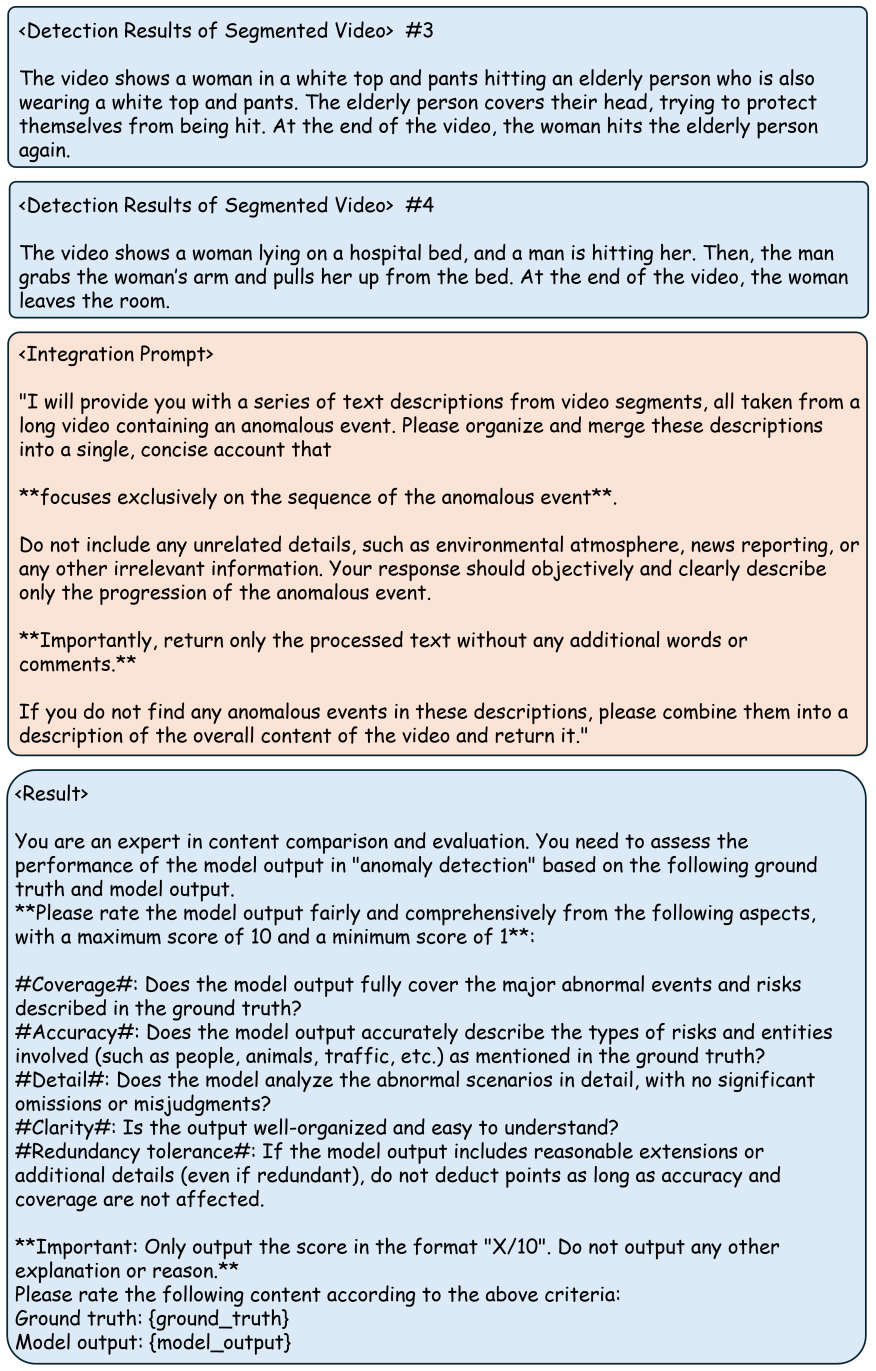
The load-bearing mechanism is the two-phase GtS loop. In the Glance phase, captions, a dataset-supplied anomaly list, and a pre-built phrase bank are turned into static (subject/scene) and dynamic (action/event) prompt lists; a pair of vision-language encoders computes cross-modal similarity curves between those prompts and video frames or segments, producing a temporal anomaly-probability curve that is smoothed and cut into high- and low-probability windows. In the Scrutinize phase, a video QA model describes the high-probability segments under non-uniform sampling weighted by the curve, a language model merges segment evidence to catch causally linked anomalies, and a temporal-grounding model converts the resulting semantic description into refined start and end times. The other central object is JeAUG, defined as $$\mathrm{JeAUG}=\min(\gamma F(\mathrm{IoU}),1)\cdot \mathrm{Score}_{AU}$$, where the grounding factor $F(\mathrm{IoU})$ is a human-preference-calibrated, piecewise logarithmic function of IoU, $\gamma$ compensates for video length, and $\mathrm{Score}_{AU}$ is an LLM rating of semantic completeness over subject, scene, course of events, and impact.
What would settle it
Measure the Glance similarity curve directly against VAGU ground-truth intervals: if anomalous segments do not receive significantly higher similarity scores than non-anomalous segments across a large share of videos, the framework's main localization mechanism is not doing the claimed work.
Extended reading notes
Core claim
On its own terms, the paper establishes a joint formulation: anomaly grounding (when) and anomaly understanding (what) are complementary and should be evaluated together, and a single benchmark can support both. It introduces VAGU as the first such benchmark, with human-verified interval annotations rather than VLM-generated ones, 21 fine-grained anomaly categories across four domains, and over 20,000 QA pairs for objective checking. It further claims that GtS, by using static and dynamic textual prompts to cut a video into high- and low-probability segments before applying a vision-language model, achieves localization and explanation at a fraction of the cost of frame-wise analysis, producing the best balance of performance and inference speed among the compared approaches. The paper also argues that JeAUG gives a fairer combined score than measuring understanding with text metrics alone or grounding with IoU alone.
Load-bearing premise
The Glance stage assumes that a vision-language model's text-video similarity score reliably ranks true anomalous moments above ordinary moments, so if that ranking fails for subtle anomalies, the whole pipeline loses localization before the detailed stage can correct it.
Editorial extensions
If this is right
- VAGU provides a single benchmark where the same model can be scored for temporal localization, anomaly description, and question answering, so "when" and "what" no longer require incompatible evaluation tracks.
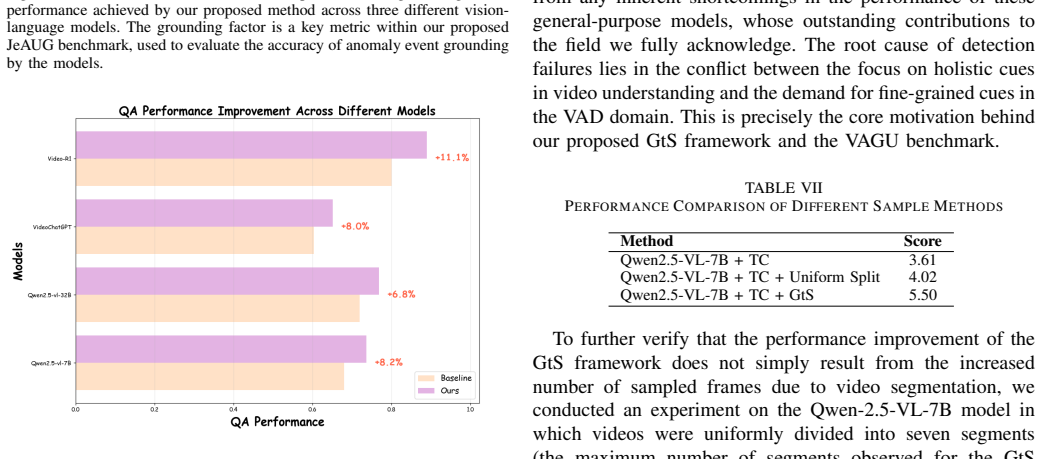
- The paper's experiments indicate that off-the-shelf video QA models improve when run through GtS, suggesting that part of their failure on anomalies comes from missing textual and sampling guidance rather than from model scale alone.
- Because GtS is training-free, switching to a new anomaly category can be done by editing textual prompts and phrase banks, without collecting fine-tuning data for that category.
- JeAUG's joint formula implies that a model cannot hide poor grounding behind a strong semantic description, or vice versa, since the final score is bounded by the product of the two dimensions.
- The paper's comparison results imply that direct transfer of general video QA or temporal-grounding models to anomaly videos performs poorly, so anomaly-specific scaffolding like GtS is needed until VLMs are trained on joint anomaly tasks.
Reading between the lines
- Editorial extension: if the Glance similarity assumption is robust, GtS could serve as a zero-shot annotator, producing candidate interval labels for new anomaly categories that humans only correct rather than create from scratch.
- Editorial extension: because JeAUG's grounding factor is calibrated to an observed human IoU consensus near 0.7, its absolute scale is dataset-dependent; applying the same coefficients to datasets with much stricter or looser boundaries would likely need recalibration.
- Editorial extension: the multi-segment evidence fusion suggests a testable prediction, namely that anomalies composed of causally connected sub-events (for example, theft with concealment and escape) should gain more from GtS than single-stage anomalies; a per-category breakdown of gains would test this directly.
- Editorial extension: replacing the dynamic and static prompt lists with random or conflicting nouns while keeping the rest of the pipeline fixed would show whether the localization is driven by the textual guidance or by the encoder's own priors, which would change how the framework should be improved.
Editorial analysis
A structured set of objections, weighed in public.
Referee Report
Summary. The paper introduces VAGU, claimed to be the first benchmark for joint video anomaly grounding and understanding, containing 7,567 videos with human-verified temporal grounding, semantic anomaly descriptions, and multiple-choice QA. It also proposes GtS, a training-free two-stage framework that uses CLIP/Video-CLIP similarity curves to localize candidate anomalous segments and then applies VQA/VTG models for detailed interpretation and boundary refinement, and JeAUG, a metric combining an LLM-based semantic score with a hand-calibrated grounding score. Experiments on VAGU show that GtS improves over direct VLM use and achieves a favorable speed-accuracy trade-off, with ablations attributing small but consistent gains to each component.
Significance. If the claims hold, VAGU would fill a real gap by providing a joint evaluation standard for anomaly understanding and grounding, and GtS would offer a practical training-free alternative for LLM-based VAD with acceptable inference speeds. The paper includes useful ablations (Tables III and VII) and makes a concrete effort to design a joint metric calibrated against human preferences. However, the benchmark is unreleased, the Glance-stage localization is not directly validated, and the 'first benchmark' claim is overstated relative to CUV A and Holmes-V AU. The central result that GtS improves over direct VLM use is plausible, but the load-bearing first stage needs additional supporting evidence before the framework's efficiency/performance balance claim can be accepted.
major comments (4)
- [IV-A, Eqs. (2)-(6), Table III] The Glance stage's central assumption—that CLIP/Video-CLIP text-frame similarity S(t) ranks anomalous segments above normal ones—is not directly validated. The paper reports no recall of the selected segments against the human grounding annotations, no per-video AUC or precision-recall for S(t), and no comparison against random or uniform peak selection beyond the uniform-split row in Table VII. Table III shows that removing dynamic or static text guidance changes JeAUG by only about 0.2, so the evidence that the coarse localization is actually finding anomalies is weak. Because the efficiency/performance balance claim rests on the Glance stage selecting high-probability segments before the expensive VLM scrutiny, please add a direct grounding-recall experiment (e.g., recall@k of the selected windows vs. the annotated anomalous intervals) or an oracle-selection upper bound that isolates the localization quality.
- [III-C and Appendix D] The VAGU dataset is not released, no download link is provided, and the annotation section reports no inter-annotator agreement statistics; the QA generation is described only as 'annotators verifying correctness.' For a benchmark paper these are essential for assessing annotation quality, which is one of the paper's headline claims over CUV A and Holmes-V AU. Additionally, the abstract and introduction state VAGU is 'the first benchmark that integrates both anomaly grounding and anomaly understanding,' but Table I lists CUV A and HIVAU-70K as already providing both A.U. and A.G. annotations (albeit with VLM-generated grounding). The novelty claim should be qualified, e.g., 'first with human-verified grounding annotations,' and the comparison should acknowledge the prior benchmarks' contributions.
- [V-B, Eqs. (3)-(7)] The implementation details for GtS are not reproducible as written. The text says 'In Equation 4, α=0.4' but α appears in Eq. (3); 'in Equation 6, γ is the mean of all peak points' but Eq. (6) uses β, not γ; and 'in Equation 7, β=total frame num / 20' but Eq. (7) has no β. The threshold τ in Eq. (5) is never assigned a value. Please correct the equation references and report the actual values for α, β, θ, τ, and the smoothing window parameters, together with the range over which they were tuned on the 100-video discarded subset.
- [Appendix B, Eq. (8)-(9)] The JeAUG grounding function F(IoU) is calibrated on a single set of 10 annotators and 50 videos, and the constants (0.63, 0.7, 0.5, and the ln10 denominator) are presented without sensitivity analysis. Since JeAUG is proposed as a general evaluation metric, it needs to be shown that rankings of methods are not driven by these arbitrary constants. Also, the A.U. score in Eq. (9) is said to evaluate four aspects (subject, scene, course, impact) but the aggregation from four aspect scores to Score_AU is not specified. Please clarify the aggregation rule and report how the human-preference consensus IoU (about 0.7) varies across the 21 anomaly categories.
minor comments (6)
- [Throughout] The dataset name is inconsistently spaced as 'V AGU' in many places, and there are typos such as 'an novel framework' (Section IV) and 'Fig, 2' (Section I); please proofread the manuscript.
- [Table II] The 'QA' column is empty for LA VAD and SU VAD; please clarify whether these methods do not report QA accuracy or were not evaluated on the QA subtask.
- [Section I and III-B] The introduction states 'over 7,567 real-world videos' while the dataset section says exactly 7,567; please make the number consistent.
- [Table IV] The metric name 'METOR' should be 'METEOR'.
- [Abstract and Appendix F] The abstract mentions 'average duration exceeding 2,716 frames' but Appendix F says 'over 2,700 frames'; please unify the figures.
- [Eq. (9)] Equation (9) uses γ, which is defined only later in Eq. (11) in Appendix A; consider defining it where it is first used.
Circularity Check
No significant circularity: GtS hyperparameters are set on discarded data, JeAUG is calibrated to external human preferences, and no prediction reduces to a fitted constant.
full rationale
The paper's derivation chain is self-contained in the sense required by the circularity pass. The GtS framework's Glance-stage hyperparameters (α, θ, β, and the window factor) are explicitly derived from 100 discarded videos excluded from evaluation (Section V-B), so the reported test-set numbers are not a fit to the evaluation videos. The JeAUG metric's F(IoU) and video-length factor γ are calibrated to a separate 10-participant, 50-video human preference study and to the stated human-consensus IoU of approximately 0.7 (Appendix B); this is an external reference rather than a re-derivation from GtS outputs. The use of the dataset-provided anomaly list is part of the benchmark task definition and is explicitly permitted by the task constraints in Section III-A. Equations (2)-(6) are direct CLIP/Video-CLIP similarity-based peak-selection operations with thresholds set on discarded data, and Equations (8)-(12) are metric definitions; no predicted quantity is defined in terms of the fitted constants. The only self-citations ([19], [23]) appear in related-work and motivation passages and are not load-bearing for the central benchmark, framework, or metric claims. The strongest potential weakness—that the Glance stage's CLIP ranking is not directly validated against human grounding—is a correctness and robustness concern, not a circularity concern, because the ranking is not constructed from the target labels. Overall, no significant circularity is present.
Assumptions & free parameters
free parameters (5)
- alpha (alpha) =
0.4
- theta (theta) =
total_frame_num/12
- beta (beta) =
total_frame_num/20
- JeAUG constants (0.63, 0.7, 0.5, ln10 denominator) =
0.63, 0.7, 0.5
- video length factor gamma (gamma) =
Function of T with constants 0.25, 0.03, 100
assumptions (5)
- domain assumption CLIP cross-modal similarity between text prompts and video frames/segments is a reliable proxy for anomalous temporal locations.
- domain assumption Off-the-shelf VLM captions during the Glance phase maintain high accuracy in subject recognition.
- domain assumption Human consensus IoU for anomaly grounding is approximately 0.7.
- domain assumption LLM-based scoring in JeAUG A.U. reflects semantic quality.
- domain assumption The provided anomaly category list is available to the model during grounding.
Cite this review
Pith. "Pith review of VAGU & GtS: LLM-Based Benchmark and Framework for Joint Video Anomaly Grounding and Understanding." pith.science (2026). https://pith.science/paper/F25AXSCU
@misc{pith2026250721507,
  author       = {Pith},
  title        = {Pith review of: VAGU & GtS: LLM-Based Benchmark and Framework for Joint Video Anomaly Grounding and Understanding},
  year         = {2026},
  howpublished = {\url{https://pith.science/paper/F25AXSCU}},
  note         = {Machine review of arXiv:2507.21507}
}
read the original abstract
Video Anomaly Detection (VAD) aims to identify anomalous events in videos and accurately determine their time intervals. Current VAD methods mainly fall into two categories: traditional DNN-based approaches that focus on temporal localization, and LLM-based approaches that emphasize semantic understanding. Both anomaly understanding and grounding are essential for comprehensive video anomaly detection and can complement each other. However, no existing model or dataset supports both tasks simultaneously. To address this, we introduce VAGU (Video Anomaly Grounding and Understanding), the first benchmark to integrate both tasks. Each VAGU instance includes annotations for anomaly category, semantic explanation, precise temporal grounding and Video QA. We also provide multiple-choice Video QA for objective evaluation. Based on this dataset, we propose Glance then Scrutinize (GtS), a training-free framework guided by textual prompts. The framework first enables coarse localization of high-probability anomalous regions, followed by detailed anomaly interpretation and temporal boundary refinement. Additionally, we propose the JeAUG metric, which jointly evaluates semantic interpretability and temporal precision, overcoming the limitations of traditional metrics. Extensive experiments verify the effectiveness of our benchmark, framework, and evaluation metric.
Figures


Figures from the paper (16 more)




Reference graph
Works this paper leans on
-
[1]
A revisit of sparse coding based anomaly detection in stacked rnn framework,
W. Luo, W. Liu, and S. Gao, “A revisit of sparse coding based anomaly detection in stacked rnn framework,” in Proceedings of the IEEE international conference on computer vision , 2017, pp. 341–349
work page 2017
-
[2]
Few-shot scene-adaptive anomaly detection,
Y . Lu, F. Yu, M. K. K. Reddy, and Y . Wang, “Few-shot scene-adaptive anomaly detection,” in European Conference on Computer Vision, 2020, pp. 125–141
work page 2020
-
[3]
Fastano: Fast anomaly de- tection via spatio-temporal patch transformation,
C. Park, M. Cho, M. Lee, and S. Lee, “Fastano: Fast anomaly de- tection via spatio-temporal patch transformation,” in Proceedings of the IEEE/CVF Winter Conference on Applications of Computer Vision , 2022, pp. 2249–2259
work page 2022
-
[4]
Improved anomaly detection in surveillance videos with multiple probabilistic models inference,
Z. Xu, X. Zeng, G. Ji, and B. Sheng, “Improved anomaly detection in surveillance videos with multiple probabilistic models inference,” Intelligent Automation & Soft Computing, vol. 31, pp. 1703–1717, 2022
work page 2022
-
[5]
Novel applications for vae-based anomaly detection systems,
L. Bergamin, T. Carraro, M. Polato, and F. Aiolli, “Novel applications for vae-based anomaly detection systems,” in International Joint Conference on Neural Networks (IJCNN) , 2022, pp. 1–8
work page 2022
-
[6]
Making reconstruction-based method great again for video anomaly detection,
Y . Wang, C. Qin, Y . Bai, Y . Xu, X. Ma, and Y . Fu, “Making reconstruction-based method great again for video anomaly detection,” in 2022 IEEE International Conference on Data Mining (ICDM) , 2022, pp. 1215–1220
work page 2022
-
[7]
Z. Liu, Y . Nie, C. Long, Q. Zhang, and G. Li, “A hybrid video anomaly detection framework via memory-augmented flow reconstruction and flow-guided frame prediction,” in Proceedings of the IEEE/CVF inter- national conference on computer vision , 2021, pp. 13 588–13 597
work page 2021
-
[8]
Video anomaly detection by solving decoupled spatio-temporal jigsaw puz- zles,
G. Wang, Y . Wang, J. Qin, D. Zhang, X. Bao, and D. Huang, “Video anomaly detection by solving decoupled spatio-temporal jigsaw puz- zles,” in European Conference on Computer Vision, 2022, pp. 494–511
work page 2022
Show all 45 references
-
[9]
Dual memory units with uncertainty reg- ulation for weakly supervised video anomaly detection,
H. Zhou, J. Yu, and W. Yang, “Dual memory units with uncertainty reg- ulation for weakly supervised video anomaly detection,” arXiv preprint arXiv:2302.05160, 2023
2023 arXiv
-
[10]
Generative cooperative learning for unsupervised video anomaly detection,
M. Z. Zaheer, A. Mahmood, M. H. Khan, M. Segu, F. Yu, and S.-I. Lee, “Generative cooperative learning for unsupervised video anomaly detection,” in Proceedings of the IEEE/CVF conference on computer vision and pattern recognition , 2022, pp. 14 744–14 754
2022
-
[11]
Clip-tsa: Clip-assisted temporal self-attention for weakly-supervised video anomaly detection,
H. K. Joo, K. V o, K. Yamazaki, and N. Le, “Clip-tsa: Clip-assisted temporal self-attention for weakly-supervised video anomaly detection,” in 2023 IEEE International Conference on Image Processing (ICIP) , 2023, pp. 3230–3234
2023
-
[12]
Vadclip: Adapting vision-language models for weakly supervised video anomaly detection,
P. Wu, X. Zhou, G. Pang, L. Zhou, Q. Yan, P. Wang, and Y . Zhang, “Vadclip: Adapting vision-language models for weakly supervised video anomaly detection,” arXiv preprint arXiv:2308.11681 , 2023
2023 arXiv
-
[13]
Catching both gray and black swans: Open-set supervised anomaly detection,
C. Ding, G. Pang, and C. Shen, “Catching both gray and black swans: Open-set supervised anomaly detection,” in Proceedings of the IEEE/CVF conference on computer vision and pattern recognition, 2022, pp. 7388–7398
2022
-
[14]
Towards open set video anomaly detection,
Y . Zhu, W. Bao, and Q. Yu, “Towards open set video anomaly detection,” in European Conference on Computer Vision , 2022, pp. 395–412
2022
-
[15]
Anomaly heterogeneity learning for open-set supervised anomaly detection,
J. Zhu, C. Ding, Y . Tian, and G. Pang, “Anomaly heterogeneity learning for open-set supervised anomaly detection,” arXiv preprint arXiv:2310.12790, 2023
2023 arXiv
-
[16]
Hawk: Learning to understand open-world video anomalies,
J. Tang, H. Lu, R. Wu, X. Xu, K. Ma, C. Fang, B. Guo, J. Lu, Q. Chen, and Y . Chen, “Hawk: Learning to understand open-world video anomalies,” Advances in Neural Information Processing Systems , vol. 37, pp. 139 751–139 785, 2024
2024
-
[17]
Vera: Explainable video anomaly detection via verbalized learning of vision-language models,
M. Ye, W. Liu, and P. He, “Vera: Explainable video anomaly detection via verbalized learning of vision-language models,” arXiv preprint arXiv:2412.01095, 2024
2024 arXiv
-
[18]
Vane- bench: Video anomaly evaluation benchmark for conversational lmms,
R. Bharadwaj, H. Gani, M. Naseer, F. S. Khan, and S. Khan, “Vane- bench: Video anomaly evaluation benchmark for conversational lmms,” arXiv preprint arXiv:2406.10326 , 2024
2024 arXiv
-
[19]
Suvad: Semantic understanding based video anomaly detection using mllm,
S. Gao, P. Yang, and L. Huang, “Suvad: Semantic understanding based video anomaly detection using mllm,” in ICASSP 2025-2025 IEEE International Conference on Acoustics, Speech and Signal Processing (ICASSP). IEEE, 2025, pp. 1–5
2025
-
[20]
Harness- ing large language models for training-free video anomaly detection,
L. Zanella, W. Menapace, M. Mancini, Y . Wang, and E. Ricci, “Harness- ing large language models for training-free video anomaly detection,” in Proceedings of the IEEE/CVF Conference on Computer Vision and Pattern Recognition, 2024, pp. 18 527–18 536
2024
-
[21]
Anyanomaly: Zero-shot customizable video anomaly detection with lvlm,
S. Ahn, Y . Jo, K. Lee, S. Kwon, I. Hong, and S. Park, “Anyanomaly: Zero-shot customizable video anomaly detection with lvlm,” arXiv preprint arXiv:2503.04504, 2025
2025
-
[22]
Video anomaly detection and explanation via large language models,
H. Lv and Q. Sun, “Video anomaly detection and explanation via large language models,” arXiv preprint arXiv:2401.05702 , 2024
2024 arXiv
-
[23]
Scene-adaptive svad based on multi- modal action-based feature extraction,
S. Gao, P. Yang, and L. Huang, “Scene-adaptive svad based on multi- modal action-based feature extraction,” in Proceedings of the Asian Conference on Computer Vision , 2024, pp. 2471–2488
2024
-
[24]
Uncovering what why and how: A comprehensive bench- mark for causation understanding of video anomaly,
H. Du, S. Zhang, B. Xie, G. Nan, J. Zhang, J. Xu, H. Liu, S. Leng, J. Liu, H. Fan et al., “Uncovering what why and how: A comprehensive bench- mark for causation understanding of video anomaly,” in Proceedings of the IEEE/CVF Conference on Computer Vision and Pattern Recogniti...
2024
-
[25]
Video-llava: Learning united visual representation by alignment before projection,
B. Lin, Y . Ye, B. Zhu, J. Cui, M. Ning, P. Jin, and L. Yuan, “Video-llava: Learning united visual representation by alignment before projection,” arXiv preprint arXiv:2311.10122 , 2023
2023 arXiv
-
[26]
Video-xl: Extra-long vision language model for hour-scale video understanding,
Y . Shu, Z. Liu, P. Zhang, M. Qin, J. Zhou, Z. Liang, T. Huang, and B. Zhao, “Video-xl: Extra-long vision language model for hour-scale video understanding,” arXiv preprint arXiv:2409.14485 , 2024
2024 arXiv
-
[27]
Video-chatgpt: Towards detailed video understanding via large vision and language models,
M. Maaz, H. Rasheed, S. Khan, and F. S. Khan, “Video-chatgpt: Towards detailed video understanding via large vision and language models,” arXiv preprint arXiv:2306.05424 , 2023
2023 arXiv
-
[28]
Vtimellm: Empower llm to grasp video moments,
B. Huang, X. Wang, H. Chen, Z. Song, and W. Zhu, “Vtimellm: Empower llm to grasp video moments,” in Proceedings of the IEEE/CVF Conference on Computer Vision and Pattern Recognition , 2024, pp. 14 271–14 280
2024
-
[29]
mplug-owl: Modularization empowers large language models with multimodality,
Q. Ye, H. Xu, G. Xu, J. Ye, M. Yan, Y . Zhou, J. Wang, A. Hu, P. Shi, Y . Shi et al. , “mplug-owl: Modularization empowers large language models with multimodality,” arXiv preprint arXiv:2304.14178 , 2023
2023 arXiv
-
[30]
Region-aware pretraining for open- vocabulary object detection with vision transformers,
D. Kim, A. Angelova, and W. Kuo, “Region-aware pretraining for open- vocabulary object detection with vision transformers,” in Proceedings of the IEEE/CVF Conference on Computer Vision and Pattern Recognition, 2023, pp. 11 144–11 154
2023
-
[31]
Dual discriminator generative adver- sarial network for video anomaly detection,
F. Dong, Y . Zhang, and X. Nie, “Dual discriminator generative adver- sarial network for video anomaly detection,” IEEE Access , vol. 8, pp. 88 170–88 176, 2020
2020
-
[32]
Spatio- temporal autoencoder for video anomaly detection,
Y . Zhao, B. Deng, C. Shen, Y . Liu, H. Lu, and X.-S. Hua, “Spatio- temporal autoencoder for video anomaly detection,” in Proceedings of the 25th ACM International Conference on Multimedia, 2017, pp. 1933– 1941
2017
-
[33]
Synthetic temporal anomaly guided end-to-end video anomaly detection,
M. Astrid, M. Z. Zaheer, and S.-I. Lee, “Synthetic temporal anomaly guided end-to-end video anomaly detection,” in Proceedings of the IEEE International Conference on Computer Vision , 2021, pp. 207–214
2021
-
[34]
Chaotic invariants of lagrangian particle trajectories for anomaly detection in crowded scenes,
S. Wu, B. E. Moore, and M. Shah, “Chaotic invariants of lagrangian particle trajectories for anomaly detection in crowded scenes,” in IEEE computer society conference on computer vision and pattern recognition. IEEE, 2010, pp. 2054–2060
2010
-
[35]
Gods: Generalized one-class discriminative subspaces for anomaly detection,
J. Wang and A. Cherian, “Gods: Generalized one-class discriminative subspaces for anomaly detection,” in Proceedings of the IEEE/CVF International Conference on Computer Vision , 2019, pp. 8201–8211
2019
-
[36]
A deep one-class neural network for anomalous event detection in complex scenes,
P. Wu, J. Liu, and F. Shen, “A deep one-class neural network for anomalous event detection in complex scenes,” IEEE transactions on neural networks and learning systems , vol. 31, no. 7, pp. 2609–2622, 2019
2019
-
[37]
Ubnormal: New benchmark for supervised open-set video anomaly detection,
A. Acsintoae, A. Florescu, M.-I. Georgescu, T. Mare, P. Sumedrea, R. T. Ionescu, F. S. Khan, and M. Shah, “Ubnormal: New benchmark for supervised open-set video anomaly detection,” in Proceedings of the IEEE/CVF conference on computer vision and pattern recognition, 2022, pp. ...
2022
-
[38]
Follow the rules: reasoning for video anomaly detection with large language models,
Y . Yang, K. Lee, B. Dariush, Y . Cao, and S.-Y . Lo, “Follow the rules: reasoning for video anomaly detection with large language models,” in European Conference on Computer Vision . Springer, 2024, pp. 304– 322
2024
-
[39]
Holmes-vad: Towards unbiased and explain- able video anomaly detection via multi-modal llm,
H. Zhang, X. Xu, X. Wang, J. Zuo, C. Han, X. Huang, C. Gao, Y . Wang, and N. Sang, “Holmes-vad: Towards unbiased and explain- able video anomaly detection via multi-modal llm,” arXiv preprint arXiv:2406.12235, 2024
2024 arXiv
-
[40]
Real-world anomaly detection in surveillance videos,
W. Sultani, C. Chen, and M. Shah, “Real-world anomaly detection in surveillance videos,” in Proceedings of the IEEE conference on computer vision and pattern recognition , 2018, pp. 6479–6488
2018
-
[41]
Not only look, but also listen: Learning multimodal violence detection under weak supervision,
P. Wu, J. Liu, Y . Shi, Y . Sun, F. Shao, Z. Wu, and Z. Yang, “Not only look, but also listen: Learning multimodal violence detection under weak supervision,” in Computer Vision–ECCV 2020: 16th European Conference, Glasgow, UK, August 23–28, 2020, Proceedings, Part XXX
2020
-
[42]
Springer, 2020, pp. 322–339
2020
-
[43]
Rouge: A package for automatic evaluation of sum- maries,
L. Chin-Yew, “Rouge: A package for automatic evaluation of sum- maries,” in Proceedings of the Workshop on Text Summarization Branches Out, 2004 , 2004
2004
-
[44]
Bleu: a method for automatic evaluation of machine translation,
K. Papineni, S. Roukos, T. Ward, and W.-J. Zhu, “Bleu: a method for automatic evaluation of machine translation,” in Proceedings of the 40th annual meeting of the Association for Computational Linguistics , 2002, pp. 311–318
2002
-
[45]
Meteor: An automatic metric for mt evalua- tion with improved correlation with human judgments,
S. Banerjee and A. Lavie, “Meteor: An automatic metric for mt evalua- tion with improved correlation with human judgments,” in Proceedings of the acl workshop on intrinsic and extrinsic evaluation measures for machine translation and/or summarization , 2005, pp. 65–72. APPENDI...
2005
Reviewed August 6, 2026 · model on record in the stance chip above.
Discussion (0). Sign in to comment.