REVIEW 3 major objections 5 minor 1 cited by
Sparse sampling approach to efficient ab initio calculations at finite temperature
T0 review · 3 major / 5 minor · reviewed 2026-08-14 · deepseek-v4-flash
Pith's one-line read Sparse sampling represents finite-temperature Green's functions on exactly as many time and frequency points as basis functions, enabling accurate low-temperature GW and GF2 calculations at a fraction of the usual cost.
desk verdict A genuinely useful sparse-sampling construction for compact Green's function representations, with solid demonstrations and one real but fixable gap: no cutoff-independence check for the IR basis parameter. read the letter →
The pith
A machine-rendered reading of the paper's core claim, the machinery that carries it, and where it could break.
The reading
What carries the argument
The machinery is the sparse sampling grid plus the $N\times N$ transform matrices. For the Chebyshev basis, time samples are the roots of the $(N+1)$-th polynomial and frequency samples are the Matsubara frequencies nearest the roots of the transformed next basis function; for the IR basis, time samples are midpoints between roots of the highest available basis function and frequency samples are the maxima of its sign-change intervals. These choices make the matrices mapping sampled values to basis coefficients well conditioned, with a Chebyshev condition number of $\sqrt{2}$ and IR condition numbers growing only slowly with $N$ and $\Lambda$, so round-off in repeated time-to-frequency round trips stays controlled. The basis coefficient vector is the central object connecting the two domains.
What would settle it
Repeat a converged H10 GF2 or GW calculation with the IR cutoff $\Lambda$ raised from $10^5$ to $10^6$ or $10^7$ at fixed basis size $N$; if the total energy or density matrix shifts by more than the stated tolerance, the Hartree-Fock-derived spectral window was too narrow and the sparse representation missed information.
Extended reading notes
Core claim
For a Green's function expanded in N basis functions, the full information needed to reconstruct the function in either imaginary time or Matsubara frequency is contained in N carefully chosen sampling values. The paper constructs such sets for Chebyshev and intermediate-representation (IR) bases, using the root structure of the highest basis function in time and the sign-change structure of its Fourier transform in frequency, with the zero bosonic frequency handled explicitly. The coefficient vector of the basis expansion then serves as a proxy that converts sampled time values into sampled frequency values and back. Applied to self-consistent GW and GF2, this reduces the numerical grids to the basis size while reaching total-energy convergence below $10^{-8}$ $E_h$ and exponential decay of density-matrix errors.
Load-bearing premise
The method assumes the energy window chosen for the basis, estimated from the Hartree-Fock spectrum, contains all spectral weight of the true interacting Green's function.
Editorial extensions
If this is right
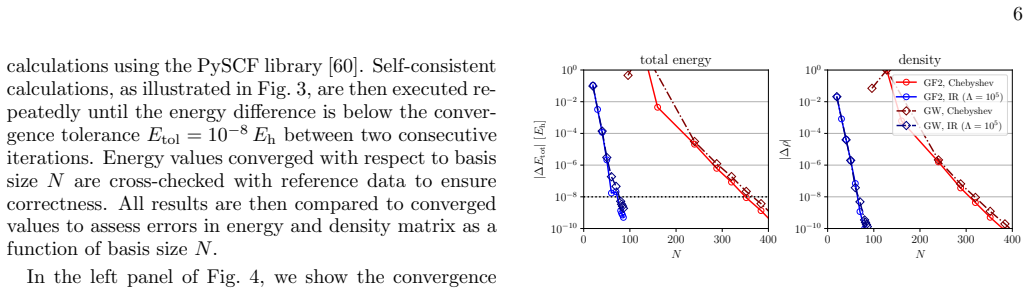
- At $\beta = 1000$, GF2 and GW on H10 converge below $10^{-8}$ $E_h$ with roughly 350 Chebyshev points and fewer than 100 IR points, with density-matrix errors falling exponentially in $N$.
- All-electron noble-gas atoms from He to Kr converge with about 100 IR basis functions, removing the need for effective core potentials in these tests.
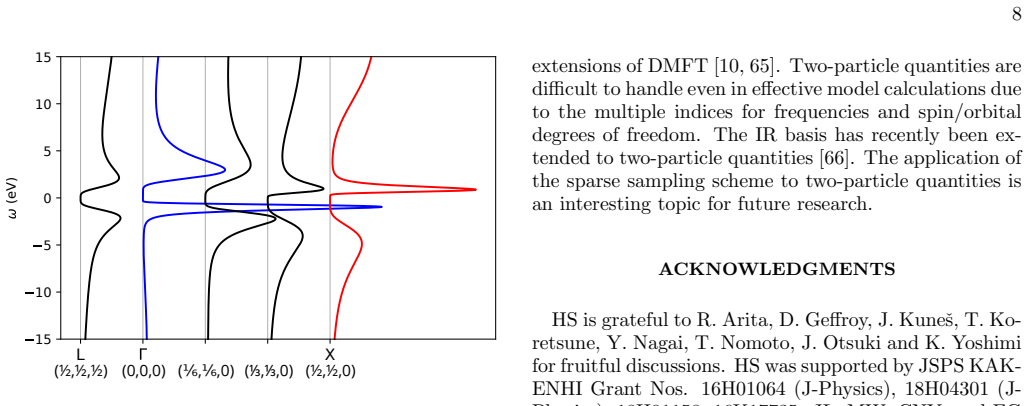
- A GW calculation on a silicon crystal with a $4\times4\times4$ momentum mesh converges to the same total energy with about 300 Chebyshev or 80 to 110 IR points, compared with roughly $10^5$ frequency points in conventional uniform grids.
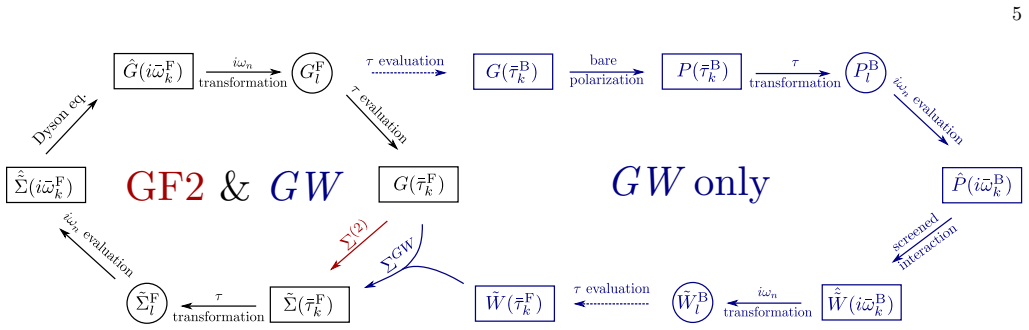
- The sparse scheme permits stable repeated switching between fermionic and bosonic representations, so the GW self-consistency loop does not accumulate extra error.
- Because the grid size equals the basis size, storage and cost scale with the compact representation rather than with temperature or bandwidth, enabling lower-temperature calculations with large energy scales.
Reading between the lines
- Beyond the paper: the same point-selection idea should give even larger savings for two-particle Green's functions, whose memory cost grows as a product of frequency grids; a vertex-function calculation is a direct test.
- Beyond the paper: the root-and-extremum choice is not claimed optimal, so an information-theoretic or condition-number-minimizing search for sampling points could make other bases or extreme $\Lambda$ values still more robust.
- Beyond the paper: if sparse frequency samples resolve both low-frequency structure and high-frequency tails, analytic continuation by maximum entropy may need fewer Matsubara points than standard dense grids; this could be checked on the same systems.
Editorial analysis
A structured set of objections, weighed in public.
Referee Report
Summary. The paper introduces a sparse sampling scheme for finite-temperature Green's functions: given a compact orthogonal basis (Chebyshev or IR) of size N, it constructs N imaginary-time sampling points from roots or sign-change midpoints of the highest basis function, and N Matsubara-frequency sampling points from the sign changes of the highest Fourier-transformed basis function. The resulting N-by-N transformation matrices are well conditioned, so Green's functions, self-energies, and screened interactions can be evaluated on the sparse grids and transformed between time and frequency with controlled information loss. The method is demonstrated in self-consistent GF2 and GW calculations for a hydrogen chain, noble gas atoms, and a silicon crystal, with convergence of the total energy to 10^-8 Eh using on the order of 50-350 sampling points per orbital index.
Significance. If the claims hold, this is a practically useful methodological contribution: it replaces uniform Matsubara/time grids with O(N) sampling points, and the transformation scheme in Fig. 1 is clean, general, and simple to implement. The paper is honest about the non-optimality of the construction (Sec. II.E), provides condition-number scaling data (Appendix B2), explicitly separates constant shifts that compact bases cannot capture (Appendix A2), and cross-checks the H10 results against reference data. The silicon calculation partially checks the IR cutoff dependence by comparing Λ=10^4 and 10^5 in Table I. The main gap is that the IR results rely on a heuristic spectral cutoff inferred from Hartree-Fock spectra, and the efficiency claims are not supported by direct timing measurements.
major comments (3)
- [Sec. IV.A-C and Appendix A2] The IR expansion is complete only if the spectral support of every represented function lies within [-omega_max, omega_max], and the paper sets Lambda=beta*omega_max from the Hartree-Fock single-particle spectrum (H10: beta*Delta E ~ 5.76e3 with Lambda=1e5; Si: beta*Delta E ~ 3e3 with Lambda=1e4 or 1e5; noble gases with Lambda=1e4-1e6). The GF2 self-energy in Eq. (15) is a convolution of three Green's functions, and the RPA polarization and screened interaction in Eqs. (17)-(18) contain particle-hole spectral content, so their support is not guaranteed to coincide with the HF eigenvalue window. The convergence tests at fixed Lambda therefore demonstrate convergence to the best representation within the truncated IR space, not to the exact physical result. Since the condition number grows as Lambda^{1/2} (Appendix B2, Fig. 8), simply increasing Lambda is not numerically harmless. I request a cutoff-independence test: for H10 and at least one noble-gas atom, compare converged energies and density matrices at Lambda and 2Lambda or 4Lambda, using N large enough for the larger Lambda; for silicon, report the same comparison at Etol=1e-8 instead of 1e-6. If the results are insensitive over that range, the claim should state this explicitly.
- [Sec. III-IV] The abstract and Sec. IV.A claim that the method 'greatly reduces the computational cost and memory requirement' and is 'efficient', but the paper provides no wall-clock time, memory, or scaling measurements. The reduction from roughly 10^4-10^5 uniform Matsubara frequencies to a few hundred sampling points is suggestive, but the actual cost also includes the matrix transformations in Eqs. (6)-(7), and one cannot judge the practical speedup without a benchmark. I recommend adding at least one direct timing comparison (same system and implementation, uniform grid vs. sparse sampling) or, if unavailable, softening the efficiency language to an asymptotic grid-size reduction claim.
- [Sec. II.C] The Matsubara-frequency sampling for the IR basis is chosen by grouping frequencies according to the sign changes of the highest basis function, and the claim that the parity requirements give exactly N sampling points is only stated as 'by checking numerically'. This is acceptable for a numerical basis, but the paper should either give a short proof of the number of sign changes from the properties of the IR basis or explicitly mark this as an empirical observation. As written, the construction of the frequency sampling points is less self-contained than the time-domain construction.
minor comments (5)
- [Sec. II.D and Fig. 2] The text says the top-left panel shows U^F_34, while the caption says the basis function used to generate sampling points has l=33; because Eq. (1) uses zero-based indices, please reconcile this inconsistency.
- [Sec. IV.A] There is a typo: 'caculations' should read 'calculations'.
- [Eq. (10)] The phrase 'roots of the (N+1)-th basis function T_N' is ambiguous; T_N is conventionally the Nth Chebyshev polynomial, so the sentence should simply say 'roots of T_N'.
- [Fig. 8] The right panel states the condition-number scaling in Lambda but does not specify in the caption how N is chosen for each Lambda; the text in Appendix B2 should state that N is the maximum number of coefficients available at the same singular-value cutoff in the irbasis library.
- [Reference [57]] Reference [57] appears corrupted ('McGraw-Hili, New York'); please fix the publisher and formatting.
Circularity Check
No significant circularity: sparse sampling points are constructed from the basis, not fitted to target data, and the IR cutoff is an external physical input.
full rationale
The derivation chain is self-contained as a numerical method paper: the sparse sampling points are generated from the roots or sign-change structure of the chosen basis functions (Eqs. (10), and the IR and Chebyshev frequency algorithms in Sec. II.C), with no parameter fitted to the Green's functions, energies, or densities that are later reported as converged results. The central transform equations (6) and (7) are exact linear algebra for any basis coefficients, so the only approximation is the basis truncation, which is validated independently by exponential coefficient decay (Fig. 5) and by agreement with external reference data for H10, noble gases, and silicon. The IR basis itself is cited from prior work (Refs. [49-51]) including the authors' own irbasis library, but this is ordinary code/infrastructure reuse rather than a load-bearing self-citation: the basis is publicly implemented, its exponential singular-value decay is stated as a property of the Lehmann kernel, and the paper's novel contribution is the sampling-point construction, not the basis. The heuristic choice of Lambda from Hartree-Fock spectra (Sec. IV) is an external input and is a robustness/correctness caveat, not a circular step, because no quantity derived from the output is used to set it. The paper even disclaims optimality ('The procedures we have presented are not unique, and we do not claim that they are optimal definitions of sampling points'), further indicating the method is not being justified by construction. Accordingly, no step reduces by definition to its own inputs, and the circularity score is 0.
Assumptions & free parameters
free parameters (1)
- IR basis dimensionless parameter Λ (or cutoff ωmax) =
10^4 to 10^6 depending on system (He Λ=10^4, Ne Λ=10^5, Ar/Kr Λ=10^6, H10 Λ=10^5, Si Λ=10^4 or 10^5)
assumptions (2)
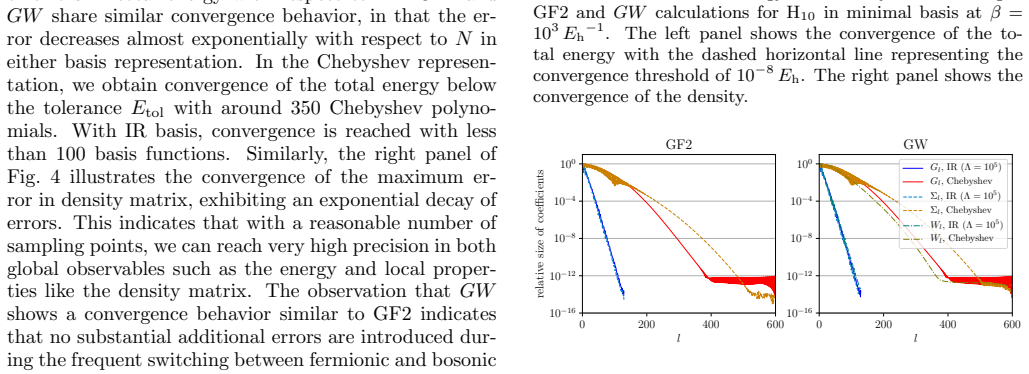
- standard math The finite-temperature Green's function is analytic in the open interval (0, β), and its Chebyshev expansion converges exponentially.
- domain assumption For the IR basis, the spectral function is assumed to be bounded within [−ωmax, ωmax], so that the Lehmann representation kernel is applicable.
Cite this review
Pith. "Pith review of Sparse sampling approach to efficient ab initio calculations at finite temperature." pith.science (2026). https://pith.science/paper/F25UUODX
@misc{pith2026190807575,
  author       = {Pith},
  title        = {Pith review of: Sparse sampling approach to efficient ab initio calculations at finite temperature},
  year         = {2026},
  howpublished = {\url{https://pith.science/paper/F25UUODX}},
  note         = {Machine review of arXiv:1908.07575}
}
abstract
Efficient ab initio calculations of correlated materials at finite temperature require compact representations of the Green's functions both in imaginary time and Matsubara frequency. In this paper, we introduce a general procedure which generates sparse sampling points in time and frequency from compact orthogonal basis representations, such as Chebyshev polynomials and intermediate representation (IR) basis functions. These sampling points accurately resolve the information contained in the Green's function, and efficient transforms between different representations are formulated with minimal loss of information. As a demonstration, we apply the sparse sampling scheme to diagrammatic $GW$ and GF2 calculations of a hydrogen chain, of noble gas atoms and of a silicon crystal.
Figures

Figures from the paper (4 more)


Forward citations
Cited by 1 Pith paper
-
Toward inclusive observables with staggered quarks: the smeared $R$~ratio
A pilot lattice QCD calculation shows that staggered quarks, with even/odd time-slice separation, produce a smeared R ratio that roughly matches the Bernecker-Meyer model below 1 GeV.
Reference graph
Works this paper leans on
-
[1]
Chebyshev basis The Chebyshev polynomials of the first kindTl(x) form an orthogonal system in the interval [ −1, 1], which can be mapped in to the interval [0,β ] via x(τ) = 2τ β − 1, τ (x) = β(x + 1) 2 (A1) such that Fα l (τ) = Tl[x(τ)]. We use the notation Tl(τ) to represent the order l Chebyshev polynomial mapped onto the interval [0,β ]. Approximating ...
-
[2]
IR basis The IR basis introduced in Refs. 49 is designed to bet- ter capture properties of Green’s functions in physical systems rather than arbitrary analytic functions. The IR basis has been applied to numerical analytic contin- uation [67] and DMFT calculations [68]. This section provides a brief description of the IR basis following the notation used ...
-
[3]
The follow- ing properties can be shown using the recursion relation developed in Ref
Matsubara sampling points for Chebyshev In the Chebyshev representation, we follow the same heuristics as in the τ sampling by finding or approximat- ing zeros of the next basis function ˆTα N(iωα n). The follow- ing properties can be shown using the recursion relation developed in Ref. 47. • ˆTα l (iωα n) can be written as a polynomial Iα l (zn) = ˆTα l (...
-
[4]
Condition numbers of transformation matrices Every time Eqs. (6) and (7) are evaluated, numerical errors, such as round-off error in floating point opera- tions, may be amplified due to the (pseudo-)inversion process. This error amplification can be quantified by the condition number of the transformation matrices Fα and ˆFα, defined as the product of the 2-nor...
-
[5]
T ransforming between fermionic and bosonic statistics Besides the transformation matrices defined in Eqs. (8) and (9), two additional matrices may be precomputed to allow fast switching between fermionic and bosonic representations in GW [FF→B]kl =F F l (¯τ B k ) (C1) [FB→F]kl =F B l (¯τ F k ). (C2) Note that the inverse transform of those matrices are no...
-
[6]
Evaluation of total energy and density matrix In the total energy evaluation (19), the frequency sum- mation term can be rewritten using an auxiliary scalar quantityS such that 1 2β ∑ n Tr [ˆ˜Σ(iωF n) ˆG(iωF n)] = 1 2β ∑ n ˆS(iωF n) = 1 2S(0−) =−1 2S(β) (C3) where ˆS(iωF n) = Tr [ˆ˜Σ(iωF n) ˆG(iωF n)]. (C4) We first evaluate ˆS(i¯ωF k ) on the frequency sa...
-
[7]
T. Matsubara, A New Approach to Quantum-Statistical Mechanics, Progress of Theoretical Physics 14, 351 (1955)
work page 1955
-
[8]
A. A. Abrikosov, L. P. Gorkov, and I. E. Dzyaloshinski, Methods of Quantum Field Theory in Statistical Physics (Dover Publications, New York, 1975)
1975
Show all 74 references
-
[9]
J. W. Negele and H. Orland, Quantum many-particle sys- tems (Advanced Book classics) (Westview Press, 1998)
1998
-
[10]
J. M. Luttinger and J. C. Ward, Ground-State Energy of a Many-Fermion System. II, Physical Review 118, 1417 (1960)
1960
-
[11]
D. J. Scalapino and R. L. Sugar, Monte Carlo calculations of coupled boson-fermion systems. II, Physical Review B 24, 4295 (1981)
1981
-
[12]
Georges, G
A. Georges, G. Kotliar, W. Krauth, and M. J. Rozen- berg, Dynamical mean-field theory of strongly correlated fermion systems and the limit of infinite dimensions, Re- views of Modern Physics 68, 13 (1996)
1996
-
[13]
Maier, M
T. Maier, M. Jarrell, T. Pruschke, and M. H. Hettler, Quantum cluster theories, Reviews of Modern Physics 77, 1027 (2005)
2005
-
[14]
Kotliar, S
G. Kotliar, S. Y. Savrasov, K. Haule, V. S. Oudovenko, O. Parcollet, and C. A. Marianetti, Electronic structure calculations with dynamical mean-field theory, Reviews of Modern Physics 78, 865 (2006)
2006
-
[15]
K. Held, I. A. Nekrasov, G. Keller, V. Eyert, N. Bl¨ umer, A. K. McMahan, R. T. Scalettar, T. Pruschke, V. I. Anisimov, and D. Vollhardt, Realistic investigations of correlated electron systems with LDA + DMFT, physica status solidi (b) 243, 2599 (2006)
2006
-
[16]
Hafermann, S
H. Hafermann, S. Brener, A. N. Rubtsov, M. I. Kat- snelson, and A. I. Lichtenstein, Cluster dual fermion ap- proach to nonlocal correlations, JETP Letters 86, 677 (2008)
2008
-
[17]
Toschi, A
A. Toschi, A. A. Katanin, and K. Held, Dynamical ver- tex approximation: A step beyond dynamical mean-field theory, Physical Review B 75, 045118 (2007)
2007
-
[18]
Rohringer, H
G. Rohringer, H. Hafermann, A. Toschi, A. A. Katanin, A. E. Antipov, M. I. Katsnelson, A. I. Lichtenstein, A. N. Rubtsov, and K. Held, Diagrammatic routes to nonlo- cal correlations beyond dynamical mean field theory, Re- views of Modern Physics 90, 25003 (2018)
2018
-
[19]
N. V. Prokof’ev and B. V. Svistunov, Polaron problem by diagrammatic quantum monte carlo, Physical Review Letters 81, 2514 (1998)
1998
-
[20]
E. Gull, A. J. Millis, A. I. Lichtenstein, A. N. Rubtsov, M. Troyer, and P. Werner, Continuous-time Monte Carlo methods for quantum impurity models, Reviews of Mod- ern Physics 83, 349 (2011)
2011
-
[21]
Hedin, New Method for Calculating the One-Particle Green’s Function with Application to the Electron-Gas Problem, Physical Review 139, A796 (1965)
L. Hedin, New Method for Calculating the One-Particle Green’s Function with Application to the Electron-Gas Problem, Physical Review 139, A796 (1965)
1965
-
[22]
Aryasetiawan and O
F. Aryasetiawan and O. Gunnarsson, The GW method, Reports on Progress in Physics 61, 237 (1998)
1998
-
[23]
A. Stan, N. E. Dahlen, and R. van Leeuwen, Levels of self-consistency in the GW approximation, The Journal of Chemical Physics 130, 114105 (2009)
2009
-
[24]
Kutepov, S
A. Kutepov, S. Y. Savrasov, and G. Kotliar, Ground- state properties of simple elements from GW calcula- tions, Physical Review B 80, 041103 (2009)
2009
-
[25]
M. J. Van Setten, F. Caruso, S. Sharifzadeh, X. Ren, M. Scheffler, F. Liu, J. Lischner, L. Lin, J. R. Deslippe, S. G. Louie, C. Yang, F. Weigend, J. B. Neaton, F. Evers, and P. Rinke, GW100: Benchmarking G0W0 for Molec- ular Systems, Journal of Chemical Theory and Compu- tation ...
2015
-
[26]
Maggio, P
E. Maggio, P. Liu, M. J. van Setten, and G. Kresse, GW 100: A Plane Wave Perspective for Small Molecules, Journal of Chemical Theory and Computation 13, 635 (2017)
2017
-
[27]
Grumet, P
M. Grumet, P. Liu, M. Kaltak, J. Klimeˇ s, and G. Kresse, Beyond the quasiparticle approximation: Fully self- consistent GW calculations, Physical Review B 98, 155143 (2018)
2018
-
[28]
A. L. Kutepov, Electronic structure of Na, K, Si, and LiF from self-consistent solution of Hedin’s equations in- cluding vertex corrections, Physical Review B 94, 155101 (2016)
2016
-
[29]
A. L. Kutepov, Self-consistent solution of Hedin’s equa- tions: Semiconductors and insulators, Physical Review B 95, 195120 (2017)
2017
-
[30]
N. E. Dahlen and R. Van Leeuwen, Self-consistent so- lution of the Dyson equation for atoms and molecules within a conserving approximation, Journal of Chemical Physics 122, 164102 (2005)
2005
-
[31]
J. J. Phillips and D. Zgid, Communication: The descrip- tion of strong correlation within self-consistent Green’s function second-order perturbation theory, Journal of Chemical Physics 140, 241101 (2014)
2014
-
[32]
J. J. Phillips, A. A. Kananenka, and D. Zgid, Fractional charge and spin errors in self-consistent Green’s function theory, Journal of Chemical Physics 142, 194108 (2015)
2015
-
[33]
A. A. Kananenka, J. J. Phillips, and D. Zgid, Efficient Temperature-Dependent Green’s Functions Methods for Realistic Systems: Compact Grids for Orthogonal Poly- nomial Transforms, Journal of Chemical Theory and Computation 12, 564 (2016)
2016
-
[34]
A. A. Kananenka, A. R. Welden, T. N. Lan, E. Gull, and D. Zgid, Efficient Temperature-Dependent Green’s Function Methods for Realistic Systems: Using Cubic Spline Interpolation to Approximate Matsubara Green’s Functions, Journal of Chemical Theory and Computation 12, 2250 (2016)
2016
-
[35]
A. A. Rusakov and D. Zgid, Self-consistent second-order Green’s function perturbation theory for periodic sys- tems, Journal of Chemical Physics 144, 54106 (2016)
2016
-
[36]
A. R. Welden, A. A. Rusakov, and D. Zgid, Exploring connections between statistical mechanics and Green’s functions for realistic systems: Temperature depen- dent electronic entropy and internal energy from a self- consistent second-order Green’s function, The Journal of Chemi...
2016
-
[37]
Iskakov, A
S. Iskakov, A. A. Rusakov, D. Zgid, and E. Gull, Effect of propagator renormalization on the band gap of insulating solids, Physical Review B 100, 085112 (2019)
2019
-
[38]
Sun and G
P. Sun and G. Kotliar, Extended dynamical mean-field theory and GW method, Physical Review B 66, 085120 (2002)
2002
-
[39]
Biermann, F
S. Biermann, F. Aryasetiawan, and A. Georges, First- Principles Approach to the Electronic Structure of Strongly Correlated Systems: Combining the GW Ap- proximation and Dynamical Mean-Field Theory, Physi- 12 cal Review Letters 90, 086402 (2003)
2003
-
[40]
J. M. Tomczak, M. Casula, T. Miyake, F. Aryaseti- awan, and S. Biermann, Combined GW and dynamical mean-field theory: Dynamical screening effects in transi- tion metal oxides, EPL (Europhysics Letters) 100, 67001 (2012)
2012
-
[41]
J. M. Tomczak, P. Liu, A. Toschi, G. Kresse, and K. Held, Merging GW with DMFT and non-local correlations be- yond, European Physical Journal: Special Topics 226, 2565 (2017)
2017
-
[42]
Werner and M
P. Werner and M. Casula, Dynamical screening in cor- related electron systems—from lattice models to realis- tic materials, Journal of Physics: Condensed Matter 28, 383001 (2016)
2016
-
[43]
A. A. Kananenka, E. Gull, and D. Zgid, Systematically improvable multiscale solver for correlated electron sys- tems, Physical Review B 91, 121111 (2015)
2015
-
[44]
T. N. Lan, A. A. Kananenka, and D. Zgid, Communi- cation: Towards ab initio self-energy embedding theory in quantum chemistry, The Journal of Chemical Physics 143, 241102 (2015)
2015
-
[45]
Zgid and E
D. Zgid and E. Gull, Finite temperature quantum em- bedding theories for correlated systems, New Journal of Physics 19, 023047 (2017)
2017
-
[46]
T. N. Lan and D. Zgid, Generalized Self-Energy Embed- ding Theory, The Journal of Physical Chemistry Letters 8, 2200 (2017)
2017
-
[47]
T. N. Lan, A. Shee, J. Li, E. Gull, and D. Zgid, Testing self-energy embedding theory in combination with GW, Physical Review B 96, 155106 (2017)
2017
-
[48]
L. N. Tran, S. Iskakov, and D. Zgid, Spin-Unrestricted Self-Energy Embedding Theory, The Journal of Physical Chemistry Letters 9, 4444 (2018)
2018
-
[49]
A. A. Rusakov, S. Iskakov, L. N. Tran, and D. Zgid, Self- Energy Embedding Theory (SEET) for Periodic Systems, Journal of Chemical Theory and Computation 15, 229 (2019)
2019
-
[50]
Ku, Electronic Excitations in Metals and Semicon- ductors: Ab Initio Studies of Realistic Many-Particle Systems, Ph.D
W. Ku, Electronic Excitations in Metals and Semicon- ductors: Ab Initio Studies of Realistic Many-Particle Systems, Ph.D. thesis, University of Tennessee (2000)
2000
-
[51]
Ku and A
W. Ku and A. G. Eguiluz, Band-Gap Problem in Semiconductors Revisited: Effects of Core States and Many-Body Self-Consistency, Physical Review Letters 89, 126401 (2002)
2002
-
[52]
Boehnke, H
L. Boehnke, H. Hafermann, M. Ferrero, F. Lechermann, and O. Parcollet, Orthogonal polynomial representation of imaginary-time Green’s functions, Physical Review B 84, 075145 (2011)
2011
-
[53]
E. Gull, S. Iskakov, I. Krivenko, A. A. Rusakov, and D. Zgid, Chebyshev polynomial representation of imaginary-time response functions, Physical Review B 98, 75127 (2018)
2018
-
[54]
Kutepov, K
A. Kutepov, K. Haule, S. Y. Savrasov, and G. Kotliar, Electronic structure of Pu and Am metals by self- consistent relativistic GW method, Physical Review B 85, 155129 (2012)
2012
-
[55]
Shinaoka, J
H. Shinaoka, J. Otsuki, M. Ohzeki, and K. Yoshimi, Compressing Green’s function using intermediate repre- sentation between imaginary-time and real-frequency do- mains, Physical Review B 96, 35147 (2017)
2017
-
[56]
Chikano, J
N. Chikano, J. Otsuki, and H. Shinaoka, Performance analysis of a physically constructed orthogonal represen- tation of imaginary-time Green’s function, Physical Re- view B 98, 35104 (2018)
2018
-
[57]
Chikano, K
N. Chikano, K. Yoshimi, J. Otsuki, and H. Shi- naoka, irbasis: Open-source database and software for intermediate-representation basis functions of imaginary- time Green’s function, Computer Physics Communica- tions 240, 181 (2019)
2019
-
[58]
Steinbeck, A
L. Steinbeck, A. Rubio, L. Reining, M. Torrent, I. White, and R. Godby, Enhancements to the GW space-time method, Computer Physics Communications 125, 105 (2000)
2000
-
[59]
Kaltak, J
M. Kaltak, J. Klimeˇ s, and G. Kresse, Low scaling algo- rithms for the random phase approximation: Imaginary time and laplace transformations, Journal of Chemical Theory and Computation 10, 2498 (2014)
2014
-
[60]
A. A. Rusakov, J. J. Phillips, and D. Zgid, Local Hamilto- nians for quantitative Green’s function embedding meth- ods, Journal of Chemical Physics 141, 194105 (2014)
2014
-
[61]
Comanac, Dynamical Mean Field Theroy of Corre- lated Electron Systems: New Algorithms and Applications to Local Observables , Ph.D
A.-B. Comanac, Dynamical Mean Field Theroy of Corre- lated Electron Systems: New Algorithms and Applications to Local Observables , Ph.D. thesis, Columbia University (2007)
2007
-
[62]
Bl¨ umer,Mott-Hubbard Metal-Insulator Transition and Optical Conductivity in High Dimensions , Ph.D
N. Bl¨ umer,Mott-Hubbard Metal-Insulator Transition and Optical Conductivity in High Dimensions , Ph.D. thesis, Universit¨ at Augsburg (2002)
2002
-
[63]
Szabo and N
A. Szabo and N. S. Ostlund, McGraw-Hili, New York (Dover Publications Inc New edition edn, 1989)
1989
-
[64]
Bohm and D
D. Bohm and D. Pines, A Collective Description of Elec- tron Interactions: III. Coulomb Interactions in a Degen- erate Electron Gas, Physical Review 92, 609 (1953)
1953
-
[65]
Motta, D
M. Motta, D. M. Ceperley, G. K.-L. Chan, J. A. Gomez, E. Gull, S. Guo, C. A. Jim´ enez-Hoyos, T. N. Lan, J. Li, F. Ma, A. J. Millis, N. V. Prokof’ev, U. Ray, G. E. Scuse- ria, S. Sorella, E. M. Stoudenmire, Q. Sun, I. S. Tupitsyn, S. R. White, D. Zgid, and S. Zhang, Towards th...
2017
-
[66]
Q. Sun, T. C. Berkelbach, N. S. Blunt, G. H. Booth, S. Guo, Z. Li, J. Liu, J. D. McClain, E. R. Sayfutyarova, S. Sharma, S. Wouters, and G. K. L. Chan, PySCF: the Python-based simulations of chemistry framework, Wi- ley Interdisciplinary Reviews: Computational Molecular Scienc...
2018
-
[67]
T. H. Dunning, Gaussian basis sets for use in correlated molecular calculations. I. The atoms boron through neon and hydrogen, The Journal of Chemical Physics 90, 1007 (1989)
1989
-
[68]
Goedecker, M
S. Goedecker, M. Teter, and J. Hutter, Separable dual- space Gaussian pseudopotentials, Physical Review B 54, 1703 (1996)
1996
-
[69]
W. Sano, T. Koretsune, T. Tadano, R. Akashi, and R. Arita, Effect of Van Hove singularities on high-Tc su- perconductivity in H 3S, Physical Review B 93, 094525 (2016)
2016
-
[70]
Jarrell, Hubbard model in infinite dimensions: A quantum Monte Carlo study, Physical Review Letters 69, 168 (1992)
M. Jarrell, Hubbard model in infinite dimensions: A quantum Monte Carlo study, Physical Review Letters 69, 168 (1992)
1992
-
[71]
K. Held, A. A. Katanin, and A. Toschi, Dynamical Vertex Approximation, Progress of Theoretical Physics Supple- ment 176, 117 (2009)
2009
-
[72]
Shinaoka, J
H. Shinaoka, J. Otsuki, K. Haule, M. Wallerberger, E. Gull, K. Yoshimi, and M. Ohzeki, Overcomplete com- pact representation of two-particle Green’s functions, Physical Review B 97, 205111 (2018). 13
2018
-
[73]
Otsuki, M
J. Otsuki, M. Ohzeki, H. Shinaoka, and K. Yoshimi, Sparse modeling approach to analytical continuation of imaginary-time quantum Monte Carlo data, Physical Re- view E 95, 061302(R) (2017)
2017
-
[74]
Nagai and H
Y. Nagai and H. Shinaoka, Smooth Self-energy in the Exact-diagonalization-based Dynamical Mean-field The- ory: Intermediate-representation Filtering Approach, Journal of the Physical Society of Japan 88, 064004 (2019)
2019
Reviewed August 14, 2026 · model on record in the stance chip above.
Discussion (0). Continue with ORCID to comment.