REVIEW 4 major objections 4 minor 108 references
Resolving topological order crossovers on NISQ hardware
T0 review · 4 major / 4 minor · reviewed 2026-08-01 · deepseek-v4-flash
Pith's one-line read Finite-size Wen–plaquette topological signatures remain measurable and distinguishable from trivial behavior on IBM Quantum hardware across static disorder, amplified circuit noise, and imaginary-field perturbations.
desk verdict A NISQ-era Wen–plaquette study with genuinely new robustness data and an honest scope, but the unreported fidelity of the variational compilation and the missing error bars leave the hardware attribution one step short of fully supported. read the letter →
The pith
A machine-rendered reading of the paper's core claim, the machinery that carries it, and where it could break.
The reading
What carries the argument
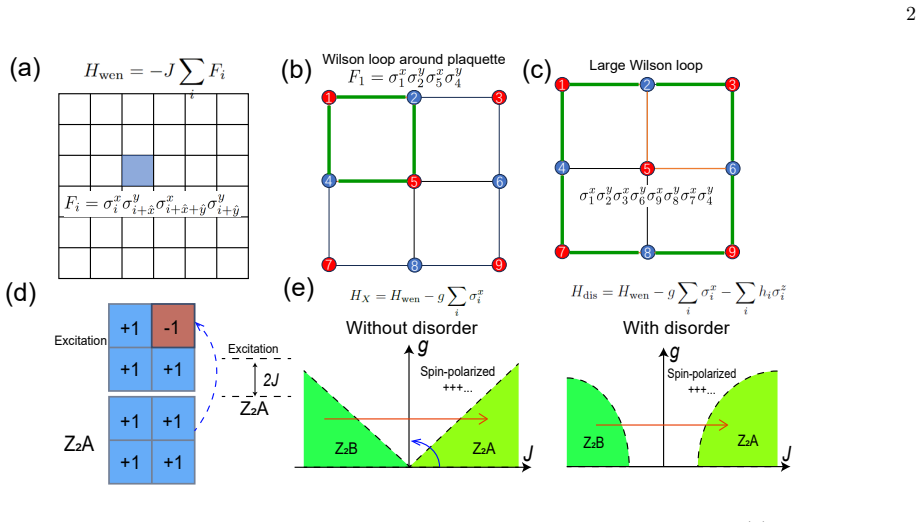
The load-bearing objects are the mutually commuting plaquette stabilizers F_{i,j} = σˣσʸσˣσʸ, whose ±1 eigenvalues label the two Z₂ sectors and whose expectation value ⟨F₁⟩ is the local diagnostic; and the boundary Wilson loop W, a long alternating Pauli string tracking the nonlocal loop response across the crossover into the trivial transverse-field regime. State preparation uses two mechanisms: variational compilation, which trains a hardware-efficient circuit V_n(θ) to minimize the fidelity loss C(θ) = 1 − F[V_n(θ)|φ₀⟩, |ψ_tar⟩] for classically computed equilibrium, quench, and normalized non-Hermitian targets, with noise amplified by appending j identity layers, V_extend = (V_id)ᶨ V_prep
What would settle it
Report the optimized fidelity loss C(θ_opt) for representative hardware points in Figs. 3–6, and re-run one crossover curve with an ansatz of markedly different depth or layer structure: if ⟨F₁⟩ or ⟨W⟩ shifts materially while the classical target is unchanged, the hardware 'signatures' track the variational approximation rather than the Wen–plaquette physics. A noiseless simulation of the exact compiled circuits (including the inserted identity layers) that reproduces the measured curves would confirm the signals are intrinsic; divergence would indict the variational layer.
Extended reading notes
Core claim
The paper's claim: finite-size Wen–plaquette signatures stay measurable and distinguishable from trivial behavior on IBM Quantum hardware. Variationally compiled nine-qubit states reproduce the expected crossovers — ⟨F₁⟩ swapping sectors with the sign of J, the Wilson loop rising at J ≃ g — surviving disorder h = 5 and j = 5 noise-adding layers. Quench dynamics collapse near the crossover but persist deep in the stabilizer regime. A non-variational construction extends this to a 5×5 lattice whose plaquette response stays near unperturbed under up to 15 amplified rotations. The authors frame the result as hardware-resolved, not a thermodynamic proof of topological order.
Load-bearing premise
Every hardware measurement in Figs. 3–6 is made on a state V_n(θ_opt)|φ₀⟩ that only approximates the classically computed target via the fidelity loss C(θ) = 1 − F (Eq. 9); the paper reports neither the achieved fidelity, the ansatz depth n, nor the optimizer convergence. If the ansatz is insufficiently expressive or trapped in a poor local minimum, the measured 'signatures' reflect the approximate circuit rather than the Wen–plaquette model; the same reliance applies to the
Editorial extensions
If this is right
- The local plaquette stabilizer crossover between the two Z₂ sectors remains clearly resolved on hardware at disorder strength h = 5, so static disorder alone does not destroy the finite-size stabilizer diagnostic.
- The nonlocal Wilson-loop crossover remains resolved after j = 5 inserted identity layers that amplify gate and decoherence errors, meaning depth-induced noise up to this level does not wash out the loop signal.
- The dynamical robustness of the stabilizer signature is controlled by the ratio of disorder (or imaginary-field strength) to the plaquette defect energy scale 2J: fragile at J ≈ 1 near the crossover, stable at J = 4–5 deep in the stabilizer regime.
- A non-variational, projection-inspired preparation protocol builds a 5×5 stabilizer-sector state on a two-dimensional processor without variational training, and its lattice-averaged plaquette response degrades only weakly under up to 15 amplified local single-qubit perturbations.
- The paper's stated scope limits these claims to finite-size, hardware-resolved signatures: they are diagnostics for NISQ devices, not a thermodynamic demonstration of topological order.
Reading between the lines
- If the achieved variational fidelities were reported (C(θ_opt) per data point), one could check whether the hardware curves track the Wen–plaquette physics or merely the ansatz; the paper's silence on achieved fidelity leaves this the single most direct target for replication.
- The appendix's noise estimate — a ≈0.78 ratio of measured to ideal 5×5 plaquette response from 64 CZ gates at ≈2.5×10⁻³ infidelity — implies a concrete scaling budget: pushing the representative-qubit protocol to larger lattices requires lower two-qubit error rates or shallower transpiled sweeps, since attenuation compounds with each CZ gate in the causal cone.
- The qualitative similarity between the disorder and imaginary-field response maps suggests the two perturbations degrade the Wilson-loop signal through a common mechanism at the level of these finite-size diagnostics; a testable extension is to see whether matching a single scale (e.g., comparing h to γ) collapses both data sets onto one curve.
- Because the layered sweep structure scales as roughly L_x + L_y − 3 stages rather than with the number of plaquettes, the representative-qubit construction is a natural template for preparing other commuting-stabilizer sectors (e.g., toric-code-type states) on 2D processors, provided the hardware connectivity supports the local controlled Pauli strings.
Editorial analysis
A structured set of objections, weighed in public.
Referee Report
Summary. The paper reports a hardware study of finite-size topological crossover signatures in the Wen–plaquette model on IBM Quantum processors. For a 3×3 nine-qubit system, the authors variationally compile classically computed target states (ground states, quench states, and normalized non-Hermitian evolved states) and measure a plaquette stabilizer and a boundary Wilson loop, studying robustness against static disorder, amplified circuit noise, and an imaginary field. They find that local plaquette signatures remain resolvable in the strong-stabilizer regime, while nonlocal Wilson-loop response is more fragile, and they extend the protocol to a 5×5 stabilizer-sector state on a 2D processor using a coherent representative-qubit construction. The central claim is explicitly scoped as a finite-size, hardware-resolved study rather than a thermodynamic demonstration of topological order.
Significance. If fully supported, the paper would provide a practical benchmark for which finite-size topological diagnostics remain measurable on current NISQ hardware, with useful guidance on noise resilience and scalable stabilizer-sector preparation. The authors are appropriately cautious in the Discussion, and the inclusion of exact-diagonalization reference curves for the equilibrium diagnostics in Fig. 4 is a strength, as is the availability of data and code upon request. However, the central evidence chain depends on an unreported variational compilation fidelity and on comparisons that in Figs. 5–6 lack an exact-target reference. The reader's stress-test concern is legitimate and lands on a load-bearing gap: without knowing the achieved fidelity and ansatz depth for Eqs. (8)–(9), the hardware data cannot be unambiguously attributed to the Wen–plaquette target states.
major comments (4)
- [§II.B–II.C, Eqs. (8)–(9), App. S2] The paper never reports the achieved variational fidelity C(θ_opt), the number of layers n, or the optimizer convergence for any of the hardware data in Figs. 3–6. Since the noiseless reference curves are simulations of the same optimized variational circuits, agreement between hardware and noiseless data can be saturated even when the ansatz poorly approximates the target state; both share the same ansatz bias. The exact-diagonalization curves in Fig. 4 provide an independent benchmark for the equilibrium cases, but Figs. 5 and 6 compare only noiseless-circuit versus hardware. The variationally compressed readout in Eq. (S6) adds a second unquantified approximation. I request per-figure reporting of n, the optimized fidelity, and the optimization procedure, plus exact-target (statevector/ED) reference curves for the quench and non-Hermitian data in Figs. 5 and 6.
- [§II.C, Figs. 3–6] Several load-bearing qualitative claims — 'clearly resolved', 'close agreement', 'substantially more stable' — are made without any per-point statistics. Appendix S2 states that each data point is estimated from 20,000 shots, which is enough to compute binomial confidence intervals, but no error bars, standard deviations, or confidence intervals appear in any figure. Without uncertainty quantification, the apparent separation between curves cannot be quantitatively distinguished from shot noise or device drift. Please add error bars or, at minimum, representative confidence intervals for all hardware data points.
- [§II.C.2, Eq. (6), Fig. 4(b,d)] The disordered Hamiltonian in Eq. (6) uses disorder fields h_i drawn uniformly from [−h/2, h/2], but the manuscript does not state whether the h=5 curves in Fig. 4 correspond to a single disorder realization or to an average over many realizations. This is not a technicality: the claim that 'strong disorder strongly suppresses' the Wilson-loop response and that the plaquette stabilizer remains 'clearly resolved' depends on the statistical representativeness of the disorder sample. Please specify the number of realizations and how the plotted curves are aggregated, and provide the per-realization spread for the disorder cases.
- [§II.D, Fig. 7(b), Eq. (24)] The scalability benchmark in Fig. 7(b) claims that the lattice-averaged plaquette response degrades only weakly under up to 15 inserted rotations, but the figure shows no error bars or spread over the stated five random realizations. In addition, the analytic estimate in Eq. (S20) predicts F_hw/F_ideal ≈ 0.78, yet no quantitative comparison between Eq. (S20) and the measured values is shown. Please provide the measured mean and spread, and indicate whether Eq. (S20) is intended as a fitted estimate or a first-principles prediction. This is needed to support the claim that the prepared stabilizer sector is robust under the deliberately amplified perturbations.
minor comments (4)
- [Appendix S5] Typo: 'ibm miamiNightHawk device' should likely be 'ibm_miami (NightHawk) device' or similar.
- [Eq. (12) and App. S3] The ancilla-assisted interferometric readout is described in detail for the plaquette F1, but the controlled-W operation used for the Wilson loop is only mentioned in the main text. Please provide the corresponding circuit decomposition for controlled-W, or state explicitly that the same compressed-readout workflow of Eq. (S6) is used for W.
- [§II.C.4, Fig. 6] The caption of Fig. 6 says 'close agreement between noiseless and experimental curves', but the dashed and solid curves in panels (c,d) appear to differ systematically in some regimes. Please clarify whether the plotted values are raw or corrected for the systematic offset discussed in §II.C.3, and state this explicitly in the caption.
- [References] Several references to the authors' own work (e.g., Refs. [37,53,80,88]) are used for methodological context rather than for the specific results; this is acceptable, but the manuscript would benefit from a sentence in the Methods identifying which prior protocols are being reused from those papers.
Circularity Check
No circularity: hardware data benchmark classically computed Wen–plaquette target states; self-citations are precedential, not load-bearing.
full rationale
The paper's derivation chain is not circular. Target states for the hardware experiments are defined independently by exact diagonalization of the Wen–plaquette Hamiltonians in Eqs. 4, 6, and 7, and Eq. 8 states explicitly that the variational circuit only approximates these classically computed targets: V_n(θ_opt)|φ0⟩ ≈ |ψ_tar⟩. The measured observables, ⟨F1⟩ and ⟨W⟩, are not fitted parameters; the variational parameters in Eq. 9 are optimized to match the target state, not to reproduce the hardware data. The crossover locations (J≈g, onset of the complex-spectrum fraction R) come from the exactly solvable model and ED response maps in Appendix S4, so the hardware curves are used in the correct evidential direction: they test whether known target-state signatures survive noise. The representative-qubit construction is derived from the stabilizer projectors in Eqs. 21–23 and Appendix S6.2, with the external reference [45] serving as a methodological precedent rather than as load-bearing support. The self-citations [37,53,80,88] appear in methodological or contextual clusters, but no central claim reduces to them. The main limitation—that the achieved variational fidelity, ansatz depth, and optimizer convergence for Eqs. 8–9 and Eq. S6 are not reported—is a genuine evidence gap about how well V_n represents |ψ_tar⟩, but it is not a circular reduction: the target states are independently specified, and the observables are not defined in terms of the fitted parameters. The paper's own stated limitations (e.g., the uncorrected systematic offset in Fig. 5 and the noise estimates in Appendix S6.3) affect precision and scalability, not the logical independence of the derivation.
Assumptions & free parameters
free parameters (5)
- variational ansatz depth n and optimization tolerance =
unreported
- identity-layer count j =
0, 1, 5
- disorder strength h and imaginary field γ =
h = 5 (also 1, 10); γ = 0.1, 0.5
- device calibration values in Eq. S20 =
ε̄_CZ = 2.5×10⁻³, τ_CZ = 68 ns, T_eff = 100 μs
- perturbation rotation range =
[−0.1, 0.1]
assumptions (6)
- standard math Wen–plaquette stabilizers commute and square to identity: [F_i,F_j]=0, F_i²=I (Eqs. 1–3, App. S1)
- domain assumption Thermodynamic-limit Z2 topological order and |J|=|g| transition of the transverse Wen–plaquette model (Refs. [59,60])
- ad hoc to paper Hardware-efficient variational ansatz can approximate every classically computed target state to high fidelity (Eq. 8, App. S2)
- ad hoc to paper Identity layers V_id leave the ideal state unchanged, so degradation is attributable to hardware noise (Eq. 11)
- domain assumption Two-qubit depolarizing error plus exponential T_eff decoherence models the device (Eq. S19)
- domain assumption Normalized right-eigenstate expectation values define the non-Hermitian observables (Eqs. 7, 18)
Cite this review
Pith. "Pith review of Resolving topological order crossovers on NISQ hardware." pith.science (2026). https://pith.science/paper/F2KULM24
@misc{pith2026260721707,
  author       = {Pith},
  title        = {Pith review of: Resolving topological order crossovers on NISQ hardware},
  year         = {2026},
  howpublished = {\url{https://pith.science/paper/F2KULM24}},
  note         = {Machine review of arXiv:2607.21707}
}
read the original abstract
Topological phases of matter provide a promising route toward robust quantum information processing, but on present-day noisy intermediate-scale quantum devices the experimentally relevant question is whether signatures of topological crossovers remain resolvable under realistic imperfections. Here, we address this question in the Wen--plaquette model through a two-stage strategy on the IBM Quantum hardware. We first use a tractable system to systematically characterize crossover signatures. Using variationally compiled equilibrium and quench-generated states, we resolve crossovers between stabilizer-dominated and trivial or disorder-dominated regimes through local plaquette stabilizers and a Wilson loop, and quantify their robustness against static disorder, deliberately amplified circuit noise, and effective non-Hermitian fields. The quench dynamics further reveal that plaquette-sector signatures remain substantially more stable deep in the strong-stabilizer regime than near the finite-size crossover. Building on the properties established in the small system, we extend the implementation to a physical two-dimensional IBM processor using a layered representative-qubit construction. The resulting lattice-averaged plaquette response exhibits only weak degradation under intentionally amplified local coherent perturbations. Together, these results connect controlled finite-size characterization with a scalable hardware implementation, providing a practical route for preparing and probing topological signatures on near-term quantum processors.
Figures


Figures from the paper (4 more)


Reference graph
Works this paper leans on
-
[1]
Wen–plaquette model and its extensions We consider the spin-1/2 Wen–plaquette model [59, 63], an exactly solvable model realizing intrinsic topolog- ical order in the thermodynamic limit, Hwen =−J X i,j Fi,j, F i,j =σ x i,jσy i+1,jσx i+1,j+1σy i,j+1, (1) whereF i,j acts on the four spins surrounding plaquette (i, j) [Fig. 1(a)]. Disorder and other effects...
-
[2]
3.Noise resilience of topological diagnostics via the Wilson loop
Noise resilience of preparation and readout We begin with the central practical question of this work: over what range of accumulated hardware noise do finite-size topological diagnostics remain experimen- tally distinguishable from trivial behavior [74–80]? Using the classically tractable small system as a calibrated ref- erence, we increase the physical...
-
[3]
Using variationally prepared states [Fig
Equilibrium diagnostics via plaquettes and Wilson loops Following the above analysis, we test whether the sta- bilizer and loop diagnostics remain distinguishable from topologically trivial behavior on quantum hardware in both clean and disordered settings. Using variationally prepared states [Fig. 2(a)], we measure a representative plaquette stabilizer a...
-
[4]
Because the system studied here is small, the corresponding equilibrium changes appear as smooth crossovers rather than sharp singularities
Unitary quenches: dynamical stability across topological sectors In the previous section, we characterized the equilib- rium structure of the Wen–plaquette model using lo- cal plaquette expectations and nonlocal Wilson-loop ob- servables. Because the system studied here is small, the corresponding equilibrium changes appear as smooth crossovers rather tha...
-
[5]
Simulation of nonunitary quenches We next extend the above quench protocol to the non- Hermitian regime. For each observation timet, we first evolve the initial state under the full non-Hermitian prop- agator and then normalize the resulting right state for state preparation and observable evaluation: |ψ′(t)⟩= e−itHγ |ψ−J ⟩ ∥e−itHγ |ψ−J ⟩∥ .(18) The norma...
-
[6]
In our implementation, we choose the representa- tive qubit to be the upper-right corner,r= (i+ 1, j+ 1)
More details are provided in Appendix S6. In our implementation, we choose the representa- tive qubit to be the upper-right corner,r= (i+ 1, j+ 1). For the plaquette convention used here, this givesF i,j =σ x/y i+1,j+1 eFi,j,so the corresponding input state for the coherent projector construction is +x/y i+1,j+1 |0⟩i,j |0⟩i+1,j |0⟩i,j+1 [Fig. 7 (a)]. We n...
-
[7]
S. M. Girvin and K. Yang,Modern condensed matter physics(Cambridge University Press, 2019)
2019
-
[8]
M. P. Marder,Condensed matter physics(John Wiley & Sons, 2010)
2010
Show all 108 references
-
[9]
Beekman, L
A. Beekman, L. Rademaker, and J. Van Wezel, An in- troduction to spontaneous symmetry breaking, SciPost Physics Lecture Notes , 011 (2019)
2019
-
[10]
Wen, Topological orders in rigid states, Interna- tional Journal of Modern Physics B4, 239 (1990)
X.-G. Wen, Topological orders in rigid states, Interna- tional Journal of Modern Physics B4, 239 (1990)
1990
-
[11]
Chen, Z.-C
X. Chen, Z.-C. Gu, and X.-G. Wen, Local unitary trans- formation, long-range quantum entanglement, wave func- tion renormalization, and topological order, Physical Re- view B82, 155138 (2010)
2010
-
[12]
D. C. Tsui, H. L. Stormer, and A. C. Gossard, Two- dimensional magnetotransport in the extreme quantum limit, Physical Review Letters48, 1559 (1982)
1982
-
[13]
R. B. Laughlin, Anomalous quantum hall effect: An in- compressible quantum fluid with fractionally charged ex- citations, Physical Review Letters50, 1395 (1983)
1983
-
[14]
H. L. Stormer, D. C. Tsui, and A. C. Gossard, The frac- tional quantum hall effect, Reviews of Modern Physics 71, S298 (1999)
1999
-
[15]
Jain, Theory of the fractional quantum hall effect, Physical Review B41, 7653 (1990)
J. Jain, Theory of the fractional quantum hall effect, Physical Review B41, 7653 (1990)
1990
-
[16]
Moore and N
G. Moore and N. Read, Nonabelions in the fractional quantum hall effect, Nuclear Physics B360, 362 (1991)
1991
-
[17]
Murthy and R
G. Murthy and R. Shankar, Hamiltonian theories of the fractional quantum hall effect, Reviews of Modern Physics75, 1101 (2003)
2003
-
[18]
J. G. Bednorz and K. A. M¨ uller, Possible high-Tc super- conductivity in the Ba–La–Cu–O system, Zeitschrift f¨ ur Physik B Condensed Matter64, 189 (1986)
1986
-
[19]
P. W. Anderson, The resonating valence bond state in La 2CuO4 and superconductivity, Science235, 1196 (1987)
1987
-
[20]
P. W. Anderson, P. Lee, M. Randeria, T. Rice, N. Trivedi, and F. Zhang, The physics behind high-temperature su- perconducting cuprates: the ‘plain vanilla’version of rvb, 12 Journal of Physics: Condensed Matter16, R755 (2004)
2004
-
[21]
Taillefer, Scattering and pairing in cuprate supercon- ductors, Annu
L. Taillefer, Scattering and pairing in cuprate supercon- ductors, Annu. Rev. Condens. Matter Phys.1, 51 (2010)
2010
-
[22]
A. Y. Kitaev, Fault-tolerant quantum computation by anyons, Annals of Physics303, 2 (2003)
2003
-
[23]
Levin and X.-G
M. Levin and X.-G. Wen, Detecting topological order in a ground state wave function, Phys. Rev. Lett.96, 110405 (2006)
2006
-
[24]
Kitaev and J
A. Kitaev and J. Preskill, Topological entanglement en- tropy, Physical Review Letters96, 110404 (2006)
2006
-
[25]
Jiang, Z
H.-C. Jiang, Z. Wang, and L. Balents, Identifying topo- logical order by entanglement entropy, Nature Physics8, 902 (2012)
2012
-
[26]
Nayak, S
C. Nayak, S. H. Simon, A. Stern, M. Freedman, and S. Das Sarma, Non-abelian anyons and topological quan- tum computation, Reviews of Modern Physics80, 1083 (2008)
2008
-
[27]
Johnson-Freyd, On the classification of topological or- ders, Communications in Mathematical Physics393, 989 (2022)
T. Johnson-Freyd, On the classification of topological or- ders, Communications in Mathematical Physics393, 989 (2022)
2022
-
[28]
B. A. Bernevig and F. Haldane, Generalized clustering conditions of jack polynomials at negative jack parameter α, Physical Review B—Condensed Matter and Materials Physics77, 184502 (2008)
2008
-
[29]
Estienne, N
B. Estienne, N. Regnault, and R. Santachiara, Clustering properties, jack polynomials and unitary conformal field theories, Nuclear physics B824, 539 (2010)
2010
-
[30]
C. H. Lee and X.-L. Qi, Lattice construction of pseu- dopotential hamiltonians for fractional chern insulators, Physical Review B90, 085103 (2014)
2014
-
[31]
C. H. Lee, Z. Papi´ c, and R. Thomale, Geometric con- struction of quantum hall clustering hamiltonians, Phys- ical Review X5, 041003 (2015)
2015
-
[32]
Dennis, A
E. Dennis, A. Kitaev, A. Landahl, and J. Preskill, Topological quantum memory, Journal of Mathematical Physics43, 4452 (2002)
2002
-
[33]
Raussendorf, J
R. Raussendorf, J. Harrington, and K. Goyal, Topologi- cal fault-tolerance in cluster state quantum computation, New Journal of Physics9, 199 (2007)
2007
-
[34]
Bombin, C
H. Bombin, C. Dawson, R. V. Mishmash, N. Nickerson, F. Pastawski, and S. Roberts, Logical blocks for fault- tolerant topological quantum computation, PRX Quan- tum4, 020303 (2023)
2023
-
[35]
Satzinger, Y.-J
K. Satzinger, Y.-J. Liu, A. Smith, C. Knapp, M. New- man, C. Jones, Z. Chen, C. Quintana, X. Mi, A. Dunsworth,et al., Realizing topologically ordered states on a quantum processor, Science374, 1237 (2021)
2021
-
[36]
Semeghini, H
G. Semeghini, H. Levine, A. Keesling, S. Ebadi, T. T. Wang, D. Bluvstein, R. Verresen, H. Pichler, M. Kali- nowski, R. Samajdar,et al., Probing topological spin liquids on a programmable quantum simulator, Science 374, 1242 (2021)
2021
-
[37]
Chen, H.-T
T. Chen, H.-T. Ding, R. Shen, S.-L. Zhu, and J. Gong, Direct probe of topology and geometry of quantum states on the ibm q quantum processor, Physical Review B110, 205402 (2024)
2024
-
[38]
Google Quantum AI and Collaborators, Non-abelian braiding of graph vertices in a superconducting proces- sor, Nature618, 264 (2023)
2023
-
[39]
Tantivasadakarn, A
N. Tantivasadakarn, A. Vishwanath, and R. Verresen, Hierarchy of topological order from finite-depth unitaries, measurement, and feedforward, PRX Quantum4, 020339 (2023)
2023
-
[40]
Iqbal, N
M. Iqbal, N. Tantivasadakarn, T. M. Gatterman, J. A. Gerber, K. Gilmore, D. Gresh, A. Hankin, N. Hewitt, C. V. Horst, M. Matheny, T. Mengle, B. Neyenhuis, A. Vishwanath, M. Foss-Feig, R. Verresen, and H. Dreyer, Topological order from measurements and feed-forward on a trapped...
2024
-
[41]
Iqbal, N
M. Iqbal, N. Tantivasadakarn, R. Verresen, S. L. Camp- bell, J. M. Dreiling, C. Figgatt, J. P. Gaebler, J. Jo- hansen, M. Mills, S. A. Moses,et al., Non-abelian topo- logical order and anyons on a trapped-ion processor, Na- ture626, 505 (2024)
2024
-
[42]
Xu, Z.-Z
S. Xu, Z.-Z. Sun, K. Wang, H. Li, Z. Zhu, H. Dong, J. Deng, X. Zhang, J. Chen, Y. Wu,et al., Non-abelian braiding of fibonacci anyons with a superconducting pro- cessor, Nature Physics20, 1469 (2024)
2024
-
[43]
R. Shen, T. Chen, B. Yang, Y. Zhong, and C. H. Lee, Robust simulations of many-body symmetry-protected topological phase transitions on a quantum processor, npj Quantum Information11, 179 (2025)
2025
-
[44]
T. Y. Ng, Y. Wang, W. J. Chan, R. Shen, T. Chen, and C. H. Lee, Digital simulation of non-hermitian knotted bands on quantum hardware, arXiv preprint arXiv:2604.26914 (2026)
2026 arXiv
-
[45]
Iqbal, A
M. Iqbal, A. Lyons, C. F. B. Lo, N. Tantivasadakarn, J. Dreiling, C. Foltz, T. M. Gatterman, D. Gresh, N. He- witt, C. A. Holliman,et al., Qutrit toric code and parafermions in trapped ions, Nature Communications 16, 6301 (2025)
2025
-
[46]
M. Will, T. A. Cochran, E. Rosenberg, B. Jobst, N. M. Eassa, P. Roushan, M. Knap, A. Gammon-Smith, and F. Pollmann, Probing non-equilibrium topological order on a quantum processor, Nature645, 348 (2025)
2025
-
[47]
S. J. Evered, M. Kalinowski, A. A. Geim, T. Manovitz, D. Bluvstein, S. H. Li, N. Maskara, H. Zhou, S. Ebadi, M. Xu,et al., Probing the kitaev honeycomb model on a neutral-atom quantum computer, Nature645, 341 (2025)
2025
-
[48]
L. Shen, M. Lin, C. Y.-Y. Lin, D. Xiao,et al., Realiza- tion of fermionic laughlin state on a quantum processor, Nature Communications17, 4919 (2026)
2026
-
[49]
Webster, M
P. Webster, M. Vasmer, T. R. Scruby, and S. D. Bartlett, Universal fault-tolerant quantum computing with stabi- lizer codes, Physical Review Research4, 013092 (2022)
2022
-
[50]
Tantivasadakarn, R
N. Tantivasadakarn, R. Verresen, and A. Vishwanath, Shortest route to non-abelian topological order on a quantum processor, Physical Review Letters131, 060405 (2023)
2023
-
[51]
Xu, Z.-Z
S. Xu, Z.-Z. Sun, K. Wang, L. Xiang, Z. Bao, Z. Zhu, F. Shen, Z. Song, P. Zhang, W. Ren,et al., Digital sim- ulation of projective non-abelian anyons with 68 super- conducting qubits, Chinese Physics Letters40, 060301 (2023)
2023
-
[52]
Vojta, G
P. Vojta, G. Ortiz, and Z. Nussinov, Topological orders beyond topological quantum field theories, Physical Re- view B111, 045142 (2025)
2025
-
[53]
Fujimoto, Topological order and non-abelian statistics in noncentrosymmetric s-wave superconductors, Physical Review B—Condensed Matter and Materials Physics77, 220501 (2008)
S. Fujimoto, Topological order and non-abelian statistics in noncentrosymmetric s-wave superconductors, Physical Review B—Condensed Matter and Materials Physics77, 220501 (2008)
2008
-
[54]
M. Sato, Y. Takahashi, and S. Fujimoto, Non-abelian topological orders and majorana fermions in spin-singlet superconductors, Physical Review B—Condensed Matter and Materials Physics82, 134521 (2010). 13
2010
-
[55]
X. Chen, L. Fidkowski, and A. Vishwanath, Symmetry enforced non-abelian topological order at the surface of a topological insulator, Physical Review B89, 165132 (2014)
2014
-
[56]
Fidkowski, X
L. Fidkowski, X. Chen, and A. Vishwanath, Non-abelian topological order on the surface of a 3d topological super- conductor from an exactly solved model, Physical Review X3, 041016 (2013)
2013
-
[57]
Y. Qin, C. H. Lee, and L. Li, Dynamical suppression of many-body non-hermitian skin effect in anyonic systems, Communications Physics8, 18 (2025)
2025
-
[58]
Gammon-Smith, M
A. Gammon-Smith, M. Knap, and F. Pollmann, Simu- lating topological order on quantum processors, Nature Reviews Physics8, 160 (2026)
2026
-
[59]
R. Shen, T. Chen, T. Tai, J. M. Koh, P. Ghaemi, and C. H. Lee, Simulating condensed matter physics on quan- tum hardware, arXiv preprint arXiv:2606.02721 (2026)
2026 arXiv
-
[60]
Castelnovo and C
C. Castelnovo and C. Chamon, Entanglement and topo- logical entropy of the toric code at finite temperature, Physical Review B—Condensed Matter and Materials Physics76, 184442 (2007)
2007
-
[61]
Stark, L
C. Stark, L. Pollet, A. Imamo˘ glu, and R. Renner, Local- ization of toric code defects, Physical review letters107, 030504 (2011)
2011
-
[62]
Kitaev and C
A. Kitaev and C. Laumann, Topological phases and quantum computation, Exact methods in low- dimensional statistical physics and quantum computing , 101 (2010)
2010
-
[63]
S. M. Linsel, L. Pollet, and F. Grusdt, Independent e- and m-anyon confinement in the parallel field toric code on non-square lattices, PRX Quantum7, 010332 (2026)
2026
-
[64]
Levin and X.-G
M. Levin and X.-G. Wen, Fermions, strings, and gauge fields in lattice spin models, Physical Review B67, 245316 (2003)
2003
-
[65]
Wen, Quantum orders in an exact soluble model, Physical review letters90, 016803 (2003)
X.-G. Wen, Quantum orders in an exact soluble model, Physical review letters90, 016803 (2003)
2003
-
[66]
Yu, S.-P
J. Yu, S.-P. Kou, and X.-G. Wen, Topological quantum phase transition in the transverse wen-plaquette model, Europhysics Letters84, 17004 (2008)
2008
-
[67]
You and X.-G
Y.-Z. You and X.-G. Wen, Projective non-abelian statis- tics of dislocation defects in a zn rotor model, Physical Review B—Condensed Matter and Materials Physics86, 161107 (2012)
2012
-
[68]
Yu, X.-H
J. Yu, X.-H. Zhang, and S.-P. Kou, Majorana edge states for z 2 topological orders of the wen plaquette and toric code models, Physical Review B—Condensed Matter and Materials Physics87, 184402 (2013)
2013
-
[69]
X. Peng, Z. Luo, W. Zheng, S. Kou, D. Suter, and J. Du, Experimental implementation of adiabatic passage be- tween different topological orders, Physical Review Let- ters113, 080404 (2014)
2014
-
[70]
X.-W. Luo, X. Zhou, C.-F. Li, J.-S. Xu, G.-C. Guo, and Z.-W. Zhou, Quantum simulation of 2d topological physics in a 1d array of optical cavities, Nature commu- nications6, 7704 (2015)
2015
-
[71]
Zhong, D
Y.-P. Zhong, D. Xu, P. Wang, C. Song, Q. Guo, W. Liu, K. Xu, B. Xia, C.-Y. Lu, S. Han,et al., Emulating any- onic fractional statistical behavior in a superconduct- ing quantum circuit, Physical review letters117, 110501 (2016)
2016
-
[72]
Sameti, A
M. Sameti, A. Potoˇ cnik, D. E. Browne, A. Wallraff, and M. J. Hartmann, Superconducting quantum simulator for topological order and the toric code, Physical Review A 95, 042330 (2017)
2017
-
[73]
K. Li, Y. Wan, L.-Y. Hung, T. Lan, G. Long, D. Lu, B. Zeng, and R. Laflamme, Experimental identification of non-abelian topological orders on a quantum simulator, Physical Review Letters118, 080502 (2017)
2017
-
[74]
C. Song, D. Xu, P. Zhang, J. Wang, Q. Guo, W. Liu, K. Xu, H. Deng, K. Huang, D. Zheng,et al., Demonstra- tion of topological robustness of anyonic braiding statis- tics with a superconducting quantum circuit, Physical Review Letters121, 030502 (2018)
2018
-
[75]
Y.-J. Hai, Z. Zhang,et al., Uniquely identifying topologi- cal order based on boundary–bulk duality and anyon con- densation, National Science Review10, nwac264 (2023)
2023
-
[76]
Xiang, W
L. Xiang, W. Jiang, Z. Bao, Z. Song, S. Xu, K. Wang, et al., Long-lived topological time-crystalline order on a quantum processor, Nature Communications15, 8963 (2024)
2024
-
[77]
Xu, Z.-Z
S. Xu, Z.-Z. Sun, K. Wang, H. Li, Z. Zhu, H. Dong,et al., Non-abelian braiding of fibonacci anyons with a super- conducting processor, Nature Physics20, 1469 (2024)
2024
-
[78]
Z. K. Minev, K. Najafi, S. Majumder, J. Wang, A. Stern, E.-A. Kim, C.-M. Jian, and G. Zhu, Realizing string- net condensation: Fibonacci anyon braiding for univer- sal gates and sampling chromatic polynomials, Nature Communications16, 6225 (2025)
2025
-
[79]
C. F. B. Lo, A. Lyons, D. Gresh, M. Mills, P. E. Siegfried, M. D. Urmey, N. Tantivasadakarn, H. Dreyer, A. Vish- wanath, R. Verresen, and M. Iqbal, Universal gates from braiding and fusing anyons on quantum hardware, Na- ture655, 591 (2026)
2026
-
[80]
Z. Cai, R. Babbush, S. C. Benjamin, S. Endo, W. J. Hug- gins, Y. Li, J. R. McClean, and T. E. O’Brien, Quantum error mitigation, Reviews of Modern Physics95, 045005 (2023)
2023
-
[81]
Temme, S
K. Temme, S. Bravyi, and J. M. Gambetta, Error miti- gation for short-depth quantum circuits, Physical review letters119, 180509 (2017)
2017
-
[82]
S. Endo, S. C. Benjamin, and Y. Li, Practical quan- tum error mitigation for near-future applications, Physi- cal Review X8, 031027 (2018)
2018
-
[83]
Takagi, S
R. Takagi, S. Endo, S. Minagawa, and M. Gu, Funda- mental limits of quantum error mitigation, npj Quantum Information8, 1 (2022)
2022
-
[84]
Knill, Quantum computing with realistically noisy de- vices, Nature434, 39 (2005)
E. Knill, Quantum computing with realistically noisy de- vices, Nature434, 39 (2005)
2005
-
[85]
Preskill, Quantum Computing in the NISQ era and beyond, Quantum2, 79 (2018)
J. Preskill, Quantum Computing in the NISQ era and beyond, Quantum2, 79 (2018)
2018
-
[86]
R. Shen, T. Chen, and C. H. Lee, Circuit structure- preserving error mitigation for high-fidelity quantum sim- ulations, arXiv preprint arXiv:2505.17187 (2025)
2025 arXiv
-
[87]
Haldar, K
A. Haldar, K. Mallayya, M. Heyl, F. Pollmann, M. Rigol, and A. Das, Signatures of quantum phase transitions af- ter quenches in quantum chaotic one-dimensional sys- tems, Phys. Rev. X11, 031062 (2021)
2021
-
[88]
Piroli, G
L. Piroli, G. Styliaris, and J. I. Cirac, Quantum circuits assisted by local operations and classical communication: Transformations and phases of matter, Physical Review Letters127, 220503 (2021), arXiv:2103.13367 [quant-ph]
2021 arXiv
-
[89]
T.-C. Lu, L. A. Lessa, I. H. Kim, and T. H. Hsieh, Measurement as a shortcut to long-range entangled quantum matter, PRX Quantum3, 040337 (2022), arXiv:2206.13527 [quant-ph]
2022 arXiv
-
[90]
S. Y.-C. Chen, C.-H. H. Yang, J. Qi, P.-Y. Chen, X. Ma, and H.-S. Goan, Variational quantum circuits for deep reinforcement learning, IEEE access8, 141007 (2020). 14
2020
-
[91]
Cerezo, A
M. Cerezo, A. Arrasmith, R. Babbush, S. C. Benjamin, S. Endo, K. Fujii, J. R. McClean, K. Mitarai, X. Yuan, L. Cincio,et al., Variational quantum algorithms, Nature Reviews Physics3, 625 (2021)
2021
-
[92]
Gong, J.-J
L.-H. Gong, J.-J. Pei, T.-F. Zhang, and N.-R. Zhou, Quantum convolutional neural network based on vari- ational quantum circuits, Optics Communications550, 129993 (2024)
2024
-
[93]
J. M. Koh, T. Tai, and C. H. Lee, Simulation of interaction-induced chiral topological dynamics on a dig- ital quantum computer, Physical Review Letters129, 140502 (2022)
2022
-
[94]
R. Shen, T. Chen, B. Yang, and C. H. Lee, Observa- tion of the non-hermitian skin effect and fermi skin on a digital quantum computer, Nature Communications16, 1340 (2025)
2025
-
[95]
J. M. Koh, W.-T. Xue, T. Tai, D. E. Koh, and C. H. Lee, Interacting non-hermitian edge and cluster bursts on a digital quantum processor, arXiv preprint arXiv:2503.14595 (2025)
2025 arXiv
-
[96]
T. Chen, R. Shen, C. H. Lee, and B. Yang, High-fidelity realization of the aklt state on a nisq-era quantum pro- cessor, SciPost Physics15, 170 (2023)
2023
-
[97]
T. Chen, R. Shen, C. Hua Lee, B. Yang, and R. Weda Bo- mantara, A robust large-period discrete time crystal and its signature in a digital quantum computer, Quantum Science and Technology11, 025030 (2026)
2026
-
[98]
R. Shen, F. Qin, J.-Y. Desaules, Z. Papi´ c, and C. H. Lee, Enhanced many-body quantum scars from the non- hermitian fock skin effect, Physical Review Letters133, 216601 (2024)
2024
-
[99]
Javadi-Abhari, M
A. Javadi-Abhari, M. Treinish, K. Krsulich, C. J. Wood, J. Lishman, J. Gacon, S. Martiel, P. D. Nation, L. S. Bishop, A. W. Cross,et al., Quantum computing with qiskit, arXiv preprint arXiv:2405.08810 (2024)
2024 arXiv
-
[100]
Steffen, D
M. Steffen, D. P. DiVincenzo, J. M. Chow, T. N. Theis, and M. B. Ketchen, Quantum computing: An ibm per- spective, IBM Journal of Research and Development55, 13 (2011)
2011
-
[101]
A. C. Santos, The ibm quantum computer and the ibm quantum experience, arXiv preprint arXiv:1610.06980 (2016)
2016 arXiv
-
[102]
IBM Quantum,https://quantum.ibm.com/(2021)
2021
-
[103]
Cleve, A
R. Cleve, A. Ekert, C. Macchiavello, and M. Mosca, Quantum algorithms revisited, Proceedings of the Royal Society of London. Series A: Mathematical, Physical and Engineering Sciences454, 339 (1998)
1998
-
[104]
A. K. Ekert, C. M. Alves, D. K. L. Oi, M. Horodecki, P. Horodecki, and L. C. Kwek, Direct estimations of lin- ear and nonlinear functionals of a quantum state, Physi- cal Review Letters88, 217901 (2002)
2002
-
[105]
Y j∈even ECRj,j+1 N−1Y j=0 U 3 k,j θk,j , ϕk,j , λk,j # ×
O. Crawford, B. v. Straaten, D. Wang, T. Parks, E. Campbell, and S. Brierley, Efficient quantum measure- ment of pauli operators in the presence of finite sampling error, Quantum5, 385 (2021). S15 APPENDIX Appendix S1: Gauge-invariant construction of Wilson-loop diagnostics Th...
2021
-
[106]
A representative state in the clean Wen–plaquette ground-state sector has the simple stabilizer form |G⟩ ∝ Y i (I+F i)|0⟩ ⊗N ,(S1) S19 (a) (b) (c) FIG
Ancilla-assisted projector implementation (block encoding, LCU, and feedforward) In this section, we propose a scalable protocol for preparing the Wen–plaquette ground-state sector. A representative state in the clean Wen–plaquette ground-state sector has the simple stabilizer...
-
[107]
Coherent representative-qubit method To avoid mid-circuit measurements and postselection in the hardware demonstration, we employ the coherent representative-qubit construction introduced in Ref. [45]. The method generates a state in a prescribed plaquette- stabilizer sector t...
-
[108]
As illustrated in Fig
Noise effect The scalability of the coherent representative-qubit construction is governed primarily by the compiled circuit depth. As illustrated in Fig. 7(a), the plaquette constraints are imposed through a layered sweep across the lattice. Projector blocks within the same s...
Reviewed August 1, 2026 · model on record in the stance chip above.
Discussion (0). Continue with ORCID to comment.