REVIEW 3 major objections 4 minor 20 references
Edge states in ordinary differential equations for dislocations
T0 review · 3 major / 4 minor · reviewed 2026-08-14 · deepseek-v4-flash
Pith's one-line read For a one-dimensional periodic Schrödinger operator with a dislocation, five topological indices—bulk Maslov, Chern, edge, and two spectral flows—all equal the gap number n, and Dirac dislocations always carry a protected mode at…
desk verdict The Schrödinger bulk-edge proof is solid and worth publishing; the Dirac section has sign and symmetry errors that need fixing before the paper should appear. read the letter →
The pith
A machine-rendered reading of the paper's core claim, the machinery that carries it, and where it could break.
The reading
What carries the argument
The load-bearing object is the exponential dichotomy of the ODE at energy $E$: the solution space splits as $L(E)=L^+(E)\oplus L^-(E)$, where $L^\pm$ are one-dimensional and consist of solutions decaying at $\pm\infty$, with continuous dependence on the dislocation parameter $t$. From this splitting one builds the angle-like function $\theta[u,x]=(u'(x)-iu(x))/(u'(x)+iu(x))\in S^1$, whose zero-crossings track the zeros of $u$. The Maslov index is the winding number of $t\mapsto\theta[L^+_t(E),x]$; the edge index is the winding of the ratio $\Omega^\sharp=\theta^+_t/\theta^-_t$, which equals $1$ precisely when the two decaying lines coincide and produce an edge state; and the Chern number is shown, via a frame determinant $\det U(k)$, to be the same kind of winding. The proof that all these windings equal $n$ reduces to counting the zeros of the Dirichlet eigenfunction in one period and to the Hellmann–Feynman identity linking branch slopes to signs of the crossings.
What would settle it
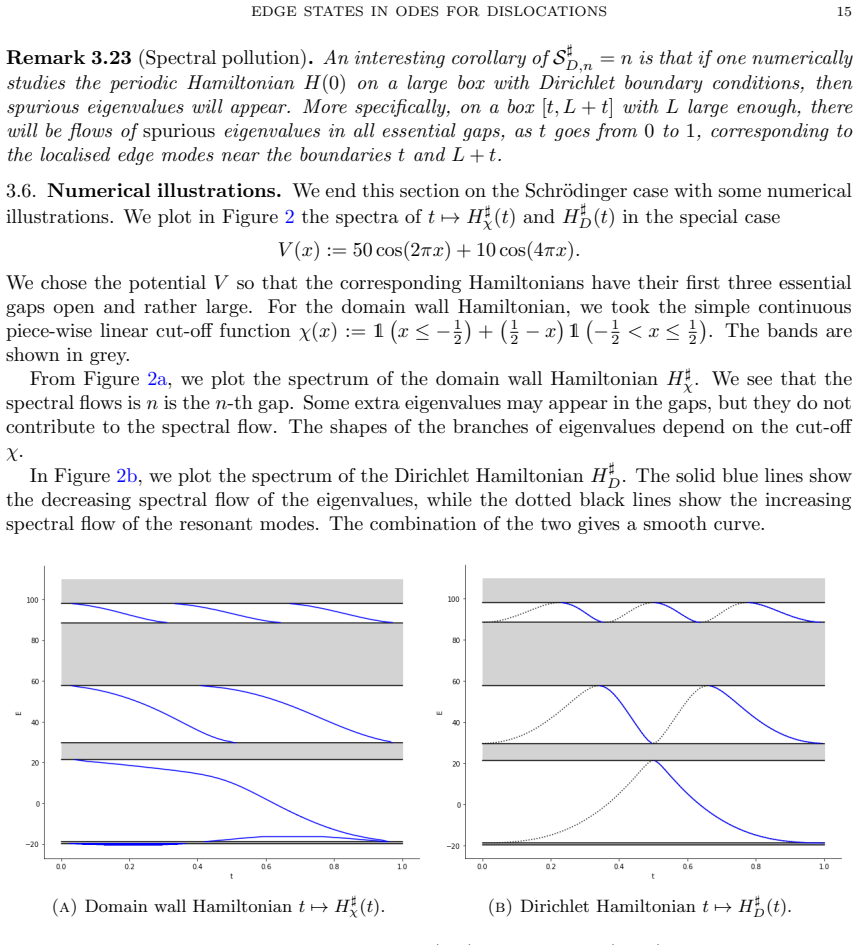
Pick a 1-periodic potential with an open $n$-th gap and compute, on a sufficiently large interval $[0,L]$ with Dirichlet conditions, the spectrum of $-\partial_x^2+V(x-t)$ as $t$ runs from $0$ to $1$; count the net number of eigenvalue branches crossing a fixed interior energy $E$ of that gap. If the count is not $n$, or if any crossing eigenvalue has multiplicity greater than one, Theorem 1.2 is false. For the Dirac case, check numerically whether $D^\sharp_\chi(1/2)$ has a simple eigenvalue at $0$ whenever $0$ lies in a gap of $D_0$.
Extended reading notes
Core claim
On the paper's own terms: for a 1-periodic potential $V$, the family $H(t)=-\partial_x^2+V(x-t)$ has spectrum independent of $t$, and solutions of $-u''+V(x-t)u=Eu$ split into one-dimensional spaces $L_t^\pm(E)$ of functions decaying at $\pm\infty$. The bulk Maslov index $B_n$ is the winding number of the line $L_t^+(E)$ as $t$ varies; the Chern number $\mathrm{Ch}(P_n)$ is the winding of $\det U(k)$ for a frame of the Bloch projector; the edge index $I^\sharp_{\chi,n}$ is the winding of the ratio of the two edge-decaying lines; and $S^\sharp_{\chi,n}$, $S^\sharp_{D,n}$ are net eigenvalue crossings in the gap. Theorem 1.2 proves all these integers coincide and equal $n$ when the $n$-th gap is open, with simple, exponentially localised edge eigenstates. For the Dirac operator $D(t)=e^{-i\pi t\sigma_3}D_0e^{i\pi t\sigma_3}$, the same machinery gives $B=I^\sharp_\chi=S^\sharp_\chi=1$ in every open gap, and Theorem 1.5 shows $0$ is a simple eigenvalue of $D^\sharp_\chi(1/2)$ whenever $0$ lies outside the essential spectrum of $D_0$.
Load-bearing premise
The whole argument assumes that at the chosen energy the solution space splits into a one-dimensional subspace decaying at $+\infty$ and one decaying at $-\infty$, varying smoothly with the dislocation parameter; if the gap closes or the splitting degenerates, the equalities are not claimed.
Editorial extensions
If this is right
- In every open n-th gap of a dislocated Schrödinger operator, exactly n eigenvalues flow across the gap over one period of the dislocation parameter, so n protected edge states exist.
- These edge states are robust: their number and localisation are independent of the choice of switch function $\chi$ and of the energy $E$ inside the gap.
- All such eigenvalues are simple and exponentially localised, so the correspondence carries no degeneracy ambiguity.
- For Dirac dislocations, every open gap has spectral flow 1, and at $t=1/2$ the operator $D^\sharp_\chi(1/2)$ has a simple eigenvalue at 0 whenever 0 is not in the essential spectrum.
- On a half-line with Dirichlet boundary conditions, the same flow appears, and spurious eigenvalues must appear in every gap of a truncated-box numerical calculation.
Reading between the lines
- Since the equality holds for every switch function, the protected edge states should persist under arbitrary local deformations of the junction, not just the smooth or piecewise-linear profiles plotted; this is a testable robustness claim.
- The same machinery, as the paper notes, extends to junctions of two different periodic media; in that setting the expected index would presumably be the difference of the two bulk indices rather than n.
- For Dirac operators, the zero mode at $t=1/2$ follows from spectral flow plus reflection symmetry; analogous half-period pinning should occur for any 1-periodic self-adjoint family with spectral flow 1 and a symmetry mapping $D(t)$ to $-D(1-t)$.
- The Dirichlet spectral-flow picture suggests a practical numerical probe: for a periodic potential with an unknown gap structure, plotting eigenvalues on a large box as a function of the translation parameter will reveal spurious flows in every open gap, providing a direct test of whether a gap is genuinely open.
Signed reviews
Editorial analysis
A structured set of objections, weighed in public.
Referee Report
Summary. The paper studies one-dimensional Schrödinger and Dirac operators with a dislocation parameter t in a periodic potential. For the Schrödinger case it defines a bulk Maslov index B_n, a Chern number Ch(P_n), edge indices I^♯_{χ,n} and S^♯_{χ,n}, and a Dirichlet spectral flow S^♯_{D,n}, and proves in Theorem 1.2 that, whenever the n-th gap is open, all of these equal n, with all edge eigenvalues simple and exponentially localized. For the Dirac case it defines analogous bulk, edge, and spectral-flow indices and proves in Theorems 1.4 and 1.5 that they all equal 1 and that at t=1/2, 0 is a simple eigenvalue when 0 is not in the essential spectrum of D(0). The proofs are based on explicit winding-number computations for ODE solution spaces, together with Bloch–Floquet theory and spectral-flow arguments.
Significance. If the results are accepted, the paper gives a self-contained, elementary proof of bulk–edge correspondence for dislocations in one-dimensional continuous systems, unifying previously scattered results by Korotyaev, Drouot, Fefferman–Lee-Thorp–Weinstein, and others. The Schrödinger half is carefully executed: the equalities in Propositions 3.7, 3.10, 3.14, 3.20, and 3.21 are obtained by direct winding-number and oscillation arguments, with no fitted parameters and no self-referential normalizations. The Dirac half has the same overall architecture and its conclusion is plausible, but the manuscript as printed contains internal sign and antilinearity inconsistencies that affect the proofs of foundational lemmas; these are locally repairable and do not appear to overturn the central claim.
major comments (3)
- [§4, Eq. (17)] The Pauli-matrix relations stated in Section 4 are inconsistent with the displayed matrices. With σ1 = [[0,1],[1,0]], σ2 = [[0,-i],[i,0]], and σ3 = [[1,0],[0,-1]], one obtains σ1σ2 = iσ3, σ2σ3 = iσ1, and σ3σ1 = iσ2, whereas the text asserts the opposite signs. Accordingly, the right-hand side of Eq. (17), D(t) = e^{-iπtσ3}D0e^{iπtσ3} = (-i∂x)σ3 + cos(2πt)V σ1 − sin(2πt)V σ2, has the wrong sign for the sin(2πt)Vσ2 term under the standard convention: the unitary conjugation gives a plus sign. This is not merely cosmetic, because the explicit family D(t) is used in the proofs of Lemma 4.3, Proposition 4.4, and Proposition 4.6. The authors should either adopt a consistent Pauli convention and correct Eq. (17), or explicitly define matrices satisfying the stated relations.
- [§4.1, Lemma 4.3] The proof of Lemma 4.3 states: 'D(t) commutes with σ1K... So if u is a solution, then so is σ1u.' Since σ1K is antilinear, the correct conclusion is that σ1\bar{u} is a solution, not σ1u. The subsequent proportionality should read σ1\bar{u} = λu, which still yields the desired conclusion |u↑| = |u↓| after taking moduli. As printed, the displayed implication is false, and because Lemma 4.3 is used to guarantee that the ratio u↓/u↑ in Eq. (18) is well-defined as an S^1-valued map, the definition of the Dirac Maslov and edge indices rests on an invalid proof. This needs to be corrected along with the preceding sign convention.
- [Appendix A.2, Lemma A.4] The proof of Lemma A.4 contains the same antilinearity error: 'if u is a solution ... then σ1u is also a solution' is false for the Dirac operator D0 = (-i∂x)σ3 + Vσ1. The true symmetry is σ1\bar{u}. Consequently the identity σ1c_E = s_E used to prove that Tr(T_E) is real is generally false; the correct identity is σ1\bar{c}_E = s_E, which still implies c_{1,E}+s_{2,E} = c_{1,E}+\overline{c_{1,E}} ∈ R. As stated, the proof of the reality of the discriminant, which underpins the spectral-gap structure of D0, is invalid. This is a load-bearing point for the Dirac half of the paper and must be repaired.
minor comments (4)
- [Abstract] The abstract contains a typo: 'providing a proof a bulk-edge correspondence' should read 'providing a proof of bulk-edge correspondence'.
- [§4, Pauli matrices] In the line introducing the Pauli matrices, the relation should be σ1^2 = σ2^2 = σ3^2 = 1, not 'σ3 = 1'; as written, the identity matrix is confused with the third Pauli matrix.
- [§4.4, Proposition 4.7] The phrase '0 /∈D0 is not in the spectrum of D0' is redundant; it should simply say '0 is not in the spectrum of D0'.
- [Proposition 3.7] The sentence 'Up to global translation, we may assume x0 = 0' is imprecise: translating the solution changes the potential, so the intended operation is a relabeling of the zero sequence (or a shift of the coordinate origin by an integer, using 1-periodicity of the zero set). The subsequent counting argument is correct, but the wording should be adjusted for clarity.
Circularity Check
No circularity: every index equality is derived from explicit ODE/Maslov/Chern/winding computations, with no fitted parameters or self-referential normalizations.
full rationale
All claimed equalities are derived rather than assumed. Bn is defined as a Maslov winding number and is shown to equal n in Proposition 3.7 from the Dirichlet oscillation count proved in Appendix B; Ch(Pn) is computed independently in Proposition 3.10 by transporting a frame, giving U(k)=e^{2pi i k}I_n and winding n; the edge index is derived in Proposition 3.14 as the bulk Maslov index minus a t-independent contribution; and the spectral flows are identified with the edge winding through Hellmann-Feynman/Wronskian computations in Propositions 3.20, 3.21, and 4.6. In the Dirac case, B=1 is an explicit computation theta_t^+=e^{2pi i t}theta_0^+, and I and S follow by the same mechanism; the t=1/2 zero mode is a standard consequence of S=1 plus the proven spectral symmetry. No parameter is fitted to any quantity that is later called a prediction, and the equalities do not reduce to the definitions. The only self-citations, [CGLM19] and [CLPS17], concern standard frame facts whose proof is reproduced in Lemma 3.9 or which are used only as context, so they are not load-bearing. The Pauli sign inconsistency in Section 4 is a correctness defect, not a circularity: the intended unitary conjugation still yields the stated index values once the sign is fixed.
Assumptions & free parameters
assumptions (5)
- standard math Floquet-Bloch band structure: the spectrum of H0 is a union of bands, and for E in an open gap the solution space splits into exponentially decaying subspaces L+ and L-.
- standard math Sturm-Liouville and Dirichlet oscillation: the n-th Dirichlet eigenvalue of -d2/dx2 + V on [0,1] lies in the n-th gap and its eigenfunction has n zeros in [0,1).
- standard math Differentiable perturbation theory for simple isolated eigenvalues, including existence of branches E_k(t) and the Hellmann-Feynman derivative formula.
- standard math Transfer-matrix determinant and discriminant properties for periodic Schrodinger and Dirac operators, giving exponential dichotomy and spectral symmetry.
- domain assumption The potential satisfies V in W^{1,1}_{per}(R) and chi is an L^infinity switch function equal to 1 near -infinity and 0 near +infinity, so the family t maps to V_t is differentiable in L^1_loc.
Cite this review
Pith. "Pith review of Edge states in ordinary differential equations for dislocations." pith.science (2026). https://pith.science/paper/F2ONL352
@misc{pith2026190801377,
  author       = {Pith},
  title        = {Pith review of: Edge states in ordinary differential equations for dislocations},
  year         = {2026},
  howpublished = {\url{https://pith.science/paper/F2ONL352}},
  note         = {Machine review of arXiv:1908.01377}
}
read the original abstract
In this article, we study Schr\"odinger operators on the real line, when the external potential represents a dislocation in a periodic medium. We study how the spectrum varies with the dislocation parameter. We introduce several integer-valued indices, including Chern number for bulk indices, and various spectral flows for edge indices. We prove that all these indices coincide, providing a proof a bulk-edge correspondence in this case. The study is also made for dislocations in Dirac models on the real line. We prove that 0 is always an eigenvalue of such operators.
Figures


Reference graph
Works this paper leans on
- [1]
-
[2]
Bal , Topological protection of perturbed edge states , arXiv preprint arXiv:1709.00605, (2017)
G. Bal , Topological protection of perturbed edge states , arXiv preprint arXiv:1709.00605, (2017)
arXiv 2017
-
[3]
height 2pt depth -1.6pt width 23pt, Continuous bulk and interface description of topological insulators , arXiv preprint arXiv:1808.07908, (2018)
work page Pith review arXiv 2018
-
[4]
H. Cornean, D. Gontier, A. Levitt, and D. Monaco , Localised W annier functions in metallic systems , Ann. Henri Poincaré, 20 (2019), pp. 1367--1391
work page 2019
- [5]
-
[6]
Defect modes for dislocated periodic media
A. Drouot, C. Fefferman, and M. Weinstein , Defect modes for dislocated periodic media , arXiv preprint arXiv:1810.05875, (2018)
work page Pith review arXiv 2018
-
[7]
The bulk-edge correspondence for continuous dislocated systems
A. Drouot , The bulk-edge correspondence for continuous dislocated systems , arXiv preprint arXiv:1810.10603, (2018)
work page Pith review arXiv 2018
-
[8]
C. Fefferman, J. Lee-Thorp, and M. Weinstein , Topologically protected states in one-dimensional systems , vol. 247, American Mathematical Society, 2017
work page 2017
Show all 20 references
-
[9]
Hatsugai , Chern number and edge states in the integer quantum hall effect , Phys
Y. Hatsugai , Chern number and edge states in the integer quantum hall effect , Phys. Rev. Lett., 71 (1993), p. 3697
1993
-
[10]
Hempel and M
R. Hempel and M. Kohlmann , A variational approach to dislocation problems for periodic S chr \"o dinger operators , J. Math. Anal. Appl., 381 (2011), pp. 166--178
2011
-
[11]
Kato , Perturbation theory for linear operators , vol
T. Kato , Perturbation theory for linear operators , vol. 132, Springer Science & Business Media, 2013
2013
-
[12]
Korotyaev , Lattice dislocations in a 1-dimensional model , Commun
E. Korotyaev , Lattice dislocations in a 1-dimensional model , Commun. Math. Phys., 213 (2000), pp. 471--489
2000
-
[13]
height 2pt depth -1.6pt width 23pt, Schr \"o dinger operator with a junction of two 1-dimensional periodic potentials , Asymptotic Analysis, 45 (2005), pp. 73--97
2005
-
[14]
Panati , Triviality of B loch and B loch- D irac bundles , Ann
G. Panati , Triviality of B loch and B loch- D irac bundles , Ann. Henri Poincaré, 8 (2007), pp. 995--1011
2007
-
[15]
Pankrashkin , A remark on the discriminant of H ill’s equation and H erglotz functions , Archiv der Mathematik, 102 (2014), pp
K. Pankrashkin , A remark on the discriminant of H ill’s equation and H erglotz functions , Archiv der Mathematik, 102 (2014), pp. 155--163
2014
-
[16]
Phillips , Self-adjoint F redholm operators and spectral flow , Can
J. Phillips , Self-adjoint F redholm operators and spectral flow , Can. Math. Bull., 39 (1996), pp. 460--467
1996
-
[17]
Prodan and H
E. Prodan and H. Schulz-Baldes , Bulk and boundary invariants for complex topological insulators , Springer International Publishing, 2016
2016
-
[18]
Pöschel and E
J. Pöschel and E. Trubowitz , Inverse Spectral Theory , vol. 130, Academic Press, 1987
1987
-
[19]
Reed and B
M. Reed and B. Simon , Methods of Modern Mathematical Physics Vol. IV: Analysis of Operators , New York, Academic Press, 1978
1978
-
[20]
Simon , Holonomy, the quantum adiabatic theorem, and B erry's phase , Phys
B. Simon , Holonomy, the quantum adiabatic theorem, and B erry's phase , Phys. Rev. Lett., 51 (1983), p. 2167
1983
Reviewed August 14, 2026 · model on record in the stance chip above.
Discussion (0). Continue with ORCID to comment.