REVIEW 4 major objections 4 minor 107 references
Vehicle-in-Virtual-Environment (VVE) Method for Developing and Evaluating VRU Safety of Connected and Autonomous Driving with Focus on Bicyclist Safety
T0 review · 4 major / 4 minor · reviewed 2026-08-05 · deepseek-v4-flash
Pith's one-line read A staged vehicle-in-virtual-environment pipeline with a barrier-function safety layer aims to make bicyclist crash scenarios testable before road deployment.
desk verdict Honest engineering progress report; the VVE pipeline is genuinely useful, but the paper's headline safety guarantee from the HOCBF layer is invalidated by input saturation, and the DRL system was never VVE-tested. read the letter →
The pith
A machine-rendered reading of the paper's core claim, the machinery that carries it, and where it could break.
The reading
What carries the argument
The load-bearing mechanism is the VVE synchronization loop: the real vehicle's position and heading are transformed into a virtual traffic world, while virtual sensor data—including the virtual bicyclist's motion—feeds back to the real onboard controller, so the real car reacts to a virtual traffic scenario in real time. Beneath that, the safety guarantee is carried by the HOCLF-HOCBF-QP layer, a quadratic program whose high-order control barrier function constraints keep the vehicle out of obstacle danger zones (a 2 m margin) regardless of what the high-level DRL agent commands. The CDOB delay-tolerant path tracker is the third piece, recasting unknown time delays as disturbances to be esti
What would settle it
Run the same FARS 230 overtaking scenario on a vehicle whose perception pipeline adds realistic position errors (for example, 1 to 3 meters of noise to the detected bicyclist position) while the barrier-function controller uses those noisy states; if the minimum distance falls below the 2 m margin or a collision occurs, the claimed safety guarantee does not transfer to real perception.
Extended reading notes
Core claim
The paper's central claim is that combining a hierarchical decision-and-control stack with a VVE testing pipeline is a viable way to develop and evaluate autonomous driving functions aimed at bicyclist safety. The stack pairs a high-level deep-reinforcement-learning agent that chooses lane-level maneuvers with a low-level control-Lyapunov/control-barrier-function quadratic program (CLF-CBF-QP) that enforces hard safety constraints, so even a wrong high-level command cannot drive the vehicle into a bicyclist. The testing pipeline moves from model-in-the-loop, through hardware-in-the-loop, into VVE, where a real vehicle's position and heading are mapped into a virtual traffic world and virtual
Load-bearing premise
The safety margins reported in the simulations come from exact simulator states—obstacle position, ego position, and heading are assumed known—so the guarantee transfers to a real vehicle only if real perception errors stay below the roughly 2 m margin.
Editorial extensions
If this is right
- If the pipeline works as claimed, the five FARS bicyclist crash types can be tested safely and repeatedly in a virtual environment without public road exposure.
- With the low-level barrier-function layer in the loop, an erroneous high-level maneuver such as merging into a bicyclist is corrected locally by steering and braking, so safety does not depend on the reinforcement-learning policy being perfect.
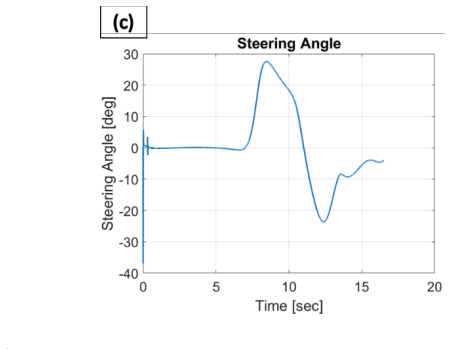
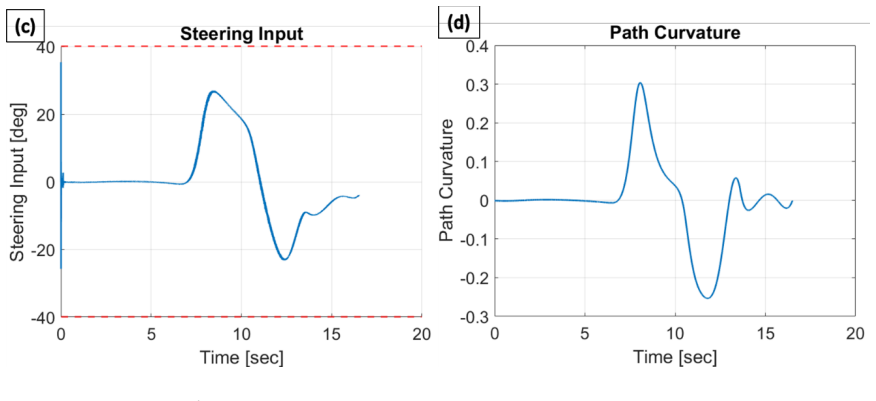
- The staged MIL-to-HIL-to-VVE sequence can expose hardware-related issues such as signal delays and unrealistic input spikes before deployment, making public road tests a final confirmation rather than a first exposure.
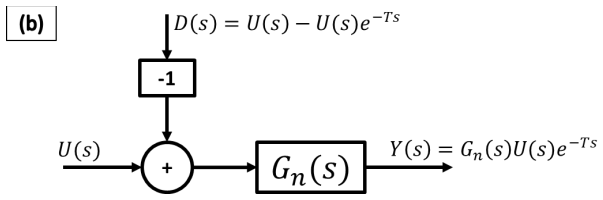
- The delay-tolerant CDOB path tracker maintains tracking accuracy under unknown time delays, which broadens the pipeline's applicability to connected and communication-delayed driving.
- The framework is modular: the high-level DRL agent can be swapped for other algorithms without changing the low-level safety layer, allowing comparisons of decision-making methods on the same safety-critical core.
Reading between the lines
- If real perception errors exceed the roughly 2 m safety margin used in the simulations, the barrier-function guarantee does not transfer to a vehicle relying on noisy camera and lidar data; injecting realistic perception noise into the VVE loop would be a direct test of this gap.
- The report's own decision not to VVE-test the DDQN emergency-braking agent because it lacks hard-coded safety rules suggests that the authors treat the barrier-function layer as a prerequisite for real-vehicle VVE testing; adding a CBF safety filter to the learned agent and running it in VVE is a natural extension.
- The VVE framework's multi-actor capability points toward testing not just the ego vehicle but the interaction between real pedestrians or bicyclists and the virtual environment, which the paper lists as future work.
- The value of the pipeline depends on how faithfully the virtual world recreates both the crash geometry and the sensor conditions; if the virtual scenarios omit real lighting, occlusion, or sensor noise, the validation is likely optimistic.
Editorial analysis
A structured set of objections, weighed in public.
Referee Report
Summary. This manuscript, formatted as a second-year project report, proposes three contributions for improving vulnerable road user (VRU) safety in connected and automated driving: (1) a CDOB-based delay-tolerant path-tracking controller, (2) a hierarchical collision-avoidance framework combining a high-level DRL agent (DQN/DDQN) with a low-level HOCLF-HOCBF-QP controller, and (3) a Vehicle-in-Virtual-Environment (VVE) testing pipeline. The authors recreate five FARS bicyclist crash scenarios in CARLA and report simulation, MIL, HIL, and partial VVE experiments. The stated aim is to use the VVE pipeline together with the hierarchical controller to develop and evaluate bicyclist-safety functions that can prevent FARS-type crashes.
Significance. If the central safety claim were fully supported, the paper would offer a useful staged testing pipeline and a safety-filter architecture for VRU collision avoidance. The VVE concept itself is previously published by the same group, and the main new value resides in applying it to bicyclist scenarios. The paper shows several promising components: real-time QP solve times (~0.66 ms), a modular controller design, and a clear argument for why a CBF layer can rescue unsafe high-level decisions. However, the reported evidence does not yet support the strongest claims: the hard safety guarantee is invalidated by input saturation and by an incorrect HOCBF derivative for moving obstacles, and the VVE pipeline is not tested with the proposed hierarchical controller or with bicyclist scenarios. The paper also provides no code, no randomized trials, and no external benchmarks.
major comments (4)
- [Sec. 4.2.2.3, Eq. (4.37), Table 4.3] The CBF safety argument requires the applied input to satisfy the HOCBF constraint. The QP in Eq. (4.37) is formulated without input limits, and Section 4.2.2.3 states that the unicycle QP is solved without input constraints and the computed input is saturated afterward. The vehicle-dynamic QP in Eq. (4.37) likewise contains no steering bounds, even though Table 4.3 defines ±0.7 rad limits. If saturation is active, the applied input does not satisfy Eq. (4.36), forward invariance of the safe set is lost, and the claimed ≥2 m minimum distance in Fig. 4.19 is not guaranteed. The paper does not verify that saturation was inactive in the reported runs. This is an internal technical gap, not merely a deployment concern.
- [Sec. 4.2.2.4, Eqs. (4.32)-(4.36)] The HOCBF derivative is computed as if the obstacle coordinates (x_o, y_o) are constant. For the dynamic-obstacle simulations and the FARS230 bicyclist scenario, the obstacle is moving, so the total derivative of h contains the terms -2(x-x_o) xdot_o - 2(y-y_o) ydot_o. These obstacle-velocity terms are omitted in Eqs. (4.33)-(4.35). Consequently, the constraint in Eq. (4.36) does not ensure h ≥ 0 over time for a moving obstacle. Recomputing the obstacle list at each low-level step (Algorithm 4.2, line 10) only enforces the distance condition at sample instants. The min-distance plot in Fig. 4.19 is therefore scenario-specific evidence, not the claimed safety guarantee, and the analogous claim for the moving bicyclist in FARS230 is unsupported.
- [Sec. 4.3.2, Sec. 4.4] The simulation-based evaluation of the hierarchical controller is a single deterministic run. There are no error bars, random seeds, perturbation tests, or sensitivity analyses; Section 4.4 explicitly states that 'more detailed sensitivity analyses and ablation studies' are future work. The FARS230 demonstration with the HOCLF-HOCBF-QP controller is presented only as trajectory snapshots (Figs. 4.20-4.21), without a minimum-distance metric, time-to-collision metric, or comparison to a baseline. The DDQN agent is assessed against the reward function it was trained to maximize, in the same training environment. These limitations undermine the 'rigorous evaluation' claimed in contribution (3).
- [Sec. 5.3.3, Sec. 5.4] The proposed VVE pipeline is not demonstrated for the proposed hierarchical controller or for the five FARS bicyclist scenarios. Section 5.3.3 states that the DDQN emergency-brake algorithm was not VVE-tested because it lacks hard-coded safety rules, and Section 5.4 states that a full test of the DRL-based collision avoidance algorithm is 'still in progress.' The only VVE result uses a pure-pursuit lane-change controller. Thus the paper's central claim of developing and evaluating bicyclist-safety functions via VVE is not supported by the reported experiments. Additionally, Chapter 2's perception and trajectory-prediction components are described but never implemented or integrated; all safety evaluations use ground-truth obstacle states.
minor comments (4)
- [Throughout] There are numerous typos and inconsistent figure references: 'denates' on p.25, 'radiii' on p.31, and 'TTZ' is used where 'TTC' is standard. The text at p.50 says 'Figure 4.18 illustrates the real time distance' but the figure is labeled 4.19; other cross-references are similarly shifted.
- [Eq. (4.14)] The HOCLF condition contains an undefined term S(h(x)). Please define it or remove it; the standard HOCLF condition does not include such a term.
- [Chapter 3] The CDOB delay-tolerant controller is presented as a contribution, but it is not integrated with the hierarchical collision-avoidance framework or with the VVE tests. The relationship between Chapter 3 and the rest of the pipeline should be clarified.
- [Chapter 5 / References [46,104]] The VVE method is described as 'novel' in this paper, but the text itself cites the authors' previous papers [46] and [104] as the source of VVE. Please state explicitly what is new in the present VVE pipeline relative to those prior works.
Circularity Check
No significant circularity; self-citations and self-defined metrics present but not load-bearing.
full rationale
The report's core derivations are standard and self-contained: the CLF-CBF-QP/HOCBF formulation follows the established theory (Ames et al., Xiao & Belta), the CDOB design is a textbook disturbance-observer variant, and the DRL agents are trained and tested in simulation without claiming external benchmark generalization. The VVE method and the DDQN emergency-brake algorithm are drawn from the authors' own prior publications ([46],[104],[106]), and Chapter 5 explicitly concedes that the DDQN agent was not VVE-tested (Section 5.3.3), so the VVE demonstration is narrower than the abstract implies. The reported 2 m safety margin is consistent with the HOCBF constraint (Eqs. 4.32-4.36), but the paper never specifies that r_o equals 2 m, so it cannot be shown by construction that the result is merely the constraint restated; at most it is a verification of a designer-chosen invariant. The input-saturation issue (Section 4.2.2.3) and the use of simulator ground truth are correctness/transfer limitations, not circularity. Overall, the central claims retain independent technical content despite multiple self-citations.
Assumptions & free parameters
free parameters (5)
- HOCLF/HOCBF class-kappa gains and relaxation penalty q =
not reported (only 'positive constant gains')
- DRL reward weights and shaped reward terms =
+25/-300/-1 for unicycle; +50/-100/-0.5 plus progress coefficient v for dynamic model
- DQN/DDQN hyperparameters =
learning rate 0.001, batch size 64, replay buffer 100,000, epsilon decay 1.0 to 0.05 over 200,000 steps
- Safe distance threshold and obstacle radius r_o =
2 m for the safety threshold; r_o not reported
- CDOB/PID gains and Q-filter bandwidth =
not reported
assumptions (7)
- standard math CLF/CBF/HOCBF theory from Ames and Xiao guarantees stability and safety when the QP constraints are feasible.
- domain assumption Perfect state and obstacle position knowledge in simulation.
- domain assumption A linear single-track model with constant speed and linear tire stiffness adequately represents real vehicle dynamics.
- domain assumption CARLA / Unreal Engine and the VVE frame transformation faithfully represent real traffic and real vehicle motion.
- domain assumption Reference path curvature is perfectly known for the CDOB feedforward.
- ad hoc to paper FARS crash scenario recreations in CARLA are realistic enough to serve as safety evaluation cases.
- ad hoc to paper DRL training convergence implies a safe policy when combined with CBF filtering.
Cite this review
Pith. "Pith review of Vehicle-in-Virtual-Environment (VVE) Method for Developing and Evaluating VRU Safety of Connected and Autonomous Driving with Focus on Bicyclist Safety." pith.science (2026). https://pith.science/paper/F342AZR2
@misc{pith2026250900624,
  author       = {Pith},
  title        = {Pith review of: Vehicle-in-Virtual-Environment (VVE) Method for Developing and Evaluating VRU Safety of Connected and Autonomous Driving with Focus on Bicyclist Safety},
  year         = {2026},
  howpublished = {\url{https://pith.science/paper/F342AZR2}},
  note         = {Machine review of arXiv:2509.00624}
}
read the original abstract
Extensive research has already been conducted in the autonomous driving field to help vehicles navigate safely and efficiently. At the same time, plenty of current research on vulnerable road user (VRU) safety is performed which largely concentrates on perception, localization, or trajectory prediction of VRUs. However, existing research still exhibits several gaps, including the lack of a unified planning and collision avoidance system for autonomous vehicles, limited investigation into delay tolerant control strategies, and the absence of an efficient and standardized testing methodology. Ensuring VRU safety remains one of the most pressing challenges in autonomous driving, particularly in dynamic and unpredictable environments. In this two year project, we focused on applying the Vehicle in Virtual Environment (VVE) method to develop, evaluate, and demonstrate safety functions for Vulnerable Road Users (VRUs) using automated steering and braking of ADS. In this current second year project report, our primary focus was on enhancing the previous year results while also considering bicyclist safety.
Figures


Figures from the paper (14 more)





Reference graph
Works this paper leans on
-
[1]
Geneva: World Health Organization, 2015
World Health Organization, Global status report on road safety 2015. Geneva: World Health Organization, 2015. Accessed: Oct. 24, 2023. [Online]. Available: https://iris.who.int/handle/10665/189242
2015
-
[2]
Investigating the Role of Roadway Environment in Driving Errors: An on Road Study,
P. M. Salmon, K. L. Young, and M. G. Lenné, “Investigating the Role of Roadway Environment in Driving Errors: An on Road Study,” Proc. Hum. Factors Ergon. Soc. Annu. Meet., vol. 55, no. 1, pp. 1879–1883, Sep. 2011, doi: 10.1177/1071181311551391
-
[3]
Relationship between Infrastructure, Driver Error, and Critical Incidents,
A. Medina, S. Lee, W. Wierwille, and R. Hanowski, “Relationship between Infrastructure, Driver Error, and Critical Incidents,” Proc. Hum. Factors Ergon. Soc. Annu. Meet., vol. 48, pp. 2075–2079, Sep. 2004, doi: 10.1177/154193120404801661
-
[4]
P. Ghorai, A. Eskandarian, Y .- K. Kim, and G. Mehr, “State Estimation and Motion Prediction of Vehicles and Vulnerable Road Users for Cooperative Autonomous Driving: A Survey,” IEEE Trans. Intell. Transp. Syst., vol. 23, no. 10, pp. 16983–17002, Oct. 2022, doi: 10.1109/TITS.2022.3160932
arXiv 2022
-
[5]
P. Markiewicz, M. Długosz, and P. Skruch, “Review of tracking and object detection systems for advanced driver assistance and autonomous driving applications with focus on vulnerable road users sensing,” in Trends in Advanced Intelligent Control, Optimiza tion and Automation, Springer, Cham, 2017, pp. 224–237. doi: 10.1007/978-3-319-60699-6_22
-
[6]
Predicting Pedestrian Crossing Intention With Feature Fusion and Spatio- Temporal Attention,
D. Yang, H. Zhang, E. Yurtsever, K. A. Redmill, and Ü. Özgüner, “Predicting Pedestrian Crossing Intention With Feature Fusion and Spatio- Temporal Attention,” IEEE Trans. Intell. Veh., vol. 7, no. 2, pp. 221–230, Jun. 2022, doi: 10.1109/TIV .2022.3162719
arXiv 2022
-
[7]
Faraway- Frustum: Dealing with Lidar Sparsity for 3D Object Detection using Fusion,
H. Zhang, D. Yang, E. Yurtsever, K. A. Redmill, and Ü. Özgüner, “Faraway- Frustum: Dealing with Lidar Sparsity for 3D Object Detection using Fusion,” in 2021 IEEE International Intelligent Transportation Systems Conference (ITSC), Sep. 2021, pp. 2646–
2021
-
[8]
Y . Guo, Y . Liu, B. Wang, P. Huang, H. Xu, and Z. Bai, “Trajectory planning framework for autonomous vehicles based on collision injury prediction for vulnerable road users,” Accid. Anal. Prev., vol. 203, p. 107610, Aug. 2024, doi: 10.1016/j.aap.2024.107610
arXiv 2024
Show all 107 references
-
[9]
Rich feature hierarchies for accurate object detection and semantic segmentation,
R. Girshick, J. Donahue, T. Darrell, and J. Malik, “Rich feature hierarchies for accurate object detection and semantic segmentation,” Oct. 22, 2014, arXiv: arXiv:1311.2524. doi: 10.48550/arXiv.1311.2524
- [10]
- [11]
- [12]
- [13]
-
[14]
YOLOv8-CB: Dense Pedestrian Detection Algorithm Based on In- Vehicle Camera,
Q. Liu, H. Ye, S. Wang, and Z. Xu, “YOLOv8-CB: Dense Pedestrian Detection Algorithm Based on In- Vehicle Camera,” Electronics, vol. 13, no. 1, Art. no. 1, Jan. 2024, doi: 10.3390/electronics13010236
2024 doi
-
[15]
Laser Scanners for Driver-Assistance Systems in Intelligent 78 Vehicles [Applications of Control],
S. Velupillai and L. Guvenc, “Laser Scanners for Driver-Assistance Systems in Intelligent 78 Vehicles [Applications of Control],” IEEE Control Syst. Mag., vol. 29, no. 2, pp. 17–19, Apr. 2009, doi: 10.1109/MSP.2008.931716
2009
-
[16]
Lidar Data Analysis for Time to Headway Determination in the DriveSafe Project Field Tests,
İ. Altay, B. Aksun-Guvenc, and L. G uvenc, “Lidar Data Analysis for Time to Headway Determination in the DriveSafe Project Field Tests,” Int. J. Veh. Technol., vol. 2013, no. 1, p. 749896, 2013, doi: 10.1155/2013/749896
2013 doi
-
[17]
Vulnerable Road User Safety Using Mobile Phones with Vehicle-to-VRU Communication,
S. Y . Gelbal, B. Aksun- Guvenc, and L. Guvenc, “Vulnerable Road User Safety Using Mobile Phones with Vehicle-to-VRU Communication,” Electronics, vol. 13, no. 2, Art. no. 2, Jan. 2024, doi: 10.3390/electronics13020331
2024 doi
- [18]
- [19]
-
[21]
V2X Communication between Connected and Automated Vehicles (CA Vs) and Unmanned Aerial Vehicles (UA Vs),
O. Kavas-Torris, S. Y . Gelbal, M. R. Cantas, B. Aksun- Guvenc, and L. Guvenc, “V2X Communication between Connected and Automated Vehicles (CA Vs) and Unmanned Aerial Vehicles (UA Vs),” Sensors, vol. 22, no. 22, Art. no. 22, Jan. 2022, doi: 10.3390/s22228941
2022 doi
-
[22]
Visual Object Detection Based LiDAR Point Cloud Classification,
S. Muhammad and G.- W. Kim, “Visual Object Detection Based LiDAR Point Cloud Classification,” in 2020 IEEE International Conference on Big Data and Smart Computing (BigComp), Feb. 2020, pp. 438–440. doi: 10.1109/BigComp48618.2020.00-32
2020
-
[23]
3D Object Detection Based on LiDAR Data,
R. Sahba, A. Sahba, M. Jamshidi, and P. Rad, “3D Object Detection Based on LiDAR Data,” in 2019 IEEE 10th Annual Ubiquitous Computing, Electronics & Mobile Communication Conference (UEMCON), Oct. 2019, pp. 0511–0514. doi: 10.1109/UEMCON47517.2019.8993088
2019
-
[24]
A LiDAR–Camera Fusion 3D Object Detection Algorithm,
L. Liu, J. He, K. Ren, Z. Xiao, and Y . Hou, “A LiDAR–Camera Fusion 3D Object Detection Algorithm,” Information, vol. 13, no. 4, Art. no. 4, Apr. 2022, doi: 10.3390/info13040169
2022 doi
-
[25]
LiDAR -Based Intensity- Aware Outdoor 3D Object Detection,
A. Y . Naich and J. R. Carrión, “LiDAR -Based Intensity- Aware Outdoor 3D Object Detection,” Sensors, vol. 24, no. 9, Art. no. 9, Jan. 2024, doi: 10.3390/s24092942
2024 doi
-
[26]
A Spatio -Temporal Graph Transformer Network for Multi -Pedestrain Trajectory Prediction | IEEE Conference Publication | IEEE Xplore
“A Spatio -Temporal Graph Transformer Network for Multi -Pedestrain Trajectory Prediction | IEEE Conference Publication | IEEE Xplore.” Accessed: Aug. 29, 2024. [Online]. Available: https://ieeexplore -ieee-org.proxy.lib.ohio- state.edu/document/9927798
2024
-
[27]
Jocher, A
G. Jocher, A. Chaurasia, and J. Qiu, Ultralytics YOLO. (Jan. 2023). Python. Accessed: Aug. 26, 2024. [Online]. Available: https://github.com/ultralytics/ultralytics
2023
-
[28]
CARLA - v20 carla_v20,
“CARLA - v20 carla_v20,” Roboflow. Accessed: Aug. 26, 2024. [Online]. Available: https://universe.roboflow.com/alec-hantson-student-howest-be/carla-izloa/dataset/20
2024
-
[29]
Guvenc, B
L. Guvenc, B. Aksun-Guvenc, B. Demirel, M.T. Emirler, 2017, Control of Mechatronic Systems, the IET, London, ISBN: 978-1-78561-144-5
2017
-
[30]
Disturbance Observer- Smith Predictor Compensation-Based Platoon Control with Estimation Deviation,
J. Wang, G. Wu, B. Sun, F. Ma, B. Aksun-Guvenc, and L. Guvenc, “Disturbance Observer- Smith Predictor Compensation-Based Platoon Control with Estimation Deviation,” J. Adv. Transp., vol. 2022, no. 1, p. 9866794, 2022, doi: 10.1155/2022/9866794. 79
2022 doi
-
[31]
Path Planning and Robust Path Tracking Control of an Automated Parallel Parking Maneuver,
Cao, X. and Guvenc, L., “Path Planning and Robust Path Tracking Control of an Automated Parallel Parking Maneuver,” SAE Technical Paper 2024-01-2558, 2024, doi:10.4271/2024-01-2558
2024 doi
-
[32]
Oscillatory Yaw Motion Control for Hydraulic Power Steering Articulated Vehicles Considering the Influence of Varying Bulk Modulus,
Y . Gao, Y . Shen, T. Xu, W. Zhang, and L. Güvenç, “Oscillatory Yaw Motion Control for Hydraulic Power Steering Articulated Vehicles Considering the Influence of Varying Bulk Modulus,” IEEE Trans. Control Syst. Technol., vol. 27, no. 3, pp. 1284–1292, May 2019, doi: 10.1109/TC...
2019
-
[33]
Guvenc, L., Aksun- Guvenc, B., Zhu, S., Gelbal, S.Y ., 2022, Autonomous Road Vehicle Path Planning and Tracking Control, Wiley / IEEE Press, Book Series on Control Systems Theory and Application, New York, ISBN: 978-1-119-74794-9
2022
-
[34]
M. T. Emirler, B. Aksun-Guvenc, and L. Guvenc, Communication Disturbance Observer Approach to Control of Integral Plant with Time Delay. Ieee, 2013. Accessed: Jul. 26, 2025. [Online]. Available: https://hdl.handle.net/20.500.14517/6374
2013
-
[35]
Communication Disturbance Observer,
A. Shimada, “Communication Disturbance Observer,” in Disturbance Observer for Advanced Motion Control with MATLAB / Simulink, IEEE, 2023, pp. 141–149. doi: 10.1002/9781394178131.ch7
2023 doi
-
[36]
Multi-Objective Digital PID Controller Design in Parameter Space and its Application to Automated Path Following,
H. Wang, S. Y . Gelbal, and L. Guvenc, “Multi-Objective Digital PID Controller Design in Parameter Space and its Application to Automated Path Following,” IEEE Access, vol. 9, pp. 46874–46885, 2021, doi: 10.1109/ACCESS.2021.3066925
2021
-
[37]
Development and Evaluation of Path and Speed Profile Planning and Tracking Control for an Autonomous Shuttle Using a Realistic, Virtual Simulation Environment,
X. Li, S. Zhu, B. Aksun- Guvenc, and L. Guvenc, “Development and Evaluation of Path and Speed Profile Planning and Tracking Control for an Autonomous Shuttle Using a Realistic, Virtual Simulation Environment,” J. Intell. Robot. Syst., vol. 101, no. 2, p. 42, Feb. 2021, doi: 10...
2021 doi
-
[38]
Trajectory Planning of Autonomous Vehicles Based on Parameterized Control Optimization in Dynamic on-Road Environments,
S. Zhu and B. Aksun- Guvenc, “Trajectory Planning of Autonomous Vehicles Based on Parameterized Control Optimization in Dynamic on-Road Environments,” J. Intell. Robot. Syst., vol. 100, no. 3, pp. 1055–1067, Dec. 2020, doi: 10.1007/s10846-020-01215-y
2020 doi
-
[39]
Localization and Perception for Control and Decision Making of a Low Speed Autonomous Shuttle in a Campus Pilot Deployment,
B. Wen, S. Gelbal, B. Aksun- Guvenc, and L. Guvenc, “Localization and Perception for Control and Decision Making of a Low Speed Autonomous Shuttle in a Campus Pilot Deployment,” Apr. 2018. doi: 10.4271/2018-01-1182
2018 doi
-
[40]
SmartShuttle: a unified, scalable and replicable approach to connected and automated driving in a smart city,
S. Y . Gelbal, B. Aksun-Guvenc, and L. Guvenc, “SmartShuttle: a unified, scalable and replicable approach to connected and automated driving in a smart city,” in Proceedings of the 2nd International Workshop on Science of Smart City Operations and Platforms Engineering, in SCO...
2017
-
[41]
Connected and Autonomous Vehicles,
L. Guvenc, B. Aksun-Guvenc, and M. T. Emirler, “Connected and Autonomous Vehicles,” in Internet of Things and Data Analytics Handbook, John Wiley & Sons, Ltd, 2017, pp. 581–595. doi: 10.1002/9781119173601.ch35
2017 doi
-
[42]
Socially Acceptable Collision Avoidance System for Vulnerable Road Users,
M. T. Emirler, H. Wang, and B. Aksun-Guvenc, “Socially Acceptable Collision Avoidance System for Vulnerable Road Users,” IFAC -Pap., vol. 49, pp. 436–441, Dec. 2016, doi: 10.1016/j.ifacol.2016.07.073
2016 doi
-
[43]
General Obstacle Avoidance Capability Assessment for Autonomous Vehicles,
E. Lowe and L. Guvenc, “General Obstacle Avoidance Capability Assessment for Autonomous Vehicles,” Electronics, vol. 13, no. 24, Art. no. 24, Jan. 2024, doi: 10.3390/electronics13244901
2024 doi
-
[44]
Autonomous Vehicle Emergency Obstacle Avoidance Maneuver Framework at Highway Speeds,
E. Lowe and L. Guvenc, “Autonomous Vehicle Emergency Obstacle Avoidance Maneuver Framework at Highway Speeds,” Electronics, vol. 12, no. 23, Art. no. 23, Jan. 2023, doi: 10.3390/electronics12234765. 80
2023 doi
-
[46]
Vehicle -in-Virtual- Environment (VVE) Method for Autonomous Driving System Development, Evaluation and Demonstration,
X. Cao, H. Chen, S. Y . Gelbal, B. Aksun- Guvenc, and L. Guvenc, “Vehicle -in-Virtual- Environment (VVE) Method for Autonomous Driving System Development, Evaluation and Demonstration,” Sensors, vol. 23, no. 11, Art. no. 11, Jan. 2023, doi: 10.3390/s23115088
2023 doi
-
[47]
Control barrier function based quadratic programs with application to adaptive cruise control,
A. D. Ames, J. W. Grizzle, and P. Tabuada, “Control barrier function based quadratic programs with application to adaptive cruise control,” in 53rd IEEE Conference on Decision and Control, Dec. 2014, pp. 6271–6278. doi: 10.1109/CDC.2014.7040372
2014
-
[48]
Control Barrier Function Based Quadratic Programs for Safety Critical Systems,
A. D. Ames, X. Xu, J. W. Grizzle, and P. Tabuada, “Control Barrier Function Based Quadratic Programs for Safety Critical Systems,” IEEE Trans. Autom. Control, vol. 62, no. 8, pp. 3861–3876, Aug. 2017, doi: 10.1109/TAC.2016.2638961
2017
-
[49]
Control Barrier Functions: Theory and Applications,
A. D. Ames, S. Coogan, M. Egerstedt, G. Notomista, K. Sreenath, and P. Tabuada, “Control Barrier Functions: Theory and Applications,” in 2019 18th European Control Conference (ECC), Jun. 2019, pp. 3420–3431. doi: 10.23919/ECC.2019.8796030
2019
-
[50]
Safety Barrier Certificates for Collisions -Free Multirobot Systems,
L. Wang, A. D. Ames, and M. Egerstedt, “Safety Barrier Certificates for Collisions -Free Multirobot Systems,” IEEE Trans. Robot., vol. 33, no. 3, pp. 661–674, Jun. 2017, doi: 10.1109/TRO.2017.2659727
2017
-
[51]
CLF-CBF Based Quadratic Programs for Safe Motion Control of Nonholonomic Mobile Robots in Presence of Moving Obstacles,
M. Desai and A. Ghaffari, “CLF-CBF Based Quadratic Programs for Safe Motion Control of Nonholonomic Mobile Robots in Presence of Moving Obstacles,” in 2022 IEEE/ASME International Conference on Advanced Intelligent Mechatronics (AIM), Jul. 2022, pp. 16–
2022
-
[52]
Safe Autonomous Multi-vehicle Navigation Using Path Following Control and Spline-Based Barrier Functions,
M. F. Reis, G. A. Andrade, and A. P. Aguiar, “Safe Autonomous Multi-vehicle Navigation Using Path Following Control and Spline-Based Barrier Functions,” in Robot 2023: Sixth Iberian Robotics Conference, L. Marques, C. Santos, J. L. Lima, D. Tardioli, and M. Ferre, Eds., Cham: ...
2023 doi
-
[53]
doi: 10.1109/AIM52237.2022.9863392
2022
-
[54]
Safety -Critical Path Planning of Autonomous Surface Vehicles Based on Rapidly-Exploring Random Tree Algorithm and High Order Control Barrier Functions,
Y . Li et al., “Safety -Critical Path Planning of Autonomous Surface Vehicles Based on Rapidly-Exploring Random Tree Algorithm and High Order Control Barrier Functions,” in 2023 8th International Conference on Automation, Control and Robotics Engineering (CACRE), Jul. 2023, pp...
2023
-
[55]
Sampling-based Motion Planning via Control Barrier Functions,
G. Yang, B. Vang, Z. Serlin, C. Belta, and R. Tron, “Sampling-based Motion Planning via Control Barrier Functions,” in Proceedings of the 2019 3rd International Conference on Automation, Control and Robots, Oct. 2019, pp. 22–29. doi: 10.1145/3365265.3365282
2019
- [56]
-
[57]
Rule -Based Safety-Critical Control Design using Control Barrier Functions with Application to Autonomous Lane Change,
S. He, J. Zeng, B. Zhang, and K. Sreenath, “Rule -Based Safety-Critical Control Design using Control Barrier Functions with Application to Autonomous Lane Change,” Mar. 23, 2021, arXiv: arXiv:2103.12382. doi: 10.48550/arXiv.2103.12382
-
[58]
Autonomous Vehicle Lane -Change Control Based on Model Predictive Control with Control Barrier Function,
X. Chen, X. Liu, and M. Zhang, “Autonomous Vehicle Lane -Change Control Based on Model Predictive Control with Control Barrier Function,” in 2024 IEEE 13th Data Driven Control and Learning Systems Conference (DDCLS), May 2024, pp. 1267–1272. doi: 10.1109/DDCLS61622.2024.10606562
2024
-
[59]
A Novel Online Safe Reinforcement Learning with Control Barrier Function Technique for Autonomous vehicles,
F. Jabbari, R. Samsami, and M. M. Arefi, “A Novel Online Safe Reinforcement Learning with Control Barrier Function Technique for Autonomous vehicles,” in 2024 10th International Conference on Control, Instrumentation and Automation (ICCIA), Nov. 2024, pp. 1–6. doi: 10.1109/ICC...
2024
-
[60]
High- Order Control Barrier Functions,
W. Xiao and C. Belta, “High- Order Control Barrier Functions,” IEEE Trans. Autom. Control, vol. 67, no. 7, pp. 3655–3662, Jul. 2022, doi: 10.1109/TAC.2021.3105491
2022
-
[61]
Safety- Critical Control and Planning for Obstacle Avoidance between Polytopes with Control Barrier Functions,
A. Thirugnanam, J. Zeng, and K. Sreenath, “Safety- Critical Control and Planning for Obstacle Avoidance between Polytopes with Control Barrier Functions,” May 31, 2022, arXiv: arXiv:2109.12313. doi: 10.48550/arXiv.2109.12313
-
[62]
Real time implementation of socially acceptable collision avoidance of a low speed autonomous shuttle using the elastic band method,
H. Wang, A. Tota, B. Aksun- Guvenc, and L. Guvenc, “Real time implementation of socially acceptable collision avoidance of a low speed autonomous shuttle using the elastic band method,” Mechatronics, vol. 50, pp. 341–355, Apr. 2018, doi: 10.1016/j.mechatronics.2017.11.009
2018 doi
-
[63]
High-Order Control Lyapunov–Barrier Functions for Real-Time Optimal Control of Constrained Non- Affine Systems,
A. E. Chriat and C. Sun, “High-Order Control Lyapunov–Barrier Functions for Real-Time Optimal Control of Constrained Non- Affine Systems,” Mathematics, vol. 12, no. 24, Art. no. 24, Jan. 2024, doi: 10.3390/math12244015
2024 doi
-
[64]
Lunar Rover Collaborated Path Planning with Artificial Potential Field -Based Heuristic on Deep Reinforcement Learning,
S. Lu, R. Xu, Z. Li, B. Wang, and Z. Zhao, “Lunar Rover Collaborated Path Planning with Artificial Potential Field -Based Heuristic on Deep Reinforcement Learning,” Aerospace, vol. 11, no. 4, Art. no. 4, Apr. 2024, doi: 10.3390/aerospace11040253
2024 doi
-
[65]
Development of a Collision Avoidance Algorithm Using Elastic Band Theory,
O. Ararat and B. Aksun-Guvenc, “Development of a Collision Avoidance Algorithm Using Elastic Band Theory,” IFAC Proc. V ol., vol. 41, no. 2, pp. 8520–8525, Jan. 2008, doi: 10.3182/20080706-5-KR-1001.01440
2008
-
[66]
Path Planning and Robust Control of Autonomous Vehicles,
S. Zhu, “Path Planning and Robust Control of Autonomous Vehicles,” Ph.D., The Ohio State University, United States -- Ohio, 2020. Accessed: Oct. 24, 2023. [Online]. Available: https://www.proquest.com/docview/2612075055/abstract/73982D6BAE3D419APQ/1
2020
-
[67]
Spatio-Temporal Planning in Multi-Vehicle Scenarios for Autonomous Vehicle Using Support Vector Machines,
M. Morsali, E. Frisk, and J. Åslund, “Spatio-Temporal Planning in Multi-Vehicle Scenarios for Autonomous Vehicle Using Support Vector Machines,” IEEE Trans. Intell. Veh., vol. 6, no. 4, pp. 611–621, Dec. 2021, doi: 10.1109/TIV .2020.3042087
2021
-
[68]
Deep Reinforcement Learning for Autonomous Driving: A Survey,
B. R. Kiran et al., “Deep Reinforcement Learning for Autonomous Driving: A Survey,” IEEE Trans. Intell. Transp. Syst., vol. 23, no. 6, pp. 4909–4926, Jun. 2022, doi: 10.1109/TITS.2021.3054625
2022
-
[69]
Emergency Obstacle Avoidance Trajectory Planning Method of Intelligent Vehicles Based on Improved Hybrid A*,
G. Chen et al., “Emergency Obstacle Avoidance Trajectory Planning Method of Intelligent Vehicles Based on Improved Hybrid A*,” SAE Int. J. Veh. Dyn. Stab. NVH, vol. 8, no. 1, pp. 10-08-01–0001, Nov. 2023, doi: 10.4271/10-08-01-0001
2023 doi
-
[70]
A Survey of Deep RL and IL for Autonomous Driving Policy Learning,
Z. Zhu and H. Zhao, “A Survey of Deep RL and IL for Autonomous Driving Policy Learning,” IEEE Trans. Intell. Transp. Syst., vol. 23, no. 9, pp. 14043–14065, Sep. 2022, doi: 10.1109/TITS.2021.3134702
2022
-
[71]
A Survey of Deep Reinforcement Learning Algorithms for Motion Planning and Control of Autonomous Vehicles,
F. Ye, S. Zhang, P. Wang, and C.- Y . Chan, “A Survey of Deep Reinforcement Learning Algorithms for Motion Planning and Control of Autonomous Vehicles,” in 2021 IEEE Intelligent Vehicles Symposium (IV), Jul. 2021, pp. 1073–1080. doi: 10.1109/IV48863.2021.9575880
2021
-
[72]
Integrating Deep Reinforcement Learning with Model-based Path Planners for Automated Driving,
E. Yurtsever, L. Capito, K. Redmill, and U. Ozguner, “Integrating Deep Reinforcement Learning with Model-based Path Planners for Automated Driving,” May 19, 2020, arXiv: arXiv:2002.00434. Accessed: Nov. 05, 2024. [Online]. Available: 82 http://arxiv.org/abs/2002.00434
2020 arXiv
- [73]
-
[74]
Deep reinforcement‐learning‐based driving policy for autonomous road vehicles - Makantasis - 2020 - IET Intelligent Transport Systems - Wiley Online Library
“Deep reinforcement‐learning‐based driving policy for autonomous road vehicles - Makantasis - 2020 - IET Intelligent Transport Systems - Wiley Online Library.” Accessed: Oct. 24, 2023. [Online]. Available: https://ietresearch.onlinelibrary.wiley.com/doi/full/10.1049/iet-its.2019.0249
2020
-
[75]
A Safety-Critical Decision-Making and Control Framework Combining Machine-Learning-Based and Rule-Based Algorithms,
A. Aksjonov and V . Kyrki, “A Safety-Critical Decision-Making and Control Framework Combining Machine-Learning-Based and Rule-Based Algorithms,” SAE Int. J. Veh. Dyn. Stab. NVH, vol. 7, no. 3, pp. 10-07-03–0018, Jun. 2023, doi: 10.4271/10-07-03-0018
2023 doi
-
[76]
Autonomous Highway Driving using Deep Reinforcement Learning,
S. Nageshrao, H. E. Tseng, and D. Filev, “Autonomous Highway Driving using Deep Reinforcement Learning,” in 2019 IEEE International Conference on Systems, Man and Cybernetics (SMC), Oct. 2019, pp. 2326–2331. doi: 10.1109/SMC.2019.8914621
2019
-
[77]
Reinforced Damage Minimization in Critical Events for Self-driving Vehicles:,
F. Merola, F. Falchi, C. Gennaro, and M. Di Benedetto, “Reinforced Damage Minimization in Critical Events for Self-driving Vehicles:,” in Proceedings of the 17th International Joint Conference on Computer Vision, Imaging and Computer Graphics Theory and Applications, Online St...
2022 doi
- [78]
-
[79]
End- to-End Autonomous Driving Through Dueling Double Deep Q - Network,
B. Peng et al., “End- to-End Autonomous Driving Through Dueling Double Deep Q - Network,” Automot. Innov., vol. 4, no. 3, pp. 328–337, Aug. 2021, doi: 10.1007/s42154- 021-00151-3
2021 doi
-
[80]
Deep reinforcement learning for autonomous vehicles: lane keep and overtaking scenarios with collision avoidance,
S. H. Ashwin and R. Naveen Raj, “Deep reinforcement learning for autonomous vehicles: lane keep and overtaking scenarios with collision avoidance,” Int. J. Inf. Technol., vol. 15, no. 7, pp. 3541–3553, Oct. 2023, doi: 10.1007/s41870-023-01412-6
2023 doi
- [81]
-
[82]
Towards Safe Load Balancing based on Control Barrier Functions and Deep Reinforcement Learning,
L. Dinh, P. T. A. Quang, and J. Leguay, “Towards Safe Load Balancing based on Control Barrier Functions and Deep Reinforcement Learning,” Jan. 10, 2024, arXiv: arXiv:2401.05525. doi: 10.48550/arXiv.2401.05525
-
[83]
Deep Reinforcement Learning-Based Driving Strategy for Avoidance of Chain Collisions and Its Safety Efficiency Analysis in Autonomous Vehicles,
A. J. M. Muzahid, S. F. Kamarulzaman, Md. A. Rahman, and A. H. Alenezi, “Deep Reinforcement Learning-Based Driving Strategy for Avoidance of Chain Collisions and Its Safety Efficiency Analysis in Autonomous Vehicles,” IEEE Access, vol. 10, pp. 43303– 43319, 2022, doi: 10.1109/...
2022
-
[84]
Deep -Reinforcement-Learning- Based Collision Avoidance of Autonomous Driving System for Vulnerable Road User Safety,
H. Chen, X. Cao, L. Guvenc, and B. Aksun- Guvenc, “Deep -Reinforcement-Learning- Based Collision Avoidance of Autonomous Driving System for Vulnerable Road User Safety,” Electronics, vol. 13, no. 10, Art. no. 10, Jan. 2024, doi: 10.3390/electronics13101952
2024 doi
-
[85]
H. Chen, F. Zhang, and B. Aksun-Guvenc, “Collision Avoidance in Autonomous Vehicles Using the Control Lyapunov Function–Control Barrier Function–Quadratic Programming Approach with Deep Reinforcement Learning Decision-Making,” Electronics, vol. 14, no. 3, Art. no. 3, Jan. 2025...
2025 doi
-
[86]
Optimization of On- Demand Shared Autonomous Vehicle Deployments Utilizing Reinforcement Learning,
K. Meneses -Cime, B. Aksun Guvenc, and L. Guvenc, “Optimization of On- Demand Shared Autonomous Vehicle Deployments Utilizing Reinforcement Learning,” Sensors, vol. 22, no. 21, Art. no. 21, Jan. 2022, doi: 10.3390/s22218317
2022 doi
-
[87]
Contact -Aware Safety in Soft Robots Using High- Order Control Barrier and Lyapunov Functions,
K. Wong, M. Stölzle, W. Xiao, C. D. Santina, D. Rus, and G. Zardini, “Contact -Aware Safety in Soft Robots Using High- Order Control Barrier and Lyapunov Functions,” May 05, 2025, arXiv: arXiv:2505.03841. doi: 10.48550/arXiv.2505.03841. 83
2025 doi
-
[88]
Q-learning,
C. J. C. H. Watkins and P. Dayan, “Q-learning,” Mach. Learn., vol. 8, no. 3, pp. 279–292, May 1992, doi: 10.1007/BF00992698
1992 doi
-
[89]
Autonomous Vehicle Decision- Making with Policy Prediction for Handling a Round Intersection,
X. Li, L. Guvenc, and B. Aksun- Guvenc, “Autonomous Vehicle Decision- Making with Policy Prediction for Handling a Round Intersection,” Electronics, vol. 12, no. 22, Art. no. 22, Jan. 2023, doi: 10.3390/electronics12224670
2023 doi
-
[90]
Human-level control through deep reinforcement learning,
V . Mnih et al., “Human-level control through deep reinforcement learning,” Nature, vol. 518, no. 7540, pp. 529–533, Feb. 2015, doi: 10.1038/nature14236
2015 doi
- [91]
- [92]
- [93]
-
[94]
Policy Gradient Methods for Reinforcement Learning with Function Approximation,
R. S. Sutton, D. McAllester, S. Singh, and Y . Mansour, “Policy Gradient Methods for Reinforcement Learning with Function Approximation,” in Advances in Neural Information Processing Systems, MIT Press, 1999. Accessed: Nov. 05, 2024. [Online]. Available: https://proceedings.ne...
1999
-
[95]
Simple statistical gradient- following algorithms for connectionist reinforcement learning,
R. J. Williams, “Simple statistical gradient- following algorithms for connectionist reinforcement learning,” Mach. Learn., vol. 8, no. 3, pp. 229–256, May 1992, doi: 10.1007/BF00992696
1992 doi
- [96]
- [97]
-
[98]
Soft Actor-Critic: Off-Policy Maximum Entropy Deep Reinforcement Learning with a Stochastic Actor,
T. Haarnoja, A. Zhou, P. Abbeel, and S. Levine, “Soft Actor-Critic: Off-Policy Maximum Entropy Deep Reinforcement Learning with a Stochastic Actor,” Aug. 08, 2018, arXiv: arXiv:1801.01290. doi: 10.48550/arXiv.1801.01290
- [99]
-
[100]
Leurent, An Environment for Autonomous Driving Decision- Making
E. Leurent, An Environment for Autonomous Driving Decision- Making. (May 2018). Python. Accessed: Jun. 14, 2025. [Online]. Available: https://github.com/eleurent/highway-env
2018
- [101]
-
[102]
A Novel Integrated Simulation and Testing 84 Platform for Self-Driving Cars With Hardware in the Loop,
S. Chen, N.-N. Zheng, Y . Chen, and S. Zhang, “A Novel Integrated Simulation and Testing 84 Platform for Self-Driving Cars With Hardware in the Loop,” IEEE Trans. Intell. Veh., vol. PP, pp. 1–1, May 2019, doi: 10.1109/TIV .2019.2919470
2019
-
[103]
Integrating tools for an effective testing of connected and automated vehicles technologies,
L. Pariota et al., “Integrating tools for an effective testing of connected and automated vehicles technologies,” IET Intell. Transp. Syst., vol. 14, no. 9, pp. 1025–1033, 2020, doi: 10.1049/iet-its.2019.0678
2020
-
[104]
Vehicle -in-Virtual- Environment Method for ADAS and Connected and Automated Driving Function Development, Demonstration and Evaluation,
X. Cao, H. Chen, S. Y . Gelbal, B. A ksun-Guvenc, and L. Guvenc, “Vehicle -in-Virtual- Environment Method for ADAS and Connected and Automated Driving Function Development, Demonstration and Evaluation,” SAE International, Warrendale, PA, SAE Technical Paper 2024-01–1967, Apr....
2024 doi
-
[105]
A connected and autonomous vehicle hardware -in-the-loop simulator for developing automated driving algorithms,
S. Y . Gelbal, S. Tamilarasan, M. R. Canta s, L. G uvenc, and B. Aksun- Guvenc, “A connected and autonomous vehicle hardware -in-the-loop simulator for developing automated driving algorithms,” in 2017 IEEE International Conference on Systems, Man, and Cybernetics (SMC), Oct. ...
2017
-
[106]
Developing a Vehicle -in-Virtual- Environment (VVE) Based Autonomous Driving Function Development and Evaluation Pipeline for Vulnerable Road User Safety,
H. Chen, X. Cao, L. Guvenc, and B. A ksun-Guvenc, “Developing a Vehicle -in-Virtual- Environment (VVE) Based Autonomous Driving Function Development and Evaluation Pipeline for Vulnerable Road User Safety,” SAE International, Warrendale, PA, SAE Technical Paper 2025-01–8061, A...
2025 doi
-
[107]
Mobile Safety Application for Pedestrians Utilizing P2V Communication over Bluetooth,
S. Y . Gelbal, M. R. Cantas, B. A ksun-Guvenc, L. Guvenc, G. Surnilla, and H. Zhang, “Mobile Safety Application for Pedestrians Utilizing P2V Communication over Bluetooth,” SAE International, Warrendale, PA, SAE Technical Paper 2022-01–0155, Mar. 2022. doi: 10.4271/2022-01-0155
2022 doi
-
[109]
A review and a comparison of Dugoff and modified Dugoff formula with Magic formula,
A. Bhoraskar and P. Sakthivel, “A review and a comparison of Dugoff and modified Dugoff formula with Magic formula,” in 2017 International Conference on Nascent Technologies in Engineering (ICNTE), Jan. 2017, pp. 1–4. doi: 10.1109/ICNTE.2017.7947898
2017
-
[2652]
doi: 10.1109/ITSC48978.2021.9564990
2021
Reviewed August 5, 2026 · model on record in the stance chip above.
Discussion (0). Sign in to comment.