REVIEW 3 major objections 5 minor 57 references
Driving interactions efficiently in a composite few-body system
T0 review · 3 major / 5 minor · reviewed 2026-08-14 · deepseek-v4-flash
Pith's one-line read A variational shortcut-to-adiabaticity ansatz designs interaction ramps that reach strongly interacting three-boson ground states faster than a naive ramp, except across phase-separation transitions that need inter-particle tunneling.
desk verdict Solid, honest variational-STA study of a three-boson mixture, but the abstract overstates the guarantee and the phase-separated strong-coupling regime is under-quantified by the energy-based metric. read the letter →
The pith
A machine-rendered reading of the paper's core claim, the machinery that carries it, and where it could break.
The reading
What carries the argument
The load-bearing object is the variational interpolatory ansatz for the relative wavefunction in Jacobi coordinates: a normalized superposition of the initial and final ground states, $(1-\eta(t))\phi_i + \eta(t)\phi_f$, multiplied by chirp phases that allow the wavefunction's widths in the two relative coordinates to change in time, with the mixing parameter $\eta(t)$ chosen as a sixth-order polynomial satisfying smooth boundary conditions. Minimizing an effective Lagrangian with respect to the mixing and chirp parameters produces Euler-Lagrange equations that fix $g_A(t)$ and $g_{AB}(t)$ in terms of the time-dependent widths, kinetic energies, and interaction integrals of the interpolating state. This machinery converts the control problem into deterministic inverse engineering, and the paper's figure of merit is the irreversible work, the excess final energy over the adiabatic ground-state energy, which vanishes for a perfect shortcut.
What would settle it
Exactly simulate the time-dependent Schrödinger equation under the designed STA ramp for the strong-fixed-coupling case ($g_{AB}=20$, $g_A^f=40$, $t_f=10$) by exact diagonalization of the two-dimensional relative Hamiltonian, and measure the final-state overlap with the target ABA ground state versus the initial BAB configuration. The paper's explanation predicts the final state remains in the BAB configuration; observing an ABA overlap that exceeds the BAB overlap would falsify the tunneling-blockade claim.
Extended reading notes
Core claim
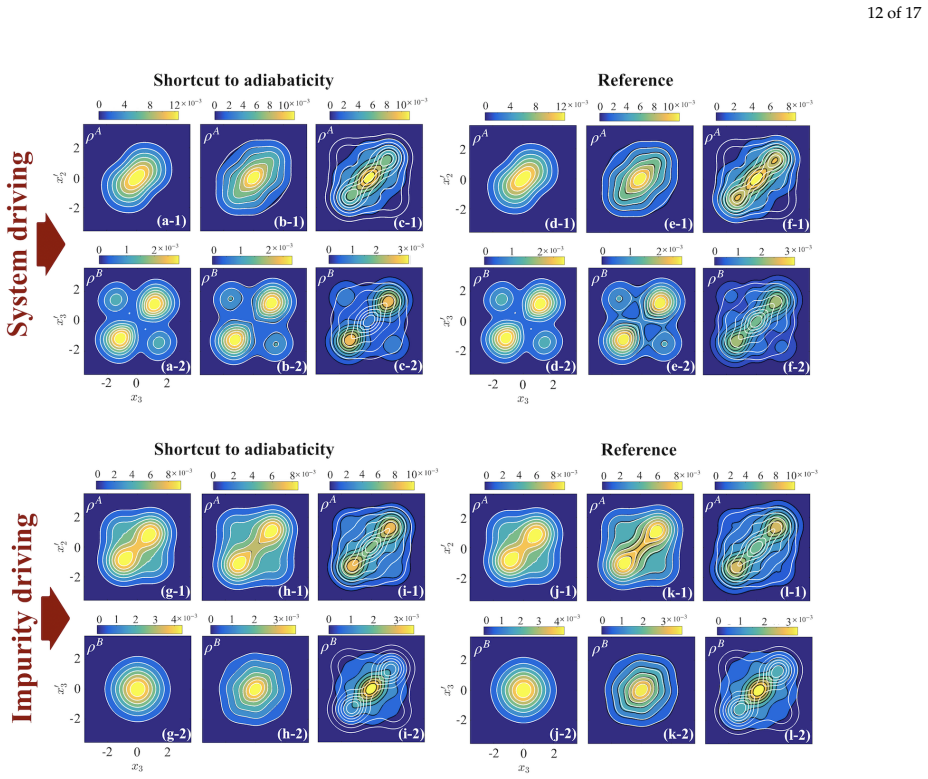
On the paper's own terms, the central claim is that inverse-engineered STA interaction ramps built from an interpolatory variational ansatz can outperform a generic smooth ramp for essentially all driving timescales in a genuinely few-body, two-component Bose gas, and that the only systematic failure is ramps crossing a phase-separation crossover. The STA is designed by writing the relative wavefunction as a normalized interpolation between the initial and final eigenstates, with time-dependent phase chirps in the Jacobi coordinates and a sixth-order polynomial controlling the smooth switch; minimizing an effective Lagrangian then yields explicit time traces for $g_A(t)$ and $g_{AB}(t)$. Against the reference ramp, the STA produces lower irreversible work for three identical bosons and for either drive in the presence of a weak fixed coupling, reaching the target state at $t_f\approx 10$ even for final coupling $g_f=40$, where the reference leaves the particles with excess kinetic energy and displaced density. When one coupling is held strong ($g=20$) and the other is driven to $g_f=40$, the STA fails in a specific way: the target ground state has a different particle ordering (ABA instead of BAB, or vice versa), reaching it requires inter-particle tunneling, and the STA's very success at suppressing excitations traps the system in the initial ordering for ramp times up to $t_f\approx 40$; in this regime the non-optimized reference can even yield lower irreversible work at long times because its spurious excitations encourage the needed reordering.
Load-bearing premise
The whole shortcut design rests on the assumption that the simple interpolatory wavefunction of Eqs. (11)-(12) stays close to the true evolving wavefunction throughout the ramp; Appendix A shows this fidelity drops sharply for strong fixed couplings and $g_f=40$, exactly in the phase-separation regime where the method is claimed to fail.
Editorial extensions
If this is right
- For three identical bosons, the STA reaches the target eigenstate effectively at $t_f=10$ for final couplings up to $g_f=40$, while the same ramp time with the reference schedule leaves a growing amount of irreversible work and a broader, hotter one-body density.
- With a weak fixed coupling, driving the intra-species interaction by STA reaches the ground state for ramp times of ten or more trap periods regardless of the final strength, whereas for impurity driving the STA advantage is significant mainly at large final impurity couplings such as $g_{AB}=40$.
- Under strong fixed coupling ($g=20$), STA ramps to weak final couplings $g_f=1$ or $5$ succeed at $t_f\approx 10$, but ramps to $g_f=40$ fail because the particles cannot reassemble from the initial phase-separated ordering into the target ordering; even at $t_f\approx 40$ the final state is not the target eigenstate.
- In the phase-separation failure regime, the non-optimized reference ramp can produce lower irreversible work than the STA for ramp times beyond about twenty trap periods, because its excitations promote the inter-particle tunneling the shortcut suppresses.
Reading between the lines
- One consequence the authors leave implicit is that the STA design principle of suppressing all excitations is actively harmful when the transformation requires transient excitations to cross a symmetry-breaking barrier; for such transitions the optimal control is closer to a two-stage protocol that first encourages reordering and then applies a shortcut to the reordered branch.
- A testable extension follows from the appendix's fidelity drop: inserting intermediate variational states along the phase-separated path should raise the ansatz fidelity in the strong-coupling regime, and if it does, recomputing the STA ramps with a multi-step interpolation would likely recover an advantage at $g_f=40$ where the current single-step ansatz fails.
- For experiments, the paper's failure mode implies that the shortest high-fidelity route to a phase-separated ground state is not the fastest interaction ramp; one should first let the system find the new ordering (for instance by shaking or deforming the trap), then drive interactions on the reordered state, a strategy consistent with the authors' own suggested future work.
Signed reviews
Editorial analysis
A structured set of objections, weighed in public.
Referee Report
Summary. The paper studies efficient interaction ramps for a one-dimensional system of three harmonically trapped bosons (two of species A and one of species B) with contact interactions. The authors construct shortcuts to adiabaticity (STA) using a variational interpolatory ansatz with chirp phases, minimizing an effective Lagrangian to design time-dependent interaction strengths g_A(t) and g_AB(t). They benchmark the STA against a smooth non-optimized reference ramp using the irreversible work <W_irr> = E_NA(t_f) - E_AD, and they analyze three scenarios: three identical particles, driving one interaction in the presence of weak fixed interactions, and driving one interaction in the presence of strong fixed interactions. They report that the STA outperforms the reference in the identical-particle and weak-fixed-coupling cases, while it fails when the target state requires crossing a phase-separation transition that forces particles to tunnel through each other. The failure is acknowledged in Sec. 6 and connected to the reduced fidelity of the variational ansatz documented in Appendix A.
Significance. If the central claim is established, the paper would meaningfully extend variational shortcut-to-adiabaticity techniques from single-particle and mean-field settings to interacting few-body systems with non-trivial ground states, showing that fast preparation of strongly interacting states is possible in certain parameter regimes. The paper's strengths include the use of exact diagonalization as an independent benchmark, the explicit fidelity check of the ansatz in Appendix A, and the candid discussion of the method's failure in the phase-separation regime. These provide a useful foundation for future work on few-body quantum control. However, the evidence for the headline claim is weakened by the reliance on an energy-based metric rather than a state-fidelity metric, and by the absence of quantitative fidelity-versus-time data in the regimes where the protocol fails.
major comments (3)
- [Sec. 5, Eq. (9), Figs. 8-9] The central success metric is the irreversible work <W_irr>, which measures an energy excess and not the fidelity with the target eigenstate. The paper never reports the exact final-state fidelity as a function of ramp time. In the strong-coupling g_f=40 cases of Sec. 5, Fig. 8 shows that the STA yields lower <W_irr> than the reference for t_f < 20, but Fig. 9 shows that at t_f = 10 both protocols leave the particles in the wrong spatial ordering (BAB instead of ABA for system driving), meaning neither final state is the target eigenstate. Moreover, for t_f > 20 the reference ramp actually has lower <W_irr> than the STA, so the claim that the STA 'outperforms' the reference for most timescales is not quantitatively supported. Because <W_irr> can be small for a state trapped in a wrong-symmetry local minimum, it does not by itself establish that the target eigenstate is reached. Please report the fidelity with the instantaneous target eigenstate as a function of t_f for all cases, and restate the performance claims in terms of the timescales and parameter regimes where the STA genuinely prepares the target state.
- [Appendix A, Sec. 6] The variational ansatz of Eqs. (11)-(12) is the input to the STA design, and Appendix A shows that its fidelity with the exact ground state drops significantly for strong fixed couplings and final interaction g_f = 40. In this regime the designed g(t) is therefore not a verified shortcut, and the comparison between the STA and the reference ramp in Sec. 5 becomes a comparison of two approximate protocols rather than a demonstration that a true shortcut exists. The paper acknowledges this limitation, but the conclusion that the STA 'produces less <W_irr>' for t_f < 20 should not be presented as evidence of an advantage. Please state this explicitly at the point where the strong-coupling results are discussed, and avoid implying that the STA is a reliable shortcut in the phase-separation regime.
- [Abstract and Sec. 1] The abstract states that the STA is 'designed to reduce these excitations at the end of the interaction ramp ensuring that the target eigenstate is reached,' but the paper itself shows in Sec. 5 that the target eigenstate is not reached when the ramp crosses a phase-separation transition requiring inter-particle tunneling. This overstatement should be corrected so that the abstract and introduction reflect the actual scope of the method, including its known failure regime.
minor comments (5)
- [Throughout] There are several typographical errors, including 'irregardless' (should be 'regardless'), 'kown' (should be 'known'), 'possesses' (should be 'possess' in the relevant sentence), and 'untypical' (should be 'atypical'). The manuscript would benefit from a careful proofread.
- [Sec. 4, first paragraph] The phrase 'possesses non-trivial groundstates' is grammatically awkward; consider revising.
- [Sec. 2, Eq. (12)] The normalization constant N(t) is introduced in Eq. (12) but its explicit form is not given. For reproducibility, please state how N(t) is computed from the interpolated wave function.
- [Sec. 3, Fig. 2] The inset of Fig. 2(e) shows <W_irr> versus g_f at t_f = 10, but the vertical axis is not labeled in the caption; please add axis labels to all insets.
- [Sec. 6] The sentence 'The timescales for which high fidelity states can be reached are comparable to those achievable using optimal control techniques in related few-body systems' is not backed by a quantitative comparison to the cited optimal-control results. Please either add the comparison or soften the claim.
Circularity Check
No significant circularity: the variational STA is derived from the action principle and benchmarked against exact dynamics, not fitted to its own success metric.
full rationale
The derivation chain is self-contained: Eqs. (11)-(14) define a variational ansatz interpolating the known non-interacting and target eigenstates, and the STA ramp g(t) is obtained by minimizing the action (13) with no free parameter fitted to the reported success metric <Wirr> (Eq. 9) or to the final OBDMs. The subsequent benchmarks use numerically exact propagation of the full Hamiltonian (1)-(2), so the comparison with the reference ramp is an external test rather than a restatement of the ansatz. The self-citations [20,21] are methodological antecedents for variational STA and irreversible-work diagnostics; the present paper re-derives the equations explicitly and does not rely on an unverified cited theorem. The acknowledged limitation in Appendix A and Sec. 6 — that the interpolatory ansatz loses fidelity for strong fixed couplings and g_f=40 — is an accuracy caveat, not a circular reduction: it identifies a regime where the approximate STA is less reliable, but the derivation of g(t) is not defined in terms of the quantities it is later used to predict. No equation in the paper reduces to its input by construction, so there is no significant circularity.
Assumptions & free parameters
assumptions (5)
- domain assumption The 1D contact interaction model with delta-function pseudo-potentials and the Olshanii renormalization is valid.
- ad hoc to paper The variational ansatz in Eqs. (11)-(12), an interpolation between initial and final eigenstates with chirp phases, accurately represents the true time-evolving state.
- domain assumption The system remains in the ground-state manifold of the relative Hamiltonian, so that the target state is the ground state.
- standard math The center-of-mass motion decouples and is unaffected by the interaction ramp.
- domain assumption Exact diagonalization yields accurate eigenstates and dynamics for this few-body system.
Cite this review
Pith. "Pith review of Driving interactions efficiently in a composite few-body system." pith.science (2026). https://pith.science/paper/F3AQU5EI
@misc{pith2026190811603,
  author       = {Pith},
  title        = {Pith review of: Driving interactions efficiently in a composite few-body system},
  year         = {2026},
  howpublished = {\url{https://pith.science/paper/F3AQU5EI}},
  note         = {Machine review of arXiv:1908.11603}
}
read the original abstract
We study how to efficiently control an interacting few-body system consisting of three harmonically trapped bosons. Specifically we investigate the process of modulating the interparticle interactions to drive an initially non-interacting state to a strongly interacting one, which is an eigenstate of a chosen Hamiltonian. We also show that for unbalanced subsystems, where one can individually control the different inter- and intra-species interactions, complex dynamics originates when the symmetry of the ground state is broken by phase separation. However, as driving the dynamics too quickly can result in unwanted excitations of the final state, we optimize the driven processes using shortcuts to adiabaticity, which are designed to reduce these excitations at the end of the interaction ramp ensuring that the target eigenstate is reached.
Figures


Figures from the paper (7 more)



Reference graph
Works this paper leans on
-
[1]
Colloquium: Trapping and manipulating photon states in atomic ensembles
Lukin, M.D. Colloquium: Trapping and manipulating photon states in atomic ensembles. Rev. Mod. Phys. 2003, 75, 457–472. doi:10.1103/RevModPhys.75.457
-
[2]
Coherence and Raman Sideband Cooling of a Single Atom in an Optical Tweezer
Thompson, J.D.; Tiecke, T.G.; Zibrov, A.S.; Vuleti´ c, V .; Lukin, M.D. Coherence and Raman Sideband Cooling of a Single Atom in an Optical Tweezer. Phys. Rev. Lett. 2013, 110, 133001. doi:10.1103/PhysRevLett.110.133001
-
[3]
High-Fidelity Control and Entanglement of Rydberg-Atom Qubits
Levine, H.; Keesling, A.; Omran, A.; Bernien, H.; Schwartz, S.; Zibrov, A.S.; Endres, M.; Greiner, M.; Vuleti´ c, V .; Lukin, M.D. High-Fidelity Control and Entanglement of Rydberg-Atom Qubits. Phys. Rev. Lett. 2018, 121, 123603. doi:10.1103/PhysRevLett.121.123603
-
[4]
Quantum optimal control theory
Werschnik, J.; Gross, E.K.U. Quantum optimal control theory. Journal of Physics B: Atomic, Molecular and Optical Physics 2007, 40, R175–R211. doi:10.1088/0953-4075/40/18/r01. 15 of 17
-
[5]
Optimal control of complex atomic quantum systems
van Frank, S.; Bonneau, M.; Schmiedmayer, J.; Hild, S.; Gross, C.; Cheneau, M.; Bloch, I.; Pichler, T.; Negretti, A.; Calarco, T.; Montangero, S. Optimal control of complex atomic quantum systems. Scientific Reports 2016, 6, 34187 EP –
work page 2016
-
[6]
Global optimization for quantum dynamics of few-fermion systems
Li, X.; P˛ ecak, D.; Sowi ´ nski, T.; Sherson, J.; Nielsen, A.E.B. Global optimization for quantum dynamics of few-fermion systems. Phys. Rev. A 2018, 97, 033602. doi:10.1103/PhysRevA.97.033602
-
[7]
Chapter 2 - Shortcuts to Adiabaticity
Torrontegui, E.; Ibáñez, S.; Martínez-Garaot, S.; Modugno, M.; del Campo, A.; Guéry-Odelin, D.; Ruschhaupt, A.; Chen, X.; Muga, J.G. Chapter 2 - Shortcuts to Adiabaticity. In Advances in Atomic, Molecular, and Optical Physics; Arimondo, E.; Berman, P .R.; Lin, C.C., Eds.; Academic Press, 2013; Vol. 62, Advances In Atomic, Molecular, and Optical Physics, p...
-
[8]
Shortcuts to Adiabaticity by Counterdiabatic Driving
del Campo, A. Shortcuts to Adiabaticity by Counterdiabatic Driving. Phys. Rev. Lett. 2013, 111, 100502. doi:10.1103/PhysRevLett.111.100502
Show all 57 references
-
[9]
Transient Particle Energies in Shortcuts to Adiabatic Expansions of Harmonic Traps
Cui, Y.Y.; Chen, X.; Muga, J.G. Transient Particle Energies in Shortcuts to Adiabatic Expansions of Harmonic Traps. The Journal of Physical Chemistry A 2016, 120, 2962–2969, [https://doi.org/10.1021/acs.jpca.5b06090]. PMID: 26237328, doi:10.1021/acs.jpca.5b06090
2016 doi
-
[10]
Minimizing irreversible losses in quantum systems by local counterdiabatic driving
Sels, D.; Polkovnikov, A. Minimizing irreversible losses in quantum systems by local counterdiabatic driving. Proceedings of the National Academy of Sciences 2017, 114, E3909–E3916, [https://www.pnas.org/content/114/20/E3909.full.pdf]. doi:10.1073/pnas.1619826114
2017 doi
-
[11]
Shortcuts to adiabaticity: concepts, methods, and applications, 2019, [arXiv:1904.08448]
Guéry-Odelin, D.; Ruschhaupt, A.; Kiely, A.; Torrontegui, E.; Martínez-Garaot, S.; Muga, J.G. Shortcuts to adiabaticity: concepts, methods, and applications, 2019, [arXiv:1904.08448]
2019 arXiv
-
[12]
Fast optimal transition between two equilibrium states
Schaff, J.F.; Song, X.L.; Vignolo, P .; Labeyrie, G. Fast optimal transition between two equilibrium states. Physical Review A 2010, 82, 033430
2010
-
[13]
Shortcut to adiabaticity for an interacting Bose-Einstein condensate
Schaff, J.F.; Song, X.L.; Capuzzi, P .; Vignolo, P .; Labeyrie, G. Shortcut to adiabaticity for an interacting Bose-Einstein condensate. EPL (Europhysics Letters) 2011, 93, 23001
2011
-
[14]
Shortcuts to adiabaticity for trapped ultracold gases.New Journal of Physics 2011, 13, 113017
Schaff, J.F.; Capuzzi, P .; Labeyrie, G.; Vignolo, P . Shortcuts to adiabaticity for trapped ultracold gases.New Journal of Physics 2011, 13, 113017
2011
-
[15]
Non-equilibrium scale invariance and shortcuts to adiabaticity in a one-dimensional Bose gas
Rohringer, W.; Fischer, D.; Steiner, F.; Mazets, I.E.; Schmiedmayer, J.; Trupke, M. Non-equilibrium scale invariance and shortcuts to adiabaticity in a one-dimensional Bose gas. Scientific reports 2015, 5, 9820
2015
-
[16]
Shortcuts to adiabaticity in the strongly coupled regime: Nonadiabatic control of a unitary Fermi gas
Deng, S.; Diao, P .; Yu, Q.; del Campo, A.; Wu, H. Shortcuts to adiabaticity in the strongly coupled regime: Nonadiabatic control of a unitary Fermi gas. Phys. Rev. A 2018, 97, 013628. doi:10.1103/PhysRevA.97.013628
2018 doi
-
[17]
Shortcuts to adiabaticity in Fermi gases
Diao, P .; Deng, S.; Li, F.; Yu, S.; Chenu, A.; del Campo, A.; Wu, H. Shortcuts to adiabaticity in Fermi gases. New Journal of Physics 2018, 20, 105004. doi:10.1088/1367-2630/aae45e
2018 doi
-
[18]
Low Energy Excitations of a Bose-Einstein Condensate: A Time-Dependent Variational Analysis
Pérez-García, V .M.; Michinel, H.; Cirac, J.I.; Lewenstein, M.; Zoller, P . Low Energy Excitations of a Bose-Einstein Condensate: A Time-Dependent Variational Analysis. Phys. Rev. Lett. 1996, 77, 5320–5323. doi:10.1103/PhysRevLett.77.5320
1996 doi
-
[19]
Shortcut to adiabatic control of soliton matter waves by tunable interaction
Li, J.; Sun, K.; Chen, X. Shortcut to adiabatic control of soliton matter waves by tunable interaction. Scientific Reports 2016, 6, 38258 EP –. Article
2016
-
[20]
An efficient nonlinear Feshbach engine
Li, J.; Fogarty, T.; Campbell, S.; Chen, X.; Busch, T. An efficient nonlinear Feshbach engine. New Journal of Physics 2018, 20, 015005. doi:10.1088/1367-2630/aa9cd8
2018 doi
-
[21]
Fast control of interactions in an ultracold two atom system: Managing correlations and irreversibility
Fogarty, T.; Ruks, L.; Li, J.; Busch, T. Fast control of interactions in an ultracold two atom system: Managing correlations and irreversibility. SciPost Phys. 2019, 6, 21. doi:10.21468/SciPostPhys.6.2.021
2019 doi
-
[22]
Dynamics of Component Separation in a Binary Mixture of Bose-Einstein Condensates
Hall, D.S.; Matthews, M.R.; Ensher, J.R.; Wieman, C.E.; Cornell, E.A. Dynamics of Component Separation in a Binary Mixture of Bose-Einstein Condensates. Phys. Rev. Lett. 1998, 81, 1539–1542. doi:10.1103/PhysRevLett.81.1539
1998 doi
-
[23]
Phase separation in a two-species Bose mixture.Phys
Mishra, T.; Pai, R.V .; Das, B.P . Phase separation in a two-species Bose mixture.Phys. Rev. A 2007, 76, 013604. doi:10.1103/PhysRevA.76.013604
2007 doi
-
[24]
Quantum correlations and spatial localization in one-dimensional ultracold bosonic mixtures
García-March, M.A.; Juliá-Díaz, B.; Astrakharchik, G.E.; Busch, T.; Boronat, J.; Polls, A. Quantum correlations and spatial localization in one-dimensional ultracold bosonic mixtures. New Journal of Physics 2014, 16, 103004. doi:10.1088/1367-2630/16/10/103004
2014 doi
-
[25]
Phase separation and dynamics of two-component Bose-Einstein condensates
Lee, K.L.; Jørgensen, N.B.; Liu, I.K.; Wacker, L.; Arlt, J.J.; Proukakis, N.P . Phase separation and dynamics of two-component Bose-Einstein condensates. Phys. Rev. A 2016, 94, 013602. doi:10.1103/PhysRevA.94.013602. 16 of 17
2016 doi
-
[26]
Production of cold molecules via magnetically tunable Feshbach resonances
Köhler, T.; Góral, K.; Julienne, P .S. Production of cold molecules via magnetically tunable Feshbach resonances. Rev. Mod. Phys. 2006, 78, 1311–1361. doi:10.1103/RevModPhys.78.1311
2006 doi
-
[27]
Feshbach resonances in ultracold gases.Rev
Chin, C.; Grimm, R.; Julienne, P .; Tiesinga, E. Feshbach resonances in ultracold gases.Rev. Mod. Phys. 2010, 82, 1225–1286. doi:10.1103/RevModPhys.82.1225
2010 doi
-
[28]
Atomic Scattering in the Presence of an External Confinement and a Gas of Impenetrable Bosons
Olshanii, M. Atomic Scattering in the Presence of an External Confinement and a Gas of Impenetrable Bosons. Phys. Rev. Lett. 1998, 81, 938–941. doi:10.1103/PhysRevLett.81.938
1998 doi
-
[29]
Fractional energy states of strongly interacting bosons in one dimension
Zinner, N.T.; Volosniev, A.G.; Fedorov, D.V .; Jensen, A.S.; Valiente, M. Fractional energy states of strongly interacting bosons in one dimension. EPL (Europhysics Letters) 2014, 107, 60003. doi:10.1209/0295-5075/107/60003
2014 doi
-
[30]
Strongly interacting mesoscopic systems of anyons in one dimension
Zinner, N.T. Strongly interacting mesoscopic systems of anyons in one dimension. Phys. Rev. A 2015, 92, 063634. doi:10.1103/PhysRevA.92.063634
2015 doi
-
[31]
Distinguishability, degeneracy, and correlations in three harmonically trapped bosons in one dimension
García-March, M.A.; Juliá-Díaz, B.; Astrakharchik, G.E.; Boronat, J.; Polls, A. Distinguishability, degeneracy, and correlations in three harmonically trapped bosons in one dimension. Phys. Rev. A 2014, 90, 063605. doi:10.1103/PhysRevA.90.063605
2014 doi
-
[32]
Sharp crossover from composite fermionization to phase separation in microscopic mixtures of ultracold bosons
Garcia-March, M.A.; Juliá-Díaz, B.; Astrakharchik, G.E.; Busch, T.; Boronat, J.; Polls, A. Sharp crossover from composite fermionization to phase separation in microscopic mixtures of ultracold bosons. Phys. Rev. A 2013, 88, 063604. doi:10.1103/PhysRevA.88.063604
2013 doi
-
[33]
Instabilities in Binary Mixtures of One-Dimensional Quantum Degenerate Gases
Cazalilla, M.A.; Ho, A.F. Instabilities in Binary Mixtures of One-Dimensional Quantum Degenerate Gases. Phys. Rev. Lett. 2003, 91, 150403. doi:10.1103/PhysRevLett.91.150403
2003 doi
-
[34]
Demixing of Bosonic Mixtures in Optical Lattices from Macroscopic to Microscopic Scales
Alon, O.E.; Streltsov, A.I.; Cederbaum, L.S. Demixing of Bosonic Mixtures in Optical Lattices from Macroscopic to Microscopic Scales. Phys. Rev. Lett. 2006, 97, 230403. doi:10.1103/PhysRevLett.97.230403
2006 doi
-
[35]
Composite fermionization of one-dimensional Bose-Bose mixtures
Zöllner, S.; Meyer, H.D.; Schmelcher, P . Composite fermionization of one-dimensional Bose-Bose mixtures. Phys. Rev. A 2008, 78, 013629. doi:10.1103/PhysRevA.78.013629
2008 doi
-
[36]
Non-equilibrium thermodynamics of harmonically trapped bosons
García-March, M.Á.; Fogarty, T.; Campbell, S.; Busch, T.; Paternostro, M. Non-equilibrium thermodynamics of harmonically trapped bosons. New Journal of Physics 2016, 18, 103035. doi:10.1088/1367-2630/18/10/103035
2016 doi
-
[37]
Classical and Quantum Shortcuts to Adiabaticity for Scale-Invariant Driving
Deffner, S.; Jarzynski, C.; del Campo, A. Classical and Quantum Shortcuts to Adiabaticity for Scale-Invariant Driving. Phys. Rev. X 2014, 4, 021013. doi:10.1103/PhysRevX.4.021013
2014 doi
-
[38]
An interpolatory ansatz captures the physics of one-dimensional confined Fermi systems
Andersen, M.E.S.; Dehkharghani, A.S.; Volosniev, A.G.; Lindgren, E.J.; Zinner, N.T. An interpolatory ansatz captures the physics of one-dimensional confined Fermi systems. Scientific Reports 2016, 6, 28362 EP –. Article
2016
-
[39]
Four fermions in a one-dimensional harmonic trap: Accuracy of a variational-ansatz approach
P˛ ecak, D.; Dehkharghani, A.S.; Zinner, N.T.; Sowi ´ nski, T. Four fermions in a one-dimensional harmonic trap: Accuracy of a variational-ansatz approach. Phys. Rev. A 2017, 95, 053632. doi:10.1103/PhysRevA.95.053632
2017 doi
-
[40]
Symmetries of three harmonically trapped particles in one dimension
Harshman, N.L. Symmetries of three harmonically trapped particles in one dimension. Phys. Rev. A 2012, 86, 052122. doi:10.1103/PhysRevA.86.052122
2012 doi
-
[41]
One-Dimensional Traps, Two-Body Interactions, Few-Body Symmetries: I
Harshman, N.L. One-Dimensional Traps, Two-Body Interactions, Few-Body Symmetries: I. One, Two, and Three Particles. Few-Body Systems 2016, 57, 11–43. doi:10.1007/s00601-015-1024-6
2016 doi
-
[42]
Observation of a One-Dimensional Tonks-Girardeau Gas
Kinoshita, T.; Wenger, T.; Weiss, D.S. Observation of a One-Dimensional Tonks-Girardeau Gas. Science 2004, 305, 1125–1128, [https://science.sciencemag.org/content/305/5687/1125.full.pdf]. doi:10.1126/science.1100700
2004 doi
-
[43]
Exact Coherent States of a Harmonically Confined Tonks-Girardeau Gas
Minguzzi, A.; Gangardt, D.M. Exact Coherent States of a Harmonically Confined Tonks-Girardeau Gas. Phys. Rev. Lett. 2005, 94, 240404. doi:10.1103/PhysRevLett.94.240404
2005 doi
-
[44]
Realization of an Excited, Strongly Correlated Quantum Gas Phase
Haller, E.; Gustavsson, M.; Mark, M.J.; Danzl, J.G.; Hart, R.; Pupillo, G.; Nägerl, H.C. Realization of an Excited, Strongly Correlated Quantum Gas Phase. Science 2009, 325, 1224–1227, [https://science.sciencemag.org/content/325/5945/1224.full.pdf]. doi:10.1126/science.1175850
2009 doi
-
[45]
Analytic results for a quantum quench from free to hard-core one-dimensional bosons
Kormos, M.; Collura, M.; Calabrese, P . Analytic results for a quantum quench from free to hard-core one-dimensional bosons. Phys. Rev. A 2014, 89, 013609. doi:10.1103/PhysRevA.89.013609
2014 doi
-
[46]
Quantum dynamics of two trapped bosons following infinite interaction quenches
Kehrberger, L.M.A.; Bolsinger, V .J.; Schmelcher, P . Quantum dynamics of two trapped bosons following infinite interaction quenches. Phys. Rev. A 2018, 97, 013606. doi:10.1103/PhysRevA.97.013606
2018 doi
-
[47]
Observation of scaling in the dynamics of a strongly quenched quantum gas
Nicklas, E.; Karl, M.; Höfer, M.; Johnson, A.; Muessel, W.; Strobel, H.; Tomkoviˇ c, J.; Gasenzer, T.; Oberthaler, M.K. Observation of scaling in the dynamics of a strongly quenched quantum gas. Physical review letters 2015, 115, 245301. 17 of 17
2015
-
[48]
Scaling of fluctuations in a trapped binary condensate
Bisset, R.; Wilson, R.; Ticknor, C. Scaling of fluctuations in a trapped binary condensate. Physical Review A 2015, 91, 053613
2015
-
[49]
Correlation effects in the quench-induced phase separation dynamics of a two species ultracold quantum gas
Mistakidis, S.I.; Katsimiga, G.C.; Kevrekidis, P .G.; Schmelcher, P . Correlation effects in the quench-induced phase separation dynamics of a two species ultracold quantum gas. New Journal of Physics 2018, 20, 043052. doi:10.1088/1367-2630/aabc6a
2018 doi
-
[50]
Material-barrier tunnelling in one-dimensional few-boson mixtures
Pflanzer, A.C.; Zöllner, S.; Schmelcher, P . Material-barrier tunnelling in one-dimensional few-boson mixtures. Journal of Physics B: Atomic, Molecular and Optical Physics 2009, 42, 231002. doi:10.1088/0953-4075/42/23/231002
2009 doi
-
[51]
Interspecies tunneling in one-dimensional Bose mixtures.Phys
Pflanzer, A.C.; Zöllner, S.; Schmelcher, P . Interspecies tunneling in one-dimensional Bose mixtures.Phys. Rev. A 2010, 81, 023612. doi:10.1103/PhysRevA.81.023612
2010 doi
-
[52]
Fast driving between arbitrary states of a quantum particle by trap deformation
Martínez-Garaot, S.; Palmero, M.; Muga, J.G.; Guéry-Odelin, D. Fast driving between arbitrary states of a quantum particle by trap deformation. Phys. Rev. A 2016, 94, 063418. doi:10.1103/PhysRevA.94.063418
2016 doi
-
[53]
Tunneling control and localization for Bose-Einstein condensates in a frequency modulated optical lattice
Zenesini, A.; Lignier, H.; Sias, C.; Morsch, O.; Ciampini, D.; Arimondo, E. Tunneling control and localization for Bose-Einstein condensates in a frequency modulated optical lattice. Laser Physics 2010, 20, 1182–1189. doi:10.1134/S1054660X10090410
2010 doi
-
[54]
Quantum tunneling of ultracold atoms in optical traps
Wu, J.H.; Qi, R.; Ji, A.C.; Liu, W.M. Quantum tunneling of ultracold atoms in optical traps. Frontiers of Physics 2014, 9, 137–152. doi:10.1007/s11467-013-0359-z
2014 doi
-
[55]
Orthogonality catastrophe as a consequence of qubit embedding in an ultracold Fermi gas
Goold, J.; Fogarty, T.; Lo Gullo, N.; Paternostro, M.; Busch, T. Orthogonality catastrophe as a consequence of qubit embedding in an ultracold Fermi gas. Phys. Rev. A 2011, 84, 063632. doi:10.1103/PhysRevA.84.063632
2011 doi
-
[56]
Time-Dependent Impurity in Ultracold Fermions: Orthogonality Catastrophe and Beyond
Knap, M.; Shashi, A.; Nishida, Y.; Imambekov, A.; Abanin, D.A.; Demler, E. Time-Dependent Impurity in Ultracold Fermions: Orthogonality Catastrophe and Beyond. Phys. Rev. X 2012, 2, 041020. doi:10.1103/PhysRevX.2.041020
2012 doi
-
[57]
Quenching small quantum gases: Genesis of the orthogonality catastrophe
Campbell, S.; García-March, M.A.; Fogarty, T.; Busch, T. Quenching small quantum gases: Genesis of the orthogonality catastrophe. Phys. Rev. A 2014, 90, 013617. doi:10.1103/PhysRevA.90.013617
2014 doi
Reviewed August 14, 2026 · model on record in the stance chip above.
Discussion (0). Continue with ORCID to comment.