REVIEW 4 major objections 4 minor 72 references
Unpaired Image-to-Image Translation for Segmentation and Signal Unmixing
T0 review · 4 major / 4 minor · reviewed 2026-08-07 · deepseek-v4-flash
Pith's one-line read Ui2i claims to be the first unpaired image-to-image translation model that separates superimposed fluorescence signals in real microscope images and adapts IHC images for nuclear segmentation without retraining the segmenter.
desk verdict A well-engineered CycleGAN variant with a genuinely new task formulation, but the headline unmixing claim is only tested on a surrogate the authors admit isn't representative. read the letter →
The pith
A machine-rendered reading of the paper's core claim, the machinery that carries it, and where it could break.
The reading
What carries the argument
The load-bearing mechanism is a set of architectural choices bundled under the name Ui2i: U-Net generators whose skip connections carry localized shallow features into the decoder, approximate bidirectional spectral normalization (a parameter-based normalization that replaces feature-based layers such as instance normalization and keeps local object responses independent of global context), channel-spatial attention in the encoders, and a shared bottleneck supervised by a content discriminator plus an N-pair contrastive loss. Cycle consistency ties the two translation directions together; the paper argues that cycle loss alone cannot pin down content preservation, so the extra bottlenecks and attention are what actually protect nuclear shapes and membrane patterns.
What would settle it
A concrete test: acquire a sample with two markers truly labeled by the same fluorophore and independently verify their locations by imaging each marker in a separate round or with spectrally distinct fluorophores; apply Ui2i to the single-channel multiplexed image and compare the separated channels to the independently acquired ground truth. If per-channel PSNR and MicroMS-SSIM are no better than a trivial assignment, such as copying the input to both channels, the first-to-unmix-with-unpaired-data claim is falsified. A second, quicker check is to scan for hallucinated structures in the output that have no counterpart in the input, as in the Appendix H failure example.
Extended reading notes
Core claim
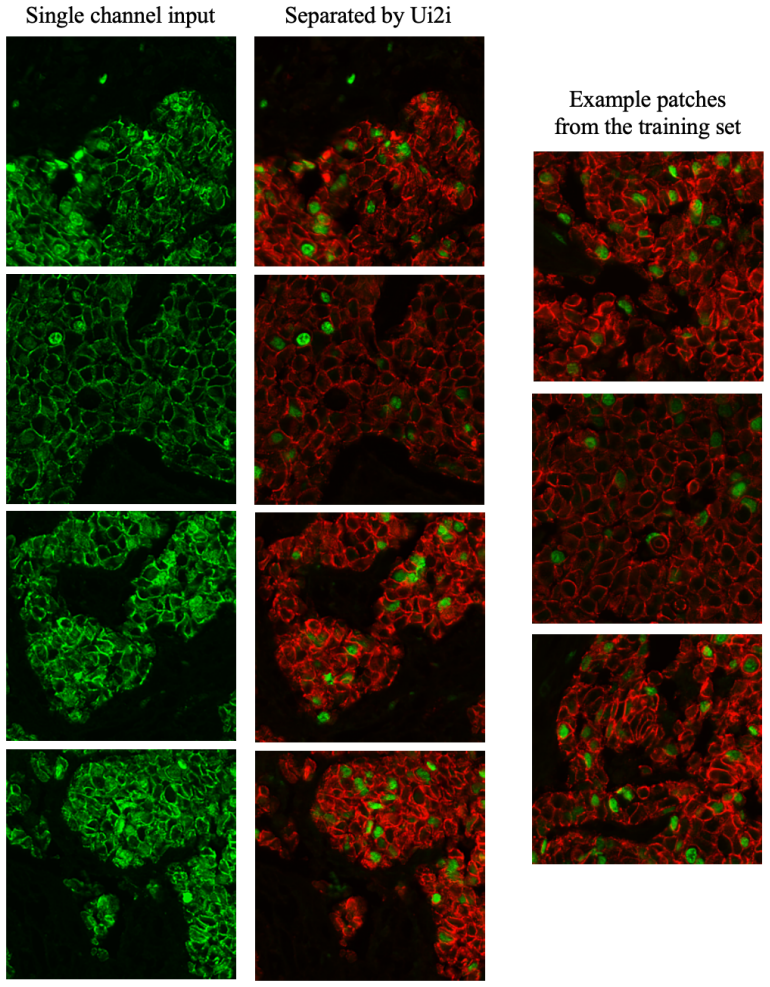
At its core, Ui2i is CycleGAN rebuilt for content fidelity. It keeps the unpaired, bidirectional cycle-consistency setup but replaces ResNet generators with U-Net-style encoders and decoders linked by skip connections, removes feature-based normalization layers and instead normalizes weights with approximate bidirectional spectral normalization, adds channel and spatial attention in the encoders, and supervises the shared bottleneck with a content discriminator and a cross-domain contrastive loss. The paper demonstrates this design on two tasks: translating IHC images to H&E so that the H&E-pretrained StarDist segmenter outperforms the IHC-domain-pretrained InstanSeg on IHC test images, and unmixing single-channel immunofluorescence images of Ki67 and E-cadherin, labeled with the same fluorophore, into separate channels. The strongest claim, stated as a first in the field, is that this is the first approach able to separate superimposed signals in IF images using real, unpaired training data.
Load-bearing premise
The load-bearing premise, stated in Appendix H, is that the source and target datasets share a common content space: if a structure appears in one domain and not the other, the model tends to hallucinate it.
Editorial extensions
If this is right
- IHC-to-H&E translation by Ui2i followed by an H&E-pretrained StarDist segmenter yields higher instance precision and recall on IHC images than applying the IHC-pretrained InstanSeg directly, so domain-aligned translation can beat a generalist segmenter.
- Single-channel IF unmixing lets one fluorophore label two biomarkers, effectively doubling multiplexed marker capacity and reducing the number of fluorophores and imaging rounds.
- Because training is unpaired, the unmixing model can be built from real single-channel and two-channel acquisitions instead of synthetic paired mixtures, which the paper argues is closer to how co-labeled markers actually appear.
- Removing feature-based normalization and using parameter-based spectral normalization suppresses blob-like hallucinations that would be counted as false-positive nuclei.
- The pipeline needs no retraining of the downstream segmenter: the translation module alone adapts the input domain.
Reading between the lines
- The same content-preservation machinery should transfer to other biomedical translation tasks where shape fidelity is critical, such as CT-to-MRI or stain transfer on whole-slide images; this is a natural extension the paper does not test.
- The declared reliance on a shared content space implies a practical curation rule: any structure that appears in only one domain must be added to the other, or the model will hallucinate it; the failure example in Appendix H already shows this by adding artifact patches to the two-channel set.
- If the doubling claim holds, multiplexed panels could be expanded combinatorially by co-labeling multiple marker pairs, not just one pair, though crosstalk between pairs would need separate validation.
- A quantitative check of the shared-content assumption could be built by measuring how often the model's outputs contain structures that have no counterpart in the input, for example with an auxiliary detector trained on the target domain.
Signed reviews
Editorial analysis
A structured set of objections, weighed in public.
Referee Report
Summary. The manuscript introduces Ui2i, an unpaired bidirectional image-to-image translation model built on CycleGAN, with U-Net generators with skip connections, removal of feature normalization in favor of approximate bidirectional spectral normalization, channel/spatial attention, scale augmentation, and a cross-domain contrastive loss. The model is evaluated on two biomedical tasks: (i) IHC-to-H&E translation followed by StarDist nuclear segmentation, where improvements over CycleGAN and over direct InstanSeg application are reported; and (ii) unmixing a single-channel immunofluorescence image into two channels representing two markers labeled with the same fluorophore, where quantitative results are reported on the HT-T24 dataset and qualitative results are shown for real breast/colon same-fluorophore data. The paper claims to be the first approach capable of separating superimposed IF signals using real, unpaired training data, and claims significantly greater content fidelity than existing i2i translation methods.
Significance. If the central claims are substantiated, the work would be practically significant: it would enable marker separation for same-fluorophore multiplexed immunofluorescence without paired training data, and it would provide a domain-adaptation pipeline for nuclear segmentation that outperforms direct application of a domain-pretrained segmenter. Strengths include evaluation with an external pretrained segmenter (StarDist), ablations of key architectural choices, and use of public datasets. However, the manuscript's load-bearing claim of same-fluorophore unmixing is not quantitatively validated in the intended regime; the only quantitative unmixing experiment uses spectrally distinct fluorophores that, as Appendix G concedes, do not reproduce same-fluorophore signal characteristics. The segmentation claim of 'significantly greater' fidelity is also not supported by statistical significance tests, given overlapping standard deviations in Table 1.
major comments (4)
- [Section 8, Table 2, Appendix G] The quantitative evaluation of unmixing is performed on HT-T24, where SOX2 and Grasp65 are labeled with spectrally distinct fluorophores and the multiplexed image was acquired by simultaneous excitation; Appendix G explicitly states that these images 'do not faithfully reproduce the signal characteristics, noise patterns, or artifact profiles of true single-fluorophore multiplexing.' The central claim in the abstract and Section 8—that Ui2i is the first to separate superimposed signals in IF images using real, unpaired data—therefore remains unverified for the intended same-fluorophore regime. The real breast/colon results (Figs. 5, 11, 12) are qualitative only, with the text noting that ground truth is impossible. I request either a quantitative same-fluorophore evaluation (for example, synthetic mixtures created by adding real single-fluorophore channels from the same sample, with realistic noise and artifact injection) or a clear restriction of the novelty claim to the surrogate regime.
- [Section 3, Eq. (3)] The paper correctly notes that infinitely many cycle-consistent generator pairs exist. For the unmixing task the degeneracy is even more direct: any pair of output channels whose sum equals the input satisfies the cycle consistency loss, so the adversarial and contrastive losses alone must select the intended biological decomposition. The manuscript does not provide a test isolating whether these losses break the degeneracy in the same-fluorophore regime; separating two spectrally distinct fluorophore statistics on HT-T24 could succeed without the model learning a same-fluorophore decomposition. A control experiment—for example, training on synthetic same-fluorophore mixtures with known ground truth, or checking that the two output channels sum to the input while matching per-channel distributions—is needed to make the unmixing claim load-bearing.
- [Introduction, Table 1, Conclusion] The claim that Ui2i preserves image content fidelity 'to a significantly greater extent' than existing methods is not supported by any statistical significance test. In Table 1, standard deviations overlap substantially (e.g., Instance Precision 0.87±0.11 vs. CycleGAN 0.72±0.18; Panoptic Quality 0.65±0.10 vs. 0.59±0.14). The paper should report per-image paired statistics, bootstrap confidence intervals, or another appropriate significance test, or soften the 'significantly' language in the abstract, introduction, and conclusion.
- [Appendix H] The failure example demonstrates that when source and target domains do not share a common content space, the model hallucinates structures. This assumption is load-bearing for both applications, because the training signal for content preservation comes from cycle consistency across unpaired domains. The manuscript does not provide evidence that the real same-fluorophore breast/colon datasets satisfy this overlap condition beyond qualitative inspection, and the reader cannot assess how often artifacts similar to Fig. 14 occur in the intended acquisition regime. Please provide a quantitative characterization of content-space overlap for the IF data (e.g., artifact frequency, or detection of structure types absent from the other domain) or discuss the failure mode explicitly as a limitation in the main text.
minor comments (4)
- [Throughout] The model name is inconsistently capitalized: 'Ui2i' and 'UI2I' are both used (e.g., Sections 5 and 6); please standardize.
- [Table 1] Table 1 reports '0.72 ∓ 0.14' for Ui2i w/o augment. Instance Recall; this should be '±'.
- [Eq. (1)] Equation (1) is typeset incorrectly in the provided PDF (the formula is garbled); please provide a clean rendering of the lower bound and verify the notation matches the cited source.
- [Section 6, Appendix B] The text mentions that 'class embeddings are explained in the Appendix,' but Appendix A and B do not clearly define or illustrate these class embeddings for the three-class discriminator; please add a short explanation or remove the cross-reference.
Circularity Check
No circular derivation found: quantitative claims rest on external benchmarks and standard losses; stated limitations are validity issues, not circular reductions.
full rationale
The paper's two quantitative evaluations are anchored to external benchmarks. In the segmentation experiment (Sec. 7), a fixed StarDist model pretrained on MoNuSeg H&E is applied to Ui2i-translated IHC images, and the reported metrics compare against expert nuclei annotations on a held-out IHC test set; no parameter of Ui2i is fitted to those annotations. In the unmixing experiment (Sec. 8), the quantitative result uses the HT-T24 dataset with ground-truth SOX2 and Grasp65 channels, training and test sections are disjoint, and the loss functions (adversarial, cycle, identity, contrastive) are standard and not constructed from the evaluation metric. The paper explicitly acknowledges in Sec. 3 that infinitely many cycle-consistent generator pairs exist, and in Appendix H that translation fails when content spaces do not overlap; these are identifiability and assumption limitations, not circular reductions, because the method does not claim that cycle consistency alone determines the output. Appendix G concedes that HT-T24 does not reproduce true single-fluorophore multiplexing characteristics, weakening external validity for the central same-fluorophore claim, but this is an evidence-strength concern rather than a circularity concern. There are no load-bearing self-citations, no fitted parameter is renamed as a prediction, and no result is derived from the paper's own outputs by construction. The real same-fluorophore results are qualitative only, but qualitative demonstration is not a circular derivation; it is a limitation of validation. Therefore no circular step can be exhibited with the paper's own equations, and the appropriate score is 0.
Assumptions & free parameters
free parameters (5)
- lambda_cyc (cycle consistency weight) =
10 (segmentation, breast/colon unmixing); 5 (HT-T24 unmixing)
- lambda_id (identity loss weight) =
1 (segmentation); 0 (unmixing, identity loss excluded)
- lambda_cl (contrastive loss weight) =
0.1
- scale augmentation range =
[0.75, 1.5]
- RMS pooling in spatial attention =
RMS replaces max pooling in the spatial attention module
assumptions (6)
- standard math Merikoski-Kumar lower bound on the spectral norm (Eq. 1) is valid.
- standard math Cycle consistency alone does not uniquely determine content-style disentanglement.
- domain assumption Source and target domains share a common content space.
- domain assumption A model trained on sequentially acquired multiplexed images (HT-T24) is a useful proxy for same-fluorophore unmixing performance.
- domain assumption StarDist pretrained on MoNuSeg H&E images is a reliable evaluator of content preservation in the translated IHC images.
- ad hoc to paper Replacing feature normalization with spectral normalization improves localized structure preservation.
Cite this review
Pith. "Pith review of Unpaired Image-to-Image Translation for Segmentation and Signal Unmixing." pith.science (2026). https://pith.science/paper/F3MWTQ56
@misc{pith2026250520746,
  author       = {Pith},
  title        = {Pith review of: Unpaired Image-to-Image Translation for Segmentation and Signal Unmixing},
  year         = {2026},
  howpublished = {\url{https://pith.science/paper/F3MWTQ56}},
  note         = {Machine review of arXiv:2505.20746}
}
read the original abstract
This work introduces Ui2i, a novel model for unpaired image-to-image translation, trained on content-wise unpaired datasets to enable style transfer across domains while preserving content. Building on CycleGAN, Ui2i incorporates key modifications to better disentangle content and style features, and preserve content integrity. Specifically, Ui2i employs U-Net-based generators with skip connections to propagate localized shallow features deep into the generator. Ui2i removes feature-based normalization layers from all modules and replaces them with approximate bidirectional spectral normalization -- a parameter-based alternative that enhances training stability. To further support content preservation, channel and spatial attention mechanisms are integrated into the generators. Training is facilitated through image scale augmentation. Evaluation on two biomedical tasks -- domain adaptation for nuclear segmentation in immunohistochemistry (IHC) images and unmixing of biological structures superimposed in single-channel immunofluorescence (IF) images -- demonstrates Ui2i's ability to preserve content fidelity in settings that demand more accurate structural preservation than typical translation tasks. To the best of our knowledge, Ui2i is the first approach capable of separating superimposed signals in IF images using real, unpaired training data.
Figures


Figures from the paper (11 more)




Reference graph
Works this paper leans on
-
[1]
Struc- turally aware bidirectional unpaired image to image translation between CT and MR, 2020
Vismay Agrawal, Avinash Kori, Vikas Kumar Anand, and Ganapathy Krishnamurthi. Struc- turally aware bidirectional unpaired image to image translation between CT and MR, 2020
work page 2020
-
[2]
Ashesh, Federico Carrara, Igor Zubarev, Vera Galinova, Melisande Croft, Joran De- schamps, and Florian Jug. MicroSplit-reproducibility. https://github.com/CAREamics/ MicroSplit-reproducibility, 2025. Accessed: 2025-05-15
work page 2025
-
[3]
MicroSplit: Semantic Unmixing of Fluorescent Microscopy Data
Ashesh Ashesh, Federico Carrara, Igor Zubarev, Vera Galinova, Melisande Croft, Melissa Pezzotti, Daozheng Gong, Francesca Casagrande, Elisa Colombo, Stefania Giussani, Elena Restelli, Eugenia Cammarota, Juan Manuel Battagliotti, Nikolai Klena, Moises Di Sante, Gaia Pigino, Elena Taverna, Oliver Harschnitz, Nicola Maghelli, Norbert Scherer, Damian Edward D...
work page 2025
-
[4]
MicroSSIM: Improved Structural Similarity for Comparing Microscopy Data
Ashesh Ashesh, Joran Deschamps, and Florian Jug. MicroSSIM: Improved Structural Similarity for Comparing Microscopy Data. arXiv preprint arXiv:2408.08747, 2024. Accepted at BIC workshop, ECCV 2024
arXiv 2024
-
[5]
indiSplit: Bringing Severity Cognizance to Image Decomposi- tion in Fluorescence Microscopy, 2025
Ashesh Ashesh and Florian Jug. indiSplit: Bringing Severity Cognizance to Image Decomposi- tion in Fluorescence Microscopy, 2025
work page 2025
-
[6]
B. Choi, S. S. Shin, J. Y . Kim, Y . H. Lee, M. S. Kim, H. G. Kim, J. S. Lee, and S. H. Lee. Blind demixing of overlapping fluorescence signals enables massively multiplexed imaging. Nature Methods, 2024
work page 2024
- [7]
-
[8]
Thibaut Goldsborough, Ben Philps, Alan O’Callaghan, Fiona Inglis, Leo Leplat, Andrew Filby, Hakan Bilen, and Peter Bankhead. InstanSeg: an embedding-based instance segmentation algorithm optimized for accurate, efficient and portable cell segmentation, 2024
work page 2024
Show all 72 references
-
[9]
Goltsev, N
Y . Goltsev, N. Samusik, J. Kennedy-Darling, S. Bhate, M. Hale, G. Vazquez, D. Black, and G. P. Nolan. Deep Profiling of Mouse Splenic Architecture with CODEX Multiplexed Imaging. Cell, 174(4):968–981.e15, 2018
2018
-
[10]
Goodfellow, Jean Pouget-Abadie, Mehdi Mirza, Bing Xu, David Warde-Farley, Sherjil Ozair, Aaron Courville, and Yoshua Bengio
Ian J. Goodfellow, Jean Pouget-Abadie, Mehdi Mirza, Bing Xu, David Warde-Farley, Sherjil Ozair, Aaron Courville, and Yoshua Bengio. Generative Adversarial Nets. In Advances in Neural Information Processing Systems, volume 27, 2014
2014
-
[11]
Simon Graham, Quoc Dang Vu, Shan E Ahmed Raza, Jin Tae Kwak, and Nasir M. Rajpoot. XY network for nuclear segmentation in multi-tissue histology images. CoRR, abs/1812.06499, 2018. 10
2018 arXiv
-
[12]
Tight and Efficient Upper Bound on Spectral Norm of Convolutional Layers
Ekaterina Grishina, Mikhail Gorbunov, and Maxim Rakhuba. Tight and Efficient Upper Bound on Spectral Norm of Convolutional Layers. In Computer Vision – ECCV 2024, volume 15147 of Lecture Notes in Computer Science , pages 19–34. Springer, 2024
2024
-
[13]
Erik Großkopf, Valay Bundele, Mehran Hossienzadeh, and Hendrik P.A. Lensch. HistDiST: Histopathological Diffusion-based Stain Transfer. arXiv preprint arXiv:2505.06793, 2025
2025
-
[14]
NuSegDA: Domain Adaptation for Nuclei Segmentation
Md Mehedi Haq, Haoran Ma, and Junzhou Huang. NuSegDA: Domain Adaptation for Nuclei Segmentation. Frontiers in Big Data, 6:1108659, Mar 2023
2023
-
[15]
Ziaul Hoque, Anja Keskinarkaus, Pia Nyberg, and Tapio Seppänen
Md. Ziaul Hoque, Anja Keskinarkaus, Pia Nyberg, and Tapio Seppänen. Stain normaliza- tion methods for histopathology image analysis: A comprehensive review and experimental comparison. Information Fusion, 102:101997, 2024
2024
-
[16]
Stacked Gen- erative Adversarial Networks
Xun Huang, Yixuan Li, Omid Poursaeed, John Hopcroft, and Serge Belongie. Stacked Gen- erative Adversarial Networks. In 2017 IEEE Conference on Computer Vision and Pattern Recognition (CVPR), pages 1866–1875, 2017
2017
-
[17]
Multimodal Unsupervised Image-to- Image Translation
Xun Huang, Ming-Yu Liu, Serge Belongie, and Jan Kautz. Multimodal Unsupervised Image-to- Image Translation. In Proceedings of the European Conference on Computer Vision (ECCV) , pages 172–189. Springer, 2018
2018
-
[18]
Lynsec: Lymphoma nuclear segmentation and classification, June 2023
Naji Hussein, Büttner Reinhard, Simon Adrian, Eich Marie-Lisa, Lohneis Philipp, and Bozek Katarzyna. Lynsec: Lymphoma nuclear segmentation and classification, June 2023
2023
-
[19]
Batch normalization: accelerating deep network training by reducing internal covariate shift
Sergey Ioffe and Christian Szegedy. Batch normalization: accelerating deep network training by reducing internal covariate shift. In Proceedings of the 32nd International Conference on International Conference on Machine Learning - V olume 37 , ICML’15, page 448–456. JMLR.org, 2015
2015
-
[20]
Phillip Isola, Jun-Yan Zhu, Tinghui Zhou, and Alexei A. Efros. Image-to-Image Translation with Conditional Adversarial Networks. In 2017 IEEE Conference on Computer Vision and Pattern Recognition (CVPR), 2017
2017
-
[21]
Extention to the tnbc dataset, brain section and cell type, July 2021
Naylor Peter Jack, Yao-Hung Hubert Tsai, Laé Marick, and Makoto Yamada. Extention to the tnbc dataset, brain section and cell type, July 2021
2021
-
[22]
DASGAN – Joint Domain Adaptation and Segmentation for the Analysis of Epithelial Regions in Histopathology PD-L1 Images, 2019
Ansh Kapil, Tobias Wiestler, Simon Lanzmich, Abraham Silva, Keith Steele, Marlon Rebelatto, Guenter Schmidt, and Nicolas Brieu. DASGAN – Joint Domain Adaptation and Segmentation for the Analysis of Epithelial Regions in Histopathology PD-L1 Images, 2019
2019
-
[23]
Progressive Growing of GANs for Improved Quality, Stability, and Variation
Tero Karras, Timo Aila, Samuli Laine, and Jaakko Lehtinen. Progressive Growing of GANs for Improved Quality, Stability, and Variation. In International Conference on Learning Representations, 2018
2018
-
[24]
Analyzing and Improving the Image Quality of StyleGAN
Tero Karras, Samuli Laine, Miika Aittala, Janne Hellsten, Jaakko Lehtinen, and Timo Aila. Analyzing and Improving the Image Quality of StyleGAN. In 2020 IEEE/CVF Conference on Computer Vision and Pattern Recognition (CVPR), pages 8107–8116, 2020
2020
-
[25]
Neeraj Kumar, Ruchika Verma, Sandeep Sharma, Rohit Bhargava, Abhishek Vahadane, and A. Sethi. A multi-organ nucleus segmentation challenge. In IEEE 14th International Symposium on Biomedical Imaging (ISBI 2017) , pages 929–932. IEEE, 2017
2017
-
[26]
Virtual staining for histology by deep learning
Leena Latonen, Sonja Koivukoski, Umair Khan, and Pekka Ruusuvuori. Virtual staining for histology by deep learning. Trends in Biotechnology, 42(9):1177–1191, 2024
2024
-
[27]
H. Lee, J. H. Lee, E. Lim, H. Kim, S. Y . Cho, J. Y . Yoo, H. Kim, D. S. Koh, C. Lee, H. Park, and Y . Park. PICASSO enables fast, high-throughput, and robust visualization of multiplexed fluorescence signals. Cell, 185(3):620–636.e24, 2022
2022
-
[28]
DRIT++: Diverse Image-to-Image Translation via Disentangled Representations
Hsin-Ying Lee, Hung-Yu Tseng, Qi Mao, Jia-Bin Huang, Yu-Ding Lu, and Ming-Hsuan Wang. DRIT++: Diverse Image-to-Image Translation via Disentangled Representations. arXiv preprint arXiv:1905.01270, 2019. 11
1905 arXiv
-
[29]
Single-Step Bidirectional Unpaired Image Translation Using Implicit Bridge Consistency Distillation, 2025
Suhyeon Lee, Kwanyoung Kim, and Jong Chul Ye. Single-Step Bidirectional Unpaired Image Translation Using Implicit Bridge Consistency Distillation, 2025
2025
-
[30]
J. R. Lin, M. Fallahi-Sichani, and P. K. Sorger. Highly multiplexed imaging of single cells using a high-throughput cyclic immunofluorescence method. eLife, 4:e13940, 2015
2015
-
[31]
Why Spectral Normalization Stabilizes GANs: Analysis and Improvements
Zinan Lin, Vyas Sekar, and Giulia Fanti. Why Spectral Normalization Stabilizes GANs: Analysis and Improvements. In A. Beygelzimer, Y . Dauphin, P. Liang, and J. Wortman Vaughan, editors, Advances in Neural Information Processing Systems , 2021
2021
-
[32]
Unsupervised Instance Segmentation in Microscopy Images via Panoptic Domain Adaptation and Task Re-Weighting
Dongnan Liu et al. Unsupervised Instance Segmentation in Microscopy Images via Panoptic Domain Adaptation and Task Re-Weighting. In 2020 IEEE/CVF Conference on Computer Vision and Pattern Recognition (CVPR), pages 4242–4251. IEEE, 2020
2020
-
[33]
A Symmetric Efficient Spatial and Channel Attention (ESCA) Module Based on Convolutional Neural Networks
Huaiyu Liu, Yueyuan Zhang, and Yiyang Chen. A Symmetric Efficient Spatial and Channel Attention (ESCA) Module Based on Convolutional Neural Networks. Symmetry, 16(8), 2024
2024
-
[34]
Nuinsseg: A fully annotated dataset for nuclei instance segmentation in h&e-stained histological images, January 2024
Amirreza Mahbod, Christine Polak, Katharina Feldmann, Rumsha Khan, Katharina Gelles, Georg Dorffner, Ramona Woitek, Sepideh Hatamikia, and Isabella Ellinger. Nuinsseg: A fully annotated dataset for nuclei instance segmentation in h&e-stained histological images, January 2024
2024
-
[35]
Lau, Zhen Wang, and Stephen Paul Smolley
Xudong Mao, Qing Li, Haoran Xie, Raymond Y .K. Lau, Zhen Wang, and Stephen Paul Smolley. Least Squares Generative Adversarial Networks . In 2017 IEEE International Conference on Computer Vision (ICCV), 2017
2017
-
[36]
Merikoski and Ravinder Kumar
Jorma K. Merikoski and Ravinder Kumar. Lower Bounds for the Spectral Norm. Journal of Inequalities in Pure and Applied Mathematics , 6(4):Article 124, 2005. Accessed: 2025-05-08
2005
-
[37]
Learning transferable features with deep adaptation networks
Long Mingsheng, Cao Yue, Wang Jianmin, and Michael Jordan. Learning transferable features with deep adaptation networks. In ICML, 2015
2015
-
[38]
Spectral Normaliza- tion for Generative Adversarial Networks
Takeru Miyato, Toshiki Kataoka, Masanori Koyama, and Yuichi Yoshida. Spectral Normaliza- tion for Generative Adversarial Networks. In International Conference on Learning Represen- tations, 2018
2018
-
[39]
EndoNuke: Nuclei Detection Dataset for Estrogen and Proges- terone Stained IHC Endometrium Scans
Anton Naumov, Egor Ushakov, Andrey Ivanov, Konstantin Midiber, Tatyana Khovanskaya, Alexandra Konyukova, Polina Vishnyakova, Sergei Nora, Liudmila Mikhaleva, Timur Fatkhudi- nov, and Evgeny Karpulevich. EndoNuke: Nuclei Detection Dataset for Estrogen and Proges- terone Stained...
2022
-
[40]
Efros, Richard Zhang, and Jun-Yan Zhu
Taesung Park, Alexei A. Efros, Richard Zhang, and Jun-Yan Zhu. Contrastive Learning for Unpaired Image-to-Image Translation. In Computer Vision – ECCV 2020: 16th European Conference, Glasgow, UK, August 23–28, 2020, Proceedings, Part IX, page 319–345, Berlin, Heidelberg, 2020....
2020
-
[41]
Improved Techniques for Training GANs, 2016
Tim Salimans, Ian Goodfellow, Wojciech Zaremba, Vicki Cheung, Alec Radford, and Xi Chen. Improved Techniques for Training GANs, 2016
2016
-
[42]
Cell Detection with Star-Convex Polygons
Uwe Schmidt, Martin Weigert, Coleman Broaddus, and Gene Myers. Cell Detection with Star-Convex Polygons. In Medical Image Computing and Computer Assisted Intervention – MICCAI 2018, 2018
2018
-
[43]
StarDist Versatile H&E Pretrained Model
Uwe Schmidt, Martin Weigert, et al. StarDist Versatile H&E Pretrained Model. https: //github.com/stardist/stardist-models, 2020. Accessed: 2025-05-15
2020
-
[44]
StainDiff: Transfer Stain Styles of Histology Images with Denoising Diffusion Probabilistic Models and Self-Ensemble
Yiqing Shen and Jing Ke. StainDiff: Transfer Stain Styles of Histology Images with Denoising Diffusion Probabilistic Models and Self-Ensemble. In Medical Image Computing and Computer Assisted Intervention – MICCAI 2023 , pages 549–559. Springer Nature Switzerland, 2023
2023
-
[45]
Improved Deep Metric Learning with Multi-class N-pair Loss Objective
Kihyuk Sohn. Improved Deep Metric Learning with Multi-class N-pair Loss Objective. In Advances in Neural Information Processing Systems , volume 29, pages 1857–1865, 2016. 12
2016
-
[46]
Learning to detect lymphocytes in immunohistochemistry with deep learning
Zaneta Swiderska-Chadaj, Hans Pinckaers, Mart van Rijthoven, Maschenka Balkenhol, Mar- garita Melnikova, Oscar Geessink, Quirine Manson, Mark Sherman, Antonio Polonia, Jeremy Parry, Mustapha Abubakar, Geert Litjens, Jeroen van der Laak, and Francesco Ciompi. Learning to detect...
2019
-
[47]
Y . Tian, D. Mahdessian, E. F. Damato, D. R. Thompson, A. N. Mitchell, B. D. Cosgrove, G. W. Miller, D. R. Albrecht, S. C. Bendall, G. D. Luker, D. J. Brady, E. T. Roussos, M. L. Adams, M. J. Tyska, and M. E. Gehm. UNMIX-ME: spectral and lifetime unmixing for high-throughput i...
2022
-
[48]
Image Translation Based Nuclei Segmentation for Immunohistochemistry Images
Roberto Trullo, Quoc-Anh Bui, Qianye Tang, and Reza Olfati-Saber. Image Translation Based Nuclei Segmentation for Immunohistochemistry Images. In Anirban Mukhopadhyay, Ilkay Oksuz, Stefan Engelhardt, Dajiang Zhu, and Yinyin Yuan, editors,Deep Generative Models, volume 13609 of...
2022
-
[49]
Filters for Common Resampling Tasks
Ken Turkowski and Steve Gabriel. Filters for Common Resampling Tasks. Glassner , Graphics Gems I. Academic Press, page 147–165, 1990
1990
-
[50]
Instance Normalization: The Missing Ingredient for Fast Stylization
Dmitry Ulyanov, Andrea Vedaldi, and Victor Lempitsky. Instance Normalization: The Missing Ingredient for Fast Stylization. arXiv preprint arXiv:1607.08022, Jul 2016
2016 arXiv
-
[51]
Image dataset from multiplex ihc stained tma sections, February 2023
Ranran Wang, Yusong Qiu, Yong Zhang, and Hongming Xu. Image dataset from multiplex ihc stained tma sections, February 2023
2023
-
[52]
Mix-domain contrastive learning for unpaired H&E-to-IHC stain translation
Song Wang, Zhong Zhang, Huan Yan, Ming Xu, and Guanghui Wang. Mix-domain contrastive learning for unpaired H&E-to-IHC stain translation. In 2024 IEEE International Conference on Image Processing (ICIP), pages 2982–2988, 2024
2024
-
[53]
CBAM: Convolutional Block Attention Module
Sanghyun Woo, Jongchan Park, Joon-Young Lee, and In So Kweon. CBAM: Convolutional Block Attention Module. In Proceedings of the European Conference on Computer Vision (ECCV), pages 3–19. Springer, 2018
2018
-
[54]
Single-Domain Generalized Object Detection in Urban Scene via Cyclic-Disentangled Self-Distillation
Aming Wu and Cheng Deng. Single-Domain Generalized Object Detection in Urban Scene via Cyclic-Disentangled Self-Distillation. In Proceedings of the IEEE/CVF Conference on Computer Vision and Pattern Recognition, pages 847–856, 2022
2022
-
[55]
Group Normalization
Yuxin Wu and Kaiming He. Group Normalization. In Computer Vision – ECCV 2018: 15th European Conference, Munich, Germany, September 8-14, 2018, Proceedings, Part XIII , page 3–19, Berlin, Heidelberg, 2018. Springer-Verlag
2018
-
[56]
DiffI2I: Efficient Diffusion Model for Image-to-Image Translation, 2023
Bin Xia, Yulun Zhang, Shiyin Wang, Yitong Wang, Xinglong Wu, Yapeng Tian, Wenming Yang, Radu Timotfe, and Luc Van Gool. DiffI2I: Efficient Diffusion Model for Image-to-Image Translation, 2023
2023
-
[57]
Unpaired Image-to-Image Trans- lation With Shortest Path Regularization
Shaoan Xie, Yanwu Xu, Mingming Gong, and Kun Zhang. Unpaired Image-to-Image Trans- lation With Shortest Path Regularization. In Proceedings of the IEEE/CVF Conference on Computer Vision and Pattern Recognition, pages 10177–10187, 2023
2023
-
[58]
Multi-attention bidirectional contrastive learning method for unpaired image-to-image translation
Benchen Yang, Xuzhao Liu, Yize Li, Haibo Jin, and Yetian Qu. Multi-attention bidirectional contrastive learning method for unpaired image-to-image translation. PLOS ONE, 19:1–18, 2024
2024
-
[59]
Segment Anything Model for Medical Image Segmentation: Current Applications and Future Directions
Yichi Zhang, Zhenrong Shen, and Rushi Jiao. Segment Anything Model for Medical Image Segmentation: Current Applications and Future Directions. Computers in Biology and Medicine, 171:108238, 2024
2024
-
[60]
Differentiable Augmentation for Data-Efficient GAN Training
Shengyu Zhao, Zhijian Liu, Ji Lin, Jun-Yan Zhu, and Song Han. Differentiable Augmentation for Data-Efficient GAN Training. In Advances in Neural Information Processing Systems , volume 33, pages 7559–7570, 2020. 13
2020
-
[61]
Unpaired image-to- image translation using cycle-consistent adversarial networks
Zhu, Jun-Yan and Park, Taesung and Isola, Phillip and Efros, Alexei A. Unpaired image-to- image translation using cycle-consistent adversarial networks. InIEEE International Conference on Computer Vision (ICCV), 2017
2017
-
[62]
Zimmermann, J
T. Zimmermann, J. Marrison, C. Hogg, and D. O’Toole. Tunable excitation: monochromators as light sources for fluorescence microscopy. Nature Methods, 11:982–984, 2014
2014
-
[63]
Zimmermann, J
T. Zimmermann, J. Rietdorf, and R. Pepperkok. Spectral imaging and its applications in live cell microscopy. Cytometry Part A, 52A(1):21–29, 2003
2003
-
[64]
real”, “fake
Igor Zingman et al. A Comparative Evaluation of Image-to-Image Translation Methods for Stain Transfer in Histopathology. In Proceedings of the International Conference on Medical Imaging with Deep Learning (MIDL) , 2023. Available online at https://2023.midl.io. 14 Supplementa...
2023
-
[65]
Additionally, x1 has a central square of the same size, where the first channel remains 0.25, but the second channel is set to 0.00875
x1 contains four 20 × 20 squares near the corners, where the first channel has a value of 0.25 and the second channel is 0. Additionally, x1 has a central square of the same size, where the first channel remains 0.25, but the second channel is set to 0.00875. 17
-
[66]
x2 has only the central square, same as in x1
-
[67]
x3 has the same squares as in x1 and adds another sixth square of size 10 × 10 where the first channel has intensity 0 and the second channel has intensity 1
-
[68]
Consider applying an instance normalization layer to each of the four feature maps, followed by a 1 × 1 convolution that reduces the number of channels to 1
x4 adds an additional square to x2 of size 10 × 10 where the first channel has intensity 1 and the second channel has intensity 0. Consider applying an instance normalization layer to each of the four feature maps, followed by a 1 × 1 convolution that reduces the number of cha...
2018
-
[69]
StarDist applied directly to test IHC images
-
[70]
CycleGAN-based translation from IHC to H&E, followed by StarDist segmentation
-
[71]
Ui2i-based translation from IHC to H&E, followed by StarDist segmentation
-
[72]
InstanSeg applied directly to test IHC images Both translation models - CycleGAN and Ui2i - were trained to map the IHC training set into the H&E domain of the MoNuSeg dataset, the exact domain StarDist was trained on. Figure 10 presents results from the four approaches on rep...
Reviewed August 7, 2026 · model on record in the stance chip above.
Discussion (0). Continue with ORCID to comment.