REVIEW 3 major objections 5 minor 97 references
New Universal Relations for Magnetized Neutron Stars
T0 review · 3 major / 5 minor · reviewed 2026-08-10 · deepseek-v4-flash
Pith's one-line read This paper derives an exact, equation-of-state-independent formula linking a magnetized neutron star's dipole moment to its compactness, and shows that three magnetic deformation parameters obey near-universal relations at the 10 percent…
desk verdict The exact dipole-compactness relation is the real result; the approximate universality is well-supported but tested for only one current profile, which the paper itself flags. read the letter →
The pith
A machine-rendered reading of the paper's core claim, the machinery that carries it, and where it could break.
The reading
What carries the argument
The machinery is a perturbative construction in the magnetic-field strength: at zeroth order one solves the standard relativistic stellar-structure equations for a spherically symmetric background; at first order one solves Maxwell's equation for a purely poloidal dipole field with a current density proportional to c_0 $r^{2}$(\rho+p); at second order one solves the Einstein equations for the perturbed metric, whose l=0 and l=2 pieces encode the spherical and quadrupolar deformations. The exact relation follows by combining the exterior dipole solution, the definition of the polar surface field strength, and the normalization \bar{\mu} = \mu/(B_s $M^{3}$). The approximate relations rest on numerically solving the interior equations for ten equations of state and fitting logarithms of the dimensionless quantities to quartic polynomials in logarithms, with the Newtonian polytropic results providing analytic cross-checks.
What would settle it
A fully nonlinear, twisted-torus magnetar equilibrium code that computes \bar{Q} and \bar{\epsilon} for the same equations of state would falsify the approximate relations if the scatter among equations of state exceeds roughly 20 percent or if the \bar{Q}–\bar{\mu} relation deviates from the fitted curve by more than the claimed few percent in the compactness range 0.1 to 0.25. For the exact \bar{\mu}–C relation, a single self-consistent configuration with a purely poloidal dipole field whose normalized dipole moment at a given C disagrees with Eq. (3.7) by more than numerical error would falsify it.
Extended reading notes
Core claim
On the paper's own terms, the central discovery is Eq. (3.7): with \bar{\mu} = \mu/(B_s $M^{3}$) the magnetic dipole moment normalized by the polar surface field and mass, and C = M/R the compactness, every static, poloidally magnetized neutron star configuration satisfies \bar{\mu} = -(4/3)[2C(C+1)+\log(1-2C)] exactly, independent of the equation of state. The paper further claims that \bar{Q} = -Q/($B_s^{2}$ $M^{5}$) and \bar{\epsilon} = \epsilon/($B_s^{2}$ $M^{2}$) obey approximate universal relations with \bar{\mu} and with each other, with fractional equation-of-state variations at the 10 percent level across realistic equations of state; Newtonian polytrope calculations reproduce the trend and give analytic estimates of the spread. The relation between \bar{Q} and \bar{\mu} is highlighted because both quantities enter the gravitational-wave phase at the same leading post-Newtonian order.
Load-bearing premise
The load-bearing premise is that a neutron star's magnetic field is weak enough for second-order perturbation theory and is purely poloidal and dipolar; if real magnetar fields contain sizable toroidal components or nonlinearities, the discovered relations may not hold for the stars we observe.
Editorial extensions
If this is right
- If Eq. (3.7) is exact for any poloidal dipolar configuration, a measurement of mass and radius determines the magnetic dipole moment normalized by the polar field, with no nuclear-physics input.
- The \bar{Q}–\bar{\mu} relation can break the degeneracy between magnetic dipole and quadrupole contributions to the gravitational-wave phase from a magnetized neutron star binary, because both enter at the same post-Newtonian order.
- The \bar{\epsilon}–\bar{\mu} and \bar{\epsilon}–\bar{Q} relations give an equation-of-state-robust way to estimate the ellipticity, and hence the continuous gravitational-wave strain, of a magnetized star from its observed dipole field and mass.
- The analytic Newtonian results for polytropes show that the 10 to 20 percent equation-of-state scatter is a real feature of the relations rather than numerical noise, and they anchor the relativistic numerical results in the small-compactness limit.
Reading between the lines
- As an editorial inference, if twisted-torus fields with comparable toroidal components preserve the structure of these relations, the normalization constants may shift but the approximate universality could survive; checking this is the paper's own suggested next step and would make the relations directly applicable to realistic magnetar models.
- The exact dipole–compactness relation suggests a null test: for a given observed polar field strength and dipole moment, compactness is fixed, so inconsistent mass–radius pairs would indicate a non-dipolar or non-poloidal field geometry, or field decay over time.
- Because the relations are derived perturbatively in field strength, they likely apply only when the magnetic energy is a small fraction of the stellar binding energy; fully nonlinear equilibrium codes for the strongest magnetar fields could test where the perturbative approximation breaks down.
- A gravitational-wave observation of a binary containing a magnetized neutron star could measure the combination of \bar{\mu} and \bar{Q} entering the waveform phase; combining that measurement with the \bar{Q}–\bar{\mu} relation would yield an equation-of-state-robust estimate of the polar field strength B_s.
Editorial analysis
A structured set of objections, weighed in public.
Referee Report
Summary. The paper constructs static, perturbatively magnetized neutron-star models with a purely poloidal dipolar magnetic field, following the Konno–Obata–Kojima formalism. It defines dimensionless normalizations of the magnetic dipole moment, magnetically induced quadrupole moment, and ellipticity using the stellar mass and the polar surface field strength, and then studies relations among these quantities and the compactness. The main results are an exact, EoS-independent relation between the normalized dipole moment and compactness, Eq. (3.7), and approximate universal relations among the normalized dipole moment, quadrupole moment, and ellipticity, with EoS scatter at the O(10%) level. The numerical study uses ten realistic EoSs plus an n=1 polytrope, and the approximate relations are supported by closed-form Newtonian polytrope calculations for n=0 and n=1. The paper also discusses the possible use of the dipole–quadrupole relation in gravitational-wave parameter estimation for magnetized neutron-star binaries.
Significance. If the claims hold, the exact relation (3.7) is a clean, parameter-free consequence of exterior matching and is a useful consistency check for numerical magnetized-star codes. The approximate relations are potentially valuable because they connect quantities that enter gravitational-wave phasing at the same leading post-Newtonian order, and the numerical evidence spans a wide range of realistic EoSs. The analytic Newtonian polytrope results strengthen the case by reproducing the limiting behavior, and the paper is honest about the perturbative and field-geometry assumptions. The main significance caveat is that the approximate universality is demonstrated for a single magnetic-field geometry, which limits the strength of the astrophysical conclusions until robustness to more realistic field configurations is established.
major comments (3)
- [Sec. IV and Sec. III.B] The approximate universality of the Qbar–mubar and epsbar–mubar relations is established only for a purely poloidal dipole field with the barotropic current profile j1=c0 r^2 (rho+p) of Eq. (A12). Section IV concedes that purely poloidal configurations are dynamically unstable and that twisted-torus configurations are more realistic. Because the proposed gravitational-wave application (Sec. IV and footnote 1) concerns magnetars, the authors should either test the relations for at least one configuration containing a toroidal component, for example using existing twisted-torus equilibrium models of Refs. [66,68,90-92], or explicitly restrict the title, abstract, and conclusions to the purely poloidal dipolar case and present the gravitational-wave statement as conditional on such a test.
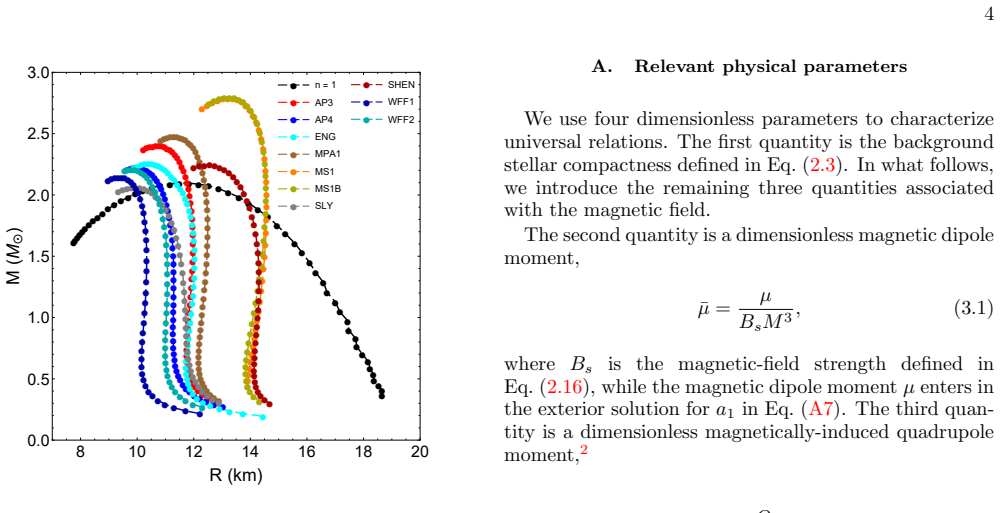
- [Figs. 1, 3, 4 and Sec. II.B] It is not stated whether the sequences shown in Figs. 3 and 4 include configurations on the dynamically unstable branch beyond the maximum mass in Fig. 1. Since the O(10%) residual claim is the quantitative basis of the universality result, the fits and residual ranges should be recomputed or at least reported for the stable branch dM/drho_c > 0 only; if unstable configurations are included, this should be stated explicitly and its effect on the residuals quantified.
- [Sec. III.B and Fig. 4] No numerical truncation-error estimate is provided for the O(epsilon^2) solutions that determine Qbar and epsbar. The exact-relation check in Fig. 3 validates only the O(epsilon) solver, while the Newtonian-limit comparison in Fig. 4 provides validation only in the small-compactness regime. A convergence test, or a comparison with an independent code, is needed to ensure that the claimed <=5% EoS scatter is not contaminated by numerical error in the relativistic regime.
minor comments (5)
- [Eq. (3.23)] The parenthetical Newtonian expression should be typeset as mubar = C^{-3}/2; as currently rendered it can be misread as mubar = C^{-3/2}, which would be inconsistent with Eq. (3.7) and with the subsequent identity Qbar = 5 mubar^2.
- [Fig. 3 caption and axis label] The fractional-difference panel should be labeled |mubar_numerical - mubar_exact|/mubar_exact; the present label appears to read as |exact|/exact, which is not a meaningful fractional error.
- [Eqs. (A9), (B4)] The symbol c2 is used both for an integration constant in the dipole-sector relation (A9) and for the homogeneous-solution coefficient in Eq. (B4); these should be distinguished to avoid confusion.
- [Table I] The table gives fit coefficients but not the range of compactness, mubar, or Qbar over which each fit is calibrated; stating the fit domain would make the relations easier to apply and to compare with future work.
- [Fig. 4] The y-axis labels in the three panels appear to omit the bars on Qbar and epsbar; please ensure the normalized quantities are labeled consistently.
Circularity Check
No significant circularity: the exact compactness–dipole relation is a matching identity, and the approximate relations are empirical fits with independent analytic support.
full rationale
The central exact result, Eq. (3.7), is obtained by matching the exterior vacuum dipole solution (A7) to the surface field strength B_s defined in Eq. (2.16); the relation \bar{\mu} = -(4/3)[2C(C+1)+\log(1-2C)] follows algebraically with no dependence on the stellar interior or EoS, so it is a parameter-free identity rather than a fitted or self-referential output. The approximate \bar{Q}–\bar{\mu}, \bar{\varepsilon}–\bar{\mu}, and \bar{\varepsilon}–\bar{Q} relations are computed by solving the O(ε²) perturbation equations (A19)–(A20) for nine realistic EoSs plus a polytrope, using the integrability-constrained current j_1 = c_0 r²(ρ+p) from Eq. (A12). These relations are explicitly labeled approximate, with EoS scatter quantified in Fig. 4 and fit coefficients reported only descriptively in Table I. Independent support is provided by the Newtonian analytic estimates for n=0 and n=1 polytropes, Eqs. (3.23)–(3.30), which reproduce the numerical behavior and yield EoS variations of 11%–23%. The paper's own Sec. IV limitation that purely poloidal fields are unstable and twisted-torus configurations are more realistic is a scope restriction, not a circular step: it affects astrophysical applicability but does not make the derivation depend on its conclusion. Self-citations in the introduction and discussion sections are background context and are not load-bearing; the perturbation framework is taken from the external Konno et al. series, and the EoS data are external tables. No fitted parameter is relabeled as a prediction, no uniqueness claim is imported from the authors' prior work, and no ansatz is smuggled in through citation.
Assumptions & free parameters
free parameters (3)
- Fit coefficients for bar-Q vs bar-mu relation (a,b,c,d,e) =
-1.45, 3.27, -2.3e-1, 1.92e-2, -6.09e-4
- Fit coefficients for bar-epsilon vs bar-mu relation (a,b,c,d,e) =
5.35e-1, 2.19, -1.97e-1, 2.09e-2, -7.94e-4
- Fit coefficients for bar-epsilon vs bar-Q relation (a,b,c,d,e) =
1.48, 6.86e-1, -1.14e-2, 9.23e-4, -2.01e-5
assumptions (5)
- domain assumption The Konno et al. perturbative framework, expanding Einstein-Maxwell equations to O(epsilon^2) in magnetic field strength, correctly describes static magnetized neutron stars.
- domain assumption The magnetic field is purely poloidal and dipolar (l=1), with current j1 = c0 r^2 (rho+p).
- ad hoc to paper The stellar radius shift and O(epsilon^2) mass correction do not affect the universal relations at the order considered.
- domain assumption The ten tabulated and polytropic EoSs accurately represent the spread of neutron star matter relevant for this calculation.
- domain assumption Newtonian-limit analytic relations for n=0 and n=1 polytropes are representative of the relativistic numerical behavior.
Cite this review
Pith. "Pith review of New Universal Relations for Magnetized Neutron Stars." pith.science (2026). https://pith.science/paper/F3U5IU3G
@misc{pith2026260807172,
  author       = {Pith},
  title        = {Pith review of: New Universal Relations for Magnetized Neutron Stars},
  year         = {2026},
  howpublished = {\url{https://pith.science/paper/F3U5IU3G}},
  note         = {Machine review of arXiv:2608.07172}
}
read the original abstract
Unlike the neutron-star mass--radius relation, which depends sensitively on the internal stellar structure through the equation of state of dense nuclear matter, certain neutron-star properties obey approximately universal relations that exhibit only weak dependence on the equation of state. In this paper, we explore new universal relations for magnetized neutron stars. We focus on a purely poloidal dipolar magnetic-field configuration and treat the effects of the magnetic field perturbatively to second order in the field strength. After appropriately normalizing the relevant quantities by the stellar mass and the magnetic-field strength at the pole, we first identify an exact universal relation between the magnetic dipole moment and stellar compactness. We then find approximate universal relations among the magnetic dipole moment, magnetically-induced stellar quadrupole moment, and ellipticity, with fractional variations due to the equation of state at the level of O(10%). We support these numerical findings with analytic estimates for Newtonian polytropes, which reproduce the observed behavior. Among the newly discovered relations, the one connecting the magnetic dipole moment and stellar quadrupole moment may be particularly useful for the analysis of gravitational-wave signals from binaries containing magnetized neutron stars.
Figures


Figures from the paper (1 more)

Reference graph
Works this paper leans on
-
[1]
II to the Newtonian counterparts at each order
Perturbation equations and exterior solutions We reduce the field equations derived in Sec. II to the Newtonian counterparts at each order. 7 AtO(ϵ), Eq. (A6) in the Newtonian limit reduces to a′′ 1,N − 2a1,N r2 =−4πc 0ρr2,(3.9) where the subscript N refers to the Newtonian limit. The exterior solution fora 1,N in the above equation becomes a1,N = µ r = B...
-
[2]
(3.9) (that is regular atr=
Incompressible Stars AtO(ϵ 0), the energy density and mass function inside an incompressible star are given by ρ(n=0) =ρ c, m (n=0) = 4π 3 ρcr3.(3.16) AtO(ϵ), the solution to Eq. (3.9) (that is regular atr=
-
[3]
(3.10) at the surface, one can determinea c andc 0 in terms ofB s
becomes a(n=0) 1,N =a cr2 − 3c0M 10R3 r4.(3.17) Matching this interior solution with the exterior solution in Eq. (3.10) at the surface, one can determinea c andc 0 in terms ofB s. One can then rewrite the vector potential function as a(n=0) 1,N = 1 4 Bsr2 5− 3r2 R2 .(3.18) Let us next estimate ¯QB and ¯εB. AtO(ϵ 2), the solu- tions to the equations forh ...
-
[4]
III B, as well as estimate the amount of EoS variation between these polytropic NSs in the universal relations
Universality Having the above analytic results, we can compare them with the numerical results presented in Sec. III B, as well as estimate the amount of EoS variation between these polytropic NSs in the universal relations. In Fig. 4, we present the analytic relations in the Newtonian limit. In particular, we used the Newtonian relation (3.29) in the top...
-
[5]
J. M. Lattimer and M. Prakash, Neutron star structure and the equation of state, Astrophys. J.550, 426 (2001), arXiv:astro-ph/0002232
arXiv 2001
-
[6]
Burgay, N
M. Burgay, N. D’Amico, A. Possenti, R. N. Manchester, A. G. Lyne, B. C. Joshi, M. A. McLaughlin, M. Kramer, J. M. Sarkissian, F. Camilo,et al., An increased esti- mate of the merger rate of double neutron stars from observations of a highly relativistic system, Nature426, 531 (2003)
2003
-
[7]
A. W. Steiner, J. M. Lattimer, and E. F. Brown, The equation of state from observed masses and radii of neutron stars, Astrophysical Journal722, 33 (2010), arXiv:1005.0811 [astro-ph.HE]
arXiv 2010
-
[8]
F. ¨Ozel and P. Freire, Masses, radii, and the equation of state of neutron stars, Annual Review of Astronomy and Astrophysics54, 401 (2016), arXiv:1603.02698 [astro- ph.HE]
arXiv 2016
Show all 97 references
-
[9]
Rezzolla and K
L. Rezzolla and K. Takami, Gravitational-wave signal from binary neutron stars: a systematic analysis of the spectral properties, Physical Review D93, 124051 (2016), arXiv:1604.00246 [gr-qc]
2016 arXiv
-
[10]
Annala, T
E. Annala, T. Gorda, A. Kurkela, and A. Vuori- nen, Gravitational-wave constraints on the neutron-star- matter equation of state, Physical Review Letters120, 172703 (2018), arXiv:1711.02644 [astro-ph.HE]
2018 arXiv
-
[11]
E. R. Most, L. R. Weih, L. Rezzolla, and J. Schaffner- Bielich, New constraints on radii and tidal deformabilities of neutron stars from gw170817, Physical Review Letters 120, 261103 (2018), arXiv:1803.00549 [gr-qc]
2018 arXiv
-
[12]
P. B. Demorest, T. Pennucci, S. M. Ransom, M. S. E. Roberts, and J. W. T. Hessels, A two-solar-mass neu- tron star measured using Shapiro delay, Nature467, 1081 (2010), arXiv:1010.5788 [astro-ph.HE]
2010 arXiv
-
[13]
Antoniadis, P
J. Antoniadis, P. C. Freire, N. Wex, T. M. Tauris, R. S. Lynch,et al., A Massive Pulsar in a Compact Relativistic Binary, Science340, 6131 (2013), arXiv:1304.6875 [astro- ph.HE]
2013 arXiv
-
[14]
H. T. Cromartieet al.(NANOGrav), Relativistic Shapiro delay measurements of an extremely massive millisecond pulsar, Nature Astron.4, 72 (2019), arXiv:1904.06759 [astro-ph.HE]
2019 arXiv
-
[15]
Safferet al., A Lower Mass Estimate for PSR J0348+0432 Based on CHIME/Pulsar Precision Timing, Astrophys
A. Safferet al., A Lower Mass Estimate for PSR J0348+0432 Based on CHIME/Pulsar Precision Timing, Astrophys. J. Lett.983, L20 (2025), arXiv:2412.02850 [astro-ph.HE]
2025 arXiv
-
[16]
T. E. Rileyet al., AN ICERView of PSR J0030+0451: Millisecond Pulsar Parameter Estimation, Astrophys. J. Lett.887, L21 (2019), arXiv:1912.05702 [astro-ph.HE]
2019 arXiv
-
[17]
M. C. Milleret al., PSR J0030+0451 Mass and Radius fromN ICERData and Implications for the Properties of Neutron Star Matter, Astrophys. J. Lett.887, L24 (2019), arXiv:1912.05705 [astro-ph.HE]
2019 arXiv
-
[18]
M. C. Milleret al., The Radius of PSR J0740+6620 from NICER and XMM-Newton Data, Astrophys. J. Lett. 918, L28 (2021), arXiv:2105.06979 [astro-ph.HE]
2021 arXiv
-
[19]
Raaijmakerset al., AN ICERview of PSR J0030+0451: Implications for the dense matter equa- tion of state, Astrophys
G. Raaijmakerset al., AN ICERview of PSR J0030+0451: Implications for the dense matter equa- tion of state, Astrophys. J. Lett.887, L22 (2019), arXiv:1912.05703 [astro-ph.HE]
2019 arXiv
-
[20]
Raaijmakers, S
G. Raaijmakers, S. K. Greif, K. Hebeler, T. Hinderer, S. Nissanke, A. Schwenk, T. E. Riley, A. L. Watts, J. M. Lattimer, and W. C. G. Ho, Constraints on the Dense Matter Equation of State and Neutron Star Prop- erties from NICER’s Mass–Radius Estimate of PSR J0740+6620 and Mul...
2021 arXiv
-
[21]
Yunes, M
N. Yunes, M. C. Miller, and K. Yagi, Gravitational-wave and X-ray probes of the neutron star equation of state, Nature Rev. Phys.4, 237 (2022), arXiv:2202.04117 [gr- qc]
2022 arXiv
-
[22]
B. P. Abbottet al.(LIGO Scientific, Virgo), GW170817: Observation of Gravitational Waves from a Binary Neu- tron Star Inspiral, Phys. Rev. Lett.119, 161101 (2017), arXiv:1710.05832 [gr-qc]
2017 arXiv
-
[23]
B. P. Abbottet al.(LIGO Scientific, Virgo), GW170817: Measurements of neutron star radii and equation of state, Phys. Rev. Lett.121, 161101 (2018), arXiv:1805.11581 [gr-qc]
2018 arXiv
-
[24]
Guedes, D
V. Guedes, D. Radice, C. Chirenti, and K. Yagi, Tight Bound on the Neutron Star Radius with Quasiperiodic Oscillations in Short Gamma-Ray Bursts, Astrophys. J. 983, 88 (2025), arXiv:2408.16534 [astro-ph.HE]
2025
-
[25]
Yagi and N
K. Yagi and N. Yunes, Approximate Universal Relations for Neutron Stars and Quark Stars, Phys. Rept.681, 1 (2017), arXiv:1608.02582 [gr-qc]
2017 arXiv
-
[26]
Yagi and N
K. Yagi and N. Yunes, I-Love-Q, Science341, 365 (2013), arXiv:1302.4499 [gr-qc]
2013 arXiv
-
[27]
Yagi and N
K. Yagi and N. Yunes, I-Love-Q Relations in Neutron Stars and their Applications to Astrophysics, Gravita- tional Waves and Fundamental Physics, Phys. Rev. D 88, 023009 (2013), arXiv:1303.1528 [gr-qc]
2013 arXiv
-
[28]
W. G. Newton, A. W. Steiner, and K. Yagi, Testing the formation scenarios of binary neutron star systems with 13 measurements of the neutron star moment of inertia, Astrophys. J.856, 19 (2018), arXiv:1611.09399 [astro- ph.SR]
2018 arXiv
-
[29]
Y. Xie, D. Chatterjee, G. Holder, D. E. Holz, S. Perkins, K. Yagi, and N. Yunes, Breaking bad degeneracies with Love relations: Improving gravitational-wave measure- ments through universal relations, Phys. Rev. D107, 043010 (2023), arXiv:2210.09386 [gr-qc]
2023 arXiv
-
[30]
Yagi and N
K. Yagi and N. Yunes, Binary Love Relations, Class. Quant. Grav.33, 13LT01 (2016), arXiv:1512.02639 [gr- qc]
2016 arXiv
-
[31]
Yagi and N
K. Yagi and N. Yunes, Approximate Universal Rela- tions among Tidal Parameters for Neutron Star Binaries, Class. Quant. Grav.34, 015006 (2017), arXiv:1608.06187 [gr-qc]
2017 arXiv
-
[32]
Gupta, B
T. Gupta, B. Majumder, K. Yagi, and N. Yunes, I-Love- Q relations for neutron stars in dynamical Chern Si- mons gravity, Class. Quant. Grav.35, 025009 (2018), arXiv:1710.07862 [gr-qc]
2018 arXiv
-
[33]
H. O. Silva, A. M. Holgado, A. C´ ardenas-Avenda˜ no, and N. Yunes, Astrophysical and theoretical physics impli- cations from multimessenger neutron star observations, Phys. Rev. Lett.126, 181101 (2021), arXiv:2004.01253 [gr-qc]
2021 arXiv
-
[34]
Saffer and K
A. Saffer and K. Yagi, Tidal deformabilities of neutron stars in scalar-Gauss-Bonnet gravity and their applica- tions to multimessenger tests of gravity, Phys. Rev. D 104, 124052 (2021), arXiv:2110.02997 [gr-qc]
2021 arXiv
-
[35]
Z. Pan, H. Yang, and K. Yagi, Repeating fast radio bursts from neutron star binaries: Multiband and multimes- senger opportunities, Phys. Rev. D108, 063014 (2023), arXiv:2208.08808 [astro-ph.HE]
2023 arXiv
-
[36]
B. N. Jayawiguna and P. Burikham, Slowly rotating and tidal deformation of nonlocal modified Tolman VII star, JCAP08, 069, arXiv:2505.20886 [gr-qc]
-
[37]
Chatterjee, A
D. Chatterjee, A. Hegade K R, G. Holder, D. E. Holz, S. Perkins, K. Yagi, and N. Yunes, Cosmology with Love: Measuring the Hubble constant using neutron star universal relations, Phys. Rev. D104, 083528 (2021), arXiv:2106.06589 [gr-qc]
2021 arXiv
-
[38]
S. R. Kulkarni and D. A. Frail, Identification of a su- pernova remnant coincident with the softγ-ray repeater SGR1806 - 20, Nature365, 33 (1993)
1993
-
[39]
Murakamiet al., Discovery of a new soft gamma re- peater, sgr 1806-20, Nature368, 127 (1994)
T. Murakamiet al., Discovery of a new soft gamma re- peater, sgr 1806-20, Nature368, 127 (1994)
1994
-
[40]
Kouveliotouet al., An x-ray pulsar with a superstrong magnetic field in the soft gamma-ray repeater sgr 1806- 20, Nature393, 235 (1998)
C. Kouveliotouet al., An x-ray pulsar with a superstrong magnetic field in the soft gamma-ray repeater sgr 1806- 20, Nature393, 235 (1998)
1998
-
[41]
Kouveliotouet al., Discovery of a magnetar associated with the soft gamma repeater sgr 1900+14, Astrophysical Journal Letters510, L115 (1999)
C. Kouveliotouet al., Discovery of a magnetar associated with the soft gamma repeater sgr 1900+14, Astrophysical Journal Letters510, L115 (1999)
1999
-
[42]
R. C. Duncan and C. Thompson, Formation of very strongly magnetized neutron stars: Implications for gamma-ray bursts, Astrophysical Journal Letters392, L9 (1992)
1992
-
[43]
Thompson and R
C. Thompson and R. C. Duncan, Neutron star dynamos and the origins of pulsar magnetism, Astrophysical Jour- nal408, 194 (1993)
1993
-
[44]
Thompson and R
C. Thompson and R. C. Duncan, The soft gamma re- peaters as very strongly magnetized neutron stars - i. radiative mechanism for outbursts, Monthly Notices of the Royal Astronomical Society275, 255 (1995)
1995
-
[45]
Thompson and R
C. Thompson and R. C. Duncan, The soft gamma re- peaters as very strongly magnetized neutron stars - ii. quiescent neutrino, x-ray, and alfv´ en wave emission, As- trophysical Journal473, 322 (1996)
1996
-
[46]
Mereghetti and L
S. Mereghetti and L. Stella, The persistent x-ray counter- part to soft gamma-ray repeater 1806-20, Astrophysical Journal Letters442, L17 (1995)
1995
-
[47]
J. H. Taylor, R. N. Manchester, and A. G. Lyne, Catalog of 558 pulsars, Astrophysical Journal Supplement Series 88, 529 (1993)
1993
-
[48]
Gao, W.-H
H. Gao, W.-H. Lei, and Z.-P. Zhu, GRB 211211A: a Prolonged Central Engine under a Strong Magnetic Field Environment, Astrophys. J. Lett.934, L12 (2022), arXiv:2205.05031 [astro-ph.HE]
2022 arXiv
-
[49]
J. A. Rueda, R. Ruffini, and Y. Wang, Short GRB 090510: A magnetized neutron star binary merger leading to a black hole, JHEAp50, 100464 (2026), arXiv:2509.08172 [astro-ph.HE]
2026 arXiv
-
[50]
B. C. Andersenet al.(CHIME/FRB), A bright millisecond-duration radio burst from a Galactic mag- netar, Nature587, 54 (2020), arXiv:2005.10324 [astro- ph.HE]
2020 arXiv
-
[51]
C. D. Bochenek, V. Ravi, K. V. Belov, G. Hallinan, J. Kocz, S. R. Kulkarni, and D. L. McKenna, A fast radio burst associated with a Galactic magnetar, Nature587, 59 (2020), arXiv:2005.10828 [astro-ph.HE]
2020 arXiv
-
[52]
Mereghettiet al., INTEGRAL discovery of a burst with associated radio emission from the magnetar SGR 1935+2154, Astrophys
S. Mereghettiet al., INTEGRAL discovery of a burst with associated radio emission from the magnetar SGR 1935+2154, Astrophys. J. Lett.898, L29 (2020), arXiv:2005.06335 [astro-ph.HE]
2020 arXiv
-
[53]
Tavaniet al., An X-ray burst from a magnetar enlight- ening the mechanism of fast radio bursts, Nature Astron
M. Tavaniet al., An X-ray burst from a magnetar enlight- ening the mechanism of fast radio bursts, Nature Astron. 5, 401 (2021), arXiv:2005.12164 [astro-ph.HE]
2021 arXiv
-
[54]
C. K. Liet al.(Insight-HXMT Team), HXMT Identifica- tion of a non-thermal X-ray burst from SGR J1935+2154 and with FRB 200428 (2020), arXiv:2005.11071 [astro- ph.HE]
2020
-
[55]
Ridnaiaet al., A peculiar hard X-ray counterpart of a Galactic fast radio burst, Nature Astron.5, 372 (2021), arXiv:2005.11178 [astro-ph.HE]
A. Ridnaiaet al., A peculiar hard X-ray counterpart of a Galactic fast radio burst, Nature Astron.5, 372 (2021), arXiv:2005.11178 [astro-ph.HE]
2021 arXiv
-
[56]
Kiuchi, A
K. Kiuchi, A. Reboul-Salze, Y. Sekiguchi, and M. Shi- bata, A magnetar formation in binary neutron star merger (2026), arXiv:2606.11299 [astro-ph.HE]
2026 arXiv
-
[57]
Ioka and M
K. Ioka and M. Sasaki, Grad-shafranov equation in non- circular stationary axisymmetric space-times, Physical Review D67, 124026 (2003), arXiv:gr-qc/0302106 [gr- qc]
2003 arXiv
-
[58]
Bonazzola and E
S. Bonazzola and E. Gourgoulhon, Gravitational waves from pulsars: Emission by the magnetic field induced distortion, Astronomy and Astrophysics312, 675 (1996), arXiv:astro-ph/9602107 [astro-ph]
1996 arXiv
-
[59]
Cutler, Gravitational waves from neutron stars with large toroidal b fields, Physical Review D66, 084025 (2002), arXiv:gr-qc/0206051 [gr-qc]
C. Cutler, Gravitational waves from neutron stars with large toroidal b fields, Physical Review D66, 084025 (2002), arXiv:gr-qc/0206051 [gr-qc]
2002 arXiv
-
[60]
Ioka and K
K. Ioka and K. Taniguchi, Gravitational waves from in- spiralling compact binaries with magnetic dipole mo- ments, Astrophys. J.537, 327 (2000), arXiv:astro- ph/0001218
2000
-
[61]
Konno, T
K. Konno, T. Obata, and Y. Kojima, Deformation of rel- ativistic magnetized stars, Astron. Astrophys.352, 211 (1999), arXiv:gr-qc/9910038
1999 arXiv
-
[62]
Konno, T
K. Konno, T. Obata, and Y. Kojima, Flattening modu- lus of a neutron star by rotation and magnetic field, As- tronomy and Astrophysics356, 234 (2000), arXiv:astro- ph/0001397. 14
2000
-
[63]
J. B. Hartle, Slowly rotating relativistic stars. i. equations of structure, Astrophysical Journal150, 1005 (1967)
1967
-
[64]
J. B. Hartle and K. S. Thorne, Slowly Rotating Relativis- tic Stars. II. Models for Neutron Stars and Supermassive Stars, Astrophys. J.153, 807 (1968)
1968
-
[65]
Chandrasekhar and E
S. Chandrasekhar and E. Fermi, Problems of gravita- tional stability in the presence of a magnetic field, As- trophysical Journal118, 116 (1953)
1953
-
[66]
V. C. A. Ferraro, The non-uniform rotation of the sun and its magnetic field, Astrophysical Journal119, 407 (1954)
1954
-
[67]
Konno, Moments of inertia of relativistic magne- tized stars, Astron
K. Konno, Moments of inertia of relativistic magne- tized stars, Astron. Astrophys.372, 594 (2001), arXiv:gr- qc/0105015
2001
-
[68]
Bocquet, S
M. Bocquet, S. Bonazzola, E. Gourgoulhon, and J. No- vak, Rotating neutron star models with magnetic field, Astron. Astrophys.301, 757 (1995), arXiv:gr- qc/9503044
1995
-
[69]
H. Asai, U. Lee, and S. Yoshida, Non-axisymmetric mag- netic modes of neutron stars with purely poloidal mag- netic fields, Monthly Notices of the Royal Astronomi- cal Society455, 2228 (2016), arXiv:1507.00314 [astro- ph.HE]
2016 arXiv
-
[71]
G. H. de Souza, E. Kemp, and C. Chirenti, Magnetized neutron stars, International Journal of Modern Physics: Conference Series45, 1760032 (2017), arXiv:1910.06263 [astro-ph.HE]
2017 arXiv
-
[73]
Haskell, R
B. Haskell, R. Ciolfi, F. Pannarale, and L. Rezzolla, On the universality of i-love-q relations in magnetized neu- tron stars, Monthly Notices of the Royal Astronomical Society: Letters438, L71 (2014), arXiv:1309.3885 [astro- ph.SR]
2014 arXiv
-
[74]
Z. Zhu, A. Li, and L. Rezzolla, Tidal deformability and gravitational-wave phase evolution of magnetized compact-star binaries, Phys. Rev. D102, 084058 (2020), arXiv:2005.02677 [astro-ph.HE]
2020 arXiv
-
[75]
Poisson, Gravitational waves from inspiraling com- pact binaries: The Quadrupole moment term, Phys.Rev
E. Poisson, Gravitational waves from inspiraling com- pact binaries: The Quadrupole moment term, Phys.Rev. D57, 5287 (1998), arXiv:gr-qc/9709032 [gr-qc]
1998 arXiv
-
[76]
F. D. Ryan, Gravitational waves from the inspiral of a compact object into a massive, axisymmetric body with arbitrary multipole moments, Phys. Rev. D52, 5707 (1995)
1995
-
[77]
F. D. Ryan, Accuracy of estimating the multipole mo- ments of a massive body from the gravitational waves of a binary inspiral, Phys. Rev. D56, 1845 (1997)
1997
-
[78]
Regge and J
T. Regge and J. A. Wheeler, Stability of a Schwarzschild singularity, Phys. Rev.108, 1063 (1957)
1957
-
[79]
Akmal, V
A. Akmal, V. R. Pandharipande, and D. G. Ravenhall, The Equation of state of nucleon matter and neutron star structure, Phys. Rev. C58, 1804 (1998), arXiv:nucl- th/9804027
1998
-
[80]
Engvik, G
L. Engvik, G. Bao, M. Hjorth-Jensen, E. Osnes, and E. Ostgaard, Asymmetric nuclear matter and neu- tron star properties, Astrophys. J.469, 794 (1996), arXiv:nucl-th/9509016
1996 arXiv
-
[81]
M¨ uther, M
H. M¨ uther, M. Prakash, and T. L. Ainsworth, The nu- clear symmetry energy in relativistic Brueckner-Hartree- Fock calculations, Phys. Lett. B199, 469 (1987)
1987
-
[82]
Mueller and B
H. Mueller and B. D. Serot, Relativistic mean field the- ory and the high density nuclear equation of state, Nucl. Phys. A606, 508 (1996), arXiv:nucl-th/9603037
1996 arXiv
-
[83]
Douchin and P
F. Douchin and P. Haensel, A unified equation of state of dense matter and neutron star structure, Astron. As- trophys.380, 151 (2001), arXiv:astro-ph/0111092
2001 arXiv
-
[84]
H. Shen, H. Toki, K. Oyamatsu, and K. Sumiyoshi, Rel- ativistic equation of state of nuclear matter for super- nova and neutron star, Nucl. Phys. A637, 435 (1998), arXiv:nucl-th/9805035
1998 arXiv
-
[85]
Y. Lim, C. H. Hyun, K. Kwak, and C.-H. Lee, Hyperon Puzzle of Neutron Stars with Skyrme Force Models, Int. J. Mod. Phys. E24, 1550100 (2015), arXiv:1412.5722 [nucl-th]
2015 arXiv
-
[86]
R. B. Wiringa, V. Fiks, and A. Fabrocini, Equation of state for dense nucleon matter, Phys. Rev. C38, 1010 (1988)
1988
-
[87]
Folomeev and V
V. Folomeev and V. Dzhunushaliev, Magnetic fields in anisotropic relativistic stars, Phys. Rev. D91, 044040 (2015), arXiv:1501.06275 [gr-qc]
2015 arXiv
-
[88]
Haskell, L
B. Haskell, L. Samuelsson, K. Glampedakis, and N. Andersson, Modelling magnetically deformed neutron stars, Mon. Not. Roy. Astron. Soc.385, 531 (2008), arXiv:0705.1780 [astro-ph]
2008 arXiv
-
[89]
Markey and R
P. Markey and R. J. Tayler, The adiabatic stability of stars containing magnetic fields ii: Poloidal fields, Monthly Notices of the Royal Astronomical Society163, 77 (1973), https://academic.oup.com/mnras/article- pdf/163/1/77/8079493/mnras163-0077.pdf
1973
-
[90]
Ciolfi, S
R. Ciolfi, S. K. Lander, G. M. Manca, and L. Rezzolla, Instability-driven evolution of poloidal magnetic fields in relativistic stars, Astrophys. J. Lett.736, L6 (2011), arXiv:1105.3971 [gr-qc]
2011 arXiv
-
[91]
Kiuchi, S
K. Kiuchi, S. Yoshida, and M. Shibata, Non- axisymmetric instabilities of neutron star with toroidal magnetic fields, Astron. Astrophys.532, A30 (2011), arXiv:1104.5561 [astro-ph.HE]
2011 arXiv
-
[92]
P. D. Lasky, B. Zink, K. D. Kokkotas, and K. Glampedakis, Hydromagnetic Instabilities in Neu- tron Stars, Astrophys. J. Lett.735, L20 (2011), arXiv:1105.1895 [astro-ph.SR]
2011 arXiv
-
[93]
Ciolfi and L
R. Ciolfi and L. Rezzolla, Poloidal-Field Instability in Magnetized Relativistic Stars, Astrophys. J.760, 1 (2012), arXiv:1206.6604 [astro-ph.SR]
2012 arXiv
-
[94]
Ciolfi, V
R. Ciolfi, V. Ferrari, L. Gualtieri, and J. A. Pons, Rel- ativistic models of magnetars: the twisted torus mag- netic field configuration, Monthly Notices of the Royal Astronomical Society397, 913 (2009), arXiv:0903.0556 [astro-ph.SR]
2009 arXiv
-
[95]
Ciolfi, V
R. Ciolfi, V. Ferrari, and L. Gualtieri, Structure and deformations of strongly magnetized neutron stars with twisted-torus configurations, Monthly Notices of the Royal Astronomical Society406, 2540 (2010), arXiv:1003.2148 [astro-ph.SR]
2010 arXiv
-
[96]
Ciolfi and L
R. Ciolfi and L. Rezzolla, Twisted-torus configurations with large toroidal magnetic fields in relativistic stars., Monthly Notices of the Royal Astronomical Society435, L43 (2013), arXiv:1306.2803 [astro-ph.SR]. 15
2013 arXiv
-
[97]
M. Das, A. Sedrakian, and B. Mukhopadhyay, Super- conductivity in magnetars: Exploring type-I and type- II states in toroidal magnetic fields, Phys. Rev. D111, L081307 (2025), arXiv:2503.14594 [astro-ph.SR]
2025 arXiv
-
[98]
standard
I. Wasserman and S. L. Shapiro, Masses, radii, and mag- netic fields of pulsating x-ray sources: Is the “standard” model self-consistent?, The Astrophysical Journal265, 1036 (1983)
1983
-
[99]
Ioka and M
K. Ioka and M. Sasaki, Relativistic stars with poloidal and toroidal magnetic fields and meridional flow, Astrophysical Journal600, 296 (2004), arXiv:astro- ph/0305352
2004
Reviewed August 10, 2026 · model on record in the stance chip above.
Discussion (0). Continue with ORCID to comment.