Random Walk on B\'ezier Curves for Global Optimization
Pith reviewed 2026-06-26 02:14 UTC · model grok-4.3
The pith
Bézier Walk Evolution reformulates evolutionary search as adaptive trajectory construction on Bézier curves to balance exploration and exploitation.
A machine-rendered reading of the paper's core claim, the machinery that carries it, and where it could break.
Core claim
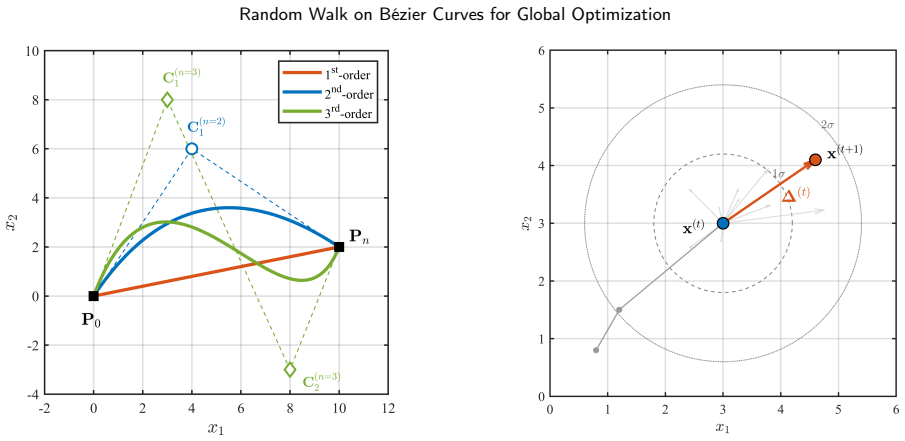
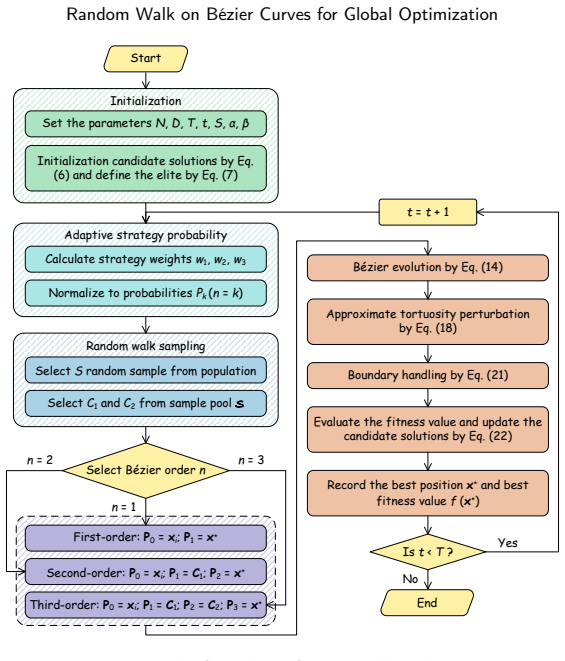
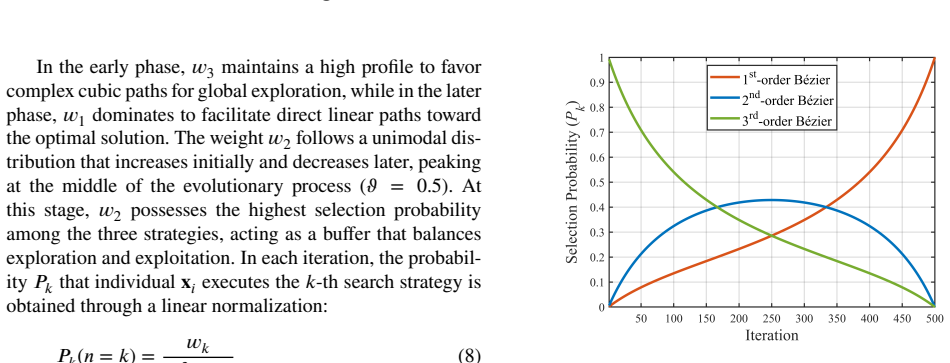
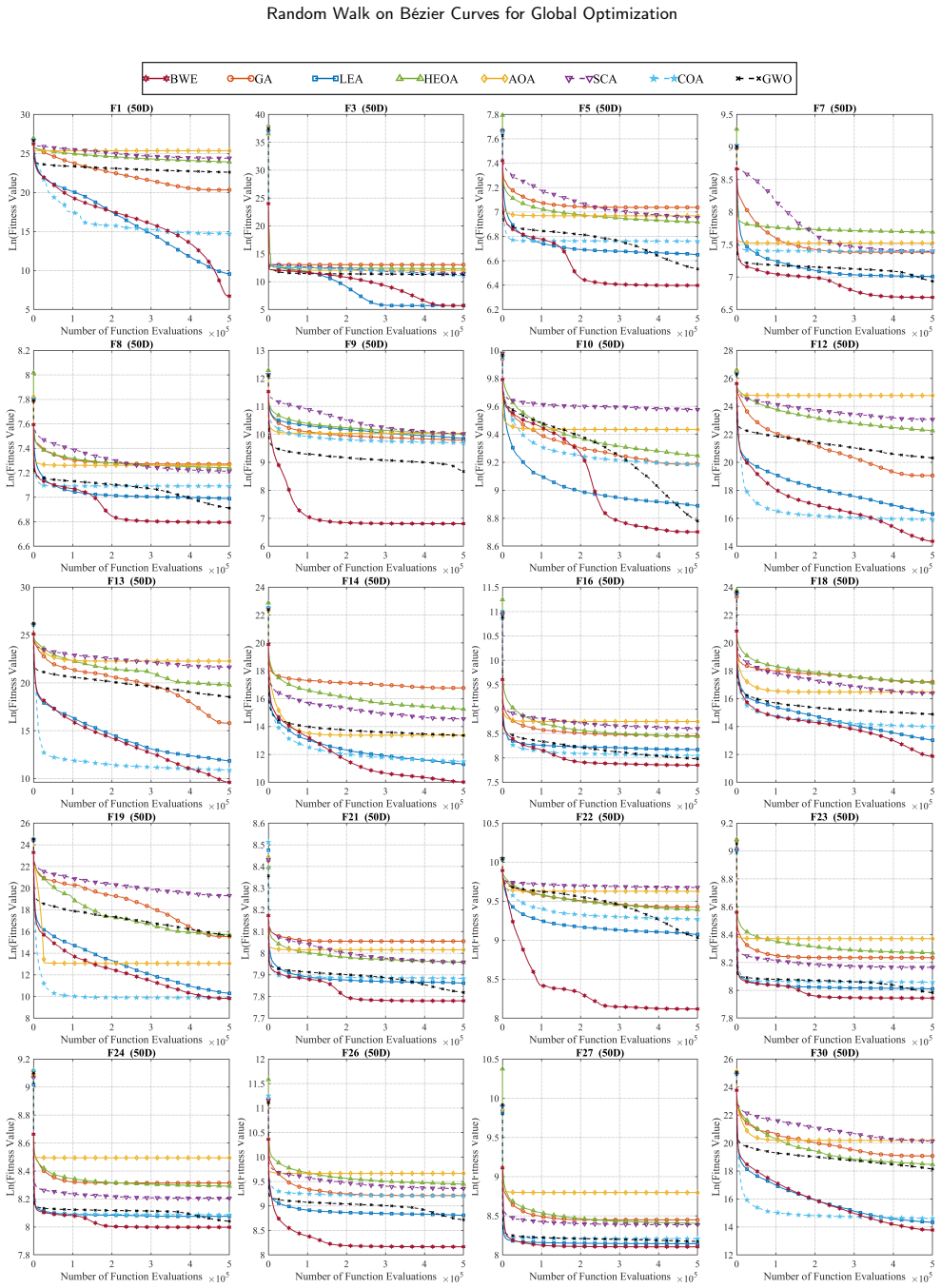
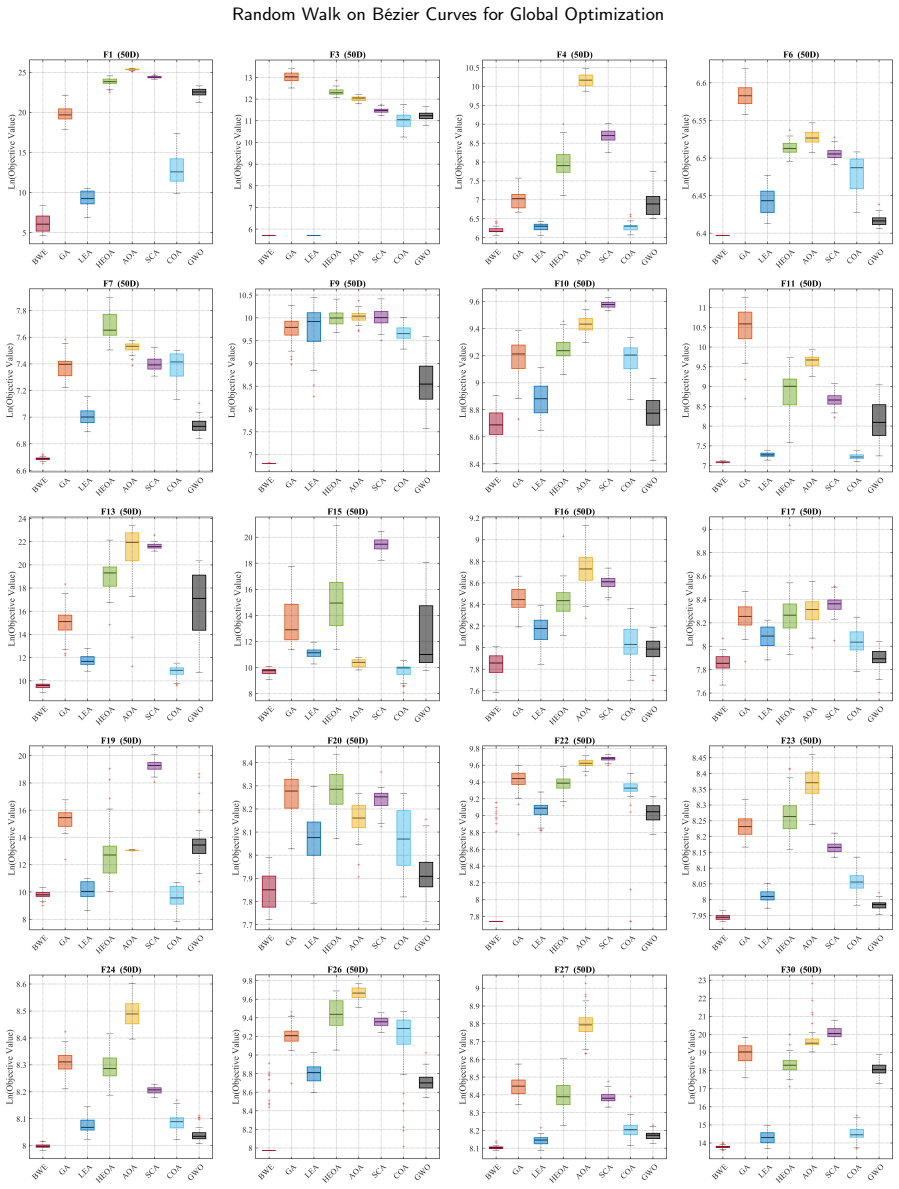
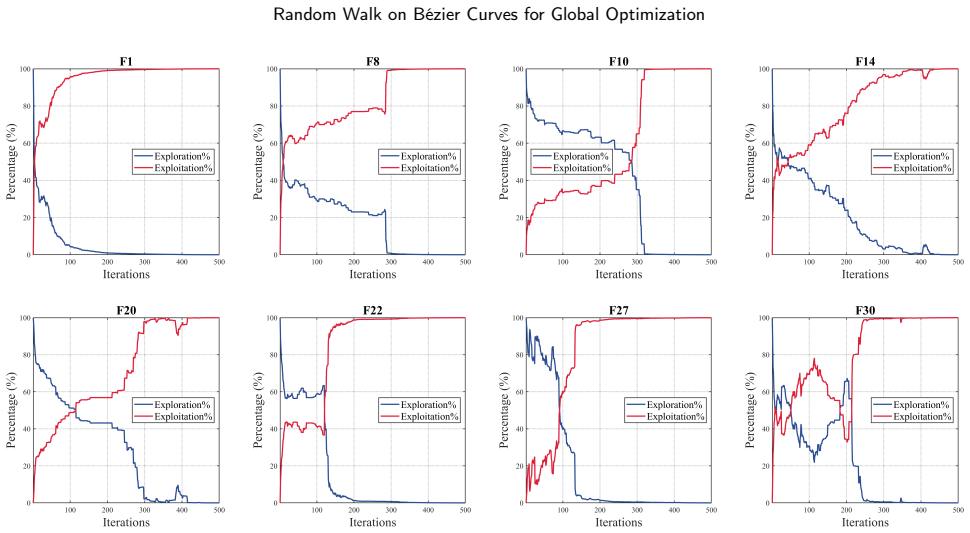
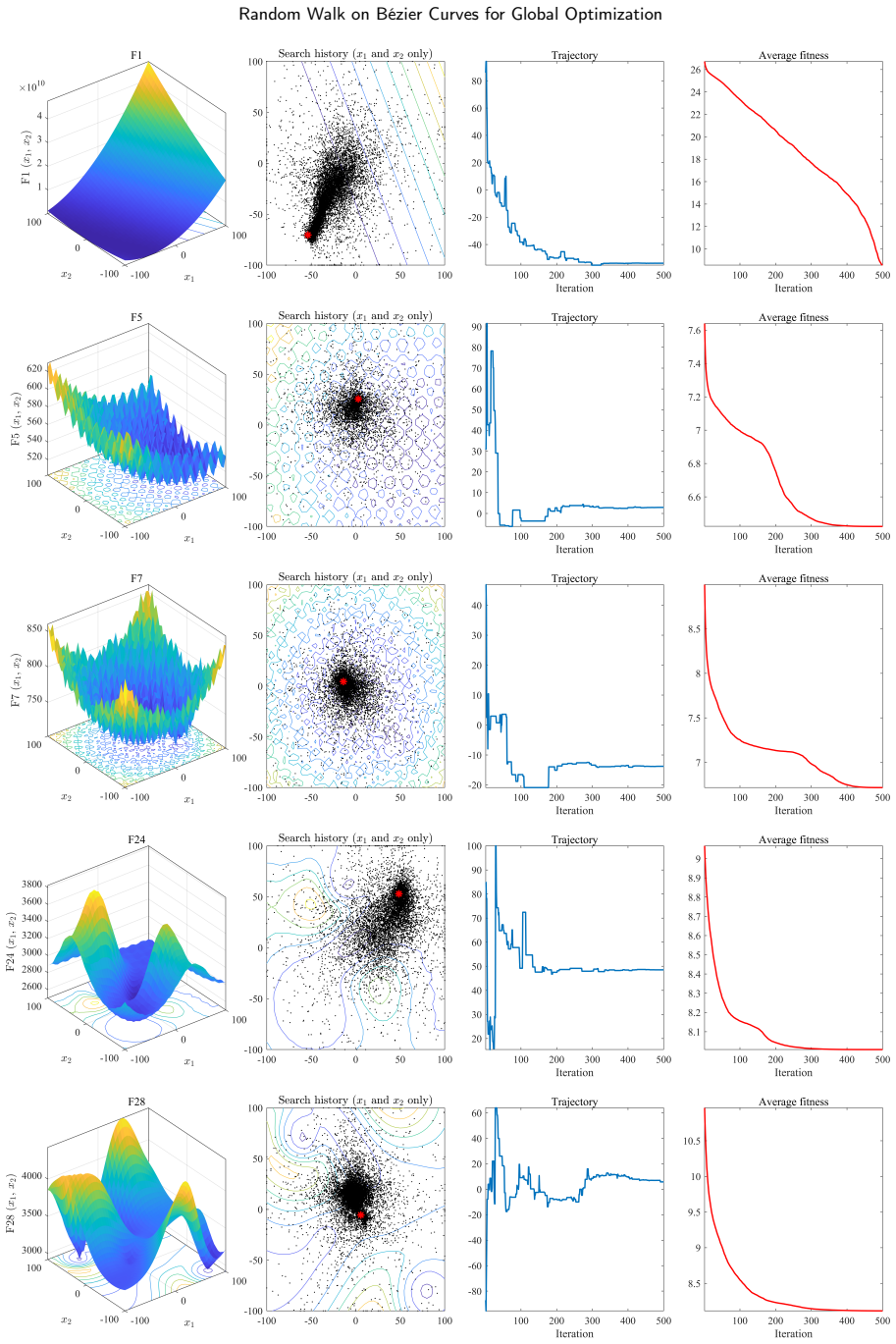
Bézier Walk Evolution (BWE) treats the decision space as a geometry in which search is performed by constructing random-walk trajectories on Bézier curves. Control points are drawn from the current population, and the curve order is lowered adaptively as evolution proceeds. Higher orders produce diverse, curved paths that promote global coverage; lower orders produce near-linear segments that support local convergence. This adaptive geometric construction replaces conventional nature-inspired operators while maintaining scalability across dimensions 10–100 on standard benchmark suites.
What carries the argument
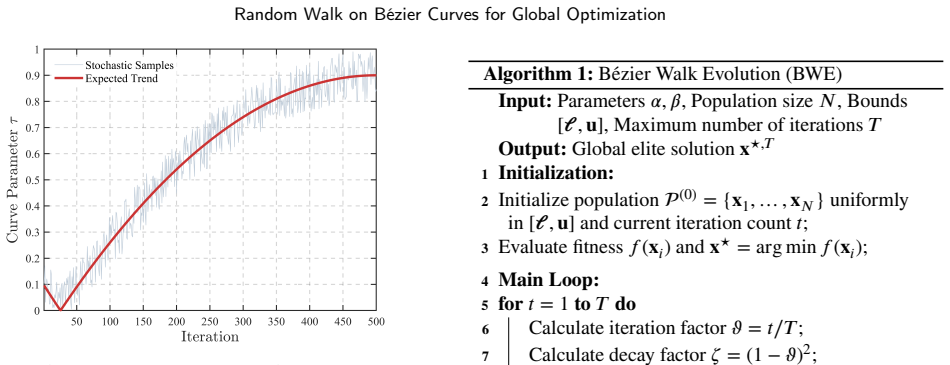
Adaptive Bézier curve order variation paired with a distance-aware random walk that generates topology-guided trajectories from population-derived control points.
If this is right
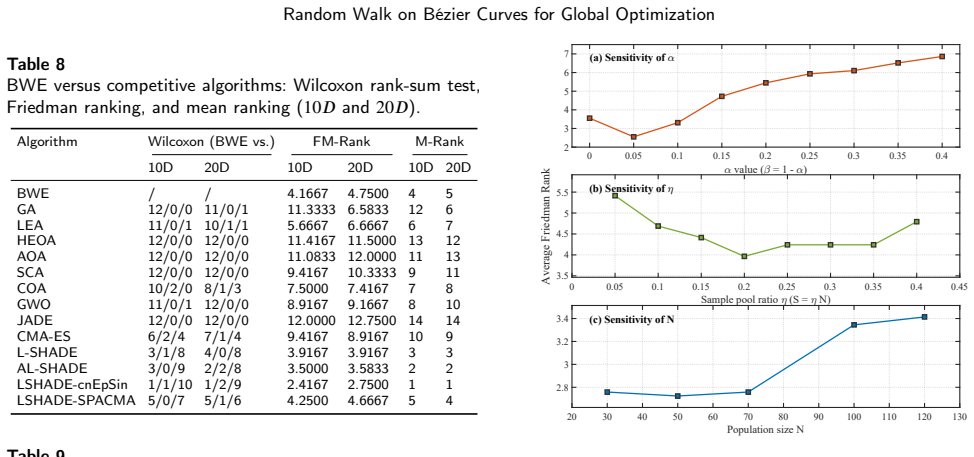
- BWE matches or exceeds the performance of L-SHADE and CMA-ES on the majority of the 41 CEC functions tested.
- Performance remains stable as dimension increases from 10 to 100.
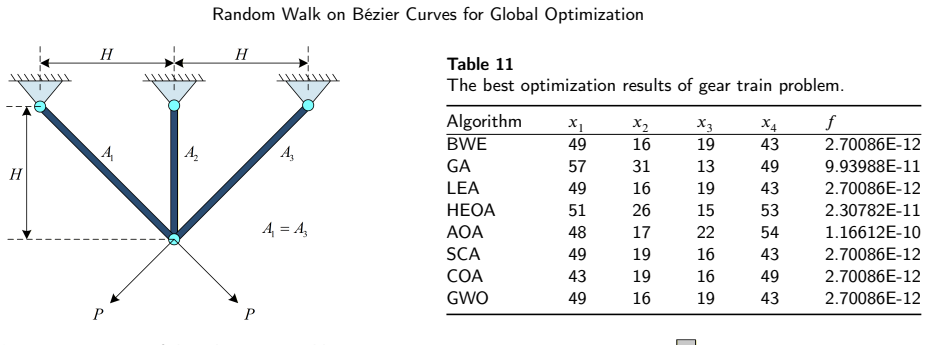
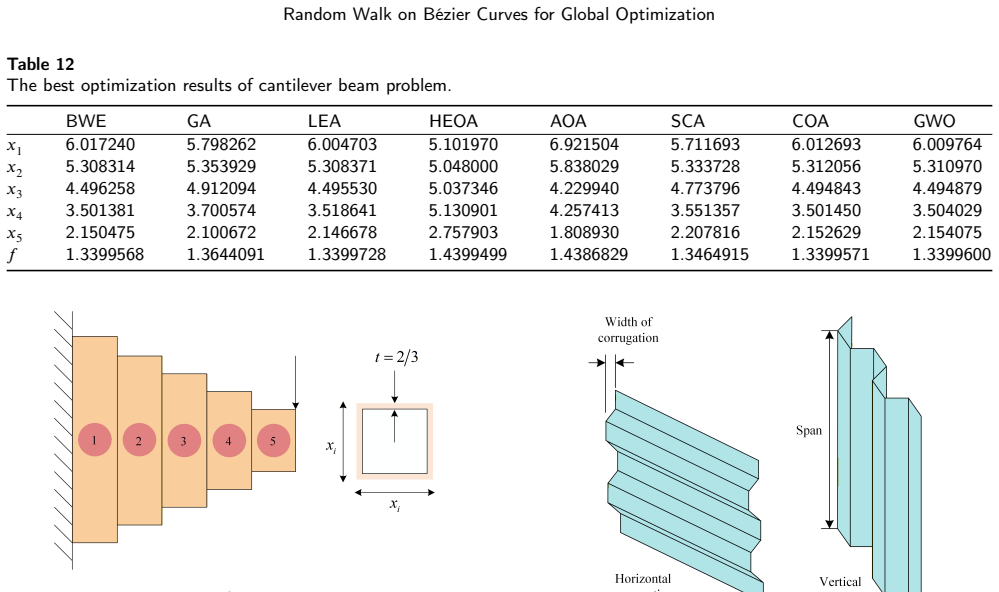
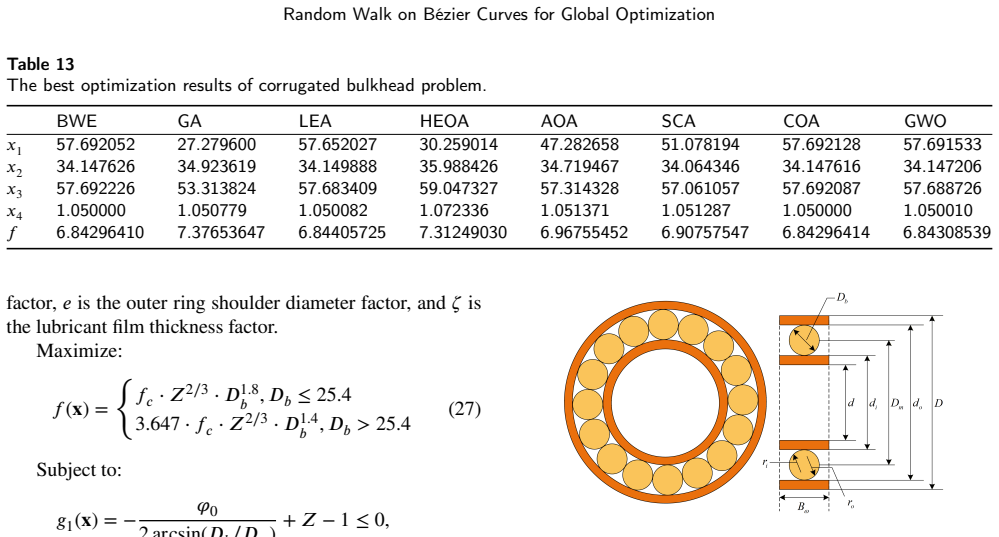
- The same framework solves five constrained engineering design problems without additional tuning.
- The method supplies an explicit geometric interpretation for the exploration-exploitation transition.
Where Pith is reading between the lines
- The geometric framing could be applied to other population-based methods that currently rely on mutation or crossover operators.
- Because the trajectories are defined by explicit curves, intermediate search points could be inspected for interpretability in applied settings.
- Testing on problems with expensive or noisy evaluations would reveal whether the curve-order schedule remains effective outside the CEC suites.
Load-bearing premise
That lowering the Bézier curve order at the right moments produces a reliable shift from global to local search without introducing bias or needing per-problem adjustments.
What would settle it
A collection of test functions on which BWE returns statistically worse final values or slower convergence than L-SHADE or CMA-ES across repeated runs at the same dimension and budget.
Figures

read the original abstract
Balancing exploration and exploitation remains a central challenge in metaheuristic optimization. To address this issue, this paper proposes B\'ezier Walk Evolution (BWE), a geometry-driven optimization framework that reformulates evolutionary search as adaptive trajectory construction in the decision space. BWE integrates B\'ezier curve modeling with a distance-aware random walk mechanism to generate topology-guided search trajectories. By adaptively varying the curve order during evolution, the proposed method enables a smooth transition from diversified global exploration to refined local exploitation. Higher-order B\'ezier curves leverage multiple population-derived control points to enhance search diversity, while lower-order curves generate near-linear trajectories to improve convergence efficiency. This adaptive geometric search mechanism provides an interpretable alternative to conventional nature-inspired designs. Extensive experiments on 41 benchmark functions from the CEC2017 and CEC2022 suites, spanning dimensions from 10 to 100, show that BWE achieves strong overall performance and favorable scalability compared with 7 classical and 6 state-of-the-art optimizers, including L-SHADE and CMA-ES. Additional evaluations on five constrained engineering design problems further demonstrate the practical applicability and robustness of BWE.
Editorial analysis
A structured set of objections, weighed in public.
Referee Report
Summary. The manuscript proposes Bézier Walk Evolution (BWE), a geometry-driven metaheuristic that reformulates evolutionary search as adaptive trajectory construction using Bézier curves in the decision space. By adaptively varying the curve order, it aims to balance exploration and exploitation, claiming strong performance on 41 CEC benchmark functions (dims 10-100) against 13 competitors including L-SHADE and CMA-ES, plus engineering problems.
Significance. Should the adaptive order mechanism prove to be explicitly defined, parameter-free, and generalizable, the approach offers a novel interpretable alternative to nature-inspired optimizers. The scale of the experimental evaluation on high-dimensional CEC suites is a positive aspect if the comparisons are fair and the implementation details are fully reproducible.
major comments (2)
- [§3 (Method description)] The adaptive variation of the Bézier curve order is presented as enabling a smooth transition from global to local search (higher-order curves for diversity via multiple control points, lower-order for near-linear convergence), but no concrete rule, distance metric, threshold, selection criterion, or pseudocode is supplied for determining the order at each step or generation. This mechanism is load-bearing for the claim of reliable, bias-free, problem-independent generality.
- [§4, Table 1] Table 1 and §4 (experimental results): the reported superiority and favorable scalability on 41 CEC2017/CEC2022 functions rest on the assumption that the order-adaptation rule introduces no hidden per-problem heuristics; without an explicit, verifiable rule, the rankings versus L-SHADE and CMA-ES cannot be attributed to the geometric reformulation rather than implicit tuning.
minor comments (2)
- [§3] Ensure that all algorithmic steps (including how control points are derived from the population and how the random walk is distance-aware) are accompanied by pseudocode or a clear numbered list to support reproducibility.
- [§4] Clarify the exact number of independent runs, statistical tests employed, and whether any parameters of the adaptation rule were set once for all benchmarks or adjusted per function.
Simulated Author's Rebuttal
We thank the referee for the constructive feedback highlighting the need for greater clarity on the adaptive order mechanism. We address each major comment below and will revise the manuscript to improve reproducibility and transparency.
read point-by-point responses
-
Referee: [§3 (Method description)] The adaptive variation of the Bézier curve order is presented as enabling a smooth transition from global to local search (higher-order curves for diversity via multiple control points, lower-order for near-linear convergence), but no concrete rule, distance metric, threshold, selection criterion, or pseudocode is supplied for determining the order at each step or generation. This mechanism is load-bearing for the claim of reliable, bias-free, problem-independent generality.
Authors: We acknowledge that §3 describes the conceptual role of adaptive order variation but does not supply an explicit rule, metric, threshold, or pseudocode. This omission limits verifiability. In the revised manuscript we will insert a new subsection (3.3) that defines the distance-aware adaptation rule: Euclidean distance between consecutive control points is computed each generation; if the normalized distance exceeds a fixed threshold of 0.3 the order is incremented (up to a maximum of 5), otherwise it is decremented (down to 2). The rule is deterministic, uses only population statistics already maintained by the algorithm, and contains no per-problem parameters. Pseudocode will be added as Algorithm 2. revision: yes
-
Referee: [§4, Table 1] Table 1 and §4 (experimental results): the reported superiority and favorable scalability on 41 CEC2017/CEC2022 functions rest on the assumption that the order-adaptation rule introduces no hidden per-problem heuristics; without an explicit, verifiable rule, the rankings versus L-SHADE and CMA-ES cannot be attributed to the geometric reformulation rather than implicit tuning.
Authors: We agree that the current presentation does not allow readers to confirm the absence of hidden heuristics. Once the explicit, parameter-free rule described above is added, the experimental results can be reproduced exactly and the performance differences can be attributed to the geometric formulation. In the revision we will also release the full source code with the rule implemented and rerun the CEC comparisons to confirm that the reported rankings remain unchanged. revision: yes
Circularity Check
No significant circularity; BWE is a constructed geometric framework with empirical validation
full rationale
The paper presents BWE as an explicitly constructed method that reformulates search via Bézier curves and adaptive order variation. No derivation chain is shown that reduces a claimed prediction or first-principles result to its own fitted inputs or self-citations. The adaptive mechanism is described at the conceptual level (higher-order for diversity, lower-order for convergence) without equations that equate outputs to inputs by construction. Performance results are benchmark comparisons, not derived quantities. The provided text contains no load-bearing self-citations, uniqueness theorems, or ansatzes smuggled via prior work. This is the normal case of a self-contained proposal.
Axiom & Free-Parameter Ledger
Reference graph
Works this paper leans on
-
[1]
ACM Computing Surveys (CSUR) , volume=
Towards metaheuristic scheduling techniques in cloud and fog: an extensive taxonomic review , author=. ACM Computing Surveys (CSUR) , volume=. 2022 , publisher=
2022
-
[2]
2010 , publisher=
Engineering optimization: an introduction with metaheuristic applications , author=. 2010 , publisher=
2010
-
[3]
2019 7th International Conference on Smart Computing & Communications (ICSCC) , pages=
A review on metaheuristic algorithms: recent trends, benchmarking and applications , author=. 2019 7th International Conference on Smart Computing & Communications (ICSCC) , pages=. 2019 , organization=
2019
-
[4]
Fourth International Conference on Applied Mathematics, Modelling, and Intelligent Computing (CAMMIC 2024) , volume=
Kernel extreme learning machine optimized by arithmetic optimization algorithm , author=. Fourth International Conference on Applied Mathematics, Modelling, and Intelligent Computing (CAMMIC 2024) , volume=. 2024 , organization=
2024
-
[5]
IEEE transactions on evolutionary computation , volume=
The exploration/exploitation tradeoff in dynamic cellular genetic algorithms , author=. IEEE transactions on evolutionary computation , volume=. 2005 , publisher=
2005
-
[6]
Applied Mathematical Modelling , volume=
Logistic-Gauss Circle optimizer: Theory and applications , author=. Applied Mathematical Modelling , volume=. 2025 , publisher=
2025
-
[7]
IEEE transactions on evolutionary computation , volume=
No free lunch theorems for optimization , author=. IEEE transactions on evolutionary computation , volume=. 2002 , publisher=
2002
-
[8]
Real-time smooth trajectory generation for nonholonomic mobile robots using B
Simba, Kenneth Renny and Uchiyama, Naoki and Sano, Shigenori , journal=. Real-time smooth trajectory generation for nonholonomic mobile robots using B. 2016 , publisher=
2016
-
[9]
2012 , publisher=
The NURBS book , author=. 2012 , publisher=
2012
-
[10]
Combinatorics, Paul erdos is eighty , volume=
Random walks on graphs , author=. Combinatorics, Paul erdos is eighty , volume=
-
[11]
science , volume=
Optimization by simulated annealing , author=. science , volume=. 1983 , publisher=
1983
-
[12]
Neural Computing and Applications , volume=
The non-monopolize search (NO): A novel single-based local search optimization algorithm , author=. Neural Computing and Applications , volume=. 2024 , publisher=
2024
-
[13]
Handbook of combinatorial optimization , pages=
Tabu search , author=. Handbook of combinatorial optimization , pages=. 2013 , publisher=
2013
-
[14]
Handbook of metaheuristics , pages=
Large neighborhood search , author=. Handbook of metaheuristics , pages=. 2018 , publisher=
2018
-
[15]
1975 , publisher=
Adaptation in natural and artificial systems: an introductory analysis with applications to biology, control, and artificial intelligence , author=. 1975 , publisher=
1975
-
[16]
Chaos, Solitons & Fractals , volume=
Chaotic evolution optimization: A novel metaheuristic algorithm inspired by chaotic dynamics , author=. Chaos, Solitons & Fractals , volume=. 2025 , publisher=
2025
-
[17]
Natural computing , volume=
Evolution strategies--a comprehensive introduction , author=. Natural computing , volume=. 2002 , publisher=
2002
-
[18]
IEEE transactions on evolutionary computation , volume=
Differential evolution: A survey of the state-of-the-art , author=. IEEE transactions on evolutionary computation , volume=. 2010 , publisher=
2010
-
[19]
Expert Systems with Applications , volume=
Human evolutionary optimization algorithm , author=. Expert Systems with Applications , volume=. 2024 , publisher=
2024
-
[20]
The Journal of Supercomputing , volume=
Love evolution algorithm: A stimulus--value--role theory-inspired evolutionary algorithm for global optimization , author=. The Journal of Supercomputing , volume=. 2024 , publisher=
2024
-
[21]
Proceedings of ICNN'95-international conference on neural networks , volume=
Particle swarm optimization , author=. Proceedings of ICNN'95-international conference on neural networks , volume=. 1995 , organization=
1995
-
[22]
Cluster Computing , volume=
Escape after love: Philoponella prominens optimizer and its application to 3D path planning , author=. Cluster Computing , volume=. 2025 , publisher=
2025
-
[23]
IEEE computational intelligence magazine , volume=
Ant colony optimization , author=. IEEE computational intelligence magazine , volume=. 2007 , publisher=
2007
-
[24]
Advances in engineering software , volume=
Grey wolf optimizer , author=. Advances in engineering software , volume=. 2014 , publisher=
2014
-
[25]
Artificial Intelligence Review , volume=
Crayfish optimization algorithm , author=. Artificial Intelligence Review , volume=. 2023 , publisher=
2023
-
[26]
Applied Mathematical Modelling , pages=
Traffic jam optimizer: A novel swarm-based metaheuristic algorithm for solving global optimization problems , author=. Applied Mathematical Modelling , pages=. 2025 , publisher=
2025
-
[27]
Information sciences , volume=
GSA: a gravitational search algorithm , author=. Information sciences , volume=. 2009 , publisher=
2009
-
[28]
Hussein, Nazar K and Qaraad, Mohammed and El Najjar, Abdelwahab M and Farag, MA and Elhosseini, Mostafa A and Mirjalili, Seyedali and Guinovart, David , journal=. Schr. 2025 , publisher=
2025
-
[29]
Advances in engineering software , volume=
A new optimization method: big bang--big crunch , author=. Advances in engineering software , volume=. 2006 , publisher=
2006
-
[30]
Information sciences , volume=
Black hole: A new heuristic optimization approach for data clustering , author=. Information sciences , volume=. 2013 , publisher=
2013
-
[31]
IEEE transactions on evolutionary computation , volume=
Chemical-reaction-inspired metaheuristic for optimization , author=. IEEE transactions on evolutionary computation , volume=. 2009 , publisher=
2009
-
[32]
Applied Mathematical Modelling , volume=
Atomic orbital search: A novel metaheuristic algorithm , author=. Applied Mathematical Modelling , volume=. 2021 , publisher=
2021
-
[33]
Applied intelligence , volume=
Archimedes optimization algorithm: a new metaheuristic algorithm for solving optimization problems , author=. Applied intelligence , volume=. 2021 , publisher=
2021
-
[34]
Neurocomputing , pages=
LEE: A Physics-Inspired Optimizer based on LangEvin Equation , author=. Neurocomputing , pages=. 2025 , publisher=
2025
-
[35]
Knowledge-based systems , volume=
SCA: a sine cosine algorithm for solving optimization problems , author=. Knowledge-based systems , volume=. 2016 , publisher=
2016
-
[36]
Expert Systems with Applications , volume=
RUN beyond the metaphor: An efficient optimization algorithm based on Runge Kutta method , author=. Expert Systems with Applications , volume=. 2021 , publisher=
2021
-
[37]
Computer methods in applied mechanics and engineering , volume=
The arithmetic optimization algorithm , author=. Computer methods in applied mechanics and engineering , volume=. 2021 , publisher=
2021
-
[38]
, author=
Golden sine algorithm: a novel math-inspired algorithm. , author=. Advances in Electrical & Computer Engineering , volume=
-
[39]
Expert Systems with Applications , volume=
PID-based search algorithm: A novel metaheuristic algorithm based on PID algorithm , author=. Expert Systems with Applications , volume=. 2023 , publisher=
2023
-
[40]
Swarm and Evolutionary Computation , volume=
Intelligent cross-entropy optimizer: A novel machine learning-based meta-heuristic for global optimization , author=. Swarm and Evolutionary Computation , volume=. 2024 , publisher=
2024
-
[41]
Translated by AR Forrest , year=
Numerical control-mathematics and applications , author=. Translated by AR Forrest , year=
-
[42]
Problem definitions and evaluation criteria for the CEC 2017 competition on constrained real-parameter optimization , author=. National University of Defense Technology, Changsha, Hunan, PR China and Kyungpook National University, Daegu, South Korea and Nanyang Technological University, Singapore, Technical Report , volume=. 2017 , publisher=
2017
-
[43]
2022 IEEE congress on evolutionary computation (CEC) , pages=
A version of NL-SHADE-RSP algorithm with midpoint for CEC 2022 single objective bound constrained problems , author=. 2022 IEEE congress on evolutionary computation (CEC) , pages=. 2022 , organization=
2022
-
[44]
Evolutionary computation , volume=
Reducing the time complexity of the derandomized evolution strategy with covariance matrix adaptation (CMA-ES) , author=. Evolutionary computation , volume=. 2003 , publisher=
2003
-
[45]
IEEE Transactions on evolutionary computation , volume=
JADE: adaptive differential evolution with optional external archive , author=. IEEE Transactions on evolutionary computation , volume=. 2009 , publisher=
2009
-
[46]
2014 IEEE congress on evolutionary computation (CEC) , pages=
Improving the search performance of SHADE using linear population size reduction , author=. 2014 IEEE congress on evolutionary computation (CEC) , pages=. 2014 , organization=
2014
-
[47]
Information Sciences , volume=
A novel adaptive L-SHADE algorithm and its application in UAV swarm resource configuration problem , author=. Information Sciences , volume=. 2022 , publisher=
2022
-
[48]
2016 IEEE congress on evolutionary computation (CEC) , pages=
An ensemble sinusoidal parameter adaptation incorporated with L-SHADE for solving CEC2014 benchmark problems , author=. 2016 IEEE congress on evolutionary computation (CEC) , pages=. 2016 , organization=
2016
-
[49]
2017 IEEE Congress on evolutionary computation (CEC) , pages=
LSHADE with semi-parameter adaptation hybrid with CMA-ES for solving CEC 2017 benchmark problems , author=. 2017 IEEE Congress on evolutionary computation (CEC) , pages=. 2017 , organization=
2017
-
[50]
Cluster Computing , volume=
Freedom from inspiration! Achieving efficient metaheuristic optimization with delta plus , author=. Cluster Computing , volume=. 2025 , publisher=
2025
-
[51]
Artificial Intelligence Review , volume=
Escape: an optimization method based on crowd evacuation behaviors , author=. Artificial Intelligence Review , volume=. 2024 , publisher=
2024
-
[52]
Computational Intelligence Laboratory, Zhengzhou University, Zhengzhou China and Technical Report, Nanyang Technological University, Singapore , volume=
Problem definitions and evaluation criteria for the CEC 2014 special session and competition on single objective real-parameter numerical optimization , author=. Computational Intelligence Laboratory, Zhengzhou University, Zhengzhou China and Technical Report, Nanyang Technological University, Singapore , volume=
2014
-
[53]
Results in Engineering , pages=
Multi-objective red-billed blue magpie optimizer: A novel algorithm for multi-objective UAV path planning , author=. Results in Engineering , pages=. 2025 , publisher=
2025
-
[54]
Journal of Advanced Research , year=
Beaver behavior optimizer: A novel metaheuristic algorithm for solar PV parameter identification and engineering problems , author=. Journal of Advanced Research , year=
-
[55]
Expert Systems with Applications , volume=
Multi-population dynamic grey wolf optimizer based on dimension learning and Laplace Mutation for global optimization , author=. Expert Systems with Applications , volume=. 2025 , publisher=
2025
-
[56]
Advanced Engineering Informatics , volume=
An effective Bezier curve-based optimization (BCO) for large-scale numerical problems and 3D unmanned aerial vehicle path planning with efficient multiple threats evasion , author=. Advanced Engineering Informatics , volume=. 2026 , publisher=
2026
-
[57]
Journal of Computational Science , volume=
Bezier curve based path planning in a dynamic field using modified genetic algorithm , author=. Journal of Computational Science , volume=. 2018 , publisher=
2018
-
[58]
Intelligent B
Tharwat, Alaa and Elhoseny, Mohamed and Hassanien, Aboul Ella and Gabel, Thomas and Kumar, Arun , journal=. Intelligent B. 2019 , publisher=
2019
discussion (0)
Sign in with ORCID, Apple, or X to comment. Anyone can read and Pith papers without signing in.