REVIEW 3 major objections 4 minor 94 references
Storage, Scrambling, and Loss of Information in the Quantum Reservoir Computing Paradigm
T0 review · 3 major / 4 minor · reviewed 2026-08-11 · deepseek-v4-flash
Pith's one-line read Quantum reservoir protocols reduce, via their process tensor, to a classical-quantum state whose Holevo quantities diagnose storage, fading memory, and scrambling; two extracted rates, γ and λ, empirically track task performance.
desk verdict A solid, carefully qualified contribution that gives QRC researchers a process-tensor-based information-theoretic toolkit; the gamma fit is fragile but the authors already scope it as a finite-size diagnostic. read the letter →
The pith
A machine-rendered reading of the paper's core claim, the machinery that carries it, and where it could break.
The reading
What carries the argument
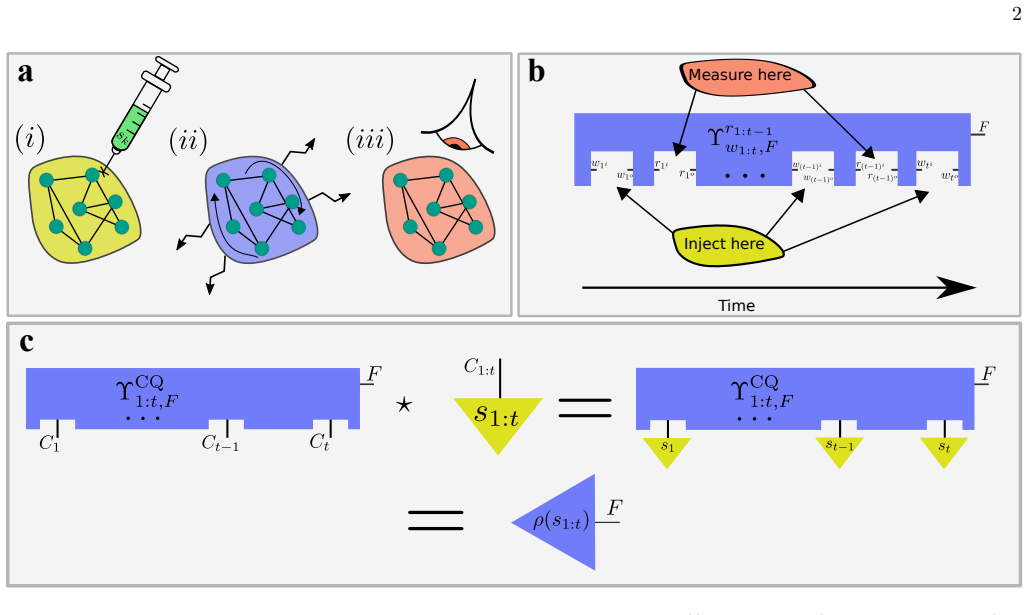
The carrying object is the classical-quantum state $\Upsilon^{\mathrm{CQ}}_{1:t,F} = \int_{\Omega^t} \rho(s_{1:t}) \otimes |s_{1:t}\rangle\langle s_{1:t}| \, ds_{1:t}$, which bundles the reservoir's response to every possible input history into one bipartite state; its von Neumann entropies give Holevo quantities, most directly $\chi_t = S(\int \rho(s_{1:t})\, ds_{1:t}) - \int S(\rho(s_{1:t}))\, ds_{1:t}$. Three derived quantities do the diagnostic work: the full Holevo quantity $\chi_t$ (information saturation), the conditional Holevo quantity $\chi_t(r) = \int \chi_{t|s_R}\, ds_R$ (fading memory, measured as deviation from a product structure between historical inputs and the final state), and the subsystem-averaged quantity $\chi_t(r,f)$ (information accessible to a probe of $f$ qubits). The exponential behaviours $C_f \sim \exp(\gamma f)$ and $X(r) \sim \exp(-\lambda r)$ are interpreted through the Bogoliubov–Kubo–Mori (BKM) metric expansion of the Holevo quantity, which connects the growth of $C_f$ to operator spreading in the all-to-all model and connects the decay of $X(r)$ to the slowest decaying modes of the average map $\Lambda = \mathcal{E} \circ \mathcal{A}$. The test substrate is the disordered all-to-all transverse-field Ising Hamiltonian with erase-and-write injections and weak $Z$-basis measurements, sweeping across integrable, chaotic, and many-body-localized regimes.
What would settle it
Recompute the scrambling diagnostic without assuming the exponential form — for instance from the ratio of the 6-site to the 2-site capacity, or from the number of contributing Pauli terms in the BKM expansion — and check whether the $(\gamma,\lambda)$-to-IPC structure of Fig. 7 survives; if the ordering of regimes changes materially, the exponential assumption is doing the work. A complementary check targets the interpretation: compute the average operator size for the same Hamiltonian samples and verify that $\gamma$ tracks it across the integrable-to-chaotic-to-localized sweep, which would settle whether $\gamma$ genuinely measures scrambling.
Extended reading notes
Core claim
On the paper's own terms, the central result is a reduction: for deterministic classical inputs and single-time expectation values passed to a linear readout, the QRC protocol is exactly represented by the classical-quantum state $\Upsilon^{\mathrm{CQ}}_{1:t,F} = \int_{\Omega^t} \rho(s_{1:t}) \otimes |s_{1:t}\rangle\langle s_{1:t}| \, ds_{1:t}$, obtained by contracting the process tensor's intervention slots with the classical encoding map and the average measurement channel. All mutual informations between subsets of the input history and physical subsystems of the reservoir are then Holevo quantities of this state: the full quantity $\chi_t$ tracks saturation of stored information, the conditional quantity $\chi_t(r)$ tracks fading memory of historical inputs, and the subsystem-averaged quantity $\chi_t(r,f)$ tracks how locally accessible the injected information is. For the disordered all-to-all transverse-field Ising substrate, subsystem memory capacities grow exponentially with subsystem size outside the localized regime, $C_f \sim \exp(\gamma f)$, defining an effective scrambling parameter $\gamma$; conditional Holevo quantities decay exponentially in the recent-input window, $X(r) \sim \exp(-\lambda r)$, defining a memory-decay rate $\lambda$ whose origin is purely non-unitary, because unitary evolution can only redistribute Holevo information, never reduce it. Finally, $\gamma$ and $\lambda$ show a regime-dependent empirical relationship with the information processing capacity: total IPC rises with both to a plateau, linear tasks favour weak scrambling and slow decay, and higher-degree nonlinear tasks favour strong scrambling and fast decay — the memory-nonlinearity trade-off expressed as a region in the $(\gamma, \lambda)$ plane, with moderate measurement strength near $g \approx 0.3$ raising IPC by increasing $\lambda$ while leaving $\gamma$ nearly unchanged.
Load-bearing premise
Everything load-bearing rests on the assumption that the exponential fits — subsystem memory capacity growing as $C_f \sim \exp(\gamma f)$ across only six subsystem sizes, and historical information decaying as $X(r) \sim \exp(-\lambda r)$ over a finite window — capture genuine physics of information spreading and loss rather than convenient curves through short fit intervals; the paper itself records that fit quality drops to about $R^2 = 0.88$ in the localized regime and validates the supporting BKM approximation only on selected samples.
Editorial extensions
If this is right
- Fading memory of the full reservoir has a strictly non-unitary origin: because the relevant Holevo quantities are invariant under unitary conjugation, only dissipative processes — here the erase-and-write injection and measurement backaction — can erase information about past inputs; scrambling only relocates it.
- The two diagnostics form a design map: linear memory tasks prefer weak scrambling and slow decay, while higher-degree nonlinear tasks prefer strong scrambling and fast decay, so tuning a substrate is a matter of steering the point in the (γ, λ) plane rather than searching task by task.
- Dissipation can be engineered as a resource: raising the measurement strength to g ≈ 0.3 increases the memory-decay rate without suppressing scrambling, improving total IPC, whereas stronger measurements depress all subsystem capacities and break the exponential subsystem-size scaling.
- Because the CQ-state construction only assumes deterministic inject-and-read cycles, the three diagnostics (storage saturation, fading memory, local accessibility) transfer to other substrates, injection maps, and POVMs without re-derivation; the paper also sketches how coherent (off-diagonal) encodings and multi-time readouts would extend the framework beyond single-time expectation values.
Reading between the lines
- A decisive test the authors did not run: compare γ against a direct scrambling witness (an out-of-time-order correlator or the average operator size) on the identical Hamiltonian samples; if the correlation is absent, γ is a six-site fit statistic rather than a scrambling measure, and the γ–IPC link would need reinterpretation.
- The γ–λ–IPC structure suggests a general design rule beyond the Ising model: any dissipation channel that raises λ without lowering γ — dephasing in a rotated basis, periodic reset of ancilla qubits, or spectral filtering of the reservoir — should improve nonlinear task performance, a prediction testable in spin-boson or continuous-variable reservoirs.
- At larger system sizes with fixed injection interval the exponential growth of subsystem memory capacity must break down, so the practical lesson is shifted: the useful operating regime of a QRC depends on system size, and fair cross-substrate comparisons require scaling the injection interval with N — a rescaling the paper leaves for future work.
- With finite-shot readout, strong scrambling concentrates local expectation values, so the optimal (γ, λ) operating point under shot noise would likely move toward weaker scrambling and slower decay than the noiseless optimum; the framework combined with a shot-noise model could be used to predict that shift.
Editorial analysis
A structured set of objections, weighed in public.
Referee Report
Summary. The paper develops an information-theoretic framework for quantum reservoir computing (QRC) by constructing a classical-quantum (CQ) state from the process tensor of the standard inject-evolve-measure protocol, under the assumptions of deterministic classical injections and readout through single-time expectation values. It shows that mutual informations between subsets of past inputs and (subsystems of) the reservoir state are Holevo quantities, and uses these to define two diagnostics: an effective scrambling parameter gamma, extracted from the exponential growth of subsystem capacity C_f ~ exp(gamma f) for f=1,...,6, and a memory-decay rate lambda, extracted from the exponential decay of the conditional Holevo information X(r,N) ~ exp(-lambda r) with history offset r. The diagnostics are computed for a six-qubit disordered all-to-all transverse-field Ising reservoir across Hamiltonian parameter sweeps and measurement strengths, and compared with the information processing capacity (IPC). The main numerical finding is an empirical relationship: linear tasks prefer weak scrambling and slow memory decay, while higher-order nonlinear tasks favour stronger scrambling and faster decay, with a measurement-strength 'sweet spot' around g=0.3. The paper also acknowledges limitations, including the finite-size nature of gamma and the breakdown of exponential fits in the localized and strongly scrambling regimes.
Significance. If the diagnostics are robust, the framework is valuable: it provides a parameter-free, information-theoretic language for storage, scrambling, and memory loss in QRC, connects QRC to the broader process-tensor literature, and offers design heuristics (e.g., tuning dissipation to improve nonlinear tasks without destroying memory). The CQ-state derivation in Appendix A is explicit and correct under the stated assumptions, and no fitted parameters enter the definition of the Holevo quantities themselves. The comparison of different dynamical regimes and the identification of a measurement-strength sweet spot are interesting and potentially actionable. However, the central quantitative link to performance rests on exponential fits whose stability is not established with confidence intervals or alternative-model comparisons, so the design-principle conclusions should be regarded as preliminary until the statistical robustness is addressed.
major comments (3)
- [§IV.B.1, Eq. (18)] The scrambling parameter gamma is extracted from an exponential fit to C_f over only f=1,...,6 (six data points), with R^2 values dropping to about 0.88 in the localized regime and no confidence intervals reported; because gamma is used as the x-axis in Fig. 7, any instability of this fit propagates directly into the central claim of an empirical scrambling-performance relation. Please provide bootstrap confidence intervals for gamma, compare the exponential model against plausible alternatives (e.g., power-law or saturating fits), and confirm that the qualitative structure of Fig. 7 persists when gamma is replaced by a more direct measure such as the ratio C_6/C_1.
- [Appendix B, Eq. (B6)] The BKM expansion in Eq. (B6) demonstrates that the number of Pauli terms in the approximation grows exponentially with subsystem size by Hilbert-space dimension, but it does not establish exponential growth of C_f under the reservoir dynamics; the passage from operator spreading to exponential C_f is an inference, not a derivation. As the fit in Eq. (18) is load-bearing, the manuscript should either derive the exponential scaling from the structure of the all-to-all model or provide systematic numerical evidence, across the full parameter range rather than only the selected samples in Fig. A3, that exponential growth is significantly better than linear or saturating growth over f=1,...,6.
- [§IV.B.2, Eq. (19)] The memory-decay rate lambda is obtained from exponential fits of X(r,N) over r=1,...,25, and the paper's own Fig. 6 and Appendix B.3 show that the decay becomes multi-exponential or non-exponential in the strongly scrambling regime (see the decomposition in Eq. (B7) and the competing eigenmodes in Eq. (B12)). Since lambda is the y-axis of Fig. 7, the qualitative IPC-lambda relationship should be checked for sensitivity to the fitting range and to the choice of full-system versus subsystem decay rates; at present the reported lambda values in those regimes are effective numbers whose uncertainty is not quantified.
minor comments (4)
- [§IV.B] The notation X(r,f) is used for the stationary values of chi_t(r,f) but is never defined formally; please add an explicit definition, e.g., X(r,f) = lim_{t->infinity} chi_t(r,f), evaluated in practice at t=50.
- [§IV.C, Fig. 7] The relationship in Fig. 7 is an in-sample correlation: gamma, lambda, and IPC are all computed from the same Hamiltonian realizations and the same input statistics. The paper should state explicitly that no out-of-sample predictive claim is intended, or perform a train/test split over Hamiltonian parameters to test predictive value.
- [§IV.C, Fig. 7] The encircled high-performance regions are defined by a coarse-graining procedure with an arbitrary 65% threshold (Appendix C.2); please state in the main text that these regions are heuristic guides rather than statistically validated clusters, and consider a sensitivity analysis for the threshold.
- [§III.A, after Eq. (7)] The sentence 'In order to link the decay of the above conditional Holevo quantities on works that use the trace distance in studying the fading memory/echo-state requirement ... a Pinsker-type inequality may be used' is grammatically incomplete and should be rewritten for clarity.
Circularity Check
No significant circularity: the CQ-state/Holevo construction is self-contained, and the gamma/lambda diagnostics are explicitly empirical fits, not predictions.
full rationale
The central mathematical construction is not circular: Eq. (3) defines the CQ state from the process tensor under deterministic classical injections and single-time readout; Eq. (5) identifies the Holevo quantity with the QMI of that state by the standard definition; and Eqs. (6)-(12) are conditional/subsystem restrictions of the same object. No fitted parameter enters the definition of the CQ state or the Holevo quantities. The scrambling parameter gamma (Eq. 18) and memory decay lambda (Eq. 19) are extracted from the same numerical Holevo data later compared with IPC, but the paper presents them as diagnostics in an empirical comparison ('extract two diagnostics ... and compare these to QRC performance'), not as independent predictions; comparing two computed functionals of the same Hamiltonian is an in-sample correlation, not a circular derivation. The BKM approximation in Appendix B is explicitly hedged ('this does not automatically imply that C_f will grow exponentially'), so the exponential ansatz is not smuggled in as a self-fulfilling assumption; the fits are presented as phenomenological, with R^2 reported and the six-point limitation acknowledged. The abundant self-citations are to prior QRC results (e.g., measurement model [8], phase-diagram dependence [24], exponential memory decay [37]) and serve as supporting context rather than load-bearing premises: the derivation of the CQ state and Holevo quantities from process-tensor formalism is standard and is carried out in Appendix A from first principles. No uniqueness theorem or prior result by the authors is invoked to force the choice of gamma or lambda; the limitation statements in Section V (6-site system, finite-size diagnostic, 'initial estimate') are correctly labeled. The fragility of the six-point exponential fit raised by the skeptic is a statistical robustness concern, not a circularity: failure of that fit would weaken the empirical link but would not make the derivation self-referential.
Assumptions & free parameters
free parameters (8)
- gamma (scrambling parameter) =
ranges from ~0.4 to ~1.0 depending on h and W
- lambda (memory decay rate) =
ranges from ~0.1 to ~2.0 across parameters and measurement strength
- Delta t (inter-injection time) =
10
- N (number of qubits) =
6
- Monte Carlo samples =
10000
- Washout steps =
1000
- IPC cutoff epsilon =
0.02
- Hamiltonian realization count =
30
assumptions (6)
- domain assumption The QRC protocol is accurately described by the process tensor formalism with deterministic classical injections and single-time expectation values passed to the readout layer.
- domain assumption Holevo quantities are computed for uniform independent inputs drawn from [0,1].
- domain assumption The BKM (Bogoliubov-Kubo-Mori) metric approximation to the Holevo quantity is accurate for the studied regimes.
- domain assumption The all-to-all transverse-field Ising model is a representative QRC substrate whose dynamical phases (integrable, chaotic, localized) are characterized by level-spacing statistics.
- domain assumption Quantum states after washout are independent of the initial state (echo state property).
- domain assumption Measurement statistics are gathered without shot noise when evaluating IPC.
Cite this review
Pith. "Pith review of Storage, Scrambling, and Loss of Information in the Quantum Reservoir Computing Paradigm." pith.science (2026). https://pith.science/paper/F4ISTY64
@misc{pith2026260807677,
  author       = {Pith},
  title        = {Pith review of: Storage, Scrambling, and Loss of Information in the Quantum Reservoir Computing Paradigm},
  year         = {2026},
  howpublished = {\url{https://pith.science/paper/F4ISTY64}},
  note         = {Machine review of arXiv:2608.07677}
}
read the original abstract
The suitability of a quantum reservoir computing (QRC) platform for a given time-series processing task is closely tied to the dynamical properties of its computational substrate and design. Information is injected into, processed by, and read from this substrate, and finally passed to a linear readout layer which is trained to perform a specific task. In this work we introduce a classical-quantum state derived from the process tensor representing the dynamical part of this process for typical QRC protocols found in the literature. Using this object, mutual informations between physical subsystems and subsets of past inputs can be written as Holevo quantities, which we then use to numerically investigate information saturation in the substrate, fading memory of past inputs, and the local accessibility of injected information for a commonly used QRC platform. We then extract two diagnostics that characterise the nonlocal scrambling of information within, and loss of information from the substrate, and compare these to QRC performance across Hamiltonian parameters and measurement strengths. Finally, we comment on future directions that the framework introduced here opens up for the study and extension of the QRC program.
Figures


Figures from the paper (5 more)


Reference graph
Works this paper leans on
-
[1]
At stepk, inject data points k into the system
-
[2]
Allow the reservoir to evolve with its native dynam- ics via the dynamical mapE k
-
[3]
Perform measurements on the system via the single-time instrumentJ={M (x)}
-
[4]
This method ofsharpinjections is carried out by ap- plying a CPTP map parameterised by the input data on all or part of the reservoir substrate
Repeat all steps above for stepk+ 1. This method ofsharpinjections is carried out by ap- plying a CPTP map parameterised by the input data on all or part of the reservoir substrate. One could also imagine injecting data by varying some parameters in the dynamical map of the substrate [14, 26], however we do not comment on thiscontinuousinjection method in...
-
[5]
Averaging the Holevo quantity over all subsets of sizeftherefore provides a meaningful charac- terization of the spatial distribution of information
The Hamiltonian We choose the disordered all-to-all transverse-field Ising model as our QRC substrate because its rich phase 3 Notice that, because the reservoir has an all-to-all connectivity, subsystems of the same size are statistically equivalent after aver- aging over disorder realizations. Averaging the Holevo quantity over all subsets of sizefthere...
-
[6]
Weak measurements will be carried out across the substrate in theZbasis
Injections & Measurements For the injection of data into the substrate, we will use the erase-and-write map: A(s)[ρ] =σ (s) ⊗tr 1(ρ),(14) 7 that traces out the first qubit and replaces it with the stateσ (s), which has the following form: σ(s) =|ψ (s)⟩⟨ψ(s)|,(15) |ψ(s)⟩= √ 1−s|0⟩+ √s|1⟩.(16) Accounting for measurements throughout the proto- col is necessa...
-
[7]
5a-bwe plot the subsystem capacitiesC f as a function of Hamiltonian parameters across different sub- system sizesf
Full- & Sub-system memory capacities In Fig. 5a-bwe plot the subsystem capacitiesC f as a function of Hamiltonian parameters across different sub- system sizesf. The memory capacity increases system- atically with subsystem size as expected, while its de- pendence on the Hamiltonian parameters varies across the different dynamical regions. Despite averagi...
-
[8]
Fading memory We now move on to studying conditional Holevo quan- tities and the decay of information from historical inputs in the reservoir. SinceX(r, f) quantifies the information retained about inputs that occurred at leastrtimesteps in the past, it is expected to decrease withras older infor- mation is progressively erased by the dissipative injectio...
Show all 94 references
-
[9]
Morgu ´ ı-Sancho, G
O. Morgu ´ ı-Sancho, G. Manzano, G. L. Giorgi, and R. Zambrini, arXiv preprint arXiv:2607.14311 (2026), arXiv:2607.14311 [quant-ph]
2026 arXiv
-
[10]
Nakajima, Japanese Journal of Applied Physics59, 060501 (2020)
K. Nakajima, Japanese Journal of Applied Physics59, 060501 (2020)
2020
-
[11]
Nakajima and I
K. Nakajima and I. Fischer,Reservoir computing (Springer, 2021)
2021
-
[12]
Fujii and K
K. Fujii and K. Nakajima, Physical Review Applied8, 024030 (2017)
2017
-
[13]
Ghosh, A
S. Ghosh, A. Opala, M. Matuszewski, T. Paterek, and T. C. Liew, npj Quantum Information5, 35 (2019)
2019
-
[14]
Nakajima, K
K. Nakajima, K. Fujii, M. Negoro, K. Mitarai, and M. Kitagawa, Physical Review Applied11, 034021 (2019)
2019
-
[15]
Kutvonen, K
A. Kutvonen, K. Fujii, and T. Sagawa, Scientific reports 10, 14687 (2020)
2020
-
[16]
Fujii and K
K. Fujii and K. Nakajima, inReservoir Computing: Theory, Physical Implementations, and Applications (Springer, 2021) pp. 423–450
2021
-
[17]
Mujal, R
P. Mujal, R. Mart ´ ınez-Pe˜ na, G. L. Giorgi, M. C. Soriano, and R. Zambrini, npj Quantum Information9, 16 (2023)
2023
-
[18]
Taranto, S
P. Taranto, S. Milz, M. Murao, M. T. Quintino, and K. Modi, arXiv preprint arXiv:2503.09693 (2025)
2025 arXiv
-
[19]
Xiong, Z
W. Xiong, Z. Holmes, A. Angrisani, Y. Suzuki, T. Chotibut, and S. Thanasilp, arXiv preprint arXiv:2505.10080 (2025)
2025 arXiv
-
[20]
Sannia, G
A. Sannia, G. L. Giorgi, and R. Zambrini, arXiv preprint arXiv:2505.10062 (2025)
2025 arXiv
-
[21]
Dambre, D
J. Dambre, D. Verstraeten, B. Schrauwen, and S. Massar, Scientific reports2, 514 (2012)
2012
-
[22]
Kobayashi and Y
K. Kobayashi and Y. Motome, SciPost Physics18, 198 (2025)
2025
- [23]
- [24]
-
[25]
S. Milz, F. A. Pollock, and K. Modi, Open Systems & Information Dynamics24, 1740016 (2017)
2017
-
[26]
Milz and K
S. Milz and K. Modi, PRX Quantum2, 030201 (2021)
2021
-
[27]
Kobayashi, Q
S. Kobayashi, Q. H. Tran, and K. Nakajima, Physical Review E110, 024207 (2024)
2024
-
[28]
A. S. Holevo, Problemy Peredachi Informatsii9, 3 (1973)
1973
-
[29]
Schumacher and M
B. Schumacher and M. D. Westmoreland, Physical Re- view A56, 131 (1997)
1997
-
[30]
A. S. Holevo, IEEE Transactions on Information Theory 44, 269 (1998)
1998
-
[31]
A. S. Holevo, arXiv preprint quant-ph/9809023 (1998)
1998 arXiv
-
[32]
M. A. Nielsen and I. L. Chuang,Quantum computation and quantum information(Cambridge university press, 2010)
2010
-
[33]
Mart ´ ınez-Pe˜ na, G
R. Mart ´ ınez-Pe˜ na, G. L. Giorgi, J. Nokkala, M. C. So- riano, and R. Zambrini, Physical Review Letters127, 100502 (2021)
2021
-
[34]
Kobayashi and Y
K. Kobayashi and Y. Motome, Physical Review Letters 136, 040602 (2026)
2026
-
[35]
Sannia, R
A. Sannia, R. Mart ´ ınez-Pe˜ na, M. C. Soriano, G. L. Giorgi, and R. Zambrini, Quantum8, 1291 (2024)
2024
-
[36]
ˇCindrak, L
S. ˇCindrak, L. Jaurigue, and K. L¨ udge, Physical Review Research7, 043190 (2025)
2025
-
[37]
Mart ´ ınez-Pe˜ na and J.-P
R. Mart ´ ınez-Pe˜ na and J.-P. Ortega, Physical Review E 107, 035306 (2023)
2023
-
[38]
Zanardi and N
P. Zanardi and N. Anand, Physical Review A103, 062214 (2021)
2021
-
[39]
Zhang and Z
P. Zhang and Z. Yu, Physical Review Letters130, 250401 (2023)
2023
-
[40]
Mujal, R
P. Mujal, R. Mart ´ ınez-Pe˜ na, J. Nokkala, J. Garc ´ ıa-Beni, G. L. Giorgi, M. C. Soriano, and R. Zambrini, Advanced Quantum Technologies4, 2100027 (2021)
2021
-
[41]
Palacios, R
A. Palacios, R. Mart ´ ınez-Pe˜ na, M. C. Soriano, G. L. Giorgi, and R. Zambrini, Communications Physics7, 369 (2024)
2024
-
[42]
Garc ´ ıa-Beni, I
J. Garc ´ ıa-Beni, I. Paparelle, V. Parigi, G. L. Giorgi, M. C. Soriano, and R. Zambrini, EPJ Quantum Tech- nology12, 63 (2025)
2025
-
[43]
S. Das, G. L. Giorgi, and R. Zambrini, arXiv preprint arXiv:2510.00171 (2025)
2025 arXiv
-
[44]
ˇCindrak, K
S. ˇCindrak, K. L¨ udge, and L. Jaurigue, Physical Review Research7, L042039 (2025)
2025
-
[45]
J. Wang, S. Lu, S.-H. Wang, and Y.-D. Zhang, Multime- dia Tools and Applications81, 41611 (2022)
2022
-
[46]
Sannia, R
A. Sannia, R. R. Rodr ´ ıguez, G. L. Giorgi, and R. Zam- brini, npj Quantum Information (2026)
2026
-
[47]
Paparelle, J
I. Paparelle, J. Henaff, J. Garcia-Beni, E. Gillet, D. Mon- tesinos, G. L. Giorgi, M. C. Soriano, R. Zambrini, and V. Parigi, Nature Photonics , 1 (2026)
2026
-
[48]
ˇCindrak, L
S. ˇCindrak, L. Giebeler, N. G¨ otting, C. Gies, and K. L¨ udge, arXiv preprint arXiv:2603.21371 (2026)
2026
-
[49]
Carles, J
B. Carles, J. Dudas, L. Balembois, J. Grollier, and D. Markovi´ c, Physical Review Applied25, 054005 (2026)
2026
-
[50]
Dowling and K
N. Dowling and K. Modi, PRX Quantum5, 010314 (2024)
2024
-
[51]
O’Donovan, N
P. O’Donovan, N. Dowling, K. Modi, and M. T. Mitchi- son, PRX Quantum7, 020322 (2026)
2026
-
[52]
Senanian, S
A. Senanian, S. Prabhu, V. Kremenetski, S. Roy, Y. Cao, J. Kline, T. Onodera, L. G. Wright, X. Wu, V. Fatemi, and P. L. McMahon, Nat. Commun.15, 7490 (2024)
2024
-
[53]
Q. Li, C. Mukhopadhyay, L. Minati, and A. Bayat, Phys- ical Review Research8, 013304 (2026)
2026
-
[54]
Yuan, S.-Y
D. Yuan, S.-Y. Zhang, Y. Wang, L.-M. Duan, and D.-L. Deng, Physical Review Research4, 023095 (2022)
2022
-
[55]
M. Gili, E. Fiorelli, A. Bl´ azquez-Garc ´ ıa, G. L. Giorgi, and R. Zambrini, Quantum Machine Intelligence8, 63 (2026)
2026
-
[56]
Sannia, G
A. Sannia, G. L. Giorgi, S. Longhi, and R. Zambrini, Opt. Quantum3, 189 (2025)
2025
-
[57]
F. Hu, S. A. Khan, N. T. Bronn, G. Angelatos, G. E. Rowlands, G. J. Ribeill, and H. E. T¨ ureci, Nat. Commun. 15, 7491 (2024)
2024
-
[58]
Mart ´ ınez-Pe˜ na, J
R. Mart ´ ınez-Pe˜ na, J. Nokkala, G. L. Giorgi, R. Zam- brini, and M. C. Soriano, Cognitive Computation15, 1440 (2023)
2023
-
[59]
Kobayashi, Q
S. Kobayashi, Q. H. Tran, and K. Nakajima, arXiv preprint arXiv:2409.12693 (2024)
2024 arXiv
-
[60]
Kullback, IEEE transactions on Information Theory 13, 126 (1967)
S. Kullback, IEEE transactions on Information Theory 13, 126 (1967)
1967
-
[61]
Zhuang, Y.-K
J.-Z. Zhuang, Y.-K. Wu, and L.-M. Duan, Physical Re- view B106, 144308 (2022)
2022
-
[62]
Nico-Katz, A
A. Nico-Katz, A. Bayat, and S. Bose, Physical Review Research4, 033070 (2022)
2022
-
[63]
D. A. Huse, R. Nandkishore, and V. Oganesyan, Physical Review B90, 174202 (2014)
2014
-
[64]
Zhuang, Y.-K
J.-Z. Zhuang, Y.-K. Wu, and L.-M. Duan, Physical Re- view Research5, L042043 (2023)
2023
- [65]
-
[66]
W. Xia, J. Zou, X. Qiu, and X. Li, arXiv preprint arXiv:2104.02727 (2021)
2021 arXiv
-
[67]
D. A. Roberts, D. Stanford, and A. Streicher, Journal of High Energy Physics2018, 1 (2018)
2018
-
[68]
Qi and A
X.-L. Qi and A. Streicher, Journal of High Energy Physics2019(2019)
2019
-
[69]
Petz, Journal of Mathematical Physics35, 780 (1994)
D. Petz, Journal of Mathematical Physics35, 780 (1994)
1994
-
[70]
Yin and A
C. Yin and A. Lucas, Physical Review A102, 022402 (2020)
2020
-
[71]
Serbyn, Z
M. Serbyn, Z. Papi´ c, and D. A. Abanin, Physical review letters111, 127201 (2013)
2013
-
[72]
Watrous,The theory of quantum information(Cam- bridge university press, 2018)
J. Watrous,The theory of quantum information(Cam- bridge university press, 2018)
2018
-
[73]
Nandkishore and D
R. Nandkishore and D. A. Huse, Annu. Rev. Condens. Matter Phys.6, 15 (2015)
2015
-
[74]
Inubushi and K
M. Inubushi and K. Yoshimura, Scientific reports7, 10199 (2017)
2017
-
[75]
Franceschetto, M
G. Franceschetto, M. P lodzie´ n, M. Lewenstein, A. Ac ´ ın, and P. Mujal, Physical Review X16, 021002 (2026)
2026
-
[76]
Sun, G.-B
B. Sun, G.-B. Cao, X.-D. Hu, and D.-B. Zhang, Physical Review A112, 012403 (2025)
2025
-
[77]
Alicki and M
R. Alicki and M. Fannes, letters in mathematical physics 32, 75 (1994)
1994
-
[78]
Z. Wu, A. J. Parzygnat, V. Vedral, and J. Fullwood, New Journal of Physics27, 064504 (2025)
2025
-
[79]
Taranto, M
P. Taranto, M. T. Quintino, M. Murao, and S. Milz, Quantum8, 1328 (2024)
2024
-
[80]
Jamio lkowski, Reports on mathematical physics3, 275 (1972)
A. Jamio lkowski, Reports on mathematical physics3, 275 (1972)
1972
-
[82]
Chiribella, G
G. Chiribella, G. M. D’Ariano, and P. Perinotti, Physical Review A—Atomic, Molecular, and Optical Physics80, 022339 (2009)
2009
-
[83]
Nahum, S
A. Nahum, S. Vijay, and J. Haah, Physical Review X8, 021014 (2018). 14
2018
-
[84]
Gopalakrishnan, D
S. Gopalakrishnan, D. A. Huse, V. Khemani, and R. Vasseur, Physical Review B98, 220303 (2018)
2018
-
[85]
X. Chen, T. Zhou, D. A. Huse, and E. Fradkin, Annalen der Physik529, 1600332 (2017)
2017
-
[86]
Swingle and D
B. Swingle and D. Chowdhury, Physical Review B95, 060201 (2017)
2017
-
[87]
Shang, Z.-G
C. Shang, Z.-G. Lu, H. Kinkawa, and T. Kuwahara, arXiv preprint arXiv:2505.07955 (2025)
2025 arXiv
-
[88]
W. J. McGill, Psychometrika19, 97 (1954)
1954
-
[89]
Hosur, X.-L
P. Hosur, X.-L. Qi, D. A. Roberts, and B. Yoshida, Jour- nal of High Energy Physics2016, 4 (2016). Appendix A: QRC Process T ensors Here we will derive the CQ state Eq. (3) that we use in the main text via the process tensor formalism, which is suited for describing the evolut...
2016
-
[90]
We will also suppress all indices for input and output spaces when it is clear from context: A = Choi[A] Aio ⋆ ρi =ρ ′ o A⋆ ρ=ρ ′ =A[ρ]
Choi state of the QRC process If we want to specify that we are talking about a chan- nel and not its Choi state [71, 72], we will use script font, and if we want to specify the Choi state, we will use Ro- man font. We will also suppress all indices for input and output spaces...
-
[91]
Deterministic vs. non-deterministic operations & the QRC process tensor Instruments provide a formalism for implement- ing non-deterministic operations: an instrumentJ is an ensemble of CP maps{M (x)}that act non- deterministically on the state. In particular, an appli- cation...
-
[92]
For the moment, let us consider the single-slot tensor Υw1,F with global future (Hilbert space for output state)
W riteable spaces for the QRC process tensor Next, we will investigate the writeable slots in Υw1:t,F . For the moment, let us consider the single-slot tensor Υw1,F with global future (Hilbert space for output state). The single inputsis written to the reservoir by inserting t...
-
[93]
•We take the time between injections to be ∆t= 10
Simulation parameters Here we give a summary of the details of the setup used for the numerics in this work. •We take the time between injections to be ∆t= 10. •Before calculating anything, we initialise the reser- voir in the all zero state, and then evolve the reser- voir wi...
-
[94]
Performance for the individual tasks that make up the IPC are calculated by using squared Pearson correlation coefficients (PCCs)
F urther IPC details In order to calculate the QRC performances shown in Section IV C, we run the protocol with uniform random inputs from [0,1] with 1000 washout steps, 2000 training steps, and then test the performance over a subsequent 2000 steps, and a least-squares cost f...
2000
-
[102]
the information processing capacity of the protocol, or IPC [12, 49] in Fig
Regions of highest performance (excluding islands) are circled, and the path in panelbrepresents the region of best performance for the individual target functionsy τ =s t−τ making up IPC 1 with increasing delay. the information processing capacity of the protocol, or IPC [12,...
Reviewed August 11, 2026 · model on record in the stance chip above.
Discussion (0). Continue with ORCID to comment.