Purity and bound energy in ancilla-assisted work extraction
Pith reviewed 2026-06-26 17:36 UTC · model grok-4.3
The pith
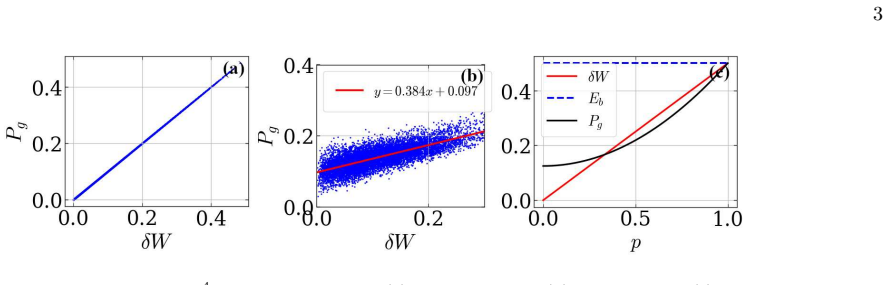
The bound energy of the reduced system tightly upper-bounds daemonic gain in ancilla-assisted work extraction and equals it for globally pure states.
A machine-rendered reading of the paper's core claim, the machinery that carries it, and where it could break.
Core claim
In ancilla-assisted work extraction, the bound energy of the reduced system provides a tight upper bound to the daemonic gain and this bound is saturated for globally pure system-ancilla states. Motivated by this, a purity-based gain is defined that qualitatively predicts the daemonic gain without explicit measurement optimization. Under collective environments, dissipation dynamically generates and stabilizes finite daemonic gain via environment-induced correlations, while intrinsic interactions modify the attainable gain through level crossings and changes to the accessible bound energy.
What carries the argument
Bound energy of the reduced system, serving as a tight upper bound on daemonic gain that saturates exactly when the global state is pure.
If this is right
- Daemonic gain is always at most the bound energy of the reduced system.
- Maximum daemonic gain is reached precisely when the global system-ancilla state is pure.
- Purity offers a simpler way to estimate daemonic gain without optimizing over measurements.
- Collective dissipation can create and stabilize nonzero daemonic gain through induced correlations.
- Level crossings from intrinsic interactions reshape the spectral structure and thereby change the maximum attainable gain.
Where Pith is reading between the lines
- Purity and bound energy could guide the choice of ancilla states to maximize extractable work in battery designs.
- The same bounding relation may apply to other protocols involving information loss in open quantum systems.
- Numerical checks on specific Hamiltonians could identify interaction strengths that optimize gain through spectral restructuring.
- The approach links work extraction limits to thermodynamic quantities like bound energy in a way that might generalize beyond ancilla assistance.
Load-bearing premise
The bound energy remains valid and tight as an upper limit on daemonic gain under the open-system dynamics and measurement protocols used, including collective dissipation and intrinsic interactions.
What would settle it
Finding a case where daemonic gain exceeds the bound energy of the reduced system for a globally pure combined state would disprove the tight bound.
Figures

read the original abstract
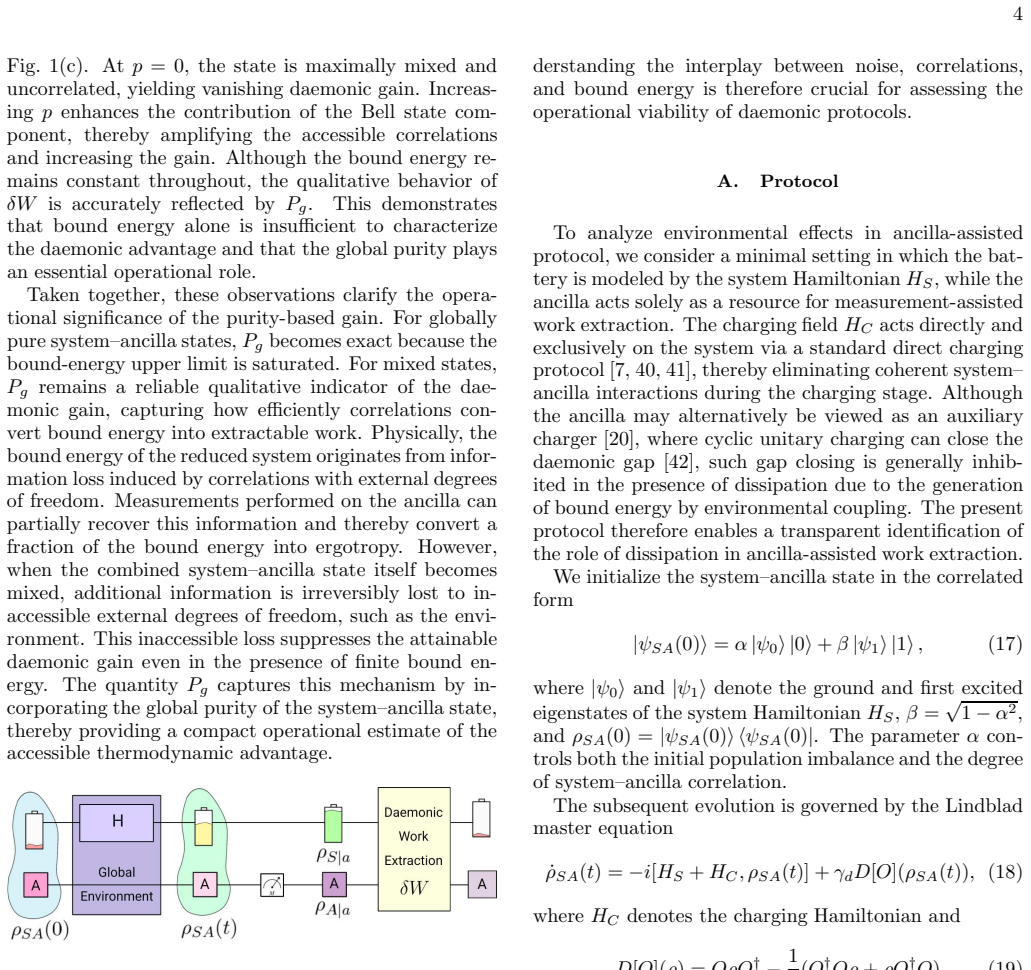
We investigate ancilla-assisted work extraction in quantum batteries from the perspective of bound energy and purity. We show that the bound energy of the reduced system provides a tight upper bound to the daemonic gain and that this bound is saturated for globally pure system--ancilla states. Motivated by this relation, we introduce a purity-based gain that qualitatively predicts the daemonic gain without requiring explicit optimization over measurements. We further introduce a protocol to analyze the role of dissipation and intrinsic interactions on daemonic gain. Under a collective environment, dissipation can dynamically generate and stabilize finite daemonic gain through environment-induced correlations. In interacting systems, level crossings and spectral restructuring strongly modify the attainable gain through their influence on the accessible bound energy. Our results demonstrate that daemonic gain is governed not only by correlations, but also by the spectral structure of the underlying Hamiltonian and information loss captured by bound energy and purity.
Editorial analysis
A structured set of objections, weighed in public.
Referee Report
Summary. The manuscript investigates ancilla-assisted work extraction in quantum batteries through the lenses of bound energy and purity. It claims that the bound energy of the reduced system supplies a tight upper bound on the daemonic gain, with equality when the global system-ancilla state is pure; introduces a purity-based gain that qualitatively tracks the daemonic gain without explicit measurement optimization; and presents a protocol showing that collective dissipation can dynamically generate and stabilize finite daemonic gain while intrinsic interactions modify the attainable gain via level crossings and spectral restructuring.
Significance. If the central bounds and saturation results hold, the work supplies a useful diagnostic linking reduced-system bound energy and purity to extractable work in the presence of ancillas, with direct relevance to quantum battery design. The demonstration that environment-induced correlations under collective dissipation can produce nonzero daemonic gain, together with the spectral analysis of interacting Hamiltonians, offers concrete, falsifiable predictions for open-system work extraction.
minor comments (4)
- [Abstract] The abstract states the central relations but contains no equations or brief derivation outline; adding the key inequality relating bound energy to daemonic gain would improve immediate readability.
- [§2] Notation for the reduced density operator and the bound-energy functional should be introduced once in §2 and used consistently; occasional redefinition of E_b in later sections risks confusion.
- [Figs. 3-5] Figure captions for the numerical plots of daemonic gain versus purity-based predictor should explicitly state the Hilbert-space dimension, the form of the collective dissipator, and the number of sampled initial states.
- [§4.2] The discussion of level crossings in interacting systems would benefit from an explicit statement of how the interaction term is included in the bound-energy calculation (full Hamiltonian versus effective reduced Hamiltonian).
Simulated Author's Rebuttal
We thank the referee for the positive assessment of our work on bound energy, purity, and daemonic gain in ancilla-assisted quantum work extraction, and for recommending minor revision. No specific major comments were raised in the report.
Circularity Check
No significant circularity in derivation chain
full rationale
The provided abstract and context describe results on bound energy upper-bounding daemonic gain, saturation for pure states, and a purity-based predictor, all framed as consequences of standard quantum thermodynamics constructions (ergotropy, daemonic extraction) under open-system dynamics. No equations are shown that would allow verification of self-definitional reductions, fitted inputs renamed as predictions, or load-bearing self-citations that collapse the central claim to its own inputs. The claims are presented as internally consistent demonstrations rather than tautologies, with extensions to dissipation and interactions treated as numerical/analytical outcomes preserving the bound. This matches the default expectation of self-contained derivations in the absence of explicit circular steps.
Axiom & Free-Parameter Ledger
Reference graph
Works this paper leans on
-
[1]
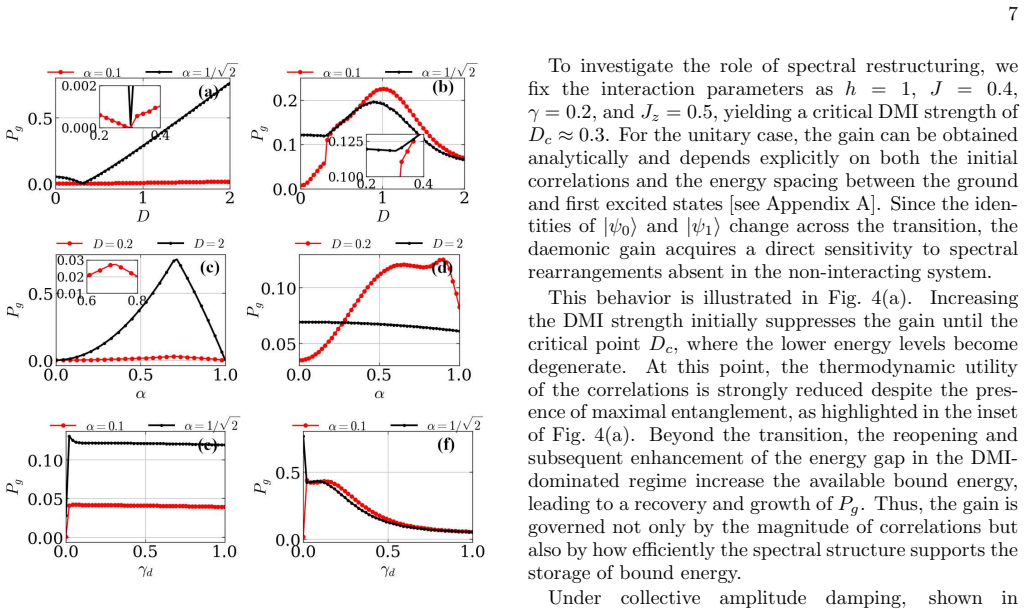
Insets highlight the behavior near the critical point Dc ≈ 0. 3. Dependence of Pg on the initial-state parameter α for weak (D = 0. 2) and strong (D = 2) DMI regimes under (c) unitary and (d) dissipative evolution, respectively. The inset illustrates the depend ence of alpha for weak DMI near maximal entanglement. Depen- dence of Pg on the dissipation str...
-
[2]
A. E. Allahverdyan, R. Balian, and T. M. Nieuwenhuizen, Maximal work extraction from finite quantum systems, Europhys. Lett. 67, 565 (2004)
2004
-
[3]
Goold, M
J. Goold, M. Huber, A. Riera, L. d. Rio, and P. Skrzypczyk, The role of quantum information in ther- modynamics—a topical review, J. Phys. A: Math. Theor. 49, 143001 (2016)
2016
-
[4]
M. N. Bera, A. Riera, M. Lewenstein, Z. B. Khanian, and A. Winter, Thermodynamics as a consequence of infor- mation conservation, Quantum 3, 121 (2019)
2019
-
[5]
Alicki and M
R. Alicki and M. Fannes, Entanglement boost for ex- tractable work from ensembles of quantum batteries, Phys. Rev. E 87, 042123 (2013)
2013
-
[6]
Ac ´ ın, I
A. Ac ´ ın, I. Bloch, H. Buhrman, T. Calarco, C. Eichler, J. Eisert, D. Esteve, N. Gisin, S. J. Glaser, F. Jelezko, et al. , The quantum technologies roadmap: A european community view, New J. Phys. 20, 080201 (2018)
2018
-
[7]
Vinjanampathy and J
S. Vinjanampathy and J. Anders, Quantum thermody- namics, Contemp. Phys. 57, 545 (2016)
2016
-
[8]
Campaioli, S
F. Campaioli, S. Gherardini, J. Q. Quach, M. Polini, and G. M. Andolina, Colloquium: Quantum batteries, Rev. Mod. Phys. 96, 031001 (2024)
2024
-
[9]
Campaioli, F
F. Campaioli, F. A. Pollock, F. C. Binder, L. C´ eleri, J. Goold, S. Vinjanampathy, and K. Modi, Enhancing the charging power of quantum batteries, Phys. Rev. Lett. 118, 150601 (2017)
2017
-
[10]
Francica, F
G. Francica, F. C. Binder, G. Guarnieri, M. T. Mitchi- son, J. Goold, and F. Plastina, Quantum coherence and ergotropy, Phys. Rev. Lett. 125, 180603 (2020)
2020
-
[11]
Rossini, G
D. Rossini, G. M. Andolina, and M. Polini, Many-body localized quantum batteries, Phys. Rev. B 100, 115142 (2019)
2019
-
[12]
Ahmadi, P
B. Ahmadi, P. Mazurek, P. Horodecki, and S. Barzanjeh, Nonreciprocal quantum batteries, Phys. Rev. Lett. 132, 210402 (2024)
2024
-
[13]
Song, H.-B
W.-L. Song, H.-B. Liu, B. Zhou, W.-L. Yang, and J.-H. An, Remote charging and degradation suppression for the quantum battery, Phys. Rev. Lett. 132, 090401 (2024)
2024
-
[14]
Z.-G. Lu, G. Tian, X.-Y. L¨ u, and C. Shang, Topological quantum batteries, Phys. Rev. Lett. 134, 180401 (2025)
2025
-
[15]
Maruyama, F
K. Maruyama, F. Nori, and V. Vedral, Colloquium: The physics of maxwell’s demon and information, Rev. Mod. Phys. 81, 1 (2009)
2009
-
[16]
Francica, J
G. Francica, J. Goold, F. Plastina, and M. Paternostro, Daemonic ergotropy: Enhanced work extraction from quantum correlations, npj Quantum Inf. 3, 12 (2017)
2017
-
[17]
Bernards, M
F. Bernards, M. Kleinmann, O. G¨ uhne, and M. Pater- nostro, Daemonic ergotropy: Generalised measurements and multipartite settings, Entropy 21, 771 (2019)
2019
-
[18]
ˇSafr´ anek, D
D. ˇSafr´ anek, D. Rosa, and F. C. Binder, Work extraction from unknown quantum sources, Phys. Rev. Lett. 130, 210401 (2023)
2023
-
[19]
Morrone, M
D. Morrone, M. A. Rossi, and M. G. Genoni, Daemonic ergotropy in continuously monitored open quantum bat- teries, Phys. Rev. A 20, 044073 (2023)
2023
-
[20]
Chaki, A
P. Chaki, A. Bhattacharyya, K. Sen, and U. Sen, Auxiliary-assisted energy distillation from quantum bat- teries, Phys. Rev. A 112, 052446 (2025)
2025
-
[21]
M. A. Satriani and F. Barra, Daemonic quantum bat- tery charged by thermalization, Quantum Sci. Technol. 9, 045035 (2024)
2024
-
[22]
K. Kua, A. Serafini, and M. G. Genoni, Daemonic er- gotropy of gaussian quantum states and the role of measurement-induced purification via general-dyne de- 10 tection, Quantum Sci. Technol. 11, 015014 (2026)
2026
-
[23]
J. Q. Quach, K. E. McGhee, L. Ganzer, D. M. Rouse, B. W. Lovett, E. M. Gauger, J. Keeling, G. Cerullo, D. G. Lidzey, and T. Virgili, Superabsorption in an or- ganic microcavity: Toward a quantum battery, Sci. Adv. 8, eabk3160 (2022)
2022
-
[24]
Joshi and T
J. Joshi and T. Mahesh, Experimental investigation of a quantum battery using star-topology nmr spin systems, Phys. Rev. A 106, 042601 (2022)
2022
-
[25]
I. M. de Buy Wenniger, S. E. Thomas, M. Maffei, S. C. Wein, M. Pont, N. Belabas, S. Prasad, A. Harouri, A. Lema ˆ ıtre, I. Sagnes,et al. , Experimental analysis of energy transfers between a quantum emitter and light fields, Phys. Rev. Lett. 131, 260401 (2023)
2023
-
[26]
C.-K. Hu, J. Qiu, P. J. P. Souza, J. Yuan, Y. Zhou, L. Zhang, J. Chu, X. Pan, L. Hu, J. Li, et al. , Optimal charging of a superconducting quantum battery, Quan- tum Sci. Technol. 7, 045018 (2022)
2022
-
[27]
Razzoli, G
L. Razzoli, G. Gemme, I. Khomchenko, M. Sassetti, H. Ouerdane, D. Ferraro, and G. Benenti, Cyclic solid- state quantum battery: Thermodynamic characteriza- tion and quantum hardware simulation, Quantum Sci. Technol. 10, 015064 (2025)
2025
-
[28]
Gemme, M
G. Gemme, M. Grossi, D. Ferraro, S. Vallecorsa, and M. Sassetti, IBM quantum platforms: A quantum bat- tery perspective, Batteries 8, 43 (2022)
2022
-
[29]
Ferraro, F
D. Ferraro, F. Cavaliere, M. G. Genoni, G. Benenti, and M. Sassetti, Opportunities and challenges of quantum batteries, Nat. Rev. Phys. , 1 (2026)
2026
-
[30]
Zhao, F.-Q
F. Zhao, F.-Q. Dou, and Q. Zhao, Quantum battery of interacting spins with environmental noise, Phys. Rev. A 103, 033715 (2021)
2021
-
[31]
Barra, Dissipative charging of a quantum battery, Phys
F. Barra, Dissipative charging of a quantum battery, Phys. Rev. Lett. 122, 210601 (2019)
2019
-
[32]
Tirone, R
S. Tirone, R. Salvia, S. Chessa, and V. Giovannetti, Quantum work extraction efficiency for noisy quantum batteries: The role of coherence, Phys. Rev. A 111, 012204 (2025)
2025
-
[33]
Tirone, R
S. Tirone, R. Salvia, S. Chessa, and V. Giovannetti, Wor k extraction processes from noisy quantum batteries: The role of nonlocal resources, Phys. Rev. Lett. 131, 060402 (2023)
2023
-
[34]
Shastri, C
R. Shastri, C. Jiang, G.-H. Xu, B. P. Venkatesh, and G. Watanabe, Dephasing enabled fast charging of quan- tum batteries, npj Quantum Inf. 11, 9 (2025)
2025
-
[35]
Vigneshwar and R
B. Vigneshwar and R. Sankaranarayanan, Noise resilien ce of spin quantum battery in the presence of dm interac- tions, J. Phys. A: Math. Theor. 59, 015302 (2026)
2026
-
[36]
Yang, Y.-H
X. Yang, Y.-H. Yang, M. Alimuddin, R. Salvia, S.-M. Fei, L.-M. Zhao, S. Nimmrichter, and M.-X. Luo, Battery capacity of energy-storing quantum systems, Phys. Rev. Lett. 131, 030402 (2023)
2023
-
[37]
B. Vigneshwar and R. Sankaranarayanan, Nonlocal con- tributions to ergotropy: A thermodynamic perspective, arXiv:2512.14497 (2025)
-
[38]
Canzio, V
A. Canzio, V. Cavina, M. Polini, and V. Giovannetti, Single-atom dissipation and dephasing in dicke and tavis- cummings quantum batteries, Phys. Rev. A 111, 022222 (2025)
2025
-
[39]
Wang, S.-Q
L. Wang, S.-Q. Liu, F.-l. Wu, H. Fan, N.-N. Li, and S.- Y. Liu, Global and local performance of a quantum bat- tery under correlated noise channels, Phys. Rev. A 112, 022206 (2025)
2025
-
[40]
B. Mula, E. M. Fern´ andez, J. E. Alvarellos, J. J. Fern´ andez, D. Garc ´ ıa-Aldea, S. N. Santalla, and J. Rodr ´ ıguez-Laguna, Ergotropy and entanglement in critical spin chains, Phys. Rev. B 107, 075116 (2023)
2023
-
[41]
Ghosh, T
S. Ghosh, T. Chanda, and A. Sen, Enhancement in the performance of a quantum battery by ordered and disor- dered interactions, Phys. Rev. A 101, 032115 (2020)
2020
-
[42]
T. P. Le, J. Levinsen, K. Modi, M. M. Parish, and F. A. Pollock, Spin-chain model of a many-body quantum bat- tery, Phys. Rev. A 97, 022106 (2018)
2018
- [43]
-
[44]
Z. Wang, Y. Ji, Y. Li, and D. Zhou, Dissipation and decoherence induced by collective dephasing in a coupled- qubit system with a common bath, Phys. Rev. A 91, 013838 (2015)
2015
-
[45]
Gelhausen and M
J. Gelhausen and M. Buchhold, Dissipative dicke model with collective atomic decay: Bistability, noise-driven a c- tivation, and the nonthermal first-order superradiance transition, Phys. Rev. A 97, 023807 (2018)
2018
-
[46]
J. R. Johansson, P. D. Nation, and F. Nori, QuTiP: An open-source python framework for the dynamics of open quantum systems, Comput. Phys. Commun. 183, 1760 (2012)
2012
-
[47]
Farina, G
D. Farina, G. M. Andolina, A. Mari, M. Polini, and V. Giovannetti, Charger-mediated energy transfer for quantum batteries: An open-system approach, Phys. Rev. B 99, 035421 (2019)
2019
-
[48]
Gherardini, F
S. Gherardini, F. Campaioli, F. Caruso, and F. C. Binder , Stabilizing open quantum batteries by sequential mea- surements, Phys. Rev. Res. 2, 013095 (2020)
2020
-
[49]
Dzyaloshinsky, A thermodynamic theory of “weak” ferromagnetism of antiferromagnetics, J
I. Dzyaloshinsky, A thermodynamic theory of “weak” ferromagnetism of antiferromagnetics, J. Phys. Chem. Solids 4, 241 (1958)
1958
-
[50]
Moriya, New mechanism of anisotropic superexchange interaction, Phys
T. Moriya, New mechanism of anisotropic superexchange interaction, Phys. Rev. Lett. 4, 228 (1960)
1960
-
[51]
Mukherjee and U
V. Mukherjee and U. Divakaran, Many-body quantum thermal machines, Journal of Physics: Condensed Matter 33, 454001 (2021)
2021
-
[52]
Murphy, A
D. Murphy, A. Kiely, I. D’amico, and S. Campbell, Er- gotropy transport in a one-dimensional spin chain, Phys. Rev. A 112, 052214 (2025)
2025
-
[53]
Campbell, I
S. Campbell, I. d’Amico, M. A. Ciampini, J. Anders, N. Ares, S. Artini, A. Auff` eves, L. Bassman Oftelie, L. P. Bettmann, M. V. Bonan¸ ca, et al. , Roadmap on quan- tum thermodynamics, Quantum Sci. Technol. 11, 012501 (2026)
2026
discussion (0)
Sign in with ORCID, Apple, or X to comment. Anyone can read and Pith papers without signing in.