REVIEW 3 major objections 5 minor 1 cited by
PulserDiff: a pulse differentiable extension for Pulser
T0 review · 3 major / 5 minor · reviewed 2026-08-07 · deepseek-v4-flash
Pith's one-line read PulserDiff is an open-source differentiable pulse optimizer that produces hardware-constrained neutral-atom pulses with fidelities above 99%.
desk verdict A genuine, useful differentiable pulse-optimization tool for Pulser, but the 'hardware-compatible' claim outruns the noiseless MockDevice simulations. read the letter →
The pith
A machine-rendered reading of the paper's core claim, the machinery that carries it, and where it could break.
The reading
What carries the argument
The key mechanism is the QuantumModel class, a wrapper that registers Pulser sequence variables as trainable parameters and uses an automatic-differentiation engine in place of Pulser's default numerical backend to compute gradients of a fidelity loss through the Schrödinger-equation time evolution. Custom waveforms are parameterized by a sparse set of control points, reconstructed on the 1-nanosecond sampling grid by a sine interpolation matrix so that each output is a linear combination of two neighboring control points; the control points are then passed through sigmoid or tanh functions, which guarantees the waveforms respect the device's amplitude and detuning bounds. This linear-interpolation-plus-bounded-transform construction is what makes the optimized pulses both smooth and hardware-compatible within the model.
What would settle it
Execute one of the optimized seven-qubit custom waveforms from Table 2 on a real neutral-atom device or through a validated noise model that includes decoherence, then measure the process fidelity via randomized benchmarking; if the measured fidelity falls well below the simulated 99.51% (for example below 90%), the hardware-fidelity claim is refuted.
Extended reading notes
Core claim
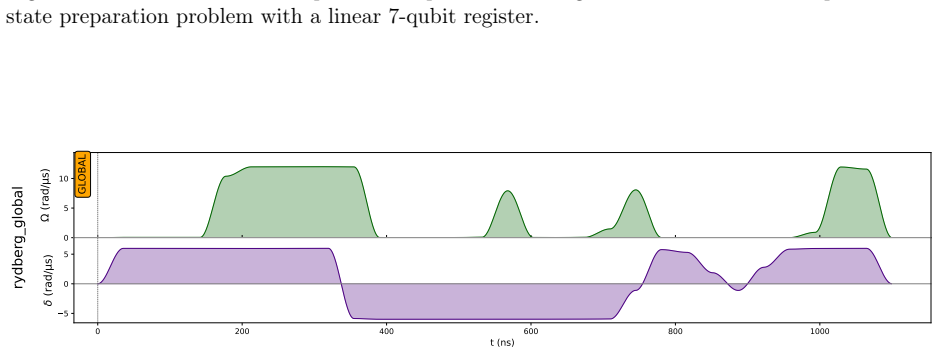
The central claim is that adding automatic differentiation to the Pulser framework turns pulse optimization into a standard machine-learning loop that reliably finds hardware-constrained waveforms. Concretely, the paper reports that sine-interpolated custom waveforms, bounded via sigmoid and tanh maps to enforce device amplitude and detuning limits, achieve process fidelities of 99.51–99.99% for global Hadamard rotations on linear registers of two to seven qubits, improving by 5–6 percentage points over piecewise-constant pulses for five or more qubits. For state preparation, a single custom pulse drives an interacting six-qubit chain from the all-zero state toward the all-one state with 99.85% fidelity, and the framework also supports optimizing total pulse duration and interatomic distances.
Load-bearing premise
The paper assumes that the noiseless Rydberg Hamiltonian together with MockDevice's hardware specifications faithfully represent real neutral-atom devices, so that pulses optimized in simulation can be called hardware-compatible—yet no experiment, noise model, or real-device run is reported.
Editorial extensions
If this is right
- Differentiable pulse shaping can recover digital-gate-emulation results comparable to the earlier variational protocol while using a standard gradient optimizer and smooth, bounded waveforms.
- Custom continuous waveforms outperform piecewise-constant sequences by 5–6 percentage points in fidelity at five or more qubits, indicating that waveform-shape flexibility is the main lever for counteracting long-range Rydberg interactions.
- Optimizing total pulse duration and register coordinates alongside pulse parameters opens a route to joint circuit-and-layout design for neutral-atom algorithms such as maximum independent set and quantum evolution kernels.
- Because the optimization loop is fully differentiable, the same machinery can later incorporate noise models through the Lindblad master equation to generate noise-resilient pulses.
- The fidelity degradation with system size is gradual, so the scheme is a plausible building block for larger registers once scalable emulators are integrated.
Reading between the lines
- The paper's 'hardware-compatible' claim rests entirely on the MockDevice constraint model; a natural next test is to execute the optimized waveforms on a real neutral-atom device or a validated noise simulator and compare measured fidelities, since decoherence effects are absent from the current results.
- The sine-interpolation parameterization is a generic constrained-waveform template that could transfer to other quantum-control platforms by swapping in the appropriate Hamiltonian and device limits.
- The state-preparation fidelities show a non-monotonic pattern across qubit number (93.55% at five qubits, above 99% at six and seven), suggesting the reported numbers are optimizer- and initialization-dependent; testing with restarts or alternative optimizers could yield different fidelity values.
- The demonstrations are limited to roughly seven qubits by dense state-vector simulation and 1-nanosecond sampling, an explicit boundary the authors flag; scaling to larger registers will require switching to approximate emulators, which the paper lists as future work.
Signed reviews
Editorial analysis
A structured set of objections, weighed in public.
Referee Report
Summary. PulserDiff is a PyTorch-based extension of the Pulser library that makes pulse-sequence parameters differentiable for gradient-based optimization on neutral-atom hardware models. The paper introduces the QuantumModel wrapper, a custom-waveform parameterization based on sine interpolation with sigmoid/tanh amplitude/detuning bounds, and an optimization loop that uses standard PyTorch autograd and optimizers. The authors demonstrate the tool on two tasks: (i) optimizing global rotations to emulate a Hadamard gate with piecewise-constant and smooth waveforms for 2–7 qubits, and (ii) preparing the |1...1> state for various register sizes and layouts. All demonstrations use the ideal Rydberg Hamiltonian (Eq. 1) and MockDevice constraints; the reported fidelities exceed 99% for smooth waveforms up to 7 qubits in the gate task and for several state-preparation settings, with lower values in other configurations. The paper claims that PulserDiff 'produces hardware-compatible pulses with remarkably high fidelities.'
Significance. If the results are reproducible and the claims appropriately scoped, PulserDiff is a useful open-source contribution: it fills a concrete gap in the Pulser ecosystem by enabling autodiff-based pulse optimization, leverages the widely used PyTorch ML stack, and provides a simple QuantumModel interface. The sine-interpolation construction (Eqs. 4–6) is mathematically sound, and the code is publicly available. However, the paper's significance is currently limited by the absence of any noise model, pulse-distortion analysis, or real-device validation; all quantitative claims are backed only by noiseless simulations of a MockDevice. The central 'hardware-compatible' claim therefore goes beyond the evidence presented, and the reported fidelities are single-run numbers without statistical characterization. With suitable revisions—either adding realistic device modeling or softening the hardware claim—the contribution would be a solid software/tool paper for the quantum control community.
major comments (3)
- [Abstract and Section 4.1.2] The central claim that PulserDiff produces 'hardware-compatible pulses with remarkably high fidelities' is not supported by the evidence. The only hardware constraints enforced are amplitude and detuning bounds taken from MockDevice (Appendix A.4, Code Samples 10 and 12). The paper explicitly acknowledges that 'ideal constant pulses are not faithfully implementable on a real quantum device mainly due to sharp rises and falls' (Section 4.1.2), but the replacement smooth pulses are never validated against a pulse-distortion model, bandwidth/rise-time limits, a Lindblad noise model, or an actual device run. As it stands, 'hardware-compatible' is an extrapolation from a mock specification to physical hardware. The authors should either add such validation or revise the wording to 'pulses compatible with Pulser's MockDevice constraints.'
- [Tables 1–5 and Appendix A.5] All fidelity numbers are the results of single optimization runs. The initialization in Appendix A.4 uses random control parameters (e.g., `amp_values = 5 * torch.rand(n_param) - 2.5` in Code Sample 12), yet no seeds, repeated trials, or statistical measures are reported. Because the optimization landscape is non-convex, a single run cannot establish the typical performance of PulserDiff. The authors should report results over multiple random seeds (mean ± standard deviation) or explicitly state that the reported fidelity is a best-of-single-run value and that no claim of reproducibility across initializations is made.
- [Abstract and Tables 1, 3, 4] The phrase 'remarkably high fidelities' overstates the results. Table 1 reports fidelities of 93–95% for constant pulses with N≥5, Table 3 reports 93.55% for state preparation with N=5, and Table 4 reports 85.36% for N=7 at τ=1000 ns. These values are respectable in some contexts but not 'remarkably high' across all cases. The abstract and conclusions should qualify the claim to the settings where >99% is achieved, e.g., custom smooth waveforms with the specific pulse durations and register layouts tested.
minor comments (5)
- [Section 4.1.1] The gate fidelity is defined as F = (1/2^N)|Tr(U†_sim U_target)|, which is a linear inner-product measure, whereas the state fidelity in Section 4.2 uses the squared overlap |⟨ψ|φ⟩|². This inconsistency should be noted explicitly; otherwise the reader may assume the standard squared fidelity is being reported for both.
- [Code Sample 2] The variable `area_param` is declared but never used in the pulse definition (`Pulse.ConstantPulse(1000, omega_param, 0.0, 0.0)`). This may confuse readers; either use it in a meaningful way or remove the declaration.
- [Section 3.4.3] The explanation of the duration-optimization sampling mechanism is somewhat long and interrupts the flow; consider moving the detailed 1 ns-sampling discussion to an appendix, as is done for other implementation details.
- [Table 4 caption] The caption 'Fidelities of the state |ψ_final⟩ after the pulse optimization with different pulse durations' does not specify which durations; add '(τ = 1000 ns and τ = 1200 ns)' to the caption.
- [Reference [MA25]] The reference for the PulserDiff repository is a GitHub URL; if the repository is archived on Zenodo or has a release DOI, that would improve reproducibility and citation stability.
Circularity Check
No significant circularity: PulserDiff's fidelity targets are external (global Hadamard unitary, |1...1> state), and the optimized fidelities are measured against those fixed targets.
full rationale
The paper reports optimized pulse-sequence fidelities for two externally specified tasks: emulating a global Hadamard unitary (Section 4.1) and preparing the target state |1...1> (Section 4.2). The fidelity definitions F = (1/2^N)|Tr(U_sim^dagger U_target)| and F = |<psi_final|psi_target>|^2 compare simulation output against fixed targets, so the reported numbers are not equivalent to any fitted parameter or input. The optimizer does minimize 1-F, but reporting the resulting training objective is the standard evaluation of a control-optimization tool, not a hidden prediction. The bounds enforced during optimization (MockDevice amplitude/detuning limits, sigmoid/tanh waveform transforms, sine interpolation in Eqs. 4-8) constrain the search space but do not define the target, so there is no self-definitional reduction. Self-citations to [CVdH+24] and [MA25] are contextual: [CVdH+24] provides the digital-emulation scheme being reproduced and [MA25] is the software repository; neither imports a load-bearing uniqueness theorem nor forbids alternatives. The main weakness, that 'hardware-compatible pulses' are supported only by noiseless MockDevice simulation without a real-device run or noise model (Section 4.1.2 and Section 5), is a domain-model validation gap rather than circular reasoning. No circular step meeting the required quote-and-reduction standard was found.
Assumptions & free parameters
free parameters (3)
- gamma_slope =
0.05
- control_point_count_M =
20 for gate optimization, 30 for state preparation
- optimizer_hyperparameters =
Adam lr=5.0, cosine annealing T_max=50, 1000 epochs
assumptions (3)
- domain assumption The Rydberg Hamiltonian in Eq. (1) with van der Waals interactions exactly describes the analog QPU dynamics for the chosen atomic states.
- standard math Numerical time propagation of the Schrödinger equation with 1 ns sampled piecewise-constant Hamiltonians (using the DP5_SE solver) is accurate enough for the reported fidelities.
- domain assumption The constraints and parameters in MockDevice correspond to a real Pasqal device's allowable amplitude, detuning, and timing ranges.
Cite this review
Pith. "Pith review of PulserDiff: a pulse differentiable extension for Pulser." pith.science (2026). https://pith.science/paper/F5MN5IK5
@misc{pith2026250516744,
  author       = {Pith},
  title        = {Pith review of: PulserDiff: a pulse differentiable extension for Pulser},
  year         = {2026},
  howpublished = {\url{https://pith.science/paper/F5MN5IK5}},
  note         = {Machine review of arXiv:2505.16744}
}
read the original abstract
Programming analog quantum processing units (QPUs), such as those produced by Pasqal, can be achieved using specialized low-level pulse libraries like Pulser. However, few currently offer the possibility to optimize pulse sequence parameters. In this paper, we introduce PulserDiff, a user-friendly and open-source Pulser extension designed to optimize pulse sequences over a well-defined set of control parameters that drive the quantum computation. We demonstrate its usefulness through several case studies involving analog configurations that emulate digital gates and state preparation. PulserDiff produces hardware-compatible pulses with remarkably high fidelities, showcasing its potential for advancing analog quantum computing applications.
Figures


Figures from the paper (20 more)




Forward citations
Cited by 1 Pith paper
-
Pulse-based optimization of quantum many-body states with Rydberg atoms in optical tweezer arrays
Adaptively segmented pulse-based VQE prepares ground states of small Heisenberg and mixed-field Ising chains in simulated Rydberg arrays, and a hybrid gate scheme is proposed for measuring the energy.
Reference graph
Works this paper leans on
-
[1]
Boris Albrecht, Constantin Dalyac, Lucas Leclerc, Luis Ortiz-Guti\'errez, Slimane Thabet, Mauro D'Arcangelo, Julia R. K. Cline, Vincent E. Elfving, Lucas Lassabli\`ere, Henrique Silv\'erio, Bruno Ximenez, Louis-Paul Henry, Adrien Signoles, and Lo\" c Henriet. Quantum feature maps for graph machine learning on a neutral atom quantum processor. Phys. Rev. A...
work page 2023
-
[2]
Kemal Bidzhiev, Stefano Grava, Pablo le Henaff, Mauro Mendizabel Pico, Elie Merhej, and Anton Quelle. Pasqal Emulators . https://github.com/pasqal-io/emulators, 2025
work page 2025
-
[3]
Many-body physics with individually controlled rydberg atoms
Antoine Browaeys and Thierry Lahaye. Many-body physics with individually controlled rydberg atoms. Nature Physics , 16(2):132--142, 2020
work page 2020
-
[4]
Rodrigo Araiza Bravo, Khadijeh Najafi, Xun Gao, and Susanne F. Yelin. Quantum reservoir computing using arrays of rydberg atoms. PRX Quantum , 3:030325, Aug 2022
work page 2022
-
[5]
Claire Chevallier, Joseph Vovrosh, Julius de Hond, Mario Dagrada, Alexandre Dauphin, and Vincent E. Elfving. Variational protocols for emulating digital gates using analog control with always-on interactions. Phys. Rev. A , 109:062604, Jun 2024
work page 2024
-
[6]
c Henriet, Daniele Loco, Nicola\
Mauro D'Arcangelo, Louis-Paul Henry, Lo\" c Henriet, Daniele Loco, Nicola\" Gouraud, Stanislas Angebault, Jules Sueiro, J\'er\^ome For\^et, Pierre Monmarch\'e, and Jean-Philip Piquemal. Leveraging analog quantum computing with neutral atoms for solvent configuration prediction in drug discovery. Phys. Rev. Res. , 6:043020, Oct 2024
work page 2024
-
[7]
Elfving, Adrien Signoles, Louis-Paul Henry, and Lo \" c Henriet
Constantin Dalyac, Lucas Leclerc, Louis Vignoli, Mehdi Djellabi, Wesley da Silva Coelho, Bruno Ximenez, Alexandre Dareau, Davide Dreon, Vincent E. Elfving, Adrien Signoles, Louis-Paul Henry, and Lo \" c Henriet. Graph algorithms with neutral atom quantum processors. The European Physical Journal A , 60(9):177, 2024
work page 2024
-
[8]
S. Ebadi, A. Keesling, M. Cain, T. T. Wang, H. Levine, D. Bluvstein, G. Semeghini, A. Omran, J.-G. Liu, R. Samajdar, X.-Z. Luo, B. Nash, X. Gao, B. Barak, E. Farhi, S. Sachdev, N. Gemelke, L. Zhou, S. Choi, H. Pichler, S.-T. Wang, M. Greiner, V. Vuletić, and M. D. Lukin. Quantum optimization of maximum independent set using rydberg atom arrays. Science , ...
work page 2022
Show all 27 references
-
[9]
Quantum bridge analytics i: a tutorial on formulating and using qubo models
Fred Glover, Gary Kochenberger, Rick Hennig, and Yu Du. Quantum bridge analytics i: a tutorial on formulating and using qubo models. Annals of Operations Research , 314(1):141--183, 2022
2022
-
[10]
Quantum computing with neutral atoms
Lo \" i c Henriet, Lucas Beguin, Adrien Signoles, Thierry Lahaye, Antoine Browaeys, Georges-Olivier Reymond, and Christophe Jurczak. Quantum computing with neutral atoms. Quantum , 4:327, September 2020
2020
-
[11]
Harris, K
Charles R. Harris, K. Jarrod Millman, St \' e fan J. van der Walt, Ralf Gommers, Pauli Virtanen, David Cournapeau, Eric Wieser, Julian Taylor, Sebastian Berg, Nathaniel J. Smith, Robert Kern, Matti Picus, Stephan Hoyer, Marten H. van Kerkwijk, Matthew Brett, Allan Haldane, Jai...
2020
-
[12]
Quantum evolution kernel: Machine learning on graphs with programmable arrays of qubits
Louis-Paul Henry, Slimane Thabet, Constantin Dalyac, and Lo\" c Henriet. Quantum evolution kernel: Machine learning on graphs with programmable arrays of qubits. Phys. Rev. A , 104:032416, Sep 2021
2021
-
[13]
Johansson, P.D
J.R. Johansson, P.D. Nation, and Franco Nori. Qutip: An open-source python framework for the dynamics of open quantum systems. Computer Physics Communications , 183(8):1760--1772, 2012
2012
-
[14]
Kingma and Jimmy Ba
Diederik P. Kingma and Jimmy Ba. Adam: A method for stochastic optimization, 2017
2017
-
[15]
Lucas Leclerc, Luis Ortiz-Guti\'errez, Sebasti\'an Grijalva, Boris Albrecht, Julia R. K. Cline, Vincent E. Elfving, Adrien Signoles, Lo\" c Henriet, Gianni Del Bimbo, Usman Ayub Sheikh, Maitree Shah, Luc Andrea, Faysal Ishtiaq, Andoni Duarte, Sam Mugel, Irene C\'aceres, Michel...
2023
-
[16]
PulserDiff
Melvin Mathé and Vytautas Abramavicius. PulserDiff . https://github.com/pasqal-io/pulser-diff, 2025
2025
-
[17]
Blueprint for a digital-analog variational quantum eigensolver using rydberg atom arrays
Antoine Michel, Sebastian Grijalva, Lo\" c Henriet, Christophe Domain, and Antoine Browaeys. Blueprint for a digital-analog variational quantum eigensolver using rydberg atom arrays. Phys. Rev. A , 107:042602, Apr 2023
2023
-
[18]
Pytorch: An imperative style, high-performance deep learning library
Adam Paszke, Sam Gross, Francisco Massa, Adam Lerer, James Bradbury, Gregory Chanan, Trevor Killeen, Zeming Lin, Natalia Gimelshein, Luca Antiga, Alban Desmaison, Andreas Köpf, Edward Yang, Zach DeVito, Martin Raison, Alykhan Tejani, Sasank Chilamkurthy, Benoit Steiner, Lu Fan...
2019
-
[19]
Black Opal
Q-CTRL. Black Opal . https://q-ctrl.com/black-opal, 2025
2025
-
[20]
https://www.qruise.com/, 2025
Qruise . https://www.qruise.com/, 2025
2025
-
[21]
Bloqade.jl: P ackage for the quantum computation and quantum simulation based on the neutral-atom architecture
QuEra. Bloqade.jl: P ackage for the quantum computation and quantum simulation based on the neutral-atom architecture. https://github.com/QuEraComputing/Bloqade.jl, 2023
2023
-
[22]
pasqal-io/pulser: v1.1.1, October 2024
Henrique Silvério, Seb Grijalva, Antoine Cornillot, Loïc Henriet, Laurent Ajdnik, Peter Karalekas, Lucas Leclerc, Clément de Terrasson, Louis Vignoli, Jbrem, Mauro D'Arcangelo, Constantin Dalyac, Louis-Paul Henry, Aleksander Wennersteen, Davide Gessa, Lembe Emmanuel, Rajatav D...
2024
-
[23]
Williams, Alexander A
Pascal Scholl, Michael Schuler, Hannah J. Williams, Alexander A. Eberharter, Daniel Barredo, Kai-Niklas Schymik, Vincent Lienhard, Louis-Paul Henry, Thomas C. Lang, Thierry Lahaye, Andreas M. L \"a uchli, and Antoine Browaeys. Quantum simulation of 2d antiferromagnets with hun...
2021
-
[24]
Maximum Independent Set
David Teller, Roland Guichard, and Manu Lahariya. Maximum Independent Set . https://github.com/pasqal-io/maximum-independent-set, 2025
2025
-
[25]
Quantum Evolution Kernel
David Teller, Roland Guichard, and Manu Lahariya. Quantum Evolution Kernel . https://github.com/pasqal-io/quantum-evolution-kernel, 2025
2025
-
[26]
Urban, T
E. Urban, T. A. Johnson, T. Henage, L. Isenhower, D. D. Yavuz, T. G. Walker, and M. Saffman. Observation of rydberg blockade between two atoms. Nature Physics , 5(2):110--114, 2009
2009
-
[27]
Jonathan Wurtz, Pedro L. S. Lopes, Christoph Gorgulla, Nathan Gemelke, Alexander Keesling, and Shengtao Wang. Industry applications of neutral-atom quantum computing solving independent set problems, 2024
2024
Reviewed August 7, 2026 · model on record in the stance chip above.
Discussion (0). Continue with ORCID to comment.