REVIEW 4 major objections 4 minor 3 cited by
A General Solution to Bellman's Lost-in-a-forest Problem
T0 review · 4 major / 4 minor · reviewed 2026-08-11 · deepseek-v4-flash
Pith's one-line read The paper claims that Bellman's lost-in-a-forest problem, for any known forest boundary, can be solved by discretizing starting points and orientations and solving a traveling-salesman-type optimization.
desk verdict A genuinely interesting TSP reformulation of Bellman's problem, but the 'general solution' theorem is a sketch and the paper's own numerics show the discretization can undercut the true optimum. read the letter →
The pith
A machine-rendered reading of the paper's core claim, the machinery that carries it, and where it could break.
The reading
What carries the argument
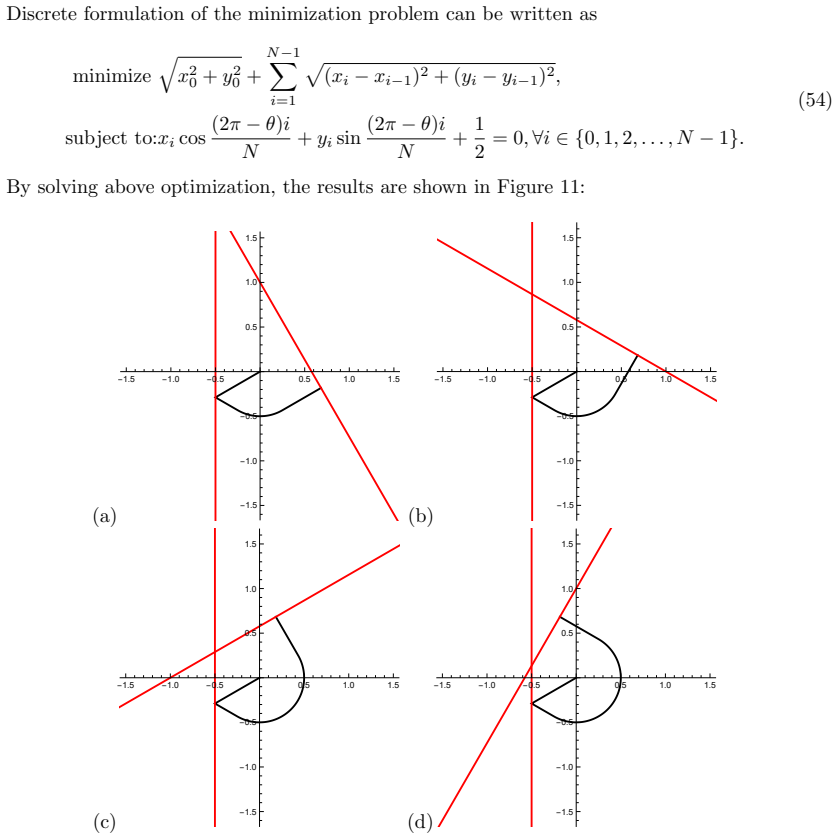
The central device is to freeze the escape path and rotate and translate the forest boundary instead: for each sampled starting point and initial heading, the boundary is moved so that the hiker's coordinate frame stays fixed, and the point where the path first hits the boundary becomes a constrained escape point lying on the transformed boundary Fki(x,y)=0. Collecting all such escape points turns the problem into finding the shortest polygonal path, starting from the origin, that visits one escape point per transformed boundary; this is an open traveling salesman or Hamiltonian path problem, which the paper writes with binary order variables and Miller–Tucker–Zemlin subtour-elimination constraints. The limiting step is the assertion that these discrete optima Γ-converge to the continuous minimax solution.
What would settle it
Take the unit circle, whose escape optimum is known to be the diameter of length 2. Solve the Weak Form II mixed-integer program to certifiable global optimality for growing M and N; if the optimal values do not converge to 2, or if the only optima require an escape path that meets a rotated boundary more than once, the general-solution claim collapses.
Extended reading notes
Core claim
The central claim is Theorem 3: when M starting points are evenly distributed in the region like grid points and N orientations are evenly distributed over [0, 2π], the solution to Weak Form II—the shortest path through the MN escape points on the corresponding rotated and translated boundary copies—yields the solution to the original Bellman problem as M and N tend to infinity. Weak Form I treats a known starting point with unknown orientation, while Weak Form II treats finitely many possible starting points. The escape path is sought as the shortest Hamiltonian path through escape points constrained to lie on the transformed boundaries, formulated with Miller–Tucker–Zemlin subtour elimination. The proof of convergence invokes Weierstrass existence, uniform continuity, Riemann-sum convergence, and Γ-convergence.
Load-bearing premise
The whole argument rests on the assumption that the shortest escape path is an open, simple, piecewise-smooth curve that crosses each rotated or translated forest boundary exactly once, and that the discrete optima genuinely converge to that continuous optimum; the convergence proof states the two Gamma-convergence inequalities but does not construct the recovery sequence.
Editorial extensions
If this is right
- For any boundary expressible as F(x,y)=0, an escape path can be approximated by solving a mixed-integer program whose size grows with the number of sampled starting points and orientations.
- Known optimal results—Isbell's half-plane search, Zalgaller's strip, and the circle and point-search cases—are recovered by the same formulation rather than by shape-specific geometry.
- The framework gives a route to upper bounds for Moser's worm problem: any solved escape path of length L for a region of area A yields A/L^2 as an upper bound on the minimal covering area.
- The same discrete formulation can be applied to opaque sets, replacing escape points with intersection points on all sampled lines, and to three-dimensional analogues.
- Closed escape paths that return to the starting point fit the same framework by adding a return segment to the objective, connecting the method to closed-worm variants.
Reading between the lines
- The paper's examples fix the visiting order of escape points, for instance assuming points are visited in increasing index; the full generality claim therefore depends on solving the complete permutation search, not the order-restricted runs shown, so global optima of the full Miller–Tucker–Zemlin problem are needed as the grid refines.
- If the convergence theorem survives scrutiny, a natural next step is to quantify the discretization error—how large M and N must be to certify an epsilon-optimal escape path—which the paper leaves open.
- The opaque-set connection suggests that the beam-detection constant for the unit circle could be attacked as a sequence of multiple-path mixed-integer programs, but only if the unconnected multi-curve variant is solved globally rather than by an imposed order.
- The proposed extension to non-Euclidean geometry is speculative because the rotation and translation constraints rely on Euclidean distance; a testable extension would replace planar rigid motions with spherical or hyperbolic ones.
Editorial analysis
A structured set of objections, weighed in public.
Referee Report
Summary. The paper proposes a discretization framework for Bellman's lost-in-a-forest problem. The original minimax problem over starting points and orientations is converted into a constrained shortest-path problem through 'escape points' on rotated and translated copies of the forest boundary. Upon discretization this becomes a Hamiltonian-path/TSP-type optimization over the locations and visiting order of the escape points. The paper claims in Theorem 3 that as the numbers of orientation samples N and starting-point samples M tend to infinity, the discrete optima converge to the solution of the original continuous problem. The bulk of the paper consists of numerical examples for lines, circles, strips, triangles, sectors, opaque sets, and related problems, with Mathematica notebooks in the appendices. The examples reproduce several known optimal or near-optimal shapes and values.
Significance. If the claimed general solution were established, this would be a substantial contribution: it would reduce a long-standing minimax problem over paths with continuous uncertainty to a sequence of discrete TSP-type optimizations and would provide a computational route to Moser's worm problem and opaque-set variants. The paper also has a genuine methodological idea—the translation/rotation reduction to escape points—and the supplied notebooks make the discrete computations reproducible. However, the central convergence claim is not proved, and the paper's own numerics indicate that the discrete problem can produce paths shorter than the known continuum optimum, so the paper does not currently deliver a verified general solution. Its value at this stage is that of a heuristic framework with several consistency checks against known results.
major comments (4)
- [Section 6.1, Theorem 3, Eqs. (60)-(61)] The proof of Theorem 3 is only a sketch and is load-bearing for the paper's main claim. The liminf inequality (60) and the recovery sequence (61) are asserted from 'lower semicontinuity' and 'continuity' without being constructed, and the discrete functionals live on spaces of dimension 3MN plus a permutation variable, so standard Gamma-convergence requires a common topological space, equi-coercivity, and control of the order variable; none of these is established. As stated, the theorem does not follow from the cited Weierstrass and uniform-continuity arguments.
- [Appendix III and Section 6.2.1] The reported numerical result for the unit strip, length 2.24853 for N=12, M=26, is smaller than Zalgaller's known continuum optimum 2.278292 quoted in Section 4.2.10. Since the continuum problem is a minimax problem over all starting points and orientations, a value below the known optimum cannot correspond to a feasible continuous escape strategy; it is an artifact of the finite discretization. This directly contradicts the convergence asserted in Theorem 3 and shows that the discrete minimizer need not even be a valid approximate escape path for the original problem.
- [Sections 4.2.1, 4.2.10, and 6.2.1] Nearly all examples fix the visiting order of the escape points rather than optimizing it. For example, Section 4.2.1 states 'If assuming the order of points ranges from 0 to N-1', and Appendix III hard-codes a permutation BB in the unit-strip computation. The formulations in Definitions 3.15 and 3.22 explicitly include the permutation as an optimization variable, so these examples solve a restricted subproblem and cannot be used as evidence for the claimed global solution of Weak Form I or II.
- [Appendix I] The continuous calculus-of-variations derivation for the half-plane example is not a derivation of the optimal path: the Euler-Lagrange equation (29) is left unsolved, and the boundary conditions are imposed by hand ('Approximate boundary value' y[1]=0.57735 and the condition y[nL]+1=0) to match the known line-search solution. The resulting length 6.39724 reproduces the known value only because those boundary values are fitted, not because the variational problem is solved from first principles.
minor comments (4)
- [Definition 3.21] The heading reads 'Length of escape path for Weak Form I' but the definition is for Weak Form II; this is confusing and should be corrected.
- [Section 4.2, introductory paragraph] The sentence 'Them are nontrivial and consistent with previous papers' contains a grammatical error and should be rewritten.
- [References] Several references are Wikipedia pages ([2], [31], [46]) rather than archival sources; for a mathematical paper these should be replaced by standard bibliographic entries.
- [Appendix III] The constraint in the Mathematica code uses angle step 2π/(nn-1) while the main text Definition 3.10 uses 2π/N; the discrepancy between N and N-1 should be explained or reconciled.
Circularity Check
No significant circularity: the discrete reformulation is a genuine, though incompletely proved, approximation, and the examples rely on explicit assumptions rather than on outputs that are definitionally equal to their inputs.
full rationale
The paper's central move (Def. 3.7 to Defs. 3.15/3.22 to Theorem 3) is a reformulation, not a renaming: the original minimax is over continuous escape paths hitting every rotated/translated boundary, while Weak Form II minimizes a polygonal length through escape points on finitely many sampled boundaries. The claimed equality in the limit is nontrivial and is asserted via Gamma-convergence in Sec. 6.1 (Eqs. (60)-(61)) without constructing the liminf inequality or recovery sequence; that is an unproved step and a serious correctness risk, but it is not circular because the conclusion is not already contained in the definitions. The examples do impose external structure: Section 4.2.1 and elsewhere say 'If assuming the order of points ranges from 0 to N-1', Section 4.2.7 fixes a specific visiting order, Section 6.2.1 uses a hand-specified order list, and Appendix I imposes y(0)=0.57735, y(2pi)=-1 as 'Approximate boundary value[s]'. These choices mean the experiments are restricted validations rather than demonstrations of the full unconstrained method, and Appendix III's N=12, M=26 length 2.24853 falling below Zalgaller's 2.278292 confirms that finite runs are not feasible continuous escape strategies. However, the paper labels these as assumptions, and the same line-search value (6.39724 = 7pi/6 + 1 + sqrt(3)) is also obtained in Appendix II by direct NMinimize with no fitted boundary values, so the boundary constants are not load-bearing. Section 10's admission that large instances are NP-hard and that NMinimize may not return global optima is a limitation, not a circular dependency. There is no self-citation chain and no imported uniqueness theorem; the only methodological citation (Braides, Gamma-convergence) is external. On the strict definition of circularity used here, a result equivalent by construction to its inputs, no step in the paper exhibits that reduction.
Assumptions & free parameters
free parameters (4)
- N, number of orientation samples =
e.g., N=12 in the unit strip example
- M, number of starting point samples =
e.g., M=26 in the unit strip example
- Order of escape points a (permutation) =
assumed as identity order in most examples; a 312-element list in the unit strip case
- Boundary values in Appendix I =
y[1]=0.57735, y[nL]+1=0
assumptions (5)
- standard math Euclidean metric invariance under SE(2) rigid motions
- domain assumption The escape path is an open simple piecewise-C1 curve
- ad hoc to paper The optimal path can be represented as a Hamiltonian path through the discrete escape points
- ad hoc to paper Gamma-convergence of the discretized minima to the continuous minimum
- standard math NP-hardness of the TSP and related mixed-integer programs
Cite this review
Pith. "Pith review of A General Solution to Bellman's Lost-in-a-forest Problem." pith.science (2026). https://pith.science/paper/F64QVYNT
@misc{pith2026241210686,
  author       = {Pith},
  title        = {Pith review of: A General Solution to Bellman's Lost-in-a-forest Problem},
  year         = {2026},
  howpublished = {\url{https://pith.science/paper/F64QVYNT}},
  note         = {Machine review of arXiv:2412.10686}
}
read the original abstract
We present a general solution and formulation framework to Bellman's lost-in-a-forest problem. The forest boundary is known and may take any shape. The starting point and the orientation are unspecified. We convert the problem into translation and rotation of the forest boundary. This transformation allows us to formulate this problem as a constrained minimization problem. Upon discretization, the problem becomes a variation of the traveling salesman problem or the Hamiltonian path problem. We leverage discrete optimization and derive several nontrivial results consistent with those from previous papers. This method is general, and we also extend the approach to related problems, including Moser's worm problem and the shortest opaque set problem.
Figures


Figures from the paper (15 more)




Forward citations
Cited by 3 Pith papers
-
Universal Triangle Covering Curve and Polygonal Chain: Escaping Forest and Fitting Worm
An exact support-function inequality is derived that characterizes shortest escape paths from arbitrary triangular forests and dual triangle covers for Moser's worm problem.
-
Proof and More Variations of Bellman's Lost-in-a-forest Problem
The paper asserts a certified computational scheme for Bellman's lost-in-a-forest problem via TSPN discretization and convergence, plus new numerical tables for two-line and closed-path variants, but the proof of the ...
-
Revisit escape path for infinite unit strip forest and unit broadworm
A convex-optimization reformulation reproduces Zalgaller's unit-strip escape path and argues the closed variant is a length-π constant-width curve, but the key equivalence is not rigorously established.
Reference graph
Works this paper leans on
-
[1]
Gross, O. A. (1955). A search problem due to Bellman
1955
-
[2]
https://en.wikipedia.org/wiki/Bellman%27s lost-in-a-forest problem 42
-
[3]
Croft, H. T., Falconer, K., & Guy, R. K. (2012). Unsolved problems in geometry: unsolved problems in intuitive mathematics (Vol. 2). Springer Science & Business Media
work page 2012
-
[4]
Gluss, B. (1961). The minimax path in a search for a circle in a plane. Naval Research Logistics Quarterly, 8(4), 357-360
work page 1961
-
[5]
Baezayates, R. A., Culberson, J. C., Rawlins, G. J. (1993). Searching in the plane. Information and computation, 106(2), 234-252
work page 1993
-
[6]
Williams, S. W. (2000). Million buck problems. National Association of Mathematicians Newsletter. 31 (2): 1–3
work page 2000
-
[7]
Isbell, J. R. (1957). An optimal search pattern. Naval Research Logistics Quarterly, 4(4), 357- 359
work page 1957
-
[8]
Joris, H. (1980). Le chasseur perdu dans la forˆ et. Elemente der Mathematik= Revue de math´ ematiques ´ el´ ementaires= Rivista di matematica elementare, 35(1), 1-14
work page 1980
Show all 67 references
-
[9]
Finch, S. (2019). A translation of Henri Joris’” Le chasseur perdu dans la forˆ et”(1980). arXiv preprint arXiv:1910.00615
2019 arXiv
-
[10]
Zalgaller, V. A. (2005). A question of Bellman. Journal of Mathematical Sciences, 131(1), 5286-5306
2005
-
[11]
R., Wetzel, J
Finch, S. R., Wetzel, J. E. (2004). Lost in a forest. The American Mathematical Monthly, 111(8), 645-654
2004
-
[12]
Ward, J. W. (2008). Exploring the Bellman Forest Problem. Spring. Dostupno na: http://wardsattic. com/joomla/Download/BellmanForestProblem. pdf
2008
-
[13]
Besicovitch, A. S. (1965). On arcs that cannot be covered by an open equilateral triangle of side 1. The Mathematical Gazette, 49(369), 286-288
1965
-
[14]
Gibbs, P. E. (2016). Lost in an isosceles triangle. Working paper
2016
-
[15]
K¨ ubel, D., Langetepe, E. (2021). On the approximation of shortest escape paths. Computa- tional Geometry, 93, 101709
2021
-
[16]
E., Tucker, A
Miller, C. E., Tucker, A. W., Zemlin, R. A. (1960). Integer programming formulation of trav- eling salesman problems. Journal of the ACM (JACM), 7(4), 326-329
1960
-
[17]
Karp, Richard M. (1972). Reducibility Among Combinatorial Problems. In R. E. Miller; J. W. Thatcher; J.D. Bohlinger (eds.). Complexity of Computer Computations. New York: Plenum. pp. 85–103
1972
-
[18]
Gavish, B., & Graves, S. C. (1978). The travelling salesman problem and related problems
1978
-
[19]
Melzak, Z. A. (2007). Companion to concrete mathematics. Courier Corporation
2007
-
[20]
A., Culberson, J
Baeza-Yates, R. A., Culberson, J. C., & Rawlins, G. J. (1988). Searching with uncertainty extended abstract. In SW AT 88: 1st Scandinavian Workshop on Algorithm Theory Halmstad, Sweden, July 5–8, 1988 Proceedings 1 (pp. 176-189). Springer Berlin Heidelberg. 43
1988
-
[21]
J., & Fekete, S
Anderson, E. J., & Fekete, S. P. (2001). Two dimensional rendezvous search. Operations Re- search, 49(1), 107-118
2001
-
[22]
Z. A. Melzak, Companion to Concrete Mathematics: Mathematical Techniques and Various Applications, Wiley, New York, 1973
1973
-
[23]
Braides, A. (2002). Gamma-convergence for Beginners (Vol. 22). Clarendon Press
2002
-
[24]
Adhikari, A., Pitman, J. (1989). The shortest planar arc of width 1. The American Mathemat- ical Monthly, 96(4), 309-327
1989
-
[25]
R., Shonder, J
Finch, S. R., Shonder, J. A. (2004). Lost at sea. arXiv preprint math/0411518
2004 arXiv
-
[26]
Movshovich, Y. (2012). Besicovitch triangles extended. Geometriae Dedicata, 159(1), 99-107
2012
-
[27]
Coulton, P., Movshovich, Y. (2006). Besicovitch triangles cover unit arcs. Geometriae Dedicata, 123(1), 79-88
2006
-
[28]
Movshovich, Y., Wetzel, J. E. (2011). Escape paths of Besicovitch triangles. Journal of Com- binatorics, 2(3), 413-433
2011
-
[29]
Movshovich, Y., Wetzel, J. E. (2017). Drapeable unit arcs fit in the unit 30 ° sector. Advances in Geometry, 17(4), 497-506
2017
-
[30]
E., Wichiramala, W
Wetzel, J. E., Wichiramala, W. (2019). Sectorial covers for unit arcs. Mathematics Magazine, 92(1), 42-46
2019
-
[31]
https://en.wikipedia.org/wiki/Moser%27s worm problem
-
[32]
Norwood, Poole. (2003). An improved upper bound for Leo Moser’s worm problem. Discrete & Computational Geometry, 29, 409-417
2003
-
[33]
Poole, G., Gerriets, J. (1973). Minimum covers for arcs of constant length. Bulletin of the American Mathematical Society, 79(2), 462-463
1973
-
[34]
Norwood, R., Poole, G., Laidacker, M. (1992). The worm problem of Leo Moser. Discrete & Computational Geometry, 7, 153-162
1992
-
[35]
A., Poole, G
Johnson, J. A., Poole, G. D., Wetzel, J. E. (2004). A small cover for convex unit arcs. Discrete & Computational Geometry, 32, 141-147
2004
-
[36]
Wang, Wei (2006), An improved upper bound for the worm problem, Acta Mathematica Sinica, 49 (4): 835–846
2006
-
[37]
Wetzel, J. E. (2013). Bounds for covers of unit arcs. Geombinatorics, 22(3), 116-122
2013
-
[38]
Khandhawit, Tirasan; Pagonakis, Dimitrios; Sriswasdi, Sira (2013), Lower Bound for Convex Hull Area and Universal Cover Problems, International Journal of Computational Geometry & Applications, 23 (3): 197–212
2013
-
[39]
Som-Am, S. (2020). Lower Bounds Of Areas Of Convex Covers For Closed Unit Arcs (Doctoral dissertation, University of Leicester). 44
2020
-
[40]
E., & Wichiramala, W
Panraksa, C., Wetzel, J. E., & Wichiramala, W. (2007). Covering n-segment unit arcs is not sufficient. Discrete & Computational Geometry, 37, 297-299
2007
-
[41]
Panraksa, C., & Wichiramala, W. (2021). Wetzel’s sector covers unit arcs. Periodica Mathe- matica Hungarica, 82(2), 213-222
2021
-
[42]
E., & Wichiramala, W
Sroysang, B., Wetzel, J. E., & Wichiramala, W. (2008). Covers for angleworms. The American Mathematical Monthly, 115(1), 61-65
2008
-
[43]
F¨ uredi, Z., & Wetzel, J. (2011). Covers for closed curves of length two. Periodica Mathematica Hungarica, 63(1), 1-17
2011
-
[44]
Wetzel, J. E. (2003). Fits and covers. Mathematics magazine, 76(5), 349-363
2003
-
[45]
E., & Wichiramala, W
Panraksa, C., Wetzel, J. E., & Wichiramala, W. (2007). The broadest three-segment unit arc. Periodica Mathematica Hungarica, 55, 157-168
2007
-
[46]
https://en.wikipedia.org/wiki/Opaque set
-
[47]
Brakke, K. A. (1992). The opaque cube problem. The American Mathematical Monthly, 99(9), 866-871
1992
-
[48]
(in Polish and French), 27: 11–16
Mazurkiewicz, Stefan (1916), Sur un ensemble ferm´ e, punctiforme, qui rencontre toute droite passant par un certain domaine, Prace Mat.-Fiz. (in Polish and French), 27: 11–16
1916
-
[49]
Bagemihl, F. (1959). Some opaque subsets of a square. Michigan Mathematical Journal, 6(2), 99-103
1959
-
[50]
Faber, V., & Mycielski, J. (1986). The shortest curve that meets all the lines that meet a convex body. The American Mathematical Monthly, 93(10), 796-801
1986
-
[51]
Croft, H. T. (1969). Curves intersecting certain sets of great-circles on the sphere. Journal of the London Mathematical Society, 2(1), 461-469
1969
-
[52]
Izumi, T. (2016). Improving the lower bound on opaque sets for equilateral triangle. Discrete Applied Mathematics, 213, 130-138
2016
-
[53]
Jones, R. E. D. (1962). Linear measure and opaque sets. Iowa State University
1962
-
[54]
Jones, R. E. D. (1964). Opaque sets of degree α. The American Mathematical Monthly, 71(5), 535-537
1964
-
[55]
Kawohl, B. (1997). The opaque square and the opaque circle. In General Inequalities 7: 7th In- ternational Conference at Oberwolfach, November 13–18, 1995 (pp. 339-346). Birkh¨ auser Basel
1997
-
[56]
P., & Kawohl, B
Kawohl, B., Pironneau, O., Tartar, L., Zol´ esio, J. P., & Kawohl, B. (2000). Some nonconvex shape optimization problems. Optimal Shape Design: Lectures given at the joint CIM/CIME Summer School held in Tr´ oia, Portugal, June 1–6, 1998, 7-46
2000
-
[57]
Kawamura, A., Moriyama, S., Otachi, Y., & Pach, J. (2019). A lower bound on opaque sets. Computational Geometry, 80, 13-22. 45
2019
-
[58]
Asimov, D., & Gerver, J. L. (2008). Minimum opaque manifolds. Geometriae Dedicata, 133, 67-82
2008
-
[59]
S., Brazil, M., Thomas, D., & Weng, J
Provan, J. S., Brazil, M., Thomas, D., & Weng, J. F. (2012). Minimum opaque covers for polygonal regions. arXiv preprint arXiv:1210.8139
2012 arXiv
-
[60]
Dumitrescu, A., Jiang, M., & T´ oth, C. D. (2015). Computing opaque interior barriers ` a la Shermer. SIAM Journal on Discrete Mathematics, 29(3), 1372-1386
2015
-
[61]
Faber, V., Mycielski, J., & Pedersen, P. (1984). On the shortest curve which meets all the lines which meet a circle. In Annales Polonici Mathematici (Vol. 44, No. 3, pp. 249-266). Polska Akademia Nauk. Instytut Matematyczny PAN
1984
-
[62]
Finch, S. R. (2005). The logarithmic spiral conjecture. arXiv preprint math/0501133
2005 arXiv
-
[63]
(2010, January)
Langetepe, E. (2010, January). On the optimality of spiral search. In Proceedings of the twenty- first annual ACM-SIAM symposium on Discrete Algorithms (pp. 1-12). Society for Industrial and Applied Mathematics
2010
-
[64]
O., & Pach, J
Brass, P., Moser, W. O., & Pach, J. (2005). Research problems in discrete geometry (Vol. 18). New York: Springer
2005
-
[65]
Ghomi, M., & Wenk, J. (2021). Shortest closed curve to inspect a sphere. Journal f¨ ur die reine und angewandte Mathematik (Crelles Journal), 2021(781), 57-84
2021
-
[66]
M., Golynski, A., Lopez-Ortiz, A., & Quimper, C
Chan, T. M., Golynski, A., Lopez-Ortiz, A., & Quimper, C. G. (2003, June). The asteroid surveying problem and other puzzles. In Proceedings of the nineteenth annual symposium on Computational geometry (pp. 372-373)
2003
-
[67]
VariationalMethods`
Zalgaller, V. A. (2003). Shortest inspection curves for a sphere. Zapiski Nauchnykh Seminarov POMI, 299, 87-108. College of Engineering and Computer Science, University of Central Florida, Orlando, FL, USA Email: zhipeng.deng@ucf.edu 46 Appendix 1 I n [ ] : = (*Weak form I, g...
2003
Reviewed August 11, 2026 · model on record in the stance chip above.
Discussion (0). Continue with ORCID to comment.