REVIEW 4 major objections 6 minor 2 cited by
Debunk and Infer: Multimodal Fake News Detection via Diffusion-Generated Evidence and LLM Reasoning
T0 review · 4 major / 6 minor · reviewed 2026-08-07 · deepseek-v4-flash
Pith's one-line read A detector that generates its own debunking evidence outperforms prior fake-news video models on two benchmarks.
desk verdict The paper has a real architectural idea, but the load-bearing debunk-diffusion module is trained on label-conditioned synthetic texts, so the reported gains may be a shortcut artifact rather than evidence of meaningful debunking. read the letter →
The pith
A machine-rendered reading of the paper's core claim, the machinery that carries it, and where it could break.
The reading
What carries the argument
The load-bearing piece is Debunk Diffusion: a continuous conditional latent diffusion model trained on LLM-augmented debunking texts. A compression network (Perceiver Resampler) maps long debunk-text encodings into a compact latent space; a denoising transformer is conditioned on concatenated text, audio, and visual features through cross-attention with sinusoidal position encodings and per-modality offsets; a self-refinement network cleans the sampled latent before fusion. Its training loss combines the diffusion reconstruction error with classification losses on compressed and refined latents. The companion piece is Chain-of-Debunk: separate MLLM agents caption the text, keyframes, and audio, then a reasoning LLM integrates those captions with the raw text and extracted event entities to produce a veracity judgment and rationale, encoded with a text-embedding model as chain-of-debunk features. Gated attention fuses these generated streams with raw multimodal features, and late fusion multiplies the multimodal prediction with a $\tanh$-gated textual-debunk prediction to produce the final decision.
What would settle it
On the FakeSV training set, shuffle the debunking texts across samples so each video is paired with another video's debunk text while labels stay fixed, then retrain DIFND. If accuracy stays near 87.68%, the diffusion module is learning label patterns instead of evidence; if accuracy drops sharply, the semantic alignment of the debunk text is the active ingredient.
Extended reading notes
Core claim
On its own terms, the paper claims that synthetic debunking knowledge, produced by a conditional latent diffusion model and by structured multimodal LLM reasoning, can be fused into a single detector to make fake-news video judgments more accurate and more explainable. It broadens debunking to mean both refuting false claims and authenticating true ones, and it uses LLM-generated debunk texts in five rhetorical styles to build a training set. At inference, the diffusion model samples latent debunk features conditioned on the text, audio, and keyframes of the news video, so evidence is available even when no human fact-check exists; in parallel, a chain-of-debunk multi-agent MLLM system writes text, visual, and audio captions and then produces a veracity judgment with reasoning. Attention-based fusion combines raw multimodal features, generated debunk cues, and the reasoning features, and late fusion combines a textual-debunk branch with a multimodal branch. The paper reports 87.68% accuracy on FakeSV and 92.16% on FVC, exceeding the compared baselines by 2.33 and 2.88 accuracy points.
Load-bearing premise
The whole gain rests on LLM-written debunking texts being faithful substitutes for real verification evidence; if those synthetic texts encode dataset-specific label patterns instead of genuine debunking logic, the generated diffusion features will not transfer to new fake-news videos.
Editorial extensions
If this is right
- Inference no longer requires a stored fact-check: the diffusion model samples debunking cues from the learned distribution, so a news video can be assessed even when no debunk text exists for it.
- Training data becomes more balanced because authenticating true claims is treated as debunking, giving the model positive evidence to learn from, not only refutations of false content.
- The chain-of-debunk output carries an audit trail, including text analysis, visual caption, audio caption, and cross-modal consistency reasoning, so the final label comes with an explanation.
- The joint training objective means evidence generation and classification must be balanced; the paper reports optimal balance weights near 1.0, which indicates the two tasks reinforce each other during training.
- The FVC result, obtained with only 40 ground-truth debunked videos in that corpus, implies the framework's benefit is largest precisely when verification evidence is scarce.
Reading between the lines
- Testable extension: sweep the fraction of LLM-generated debunk texts used in training; if accuracy degrades smoothly as synthetic data is removed, the augmentation is the active ingredient, and the same recipe could transfer to other low-resource verification tasks.
- Neighbouring application: the same conditional latent diffusion of counter-evidence could be adapted to claim verification and rumor detection, where the conditioning input would be claim text, source, and event history instead of video frames.
- Because the paper labels authentication of true claims as debunking, the framework implicitly learns what positive evidence looks like; this suggests a possible secondary use as an unverifiability flag for claims that lack either refuting or authenticating cues.
- The paper notes chain-of-debunk has inherent judgment bias; a natural extension would be to calibrate the reasoning agent's confidence or down-weight its contribution in the gated fusion when captions are uncertain.
Editorial analysis
A structured set of objections, weighed in public.
Referee Report
Summary. The paper proposes DIFND, a multimodal fake news detection framework for short video platforms. The framework has three main components: (1) a debunk diffusion module that is trained to generate latent debunking features conditioned on multimodal news content, (2) a chain-of-debunk module in which multiple MLLM agents produce captions and a final veracity judgment with reasoning, and (3) a Veri-Verdict fusion mechanism that combines the textual/debunk branch with the multimodal branch. The authors augment the scarce debunking data with LLM-generated texts using five prompt styles. Experiments on FakeSV and FVC report state-of-the-art accuracy (87.68% and 92.16% respectively) and ablations show contributions from each module. The paper emphasizes that the generated debunking cues improve both accuracy and interpretability.
Significance. If the central claims hold, the work advances the use of generative models for evidence-style feature augmentation in fake news detection and provides an architecture that integrates diffusion-based generation with MLLM reasoning. The authors evaluate on two standard benchmarks and include a useful ablation structure that separates the contributions of multimodal fusion, debunk diffusion, and chain-of-debunk. However, the evidence for the load-bearing claim is weakened by a likely label-related shortcut in the debunk diffusion training, the lack of any uncertainty quantification, and the unexplained final fusion rule. These issues prevent the current version from being accepted, but they are addressable with additional experiments and analysis.
major comments (4)
- [Section III-B.5, Appendix A.1, Eq. (8)] The debunk diffusion module is trained on LLM-generated texts that are produced with distinct prompts for fake and real news, as stated in Appendix A.1 ('we design distinct prompts to augment debunking texts for fake and real news') and Section III-B.5 mentions the use of 'existing annotations.' Since the diffusion target z = E(Θ(w)) is a function of these label-conditional texts, and the total loss in Eq. (8) includes the auxiliary classifier losses L_d and \hat{L}_d, the model is explicitly trained to make the latent debunk representation label-predictive. At inference, the denoiser can infer the label from X_cond and produce a cue that correlates with the ground truth without actually capturing verifiable debunking evidence. The ablation in Table II shows that removing DD reduces accuracy by 1.47% on FakeSV and 1.82% on FVC, but this does not distinguish 'useful debunking evidence' from 'a label shortcut.' To support the paper's central interpretation, please provide: (i) an ablation in which the LLM augmentation prompts are label-agnostic, (ii) an ablation in which the auxiliary classifier losses are removed, and (iii) an analysis that quantifies how much label information the generated features carry beyond X_cond. Without these, the claim that DD contributes meaningful debunking knowledge is not established.
- [Section IV.A.1, Table IV] The FVC dataset contains only 40 debunked videos, so for the 483 real videos there is no ground-truth debunk text and the debunk diffusion must rely entirely on LLM-generated 'authenticating' texts. Table IV reports the effect of data augmentation only on FakeSV; no FVC ablation is provided. Given that the central result on FVC (92.16% accuracy, with DD contributing 1.82% in Table II) is a headline claim, the absence of an FVC augmentation study is a load-bearing gap. Please report the FVC augmentation table, and include a sensitivity analysis that varies the number of synthetic authenticating texts or measures the robustness of the DD module when the real-debunk count is even smaller. Without this, the reader cannot tell whether the FVC gain is an artifact of the 40-sample ground-truth set or a reliable property of the method.
- [Tables I-IV] All quantitative claims are presented as point estimates with no standard deviations, confidence intervals, or significance tests. The reported improvements over the best baselines are 2.33% on FakeSV and 2.88% on FVC, and the ablation gaps are sometimes below 2% (e.g., removing DD on FakeSV: 87.68 vs 86.21). Since the FVC protocol is five-fold cross-validation, per-fold results should be available; please report them and provide a paired significance test (e.g., McNemar or a bootstrap test) for the main comparisons and ablations. This is a standard requirement for empirical claims of this kind, and it is important here because the differences are small enough that sampling variability could change the qualitative conclusions.
- [Section III.D, Eq. (16)] The final fusion rule \hat{Y}_{FND} = \hat{Y}_{mm} · tanh(\hat{Y}_{td}) is unusual and not justified in the text. If \hat{Y}_{td} is a probability in [0,1], tanh(\hat{Y}_{td}) lies in [0,0.76], and the product with \hat{Y}_{mm} is not a normalized probability, which makes the subsequent cross-entropy loss in Eq. (17) difficult to interpret. No explanation, calibration analysis, or comparison with simpler alternatives (addition, weighted sum, concatenation with an MLP) is provided. Since this rule produces the final prediction that is compared in Table I, it is part of the central claim. Please either derive the rule from a probabilistic model, show that \hat{Y}_{FND} is a valid score for the loss used, and provide an ablation over fusion functions, or replace it with a standard combination.
minor comments (6)
- [Eq. (12)] The list of inputs to the verification LLM includes 'P_v', but the formula uses 'P' for the suffix prompt; please unify the notation.
- [Section III.D] The TD-Fusion branch is described in prose only. Please provide the corresponding equations (e.g., for the self-attention and gated-attention operations) so that the architecture is fully specified and reproducible.
- [Table I footnote] The note 'Fakingrecipe* results were reproduced with a portion of the models due to the absence of on-screen text' should specify which portions of the model were used and why the results are directly comparable to those of other baselines.
- [Section III.B.2] In Eq. (3), γ(t) is described as 'monotonically decreasing from 1 to 0,' which is opposite to the common formulation in many diffusion papers; consider clarifying the convention or aligning with a standard reference.
- [Throughout] The manuscript contains several typographical errors, e.g., 'MM-usion' and 'branchs' in Section III.D, 'donated' instead of 'denoted' in Section III.B.1, and misplaced brace brackets in Eq. (4). A careful proofreading pass is recommended.
- [Section IV.B, Conclusion] The paper claims that DIFND 'delivers trustworthy decisions,' but no human evaluation or faithfulness metric is provided. Please either include an interpretability evaluation or soften the claim.
Circularity Check
DIFND's debunk-diffusion 'evidence' is label-conditioned by construction: the debunk texts are generated with different prompts for fake vs. real news, and the latent is trained with fake/real classifier losses, so the generated cues are fitted label predictions rather than independent evidence.
-
self definitional
[Section III.B (Debunk Text Augmentation by LLM) and Appendix A.1 (Prompts of Debunking Text Augmentation for LLM)]
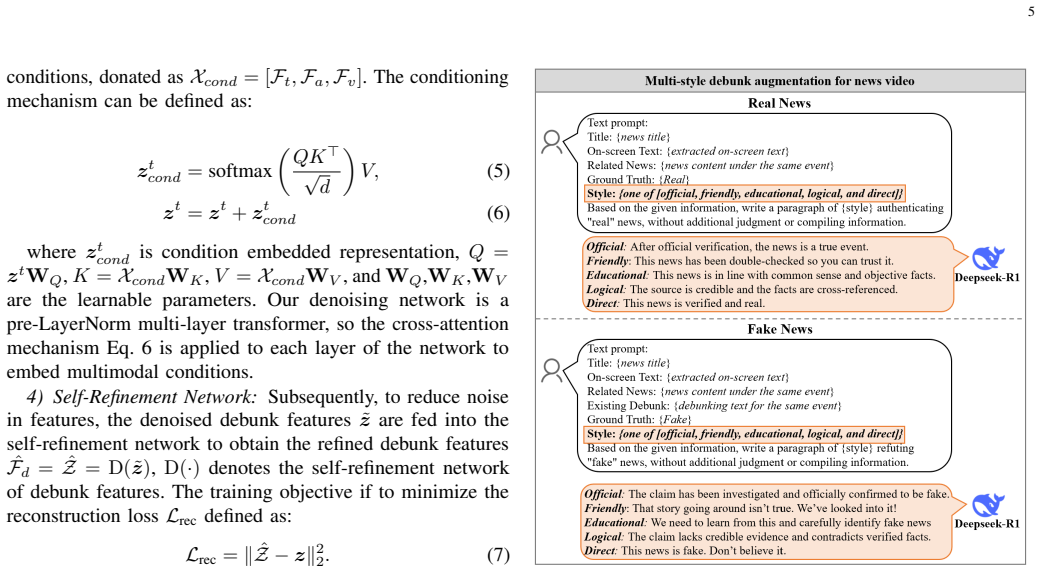
"We begin by broadening the definition of debunking to encompass both the refutation of fake claims and the verification of true ones ... As shown in Figure 6, we design distinct prompts to augment debunking texts for fake and real news, leveraging cues from the news content itself, related news within the same event, and existing annotations."
The debunking evidence is defined by the target label: fake samples are paired with refutation-style texts and real samples with authentication-style texts. The diffusion target is z = E(Theta(w)) = E(F_d), i.e., the encoded feature of these label-conditional texts. At inference, the model generates 'refuting or authenticating' cues from the multimodal content; because the training targets already encode the label through the prompt choice, the generated cue is a learned guess of the label, not an external source of evidence. The final classifier then consumes this cue, so the 'evidence' is a function of the label by construction.
-
fitted input called prediction
[Section III.B.4 (Self-Refinement Network), Eq. (8), and Section III.D (TD-Fusion)]
"Finally, to further guide the denoise objective, we apply mean pooling to the denoise latent features ˆz and then feed it into a classifier to obtain loss ˆLd. So the overall training objective is Ldiff = Lmse + Lrec + Ld + ˆLd ... gated attention adaptively integrates original text, denoised debunking cues ˆFd and chain-of-debunk features Fc."
The debunk latent is explicitly supervised with the fake/real label through L_d and \hat L_d while being trained. The same denoised latent \hat F_d is then fed into the TD-Fusion branch that produces \hat Y_td. Thus the 'debunking cue' is a fitted label predictor, and the final prediction is at least partly a re-use of that fitted predictor. The reported DD contribution in Table II therefore may reflect label information injected through the classifier losses and label-conditional augmentation, rather than independent debunking knowledge.
full rationale
The framework is not globally circular: it is evaluated on two external benchmarks against published baselines, and the chain-of-debunk module uses an external LLM's independent reasoning as a feature, which is a standard stacking practice. No load-bearing self-citation or imported uniqueness theorem was found. The central problem is the debunk-diffusion branch. Its training target is the embedding of debunking texts generated with prompts that differ by fake/real label, so the target distribution is label-conditional. The diffusion latent is additionally supervised by cross-entropy losses L_d and \hat L_d on the fake/real label. At inference, the denoised latent \hat F_d is used as a 'debunking cue' in the TD-Fusion branch that produces \hat Y_td. The cue is therefore a learned, label-trained projection of the multimodal content, not an independent evidence source; any gain from DD in Table II may be due to label information injected through the augmentation and classifier losses rather than to genuine debunking knowledge. This is especially consequential for FVC, which has only 40 ground-truth debunked videos, so the real-video 'authenticating' texts are essentially all synthetic. Because the central reported improvement over baselines is partly carried by this module, the circularity is partial but real.
Assumptions & free parameters
free parameters (4)
- Loss weights α, β, γ =
1.0 (reported optimal)
- Number of LLM repetitions =
3
- Debunk texts per instance =
5
- Latent dimension and query count =
Not reported
assumptions (4)
- domain assumption LLM-generated debunk texts are semantically faithful and useful for training the diffusion model.
- domain assumption Chain-of-debunk reasoning features are informative and do not inject systematic label bias.
- standard math Latent diffusion with a regression objective can generate debunk-relevant feature vectors.
- domain assumption The dataset splits prevent event leakage.
Cite this review
Pith. "Pith review of Debunk and Infer: Multimodal Fake News Detection via Diffusion-Generated Evidence and LLM Reasoning." pith.science (2026). https://pith.science/paper/F655BVDY
@misc{pith2026250621557,
  author       = {Pith},
  title        = {Pith review of: Debunk and Infer: Multimodal Fake News Detection via Diffusion-Generated Evidence and LLM Reasoning},
  year         = {2026},
  howpublished = {\url{https://pith.science/paper/F655BVDY}},
  note         = {Machine review of arXiv:2506.21557}
}
read the original abstract
The rapid spread of fake news across multimedia platforms presents serious challenges to information credibility. In this paper, we propose a Debunk-and-Infer framework for Fake News Detection(DIFND) that leverages debunking knowledge to enhance both the performance and interpretability of fake news detection. DIFND integrates the generative strength of conditional diffusion models with the collaborative reasoning capabilities of multimodal large language models (MLLMs). Specifically, debunk diffusion is employed to generate refuting or authenticating evidence based on the multimodal content of news videos, enriching the evaluation process with diverse yet semantically aligned synthetic samples. To improve inference, we propose a chain-of-debunk strategy where a multi-agent MLLM system produces logic-grounded, multimodal-aware reasoning content and final veracity judgment. By jointly modeling multimodal features, generative debunking cues, and reasoning-rich verification within a unified architecture, DIFND achieves notable improvements in detection accuracy. Extensive experiments on the FakeSV and FVC datasets show that DIFND not only outperforms existing approaches but also delivers trustworthy decisions.
Figures


Figures from the paper (4 more)


Forward citations
Cited by 2 Pith papers
-
Maximizing Mutual Information Between Prompt and Response Improves LLM Performance With No Additional Data
MIPO constructs contrastive preference pairs from correct versus random prompts and uses DPO to maximize mutual information between prompts and responses, producing 3-40% gains on personalization and 1-18% on math tas...
-
A Survey on Diffusion Language Models
A comprehensive survey of diffusion language models covering taxonomy, training and inference techniques, and comparisons with autoregressive models.
Reference graph
Works this paper leans on
-
[1]
J. M. Jordan,The Rise of the Algorithms: How YouTube and TikTok Conquered the World. Penn State Press, 2024
work page 2024
-
[2]
Beyond news contents: The role of social context for fake news detection,
K. Shu, S. Wang, and H. Liu, “Beyond news contents: The role of social context for fake news detection,” in Proceedings of the twelfth ACM international conference on web search and data mining, 2019, pp. 312–320
work page 2019
-
[3]
Nlp-based feature extraction for the detection of covid-19 misinformation videos on youtube,
J. C. M. Serrano, O. Papakyriakopoulos, and S. Hegelich, “Nlp-based feature extraction for the detection of covid-19 misinformation videos on youtube,” inProceedings of the 1st Workshop on NLP for COVID-19 at ACL 2020, 2020
work page 2020
-
[4]
Exposing deep fakes using inconsistent head poses,
X. Yang, Y . Li, and S. Lyu, “Exposing deep fakes using inconsistent head poses,” inICASSP 2019-2019 IEEE International Conference on Acoustics, Speech and Signal Processing (ICASSP). IEEE, 2019, pp. 8261–8265
work page 2019
-
[5]
Spotfake+: A multimodal framework for fake news detection via transfer learning (student abstract),
S. Singhal, A. Kabra, M. Sharma, R. R. Shah, T. Chakraborty, and P. Kumaraguru, “Spotfake+: A multimodal framework for fake news detection via transfer learning (student abstract),” inProceedings of the AAAI conference on artificial intelligence, vol. 34, no. 10, 2020, pp. 13 915–13 916
work page 2020
-
[6]
Fmfn: Fine-grained multimodal fusion networks for fake news detection,
J. Wang, H. Mao, and H. Li, “Fmfn: Fine-grained multimodal fusion networks for fake news detection,” Applied Sciences, vol. 12, no. 3, p. 1093, 2022
work page 2022
-
[7]
L. Peng, S. Jian, Z. Kan, L. Qiao, and D. Li, “Not all fake news is semantically similar: Contextual semantic representation learning for multimodal fake news detec- tion,”Information Processing & Management, vol. 61, no. 1, p. 103564, 2024
work page 2024
-
[8]
Modeling both intra-and inter-modality uncertainty for multimodal fake news detection,
L. Wei, D. Hu, W. Zhou, and S. Hu, “Modeling both intra-and inter-modality uncertainty for multimodal fake news detection,”IEEE Transactions on Multimedia, 2023
work page 2023
Show all 60 references
-
[9]
Cross-modal contrastive learning for multimodal fake news detection,
L. Wang, C. Zhang, H. Xu, Y . Xu, X. Xu, and S. Wang, “Cross-modal contrastive learning for multimodal fake news detection,” inProceedings of the 31st ACM interna- tional conference on multimedia, 2023, pp. 5696–5704
2023
-
[10]
Fakesv: A multimodal benchmark with rich social context for fake news detection on short video platforms,
P. Qi, Y . Bu, J. Cao, W. Ji, R. Shui, J. Xiao, D. Wang, and T.-S. Chua, “Fakesv: A multimodal benchmark with rich social context for fake news detection on short video platforms,” inProceedings of the AAAI Conference on Artificial Intelligence, vol. 37, no. 12, 2023, pp. 14 4...
2023
-
[11]
A multimodal fake news detection model based on crossmodal attention residual and multichannel convolutional neural networks,
C. Song, N. Ning, Y . Zhang, and B. Wu, “A multimodal fake news detection model based on crossmodal attention residual and multichannel convolutional neural networks,” Information Processing & Management, vol. 58, no. 1, p. 102437, 2021
2021
-
[12]
" this is fake news
K. Miyazaki, T. Uchiba, K. Tanaka, J. An, H. Kwak, and K. Sasahara, “" this is fake news": Characterizing the spontaneous debunking from twitter users to covid-19 false information,” inProceedings of the International AAAI Conference on Web and Social Media, vol. 17, 2023, pp. 650–661
2023
-
[13]
Two heads are better than one: Improving fake news video detection by correlating with neighbors,
P. Qi, Y . Zhao, Y . Shen, W. Ji, J. Cao, and T.-S. Chua, “Two heads are better than one: Improving fake news video detection by correlating with neighbors,”arXiv preprint arXiv:2306.05241, 2023
2023 arXiv
-
[14]
Wsdms: debunk fake news via weakly supervised detection of mis- informing sentences with contextualized social wisdom,
R. Yang, W. Gao, J. Ma, H. Lin, and Z. Yang, “Wsdms: debunk fake news via weakly supervised detection of mis- informing sentences with contextualized social wisdom,” arXiv preprint arXiv:2310.16579, 2023
2023 arXiv
-
[15]
Missing counter- evidence renders nlp fact-checking unrealistic for misin- formation,
M. Glockner, Y . Hou, and I. Gurevych, “Missing counter- evidence renders nlp fact-checking unrealistic for misin- formation,”arXiv preprint arXiv:2210.13865, 2022
2022 arXiv
-
[16]
Ambifc: Fact-checking ambiguous claims with evidence,
M. Glockner, I. Stali ¯unait˙e, J. Thorne, G. Vallejo, A. Vla- chos, and I. Gurevych, “Ambifc: Fact-checking ambiguous claims with evidence,”Transactions of the Association for Computational Linguistics, vol. 12, pp. 1–18, 2024
2024
-
[17]
Credible, unreliable or leaked?: Evi- dence verification for enhanced automated fact-checking,
Z. Chrysidis, S.-I. Papadopoulos, S. Papadopoulos, and P. Petrantonakis, “Credible, unreliable or leaked?: Evi- dence verification for enhanced automated fact-checking,” inProceedings of the 3rd ACM International Workshop on Multimedia AI against Disinformation, 2024, pp. 73–81
2024
-
[18]
A survey on data augmentation in large model era,
Y . Zhou, C. Guo, X. Wang, Y . Chang, and Y . Wu, “A survey on data augmentation in large model era,”arXiv preprint arXiv:2401.15422, 2024
2024 arXiv
-
[19]
Text data augmentation for large language models: A comprehensive survey of methods, challenges, and opportunities,
Y . Chai, H. Xie, and J. S. Qin, “Text data augmentation for large language models: A comprehensive survey of methods, challenges, and opportunities,”arXiv preprint arXiv:2501.18845, 2025
2025 arXiv
-
[20]
Empowering llms with logical reasoning: A comprehensive survey,
F. Cheng, H. Li, F. Liu, R. van Rooij, K. Zhang, and Z. Lin, “Empowering llms with logical reasoning: A comprehensive survey,”arXiv preprint arXiv:2502.15652, 2025
2025 arXiv
-
[21]
Fka-owl: Advancing multimodal fake news detection through knowledge-augmented lvlms,
X. Liu, P. Li, H. Huang, Z. Li, X. Cui, J. Liang, L. Qin, W. Deng, and Z. He, “Fka-owl: Advancing multimodal fake news detection through knowledge-augmented lvlms,” inProceedings of the 32nd ACM International Conference on Multimedia, 2024, pp. 10 154–10 163
2024
-
[22]
Fakenewsgpt4: advancing multimodal fake news detection through knowledge-augmented lvlms,
——, “Fakenewsgpt4: advancing multimodal fake news detection through knowledge-augmented lvlms,”arXiv e-prints, pp. arXiv–2403, 2024
2024
-
[23]
Enhanc- ing multilingual fake news detection through llm-based data augmentation,
R. Chalehchaleh, R. Farahbakhsh, and N. Crespi, “Enhanc- ing multilingual fake news detection through llm-based data augmentation,” inThe 13th International Conference on Complex Networks and their Applications, 2024
2024
-
[24]
Bad actor, good advisor: Exploring the role of large language models in fake news detection,
B. Hu, Q. Sheng, J. Cao, Y . Shi, Y . Li, D. Wang, and P. Qi, “Bad actor, good advisor: Exploring the role of large language models in fake news detection,” inProceedings of the AAAI Conference on Artificial Intelligence, vol. 38, no. 20, 2024, pp. 22 105–22 113
2024
-
[25]
Explainable fake news detection with large language model via defense among competing wisdom,
B. Wang, J. Ma, H. Lin, Z. Yang, R. Yang, Y . Tian, and Y . Chang, “Explainable fake news detection with large language model via defense among competing wisdom,” inProceedings of the ACM Web Conference 2024, 2024, pp. 2452–2463
2024
-
[26]
Limited effectiveness of llm-based data augmentation for covid-19 misinformation stance detection,
E. C. Choi, A. Balasubramanian, J. Qi, and E. Ferrara, “Limited effectiveness of llm-based data augmentation for covid-19 misinformation stance detection,”arXiv preprint arXiv:2503.02328, 2025
2025 arXiv
-
[27]
Fak- ingrecipe: Detecting fake news on short video platforms from the perspective of creative process,
Y . Bu, Q. Sheng, J. Cao, P. Qi, D. Wang, and J. Li, “Fak- ingrecipe: Detecting fake news on short video platforms from the perspective of creative process,” inProceedings of the 32nd ACM International Conference on Multimedia, 10 2024, pp. 1351–1360
2024
-
[28]
Modality interactive mixture-of-experts for fake news detection,
Y . Liu, Y . Liu, Z. Li, R. Yao, Y . Zhang, and D. Wang, “Modality interactive mixture-of-experts for fake news detection,”arXiv preprint arXiv:2501.12431, 2025
2025 arXiv
-
[29]
Dsen-ek: Dual-layer semantic information extraction network with external knowledge for fake news detection,
Y . Qiu, K. Ma, W. Zhang, R. Pan, and Z. Chen, “Dsen-ek: Dual-layer semantic information extraction network with external knowledge for fake news detection,”International Journal of Web Information Systems, 2025
2025
-
[30]
Cross-modal augmentation for few-shot multimodal fake news detection,
Y . Jiang, T. Wang, X. Xu, Y . Wang, X. Song, and D. Maynard, “Cross-modal augmentation for few-shot multimodal fake news detection,”Engineering Applica- tions of Artificial Intelligence, vol. 142, p. 109931, 2025
2025
-
[31]
On fake news detection with llm enhanced semantics mining,
X. Ma, Y . Zhang, K. Ding, J. Yang, J. Wu, and H. Fan, “On fake news detection with llm enhanced semantics mining,” inProceedings of the 2024 Conference on Empirical Methods in Natural Language Processing, 2024, pp. 508–521
2024
-
[32]
Diffusion models in text generation: a survey,
Q. Yi, X. Chen, C. Zhang, Z. Zhou, L. Zhu, and X. Kong, “Diffusion models in text generation: a survey,”PeerJ Computer Science, vol. 10, p. e1905, 2024
2024
-
[33]
Diffuseq: Sequence to sequence text generation with diffusion models,
S. Gong, M. Li, J. Feng, Z. Wu, and L. Kong, “Diffuseq: Sequence to sequence text generation with diffusion models,”arXiv preprint arXiv:2210.08933, 2022
2022 arXiv
-
[34]
Latent diffusion for language generation,
J. Lovelace, V . Kishore, C. Wan, E. Shekhtman, and K. Q. Weinberger, “Latent diffusion for language generation,” Advances in Neural Information Processing Systems, vol. 36, pp. 56 998–57 025, 2023
2023
-
[35]
Difflm: Controllable synthetic data generation via diffusion language models,
Y . Zhou, X. Wang, Y . Niu, Y . Shen, L. Tang, F. Chen, B. He, L. Sun, and L. Wen, “Difflm: Controllable synthetic data generation via diffusion language models,”arXiv preprint arXiv:2411.03250, 2024
2024 arXiv
-
[36]
An effective deployment of diffusion lm for data aug- mentation in low-resource sentiment classification,
Z. Chen, L. Wang, Y . Wu, X. Liao, Y . Tian, and J. Zhong, “An effective deployment of diffusion lm for data aug- mentation in low-resource sentiment classification,”arXiv preprint arXiv:2409.03203, 2024
2024 arXiv
-
[37]
Incomplete multimodality- diffused emotion recognition,
Y . Wang, Y . Li, and Z. Cui, “Incomplete multimodality- diffused emotion recognition,”Advances in Neural Infor- mation Processing Systems, vol. 36, pp. 17 117–17 128, 2023
2023
-
[38]
Data augmentation via diffusion model to enhance ai fairness,
C. H. Blow, L. Qian, C. Gibson, P. Obiomon, and X. Dong, “Data augmentation via diffusion model to enhance ai fairness,”Frontiers in Artificial Intelligence, vol. 8, p. 1530397, 2025
2025
-
[39]
Chain-of-thought prompting elicits reasoning in large language models,
J. Wei, X. Wang, D. Schuurmans, M. Bosma, F. Xia, E. Chi, Q. V . Le, D. Zhouet al., “Chain-of-thought prompting elicits reasoning in large language models,”Ad- vances in neural information processing systems, vol. 35, pp. 24 824–24 837, 2022
2022
-
[40]
React: Synergizing reasoning and acting in language models,
S. Yao, J. Zhao, D. Yu, N. Du, I. Shafran, K. Narasimhan, and Y . Cao, “React: Synergizing reasoning and acting in language models,” inInternational Conference on Learning Representations (ICLR), 2023
2023
-
[41]
Lvagent: Long video understanding by multi- round dynamical collaboration of mllm agents,
B. Chen, Z. Yue, S. Chen, Z. Wang, Y . Liu, P. Li, and Y . Wang, “Lvagent: Long video understanding by multi- round dynamical collaboration of mllm agents,”arXiv preprint arXiv:2503.10200, 2025
2025
-
[42]
Unlocking video- llm via agent-of-thoughts distillation,
Y . Shi, S. Di, Q. Chen, and W. Xie, “Unlocking video- llm via agent-of-thoughts distillation,”arXiv preprint arXiv:2412.01694, 2024
2024 arXiv
-
[43]
Detect, investigate, judge and determine: A novel llm-based framework for few-shot fake news detection,
Y . Liu, J. Zhu, K. Zhang, H. Tang, Y . Zhang, X. Liu, Q. Liu, and E. Chen, “Detect, investigate, judge and determine: A novel llm-based framework for few-shot fake news detection,”arXiv preprint arXiv:2407.08952, 2024
2024 arXiv
-
[44]
Is llms hallucination usable? llm-based negative reasoning for fake news detection,
C. Zhang, Z. Feng, Z. Zhang, J. Qiang, G. Xu, and Y . Li, “Is llms hallucination usable? llm-based negative reasoning for fake news detection,” inProceedings of the AAAI Conference on Artificial Intelligence, vol. 39, no. 1, 2025, pp. 1031–1039
2025
-
[45]
A corpus of debunked and verified user- generated videos,
O. Papadopoulou, M. Zampoglou, S. Papadopoulos, and I. Kompatsiaris, “A corpus of debunked and verified user- generated videos,”Online information review, vol. 43, no. 1, pp. 72–88, 2019
2019
-
[46]
A multimodal misinformation detector for covid-19 short videos on tiktok,
L. Shang, Z. Kou, Y . Zhang, and D. Wang, “A multimodal misinformation detector for covid-19 short videos on tiktok,” in2021 IEEE international conference on big data (big data). IEEE, 2021, pp. 899–908
2021
-
[47]
Using topic modeling and adversarial neural networks for fake news video detection,
H. Choi and Y . Ko, “Using topic modeling and adversarial neural networks for fake news video detection,” in Proceedings of the 30th ACM international conference on information & knowledge management, 2021, pp. 2950– 2954
2021
-
[48]
Mitigating world biases: A multimodal multi-view debiasing framework for fake news video detection,
Z. Zeng, M. Luo, X. Kong, H. Liu, H. Guo, H. Yang, Z. Ma, and X. Zhao, “Mitigating world biases: A multimodal multi-view debiasing framework for fake news video detection,” inProceedings of the 32nd ACM International Conference on Multimedia, 2024, pp. 6492– 6500
2024
-
[49]
Mmsfd: Multi-grained and multi-modal fusion for short video fake news detection,
S. Ren, Y . Liu, Y . Zhu, W. Bing, H. Ma, and W. Wang, “Mmsfd: Multi-grained and multi-modal fusion for short video fake news detection,” in2024 7th International Conference on Data Science and Information Technology (DSIT). IEEE, 2024, pp. 1–11
2024
-
[50]
The dawn of lmms: Preliminary explorations with gpt-4v (ision),
Z. Yang, L. Li, K. Lin, J. Wang, C.-C. Lin, Z. Liu, and L. Wang, “The dawn of lmms: Preliminary explorations with gpt-4v (ision),”arXiv preprint arXiv:2309.17421, vol. 9, no. 1, p. 1, 2023
2023 arXiv
-
[51]
Qwen2. 5-vl technical report,
S. Bai, K. Chen, X. Liu, J. Wang, W. Ge, S. Song, K. Dang, P. Wang, S. Wang, J. Tanget al., “Qwen2. 5-vl technical report,”arXiv preprint arXiv:2502.13923, 2025
2025 arXiv
-
[52]
Qwen2. 5-omni technical report,
J. Xu, Z. Guo, J. He, H. Hu, T. He, S. Bai, K. Chen, J. Wang, Y . Fan, K. Danget al., “Qwen2. 5-omni technical report,”arXiv preprint arXiv:2503.20215, 2025
2025 arXiv
-
[53]
Glm-4-voice: Towards intelli- gent and human-like end-to-end spoken chatbot,
A. Zeng, Z. Du, M. Liu, K. Wang, S. Jiang, L. Zhao, Y . Dong, and J. Tang, “Glm-4-voice: Towards intelli- gent and human-like end-to-end spoken chatbot,”arXiv preprint arXiv:2412.02612, 2024
2024 arXiv
-
[54]
Deepseek-r1: In- centivizing reasoning capability in llms via reinforcement learning,
D. Guo, D. Yang, H. Zhang, J. Song, R. Zhang, R. Xu, Q. Zhu, S. Ma, P. Wang, X. Biet al., “Deepseek-r1: In- centivizing reasoning capability in llms via reinforcement learning,”arXiv preprint arXiv:2501.12948, 2025
2025 arXiv
-
[55]
Bge m3-embedding: Multi-lingual, multi-functionality, multi-granularity text embeddings through self-knowledge distillation,
J. Chen, S. Xiao, P. Zhang, K. Luo, D. Lian, and Z. Liu, “Bge m3-embedding: Multi-lingual, multi-functionality, multi-granularity text embeddings through self-knowledge distillation,”arXiv preprint arXiv:2402.03216, 2024. 11
2024 arXiv
-
[56]
Unsupervised cross-lingual representa- tion learning at scale,
A. Conneau, K. Khandelwal, N. Goyal, V . Chaudhary, G. Wenzek, F. Guzmán, E. Grave, M. Ott, L. Zettlemoyer, and V . Stoyanov, “Unsupervised cross-lingual representa- tion learning at scale,”arXiv preprint arXiv:1911.02116, 2019
1911 arXiv
-
[57]
Learning transferable visual models from natural language supervision,
A. Radford, J. W. Kim, C. Hallacy, A. Ramesh, G. Goh, S. Agarwal, G. Sastry, A. Askell, P. Mishkin, J. Clark et al., “Learning transferable visual models from natural language supervision,” inInternational conference on machine learning. PmLR, 2021, pp. 8748–8763
2021
-
[58]
Large-scale contrastive language-audio pretraining with feature fusion and keyword-to-caption augmentation,
Y . Wu, K. Chen, T. Zhang, Y . Hui, T. Berg-Kirkpatrick, and S. Dubnov, “Large-scale contrastive language-audio pretraining with feature fusion and keyword-to-caption augmentation,” inICASSP 2023-2023 IEEE International Conference on Acoustics, Speech and Signal Processing (IC...
2023
-
[59]
Prompts of Debunking Text Augmentation for LLM:As shown in Figure 6, we design distinct prompts to augment debunking texts for fake and real news, leveraging cues from the news content itself, related news within the same event, and existing annotations
-
[60]
These inputs are processed to generate the veracity judgment
Prompts of the Detection Task for baseline MLLMs: As shown in Figure 7, the input for vision-language models (VLMs) such as GPT-4V and Qwen2.5-VL includes video keyframes, title, on-screen text, and a textual prompt. These inputs are processed to generate the veracity judgment...
Reviewed August 7, 2026 · model on record in the stance chip above.
Discussion (0). Sign in to comment.