REVIEW 4 major objections 4 minor 1 cited by
Revisiting constraints on proton PDFs from HERA DIS, Drell-Yan, W/Z Boson production, and projected EIC measurements
T0 review · 4 major / 4 minor · reviewed 2026-08-11 · deepseek-v4-flash
Pith's one-line read A new global QCD fit to HERA DIS, Drell-Yan, and W/Z data yields NLO and NNLO proton PDFs with reduced uncertainties, a strange-sea ratio of 1.069 ± 0.053, and a strong coupling of 0.1128 ± 0.0014.
desk verdict Competent incremental PDF fit, but the headline strange ratio is internally inconsistent with the paper's own parameterization and alpha_s swings 0.1075–0.1300 across fits; worth refereeing, not citable as-is. read the letter →
The pith
A machine-rendered reading of the paper's core claim, the machinery that carries it, and where it could break.
The reading
What carries the argument
The engine of the analysis is the input parameterization of Eq. (6) at the starting scale $Q_0^2 = 1.9$ GeV$^2$, evolved with DGLAP equations and fitted with the Hessian method for uncertainty propagation. The parameterization uses six independent distributions—$xu_v$, $xd_v$, $xg$, $x\bar{u}$, $x\bar{d}$, and $xs = x\bar{s}$—with the simplifying assumptions $A_{\bar{d}}=A_{\bar{u}}$, $B_{\bar{d}}=B_{\bar{u}}$, $s=\bar{s}$, $A_s=A_{\bar{d}}$, $B_s=B_{\bar{d}}$, and a fixed coefficient $C_{g'}=25$; the strange-to-down ratio $r_s$ and the strong coupling $\alpha_s(M_Z)$ are free parameters of the fit. The complementarity of the datasets is the operative mechanism: DIS fixes the overall quark content, Drell-Yan data separate the sea quark flavors, and W/Z rapidity distributions decompose valence and sea contributions, in particular pinning down the strange quark density.
What would settle it
Refit the same data with a more flexible parameterization—freeing $C_{g'}$ and the strange-sea powers, and dropping the equality between $\bar{d}$ and $\bar{u}$ low-$x$ behavior—and check whether $r_s$ moves outside $1.069 \pm 0.053$ and $\alpha_s(M_Z)$ outside $0.1128 \pm 0.0014$; a shift beyond those bands would show that the quoted uncertainties are understated. A simpler check: the nominal $\alpha_s$ must be compared with the world average; if the difference exceeds the quoted error, the fit is biasing the coupling.
Extended reading notes
Core claim
The central discovery is a set of NLO and NNLO proton PDFs extracted from a global QCD analysis of the combined HERA I+II DIS data together with Drell-Yan pair production and W/Z boson production data from the LHC and Tevatron. The nominal fit yields an unsuppressed strange sea, $r_s = 1.069 \pm 0.053$ at $Q^2 = 1.9$ GeV$^2$ and $x = 0.023$, and $\alpha_s(M_Z) = 0.1128 \pm 0.0014$ at NNLO, with the Hessian method providing the uncertainty sets. The same analysis projects that the EIC will reduce the $\alpha_s$ uncertainty to $\pm 0.0008$, and that adding HERA jet/dijet data on top of EIC data will bring it to $\pm 0.0003$ while shrinking gluon PDF uncertainties for $x \le 0.2$. The resulting PDFs and their eigenvector variations are released in standard grid format so that the improved precision can be used directly in collider predictions.
Load-bearing premise
The load-bearing premise is that the input functional form for the parton distributions, with fixed $C_{g'}=25$ and with the up, down, and strange sea quarks forced to share the same small-$x$ power behavior, is flexible enough that the extracted $r_s$ and $\alpha_s(M_Z)$ are dictated by the data rather than by the parameterization.
Editorial extensions
If this is right
- The released NLO and NNLO PDF grids, complete with Hessian eigenvector sets, provide an independent input for precision calculations of LHC processes such as W/Z production, Higgs production, and new-physics searches.
- A strange-sea ratio near unity at low $x$ implies that strange quarks are not suppressed relative to down quarks, which directly affects predictions for processes such as $W+c$ and $Z+c$ production that depend on the strange density.
- Adding simulated EIC inclusive DIS data to the fit lowers the uncertainty on $\alpha_s(M_Z)$ from $\pm 0.0014$ to $\pm 0.0008$, and adding HERA jet/dijet data on top further reduces it to $\pm 0.0003$, quantifying the future gain in precision.
- The better fit quality at NNLO than at NLO, especially for the W/Z data, supports the use of NNLO theory for electroweak precision measurements at the LHC.
- Gluon uncertainties are reduced for $x \le 0.2$ when EIC and jet/dijet data are included, which benefits gluon-fusion Higgs production and searches for high-mass states.
Reading between the lines
- The four fits in Table III produce strongly dataset-dependent values of $\alpha_s(M_Z)$, from $0.13005 \pm 0.001$ (Fit B) to $0.1075 \pm 0.0030$ (Fit C); we infer that the parameterization, or the treatment of dataset-specific systematics, is imprinting on the coupling, and a more flexible functional form could shift the nominal value beyond the quoted $\pm 0.0014$.
- If $r_s \approx 1.07$ survives a parameterization-free fit, non-perturbative mechanisms that usually suppress strangeness in the nucleon sea would need to be revisited, because the data would no longer require such suppression.
- The projected $\alpha_s$ precision of $\pm 0.0003$ from EIC-plus-jet pseudodata depends on the assumed smearing, normalization uncertainties, and experimental systematics; real EIC data may not yield the same precision if these assumptions differ.
- Because the sea symmetry assumptions $A_{\bar{d}}=A_{\bar{u}}$, $A_s=A_{\bar{d}}$, and $B_s=B_{\bar{d}}$ are imposed rather than fitted, freeing these parameters in a future analysis would test whether the central value of $r_s$ is stable or a consequence of the assumed sea flavor symmetry.
Editorial analysis
A structured set of objections, weighed in public.
Referee Report
Summary. The manuscript describes a global QCD analysis at NLO and NNLO using the xFitter framework. It fits combined HERA I+II inclusive DIS data, ATLAS and E866 Drell-Yan data, and W/Z production data from ATLAS, CMS, CDF, and D0 in four configurations (Fit A through Fit D), with Fit D as the nominal set. It reports Hessian PDF uncertainties, a strange-to-down sea ratio r_s, a strong-coupling extraction α_s(M_Z), comparisons with CT18, MSHT20, and NNPDF4.0, and projections based on EIC pseudodata and HERA jet/dijet data.
Significance. If the quantitative claims were sound, the paper would provide a useful independent PDF set and an illustration of the constraining power of W/Z and Drell-Yan data beyond HERA. The fits use a standard, widely validated framework, report reasonable total χ²/dof values (1.149–1.253), and are transparent about dataset selection. The Hessian uncertainty-reduction pattern across Fits A–D is plausible, and the comparison with established PDF sets is a useful sanity check. However, the reported r_s is internally inconsistent with the stated parameterization, the α_s values are strongly dataset-dependent without a stability analysis, and the EIC projections are in-sample forecasts. These issues affect the paper's headline quantitative results, so they need to be fixed before the PDF set can be endorsed as a precision release.
major comments (4)
- [Secs. IV A and VIII; Eq. (6); Table VIII] The quoted quantity r_s is not the physical ratio at x=0.023 under the stated parameterization. Equation (6) gives x s(x) = A_\bar{d} r_s x^{B_\bar{d}} (1-x)^{C_s}, and the text states A_\bar{s}=A_\bar{d}, B_\bar{s}=B_\bar{d}. Since x \bar{d}(x)= A_\bar{d} x^{B_\bar{d}} (1-x)^{C_\bar{d}}, the physical ratio defined in Eq. (5) is x s / x \bar{d} = r_s (1-x)^{C_s - C_\bar{d}}. Using the Fit D values C_s=16.4±1.5 and C_\bar{d}=5.68±0.32 from Table III, at x=0.023 the factor is (0.977)^{10.72}≈0.78, so the physical ratio is ≈0.83±0.05, not 1.069±0.053. Either r_s is only a fit-normalization parameter, in which case the abstract, Table VIII, and Fig. 21 mislabel it as the ratio at x=0.023, or the strange-quark normalization is not what Eq. (6) states. Because r_s is a headline result compared with ATLAS, NNPDF3.0, and MMHT14, this inconsistency must be resolved by refitting or by correcting the definition and all reported values.
- [Table III; Secs. V A and IX] The strong coupling constant extracted from the same parameterization varies from 0.13005±0.0010 (Fit B) to 0.1075±0.0030 (Fit C), and the nominal Fit D value 0.1128±0.0014 is about 3.7σ below the PDG 2024 world average of 0.1180. The quoted Hessian uncertainties clearly do not cover the dataset-selection spread; adding jet/dijet data changes α_s from 0.1128 to 0.1192 (Table VIII). The manuscript does not discuss these tensions or attempt a stability test, such as leaving one experiment out, varying Q_0^2, or relaxing the fixed C_g'=25. Without such a test, the claimed α_s precision from Fit D cannot be regarded as reliable, and the EIC-improvement statement in Sec. IX compares two uncertain baselines.
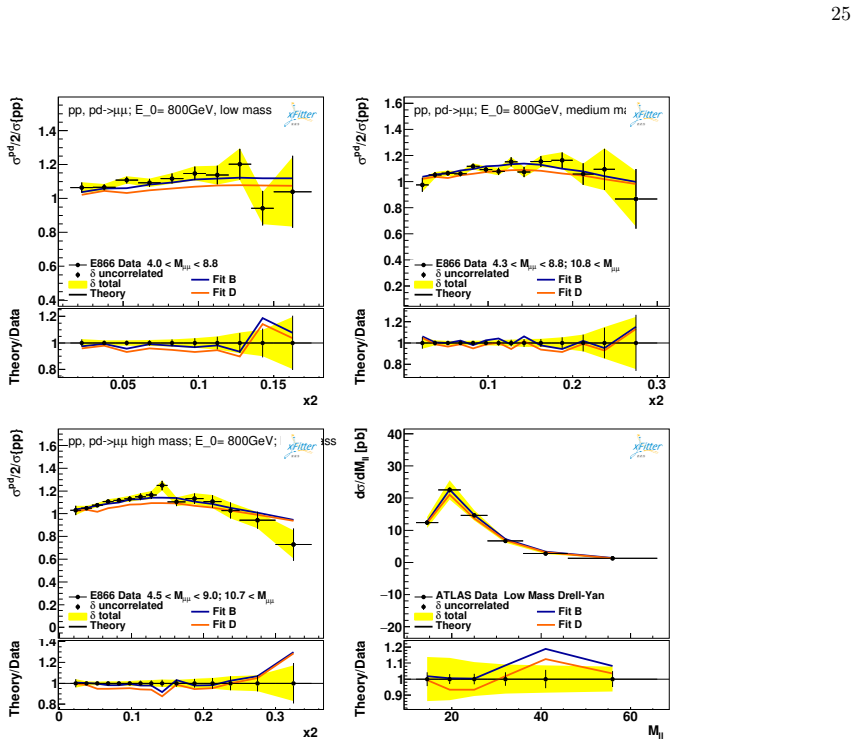
- [Sec. VI; Tables VI and VIII] The EIC projections are in-sample. The pseudodata are generated from HERAPDF2.0NLO and HERAPDF2.0NNLO (Sec. VI) and are then fitted with the same HERAPDF-like functional form of Eq. (6), so the reported reductions in the gluon uncertainty and in α_s (from 0.0014 to 0.0008, and to 0.0003 with jets) are consequences of the assumed input rather than independent forecasts. No closure tests with alternative generator PDFs or alternative parameterizations are presented. The conclusions in Sec. XI that EIC data 'could play a crucial role in constraining α_s' should be rephrased as an illustrative projection, or substantiated by varying the pseudo-data generator and the fit parameterization.
- [Sec. IV C and Sec. V D] The Hessian uncertainty procedure is not fully specified. Equation (13) gives the error-propagation formula, but the manuscript never states the Δχ² or tolerance criterion used to define the eigenvector displacements, nor how the resulting uncertainties are normalized to the '68% CL' claimed in Sec. V D. Without this information, the central quantitative claim that Fit D uncertainties are smaller than those of CT18, MSHT20, and NNPDF4.0 cannot be reproduced or compared on an equal footing. This is a standard but mandatory detail for a Hessian PDF release.
minor comments (4)
- [Table II] The table contains a duplicated row for 'ATLAS W+ [48]' (two identical 15/11 entries). The text states that Fit D uses 1355 data points, and the totals in the table are consistent with that number, but the printed rows sum to 1366; the duplicate should be removed or corrected.
- [Table I] In the W/Z production rows, the ATLAS 7 TeV data are listed with 'L = 4.6 pb−1'; the unit should be fb−1 for the 4.6 fb−1 dataset referenced as [45].
- [Availability of proton PDFs sets] The statement that PDF sets are available 'via email upon request' is not a satisfactory release mechanism for a PDF publication; the LHAPDF grids should be deposited with a permanent DOI or URL, and the exact Δχ² tolerance used for the eigenvector sets should accompany them.
- [Table VI] Several real-data χ² values worsen substantially when EIC pseudodata are added: ATLAS W/Z changes from 104.8/91 to 111.3/91, D0 W/Z from 67/51 to 77/51, and E866 Drell-Yan from 50/39 to 70/39. This tension is not discussed in Sec. VI and should be addressed.
Circularity Check
Reported strange-sea ratio rs=1.069 at x=0.023 is the Eq. (6) fit parameter, not the ratio defined by Eq. (14).
-
fitted input called prediction
[Sec. VIII; Eq. (6) and Eq. (14); Table VIII (Fit D); cf. Table III Fit D parameters C_s=16.4, C_dbar=5.68]
"xs(x) = A¯s rs x^{B¯s} (1 − x)^{Cs} ... In this analysis, we determine rs at Q2 = 1.9GeV2 and x = 0.023 ... The baseline fit (Fit D) yields rs = 1.069 ± 0.053"
Under Eqs. (5)-(6), with A_sbar=A_dbar and B_sbar=B_dbar, the physical ratio (s+sbar)/(2 dbar) equals xs/xdbar = rs*(1-x)^(C_s-C_dbar). At x=0.023, Fit D Table III gives C_s=16.4 and C_dbar=5.68, so (1-x)^(C_s-C_dbar) ≈ 0.78, making the ratio ≈0.83, not 1.069. The quoted 'rs at x=0.023' is therefore the fitted normalization parameter from Eq. (6) read off as if it were the ratio defined in Eq. (14). The x-dependence is dropped, so the headline strange-sea result is a fitted input renamed as a prediction, not an evaluated ratio.
full rationale
The central PDF extraction is self-contained and data-driven: Fits A-D minimize a chi-square against external HERA, Drell-Yan, and W/Z measurements, and the Hessian uncertainty propagation is standard. I found no load-bearing self-citation; the cited HERAPDF, MSHT, NNPDF, CT18, and EIC projection works are independent groups. The EIC section is an explicitly labeled projection: pseudo-data are generated from HERAPDF2.0 with assumed uncertainties, so the projected reductions in PDF/alpha_s uncertainties are inherited from those assumptions rather than from data; because the paper calls them simulated/projected, this is not a hidden circular derivation. The one concrete circular/mislabeled step is the strange-sea ratio. Equation (6) introduces rs as a multiplicative normalization in xs(x) while Eq. (14) defines rs as the physical ratio (s+sbar)/(2 dbar). With A_sbar=A_dbar and B_sbar=B_dbar, the physical ratio equals rs (1-x)^(C_s-C_dbar). Using Fit D's C_s=16.4 and C_dbar=5.68, at x=0.023 the factor is ~0.78, so the physical ratio is ~0.83, not 1.069. Table VIII quotes the fitted parameter as if it were the ratio at x=0.023, dropping the x-dependent factor. This is a fitted input renamed as a result, though it does not invalidate the independent PDF determination. Overall score reflects one secondary 'prediction' reducing by construction while the main global fit remains externally anchored.
Assumptions & free parameters
free parameters (6)
- PDF valence shape parameters: Auv, Buv, Cuv, Euv, Adv, Bdv, Cdv =
Table III (Fit D)
- PDF sea parameters: A_dbar, B_dbar, C_dbar, C_ubar, C_s =
Table III (Fit D)
- Gluon parameters: Ag, Bg, Cg, Ag', Bg' =
Table III (Fit D)
- C_g' =
25 (fixed)
- alpha_s(MZ) =
0.1128 +/- 0.0014 (Fit D)
- r_s = (s+sbar)/(2 dbar) =
1.069 +/- 0.053 (Fit D)
assumptions (7)
- standard math QCD factorization and DGLAP evolution at NLO and NNLO are valid for the fitted processes.
- ad hoc to paper The HERAPDF-like parameterization of Eq. (6) is sufficiently flexible and unbiased.
- ad hoc to paper The sea-quark symmetry assumptions (A_dbar=A_ubar, B_dbar=B_ubar, s=sbar, A_s=A_dbar, B_s=B_dbar) are valid.
- domain assumption The Q^2 > 10 GeV^2 cut removes higher-twist contributions.
- ad hoc to paper EIC pseudo-data generated from HERAPDF2.0 with assumed uncertainties represent future EIC measurements.
- domain assumption The Hessian quadratic approximation gives reliable uncertainty propagation.
- domain assumption The Thorne-Roberts variable flavor number scheme is adequate for heavy quarks.
Cite this review
Pith. "Pith review of Revisiting constraints on proton PDFs from HERA DIS, Drell-Yan, W/Z Boson production, and projected EIC measurements." pith.science (2026). https://pith.science/paper/F73NEVXX
@misc{pith2026241210727,
  author       = {Pith},
  title        = {Pith review of: Revisiting constraints on proton PDFs from HERA DIS, Drell-Yan, W/Z Boson production, and projected EIC measurements},
  year         = {2026},
  howpublished = {\url{https://pith.science/paper/F73NEVXX}},
  note         = {Machine review of arXiv:2412.10727}
}
abstract
We present new parton distribution functions (PDFs) at next-to-leading order (NLO) and next-to-next-to-leading order (NNLO) in perturbative QCD, derived from a comprehensive global QCD analysis of high-precision data sets from combined HERA deep-inelastic scattering (DIS), the Tevatron, and the Large Hadron Collider (LHC). To improve constraints on quark flavor separation, we incorporate Drell-Yan pair production data, which provides critical sensitivity to the quark distributions. In addition, we include the latest W and Z boson production data from the CDF, D0, ATLAS, and CMS collaborations, further refining both quark and gluon distributions. Our nominal global QCD fit integrates these datasets and examines the resulting impact on the PDFs and their associated uncertainties. Uncertainties in the PDFs are quantified using the Hessian method, ensuring robust error estimates. Furthermore, we explore the sensitivity of the strong coupling constant, $\alpha_s(M_Z^2)$, and proton PDFs in light of the projected measurements from the Electron-Ion Collider (EIC), where improvements in precision are expected. The analysis also investigates the effects of inclusive jet and dijet production data, which provide enhanced constraints on the gluon PDF and $\alpha_s(M_Z^2)$.
Figures


Figures from the paper (20 more)




Forward citations
Cited by 1 Pith paper
-
Toward Precision Helicity PDFs from Global DIS and SIDIS Fits with Projected EIC Measurements
Projected EIC pion and kaon SIDIS measurements would substantially reduce the uncertainties on the proton's sea-quark and gluon helicity distributions, most strongly at small momentum fractions.
Reference graph
Works this paper leans on
-
[1]
Review of Searches for Rare Processes and Physics Beyond the Stan- dard Model at HERA,
D. M. South and M. Turcato, “Review of Searches for Rare Processes and Physics Beyond the Stan- dard Model at HERA,” Eur. Phys. J. C 76, no.6, 336 (2016) doi:10.1140/epjc/s10052-016-4152-3 [arXiv:1605.03459 [hep-ex]]
arXiv 2016
-
[2]
50 Years of Quan- tum Chromodynamics,
F. Gross, E. Klempt, S. J. Brodsky, A. J. Buras, V. D. Burkert, G. Heinrich, K. Jakobs, C. A. Meyer, K. Orginos and M. Strickland,et al. “50 Years of Quan- tum Chromodynamics,” Eur. Phys. J. C83, 1125 (2023), [arXiv:2212.11107 [hep-ph]]
arXiv 2023
-
[3]
Deep-inelastic scattering: What do we know?,
J. Blümlein, “Deep-inelastic scattering: What do we know?,” Int. J. Mod. Phys. A 39, no.09n10, 2441004 (2024), [arXiv:2306.01362 [hep-ph]]
arXiv 2024
-
[4]
The Theory of Deeply Inelastic Scat- tering,
J. Blumlein, “The Theory of Deeply Inelastic Scat- tering,” Prog. Part. Nucl. Phys. 69, 28-84 (2013), [arXiv:1208.6087 [hep-ph]]
arXiv 2013
-
[5]
The Structure of the Proton in the LHC Precision Era,
J. Gao, L. Harland-Lang and J. Rojo, “The Structure of the Proton in the LHC Precision Era,” Phys. Rept.742, 1-121 (2018), [arXiv:1709.04922 [hep-ph]]
arXiv 2018
-
[6]
Science Requirements and Detector Concepts for the Electron-Ion Collider: EIC Yellow Report,
R. Abdul Khalek, A. Accardi, J. Adam, D. Adamiak, W. Akers, M. Albaladejo, A. Al-bataineh, M. G. Alexeev, F. Ameli and P. Antonioli,et al. “Science Requirements and Detector Concepts for the Electron-Ion Collider: EIC Yellow Report,” Nucl. Phys. A1026, 122447 (2022) doi:10.1016/j.nuclphysa.2022.122447 [arXiv:2103.05419 [physics.ins-det]]
arXiv 2022
-
[7]
Snowmass 2021 White Paper: Electron Ion Collider for High Energy Physics,
R. Abdul Khalek, U. D’Alesio, M. Arratia, A. Bacchetta, M. Battaglieri, M. Begel, M. Boglione, R. Boughezal, R. Boussarie and G. Bozzi,et al. “Snowmass 2021 White Paper: Electron Ion Collider for High Energy Physics,” [arXiv:2203.13199 [hep-ph]]
arXiv 2021
-
[8]
The Large Hadron–Electron Collider at the HL-LHC,
P. Agostini et al. [LHeC and FCC-he Study Group], “The Large Hadron–Electron Collider at the HL-LHC,” J. Phys. G48, no.11, 110501 (2021) doi:10.1088/1361- 6471/abf3ba [arXiv:2007.14491 [hep-ex]]
arXiv 2021
Show all 94 references
-
[9]
FCC Physics Opportuni- ties: Future Circular Collider Conceptual Design Re- port Volume 1,
A. Abada et al. [FCC], “FCC Physics Opportuni- ties: Future Circular Collider Conceptual Design Re- port Volume 1,” Eur. Phys. J. C79, no.6, 474 (2019) doi:10.1140/epjc/s10052-019-6904-3
2019 doi
-
[10]
FCC-hh: The Hadron Collider: Future Circular Collider Conceptual Design Report Vol- ume 3,
A. Abada et al. [FCC], “FCC-hh: The Hadron Collider: Future Circular Collider Conceptual Design Report Vol- ume 3,” Eur. Phys. J. ST 228, no.4, 755-1107 (2019) doi:10.1140/epjst/e2019-900087-0
2019 doi
-
[11]
HE-LHC: The High-Energy Large Hadron Collider: Future Circular Collider Con- ceptual Design Report Volume 4,
A. Abada et al. [FCC], “HE-LHC: The High-Energy Large Hadron Collider: Future Circular Collider Con- ceptual Design Report Volume 4,” Eur. Phys. J. ST228, no.5, 1109-1382 (2019) doi:10.1140/epjst/e2019-900088-6
2019 doi
-
[12]
New CTEQ global analysis of quantum chromodynamics with high-precision data from the LHC,
T. J. Hou, J. Gao, T. J. Hobbs, K. Xie, S. Du- lat, M. Guzzi, J. Huston, P. Nadolsky, J. Pumplin and C. Schmidt, et al. “New CTEQ global analysis of quantum chromodynamics with high-precision data from the LHC,” Phys. Rev. D 103, no.1, 014013 (2021), [arXiv:1912.10053 [hep-ph]]. 39
2021 arXiv
-
[13]
New results in the CTEQ-TEA global analysis ofpartondistributionsinthenucleon,
A. Ablat, A. Courtoy, S. Dulat, M. Guzzi, T. J. Hobbs, T. J. Hou, J. Huston, K. Mohan, H. W. Lin and P. Nadol- sky, et al. “New results in the CTEQ-TEA global analysis ofpartondistributionsinthenucleon,” [arXiv:2408.04020 [hep-ph]]
-
[14]
The path to proton structure at 1% accuracy,
R. D. Ballet al. [NNPDF], “The path to proton structure at 1% accuracy,” Eur. Phys. J. C82, no.5, 428 (2022), [arXiv:2109.02653 [hep-ph]]
2022 arXiv
-
[15]
LO, NLO, and NNLO parton distributions for LHC event generators,
J. Cruz-Martinez, S. Forte, N. Laurenti, T. R. Rabe- mananjara and J. Rojo, “LO, NLO, and NNLO parton distributions for LHC event generators,” JHEP09, 088 (2024) doi:10.1007/JHEP09(2024)088 [arXiv:2406.12961 [hep-ph]]
2024 arXiv
-
[16]
Parton distributions from LHC, HERA, Tevatron and fixed target data: MSHT20 PDFs,
S. Bailey, T. Cridge, L. A. Harland-Lang, A. D. Mar- tin and R. S. Thorne, “Parton distributions from LHC, HERA, Tevatron and fixed target data: MSHT20 PDFs,” Eur. Phys. J. C81, no.4, 341 (2021), [arXiv:2012.04684 [hep-ph]]
2021 arXiv
-
[17]
Impact of jet-production data on the next-to-next-to-leading-order determination of HERAPDF2.0 parton distributions,
I. Abt et al. [H1 and ZEUS], “Impact of jet-production data on the next-to-next-to-leading-order determination of HERAPDF2.0 parton distributions,” Eur. Phys. J. C 82, no.3, 243 (2022) [arXiv:2112.01120 [hep-ex]]
2022 arXiv
-
[18]
Determination of the parton distribution functions of the proton using diverse ATLAS data from pp collisions at √s = 7, 8 and 13 TeV,
G. Aad et al. [ATLAS], “Determination of the parton distribution functions of the proton using diverse ATLAS data from pp collisions at √s = 7, 8 and 13 TeV,” Eur. Phys. J. C82, no.5, 438 (2022) [arXiv:2112.11266 [hep- ex]]
2022 arXiv
-
[19]
NNLO PDFs driven by top-quark data,
S. Alekhin, M. V. Garzelli, S. O. Moch and O. Zenaiev, “NNLO PDFs driven by top-quark data,” [arXiv:2407.00545 [hep-ph]]
-
[20]
Parton distributions from high-precision collider data,
R. D. Ball et al. [NNPDF], “Parton distributions from high-precision collider data,” Eur. Phys. J. C77, no.10, 663 (2017), [arXiv:1706.00428 [hep-ph]]
2017 arXiv
-
[21]
Parton distributions in the LHC era: MMHT 2014 PDFs,
L. A. Harland-Lang, A. D. Martin, P. Motylin- ski and R. S. Thorne, “Parton distributions in the LHC era: MMHT 2014 PDFs,” Eur. Phys. J. C 75, no.5, 204 (2015) doi:10.1140/epjc/s10052-015-3397-6 [arXiv:1412.3989 [hep-ph]]
2015 arXiv
-
[22]
A Stress Test of Global PDF Fits: Closure Testing the MSHT PDFs and a First Direct Comparison to the Neu- ral Net Approach,
L. A. Harland-Lang, T. Cridge and R. S. Thorne, “A Stress Test of Global PDF Fits: Closure Testing the MSHT PDFs and a First Direct Comparison to the Neu- ral Net Approach,” [arXiv:2407.07944 [hep-ph]]
-
[23]
QCD analysis of the ATLAS and CMS W ± and Z cross-section measurements and implications for the strange sea density,
A. M. Cooper-Sarkar and K. Wichmann, “QCD analysis of the ATLAS and CMS W ± and Z cross-section measurements and implications for the strange sea density,” Phys. Rev. D 98, no.1, 014027 (2018) doi:10.1103/PhysRevD.98.014027 [arXiv:1803.00968 [hep-ex]]
2018 arXiv
-
[24]
Strange quark suppression from a simultaneous Monte Carlo analysis of parton distribu- tions and fragmentation functions,
N. Sato et al. [JAM], “Strange quark suppression from a simultaneous Monte Carlo analysis of parton distribu- tions and fragmentation functions,” Phys. Rev. D101, no.7, 074020 (2020) doi:10.1103/PhysRevD.101.074020 [arXiv:1905.03788 [hep-ph]]
2020 arXiv
-
[25]
Impact of inclusive electron ion collider data on collinear parton distributions,
N. Armesto, T. Cridge, F. Giuli, L. Harland-Lang, P. Newman, B. Schmookler, R. Thorne and K. Wich- mann, “Impact of inclusive electron ion collider data on collinear parton distributions,” Phys. Rev. D 109, no.5, 5 (2024) doi:10.1103/PhysRevD.109.054019 [arXiv:2309.11269 [hep-ph]]
2024 arXiv
-
[26]
Extraction of the strong coupling with HERA and EIC inclusive data,
S. Cerci, Z. S. Demiroglu, A. Deshpande, P. R. New- man, B. Schmookler, D. Sunar Cerci and K. Wichmann, “Extraction of the strong coupling with HERA and EIC inclusive data,” Eur. Phys. J. C83, no.11, 1011 (2023) doi:10.1140/epjc/s10052-023-12176-5 [arXiv:2307.01183 [hep-ph]]
2023 arXiv
-
[27]
Factorization of Hard Processes in QCD,
J. C. Collins, D. E. Soper and G. F. Ster- man, “Factorization of Hard Processes in QCD,” Adv. Ser. Direct. High Energy Phys. 5, 1-91 (1989) doi:10.1142/9789814503266_0001 [arXiv:hep- ph/0409313 [hep-ph]]
1989
-
[28]
Parton distributions for the LHC,
A. D. Martin, W. J. Stirling, R. S. Thorne and G. Watt, “Parton distributions for the LHC,” Eur. Phys. J. C 63, 189-285 (2009) doi:10.1140/epjc/s10052-009-1072-5 [arXiv:0901.0002 [hep-ph]]
2009 arXiv
-
[29]
Parton Distribution Functions and Benchmark Cross Sec- tions at NNLO,
S. Alekhin, J. Blumlein and S. Moch, “Parton Distribution Functions and Benchmark Cross Sec- tions at NNLO,” Phys. Rev. D 86, 054009 (2012) doi:10.1103/PhysRevD.86.054009 [arXiv:1202.2281 [hep- ph]]
2012 arXiv
-
[30]
Improved measurement of the anti-d / anti-u asymmetry in the nucleon sea,
R. S. Towellet al. [NuSea], “Improved measurement of the anti-d / anti-u asymmetry in the nucleon sea,” Phys. Rev. D 64 (2001), 052002 [arXiv:hep-ex/0103030 [hep- ex]]
2001 arXiv
-
[31]
A complete calculation of the order α − s2 correction to the Drell-Yan K factor,
R. Hamberg, W. L. van Neerven and T. Matsuura, “A complete calculation of the order α − s2 correction to the Drell-Yan K factor,” Nucl. Phys. B 359, 343-405 (1991) [erratum: Nucl. Phys. B 644, 403-404 (2002)] doi:10.1016/0550-3213(91)90064-5
1991 doi
-
[32]
Theory of W and Z boson pro- duction,
P. M. Nadolsky, “Theory of W and Z boson pro- duction,” AIP Conf. Proc. 753, no.1, 158-170 (2005) doi:10.1063/1.1896698 [arXiv:hep-ph/0412146 [hep-ph]]
2005 arXiv
-
[33]
QCD and Jets at Hadron Collid- ers,
S. Sapeta, “QCD and Jets at Hadron Collid- ers,” Prog. Part. Nucl. Phys. 89, 1-55 (2016) doi:10.1016/j.ppnp.2016.02.002 [arXiv:1511.09336 [hep- ph]]
2016 arXiv
-
[34]
A General algorithm for calculating jet cross-sections in NLO QCD,
S. Catani and M. H. Seymour, “A General algorithm for calculating jet cross-sections in NLO QCD,” Nucl. Phys. B 485, 291-419 (1997) [erratum: Nucl. Phys. B 510, 503-504 (1998)] doi:10.1016/S0550-3213(96)00589- 5 [arXiv:hep-ph/9605323 [hep-ph]]
1997 arXiv
-
[35]
Next-to- next-to-leading order Higgs production at hadron colliders,
R. V. Harlander and W. B. Kilgore, “Next-to- next-to-leading order Higgs production at hadron colliders,” Phys. Rev. Lett. 88, 201801 (2002) doi:10.1103/PhysRevLett.88.201801 [arXiv:hep- ph/0201206 [hep-ph]]
2002
-
[36]
Benchmark of deep- inelastic-scattering structure functions at O α3 s ,
V. Bertone and A. Karlberg, “Benchmark of deep- inelastic-scattering structure functions at O α3 s ,” Eur. Phys. J. C84, no.8, 774 (2024) doi:10.1140/epjc/s10052- 024-13133-6 [arXiv:2404.15711 [hep-ph]]
2024 arXiv
-
[37]
A Variable-flavor number scheme for NNLO,
R. S. Thorne, “A Variable-flavor number scheme for NNLO,” Phys. Rev. D 73, 054019 (2006) doi:10.1103/PhysRevD.73.054019 [arXiv:hep- ph/0601245 [hep-ph]]
2006
-
[38]
Neural network parametrization of deep inelastic struc- ture functions,
S. Forte, L. Garrido, J. I. Latorre and A. Piccione, “Neural network parametrization of deep inelastic struc- ture functions,” JHEP05, 062 (2002) doi:10.1088/1126- 6708/2002/05/062 [arXiv:hep-ph/0204232 [hep-ph]]
2002 arXiv
-
[39]
An FONLL prescription with coexisting flavor number PDFs,
A. Barontini, A. Candido, F. Hekhorn, G. Magni and R. Stegeman, “An FONLL prescription with coexisting flavor number PDFs,” [arXiv:2408.07383 [hep-ph]]
-
[40]
Leptoproduction of heavy quarks. 1. General formal- ism and kinematics of charged current and neutral cur- rent production processes,
M. A. G. Aivazis, F. I. Olness and W. K. Tung, “Leptoproduction of heavy quarks. 1. General formal- ism and kinematics of charged current and neutral cur- rent production processes,” Phys. Rev. D 50, 3085- 3101 (1994) doi:10.1103/PhysRevD.50.3085 [arXiv:hep- ph/9312318 [hep-ph]]
1994
-
[41]
Hard scattering factorization with heavy quarks: A General treatment,
J. C. Collins, “Hard scattering factorization with heavy quarks: A General treatment,” Phys. Rev. 40 D 58, 094002 (1998) doi:10.1103/PhysRevD.58.094002 [arXiv:hep-ph/9806259 [hep-ph]]
1998 arXiv
-
[42]
Charm electroproduction viewed in the vari- able flavor number scheme versus fixed order pertur- bation theory,
M. Buza, Y. Matiounine, J. Smith and W. L. van Neerven, “Charm electroproduction viewed in the vari- able flavor number scheme versus fixed order pertur- bation theory,” Eur. Phys. J. C 1, 301-320 (1998) doi:10.1007/BF01245820 [arXiv:hep-ph/9612398 [hep- ph]]
1998 arXiv
-
[43]
An Ordered analysis of heavy flavor production in deep inelas- tic scattering,
R. S. Thorne and R. G. Roberts, “An Ordered analysis of heavy flavor production in deep inelas- tic scattering,” Phys. Rev. D 57, 6871-6898 (1998) doi:10.1103/PhysRevD.57.6871 [arXiv:hep-ph/9709442 [hep-ph]]
1998 arXiv
-
[45]
Precision measurement and interpretation of inclusive W + , W − and Z/γ ∗ produc- tion cross sections with the ATLAS detector,
M. Aaboud et al. [ATLAS], “Precision measurement and interpretation of inclusive W + , W − and Z/γ ∗ produc- tion cross sections with the ATLAS detector,” Eur. Phys. J. C77 (2017) no.6, 367 [arXiv:1612.03016 [hep-ex]]
2017 arXiv
-
[46]
Measurement of the low- mass Drell-Yan differential cross section at √s = 7 TeV using the ATLAS detector,
G. Aad et al. [ATLAS], “Measurement of the low- mass Drell-Yan differential cross section at √s = 7 TeV using the ATLAS detector,” JHEP06 (2014), 112 [arXiv:1404.1212 [hep-ex]]
2014 arXiv
-
[47]
Measurement of the high-mass Drell–Yan differential cross-section in pp collisions at sqrt(s)=7 TeV with the ATLAS detector,
G. Aad et al. [ATLAS], “Measurement of the high-mass Drell–Yan differential cross-section in pp collisions at sqrt(s)=7 TeV with the ATLAS detector,” Phys. Lett. B 725 (2013), 223-242 [arXiv:1305.4192 [hep-ex]]
2013 arXiv
-
[48]
Determination of the strange quark density of the proton from ATLAS measurements of the W → ℓν and Z → ℓℓ cross sections,
G. Aad et al. [ATLAS], “Determination of the strange quark density of the proton from ATLAS measurements of the W → ℓν and Z → ℓℓ cross sections,” Phys. Rev. Lett. 109 (2012), 012001 [arXiv:1203.4051 [hep-ex]]
2012 arXiv
-
[49]
Measurement of the Elec- tron Charge Asymmetry in InclusiveW Production inpp Collisions at √s = 7 TeV,
S. Chatrchyan et al. [CMS], “Measurement of the Elec- tron Charge Asymmetry in InclusiveW Production inpp Collisions at √s = 7 TeV,” Phys. Rev. Lett.109 (2012), 111806 [arXiv:1206.2598 [hep-ex]]
2012 arXiv
-
[50]
Measurement of the Muon Charge Asymmetry in Inclusivepp → W + X Production at √s = 7 TeV and an Improved Determination of Light Parton Distribution Functions,
S. Chatrchyanet al. [CMS], “Measurement of the Muon Charge Asymmetry in Inclusivepp → W + X Production at √s = 7 TeV and an Improved Determination of Light Parton Distribution Functions,” Phys. Rev. D90 (2014) no.3, 032004 [arXiv:1312.6283 [hep-ex]]
2014 arXiv
-
[51]
Measurement of the differ- ential cross section and charge asymmetry for inclusive pp → W± + X production at √s = 8 TeV,
V. Khachatryanet al. [CMS], “Measurement of the differ- ential cross section and charge asymmetry for inclusive pp → W± + X production at √s = 8 TeV,” Eur. Phys. J. C76 (2016) no.8, 469 [arXiv:1603.01803 [hep-ex]]
2016 arXiv
-
[52]
Measurement of the Rapid- ity and Transverse Momentum Distributions ofZ Bosons in pp Collisions at√s = 7 TeV,
S. Chatrchyanet al. [CMS], “Measurement of the Rapid- ity and Transverse Momentum Distributions ofZ Bosons in pp Collisions at√s = 7 TeV,” Phys. Rev. D85, 032002 (2012), [arXiv:1110.4973 [hep-ex]]
2012 arXiv
-
[53]
Direct Measurement of the W Production Charge Asymmetry in p¯p Collisions at√s = 1 .96 TeV,
T. Aaltonen et al. [CDF], “Direct Measurement of the W Production Charge Asymmetry in p¯p Collisions at√s = 1 .96 TeV,” Phys. Rev. Lett.102, 181801 (2009) [arXiv:0901.2169 [hep-ex]]
2009 arXiv
-
[54]
Measurement ofdσ/dy of Drell-Yan e+e− pairs in theZ Mass Region fromp¯p Col- lisions at √s = 1 .96 TeV,
T. A. Aaltonenet al. [CDF], “Measurement ofdσ/dy of Drell-Yan e+e− pairs in theZ Mass Region fromp¯p Col- lisions at √s = 1 .96 TeV,” Phys. Lett. B692, 232-239 (2010), [arXiv:0908.3914 [hep-ex]]
2010 arXiv
-
[55]
Measurement of the electron charge asymmetry inp ¯p → W + X → eν + X decays in p ¯p collisions at √s = 1.96 TeV,
V. M. Abazovet al. [D0], “Measurement of the electron charge asymmetry inp ¯p → W + X → eν + X decays in p ¯p collisions at √s = 1.96 TeV,” Phys. Rev. D91, no.3, 032007 (2015) [erratum: Phys. Rev. D 91, no.7, 079901 (2015)] [arXiv:1412.2862 [hep-ex]]
2015 arXiv
-
[56]
Measurement of the Muon Charge Asymmetry in p¯p → W+X → µν + X Events at √s=1.96 TeV,
V. M. Abazov et al. [D0], “Measurement of the Muon Charge Asymmetry in p¯p → W+X → µν + X Events at √s=1.96 TeV,” Phys. Rev. D 88, 091102 (2013) [arXiv:1309.2591 [hep-ex]]
2013 arXiv
-
[57]
Measurement of the Shape of the Boson Rapidity Distribution for p¯p → Z/γ ∗ → e+e− + X Events Produced at √s of 1.96-TeV,
V. M. Abazov et al. [D0], “Measurement of the Shape of the Boson Rapidity Distribution for p¯p → Z/γ ∗ → e+e− + X Events Produced at √s of 1.96-TeV,” Phys. Rev. D76, 012003 (2007), [arXiv:hep-ex/0702025 [hep- ex]]
2007 arXiv
-
[58]
xFitter: AnOpenSource QCD Analysis Framework. A resource and reference doc- ument for the Snowmass study,
H.Abdolmaleki et al. [xFitter], “xFitter: AnOpenSource QCD Analysis Framework. A resource and reference doc- ument for the Snowmass study,” [arXiv:2206.12465 [hep- ph]]
-
[59]
HERAFitter,
S. Alekhin, O. Behnke, P. Belov, S. Borroni, M. Botje, D. Britzger, S. Camarda, A. M. Cooper-Sarkar, K. Daum and C. Diaconu, et al. “HERAFitter,” Eur. Phys. J. C 75, no.7, 304 (2015) doi:10.1140/epjc/s10052-015-3480-z [arXiv:1410.4412 [hep-ph]]
2015 arXiv
-
[60]
Asymptotic Freedom in Parton Language,
G. Altarelli and G. Parisi, “Asymptotic Freedom in Parton Language,” Nucl. Phys. B 126, 298-318 (1977) doi:10.1016/0550-3213(77)90384-4
1977 doi
-
[61]
Deep inelastic e p scat- tering in perturbation theory,
V. N. Gribov and L. N. Lipatov, “Deep inelastic e p scat- tering in perturbation theory,” Sov. J. Nucl. Phys.15, 438-450 (1972) IPTI-381-71
1972
-
[62]
Calculation of the Structure Func- tions for Deep Inelastic Scattering and e+ e- Annihilation by Perturbation Theory in Quantum Chromodynamics.,
Y. L. Dokshitzer, “Calculation of the Structure Func- tions for Deep Inelastic Scattering and e+ e- Annihilation by Perturbation Theory in Quantum Chromodynamics.,” Sov. Phys. JETP46, 641-653 (1977)
1977
-
[63]
Minuit: A System for Func- tion Minimization and Analysis of the Parameter Errors and Correlations,
F. James and M. Roos, “Minuit: A System for Func- tion Minimization and Analysis of the Parameter Errors and Correlations,” Comput. Phys. Commun.10, 343-367 (1975)
1975
-
[64]
MINUIT Function Minimization and Error Analysis: Reference Manual Version 94.1,
F. James, “MINUIT Function Minimization and Error Analysis: Reference Manual Version 94.1,” CERN-D-506
-
[65]
Effect of changes of variable flavor num- ber scheme on parton distribution functions and pre- dicted cross sections,
R. S. Thorne, “Effect of changes of variable flavor num- ber scheme on parton distribution functions and pre- dicted cross sections,” Phys. Rev. D86, 074017 (2012) doi:10.1103/PhysRevD.86.074017 [arXiv:1201.6180 [hep- ph]]
2012 arXiv
-
[66]
Combination of measurements of inclusive deep inelastice±p scattering cross sections and QCD analysis of HERA data,
H. Abramowicz et al. [H1 and ZEUS], “Combination of measurements of inclusive deep inelastice±p scattering cross sections and QCD analysis of HERA data,” Eur. Phys. J. C75 (2015) no.12, 580 [arXiv:1506.06042 [hep- ex]]
2015 arXiv
-
[67]
MRST2001: Partons and αs from pre- cise deep inelastic scattering and Tevatron jet data,
A. D. Martin, R. G. Roberts, W. J. Stirling and R. S. Thorne, “MRST2001: Partons and αs from pre- cise deep inelastic scattering and Tevatron jet data,” Eur. Phys. J. C23, 73-87 (2002) doi:10.1007/s100520100842 [arXiv:hep-ph/0110215 [hep-ph]]
2002 arXiv
-
[68]
LHAPDF6: parton density access in the LHC precision era,
A. Buckley, J. Ferrando, S. Lloyd, K. Nordström, B. Page, M. Rüfenacht, M. Schönherr and G. Watt, “LHAPDF6: parton density access in the LHC precision era,” Eur. Phys. J. C 75, 132 (2015) doi:10.1140/epjc/s10052-015-3318-8 [arXiv:1412.7420 [hep-ph]]
2015 arXiv
-
[69]
Un- certainties of predictions from parton distribution functions. 2. The Hessian method,
J. Pumplin, D. Stump, R. Brock, D. Casey, J. Hus- ton, J. Kalk, H. L. Lai and W. K. Tung, “Un- certainties of predictions from parton distribution functions. 2. The Hessian method,” Phys. Rev. D 65, 014013 (2001) doi:10.1103/PhysRevD.65.014013 [arXiv:hep-ph/0101032 [hep-ph]]
2001 arXiv
-
[70]
Par- ton Distribution Function Uncertainties,
W. T. Giele, S. A. Keller and D. A. Kosower, “Par- ton Distribution Function Uncertainties,” [arXiv:hep- ph/0104052 [hep-ph]]. 41
-
[71]
Precision studies of QCD in the low energy domain of the EIC,
V. D. Burkert, L. Elouadrhiri, A. Afanasev, J. Ar- rington, M. Contalbrigo, W. Cosyn, A. Deshpande, D. I. Glazier, X. Ji and S. Liuti, et al. “Precision studies of QCD in the low energy domain of the EIC,” Prog. Part. Nucl. Phys. 131, 104032 (2023) doi:10.1016/j.ppnp.2023.1040...
2023
-
[72]
Electron Ion Col- lider: The Next QCD Frontier: Understanding the glue that binds us all,
A. Accardi, J. L. Albacete, M. Anselmino, N. Armesto, E. C. Aschenauer, A. Bacchetta, D. Boer, W. K. Brooks, T. Burton and N. B. Chang, et al. “Electron Ion Col- lider: The Next QCD Frontier: Understanding the glue that binds us all,” Eur. Phys. J. A52, no.9, 268 (2016) doi:10...
2016 arXiv
-
[73]
ATHENA detector pro- posal — a totally hermetic electron nucleus appara- tus proposed for IP6 at the Electron-Ion Collider,
J. Adam et al. [ATHENA], “ATHENA detector pro- posal — a totally hermetic electron nucleus appara- tus proposed for IP6 at the Electron-Ion Collider,” JINST 17, no.10, P10019 (2022) doi:10.1088/1748- 0221/17/10/P10019 [arXiv:2210.09048 [physics.ins-det]]
2022
-
[74]
Measurement of inclusive jet pro- duction in deep-inelastic scattering at high Q**2 and de- termination of the strong coupling,
A. Aktas et al. [H1], “Measurement of inclusive jet pro- duction in deep-inelastic scattering at high Q**2 and de- termination of the strong coupling,” Phys. Lett. B653, 134-144 (2007) [arXiv:0706.3722 [hep-ex]]
2007 arXiv
-
[75]
Jet Production in ep Collisions at Low Q**2 and Determination of alpha(s),
F. D. Aaronet al. [H1], “Jet Production in ep Collisions at Low Q**2 and Determination of alpha(s),” Eur. Phys. J. C67, 1-24 (2010) [arXiv:0911.5678 [hep-ex]]
2010 arXiv
-
[76]
Inclusive jet cross-sections in the Breit frame in neutral current deep inelastic scatter- ing at HERA and determination of alpha(s),
S. Chekanovet al. [ZEUS], “Inclusive jet cross-sections in the Breit frame in neutral current deep inelastic scatter- ing at HERA and determination of alpha(s),” Phys. Lett. B 547, 164-180 (2002) [arXiv:hep-ex/0208037 [hep-ex]]
2002 arXiv
-
[77]
Inclusive-jet and dijet cross- sections in deep inelastic scattering at HERA,
S. Chekanovet al. [ZEUS], “Inclusive-jet and dijet cross- sections in deep inelastic scattering at HERA,” Nucl. Phys. B 765, 1-30 (2007) [arXiv:hep-ex/0608048 [hep- ex]]
2007 arXiv
-
[78]
Inclusive dijet cross sections in neutral current deep inelastic scattering at HERA,
H. Abramowicz et al. [ZEUS], “Inclusive dijet cross sections in neutral current deep inelastic scattering at HERA,” Eur. Phys. J. C 70, 965-982 (2010) [arXiv:1010.6167 [hep-ex]]
2010 arXiv
-
[79]
FastNLO: Fast pQCD calculations for PDF fits,
T. Kluge, K. Rabbertz and M. Wobisch, “FastNLO: Fast pQCD calculations for PDF fits,” doi:10.1142/9789812706706_0110 [arXiv:hep- ph/0609285 [hep-ph]]
-
[80]
Parton distributions for the LHC Run II,
R. D. Ball et al. [NNPDF], “Parton distributions for the LHC Run II,” JHEP 04, 040 (2015) doi:10.1007/JHEP04(2015)040 [arXiv:1410.8849 [hep- ph]]
2015 arXiv
-
[81]
Measurement of jet production in deep inelastic scattering and NNLO determination of the strong coupling at ZEUS,
I. Abt et al. [ZEUS], “Measurement of jet production in deep inelastic scattering and NNLO determination of the strong coupling at ZEUS,” Eur. Phys. J. C83, no.11, 1082 (2023) doi:10.1140/epjc/s10052-023-12180-9 [arXiv:2309.02889 [hep-ex]]
2023 arXiv
-
[82]
Determination of the strong coupling constant from transverse energy−energy cor- relations in multijet events at √s = 13 TeV with the ATLAS detector,
G. Aad et al. [ATLAS], “Determination of the strong coupling constant from transverse energy−energy cor- relations in multijet events at √s = 13 TeV with the ATLAS detector,” JHEP 07, 085 (2023) doi:10.1007/JHEP07(2023)085 [arXiv:2301.09351 [hep- ex]]
2023 arXiv
-
[83]
Aprecisedeterminationofthestrong-coupling constant from the recoil of Z bosons with the ATLAS experiment at √s = 8 TeV,
[ATLAS],“Aprecisedeterminationofthestrong-coupling constant from the recoil of Z bosons with the ATLAS experiment at √s = 8 TeV,” ATLAS-CONF-2023-015
2023
-
[84]
Measurement and QCD anal- ysis of double-differential inclusive jet cross sections in proton-proton collisions at√s = 13 TeV,
A. Tumasyanet al. [CMS], “Measurement and QCD anal- ysis of double-differential inclusive jet cross sections in proton-proton collisions at√s = 13 TeV,” JHEP02, 142 (2022) doi:10.1007/JHEP02(2022)142 [arXiv:2111.10431 [hep-ex]]
2022 arXiv
-
[85]
Determination of the strong cou- pling constant αs(mZ ) in next-to-next-to-leading order QCD using H1 jet cross section measurements,
V. Andreevet al. [H1], “Determination of the strong cou- pling constant αs(mZ ) in next-to-next-to-leading order QCD using H1 jet cross section measurements,” Eur. Phys. J. C77, no.11, 791 (2017) [erratum: Eur. Phys. J. C81, 738 (2021)] doi:10.1140/epjc/s10052-017-5314-7 [arXi...
2017 arXiv
-
[86]
Aad et al
G. Aad et al. [ATLAS], “Measurement of trans- verse energy-energy correlations in multi-jet events in pp collisions at √s = 7 TeV using the ATLAS detector and determination of the strong coupling constant αs(mZ ),” Phys. Lett. B 750, 427-447 (2015) doi:10.1016/j.physletb.2015....
2015 arXiv
-
[87]
Determination of the strong coupling constant αs from transverse energy–energy correlations in multijet events at √s = 8 TeV using the ATLAS detector,
M. Aaboudet al. [ATLAS], “Determination of the strong coupling constant αs from transverse energy–energy correlations in multijet events at √s = 8 TeV using the ATLAS detector,” Eur. Phys. J. C 77, no.12, 872 (2017) doi:10.1140/epjc/s10052-017-5442-0 [arXiv:1707.02562 [hep-ex]]
2017 arXiv
-
[88]
Measurement of dijet azimuthal decorrelations in pp collisions at √s = 8 TeV with the ATLAS detector and determina- tion of the strong coupling,
M. Aaboud et al. [ATLAS], “Measurement of dijet azimuthal decorrelations in pp collisions at √s = 8 TeV with the ATLAS detector and determina- tion of the strong coupling,” Phys. Rev. D 98, no.9, 092004 (2018) doi:10.1103/PhysRevD.98.092004 [arXiv:1805.04691 [hep-ex]]
2018 arXiv
-
[89]
Khachatryan et al
V. Khachatryan et al. [CMS], “Measurement of the in- clusive 3-jet production differential cross section in pro- ton–proton collisions at 7 TeV and determination of the strong coupling constant in the TeV range,” Eur. Phys. J. C 75, no.5, 186 (2015) doi:10.1140/epjc/s10052-015...
2015 arXiv
-
[90]
Constraints on par- ton distribution functions and extraction of the strong coupling constant from the inclusive jet cross section in pp collisions at √s = 7 TeV,
V. Khachatryan et al. [CMS], “Constraints on par- ton distribution functions and extraction of the strong coupling constant from the inclusive jet cross section in pp collisions at √s = 7 TeV,” Eur. Phys. J. C 75, no.6, 288 (2015) doi:10.1140/epjc/s10052-015-3499-1 [arXiv:1410...
2015 arXiv
-
[91]
Measurement and QCD analysis of double-differential inclusive jet cross sec- tions in pp collisions at √s = 8 TeV and cross sec- tion ratios to 2.76 and 7 TeV,
V. Khachatryan et al. [CMS], “Measurement and QCD analysis of double-differential inclusive jet cross sec- tions in pp collisions at √s = 8 TeV and cross sec- tion ratios to 2.76 and 7 TeV,” JHEP 03, 156 (2017) doi:10.1007/JHEP03(2017)156 [arXiv:1609.05331 [hep- ex]]
2017 arXiv
-
[92]
Determination of the strong coupling constant from the measurement of inclusive multijet event cross sections in pp collisions at √s = 8 TeV ,
[CMS], “Determination of the strong coupling constant from the measurement of inclusive multijet event cross sections in pp collisions at √s = 8 TeV ,” CMS-PAS- SMP-16-008
-
[93]
Measurement of the tt production cross section, the top quark mass, and the strong coupling constant using dilepton events in pp collisions at √s = 13 TeV,
A. M. Sirunyan et al. [CMS], “Measurement of the tt production cross section, the top quark mass, and the strong coupling constant using dilepton events in pp collisions at √s = 13 TeV,” Eur. Phys. J. C 79, no.5, 368 (2019) doi:10.1140/epjc/s10052-019-6863-8 [arXiv:1812.10505 ...
2019 arXiv
-
[94]
A. M. Sirunyan et al. [CMS], “Measurement of t¯t nor- malised multi-differential cross sections in pp collisions at √s = 13 TeV, and simultaneous determination of the strong coupling strength, top quark pole mass, and parton distribution functions,” Eur. Phys. J. C 80, no.7, 6...
2020 arXiv
-
[95]
Review of particle physics,
S. Navaset al. [Particle Data Group], “Review of particle physics,” Phys. Rev. D110, no.3, 030001 (2024)
2024
Reviewed August 11, 2026 · model on record in the stance chip above.
Discussion (0). Continue with ORCID to comment.