REVIEW 3 major objections 6 minor 71 references
New Venues in Formation and Detection for Primordial Black Hole Dark Matter
T0 review · 3 major / 6 minor · reviewed 2026-08-14 · deepseek-v4-flash
Pith's one-line read This paper proposes that scalar field fragmentation into Q-balls or oscillons forms primordial black holes without inflaton fine-tuning, and that asteroid-mass PBHs captured by neutron stars can explain r-process elements, orphan…
desk verdict A competent proceedings summary of the author's own PBH program, not a new research claim; the gating Q-ball lifetime is parameterized but neither estimated nor compared with t_Q, so the formation channel rests on prior work. read the letter →
The pith
A machine-rendered reading of the paper's core claim, the machinery that carries it, and where it could break.
The reading
What carries the argument
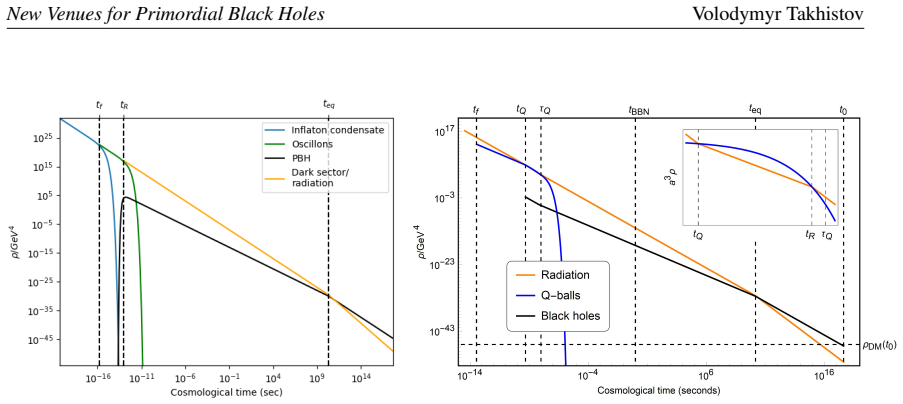
The load-bearing object is the solitonic lump, a Q-ball or oscillon produced when a scalar condensate is unstable to fragmentation. Q-balls are stable, spherical lumps of scalar field held together by a conserved charge; oscillons are their long-lived real-field counterparts. The instability condition is $V''(R) - \dot{\Omega} < 0$, where $R$ and $\Omega$ are the radial amplitude and rotating phase of the complex field, and it generalises tachyonic resonance. The lumps form a matter-like gas that comes to dominate the energy density, and the paper's formation estimate counts how often a Poisson fluctuation in the lump distribution exceeds the critical collapse overdensity $\delta_c \sim O(1)$ during that matter-dominated era. On the detection side, the key mechanism is capture: a PBH passing through a neutron star or white dwarf loses energy through dynamical friction and accretion, settles inside, and consumes the star on timescales that depend on $M_{\rm PBH}$. The consumption of the neutron star ejects neutron-rich material, enabling r-process nucleosynthesis, and powers the various electromagnetic signatures described in the paper.
What would settle it
A simulation or analytic calculation showing that Q-balls or oscillons decay before the matter-dominated era begins (that their lifetime is shorter than the time of matter domination) would kill the formation mechanism; on the observational side, a sensitive all-sky search that finds no orphan kilonovae or gamma-ray bursts without gravitational-wave counterparts in the relevant mass window would rule out asteroid-mass PBHs as all of dark matter.
Extended reading notes
Core claim
The paper's central claim is that primordial black holes arise generically from scalar field fragmentation: a light complex scalar field with self-interactions, displaced during inflation, develops growing oscillation instabilities and breaks up into solitonic lumps; the stochastic collapse of overdense clumps of those lumps then makes black holes during a temporary matter-dominated era. This is claimed to work whether the scalar is the inflaton fragmenting into oscillons or a spectator field fragmenting into Q-balls, and to avoid the inflaton-potential fine-tuning common to curvature-perturbation PBH models. The paper further claims that PBHs in the unconstrained sub-lunar/asteroid mass range around $10^{17}$ to $10^{22}$ g can be all of dark matter, and that their capture by neutron stars and white dwarfs in dark-matter-rich environments leads to destruction of the host stars with a distinctive set of signals: orphan kilonovae and short gamma-ray bursts with no gravitational-wave counterpart, non-repeating fast radio bursts, 511 keV emission consistent with the Galactic Center excess, r-process nucleosynthesis matching Milky Way and ultra-faint dwarf abundances, and solar-mass black hole remnants from transmuted binaries. Getting any one of these channels right would open a new observational window on PBH dark matter.
Load-bearing premise
The creation of black holes requires that the clumps of scalar field survive long enough to take over the universe's energy and collapse; the paper assumes this lifetime but does not show it holds.
Editorial extensions
If this is right
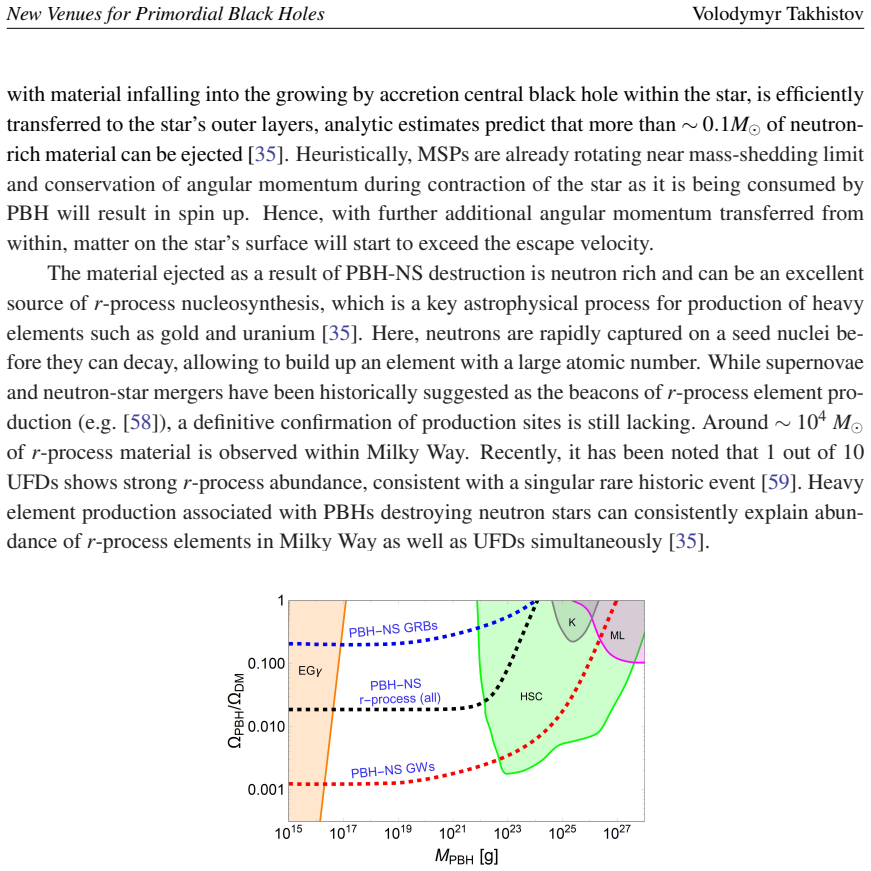
- If PBHs fill the open 10^17 to 10^22 g window, neutron-star captures in the Galactic Center would consume about 10 percent of millisecond pulsars, matching the missing-pulsar problem.
- The neutron-rich ejecta from a PBH-destroyed neutron star can account for r-process abundances in both the Milky Way and ultra-faint dwarf galaxies at once.
- PBH-neutron-star systems would produce kilonovae and short gamma-ray bursts with no gravitational-wave counterpart, giving a clean electromagnetic-only signature.
- The 511 keV line from positron annihilation is naturally produced in these events and can explain the Galactic Center excess.
- Some compact stars consumed by PBHs leave solar-mass black holes, a population not expected from stellar evolution and possibly distinguishable by future higher-order gravitational-wave observations.
Reading between the lines
- Beyond the paper, the same stochastic-collapse logic could be applied to other long-lived soliton-like objects, such as axion stars, provided they survive long enough to dominate the energy density.
- Because PBHs formed in a matter-dominated era can carry large spins, future gravitational-wave measurements of merging PBH binaries could test the formation route independently of the compact-star signals.
- Deep searches for orphan kilonovae in ultra-faint dwarf galaxies, where the capture rate is highest, could directly test the scenario: a handful of events with no associated gravitational-wave signal would support asteroid-mass PBH dark matter.
- Neutron-star disruption by PBHs and by binary neutron-star mergers may produce distinguishable r-process abundance patterns and timing, so abundance ratios in a galaxy like Reticulum II could discriminate between the two sources.
Signed reviews
Editorial analysis
A structured set of objections, weighed in public.
Referee Report
Summary. This proceedings paper summarizes a proposal in which primordial black holes (PBHs) form from scalar-field fragmentation into solitonic lumps (Q-balls or oscillons), with collapse occurring during a matter-dominated era. The formation mechanism is presented as a way to avoid the inflaton-potential fine-tuning typical of standard PBH scenarios, and the paper then reviews how PBHs in the sub-lunar/asteroid-mass window (roughly 10^17 to 10^22 g) could be captured by neutron stars and white dwarfs, producing orphan kilonovae, gamma-ray bursts, r-process nucleosynthesis, 511 keV emission, and solar-mass black holes. The formation discussion follows Refs. [24-27] and the detection discussion follows Refs. [35-37]; the paper does not present new derivations or a new quantitative analysis.
Significance. If the proposed formation mechanism works, it would provide a viable route to PBH dark matter in the open mass window and predict a distinctive set of multimessenger signatures. The paper is clearly written and gives a useful, honest overview of a research program, including a fair summary of existing constraints. Its main value is as a conference proceedings contribution that consolidates prior work; it does not itself establish the central formation claim, and the detection discussion is qualitative. The manuscript would be strengthened by making the key timescale condition (Q-ball lifetime versus matter-domination time) explicit and by presenting at least one concrete benchmark that yields f_DM ≈ 1.
major comments (3)
- [Sec. 2.2, Fig. 1] The formation scenario requires Q-balls produced at t_f to survive past t_Q, when they come to dominate the energy density, and to collapse into PBHs before decaying at τ_Q. However, τ_Q is introduced in Sec. 2.1 only as a phenomenological parameter τ_Q = 1/Γ_Q, and the paper provides no calculation or citation for Γ_Q in the models discussed, nor any comparison of τ_Q with t_Q. If τ_Q ≲ t_Q, the Q-ball gas never dominates, Eq. (2.6) gives a vanishing PBH abundance, and the compact-star signals of Sec. 3 cannot rescue the formation claim because they presuppose that the PBHs exist. Please add an explicit decay-rate estimate (or a reference to a concrete calculation for a specific model, e.g., gauge-mediated SUSY) and state the condition τ_Q > t_Q as a requirement.
- [Eqs. (2.4)-(2.6), Sec. 2.2] The central abundance calculation is not performed in this paper; Eq. (2.4) is taken from Refs. [24-27], with P(M|V) assumed to be Poisson and B(M,V) ∼ K θ[δ0 − δ_c] containing two free parameters, K and δ_c. As written, the claim that PBHs from scalar-field fragmentation can constitute all of dark matter is parametric rather than predictive: no ranges for K and δ_c are given, and no demonstration is provided that the resulting mass function peaks in the 10^17–10^22 g window. Please summarize the key steps of the derivation from Refs. [24-27] and provide benchmark parameter values that yield f_DM ≈ 1.
- [Sec. 3, Fig. 2] The detection section is largely qualitative. Figure 2 displays 'maximum reach' regions that assume 'the most optimistic input parameter choice', and several statements rely on 'crude estimates' (e.g., the expected 511 keV signal). To make the claimed new astrophysical signatures falsifiable, the paper should state at least one quantitative prediction per signal (e.g., event rates, flux ranges, or abundance limits) and identify the key assumptions (DM density in the Galactic Center and UFDs, capture-rate normalization, ejected mass, and jet efficiency). Without such numbers, the reader cannot assess whether the proposed channels are distinguishable from standard astrophysical explanations.
minor comments (6)
- [Sec. 3] In the paragraph on millisecond pulsars, 'consistent with our the scenario' should read 'consistent with the scenario'.
- [Sec. 3] 'the time for BH to consume the star form the inside' should be 'from the inside'.
- [Fig. 2 caption] 'along with experimental constrains' should be 'constraints'.
- [Sec. 2.1] The number density estimate 'n ∼ (k_nl/2π)^3 ∼ 10−10^6' is ambiguous; please write '10 to 10^6' or use superscripts consistently.
- [Sec. 2.2, Fig. 1] Eq. (2.5) uses t_R for the end of the matter-dominated era, while Fig. 1 and the text describe the Q-ball era as lasting until τ_Q; please align the notation and clarify whether t_R = τ_Q or t_R is determined by something else.
- [Abstract] The abstract says 'We present a novel general PBH formation mechanism', but the mechanism is largely a summary of Refs. [24-27]; consider rephrasing to 'We review' or 'We discuss' to avoid overclaiming novelty.
Circularity Check
Heavy transparent self-citation in both formation and detection threads, but no step reduces a prediction to its input by construction; the Q-ball lifetime concern is an unverified condition, not a circularity.
full rationale
This ICRC proceedings paper is essentially a summary of the author's prior work: the PBH-from-fragmentation mass function is imported from Refs. [24-27] ('At fragmentation time t_f, the resulting PBH-mass function can be obtained via [24, 25, 26, 27]'), and the compact-star signals follow Refs. [35-37]. That is extensive self-citation, but it is transparent attribution to peer-reviewed derivations, not a definitional loop. Eq. (2.4) is not defined in terms of its own output; it is an analytic model with explicit assumptions (Poisson P(M|V), step-function collapse criterion B(M,V) ~ K theta[delta0 - delta_c]), and the free parameters K and delta_c are not fitted to the quantities being predicted. The Q-ball lifetime tau_Q is introduced phenomenologically and the paper does not provide a calculation showing tau_Q > t_Q; however, that is a missing calculation or an unverified assumption, not a circular reduction. The astrophysical 'signals' are presented as conditional consistency statements ('can account for', 'consistent with') against external observations such as r-process abundances, the 511 keV excess, and the missing pulsar problem, so they are not forced by construction from the model assumptions. The main caveat is that the novelty of the 'mechanism' rests on self-citations, but because those citations point to prior work with independent simulation support for Q-ball/oscillon formation and to external observational comparisons, the circularity score remains low.
Assumptions & free parameters
free parameters (6)
- K =
unconstrained
- delta_c =
O(1)
- f_Q =
10^-1 to 10^-2
- alpha, beta =
model-dependent (e.g., 3/4, 1/4 for gauge-mediated SUSY)
- Lambda (e.g., M_SUSY) =
unspecified
- tau_Q (or Gamma_Q) =
unspecified
assumptions (5)
- domain assumption A light complex scalar field with a flat direction and self-interactions exists generically in BSM models (SUSY, string theory).
- domain assumption The instability condition V''(R) - Omega_dot < 0 (Eq. 2.1) is a sufficient and general criterion for fragmentation into Q-balls or oscillons.
- domain assumption Fragmentation produces a Poisson-distributed, uncorrelated population of soliton lumps at fragmentation time.
- domain assumption Q-balls and oscillons are stable long enough to dominate the energy density and collapse to PBHs before decaying.
- domain assumption The mass window ~10^17-10^22 g is truly open, based on reanalyses of femtolensing, microlensing, and neutron-star capture constraints.
Cite this review
Pith. "Pith review of New Venues in Formation and Detection for Primordial Black Hole Dark Matter." pith.science (2026). https://pith.science/paper/F7E4C6WN
@misc{pith2026190801464,
  author       = {Pith},
  title        = {Pith review of: New Venues in Formation and Detection for Primordial Black Hole Dark Matter},
  year         = {2026},
  howpublished = {\url{https://pith.science/paper/F7E4C6WN}},
  note         = {Machine review of arXiv:1908.01464}
}
read the original abstract
Primordial black holes (PBHs) are not as exotic as once thought and constitute a compelling non-particle dark matter (DM) candidate. We present a novel general PBH formation mechanism from scalar field fragmentation, which does not suffer from the inflaton potential fine-tuning that plagues many of the standard PBH formation models. We discuss how interactions of compact stars with very small sub-lunar/asteroid-size PBHs, which reside in the open window of parameter space where PBHs can constitute all of DM, allow for a slew of new astrophysical signatures that could shed light on PBH DM and are particularly interesting in the era of multi-messenger astronomy.
Figures
Reference graph
Works this paper leans on
-
[1]
Y . B. Zel’dovich and I. D. Novikov,The Hypothesis of Cores Retarded during Expansion and the Hot Cosmological Model, Sov. Astron.10 (1967) 602
work page 1967
-
[2]
Hawking, Gravitationally collapsed objects of very low mass, Mon
S. Hawking, Gravitationally collapsed objects of very low mass, Mon. Not. Roy. Astron. Soc. 152 (1971) 75
1971
-
[3]
B. J. Carr and S. W. Hawking, Black holes in the early Universe, Mon. Not. Roy. Astron. Soc. 168 (1974) 399
work page 1974
-
[4]
B. Carr, F. Kuhnel and M. Sandstad, Primordial Black Holes as Dark Matter, Phys. Rev. D94 (2016) 083504 [1607.06077]
arXiv 2016
- [5]
-
[6]
M. Yu. Khlopov, Primordial Black Holes, Res. Astron. Astrophys. 10 (2010) 495 [0801.0116]
arXiv 2010
-
[7]
J. Liu, X. Chen and X. Ji, Current status of direct dark matter detection experiments, Nature Phys. 13 (2017) 212 [1709.00688]
arXiv 2017
-
[8]
V IRGO , LIGO collaboration, B. P. Abbott et al., Observation of Gravitational Waves from a Binary Black Hole Merger, Phys. Rev. Lett. 116 (2016) 061102 [1602.03837]
arXiv 2016
Show all 71 references
-
[9]
V IRGO , LIGO collaboration, B. P. Abbott et al., GW151226: Observation of Gravitational Waves from a 22-Solar-Mass Binary Black Hole Coalescence, Phys. Rev. Lett. 116 (2016) 241103 [1606.04855]
2016 arXiv
-
[10]
V IRGO , LIGO collaboration, B. P. Abbott et al., GW170104: Observation of a 50-Solar-Mass Binary Black Hole Coalescence at Redshift 0.2, Phys. Rev. Lett. 118 (2017) 221101 [1706.01812]
2017 arXiv
-
[11]
Nakamura, M
T. Nakamura, M. Sasaki, T. Tanaka and K. S. Thorne, Gravitational waves from coalescing black hole MACHO binaries, Astrophys. J. 487 (1997) L139 [astro-ph/9708060]
1997 arXiv
-
[12]
Clesse and J
S. Clesse and J. Garcia-Bellido, Massive Primordial Black Holes from Hybrid Inflation as Dark Matter and the seeds of Galaxies, Phys. Rev. D92 (2015) 023524 [1501.07565]
2015 arXiv
-
[13]
Bird et al., Did LIGO detect dark matter?, Phys
S. Bird et al., Did LIGO detect dark matter?, Phys. Rev. Lett. 116 (2016) 201301 [1603.00464]
2016 arXiv
-
[14]
Sasaki, T
M. Sasaki, T. Suyama, T. Tanaka and S. Yokoyama, Primordial Black Hole Scenario for the Gravitational-Wave Event GW150914, Phys. Rev. Lett. 117 (2016) 061101 [1603.08338]
2016 arXiv
-
[15]
Kawasaki, A
M. Kawasaki, A. Kusenko and T. T. Yanagida, Primordial seeds of supermassive black holes, Phys. Lett. B711 (2012) 1 [1202.3848]
2012 arXiv
-
[16]
Kawasaki, N
M. Kawasaki, N. Kitajima and T. T. Yanagida, Primordial black hole formation from an axionlike curvaton model, Phys. Rev. D87 (2013) 063519 [1207.2550]. 8 New Venues for Primordial Black Holes V olodymyr Takhistov
2013 arXiv
-
[17]
Kawasaki and K
M. Kawasaki and K. Murai, Formation of supermassive primordial black holes by Affleck-Dine mechanism, 1907.02273
1907 arXiv
-
[18]
Polnarev and R
A. Polnarev and R. Zembowicz, Formation of Primordial Black Holes by Cosmic Strings, Phys. Rev. D43 (1991) 1106
1991
-
[19]
Aghanim et al., Planck 2018 results
P LANCK collaboration, N. Aghanim et al., Planck 2018 results. VI. Cosmological parameters, 1807.06209
2018 arXiv
-
[20]
Kawasaki and V
M. Kawasaki and V . Takhistov,Primordial Black Holes and the String Swampland, Phys. Rev. D98 (2018) 123514 [1810.02547]
2018 arXiv
-
[21]
Germani and I
C. Germani and I. Musco, The abundance of primordial black holes depends on the shape of the inflationary power spectrum, Phys. Rev. Lett. 122 (2019) 141302 [1805.04087]
2019 arXiv
-
[22]
J. R. Espinosa, D. Racco and A. Riotto, Cosmological Signature of the Standard Model Higgs Vacuum Instability: Primordial Black Holes as Dark Matter, Phys. Rev. Lett. 120 (2018) 121301 [1710.11196]
2018 arXiv
-
[23]
Ali-Haimoud, Correlation Function of High-Threshold Regions and Application to the Initial Small-Scale Clustering of Primordial Black Holes, Phys
Y . Ali-Haimoud, Correlation Function of High-Threshold Regions and Application to the Initial Small-Scale Clustering of Primordial Black Holes, Phys. Rev. Lett. 121 (2018) 081304 [1805.05912]
2018 arXiv
-
[24]
Cotner and A
E. Cotner and A. Kusenko, Primordial black holes from supersymmetry in the early universe, Phys. Rev. Lett. 119 (2017) 031103 [1612.02529]
2017 arXiv
-
[25]
Cotner and A
E. Cotner and A. Kusenko, Primordial black holes from scalar field evolution in the early universe, Phys. Rev. D96 (2017) 103002 [1706.09003]
2017 arXiv
-
[26]
Cotner, A
E. Cotner, A. Kusenko and V . Takhistov,Primordial Black Holes from Inflaton Fragmentation into Oscillons, Phys. Rev. D98 (2018) 083513 [1801.03321]
2018 arXiv
-
[27]
Cotner, A
E. Cotner, A. Kusenko, M. Sasaki and V . Takhistov,Analytic Description of Primordial Black Hole Formation from Scalar Field Fragmentation, 1907.10613
1907 arXiv
-
[28]
Arvanitaki, S
A. Arvanitaki, S. Dimopoulos, S. Dubovsky, N. Kaloper and J. March-Russell, String Axiverse, Phys. Rev. D81 (2010) 123530 [0905.4720]
2010 arXiv
-
[29]
Gherghetta, C
T. Gherghetta, C. F. Kolda and S. P. Martin, Flat directions in the scalar potential of the supersymmetric standard model, Nucl. Phys. B468 (1996) 37 [hep-ph/9510370]
1996 arXiv
-
[30]
S. R. Coleman, Q Balls, Nucl. Phys. B262 (1985) 263
1985
-
[31]
Kasuya, M
S. Kasuya, M. Kawasaki and F. Takahashi, I-balls, Phys. Lett. B559 (2003) 99 [hep-ph/0209358]
2003 arXiv
-
[32]
DeRocco and P
W. DeRocco and P. W. Graham, Constraining primordial black hole abundance with the Galactic 511 keV line, 1906.07740
1906 arXiv
-
[33]
Laha, Primordial black holes as dark matter candidate are severely constrained by the Galactic Center 511 keV gamma-ray line, 1906.09994
R. Laha, Primordial black holes as dark matter candidate are severely constrained by the Galactic Center 511 keV gamma-ray line, 1906.09994
1906 arXiv
-
[34]
Capela, M
F. Capela, M. Pshirkov and P. Tinyakov, Constraints on primordial black holes as dark matter candidates from capture by neutron stars, Phys. Rev. D87 (2013) 123524 [1301.4984]
2013 arXiv
-
[35]
G. M. Fuller, A. Kusenko and V . Takhistov,Primordial Black Holes and r-Process Nucleosynthesis, Phys. Rev. Lett. 119 (2017) 061101 [1704.01129]
2017 arXiv
-
[36]
Takhistov,Transmuted Gravity Wave Signals from Primordial Black Holes, Phys
V . Takhistov,Transmuted Gravity Wave Signals from Primordial Black Holes, Phys. Lett. B782 (2018) 77 [1707.05849]
2018 arXiv
-
[37]
Takhistov,Positrons from Primordial Black Hole Microquasars and Gamma-ray Bursts, Phys
V . Takhistov,Positrons from Primordial Black Hole Microquasars and Gamma-ray Bursts, Phys. Lett. B789 (2019) 538 [1710.09458]
2019 arXiv
-
[38]
Enqvist, T
K. Enqvist, T. Meriniemi and S. Nurmi, Generation of the Higgs Condensate and Its Decay after Inflation, JCAP 1310 (2013) 057 [1306.4511]. 9 New Venues for Primordial Black Holes V olodymyr Takhistov
2013 arXiv
-
[39]
Kusenko and M
A. Kusenko and M. E. Shaposhnikov, Supersymmetric Q balls as dark matter, Phys. Lett. B418 (1998) 46 [hep-ph/9709492]
1998 arXiv
-
[40]
M. S. Turner, Coherent Scalar Field Oscillations in an Expanding Universe, Phys. Rev. D28 (1983) 1243
1983
-
[41]
Kasuya and M
S. Kasuya and M. Kawasaki, Q Ball formation in the gravity mediated SUSY breaking scenario, Phys. Rev. D62 (2000) 023512 [hep-ph/0002285]
2000 arXiv
-
[42]
Multamaki and I
T. Multamaki and I. Vilja, Simulations of Q ball formation, Phys. Lett. B535 (2002) 170 [hep-ph/0203195]
2002 arXiv
-
[43]
Mukaida and M
K. Mukaida and M. Takimoto, Correspondence of I- and Q-balls as Non-relativistic Condensates, JCAP 1408 (2014) 051 [1405.3233]
2014 arXiv
-
[44]
A. G. Polnarev and M. Yu. Khlopov, Cosmology, Primordial Black Holes and Supermassive Particles, Sov. Phys. Usp. 28 (1985) 213
1985
-
[45]
Harada, C.-M
T. Harada, C.-M. Yoo, K. Kohri, K.-i. Nakao and S. Jhingan, Primordial black hole formation in the matter-dominated phase of the Universe, Astrophys. J. 833 (2016) 61 [1609.01588]
2016 arXiv
-
[46]
Harada, C.-M
T. Harada, C.-M. Yoo, K. Kohri and K.-I. Nakao, Spins of primordial black holes formed in the matter-dominated phase of the Universe, Phys. Rev. D96 (2017) 083517 [1707.03595]
2017 arXiv
-
[47]
K. D. Lozanov and M. A. Amin, Gravitational perturbations from oscillons and transients after inflation, Phys. Rev. D99 (2019) 123504 [1902.06736]
2019 arXiv
-
[48]
Barnacka, J
A. Barnacka, J. F. Glicenstein and R. Moderski, New constraints on primordial black holes abundance from femtolensing of gamma-ray bursts, Phys. Rev. D86 (2012) 043001 [1204.2056]
2012 arXiv
-
[49]
P. W. Graham, S. Rajendran and J. Varela, Dark Matter Triggers of Supernovae, Phys. Rev. D92 (2015) 063007 [1505.04444]
2015 arXiv
-
[50]
A. Katz, J. Kopp, S. Sibiryakov and W. Xue, Femtolensing by Dark Matter Revisited, JCAP 1812 (2018) 005 [1807.11495]
2018 arXiv
-
[51]
Niikura et al., Microlensing constraints on primordial black holes with Subaru/HSC Andromeda observations, Nat
H. Niikura et al., Microlensing constraints on primordial black holes with Subaru/HSC Andromeda observations, Nat. Astron. 3 (2019) 524 [1701.02151]
2019 arXiv
-
[52]
J. D. Bradford, M. Geha, R. Munoz, F. A. Santana, J. D. Simon, P. Cote et al., Structure and Dynamics of the Globular Cluster Palomar 13, Astrophys. J. 743 (2011) 167 [1110.0484]
2011 arXiv
-
[53]
Sollima, C
A. Sollima, C. Nipoti, A. M. Battisti, M. Montuori and R. Capuzzo-Dolcetta, A Monte Carlo analysis of the velocity dispersion of the globular cluster Palomar 14, Astrophys. J. 744 (2012) 196 [1111.1689]
2012 arXiv
-
[54]
Montero-Camacho, X
P. Montero-Camacho, X. Fang, G. Vasquez, M. Silva and C. M. Hirata, Revisiting constraints on asteroid-mass primordial black holes as dark matter candidates, 1906.05950
1906 arXiv
-
[55]
Kouvaris and P
C. Kouvaris and P. Tinyakov, Growth of Black Holes in the interior of Rotating Neutron Stars, Phys. Rev. D90 (2014) 043512 [1312.3764]
2014 arXiv
-
[56]
Dexter and R
J. Dexter and R. M. O’Leary, The Peculiar Pulsar Population of the Central Parsec, Astrophys. J. 783 (2014) L7 [1310.7022]
2014 arXiv
-
[57]
F. C. Zelati et al., The X-ray outburst of the Galactic Centre magnetar SGR J1745-2900 during the first 1.5 year, Mon. Not. Roy. Astron. Soc. 449 (2015) 2685 [1503.01307]
2015 arXiv
-
[58]
Eichler, M
D. Eichler, M. Livio, T. Piran and D. N. Schramm, Nucleosynthesis, Neutrino Bursts and Gamma-Rays from Coalescing Neutron Stars, Nature 340 (1989) 126
1989
-
[59]
A. P. Ji, A. Frebel, A. Chiti and J. D. Simon, R-process enrichment from a single event in an ancient dwarf galaxy, Nature 531 (2016) 610 [1512.01558]. 10 New Venues for Primordial Black Holes V olodymyr Takhistov
2016 arXiv
-
[60]
B. J. Carr, K. Kohri, Y . Sendouda and J. Yokoyama,New cosmological constraints on primordial black holes, Phys. Rev. D81 (2010) 104019 [0912.5297]
2010 arXiv
-
[61]
Griest, A
K. Griest, A. M. Cieplak and M. J. Lehner, Experimental Limits on Primordial Black Hole Dark Matter from the First 2 yr of Kepler Data, Astrophys. J. 786 (2014) 158 [1307.5798]
2014 arXiv
-
[62]
Tisserand et al., Limits on the Macho Content of the Galactic Halo from the EROS-2 Survey of the Magellanic Clouds, Astron
EROS-2 collaboration, P. Tisserand et al., Limits on the Macho Content of the Galactic Halo from the EROS-2 Survey of the Magellanic Clouds, Astron. Astrophys. 469 (2007) 387 [astro-ph/0607207]
2007 arXiv
-
[63]
Bramante, T
J. Bramante, T. Linden and Y .-D. Tsai,Searching for dark matter with neutron star mergers and quiet kilonovae, Phys. Rev. D97 (2018) 055016 [1706.00001]
2018 arXiv
-
[64]
J. I. Katz, Fast Radio Bursts, Prog. Part. Nucl. Phys.103 (2018) 1 [1804.09092]
2018 arXiv
-
[65]
Fuller and C
J. Fuller and C. Ott, Dark Matter-induced Collapse of Neutron Stars: A Possible Link Between Fast Radio Bursts and the Missing Pulsar Problem, Mon. Not. Roy. Astron. Soc. 450 (2015) L71 [1412.6119]
2015 arXiv
-
[66]
Prantzos et al., The 511 keV emission from positron annihilation in the Galaxy, Rev
N. Prantzos et al., The 511 keV emission from positron annihilation in the Galaxy, Rev. Mod. Phys. 83 (2011) 1001 [1009.4620]
2011 arXiv
-
[67]
Siegert, R
T. Siegert, R. Diehl, A. C. Vincent, F. Guglielmetti, M. G. H. Krause and C. Boehm, Search for 511 keV Emission in Satellite Galaxies of the Milky Way with INTEGRAL/SPI, Astron. Astrophys. 595 (2016) A25 [1608.00393]
2016 arXiv
-
[68]
G. M. Fuller, A. Kusenko, D. Radice and V . Takhistov,Positrons and 511 keV Radiation as Tracers of Recent Binary Neutron Star Mergers, Phys. Rev. Lett. 122 (2019) 121101 [1811.00133]
2019 arXiv
-
[69]
Adriani et al., Cosmic-Ray Positron Energy Spectrum Measured by PAMELA, Phys
PAMELA collaboration, O. Adriani et al., Cosmic-Ray Positron Energy Spectrum Measured by PAMELA, Phys. Rev. Lett. 111 (2013) 081102 [1308.0133]
2013 arXiv
-
[70]
Ackermann et al., Measurement of separate cosmic-ray electron and positron spectra with the Fermi Large Area Telescope, Phys
F ERMI -LAT collaboration, M. Ackermann et al., Measurement of separate cosmic-ray electron and positron spectra with the Fermi Large Area Telescope, Phys. Rev. Lett. 108 (2012) 011103 [1109.0521]
2012 arXiv
-
[71]
AMS collaboration, M. Aguilar et al., First Result from the Alpha Magnetic Spectrometer on the International Space Station: Precision Measurement of the Positron Fraction in Primary Cosmic Rays of 0.5-350 GeV, Phys. Rev. Lett. 110 (2013) 141102. 11
2013
Reviewed August 14, 2026 · model on record in the stance chip above.
Discussion (0). Continue with ORCID to comment.