REVIEW 3 major objections 3 minor 35 references
Multi-period Asset-liability Management with Reinforcement Learning in a Regime-Switching Market
T0 review · 3 major / 3 minor · reviewed 2026-08-15 · deepseek-v4-flash
Pith's one-line read The paper derives a Gaussian optimal policy for mean-variance asset-liability management with hidden bull-bear regimes, and claims an RL algorithm learns it.
desk verdict The partial-information result rests on a filter that ignores the data, so the paper's main claim collapses; the complete-information extension is real but does not rescue it. read the letter →
The pith
A machine-rendered reading of the paper's core claim, the machinery that carries it, and where it could break.
The reading
What carries the argument
The engine of the paper is a Bellman recursion for a value function that is quadratic in wealth $x$ and liability $l$, together with an entropy-regularized policy improvement step. At each period the minimizing control is a Gaussian density: the mean cancels the linear terms built from the filtered moments $\hat A_{0,t},\hat A_{1,t},\hat A_{2,t}$ and the products $\hat F_{1,k}/\hat B_{1,k}$, and the variance is the exploration temperature $\lambda$ divided by the filtered second moment of the excess return, times a product of ratios $\hat B_{1,k}/\hat F_{1,k}$. The recursive filter for the hidden regime probability, $\hat p_{t+1}=P_{21}+\hat p_t(P_{11}-P_{21})$, is what converts the partial-information problem into a complete-information problem in $\hat p$, and the same quadratic structure yields finite-step policy improvement and convergence theorems for both the observable and filtered cases.
What would settle it
Simulate the paper's model while recording the true regime alongside $x_t$ and $l_t$, and at each step compute the Bayes posterior $P(\varepsilon_{t+1}=1\mid x_{t+1},l_{t+1},x_t,l_t)$ from the model's likelihoods. Compare it with the deterministic value $P_{21}+\hat p_t(P_{11}-P_{21})$; if the two diverge on paths with unusually high or low excess returns — as they will whenever returns are regime-informative — the filter, the separation argument, and the claimed optimal policy all fail.
Extended reading notes
Core claim
On its own terms, the paper's central discovery is Theorem 3.2: for fixed Lagrange multiplier $w$, the partially observable exploratory mean-variance problem with liabilities in a two-regime Markov market has value function (3.18) and an optimal feedback control (3.21), which is Gaussian. The mean of that Gaussian is the negative of a linear combination of wealth $x$, the filtered first moments of asset and liability returns, and the product term $(w+l\prod_{k=t}^{T-1}\hat A_{2,k})$; the variance is $\frac{\lambda}{2\hat B_{1,t}}\prod_{k=t+1}^{T-1}\frac{\hat B_{1,k}}{\hat F_{1,k}}$. The route to the theorem is Lemma 3.1, which asserts that the hidden-regime posterior follows the deterministic recursion $\hat p_{t+1}=P_{21}+\hat p_t(P_{11}-P_{21})$ and that the observable filtration is generated by $\hat p$, so the partial-information control problem becomes a complete-information problem in the belief variable. The paper also claims that its PoEMV-1 actor-critic algorithm converges to this policy in finitely many improvement steps and, in both simulation and out-of-sample S&P 500 tests, gives mean terminal wealth close to $d=8$ with lower variance than PoEMV-2 and CoEMV.
Load-bearing premise
The load-bearing premise is that observing asset prices and liabilities adds no information about the next market regime beyond the current belief, so the posterior $\hat p$ evolves by the deterministic recursion $\hat p_{t+1}=P_{21}+\hat p_t(P_{11}-P_{21})$ with no likelihood update; if returns and liabilities do inform the regime, the closed-form Gaussian policy of Theorem 3.2 is not the optimal policy claimed.
Editorial extensions
If this is right
- If Theorem 3.2 is right, an investor who never observes the market regime can still rebalance by a closed-form Gaussian rule that depends only on wealth, liabilities, and filtered moments of returns.
- The PoEMV-1 algorithm should converge to that rule after at most $T-t$ policy-improvement iterations for a fixed Lagrange multiplier $w$, so the learning step is a finite procedure rather than a heuristic search.
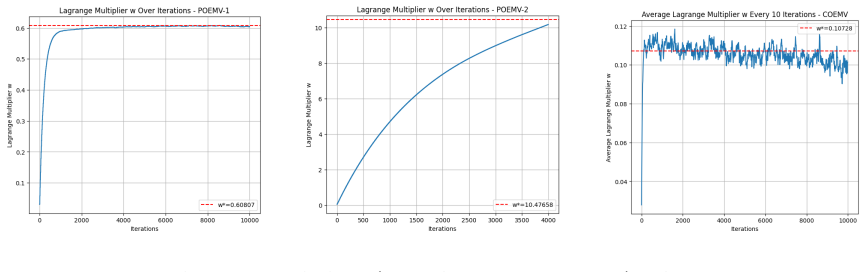
- The self-correcting update of $w$ drives terminal surplus toward the target; the reported simulation mean terminal wealth is $7.9985$ and the S&P 500 out-of-sample mean is $8.0625$, both near $d=8$.
- Ignoring regime learning (PoEMV-2) leaves mean terminal wealth at $6.8491$ in simulation, well below target, so the filtered belief rather than the unconditional regime expectation is what carries performance.
- The complete-information benchmark CoEMV reaches the target but with terminal-wealth variance $0.8199$ versus $0.0094$ for PoEMV-1, indicating that the paper's claimed advantage of filtering is not merely matching an omniscient policy.
Reading between the lines
- Editorial inference: if the deterministic filter of Lemma 3.1 were replaced by a likelihood-based Bayesian update using observed returns and liabilities, the optimal policy would generically depend on the latest observations; comparing these two filters on the paper's own simulated paths would isolate whether regime learning or deterministic belief motion drives the reported gains.
- Editorial inference: the self-correcting Lagrange multiplier is a heuristic average over the most recent terminal surpluses; its convergence is demonstrated empirically but not proved, so a rate or almost-sure guarantee would be a natural extension.
- Editorial inference: the same quadratic value function and Gaussian policy family should extend to more than two regimes and to multiple risky assets, with a multivariate Gaussian policy and positive-definite filtered second-moment matrices playing the role of $\hat B_{1,t}$.
- Editorial inference: the entropy-regularized formulation suggests a direct test of the exploration-exploitation tradeoff: varying $\lambda$ should shift terminal wealth variance monotonically, and the paper's closed form predicts exactly how.
Signed reviews
Editorial analysis
A structured set of objections, weighed in public.
Referee Report
Summary. The paper studies a multi-period mean-variance asset-liability management problem in a regime-switching market, with an entropy-regularized exploratory formulation solved by reinforcement learning. Under complete information, Theorem 3.1 gives a Bellman-derived Gaussian optimal policy and quadratic value function. Under partial information, the paper introduces a filtering process for the hidden regime, states a separation principle in Lemma 3.1, and obtains an analogous optimal policy in Theorem 3.2. Based on these policies, the authors propose three algorithms: CoEMV (complete information), PoEMV-1 (filtered regime learning), and PoEMV-2 (regime estimated by its unconditional expectation), together with a self-correcting Lagrange multiplier update for learning the target wealth constraint. Numerical simulations and an S&P 500 empirical study report that PoEMV-1 performs best in mean terminal wealth, variance, and Sharpe ratio.
Significance. If the main derivation were valid, the paper would make a useful contribution by extending the exploratory mean-variance RL framework of Cui et al. to include uncontrollable liabilities and regime-switching markets. The complete-information derivation in Appendix A.1 is detailed and appears internally consistent as an extension of known results, and the policy-improvement theorems in Appendix A.2 provide a structured convergence argument. The paper also makes a genuine effort at algorithmic implementation and out-of-sample testing. However, the partial-information contribution, which is the paper's central claimed novelty, rests on Lemma 3.1. That lemma asserts a deterministic filter that ignores observations and an impossible sigma-field equality. Since Theorem 3.2, Algorithm 2, and all of the PoEMV-1 results are built on this lemma, the partial-information results are not supported. In addition, the numerical evidence that PoEMV-1 achieves the target mean is largely a consequence of the self-correcting Lagrange multiplier update rather than independent evidence of optimality.
major comments (3)
- [Section 3.2, Lemma 3.1] Lemma 3.1 is the load-bearing step of the partial-information analysis, and it is incorrect. Equation (3.8) gives p_hat_{t+1} = P21 + p_hat_t(P11 - P21), a recursion that depends only on the known initial distribution p_hat_0 and the known transition matrix P. Hence p_hat_t is a deterministic function of t, so the sigma-field sigma(p_hat_s, s <= t) is trivial. The lemma also asserts sigma(x_s, l_s, s <= t) = sigma(p_hat_s, s <= t), which is impossible because x_t and l_t are random while p_hat_t is deterministic. The proof's fourth equality cancels the density of (x_{t+1}, l_{t+1}) given (epsilon_{t+1}=1, F_t^{x,l}) against the density given F_t^{x,l}, claiming that epsilon_{t+1} cannot improve knowledge of x_{t+1} and l_{t+1}. That claim is false: the conditional law of the asset return e_t(epsilon_t) and liability return q_t(epsilon_t) depends on the regime, so the observation likelihood must enter the filter update. A correct hidden-Markov filter would make p_hat_{t+1} depend on the realized x_{t+1} and l_{t+1} through the likelihood, not merely on the transition matrix.
- [Theorem 3.2 and Algorithm 2] Because Lemma 3.1 is invalid, the separation principle stated in Section 3.2 and Theorem 3.2 are unsupported. The proof of Theorem 3.2 in Appendix A.1 is explicitly only a substitution of hatted quantities into the complete-information formulas; it does not supply an independent argument that the filtered dynamics (3.11) correctly represent the conditional law of the surplus under F^{x,l}. Consequently, the optimal policy (3.21), the PoEMV-1 algorithm in Section 4.2.2, and the simulation and empirical results labeled PoEMV-1 all rest on an unjustified reduction of a partial-information problem to a complete-information problem. Even if the complete-information Theorem 3.1 is correct, it does not rescue the paper's main claimed contribution of an RL solution for unobservable regimes.
- [Section 4.2.1, Lagrange multiplier update] The self-correcting update w <- w - alpha(average terminal surplus - d) forces the mean terminal surplus toward the target d by construction. After enough updates, any policy of sufficiently flexible form will have sample mean terminal surplus near d, regardless of whether the policy is optimal for the constrained mean-variance problem. The paper uses mean terminal wealth close to d as a headline result in Table 1 and Table 2, but this is not independent evidence of optimality or of superior performance. The meaningful comparison would need to hold fixed the way the target is enforced across algorithms and report results without the self-correcting mean-matching update, or otherwise demonstrate that the learned multiplier solves the original constraint rather than merely matching the sample average.
minor comments (3)
- [Section 2.2.2, Eq. (2.6)] The notation S_t^pi for the surplus and later ^S_t^pi for the filtered surplus is introduced but not used consistently; the paper switches between x_t, l_t and ^x_t, ^l_t without always stating which process is meant, which makes the filtering section hard to follow.
- [Section 5.1, Table 1] PoEMV-2 is trained for 4,000 iterations while PoEMV-1 and CoEMV are trained for 10,000 iterations; the claim of 'faster convergence' for PoEMV-1 relative to PoEMV-2 is confounded by the unequal training budgets, so the comparison should be repeated with matched iteration counts.
- [Section 3.2, Eq. (3.11)] The sentence 'From Lemma 3.1 we have ... E_{t,x,l}[S_{t+1}^pi | F_t^{x,l}] = E_{t,x,l,^p}[S_{t+1}^pi] = ^S_{t+1}^pi' is not justified: replacing unobservable random returns by their conditional expectations inside the nonlinear surplus dynamics changes the conditional expectation, and the equality would require a linearity argument that is absent.
Circularity Check
The self-correcting Lagrange-multiplier update forces mean terminal wealth toward the target, so the reported near-target means are by construction; the fixed-w optimal-policy derivation is otherwise self-contained.
-
fitted input called prediction
[Sections 4.2.1-4.2.2 (self-correcting Lagrange multiplier update) and Table 1]
"For self-correcting scheme in learning the Lagrange multiplier w, we set the learning rate to be α, and then obtain wn+1 = wn − α(xT − lT − d). This scheme works as follows: if the empirical terminal surplus falls below the expected level d, the self-correcting rule raises w to increase the mean of our strategy (4.6), guiding the terminal surplus to increase to the expected level. ... PoEMV-1 7.9985 0.0094 72.0167"
The Lagrange multiplier w is updated as a proportional feedback controller on the terminal surplus error x_T - l_T - d. This is a calibration step that, once converged, drives the mean terminal surplus toward the target d by construction. The paper then reports PoEMV-1's out-of-sample mean terminal wealth (7.9985 in Table 1, 8.0625 in the empirical study) as evidence that the algorithm achieves the target mean. That near-target mean is therefore the fitted target of the update, not an independent prediction of the learned policy. Only the variance and Sharpe ratio provide independent evidence of performance; the 'achieves the target mean' claim is circular by construction. The optimal-policy theorems for fixed w are not affected by this step.
full rationale
The Bellman derivation of Theorem 3.1 is self-contained: Appendix A.1 starts from the terminal condition, performs the minimization over Gaussian densities, and inducts backward, so the Gaussian feedback form (3.6) is not assumed and does not reduce to a citation. Theorem 3.2 is obtained by substituting filtered moments and p_hat into Theorem 3.1; this is a legitimate algebraic extension only if Lemma 3.1 were valid. I do not count Lemma 3.1 as circularity: the paper's unjustified cancellation of the observation likelihood is a mathematical correctness issue, not a reduction of the output to the input. The citations to Cui et al. (2023), which includes co-author X. Li, are used for background and algorithmic framing, but the policy-improvement theorems 4.1 and 4.2 are proved by the same backward induction, so the self-citation is not load-bearing. The one genuine circular element is the numerical headline: the self-correcting scheme wn+1 = wn - alpha(x_T - l_T - d) is an explicit feedback calibrator for the terminal surplus, and Table 1's near-target means for PoEMV-1 simply reflect that calibrated target. This makes the 'achieves the target mean' claim circular by construction, while variance and Sharpe comparisons remain informative. The score of 6 reflects partial circularity rather than a complete collapse of the derivation.
Assumptions & free parameters
free parameters (3)
- Exploration weight lambda =
lambda = 2 in simulations and empirical study
- Learning rates and sample size =
eta_theta=1e-12, eta_vartheta=1e-12, eta_psi=1e-9, eta_phi=1e-9, alpha=1e-2, N=10
- Bull/bear classification thresholds gamma1, gamma2 =
gamma1=24%, gamma2=19%
assumptions (6)
- domain assumption Asset returns and liability returns are independent across time given the current regime, and the two risky returns are independent within a period (Section 2.2.1).
- domain assumption The market regime epsilon is a two-state time-homogeneous Markov chain with known transition matrix P (Section 2.2.1).
- domain assumption Admissible strategies are absolutely continuous densities with finite second moment and finite entropy (Definition 2.1), and the entropy-regularized objective with weight lambda defines the exploratory problem (2.7).
- ad hoc to paper The filter update in Lemma 3.1, hat p_{t+1} = P21 + hat p_t (P11 - P21), and the equality of sigma-fields sigma(x_s, l_s, s <= t) = sigma(hat p_s, s <= t).
- standard math Bellman's principle applies to the fixed-w Lagrangian, and the precommitted mean-variance constraint is handled by solving E[terminal surplus] = d for w (Section 2.1, Appendix A.1).
- standard math The separation principle for mean-variance portfolio selection under partial information is valid, following Xiong and Zhou (2007).
Cite this review
Pith. "Pith review of Multi-period Asset-liability Management with Reinforcement Learning in a Regime-Switching Market." pith.science (2026). https://pith.science/paper/FA5GZ3YS
@misc{pith2026250903251,
  author       = {Pith},
  title        = {Pith review of: Multi-period Asset-liability Management with Reinforcement Learning in a Regime-Switching Market},
  year         = {2026},
  howpublished = {\url{https://pith.science/paper/FA5GZ3YS}},
  note         = {Machine review of arXiv:2509.03251}
}
read the original abstract
This paper explores the mean-variance portfolio selection problem in a multi-period financial market characterized by regime-switching dynamics and uncontrollable liabilities. To address the uncertainty in the decision-making process within the financial market, we incorporate reinforcement learning (RL) techniques. Specifically, the study examines an exploratory mean-variance (EMV) framework where investors aim to minimize risk while maximizing returns under incomplete market information, influenced by shifting economic regimes. The market model includes risk-free and risky assets, with liability dynamics driven by a Markov regime-switching process. To align with real-world scenarios where financial decisions are made over discrete time periods, we adopt a multi-period dynamic model. We present an optimal portfolio strategy derived using RL techniques that adapt to these market conditions. The proposed solution addresses the inherent time inconsistency in classical mean-variance models by integrating a pre-committed strategy formulation. Furthermore, we incorporate partial market observability, employing stochastic filtering techniques to estimate unobservable market states. Numerical simulations and empirical tests on real financial data demonstrate that our method achieves superior returns, lower risk, and faster convergence compared to traditional models. These findings highlight the robustness and adaptability of our RL-based solution in dynamic and complex financial environments.
Figures


Figures from the paper (2 more)

Reference graph
Works this paper leans on
-
[1]
A. Andonov, R.M.M.J. Bauer, K.J.M. Cremers, Pension fund asset allocation and liability discount rates, The Review of Financial Studies. 30(8) (2017) 2555-2595. https://doi.org/10.1093/rfs/hhx020
-
[2]
A. Ang, G. Bekaert, International asset allocation with regime shifts, The Review of Financial Studies. 15(4) (2002) 1137-1187. https://doi.org/10.1093/rfs/15.4.1137
-
[3]
A. Cowley, J.D. Cummins, Securitization of life insurance assets and liabilities, Journal of Risk and Insurance. 72(2) (2005) 193-226. https://doi.org/10.1111/j.1539-6975.2005.00121.x
-
[4]
B. Hambly, R.Y. Xu, H.N. Yang, Recent advances in reinforcement learning in finance, Mathematical Finance. 33(3) (2023) 437-503. https://doi.org/10.1111/mafi.12382
-
[5]
B. Wu, L.F. Li, Reinforcement learning for continuous-time mean-variance portfolio selection in a regime-switching market, Journal of Economic Dynamics and Control. 158(1) (2024) 104787. https://doi.org/10.1016/j.jedc.2023.104787
arXiv 2024
-
[6]
D. Li, W.L. Ng, Optimal dynamic portfolio selection: multiperiod mean-variance formulation, Mathematical Finance. 10(3) (2001) 387-406. https://doi.org/10.1111/1467-9965.00100
arXiv 2001
-
[7]
D.P. Li, Y. Shen, Y. Zeng, Dynamic derivative-based investment strategy for mean-variance asset-liability management with stochastic volatility, Insurance: Mathematics and Economics. 78(1) (2018) 72-86. https://doi.org/10.1016/j.insmatheco.2017.11.006
-
[8]
J.D. Hamilton, A new approach to the economic analysis of nonstationary time series and the business cycle, Econometrica. 57(2) (1989) 357-384. https://doi.org/10.2307/1912559
doi:10.2307/1912559 1989
Show all 35 references
-
[9]
Wang, X.Y
H.R. Wang, X.Y. Zhou, Continuous-time mean-variance portfolio selection: A reinforcement learning framework, Mathematical Finance. 30(4) (2020) 1273-1308. https://doi.org/10.1111/mafi.12281
2020 doi
-
[10]
H.X. Yao, X. Li, Z.F. Hao, Y. Li, Dynamic asset-liability management in a markov market with stochastic cash flows, Quantitative Finance. 16(10) (2016) 1575-1597. https://doi.org/10.1080/14697688.2016.1151070
2016
-
[11]
Wei, K.C
J. Wei, K.C. Wong, S.C.P. Yam, S.P. Yung, Markowitz's mean-variance asset-liability management with regime switching: A time-consistent approach, Insurance: Mathematics and Economics. 53(1) (2013) 281-291. https://doi.org/10.1016/j.insmatheco.2013.05.008
2013 doi
-
[12]
Xiong, X.Y
J. Xiong, X.Y. Zhou, Mean-variance portfolio selection under partial information, SIAM Journal on Control and Optimization. 46(1) (2007) 156-175. https://doi.org/10.1137/050641132
2007 doi
-
[13]
Zhang, P
J.N. Zhang, P. Chen, Z. Jin, S.M. Li, Open-loop equilibrium strategy for mean-variance asset-liability management portfolio selection problem with debt ratio, Journal of Computational and Applied Mathematics. 380(15) (2020) 112951. https://doi.org/10.1016/j.cam.2020.112951
2020
-
[14]
Wei, T.X
J.Q. Wei, T.X. Wang, Time-consistent mean-variance asset-liability management with random coefficients, Insurance: Mathematics and Economics. 77(11) (2017) 84-96. https://doi.org/10.1016/j.insmatheco.2017.08.011
2017 doi
-
[15]
M. Dai, Q. Zhang, Q. J. Zhu, Trend following trading under a regime switching model, SIAM Journal on Financial Mathematics. 1(1) (2010) 780-810. https://doi.org/10.1137/090770552
2010 doi
-
[16]
M. Dai, Z. Yang, Q. Zhang, Q.J. Zhu, Optimal trend following trading rules, Mathematics of Operations Research. 41(2) (2016) 626-642. https://doi.org/10.1287/moor.2015.0743
2016
-
[17]
Dai, Y.C
M. Dai, Y.C. Dong, Y.W. Jia, Learning equilibrium mean-variance strategy, Mathematical Finance. 33(4) (2023) 1166-1212. https://doi.org/10.1111/mafi.12402
2023 doi
-
[18]
Zhang, P
M. Zhang, P. Chen, Mean-variance asset-liability management under constant elasticity of variance process, Insurance: Mathematics and Economics. 70(9) (2016) 11-18. https://doi.org/10.1016/j.insmatheco.2016.05.019
2016 doi
-
[19]
Markowitz
H. Markowitz. Portfolio selection, The Journal of Finance. 7(1) (1952) 77-91. https://doi.org/10.2307/2975974
1952 doi
-
[20]
Hardy, A Regime-Switching Model of Long-Term Stock Returns, North American Actuarial Journal
M.R. Hardy, A Regime-Switching Model of Long-Term Stock Returns, North American Actuarial Journal. 5(2) (2001) 41-53. https://doi.org/10.1080/10920277.2001.10595984
2001
-
[21]
Chen, H.L
P. Chen, H.L. Yang, G. Yin, Markowitz's mean-variance asset-liability management with regime switching: A continuous-time model, Insurance: Mathematics and Economics. 43(12) (2008) 456-465. https://doi.org/10.1016/j.insmatheco.2008.09.001
2008 doi
-
[22]
Chen, H.L
P. Chen, H.L. Yang, Markowitz's mean-variance asset-liability management with regime switching: A multi-period model, Applied Mathematical Finance. 18(1) (2011) 29-50. https://doi.org/10.1080/13504861003703633
2011 doi
-
[23]
Novy-Marx, J.D
R. Novy-Marx, J.D. Rauh, Public pension promises: how big are they and what are they worth?, The Journal of Finance. 66(4) (2011) 1211-1249. https://doi.org/10.1111/j.1540-6261.2011.01664.x
2011
-
[24]
Elliott, L
R.J. Elliott, L. Aggoun, J.B. Moore, Hidden Markov Models, Springer, 1997
1997
-
[25]
Hoevenaars, R.D.J
R.P.M.M. Hoevenaars, R.D.J. Molenaar, P.C. Schotman, T.B.M. Steenkamp, Strategic asset allocation with liabilities: Beyond stocks and bonds, Journal of Economic Dynamics and Control. 32(9) (2008) 2939-2970. https://doi.org/10.1016/j.jedc.2007.11.003
2008 doi
-
[26]
Sutton, A.G
R.S. Sutton, A.G. Barto, Reinforcement learning: An introduction, MIT press, 1998
1998
-
[27]
Basak, G
S. Basak, G. Chabakauri, Dynamic mean-variance asset allocation, Review of Financial Studies. 23(8) (2010) 2970-3016. https://doi.org/10.1093/rfs/hhq028
2010 doi
-
[28]
Theodossiou, Financial data and the skewed generalized T distribution, Management Science
P. Theodossiou, Financial data and the skewed generalized T distribution, Management Science. 44(12) (1998) 1650-1661. https://doi.org/10.1287/mnsc.44.12.1650
1998 doi
-
[29]
Peng, F.G
X.C. Peng, F.G. Chen, Mean-variance asset-liability management with partial information and uncertain time horizon, Optimization. 70(7) (2021) 1609-1636. https://doi.org/10.1080/02331934.2020.1745795
2021
-
[30]
X.Y Cui, J.J Gao, X. Li, Y. Shi, Survey on multi-period mean-variance portfolio selection model, Journal of the Operations Research Society of China. 10 (2022) 599-622. https://doi.org/10.1007/s40305-022-00397-6
2022 doi
- [31]
-
[32]
Y. Deng, F. Bao, Y. Kong, Z. Ren, Q. Dai, Deep direct reinforcement learning for financial signal representation and trading, IEEE Transactions on Neural Networks and Learning Systems. 28(3) (2016) 653-664. https://doi.org/10.1109/TNNLS.2016.2522401
2016
-
[33]
Jia, X.Y
Y.W. Jia, X.Y. Zhou, Policy evaluation and temporal-difference learning in continuous time and space: A martingale approach, Available at SSRN 3905379. (2022). https://doi.org/10.2139/ssrn.3905379
2022 doi
- [34]
-
[35]
Liang, M
Z.X. Liang, M. Song, Time-consistent reinsurance and investment strategies for mean-variance insurer under partial information, Insurance: Mathematics and Economics. 65(11) (2015) 66-76. https://doi.org/10.1016/j.insmatheco.2015.08.008
2015 doi
Reviewed August 15, 2026 · model on record in the stance chip above.
Discussion (0). Continue with ORCID to comment.