REVIEW 1 major objections 6 minor 41 references
Nonlocal correlations in quantum energy teleportation: perspectives from their Majorana representations and information thermodynamics
T0 review · 1 major / 6 minor · reviewed 2026-08-11 · deepseek-v4-flash
Pith's one-line read This paper claims that in a four-spin chain, quantum energy teleportation extracts positive energy exactly when a nonlocal Majorana correlator between Alice and Bob is nonzero, and derives the exact amount extracted.
desk verdict Clean analytic QET result with a new Majorana-correlator characterization; the abstract oversimplifies the positivity condition by dropping the local field h, but the math and figures get it right. read the letter →
The pith
A machine-rendered reading of the paper's core claim, the machinery that carries it, and where it could break.
The reading
What carries the argument
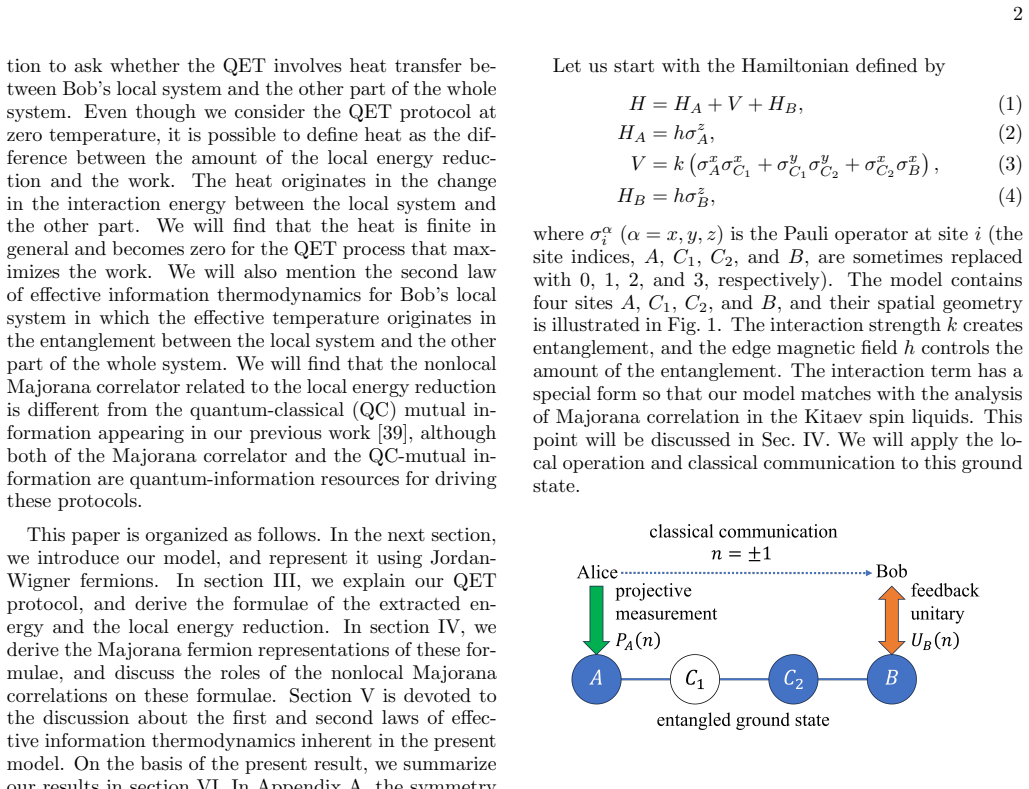
The central machinery is the mapping of the four-spin chain to a Majorana model: with $b_l = f_l^\dagger + f_l$ and $c_l = i(f_l^\dagger - f_l)$, the Hamiltonian becomes $H = i h b_A c_A - i k(c_A c_{C_1} - c_{C_1} c_{C_2} + c_{C_2} c_B) + i h c_B b_B$, where the c-Majorana fermions are the itinerant species and the b-Majorana fermions are the localized species (zero modes at $h=0$). In this representation the spin correlators that activate Bob's feedback are literally the nonlocal Majorana correlators $D_{AB} = \langle i c_A c_B\rangle$ and $-C_{AB} = \langle i b_A b_B\rangle$. The QET protocol itself is the standard sequence: Alice's projective measurement $P_A(n) = (I_A + n \vec{r}\cdot\vec{\sigma}_A)/2$, classical communication of $n$, and Bob's feedback rotation $U_B(n) = e^{i n \theta \vec{s}\cdot\vec{\sigma}_B}$. Optimizing the measurement axis, feedback axis, and rotation angle yields the two envelope formulae (41) and (48), with the optimizing values $\vec{r}=(0,1,0)$, $\vec{s}=(1,0,0)$ for $\Delta E_B^{\max}$ and $\vec{r}=(1,0,0)$, $\vec{s}=(0,1,0)$ for $\Delta E_{B,B}^{\max}$, and $\sin(2\theta)$, $\cos(2\theta)$ set by the correlators.
What would settle it
Run the protocol with a controllable delay between Alice's measurement and Bob's feedback: if positive extracted energy survives when the delay exceeds the time for an elementary excitation to propagate across the chain (set by the coupling $k$), the claim that the Majorana correlator alone is the resource would be refuted. Alternatively, measure $\Delta E_B$ at $h=0$, where $hD_{AB}=0$: the formula predicts exactly zero extraction, so any nonzero extracted energy in that limit would falsify the identification.
Extended reading notes
Core claim
We derive two exact formulae for the four-spin Hamiltonian $H = h\sigma_z^A + k(\sigma_x^A\sigma_x^{C_1} + \sigma_y^{C_1}\sigma_y^{C_2} + \sigma_x^{C_2}\sigma_x^B) + h\sigma_z^B$, transformed to Majorana fermions. The maximum energy Bob can extract is $\Delta E_B^{\max} = \sqrt{\epsilon_B^2 + (h D_{AB})^2} - |\epsilon_B|$, where $D_{AB} = \langle i c_A c_B\rangle$ is the nonlocal c-Majorana correlator, and the maximum reduction of Bob's local energy is $\Delta E_{B,B}^{\max} = \sqrt{\epsilon_B^2 + (h C_{AB})^2} - |\epsilon_B|$, where $C_{AB} = \langle \sigma_x^A \sigma_x^B\rangle = -\langle i b_A b_B\rangle$ in the even-parity sector. Extraction is positive exactly when $hD_{AB}$ is nonzero; local energy reduction is positive exactly when $hC_{AB}$ is nonzero. Both correlators enter through Bob's feedback unitary $U_B(n) = e^{i n \theta \vec{s}\cdot\vec{\sigma}_B}$, and the optimizing measurement axes and rotation angle are given explicitly. We also identify $\Delta E_{B,R}$ as effective heat absorbed by Bob's local system, so that the maximization of $\Delta E_B$ happens with zero heat transfer, and we show that the previous upper bound in terms of quantum-classical mutual information is saturated by the same measurement.
Load-bearing premise
The argument assumes Alice's classical communication and Bob's feedback are so fast that no physical excitation can travel from Alice to Bob during the protocol; if that speed condition fails, the extracted energy could be blamed on the traveling disturbance rather than on the nonlocal Majorana correlation.
Editorial extensions
If this is right
- In this protocol, positive energy extraction is possible if and only if the nonlocal c-Majorana correlator $D_{AB}$ is nonzero, and positive local energy reduction if and only if the b-Majorana correlator $C_{AB}$ is nonzero.
- The extracted-energy and local-energy-reduction maxima are exactly given by Eqs. (41) and (48), and they depend only on the edge field $h$ and the correlators, not on the details of the middle coupling.
- At the parameter set that maximizes extracted energy, the effective heat $\Delta E_{B,R}$ vanishes, so maximal work extraction and zero heat exchange between Bob's local system and the rest coincide.
- The same measurement that maximizes the local energy reduction saturates the second-law-like inequality with quantum-classical mutual information, so the bound is tight for this model.
- Because the protocol formulae hold irrespective of the middle-coupling details, the results extend to larger and higher-dimensional lattices; in one dimension the correlators decay as a power law with system size, signalling quantum criticality.
Reading between the lines
- If the identification holds beyond the four-site model, the correlators $D_{AB}$ and $C_{AB}$ could serve as witnesses for QET-capable correlations in candidate spin-liquid materials, since they relate directly to spin correlations that scattering or local-probe experiments might access.
- The zero-heat condition at maximum extraction suggests a design rule for QET variants: optimizing work extraction automatically suppresses unwanted heat leakage, which could be tested in protocols with larger or more complex environments.
- The time-delay caveat implies a quantitative trade-off between extracted energy and communication speed; a natural extension would be to compute $\Delta E_B$ as a function of delay and identify the speed threshold below which extraction vanishes.
- Because the optimizing measurement also minimizes the post-measurement von Neumann entropy, the protocol could be repurposed as a probe of the effective entanglement temperature $\beta_{\mathrm{eff}}$ in larger or higher-dimensional systems.
Editorial analysis
A structured set of objections, weighed in public.
Referee Report
Summary. The paper proposes a four-site quantum energy teleportation (QET) protocol on a spin model that maps exactly to Majorana fermions, and derives closed-form expressions for the maximum energy extractable at Bob's site and for the maximum local energy reduction. The protocol consists of Alice's projective measurement, classical communication, and Bob's feedback unitary. The central results are Delta E_B^max = sqrt(epsilon_B^2 + (h D_AB)^2) - |epsilon_B| (Eq. 41) and Delta E_{B,B}^max = sqrt(epsilon_B^2 + (h C_AB)^2) - |epsilon_B| (Eq. 48), where D_AB and C_AB are nonlocal Majorana correlators. The paper also connects Delta E_{B,B}^max to an information-thermodynamic bound from the authors' prior work and proves equality in Appendix E. Detailed appendices supply the optimization derivations, symmetry analysis, parity-sector checks, and the Majorana representation of the correlators.
Significance. The analytic derivations are self-contained, parameter-free, and algebraically consistent; spot checks of the optimization and the Majorana mapping confirm the main formulae. The Majorana representation gives a physically transparent interpretation of the resource, and the equality between Eq. (48) and the information-thermodynamic bound in Appendix E is a genuine consistency check rather than an assumption. The results yield falsifiable predictions, for example the vanishing of Delta E_B^max at h = 0 despite a finite D_AB, which could be tested in small quantum simulators. Once the presentation issue described below is corrected, the paper is a solid contribution to the QET literature.
major comments (1)
- [Abstract; Sec. III Eq. (41); Sec. VI] The abstract states that the extracted energy becomes positive 'when a nonlocal correlator ... is finite,' but Eq. (41) shows that the positivity condition is h D_AB != 0, not merely D_AB != 0. At h = 0, D_AB = 4 Z^2 (1 - alpha beta) is finite and negative, yet Delta E_B^max = 0 because the optimal feedback angle is forced to zero by Eqs. (44)-(45). The same omission occurs for the local energy reduction in Eq. (48), which requires h C_AB != 0. Please revise the abstract and the corresponding statements in Sec. VI to state that the product of the field strength h and the Majorana correlator must be nonzero, or equivalently that the correlator is necessary but not sufficient. The paper's own Fig. 3 and Sec. V already use the products hD_AB and hC_AB, so this is a presentational correction rather than a change to the derivation.
minor comments (6)
- [Sec. III, after Eq. (35)] The sentence 'The first terms in Eqs. (34) and (35) are always negative' should say 'non-positive', since those terms vanish when s_z = +/-1 or s_x = +/-1.
- [Introduction] The word 'researchs' in the first paragraph should be 'research'.
- [References] Reference [22] has '126. 090502'; the period between the volume and article number should be a comma: 126, 090502.
- [Fig. 3 caption] The square symbols in the caption may not render correctly; consider replacing them with descriptive labels such as 'C_AB' and 'D_AB' in the legend.
- [Abstract] For clarity, the abstract should name the two correlators explicitly (the b-Majorana correlator C_AB and the c-Majorana correlator D_AB) when stating the two positivity claims.
- [Sec. VI] The numerical evaluation for L up to 1000 is mentioned without a figure or table; including a small plot of C_AB and D_AB versus L would support the generalization claim.
Circularity Check
No significant circularity: the central QET formulae are derived from first principles without fitted parameters; the authors' prior bound is used only as a non-load-bearing consistency check.
full rationale
The central derivation is self-contained. The QET protocol is defined in Secs. II and III, and the expressions for the injected energy, extracted energy, and local energy reduction (Eqs. 27-40) are obtained by direct operator algebra with no fitting. The optima in Eqs. (41) and (48) follow from the trigonometric maximization in Appendix B (Eqs. B1-B15); the Majorana correlators C_AB, D_AB, and C_AR are independently defined ground-state expectation values (Eqs. 36-38) and are shown by the exact Jordan-Wigner/Majorana mapping to equal the corresponding Majorana correlators (Eqs. 59-63). No input is defined in terms of the output energy. The self-citations to Refs. [31] and [39] are not load-bearing: Eq. (48) is derived before the discussion of the second-law-like bound, and Appendix E proves the equality between Eq. (48) and the right-hand side of Eq. (65) using only the model parameters and the beta_eff determined by Eq. (68). Thus the prior work is used as a consistency check and corroboration, not as the source of the result. The abstract's wording that energy extraction becomes positive 'when a nonlocal correlator ... is finite' is imprecise because positivity actually requires h D_AB != 0 and h C_AB != 0 (Eqs. 41 and 48), and at h = 0 the correlators are finite while the extraction vanishes. This is a presentational/correctness issue, not a circularity. The acknowledgment in Sec. VI that time-delayed communication may weaken the result is an honest limitation and does not affect the circularity analysis.
Assumptions & free parameters
assumptions (5)
- domain assumption Alice's classical communication and Bob's feedback operation are effectively instantaneous compared to propagation of excitations from Alice's measurement.
- domain assumption The exact ground state |psi> in Eq. (10) is the lowest-energy state of H for h >= 0.
- domain assumption The four-site Hamiltonian in Eq. (3) faithfully represents the edge-field Majorana physics of the Kitaev spin liquid.
- standard math Standard quantum mechanics (projective measurement, unitary feedback, and expectation values).
- domain assumption Zero-temperature initial state.
Cite this review
Pith. "Pith review of Nonlocal correlations in quantum energy teleportation: perspectives from their Majorana representations and information thermodynamics." pith.science (2026). https://pith.science/paper/FA7HKC3D
@misc{pith2026241205565,
  author       = {Pith},
  title        = {Pith review of: Nonlocal correlations in quantum energy teleportation: perspectives from their Majorana representations and information thermodynamics},
  year         = {2026},
  howpublished = {\url{https://pith.science/paper/FA7HKC3D}},
  note         = {Machine review of arXiv:2412.05565}
}
read the original abstract
Motivated by anomalous nonlocal correlation in the Kitaev spin liquids, we propose a quantum energy teleportation protocol between remote partners Alice and Bob on a quantum spin model, and examine how its performance is characterized by Majorana fermions that clearly depict nonlocal correlations inherent in the model. In our model, Bob's energy extraction is activated by local energy injection by Alice's projective measurement and subsequent classical communication of the measurement result. We derive two formulae: one for the maximally extracted energy by the protocol and the other for the maximum of energy reduction at Bob's local site. We find that the extracted energy becomes positive when a nonlocal correlator defined by Majorana fermions at Alice's and Bob's sites is finite. We also find that the amount of the energy reduction becomes positive when another nonlocal Majorana correlator is finite. In both formulae, the correlators appear as a result of Bob's feedback unitary operation. We discuss effective information-thermodynamical aspects behind the protocol at zero temperature.
Figures


Figures from the paper (1 more)

Reference graph
Works this paper leans on
-
[39]
K. Itoh, Y. Masaki, and H. Matsueda, arXiv:2408.11522
-
[1]
C. H. Bennett, G. Brassard, C. Crepeau, R. Jozsa, A. Peres, and W. K. Wootters., Phys. Rev. Lett. 70, 1895 (1993)
work page 1993
- [2]
-
[3]
T. Schuster, B. Kobrin, P. Gao, I. Cong, E. T. Khabi- boulline, N. M. Linke, M. D. Lukin, C. Monroe, B. Yoshida, and N. Y. Yao., Phys. Rev. X12, 031013 (2022)
work page 2022
-
[4]
D. Jafferis, A. Zlokapa. J. D. Lykken, D. K. Kolchmeyer, S. I. Davis, N. Lauk, H. Neven, M. Spiropulu., Nature 612, 51 (2022)
work page 2022
- [5]
- [6]
- [7]
Show all 41 references
-
[8]
Hermanns, I
M. Hermanns, I. Kimchi, and J. Knolle, Annu. Rev. Con- dens. Matter Phys. 9, 17 (2018)
2018
-
[9]
Knolle and R
J. Knolle and R. Moessner, Annu. Rev. Condens. Matter Phys. 10, 451 (2019)
2019
-
[10]
Takagi, T
H. Takagi, T. Takayama, G. Jackeli, G. Khaliullin, and S. E. Nagler, Nat. Rev. Phys. 1, 264 (2019)
2019
-
[11]
Janssen and M
L. Janssen and M. Vojta. J. Phys.: Condens. Matter 31, 423002 (2019)
2019
-
[12]
Motome and J
Y. Motome and J. Nasu, J. Phys. Soc. Jpn. 89, 012002 (2020)
2020
-
[13]
Hickey and S
C. Hickey and S. Trebst, Phys. Rep. 950, 1 (2022)
2022
-
[14]
Minakawa, Y
T. Minakawa, Y. Murakami, A. Koga, and J. Nasu, Phys. Rev. Lett. 125, 047204 (2020)
2020
-
[15]
A. Koga, Y. Murakami, and J. Nasu, Phys. Rev. B 103, 214421 (2021)
2021
-
[16]
Taguchi, Y
H. Taguchi, Y. Murakami, A. Koga, and J. Nasu, Phys. Rev. B 104, 125139 (2021)
2021
-
[17]
J. Nasu, Y. Murakami, and A. Koga, Phys. Rev. B 106, 024411 (2022)
2022
-
[18]
Misawa, J
T. Misawa, J. Nasu, and Y. Motome, Phys. Rev. B 108, 115117 (2023)
2023
-
[19]
M. O. Takahashi, M. G. Yamada, M. Udagawa, T. Mizushima, S. Fujimoto., Phys. Rev. Lett. 131, 236701 (2023)
2023
-
[20]
Vijay and L
S. Vijay and L. Fu, Phys. Rev. B 94, 235446 (2016)
2016
-
[21]
Fu, Phys
L. Fu, Phys. Rev. Lett. 104, 056402 (2010)
2010
-
[22]
Huang, M
H.-L. Huang, M. Narozniak, F. Liang, Y. Zhao, A. D. Castellano, M. Gong, Y. Wu, S. Wang, J. Lin, Y. Xu, H. Deng, H. Rong, J. P. Dowling, C.-Z. Peng, T. Byrnes, X. Zhu, and J.-W. Pan, Phys. Rev. Lett. 126. 090502 (2021)
2021
-
[23]
Hotta, Phys
M. Hotta, Phys. Lett. A 372, 5671 (2008)
2008
-
[24]
Hotta, Phys
M. Hotta, Phys. Rev. D 78, 045006 (2008)
2008
-
[25]
Hotta, J
M. Hotta, J. Phys. Soc. Jpn. 78, 034001 (2009)
2009
-
[26]
Hotta, Phys
M. Hotta, Phys. Lett. A 374, 3416 (2010)
2010
-
[27]
Trevison and M
J. Trevison and M. Hotta, J. Phys. A: Math. Theor. 48, 175302 (2015)
2015
-
[28]
N. A. Rodriguez-Briones, H. Katiyar, E. Martin- Martinez, and R. Laflamme., Phys. Rev. Lett. 130, 110801 (2023)
2023
-
[29]
Ikeda, Phys
K. Ikeda, Phys. Rev. Appl. 20, 024051 (2023)
2023
-
[30]
Ikeda, A VS Quantum Sci
K. Ikeda, A VS Quantum Sci. 5, 035002 (2023)
2023
-
[31]
K. Itoh, Y. Masaki, and H. Matsueda, arXiv:2305.03967
- [32]
-
[33]
Sagawa and M
T. Sagawa and M. Ueda, Phys. Rev. Lett. 100, 080403 (2008)
2008
-
[34]
Tajima, Phys
H. Tajima, Phys. Rev. E 88, 042143 (2013)
2013
-
[35]
K. Funo, Y. Watanabe, and M. Ueda, Phys. Rev. A 88, 052319 (2013)
2013
-
[36]
J. J. Park, K.-H. Kim, T. Sagawa, and S. W. Kim, Phys. Rev. Lett. 111, 230402 (2013)
2013
-
[37]
Manzano, F
G. Manzano, F. Plastina, and R. Zambrini, Phys. Rev. Lett. 121, 120602 (2018)
2018
- [38]
-
[40]
H. J. Groenewold, Int. J. Theor. Phys. 4, 327 (1971)
1971
-
[41]
Ozawa, J
M. Ozawa, J. Math. Phys. 27, 759 (1986). Appendix A: Symmetry operations The eigenstates of our model can be characterized by various operators commuting or anticommuting with the Hamiltonian. We define the following four operators: P = σz Aσz C1 σz C2 σz B, (A1) Q = σz Aσz C1...
1986
Reviewed August 11, 2026 · model on record in the stance chip above.
Discussion (0). Continue with ORCID to comment.