REVIEW 4 major objections 4 minor 83 references
A single-GPU serving system that coordinates which omni requests enter the shared stage and how many SMs that stage gets when downstream generators co-run preserves class-specific first-response SLOs across text, speech, and image traffic.
Reviewed by Pith at T0; open to challenge. T0 means a machine referee read the full paper against a public rubric. the ladder, T0–T4 →
T0 review · deepseek-v4-flash
2026-08-04 20:53 UTC pith:FABQALSQ
load-bearing objection Real problem, coherent design, plausible gains — but the evaluation needs variance bars, stronger baselines, and a non-circular validation before I'd trust the headline numbers. the 4 major comments →
HorizonServe: Coordinating Request Scheduling with GPU Sharing for Omni-Model Serving
The pith
A machine-rendered reading of the paper's core claim, the machinery that carries it, and where it could break.
Core claim
The paper's central claim is that SLO-satisfied goodput on one GPU collapses under omni traffic not because of raw load alone, but because temporal sharing of the shared stage and spatial sharing with downstream generators reinforce each other: a long-path request consumes shared-stage slots, then adds memory-bandwidth pressure that inflates short-path TTFT, and the tightest-SLO class degrades first. HorizonServe establishes that both sides must be controlled together. It admits requests based on remaining slack, hides non-phase requests from the scheduler view for one step to rotate paths, caps ordinary long-path admissions, and maps a smoothed memory-pressure signal to a bounded shared-sta
What carries the argument
The load-bearing object is the omni-specific feedback loop connecting four signals: output-path admission into the shared stage, deadline slack, downstream activation from admitted long-path requests, and the bounded shared-stage SM cap. It is realized by two coupled schedulers: a temporal scheduler that shows the base runtime a filtered queue view (keeping protected and decode work visible, stashing ordinary non-phase prefills, rotating short/long phases, and capping long-path prefills), and a spatial controller that selects an SM cap from an offline ladder based on a normalized, EWMA-smoothed memory-activity signal. The cap is the crucial mechanism: because fixed-SM profiling shows decode
Load-bearing premise
The system assumes that the offline calibration — decode throughput stops improving past roughly 64–80 SMs and full allocation during co-running sharply inflates short-reply latency — remains true under the live workload; if real traffic changes that scaling behavior, the SM-throttling mechanism could hurt instead of help.
What would settle it
Run the same three workloads and arrival rates on a GPU or model where shared-stage decode keeps getting faster well past the calibrated SM cap, with no early throughput saturation and no memory-bandwidth cliff. If bounding the shared stage to the cap then yields lower SLO attainment than allowing full allocation, the central throttling claim fails. A cheaper check: in a long-path sweep, verify that the controller's memory-activity pressure signal tracks measured achieved memory bandwidth; if they diverge during co-running, the controller is steering by a stale proxy.
If this is right
- Short-path requests keep their first-response SLO even when a burst of speech or image requests is queued; the tightest-SLO class stops being the first casualty.
- SLO attainment gains appear on two GPU families with different SM counts and memory bandwidths, so the mechanism is not an artifact of one hardware profile.
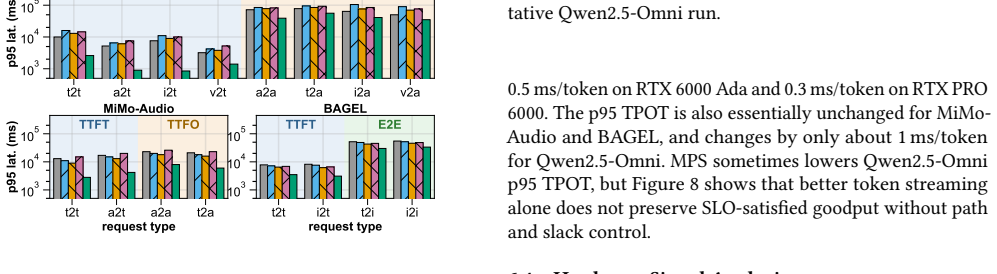
- Shared-stage token throughput is essentially preserved (p50 TPOT changes at most about 0.5 ms/token, p95 at most about 1 ms/token), so the latency gains are not bought by throttling decode.
- The policy stacks on any base serving runtime that exposes scheduling-step boundaries and a per-stage SM cap; the control loop costs under 1% throughput.
- The design generalizes across three downstream generation patterns — speech synthesis, audio-code/waveform generation, and image diffusion — covering the spectrum of current omni outputs.
Where Pith is reading between the lines
- A natural extension is to apply the temporal half — slack-aware path rotation and long-path admission caps — to disaggregated or multi-GPU omni serving, where the spatial SM split becomes less relevant but path admission still shapes downstream device load.
- The fixed number of long-path phases and the offline SM ladder are calibration choices; one could make both adaptive online, for instance inferring saturation from runtime TPOT-versus-SM observations instead of a one-time sweep.
- The memory-pressure proxy in the prototype is tied to one vendor's activity counters; the same ladder logic should port to other hardware via equivalent counters, which is testable on non-NVIDIA GPUs.
- The 5x SLO multiplier is a policy knob; under tighter multipliers the same feedback loop may need more aggressive path rotation, a regime the paper does not report.
Editorial analysis
A structured set of objections, weighed in public.
Referee Report
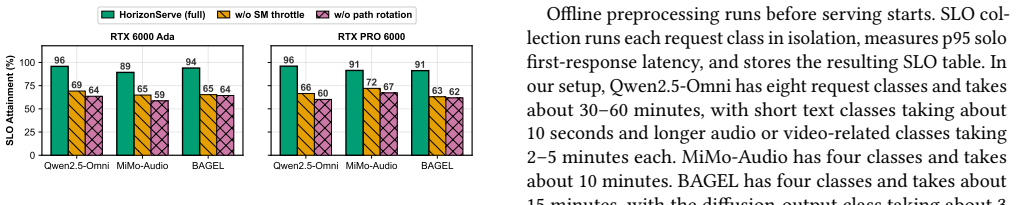
Summary. HorizonServe targets single-GPU serving of omni-models whose requests share an initial multimodal backbone and then diverge into short text-output paths or long speech/image-generation paths with heterogeneous first-response SLOs. The paper makes three observations (§3): heterogeneous latency regimes make shared-stage delay asymmetric across classes, long-path traffic collapses short-path goodput, and full shared-stage SM allocation under co-running downstream stages degrades short-request TTFT. It then presents a serving system that combines (i) offline profiling of per-class solo p95 latency and fixed-SM decode TPOT, (ii) a temporal scheduler with path rotation, slack protection, and a long-path admission cap (§4.3), and (iii) a spatial controller that maps a smoothed GPU memory-activity signal to a shared-stage SM cap via Eq. (1) (§4.4). The evaluation (§6) covers three omni-model pipelines (Qwen2.5-Omni, MiMo-Audio, BAGEL) on two GPUs, comparing against Vanilla, EDF, MPS, and EDF-MPS baselines. The paper claims up to 4.9× SLO-attainment improvement in arrival-rate sweeps and 7.0× under downstream-heavy traffic, with per-class p95 first-response latency reductions of 38.4–63.7%, while preserving shared-stage TPOT and adding <1% throughput overhead.
Significance. If validated, HorizonServe addresses a genuinely new scheduling problem: the feedback path from output-path admission to downstream GPU pressure and back to shared-stage SM allocation. The paper identifies a real workload pattern in recent omni-model architectures and proposes a coherent joint temporal–spatial control loop. Strengths include: implementation on top of vLLM-Omni, evaluation across three distinct downstream-generation patterns and two GPU platforms, ablation of the two main mechanisms (§6.5), direct measurement of scheduling overhead (Table 4), and an honest statement in §6.4 that the hardware-signal trace is not a standalone performance comparison. The empirical claims are, however, supported by representative single runs without error bars, and the spatial controller’s key calibration is validated only by a correlation that is partly circular. These issues do not disprove the central idea, but they mean the quantitative contribution is not yet established at the level expected for a systems venue.
major comments (4)
- [§4.4, Eq. (1), §3.3, Fig. 4] The spatial controller is calibrated entirely from an isolated fixed-SM sweep: §4.2 chooses S_cap as the smallest SM count with near-best decode TPOT from Fig. 4(b), and Eq. (1) never lets the runtime cap exceed S_cap. Fig. 4(b) is measured with a fixed batch and a specific downstream stage, outside the mixed workloads of Fig. 8. Nothing in the paper shows that the TPOT saturation knee or the TTFT degradation curve is invariant to batch composition, KV-cache state, downstream generator type, or arrival rate. If the knee shifts, the fixed cap either over-throttles shared-stage throughput (adding queueing delay) or under-throttles (reproducing full-allocation contention). This is load-bearing because the paper’s stated contribution is the feedback loop itself; if S_cap is miscalibrated under the actual workload, SM throttling can actively reduce SLO attainment. I request a concrete robustn
- [§6.4] The 0.926 correlation between the smoothed memory signal and the selected SM cap is presented as validating the bandwidth proxy. This is circular: s*_shared is a deterministic monotone function of the smoothed pressure signal through Eq. (1), so a high correlation follows by construction and says nothing about whether the proxy or the cap is correct. The paragraph does acknowledge the figure is not a standalone performance comparison, but the correlation statement still overinterprets the trace. To validate the proxy, compare the PyNVML signal against an independently measured memory-bandwidth counter (e.g., GPU hardware performance counters) under the same traffic, or show that a controller driven by the proxy outperforms one driven by an oracle bandwidth signal. As written, the runtime evidence for the pressure-to-cap mapping is lacking.
- [§6.2 and §6.1] The main quantitative claims rest on single representative runs without error bars or confidence intervals. The paper says 'We observed consistent trends across repeated runs and report representative runs' but does not report the variance. In a systems evaluation, the 4.9× and 7.0× improvements (Figs. 8, and the per-class latency claims in §6.3) should be accompanied by repeated-run statistics, especially under Poisson arrivals where stochastic variability can be substantial. I request at least mean ± spread over a small number of seeds for the key stressed points, or a statement of why single runs are sufficient on this platform. This does not invalidate the qualitative direction, but it prevents the reader from assessing reliability of the specific improvement factors.
- [§6.1, baselines] The comparison set (Vanilla, EDF, MPS, EDF-MPS) is quite simple. EDF and MPS are primitives, not state-of-the-art serving policies. The paper argues that existing VLM/LMM and GPU-sharing systems do not handle omni output paths, which is fair, but a more informative baseline would combine a modern scheduling policy (e.g., priority-aware or shortest-remaining-time admission within vLLM-Omni) with a modern spatial-sharing mechanism (e.g., MIG if available, or a fixed-SM split chosen by an offline optimizer). At minimum, an ablation that separates path rotation from SM throttling is present (§6.5), but the absence of any competitive serving baseline makes the claimed gains relative only to a weak default. I would like to see at least one stronger baseline or a discussion of why such baselines cannot be adapted without already adopting HorizonServe’s feedback structure.
minor comments (4)
- [§6.1, Fig. 8] Inconsistent naming: the figure legend says 'EDF+MPS' while the text and §6.2 use 'EDF-MPS'. Please unify.
- [§4.2] The definition of S_cap is split between §4.2 and §4.4; Eq. (1) uses S_cap, S_min, and S_aggr, but the reader must infer the relationship S_aggr > S_cap > S_min from the text. A formal definition or a small table of the ladder would improve readability.
- [§6.4, Fig. 10] Figure 10(c) y-axis label 'Stage0 SM cap (%)' and the referenced values (63, 100) are not clearly tied to the SM ladder levels. Please clarify whether the percentage is of total SMs and how ladder levels are converted.
- [§6.1] The SLO multiplier is set to 5× for all classes, which is a reasonable and explicitly stated choice. However, the paper should state whether results are sensitive to this multiplier; a single value leaves the reader unsure whether the observed gains are specific to the chosen SLO tightness.
Circularity Check
Headline SLO/latency results are empirical and independent; only the Section 6.4 correlation is self-referential, and the paper itself disclaims it as standalone.
specific steps
-
self definitional
[Section 6.4 (Figure 10) vs. Section 4.4 Eq. (1)]
"Across this run, the correlation between the smoothed memory signal and the selected cap is0.926, showing that the controller tracks the pressure signal while staying within the cap range motivated by Figure 4."
Eq. (1) defines the selected cap s*_shared(t) as snap_S(S_min + rho(t)(S_cap - S_min)) when downstream is active, where rho(t) is the clamped normalized EWMA of the same B_hat(t) signal. Hence the 'smoothed memory signal' and the 'selected cap' are input and deterministic monotone transform of input by construction; a high correlation between them is baked into the control law and cannot independently validate the PyNVML pressure proxy. The paper explicitly says this is not a standalone bandwidth measurement and it is not used to derive the main SLO-improvement claims, so the circularity is minor and non-load-bearing.
full rationale
HorizonServe's central contributions are supported by direct measurements: SLO attainment (Fig. 8), per-class p95 latency (Fig. 9), TPOT (Table 3), and ablations (Fig. 11) compare HorizonServe against Vanilla/EDF/MPS/EDF-MPS in the same runtime, so the headline 4.9x/7.0x and 38.4-63.7% numbers are empirical, not derived from fitted parameters. The offline S_cap and SM-ladder calibration (Sections 3.3, 4.2) is standard isolated profiling, not fitting to the test workload, and the SM-throttling equation bounds the cap rather than encoding the outcome. The paper's self-citation ([74]) appears only in a related-work enumeration and is not load-bearing. The one genuinely self-referential passage is the 0.926 correlation in Section 6.4, which is between the controller's input and a deterministic function of that input by Eq. (1); the paper itself cautions that it is not a standalone bandwidth measurement. Because the main results do not rest on this correlation, the overall circularity is minor.
Axiom & Free-Parameter Ledger
free parameters (7)
- S_cap (co-running SM cap)
- SM ladder [S_min, S_cap]
- N range [2,8] and M=2 =
N in [2,8], M=2
- SLO multiplier m_c =
5
- EWMA weight gamma =
0.4
- Saturation pressure B_sat
- Slack guard u_guard
axioms (4)
- domain assumption The shared-stage/downstream-stage abstraction captures the execution structure of representative omni models.
- domain assumption Offline solo-latency profiling and fixed-SM scaling results transfer to runtime co-located traffic.
- domain assumption GPU memory-bandwidth contention is the dominant cross-stage bottleneck, and SM count is an effective control knob for it.
- domain assumption The PyNVML memory-activity signal is a valid online proxy for achieved bandwidth.
Cite this review
Pith. "Pith review of HorizonServe: Coordinating Request Scheduling with GPU Sharing for Omni-Model Serving." pith.science (2026). https://pith.science/paper/FABQALSQ
@misc{pith2026260801785,
  author       = {Pith},
  title        = {Pith review of: HorizonServe: Coordinating Request Scheduling with GPU Sharing for Omni-Model Serving},
  year         = {2026},
  howpublished = {\url{https://pith.science/paper/FABQALSQ}},
  note         = {Machine review of arXiv:2608.01785}
}
read the original abstract
Omni models unify text, speech, image, and multimodal reasoning in a single serving backend, but this unified deployment exposes a new scheduling problem. Requests with different output modalities may share an initial multimodal backbone and then diverge into downstream generation stages, creating heterogeneous first-response metrics and service-level objective (SLO) targets on the same GPU. Existing large language model (LLM) and multimodal serving systems mainly optimize token progress or input-side processing, and they do not jointly control temporal sharing in the shared stage and spatial sharing among co-running stages. This paper presents HorizonServe, a single-GPU omni-model serving system that coordinates request admission and GPU allocation under heterogeneous SLOs. HorizonServe profiles per-class first-response latency, protects requests with limited slack, rotates shared-stage opportunities across execution paths, and throttles the shared-stage streaming multiprocessor (SM) allocation when downstream stages are active. Across three omni-model workloads and two GPU platforms, HorizonServe improves SLO attainment by up to 4.9$\times$ in arrival-rate sweeps and 7.0$\times$ under downstream-heavy traffic, and reduces per-class first-response latency by 38.4--63.7\%.
Figures


Reference graph
Works this paper leans on
-
[1]
Amey Agrawal, Nitin Kedia, Ashish Panwar, Jayashree Mohan, Nipun Kwatra, Bhargav Gulavani, Alexey Tumanov, and Ramachandran Ram- jee. 2024. Taming Throughput-Latency Tradeoff in LLM Inference with Sarathi-Serve. In18th USENIX Symposium on Operating Systems Design and Implementation (OSDI 24). USENIX Association, Santa Clara, CA, 117–134.https://www.usenix...
2024
-
[2]
Inclusion AI, :, Bowen Ma, Cheng Zou, ChengKun Du, Canxiang Yan, Chunxiang Jin, Chunjie Shen, Chenyu Lian, Chengxiang Fan, Dan- dan Zheng, Fudong Wang, Furong Xu, Guangming Yao, Haohao Liu, Han Peng, Jun Zhou, Junluan Xia, Jingdong Chen, Jianing Li, Jianxin Sun, Jianjiang Zhu, Jianping Jiang, Jinpeng Ou, Jun Peng, Jin Peng, Kaixiang Ji, Li Tang, Libin Wan...
arXiv 2026
-
[3]
Inclusion AI, Biao Gong, Cheng Zou, Chuanyang Zheng, Chunluan Zhou, Canxiang Yan, Chunxiang Jin, Chunjie Shen, Dandan Zheng, Fudong Wang, Furong Xu, GuangMing Yao, Jun Zhou, Jingdong Chen, Jianxin Sun, Jiajia Liu, Jianjiang Zhu, Jun Peng, Kaixiang Ji, Kaiyou Song, Kaimeng Ren, Libin Wang, Lixiang Ru, Lele Xie, Longhua Tan, Lyuxin Xue, Lan Wang, Mochen Bai...
Pith/arXiv arXiv 2025
-
[4]
Fan Bai, Pai Peng, Zhengzhi Tang, Zhe Wang, Gong Chen, Xiang Lu, Yinuo Li, Huan Lin, Weizhe Lin, Yaoyuan Wang, et al. 2026. EPD-Serve: A Flexible Multimodal EPD Disaggregation Inference Serving System On Ascend.arXiv preprint arXiv:2601.11590(2026)
arXiv 2026
- [5]
-
[6]
Lukas Bossard, Matthieu Guillaumin, and Luc Van Gool. 2014. Food- 101: Mining Discriminative Components with Random Forests. In Proceedings of the European Conference on Computer Vision Workshops. Springer, 446–461
2014
-
[7]
Sanyuan Chen, Chengyi Wang, Yu Wu, Ziqiang Zhang, Long Zhou, Shujie Liu, Zhuo Chen, Yanqing Liu, Huaming Wang, Jinyu Li, Lei He, Sheng Zhao, and Furu Wei. 2025. Neural Codec Language Models are Zero-Shot Text to Speech Synthesizers.IEEE Transac- tions on Audio, Speech and Language Processing33 (2025), 705–718. doi:10.1109/TASLPRO.2025.3530270
arXiv 2025
-
[8]
Xiaokang Chen, Zhiyu Wu, Xingchao Liu, Zizheng Pan, Wen Liu, Zhenda Xie, Xingkai Yu, and Chong Ruan. 2025. Janus-Pro: Unified Multimodal Understanding and Generation with Data and Model Scal- ing. arXiv:2501.17811 [cs.AI]https://arxiv.org/abs/2501.17811
Pith/arXiv arXiv 2025
-
[9]
Yukang Chen, Weihao Cui, Han Zhao, Ziyi Xu, Xiaoze Fan, Xusheng Chen, Yangjie Zhou, Shixuan Sun, Bingsheng He, and Quan Chen. 2026. Towards High-Goodput LLM Serving with Prefill-decode Multiplexing. InProceedings of the 31st ACM International Conference on Architectural Support for Programming Languages and Operating Systems, Volume 2. 2030–2047
2026
-
[10]
Seungbeom Choi, Sunho Lee, Yeonjae Kim, Jongse Park, Youngjin Kwon, and Jaehyuk Huh. 2022. Serving Heterogeneous Machine Learning Models on Multi-GPU Servers with Spatio-Temporal Shar- ing. In2022 USENIX Annual Technical Conference (USENIX ATC 22). USENIX Association, Carlsbad, CA, 199–216.https://www.usenix.org/ conference/atc22/presentation/choi-seungbeom
work page 2022
-
[11]
Xiangxiang Chu, Limeng Qiao, Xinyang Lin, Shuang Xu, Yang Yang, Yiming Hu, Fei Wei, Xinyu Zhang, Bo Zhang, Xiaolin Wei, and Chunhua Shen. 2023. MobileVLM: A Fast, Strong and Open Vision Language Assistant for Mobile Devices. arXiv:2312.16886 [cs.CV] https://arxiv.org/abs/2312.16886
Pith/arXiv arXiv 2023
-
[12]
Daniel Crankshaw, Xin Wang, Guilio Zhou, Michael J. Franklin, Joseph E. Gonzalez, and Ion Stoica. 2017. Clipper: A Low-Latency Online Prediction Serving System. In14th USENIX Symposium on Networked Systems Design and Implementation (NSDI 17). USENIX As- sociation, Boston, MA, 613–627.https://www.usenix.org/conference/ nsdi17/technical-sessions/presentatio...
work page 2017
-
[13]
Alexandre Défossez, Jade Copet, Gabriel Synnaeve, and Yossi Adi
-
[14]
Chaorui Deng, Deyao Zhu, Kunchang Li, Chenhui Gou, Feng Li, Zeyu Wang, Shu Zhong, Weihao Yu, Xiaonan Nie, Ziang Song, Guang Shi, and Haoqi Fan. 2025. Emerging Properties in Unified Multimodal Pretraining.arXiv preprint arXiv:2505.14683(2025)
Pith/arXiv arXiv 2025
-
[15]
Jiangfei Duan, Runyu Lu, Haojie Duanmu, Xiuhong Li, Xingcheng Zhang, Dahua Lin, Ion Stoica, and Hao Zhang. 2024. MuxServe: flexible spatial-temporal multiplexing for multiple LLM serving. InProceed- ings of the 41st International Conference on Machine Learning(Vienna, Austria)(ICML’24). JMLR.org, Article 473, 13 pages
work page 2024
-
[16]
Chaoyou Fu, Haojia Lin, Xiong Wang, YiFan Zhang, Yunhang Shen, Xiaoyu Liu, Haoyu Cao, Zuwei Long, Heting Gao, Ke Li, Long MA, Xiawu Zheng, Rongrong Ji, Xing Sun, Caifeng Shan, and Ran He. 2026. VITA-1.5: Towards GPT-4o Level Real-Time Vision and Speech Inter- action. InThe Thirty-ninth Annual Conference on Neural Information Processing Systems.https://ope...
work page 2026
-
[17]
Yao Fu, Leyang Xue, Yeqi Huang, Andrei-Octavian Brabete, Dmitrii Ustiugov, Yuvraj Patel, and Luo Mai. 2024. ServerlessLLM: Low- Latency Serverless Inference for Large Language Models. In18th 13 USENIX Symposium on Operating Systems Design and Implementa- tion (OSDI 24). USENIX Association, Santa Clara, CA, 135–153.https: //www.usenix.org/conference/osdi24...
work page 2024
-
[18]
Arpan Gujarati, Reza Karimi, Safya Alzayat, Wei Hao, Antoine Kauf- mann, Ymir Vigfusson, and Jonathan Mace. 2020. Serving DNNs like Clockwork: Performance Predictability from the Bottom Up. In 14th USENIX Symposium on Operating Systems Design and Imple- mentation (OSDI 20). USENIX Association, Virtual Event, 443–462. https://www.usenix.org/conference/osdi...
work page 2020
- [19]
-
[20]
Mingcong Han, Hanze Zhang, Rong Chen, and Haibo Chen. 2022. Microsecond-scale Preemption for Concurrent GPU-accelerated DNN Inferences. In16th USENIX Symposium on Operating Systems Design and Implementation (OSDI 22). USENIX Association, Carlsbad, CA, 539– 558.https://www.usenix.org/conference/osdi22/presentation/han
2022
-
[21]
Karl Moritz Hermann, Tomáš Kočiský, Edward Grefenstette, Lasse Es- peholt, Will Kay, Mustafa Suleyman, and Phil Blunsom. 2015. Teaching machines to read and comprehend. InProceedings of the 29th Inter- national Conference on Neural Information Processing Systems - Vol- ume 1(Montreal, Canada)(NIPS’15). MIT Press, Cambridge, MA, USA, 1693–1701
work page 2015
-
[22]
Jonathan Ho, Ajay Jain, and Pieter Abbeel. 2020. Denoising Diffu- sion Probabilistic Models. InAdvances in Neural Information Pro- cessing Systems, H. Larochelle, M. Ranzato, R. Hadsell, M.F. Bal- can, and H. Lin (Eds.), Vol. 33. Curran Associates, Inc., 6840– 6851.https://proceedings.neurips.cc/paper_files/paper/2020/file/ 4c5bcfec8584af0d967f1ab10179ca4...
work page 2020
-
[23]
Yibo Jin, Tao Wang, Huimin Lin, Mingyang Song, Peiyang Li, Yipeng Ma, Yicheng Shan, Zhengfan Yuan, Cailong Li, Yajing Sun, Tiandeng Wu, Xing Chu, Ruizhi Huan, Li Ma, Xiao You, Wenting Zhou, Yun- peng Ye, Wen Liu, Xiangkun Xu, Yongsheng Zhang, Tiantian Dong, Jiawei Zhu, Zhe Wang, Xijian Ju, Jianxun Song, Haoliang Cheng, Xi- aojing Li, Jiandong Ding, Hefei ...
Pith/arXiv arXiv 2024
-
[24]
Jungil Kong, Jaehyeon Kim, and Jaekyoung Bae. 2020. HiFi-GAN: generative adversarial networks for efficient and high fidelity speech synthesis. InProceedings of the 34th International Conference on Neural Information Processing Systems(Vancouver, BC, Canada)(NIPS ’20). Curran Associates Inc., Red Hook, NY, USA, Article 1428, 12 pages
work page 2020
-
[25]
Gonzalez, Hao Zhang, and Ion Sto- ica
Woosuk Kwon, Zhuohan Li, Siyuan Zhuang, Ying Sheng, Lianmin Zheng, Cody Hao Yu, Joseph E. Gonzalez, Hao Zhang, and Ion Sto- ica. 2023. Efficient Memory Management for Large Language Model Serving with PagedAttention. InProceedings of the 29th Symposium on Operating Systems Principles. Association for Computing Machinery, New York, NY, USA, 611–626. doi:10...
arXiv 2023
-
[26]
Zikun Li, Zhuofu Chen, Remi Delacourt, Gabriele Oliaro, Zeyu Wang, Qinghan Chen, Shuhuai Lin, April Yang, Zhihao Zhang, Zhuom- ing Chen, Yi-Hsiang Lai, Xinhao Cheng, Xupeng Miao, and Zhi- hao Jia. 2026. AdaServe: Accelerating Multi-SLO LLM Serving with SLO-Customized Speculative Decoding. InProceedings of the 21st European Conference on Computer Systems(M...
-
[27]
Jianxiong Liao, Quanxing Dong, Yunkai Liang, Zhi Zhou, and Xu Chen
-
[28]
Zejia Lin, Hongxin Xu, Guanyi Chen, Zhiguang Chen, Yutong Lu, and Xianwei Zhang. 2026. Bullet: Boosting GPU Utilization for LLM Serving via Dynamic Spatial-Temporal Orchestration. InProceedings of the 31st ACM International Conference on Architectural Support for Programming Languages and Operating Systems, Volume 2(USA)(ASP- LOS ’26). Association for Com...
arXiv 2026
-
[29]
2025.Choose Between Cloud-Based and Local AI Models
Microsoft. 2025.Choose Between Cloud-Based and Local AI Models. https://learn.microsoft.com/en-us/windows/ai/cloud-ai
work page 2025
-
[30]
NVIDIA. 2022. What Is Edge AI and How Does It Work?https: //blogs.nvidia.com/blog/what-is-edge-ai/
work page 2022
-
[31]
2026.CUDA C++ Programming Guide.https://docs.nvidia
NVIDIA. 2026.CUDA C++ Programming Guide.https://docs.nvidia. com/cuda/cuda-c-programming-guide/
work page 2026
-
[32]
NVIDIA. 2026.CUDA Driver API: Green Contexts.https: //docs.nvidia.com/cuda/cuda-driver-api/group__CUDA__GREEN_ _CONTEXTS.html
work page 2026
-
[33]
2026.Multi-Process Service User Guide.https://docs.nvidia
NVIDIA. 2026.Multi-Process Service User Guide.https://docs.nvidia. com/deploy/mps/
work page 2026
-
[34]
2026.NVIDIA Multi-Instance GPU User Guide.https://docs
NVIDIA. 2026.NVIDIA Multi-Instance GPU User Guide.https://docs. nvidia.com/datacenter/tesla/mig-user-guide/
work page 2026
-
[35]
NVIDIA. 2026.NVIDIA RTX 6000 Ada Generation Graphics Card.https: //www.nvidia.com/en-us/products/workstations/rtx-6000/
work page 2026
-
[36]
NVIDIA. 2026.NVIDIA RTX PRO 6000 Blackwell Workstation Edition.https://www.nvidia.com/en-us/products/workstations/ professional-desktop-gpus/rtx-pro-6000/
work page 2026
-
[37]
NVIDIA. 2026.NVIDIA RTX PRO AI Workstation Solutions.https: //www.nvidia.com/en-us/products/workstations/ai-workstations/
work page 2026
-
[38]
OpenAI. 2024. Hello GPT-4o.https://openai.com/index/hello-gpt-4o/
work page 2024
-
[39]
Vassil Panayotov, Guoguo Chen, Daniel Povey, and Sanjeev Khudanpur
-
[40]
Pratyush Patel, Esha Choukse, Chaojie Zhang, Aashaka Shah, Íñigo Goiri, Saeed Maleki, and Ricardo Bianchini. 2025. Splitwise: Efficient Generative LLM Inference Using Phase Splitting. InProceedings of the 51st Annual International Symposium on Computer Architecture (Buenos Aires, Argentina)(ISCA ’24). IEEE Press, 118–132. doi:10. 1109/ISCA59077.2024.00019
arXiv 2025
-
[41]
William Peebles and Saining Xie. 2023. Scalable diffusion models with transformers. InProceedings of the IEEE/CVF international conference on computer vision. 4195–4205
work page 2023
-
[42]
Ruoyu Qin, Zheming Li, Weiran He, Jialei Cui, Feng Ren, Mingxing Zhang, Yongwei Wu, Weimin Zheng, and Xinran Xu. 2025. Moon- cake: Trading More Storage for Less Computation — A KVCache- centric Architecture for Serving LLM Chatbot. In23rd USENIX Confer- ence on File and Storage Technologies (FAST 25). USENIX Association, Santa Clara, CA, 155–170.https://w...
2025
-
[43]
Haoran Qiu, Anish Biswas, Zihan Zhao, Jayashree Mohan, Alind Khare, Esha Choukse, Íñigo Goiri, Zeyu Zhang, Haiying Shen, Chetan Bansal, Ram Ramjee, and Rodrigo Fonseca. 2026. ModServe: Modality- and Stage-Aware Resource Disaggregation for Scalable Multimodal Model Serving. InProceedings of the 2025 ACM Symposium on Cloud Comput- ing (SoCC ’25). Associatio...
-
[44]
Alec Radford, Jong Wook Kim, Chris Hallacy, Aditya Ramesh, Gabriel Goh, Sandhini Agarwal, Girish Sastry, Amanda Askell, Pamela Mishkin, Jack Clark, Gretchen Krueger, and Ilya Sutskever. 2021. Learning Transferable Visual Models From Natural Language Supervision. In Proceedings of the 38th International Conference on Machine Learning (Proceedings of Machin...
work page 2021
-
[45]
Alec Radford, Jong Wook Kim, Tao Xu, Greg Brockman, Christine McLeavey, and Ilya Sutskever. 2023. Robust speech recognition via 14 large-scale weak supervision. InInternational conference on machine learning. PMLR, 28492–28518
work page 2023
-
[46]
Alec Radford, Karthik Narasimhan, Tim Salimans, Ilya Sutskever, et al
-
[47]
Robin Rombach, Andreas Blattmann, Dominik Lorenz, Patrick Esser, and Björn Ommer. 2022. High-resolution image synthesis with latent diffusion models. InProceedings of the IEEE/CVF conference on computer vision and pattern recognition. 10684–10695
2022
-
[48]
Yadwadkar, and Christos Kozyrakis
Francisco Romero, Qian Li, Neeraja J. Yadwadkar, and Christos Kozyrakis. 2021. INFaaS: Automated Model-less Inference Serv- ing. In2021 USENIX Annual Technical Conference (USENIX ATC 21). USENIX Association, Virtual Event, 397–411.https://www.usenix. org/conference/atc21/presentation/romero
work page 2021
-
[49]
Charlie F. Ruan, Yucheng Qin, Xun Zhou, Ruihang Lai, Hongyi Jin, Yixin Dong, Bohan Hou, Meng-Shiun Yu, Yiyan Zhai, Sudeep Agarwal, Hangrui Cao, Siyuan Feng, and Tianqi Chen. 2024. We- bLLM: A High-Performance In-Browser LLM Inference Engine. arXiv:2412.15803 [cs.LG]https://arxiv.org/abs/2412.15803
Pith/arXiv arXiv 2024
-
[50]
Haichen Shen, Lequn Chen, Yuchen Jin, Liangyu Zhao, Bingyu Kong, Matthai Philipose, Arvind Krishnamurthy, and Ravi Sundaram. 2019. Nexus: A GPU Cluster Engine for Accelerating DNN-Based Video Analysis. InProceedings of the 27th ACM Symposium on Operating Systems Principles. Association for Computing Machinery, New York, NY, USA, 322–337. doi:10.1145/33413...
arXiv 2019
-
[51]
Ying Sheng, Lianmin Zheng, Binhang Yuan, Zhuohan Li, Max Ryabinin, Beidi Chen, Percy Liang, Christopher Ré, Ion Stoica, and Ce Zhang
-
[52]
Sudipta Saha Shubha, Haiying Shen, and Anand Iyer. 2024. USHER: Holistic Interference Avoidance for Resource Optimized ML Inference. In18th USENIX Symposium on Operating Systems Design and Imple- mentation (OSDI 24). USENIX Association, Santa Clara, CA, 947–964. https://www.usenix.org/conference/osdi24/presentation/shubha
work page 2024
-
[54]
Khurram Soomro, Amir Roshan Zamir, and Mubarak Shah. 2012. UCF101: A Dataset of 101 Human Actions Classes From Videos in the Wild. arXiv:1212.0402 [cs.CV]
Pith/arXiv arXiv 2012
-
[55]
Biao Sun, Ziming Huang, Hanyu Zhao, Wencong Xiao, Xinyi Zhang, Yong Li, and Wei Lin. 2024. Llumnix: Dynamic Scheduling for Large Language Model Serving. In18th USENIX Symposium on Operating Systems Design and Implementation (OSDI 24). USENIX Association, Santa Clara, CA, 173–191.https://www.usenix.org/conference/osdi24/ presentation/sun-biao
2024
-
[56]
FlexGen: high-throughput generative inference of large language models with a single GPU. InProceedings of the 40th International Conference on Machine Learning(Honolulu, Hawaii, USA)(ICML’23). JMLR.org, Article 1288, 23 pages
-
[57]
Meituan LongCat Team, Bairui Wang, Bayan, Bin Xiao, Bo Zhang, Bolin Rong, Borun Chen, Chang Wan, Chao Zhang, Chen Huang, Chen Chen, Chen Chen, Chengxu Yang, Chengzuo Yang, Cong Han, Dandan Peng, Delian Ruan, Detai Xin, Disong Wang, Dongchao Yang, Fanfan Liu, Fengjiao Chen, Fengyu Yang, Gan Dong, Gang Huang, Gang Xu, Guanglu Wan, Guoqiang Tan, Guoqiao Yu, ...
arXiv 2025
-
[58]
Wenwen Tong, Hewei Guo, Dongchuan Ran, Jiangnan Chen, Jiefan Lu, Kaibin Wang, Keqiang Li, Xiaoxu Zhu, Jiakui Li, Kehan Li, Xueheng Li, Lumin Li, Chenxu Guo, Jiasheng Zhou, Jiandong Chen, Xianye Wu, Jiahao Wang, Silei Wu, Lei Chen, Hanming Deng, Yuxuan Song, Dinghao Zhou, Guiping Zhong, Ken Zheng, Shiyin Kang, and Lewei Lu
-
[59]
Ashish Vaswani, Noam Shazeer, Niki Parmar, Jakob Uszkoreit, Llion Jones, Aidan N Gomez, Ł ukasz Kaiser, and Illia Polosukhin. 2017. Attention is All you Need. InAdvances in Neural Information Pro- cessing Systems, I. Guyon, U. Von Luxburg, S. Bengio, H. Wallach, R. Fergus, S. Vishwanathan, and R. Garnett (Eds.), Vol. 30. Curran As- sociates, Inc.https://p...
work page 2017
-
[60]
Haoxin Wang, Xiaolong Tu, Hongyu Ke, Huirong Chai, Dawei Chen, and Kyungtae Han. 2025. lm-Meter: Unveiling Runtime Inference La- tency for On-Device Language Models. InProceedings of the Tenth ACM/IEEE Symposium on Edge Computing(the Hilton Arlington National Landing, Arlington, VA, USA)(SEC ’25). Association for Computing Machinery, New York, NY, USA, Ar...
-
[61]
Core Team, Dong Zhang, Gang Wang, Jinlong Xue, Kai Fang, Liang Zhao, Rui Ma, Shuhuai Ren, Shuo Liu, Tao Guo, Weiji Zhuang, Xin Zhang, Xingchen Song, Yihan Yan, Yongzhe He, Cici, Bowen Shen, Chengxuan Zhu, Chong Ma, Chun Chen, Heyu Chen, Jiawei Li, Lei Li, Menghang Zhu, Peidian Li, Qiying Wang, Sirui Deng, Weimin Xiong, Wenshan Huang, Wenyu Yang, Yilin Jia...
arXiv 2025
-
[62]
Chengyue Wu, Xiaokang Chen, Zhiyu Wu, Yiyang Ma, Xingchao Liu, Zizheng Pan, Wen Liu, Zhenda Xie, Xingkai Yu, Chong Ruan, and Ping Luo. 2024. Janus: Decoupling Visual Encoding for Unified 15 Multimodal Understanding and Generation. arXiv:2410.13848 [cs.CV] https://arxiv.org/abs/2410.13848
Pith/arXiv arXiv 2024
-
[63]
Jin Xu, Zhifang Guo, Jinzheng He, Hangrui Hu, Ting He, Shuai Bai, Keqin Chen, Jialin Wang, Yang Fan, Kai Dang, Bin Zhang, Xiong Wang, Yunfei Chu, and Junyang Lin. 2025. Qwen2.5-Omni Technical Report. arXiv:2503.20215 [cs.CL]https://arxiv.org/abs/2503.20215
Pith/arXiv arXiv 2025
-
[64]
Jin Xu, Zhifang Guo, Hangrui Hu, Yunfei Chu, Xiong Wang, Jinzheng He, Yuxuan Wang, Xian Shi, Ting He, Xinfa Zhu, Yuanjun Lv, Yongqi Wang, Dake Guo, He Wang, Linhan Ma, Pei Zhang, Xinyu Zhang, Hongkun Hao, Zishan Guo, Baosong Yang, Bin Zhang, Ziyang Ma, Xipin Wei, Shuai Bai, Keqin Chen, Xuejing Liu, Peng Wang, Mingkun Yang, Dayiheng Liu, Xingzhang Ren, Bo ...
Pith/arXiv arXiv 2025
-
[65]
Yuan Yao, Tianyu Yu, Ao Zhang, Chongyi Wang, Junbo Cui, Hongji Zhu, Tianchi Cai, Haoyu Li, Weilin Zhao, Zhihui He, et al . 2024. MiniCPM-V: A GPT-4V Level MLLM on Your Phone.arXiv preprint arXiv:2408.01800(2024)
Pith/arXiv arXiv 2024
-
[66]
Fanjiang Ye, Zhangke Li, Xinrui Zhong, Ethan Ma, Russell Chen, Kai- jian Wang, Jingwei Zuo, Desen Sun, Ye Cao, Triston Cao, Myungjin Lee, Arvind Krishnamurthy, and Yuke Wang. 2026. GENSERVE: Efficient Co-Serving of Heterogeneous Diffusion Model Workloads. arXiv:2604.04335 [cs.DC]https://arxiv.org/abs/2604.04335
Pith/arXiv arXiv 2026
-
[67]
Bingyang Wu, Shengyu Liu, Yinmin Zhong, Peng Sun, Xuanzhe Liu, and Xin Jin. 2024. LoongServe: Efficiently Serving Long-Context Large Language Models with Elastic Sequence Parallelism. InProceedings of the ACM SIGOPS 30th Symposium on Operating Systems Principles (Austin, TX, USA)(SOSP ’24). Association for Computing Machinery, New York, NY, USA, 640–654. ...
arXiv 2024
-
[68]
Gyeong-In Yu, Joo Seong Jeong, Geon-Woo Kim, Soojeong Kim, and Byung-Gon Chun. 2022. Orca: A Distributed Serving System for Transformer-Based Generative Models. In16th USENIX Symposium on Operating Systems Design and Implementation (OSDI 22). USENIX Asso- ciation, Carlsbad, CA, 521–538.https://www.usenix.org/conference/ osdi22/presentation/yu
2022
-
[69]
Peifeng Yu and Mosharaf Chowdhury. 2020. Salus: Fine- Grained GPU Sharing Primitives for Deep Learning Applications. arXiv:1902.04610 [cs.DC]https://arxiv.org/abs/1902.04610
work page internal anchor Pith review Pith/arXiv arXiv 2020
-
[70]
Neil Zeghidour, Alejandro Luebs, Ahmed Omran, Jan Skoglund, and Marco Tagliasacchi. 2021. Soundstream: An end-to-end neural au- dio codec.IEEE/ACM Transactions on Audio, Speech, and Language Processing30 (2021), 495–507
work page 2021
-
[71]
Xiaohua Zhai, Basil Mustafa, Alexander Kolesnikov, and Lucas Beyer
-
[72]
Chengliang Zhang, Minchen Yu, Wei Wang, and Feng Yan. 2019. MArk: Exploiting Cloud Services for Cost-Effective, SLO-Aware Machine Learning Inference Serving. In2019 USENIX Annual Technical Con- ference (USENIX ATC 19). USENIX Association, Renton, WA, 1049– 1062.https://www.usenix.org/conference/atc19/presentation/zhang- chengliang
work page 2019
-
[73]
Peiqi Yin, Jiangyun Zhu, Han Gao, Chenguang Zheng, Yongxiang Huang, Taichang Zhou, Ruirui Yang, Weizhi Liu, Weiqing Chen, Canlin Guo, Didan Deng, Zifeng Mo, Cong Wang, James Cheng, Roger Wang, and Hongsheng Liu. 2026. vLLM-Omni: Fully Disaggregated Serving for Any-to-Any Multimodal Models. arXiv:2602.02204 [cs.DC]https: //arxiv.org/abs/2602.02204
arXiv 2026
- [74]
-
[75]
Gonzalez, Clark Barrett, and Ying Sheng
Lianmin Zheng, Liangsheng Yin, Zhiqiang Xie, Chuyue Sun, Jeff Huang, Cody Hao Yu, Shiyi Cao, Christos Kozyrakis, Ion Stoica, Joseph E. Gonzalez, Clark Barrett, and Ying Sheng. 2024. SGLang: efficient execution of structured language model programs. InPro- ceedings of the 38th International Conference on Neural Information Processing Systems(Vancouver, BC,...
2024
-
[76]
Yinmin Zhong, Shengyu Liu, Junda Chen, Jianbo Hu, Yibo Zhu, Xu- anzhe Liu, Xin Jin, and Hao Zhang. 2024. DistServe: Disaggregating Prefill and Decoding for Goodput-optimized Large Language Model Serving. In18th USENIX Symposium on Operating Systems Design and Implementation (OSDI 24). USENIX Association, Santa Clara, CA, 193– 210.https://www.usenix.org/co...
2024
-
[77]
Kan Zhu, Yufei Gao, Yilong Zhao, Liangyu Zhao, Gefei Zuo, Yile Gu, Dedong Xie, Zihao Ye, Keisuke Kamahori, Chien-Yu Lin, Ziren Wang, Stephanie Wang, Arvind Krishnamurthy, and Baris Kasikci. 2025. NanoFlow: Towards Optimal Large Language Model Serving Through- put. In19th USENIX Symposium on Operating Systems Design and Implementation (OSDI 25). USENIX Ass...
work page 2025
-
[78]
InProceedings of the IEEE/CVF International Conference on Computer Vision
Sigmoid Loss for Language Image Pre-Training. InProceedings of the IEEE/CVF International Conference on Computer Vision. IEEE, Paris, France, 11975–11986.https://openaccess.thecvf.com/content/ ICCV2023/html/Zhai_Sigmoid_Loss_for_Language_Image_Pre- Training_ICCV_2023_paper.html
-
[80]
Hong Zhang, Yupeng Tang, Anurag Khandelwal, and Ion Stoica. 2023. SHEPHERD: Serving DNNs in the Wild. In20th USENIX Symposium on Networked Systems Design and Implementation (NSDI 23). USENIX As- sociation, Boston, MA, 787–808.https://www.usenix.org/conference/ nsdi23/presentation/zhang-hong
work page 2023
-
[2015]
InProceedings of the IEEE International Conference on Acoustics, Speech and Signal Processing
LibriSpeech: An ASR Corpus Based on Public Domain Audio Books. InProceedings of the IEEE International Conference on Acoustics, Speech and Signal Processing. IEEE, 5206–5210
-
[2018]
Improving language understanding by generative pre-training. (2018)
2018
discussion (0)
Sign in with ORCID, Apple, or X to comment. Anyone can read and Pith papers without signing in.