Peak Sidelobe Suppression in Planar Fluid Antenna Array
Pith reviewed 2026-07-01 03:47 UTC · model grok-4.3
The pith
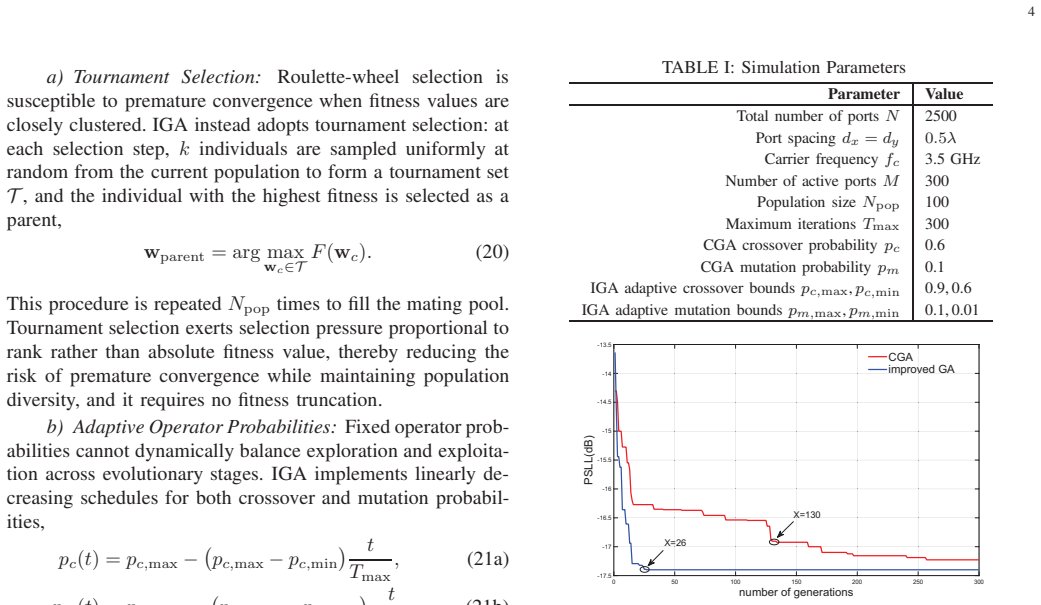
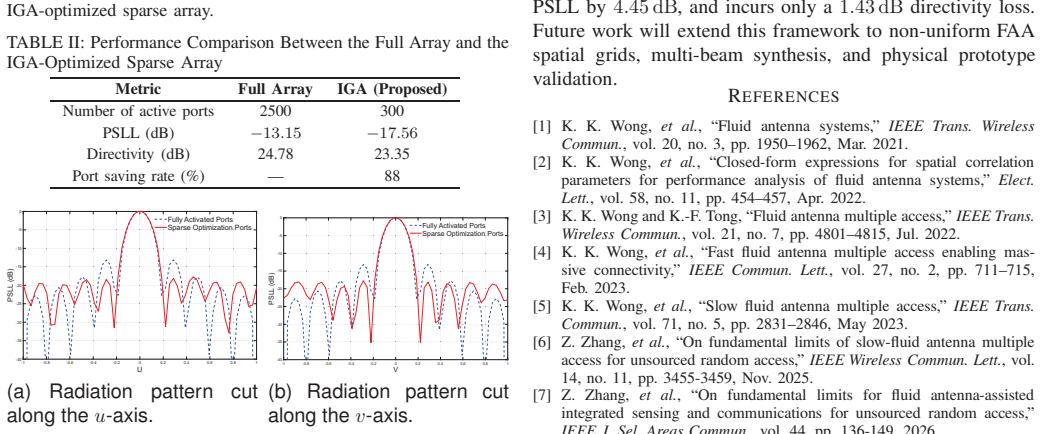
An improved genetic algorithm reduces peak sidelobe levels in sparse planar fluid antenna arrays by 4.45 dB.
A machine-rendered reading of the paper's core claim, the machinery that carries it, and where it could break.
Core claim
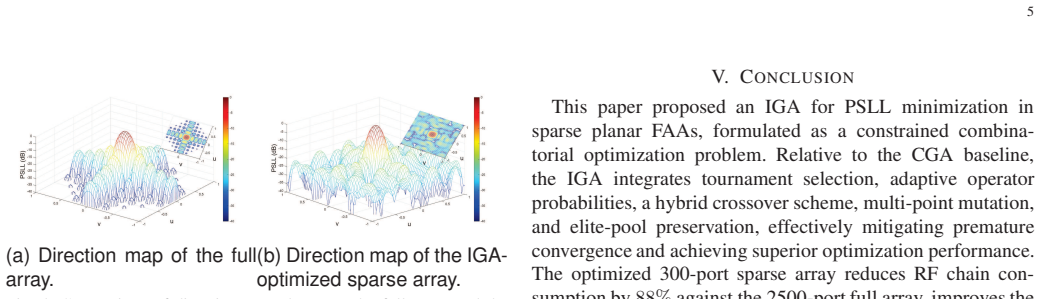
The improved genetic algorithm (IGA) with tournament selection, adaptive operator probabilities, hybrid crossover, multi-point mutation, and elite-pool preservation finds port activation patterns that minimize peak sidelobe level under sparsity constraints in planar fluid antenna arrays, delivering a 4.45 dB sidelobe reduction over the canonical genetic algorithm with comparable mainlobe width.
What carries the argument
The improved genetic algorithm (IGA) that searches for optimal port activation patterns to minimize peak sidelobe level under sparsity constraints.
If this is right
- The IGA reaches lower final peak sidelobe levels than the standard genetic algorithm.
- Convergence happens faster under the same sparsity rules.
- Mainlobe width stays nearly unchanged while sidelobes drop.
- Geometric flexibility of fluid antennas can be used more effectively for pattern control.
Where Pith is reading between the lines
- Faster optimization could support dynamic port switching when the environment changes.
- The same search method might help place nulls or shape beams in other reconfigurable arrays.
- If scaled to larger grids, it could reduce interference in dense wireless networks.
Load-bearing premise
The specific sparsity constraints, array sizes, and metrics used in the simulations match real fluid antenna behavior without extra tuning that favors the proposed algorithm.
What would settle it
Running the same algorithm on a new array geometry or measured hardware prototype and checking whether the 4.45 dB sidelobe improvement still appears.
Figures
read the original abstract
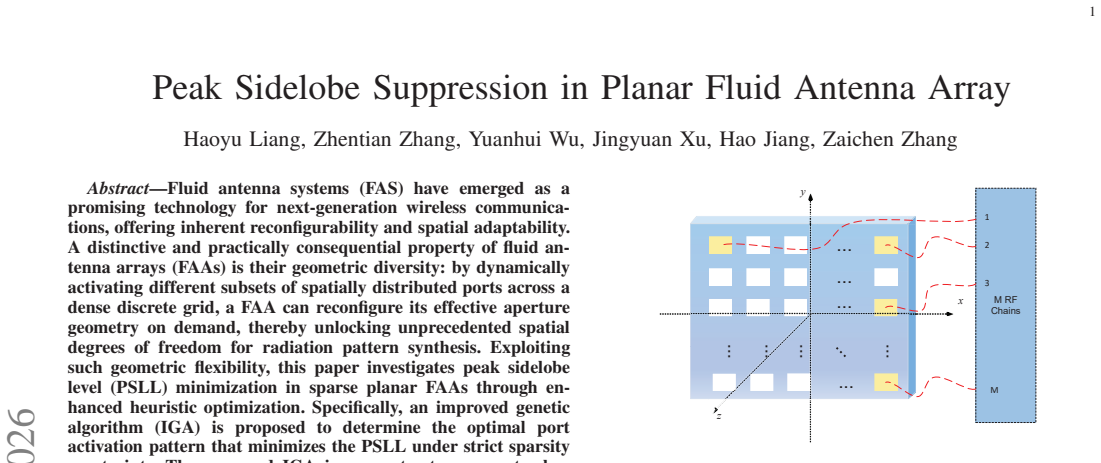
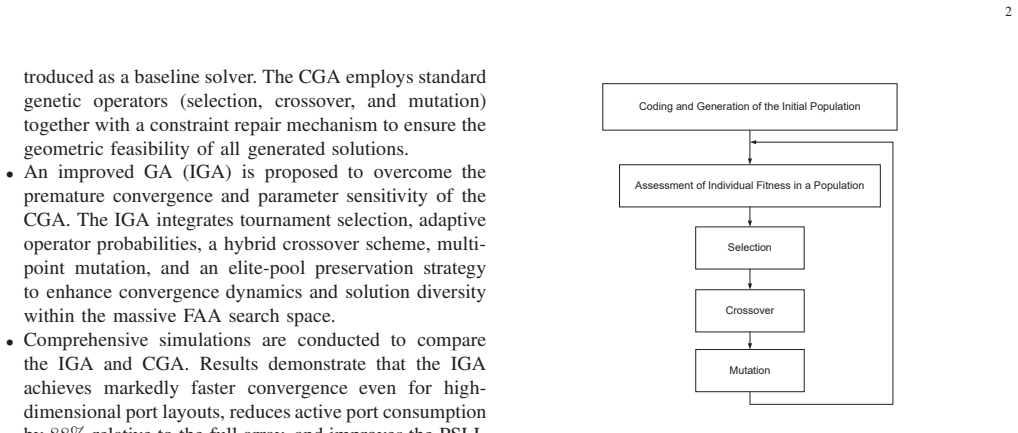
Fluid antenna systems (FAS) have emerged as a promising technology for next-generation wireless communications, offering inherent reconfigurability and spatial adaptability. A distinctive and practically consequential property of fluid antenna arrays (FAAs) is their geometric diversity: by dynamically activating different subsets of spatially distributed ports across a dense discrete grid, a FAA can reconfigure its effective aperture geometry on demand, thereby unlocking unprecedented spatial degrees of freedom for radiation pattern synthesis. Exploiting such geometric flexibility, this paper investigates peak sidelobe level (PSLL) minimization in sparse planar FAAs through enhanced heuristic optimization. Specifically, an improved genetic algorithm (IGA) is proposed to determine the optimal port activation pattern that minimizes the PSLL under strict sparsity constraints. The proposed IGA incorporates tournament selection, adaptive operator probabilities, a hybrid crossover scheme, multi-point mutation, and an elite-pool preservation strategy to improve both convergence speed and solution quality. Simulation results demonstrate that the IGA significantly outperforms the canonical GA (CGA) in convergence behavior and final PSLL performance, achieving a 4.45 dB reduction in sidelobe levels while maintaining a comparable mainlobe width.
Editorial analysis
A structured set of objections, weighed in public.
Referee Report
Summary. The paper proposes an improved genetic algorithm (IGA) incorporating tournament selection, adaptive operator probabilities, hybrid crossover, multi-point mutation, and elite-pool preservation to minimize peak sidelobe level (PSLL) in sparse planar fluid antenna arrays (FAAs) by optimizing port activation patterns under sparsity constraints. Simulation results are claimed to show that the IGA outperforms the canonical GA (CGA) with a 4.45 dB PSLL reduction while maintaining comparable mainlobe width.
Significance. If the reported 4.45 dB PSLL gain is shown to be robustly attributable to the listed IGA operators rather than experimental setup choices, and if the results are reproducible with full parameter disclosure, the work would provide a concrete heuristic improvement for radiation pattern synthesis in reconfigurable fluid antenna systems. The approach leverages geometric diversity in FAAs, which is a timely topic in wireless communications.
major comments (2)
- [Abstract] Abstract: The central claim of a 4.45 dB PSLL reduction is stated without any simulation parameters (e.g., array size, grid density, sparsity level, frequency), error bars, number of independent runs, or explicit comparison metrics beyond CGA, so the data-to-claim link cannot be assessed and it is impossible to determine whether the gap would survive re-tuning of the CGA baseline.
- [Simulation Results] Simulation Results section: No equations are supplied for the array factor, no definition is given for the sparsity constraint or performance metric, and there is no ablation study isolating the contribution of individual IGA operators (tournament selection, adaptive probabilities, etc.), making it impossible to verify that the reported improvement is produced by the algorithmic enhancements rather than by the chosen experimental configuration.
minor comments (1)
- [Abstract] The abstract refers to 'strict sparsity constraints' without quantifying them; adding a brief definition or reference to the relevant equation in the methods section would improve clarity.
Simulated Author's Rebuttal
We thank the referee for the constructive feedback on our manuscript. We address the major comments point by point below and will revise the manuscript to improve clarity and verifiability.
read point-by-point responses
-
Referee: [Abstract] Abstract: The central claim of a 4.45 dB PSLL reduction is stated without any simulation parameters (e.g., array size, grid density, sparsity level, frequency), error bars, number of independent runs, or explicit comparison metrics beyond CGA, so the data-to-claim link cannot be assessed and it is impossible to determine whether the gap would survive re-tuning of the CGA baseline.
Authors: We agree that the abstract would benefit from additional context. In the revised manuscript, we will include key parameters such as array size, grid density, sparsity level, and frequency, along with the number of independent runs performed. This will strengthen the data-to-claim link for the reported improvement. revision: yes
-
Referee: [Simulation Results] Simulation Results section: No equations are supplied for the array factor, no definition is given for the sparsity constraint or performance metric, and there is no ablation study isolating the contribution of individual IGA operators (tournament selection, adaptive probabilities, etc.), making it impossible to verify that the reported improvement is produced by the algorithmic enhancements rather than by the chosen experimental configuration.
Authors: We will revise the Simulation Results section to explicitly include the array factor equation, definitions of the sparsity constraint and PSLL metric, and an ablation study comparing IGA variants with and without key operators. This will help attribute the PSLL reduction to the proposed enhancements. revision: yes
Circularity Check
No circularity; performance claims rest on independent simulation runs
full rationale
The paper's central claim is an empirical performance gap (4.45 dB PSLL reduction) obtained by executing an optimization algorithm (IGA vs. CGA) on simulated far-field patterns under sparsity constraints. No derivation chain exists that reduces the reported gain to a fitted parameter, self-citation, or definitional equivalence. The abstract and described method contain no equations that equate the output metric to the input configuration by construction, and the result is externally falsifiable by re-running the optimizer under altered grids or operators. This is the normal non-circular case for heuristic-optimization papers whose value lies in numerical evidence rather than analytic reduction.
Axiom & Free-Parameter Ledger
Reference graph
Works this paper leans on
-
[1]
Fluid antenna systems,
K. K. Wong, et al. , “Fluid antenna systems,” IEEE Trans. Wireless Commun., vol. 20, no. 3, pp. 1950–1962, Mar. 2021
1950
-
[2]
Closed-form expressions for spatial correlation parameters for performance analysis of fluid antenna system s,
K. K. Wong, et al. , “Closed-form expressions for spatial correlation parameters for performance analysis of fluid antenna system s,” Elect. Lett., vol. 58, no. 11, pp. 454–457, Apr. 2022
2022
-
[3]
Fluid antenna multiple access ,
K. K. Wong and K.-F. Tong, “Fluid antenna multiple access ,” IEEE Trans. Wireless Commun., vol. 21, no. 7, pp. 4801–4815, Jul. 2022
2022
-
[4]
Fast fluid antenna multiple access enabling mas- sive connectivity,
K. K. Wong, et al. , “Fast fluid antenna multiple access enabling mas- sive connectivity,” IEEE Commun. Lett. , vol. 27, no. 2, pp. 711–715, Feb. 2023
2023
-
[5]
Slow fluid antenna multiple access,
K. K. Wong, et al. , “Slow fluid antenna multiple access,” IEEE Trans. Commun., vol. 71, no. 5, pp. 2831–2846, May 2023
2023
-
[6]
On fundamental limits of slow-fluid antenna multiple access for unsourced random access,
Z. Zhang, et al. , “On fundamental limits of slow-fluid antenna multiple access for unsourced random access,” IEEE Wireless Commun. Lett. , vol. 14, no. 11, pp. 3455-3459, Nov. 2025
2025
-
[7]
On fundamental limits for fluid antenna-assisted integrated sensing and communications for unsourced rando m access,
Z. Zhang, et al. , “On fundamental limits for fluid antenna-assisted integrated sensing and communications for unsourced rando m access,” IEEE J. Sel. Areas Commun. , vol. 44, pp. 136-149, 2026
2026
-
[8]
Cram´ er– Rao bounds for activity detection in conventional and fluid a ntenna systems,
Z. Zhang, K. K. Wong, H. Jiang, C. Masouros and C.-B. Chae, “Cram´ er– Rao bounds for activity detection in conventional and fluid a ntenna systems,” IEEE Wireless Commun. Lett. , vol. 15, pp. 3059-3063, 2026
2026
-
[9]
FAS meets OFDM: Enabling wideband 5G NR,
H. Hong, et al. , “FAS meets OFDM: Enabling wideband 5G NR,” IEEE Trans. Commun., vol. 73, no. 11, pp. 12884–12898, Nov. 2025
2025
-
[10]
Downlink OFDM-FAMA in 5G-NR systems,
H. Hong, et al. , “Downlink OFDM-FAMA in 5G-NR systems,” IEEE Trans. Wireless Commun., vol. 24, no. 12, pp. 10116–10132, Dec. 2025
2025
-
[11]
Finite-blocklength fluid antenna systems with spatial block-correlation channel model,
Z. Zhang, et al. , “Finite-blocklength fluid antenna systems with spatial block-correlation channel model,” IEEE Wireless Commun. Lett. , vol. 15, pp. 1911-1915, 2026
1911
-
[12]
Finite-blocklength Fluid Antenna Systems,
Z. Zhang, et al. , “Finite-blocklength Fluid Antenna Systems,” preprint: ariXiv2509.15643v2
-
[13]
Fluid antenna-enhanced flexible beamforming,
J. Xu, et al. , “Fluid antenna-enhanced flexible beamforming,” in Proc. IEEE Wireless Commun. Netw. Conf. (WCNC) , 13-16 Apr. 2026, Kuala Lumpur, Malaysia
2026
-
[14]
Finite-aperture fluid antenna array design: Analysis and algorithm,
Z. Zhang et al. , “Finite-aperture fluid antenna array design: Analysis and algorithm,” IEEE Wireless Commun. Lett. , vol. 15, pp. 3199-3203, 2026
2026
-
[15]
Joint activity detection and channel estimation for fluid antenna system exploiting geographical and angular inform ation,
Z. Zhang, et al., “Joint activity detection and channel estimation for fluid antenna system exploiting geographical and angular inform ation,” IEEE J. Sel. Top. Signal Process. , vol. 20, no. 3, pp. 354-370, April 2026
2026
-
[16]
Finite-Aperture Planar Fluid Antenna Array
Z. Zhang, et al. , “Finite-aperture planar fluid antenna array,” preprint arXiv:2605.22040v1
work page internal anchor Pith review Pith/arXiv arXiv
-
[17]
Fundamental tradeoffs for multiple access in finite- blocklength regime,
Z. Zhang, et al. , “Fundamental tradeoffs for ISAC multiple access in finite-blocklength regime,” preprint arXiv:2601.05165v1
-
[18]
Optimization design for sparse planar array in satellite communications,
Y . He, et al. , “Optimization design for sparse planar array in satellite communications,” Electronics., vol. 12, no. 8, p. 1763, Apr. 2023
2023
-
[19]
Sidelobe level suppression in linear and planar phased arrays using grey wolf optimization with l ocal search refinements,
M. Athallah Adriansyah, et al. , “Sidelobe level suppression in linear and planar phased arrays using grey wolf optimization with l ocal search refinements,” IEEE Access , vol. 13, pp. 27818-27832, 2025
2025
-
[20]
Nature-inspired cuckoo search algorithm for side lobe suppression in a symmetric linear antenna array,
K. N. Abdul Rani, et al. , “Nature-inspired cuckoo search algorithm for side lobe suppression in a symmetric linear antenna array,” Radioengi- neering, vol. 21, no. 3, pp. 865–874, Sep. 2012
2012
-
[21]
Sidelobe-level suppression for linear and circular antenna arrays via the cuckoo search-chicken swarm optimis ation algo- rithm,
S. Liang, et al. , “Sidelobe-level suppression for linear and circular antenna arrays via the cuckoo search-chicken swarm optimis ation algo- rithm,” IET Microw. Antennas Propag. , vol. 11, no. 2, pp. 209–218, Jan. 2017
2017
discussion (0)
Sign in with ORCID, Apple, or X to comment. Anyone can read and Pith papers without signing in.