REVIEW 3 major objections 5 minor 1 cited by
Measuring the distances to quasars at high redshifts with strong lensing
T0 review · 3 major / 5 minor · reviewed 2026-08-14 · deepseek-v4-flash
Pith's one-line read This paper shows that, under the assumption of a flat universe, strong-lensing time-delay observations determine the angular diameter distances $D_S$ to lensed quasars at redshifts up to $z_S\sim4$, filling the Hubble-diagram gap between…
desk verdict Eq.8 is correct but is just algebra: under flatness, D_S is a deterministic function of D_dt and D_L, so the paper's own admission in Section 3 that it adds no extra cosmological information is the real verdict. read the letter →
The pith
A machine-rendered reading of the paper's core claim, the machinery that carries it, and where it could break.
The reading
What carries the argument
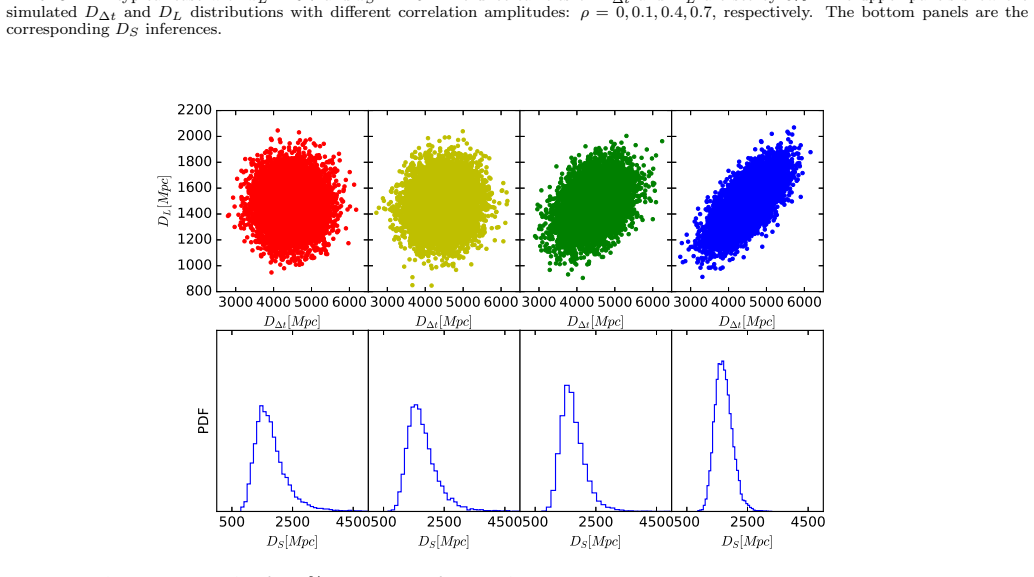
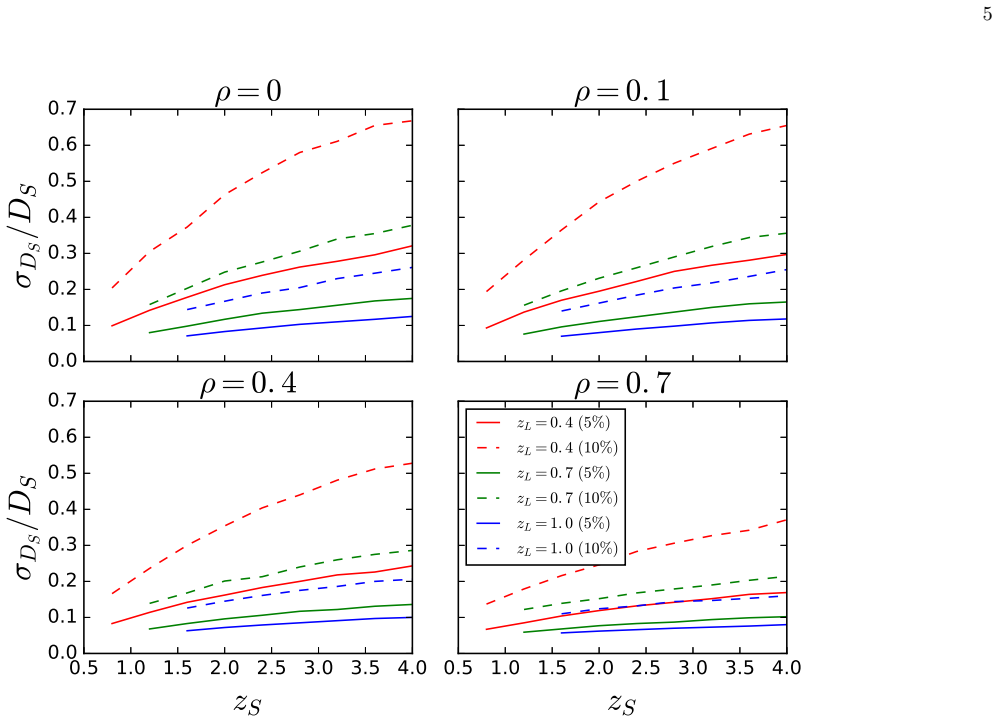
The load-bearing object is Eq. (8), a ratio identity that re-arranges the two standard lensing distances into the source distance. The flat-space distance relation $D_{LS}=D_S-\frac{1+z_L}{1+z_S}D_L$ is the geometric input; substituting it into $D_{\Delta t}=(1+z_L)D_LD_S/D_{LS}$ and solving for $D_S$ gives a formula involving only $z_L$, $z_S$, $D_{\Delta t}$ and $D_L$. The paper's use of this machinery is straightforward in principle: take the joint posterior samples of $D_{\Delta t}$ and $D_L$ (including their correlation), evaluate Eq. (8) pointwise, and build the resulting $D_S$ distribution. The same identity drives the forecast, where Gaussian mock measurements with 5% or 10% errors and correlation coefficients $\rho=0.1,0.4,0.7$ are propagated. It also implies that one of the three distances is redundant, since with $z_L,z_S$ and any two of $D_{\Delta t},D_L,D_S$ the third follows.
What would settle it
Compare Eq. (8) against an independent, model-free distance to the same source at the same redshift. A clean test would be a strongly lensed quasar with a gravitational-wave standard siren from a compact binary at nearly the same redshift: any systematic mismatch between $D_S$ from lensing and the standard-siren distance that grows with redshift would falsify the flat-universe interpretation. In the absence of such data, a precise curvature measurement from CMB and BAO that excludes $\Omega_K=0$ would already break the required geometric assumption.
Extended reading notes
Core claim
The central claim is that, under spatial flatness, a time-delay lens gives a direct measurement of the angular diameter distance to the source quasar, $D_S$, rather than only the distance to the lens or the time-delay combination. The derivation is an algebraic elimination: writing the source-lens distance in a flat universe as $D_{LS}=D_S-\frac{1+z_L}{1+z_S}D_L$ and inserting it into the definition $D_{\Delta t}=(1+z_L)D_LD_S/D_{LS}$ yields Eq. (8), $D_S=\frac{(1+z_L)D_LD_{\Delta t}}{(1+z_S)[D_{\Delta t}-(1+z_L)D_L]}$. The paper argues that no new observable is needed and that the same posteriors the lensing community already produces for $D_{\Delta t}$ and $D_L$ can be converted into a $D_S$ posterior. It does this for the known system SDSS 1206+4332, obtaining a heavily non-Gaussian $D_S$ distribution, and simulates the LSST era to show how the precision depends on lens and source redshifts, on the 5% or 10% distance uncertainties, and on the correlation between $D_{\Delta t}$ and $D_L$, with larger correlation giving tighter $D_S$.
Load-bearing premise
The load-bearing premise is that the universe is spatially flat; the identity $D_{LS}=D_S-\frac{1+z_L}{1+z_S}D_L$ holds only in flat geometry, so if $\Omega_K\neq0$, Eq. (8) no longer gives the source's angular diameter distance.
Editorial extensions
If this is right
- Every time-delay lens with both $D_{\Delta t}$ and $D_L$ will automatically yield $D_S$; no additional observations or new fitting machinery are needed.
- The inferred $D_S$ values, at $z_S$ up to about 4, extend the model-independent Hubble diagram into the gap between SNe Ia and the CMB and can feed direct reconstructions of $H(z)$, $q(z)$ and $w(z)$.
- The precision of $D_S$ improves when $D_{\Delta t}$ and $D_L$ are strongly correlated, so analysing the two distances jointly is preferable to treating them as independent.
- With LSST-era data, roughly 55 high-quality lens systems (about 35 with $z_S>2$) could deliver $D_S$ at roughly 5-10% precision, making the method a practical source of high-redshift distances.
- Any bias in $D_{\Delta t}$ or $D_L$ propagates directly into $D_S$; the paper therefore relies on blind analyses and data challenges to keep systematics under control.
Reading between the lines
- Implicit but not stated: Eq. (8) is a re-parameterisation, not a new observable; $D_S$ inherits all information from $D_{\Delta t}$ and $D_L$, so its value is as a convenient compile point rather than extra constraining power.
- If the flatness assumption is ever relaxed, the identity becomes a three-distance consistency relation that could be inverted to measure curvature from lenses at different redshifts.
- Pairing the inferred angular diameter distance with a luminosity distance at the same redshift would directly test distance duality, $(1+z)^2D_A=D_L$, probing cosmic opacity and photon conservation.
- The highly skewed $D_S$ distribution for SDSS 1206+4332 is a warning that future distance compilations should preserve full posteriors or the paper's log-normal fit, not reduce them to symmetric error bars.
Editorial analysis
A structured set of objections, weighed in public.
Referee Report
Summary. This paper proposes that, under the assumption of a spatially flat universe, the angular diameter distance D_S to a lensed quasar can be inferred from published strong-lensing time-delay and lens-galaxy distance measurements. Section 3 derives Eq. (8), D_S = (1+z_L)D_L D_Δt / [(1+z_S)(D_Δt − (1+z_L)D_L)], from the flat-space identity D_LS = D_S − (1+z_L)/(1+z_S)D_L. The author applies this to the public H0LiCOW posterior samples for SDSS 1206+4332, obtaining a very broad and skewed distribution (median 2388^{+2632}_{−978} Mpc), and presents an LSST-era forecast in which 5% and 10% Gaussian errors on D_Δt and D_L, with assumed correlation coefficients, are propagated through Eq. (8). The paper argues that the resulting high-redshift D_S measurements can fill the data desert between SNe Ia and CMB and be used in model-independent reconstructions of H(z), q(z), and w(z).
Significance. The algebraic derivation and the propagation of the published H0LiCOW posteriors are internally consistent. The main strengths are the use of public posterior samples for the one real application, the transparent acknowledgment in Section 3 that D_S carries no information beyond D_Δt and D_L, and a forecast with explicitly stated error assumptions. If the LSST-era assumptions are realized, a population of high-redshift D_S measurements could complement the low-redshift Hubble diagram. However, the significance is tempered by three facts: the current real measurement has an uncertainty of roughly −41% to +110%, the method is a deterministic transformation of previously published distance quantities rather than a new observable, and the central model-independent claim is conditioned on a flat universe. These issues are correctable in revision but currently affect the abstract's headline claims.
major comments (3)
- [Abstract and §4] The abstract's claim that strong lensing can accurately measure D_S is not supported by the only real application: for SDSS 1206+4332 the median is 2388^{+2632}_{−978} Mpc, a 68% interval spanning roughly −41% to +110%, and the alternative most probable value is 1800^{+1796}_{−850} Mpc. Please qualify the abstract so that 'accurate' is attached to the LSST-era forecast rather than to current measurements, or explicitly report both statistics and state which one is quoted.
- [§3, Eq. (7)] The identity D_LS = D_S − (1+z_L)/(1+z_S)D_L used in Eq. (7) is exact only for Ω_k = 0. The paper nowhere quantifies the bias in Eq. (8) when the universe has a small nonzero curvature, even though current constraints still allow |Ω_k| of order a few times 10^{-3} or larger depending on the dataset. Since the Abstract and Section 6 describe the D_S measurements as cosmological-model-independent probes of dark energy, this flatness dependence is load-bearing. Please derive or numerically estimate the fractional error in D_S as a function of Ω_k and either remove the model-independence wording or explicitly state that the method is model-independent only within the class of flat cosmologies.
- [§3, 'we emphasize' paragraph] The paper correctly states that determining D_S would not bring extra information for constraining parameters in specific cosmological models and that only one distance among D_L, D_S, and D_Δt is independent. Because Eq. (8) is a deterministic transformation of the published D_Δt and D_L posteriors, the title and abstract phrase measuring the distances to quasars describes a repackaging rather than a new observable. I recommend either explicitly labeling D_S as a derived quantity in the title and abstract, or implementing and demonstrating the direct fitting of D_S suggested later in Section 3.
minor comments (5)
- [§4, 'Note that' paragraph] The text refers to 'SDSS 1206+080' as the only doubly lensed H0LiCOW system; this should be 'SDSS 1206+4332', the system analyzed throughout the paper.
- [§4, Eq. (12)] The fitted distribution is for D_S, but the equation writes P(D_Δt) and defines x = D_Δt/(1 Mpc); both should be replaced by D_S.
- [Fig. 5] The caption does not define the line types or colors used for the different z_L values and for the 5% and 10% precision assumptions, and it should state that σ_DS is half the 16th–84th percentile range rather than a Gaussian 1σ uncertainty.
- [Abstract and §4] The abstract quotes only the median-based D_S = 2388^{+2632}_{−978} Mpc, while Section 4 also reports a substantially different most probable value; please clarify which statistic is being quoted.
- [§6, 'Schneier & Sluse 2013'] The citation should be 'Schneider & Sluse 2013', matching the reference list.
Circularity Check
The headline D_S measurement is a deterministic algebraic transform of the published D_dt and D_L inputs; the paper itself concedes that only one distance among D_L, D_S, and D_dt is independent.
-
renaming known result
[Section 3, Eq. (8)]
"In other words, if lensing observations give DΔt and DL, one can always measure (infer) DS equivalently. We emphasize that although determining DS in this way would not bring any benefits (extra information) for constraining parameters in specific cosmological models, the measured DS at high-redshifts can be further used in the model-independent reconstruction of the expansion history of the Universe, whereas DL can be replaced by other low-redshift data, for example, the SNe Ia."
Equation (8) is obtained by solving the time-delay-distance definition DΔt = (1+zL)DLDS/DLS (Eq. 2) using the flat-space identity DLS = DS - (1+zL)/(1+zS)DL (Eq. 7). Therefore D_S is not a new observable; it is algebraically fixed by the same DΔt and DL inputs that the paper uses. The application to SDSS 1206+4332 (D_S = 2388^{+2632}_{-978} Mpc) is merely the transform of the published posteriors, and the LSST forecast is propagated noise from simulated DΔt and DL. No independent information enters the claimed D_S measurement, and the paper itself acknowledges that only one distance among DL, DS, and DΔt is totally independent.
full rationale
The only identifiable circularity is the framing of D_S as a new measurable quantity: it is presented as a novel use of strong lensing, but Eq. (8) is a rearrangement of Eq. (2) under the flat-space relation Eq. (7), so the D_S posterior and its forecast uncertainties are equivalent to the input DΔt and DL posteriors by construction. The paper is transparent about this, explicitly stating that determining D_S brings no extra information for cosmological parameter constraints. No load-bearing self-citation chain or fitted-parameter-as-prediction issue is present; self-citations to Liao et al. are for standard lensing theory and data challenges and are not central to the derivation. The flatness assumption is a substantive correctness risk for the 'cosmological-model-independent' claim, because Eq. (7) is exact only for Ω_k = 0, but that is an assumption/bias concern rather than a further circularity.
Assumptions & free parameters
free parameters (3)
- Input distance uncertainties in LSST forecast =
5% and 10%
- Correlation coefficient between D_dt and D_L =
rho = 0.1, 0.4, 0.7
- Fiducial cosmological parameters for mock forecast =
H0=70 km/s/Mpc, Omega_m=0.3
assumptions (5)
- domain assumption The Universe is spatially flat.
- domain assumption The published H0LiCOW posteriors for D_dt and D_L are unbiased and include systematic errors.
- domain assumption The lens model and stellar kinematics give controlled constraints on D_dt and D_L.
- domain assumption The mock lens catalog and selection criteria represent the future LSST sample.
- domain assumption Gaussian noise models with specified sigma and rho capture the statistical uncertainties of D_dt and D_L.
Cite this review
Pith. "Pith review of Measuring the distances to quasars at high redshifts with strong lensing." pith.science (2026). https://pith.science/paper/FAU3WW5W
@misc{pith2026190802892,
  author       = {Pith},
  title        = {Pith review of: Measuring the distances to quasars at high redshifts with strong lensing},
  year         = {2026},
  howpublished = {\url{https://pith.science/paper/FAU3WW5W}},
  note         = {Machine review of arXiv:1908.02892}
}
abstract
Strongly lensed quasars with time-delay measurements are well known to provide the "time-delay distances" $D_{\Delta t}=(1+z_L)D_LD_S/D_{LS}$ and the angular diameter distances to lens galaxies $D_L$. These two kinds of distances give stringent constraints on cosmological parameters. In this work, we explore a different use of time-delay observables: Under the assumption of a flat Universe, strong lensing observations can accurately measure the angular diameter distances to sources $D_S$. The corresponding redshifts of quasars may be up to $z_S\sim4$ according to the forecast. The high-redshift distances would sample the Hubble diagram between SNe Ia and CMB, cosmological-model-independently providing direct information on the evolution of the nature of our Universe, for example, the dark energy Equation-of-State parameter $w(z)$. We apply our method to the existing lensing system SDSS 1206+4332 and get $D_S=2388_{-978}^{+2632}Mpc$ at $z_S=1.789$. We also make a forecast for the era of LSST. The uncertainty of $D_S$ depends on the redshifts of lens and source, the uncertainties of $D_{\Delta t}$ and $D_L$, and the correlation between $D_{\Delta t}$ and $D_L$ as well. Larger correlation would result in tighter $D_S$ determination.
Figures


Figures from the paper (2 more)
Forward citations
Cited by 1 Pith paper
-
A model-independent determination of the Hubble constant from lensed quasars and supernovae using Gaussian process regression
A Gaussian process reconstruction of supernova distances, anchored by four H0LiCOW lens time delays, gives H0 = 72.2 ± 2.1 km/s/Mpc in a flat universe without assuming a dark energy model.
Reference graph
Works this paper leans on
-
[1]
G., et al., 2019, PhRvD, 99, 123515
Anselmi S., Corasaniti P.-S., Sanchez A. G., et al., 2019, PhRvD, 99, 123515
work page 2019
-
[2]
Arendse N., Agnello A., Wojtak R., 2019, arXiv: 1905.12000
work page Pith review arXiv 2019
-
[3]
Birrer S., Amara A., Refregier A., 2016, JCAP, 08, 020
work page 2016
-
[4]
E., et al., 2019, MNRAS, 484, 4726
Birrer S., Treu T., Rusu C. E., et al., 2019, MNRAS, 484, 4726
work page 2019
-
[5]
Betoule M., Kessler R., Guy J., et al., 2014, A&A, 568, A22
work page 2014
- [6]
-
[7]
Chen Y., Ratra B., 2012, A&A, 543, A104
work page 2012
-
[8]
Chen Y., Kumar S., Ratra B., 2017, ApJ, 835, 86
work page 2017
Show all 60 references
-
[9]
Cai R.-G., Yang T., 2017, PhRvD, 95, 044024
2017
-
[10]
Clarkson C., Zunckel C., 2010, PhRvL, 104, 211301
2010
-
[11]
Courbin F., Bonvin V., Buckley-Geer E., et al., 2018, A&A, 609, A71
2018
-
[12]
V., Shafieloo A., 2018, JCAP, 03, 041
Denissenya M., Linder E. V., Shafieloo A., 2018, JCAP, 03, 041
2018
-
[13]
Ding X., Biesiada M., Cao S., Li Z., Zhu Z.-H., 2015, ApJ, 803, L22
2015
-
[14]
J., et al., 2018, arXiv: 1801.01506
Ding X., Treu T., Shajib A. J., et al., 2018, arXiv: 1801.01506
2018 arXiv
-
[15]
A., Turner M
Frieman J. A., Turner M. S., Huterer D., 2008, Annu. Rev. Astro. Astrophys., 46, 385
2008
-
[16]
L., 2017, Nature Astronomy, 1, 0121
Freedman W. L., 2017, Nature Astronomy, 1, 0121
2017
- [17]
-
[18]
E., Gorenstein M
Falco E. E., Gorenstein M. V., Shapiro I. I., 1985, ApJ, 289, L1
1985
-
[19]
Izzo L., Capozziello S., Govone G., Capaccioli M., 2009, A&A, 508, 63
2009
-
[20]
H., 2015, JCAP, 11, 033
Jee I., Komatsu E., Suyu S. H., 2015, JCAP, 11, 033
2015
-
[21]
H., Huterer D., 2016, JCAP, 04, 031
Jee I., Komatsu E., Suyu S. H., Huterer D., 2016, JCAP, 04, 031
2016
-
[22]
S., 2007, ApJ, 671, 1568
Jiang G., Kochanek C. S., 2007, ApJ, 671, 1568
2007
-
[23]
Li E.-K., Du M., Xu L., 2019, arXiv: 1903.11433
2019 arXiv
-
[24]
Liao K., Treu T., Marshall P., et al., 2015, ApJ, 800, 11
2015
-
[25]
Liao K., Ding X., Biesiada M., Fan X.-L., Zhu Z.-H., 2018, ApJ, 867, 69
2018
-
[26]
Liao K., 2019, ApJ, 871, 113
2019
-
[27]
V., 2011, PhRvD, 84, 123529
Linder E. V., 2011, PhRvD, 84, 123529
2011
-
[28]
V., Kim A
L'Huillier B., Shafieloo A., Linder E. V., Kim A. G., 2019, MNRAS, 485, 2783
2019
-
[29]
Moore B., 1994, Nature, 370, 629
1994
-
[30]
Moore B., Ghigna S., Governato F., et al., 1999, ApJ, 524, L19
1999
-
[31]
F., et al., 2005, ApJ, 622, 106
Oguri M., Inada N., Hennawi J. F., et al., 2005, ApJ, 622, 106
2005
-
[32]
J., 2010, MNRAS, 405, 2579
Oguri M., Marshall P. J., 2010, MNRAS, 405, 2579
2010
-
[33]
Planck Collaboration, 2018, arXiv: 1807.06209
2018 arXiv
-
[34]
Paraficz D., Hjorth J., 2009, A&A, 507, L49
2009
-
[35]
Refsdal S., 1964, MNRAS, 128, 307
1964
-
[36]
G., Casertano S., Yuan W., Macri L
Riess A. G., Casertano S., Yuan W., Macri L. M., Scolnic D., 2019, ApJ, 876, 85
2019
-
[37]
E., Fassnacht C
Rusu C. E., Fassnacht C. D., Sluse D., et al., 2017, MNRAS, 467, 4220
2017
-
[38]
Risaliti G., Lusso E., 2019, Nature Astronomy, 3, 272
2019
-
[39]
E., 2003, ApJ, 583, L67
Schaefer B. E., 2003, ApJ, 583, L67
2003
-
[40]
A., 2006, MNRAS, 366, 1081
Shafieloo A., Alam U., Sahni V., Starobinsky A. A., 2006, MNRAS, 366, 1081
2006
-
[41]
Shafieloo A., 2007, MNRAS, 380, 1573
2007
-
[42]
G., Linder E
Shafieloo A., Kim A. G., Linder E. V., 2012, PhRvD, 85, 123530
2012
-
[43]
Seikel M., Clarkson C., Smith M., 2012, JCAP, 06, 026
2012
-
[44]
F., 1986, Nature, 323, 310
Schutz B. F., 1986, Nature, 323, 310
1986
-
[45]
J., Treu T., Agnello A., 2018a, MNRAS, 473, 210
Shajib A. J., Treu T., Agnello A., 2018a, MNRAS, 473, 210
-
[46]
J., Birrer S., Treu T., et al., 2018b, MNRAS, 483, 5649
Shajib A. J., Birrer S., Treu T., et al., 2018b, MNRAS, 483, 5649
-
[47]
H., Marshall P
Suyu S. H., Marshall P. J., Auger M. W., et al., 2010, ApJ, 711, 201
2010
-
[48]
H., Bonvin V., Courbin F., et al., 2017, MNRAS, 468, 2590
Suyu S. H., Bonvin V., Courbin F., et al., 2017, MNRAS, 468, 2590
2017
-
[49]
P., Lazkoz R., 2015, PhRvL, 114, 101304
Salzano V., Dabrowski M. P., Lazkoz R., 2015, PhRvL, 114, 101304
2015
-
[50]
Schneider P., Sluse D., 2013, A&A, 559, A37
2013
-
[51]
Treu T., 2010, Annu. Rev. Astron. Astrophys. 48, 87
2010
-
[52]
J., 2016, The Astronomy and Astrophysics Review, 24, 11
Treu T., Marshall P. J., 2016, The Astronomy and Astrophysics Review, 24, 11
2016
-
[53]
H., Komatsu E., 2019, arXiv:1905.12496
Taubenberger S., Suyu S. H., Komatsu E., 2019, arXiv:1905.12496
2019 arXiv
-
[54]
S., Kochanek C
Tie S. S., Kochanek C. S., 2017, MNRAS, 473, 80
2017
-
[55]
Wei H., 2010, JCAP, 1008, 020
2010
-
[56]
Y., Dai Z
Wang F. Y., Dai Z. G., Liang E. W, 2015, New Astronomy Reviews, 67, 1
2015
- [57]
-
[58]
Yang T., Guo Z.-K., Cai R.-G., 2015, PhRvD, 91, 123533
2015
-
[59]
H., Halkola A., 2019, arXiv:1904.07237
Y ld r m A., Suyu S. H., Halkola A., 2019, arXiv:1904.07237
2019 arXiv
-
[60]
Zhao W., Wen L., 2018, PhRvD, 97, 064031
2018
Reviewed August 14, 2026 · model on record in the stance chip above.
Discussion (0). Continue with ORCID to comment.