REVIEW 4 major objections 4 minor 44 references
HENT-SRT: Hierarchical Efficient Neural Transducer with Self-Distillation for Joint Speech Recognition and Translation
T0 review · 4 major / 4 minor · reviewed 2026-08-07 · deepseek-v4-flash
Pith's one-line read HENT-SRT shows that a hierarchical neural transducer with self-distillation and a blank penalty nearly closes the quality gap to offline AED speech translation.
desk verdict Solid ablation-rich study of a hierarchical transducer for ST, but the headline NT SOTA claim rests on a blank penalty that the main table never applies to the baseline. read the letter →
The pith
A machine-rendered reading of the paper's core claim, the machinery that carries it, and where it could break.
The reading
What carries the argument
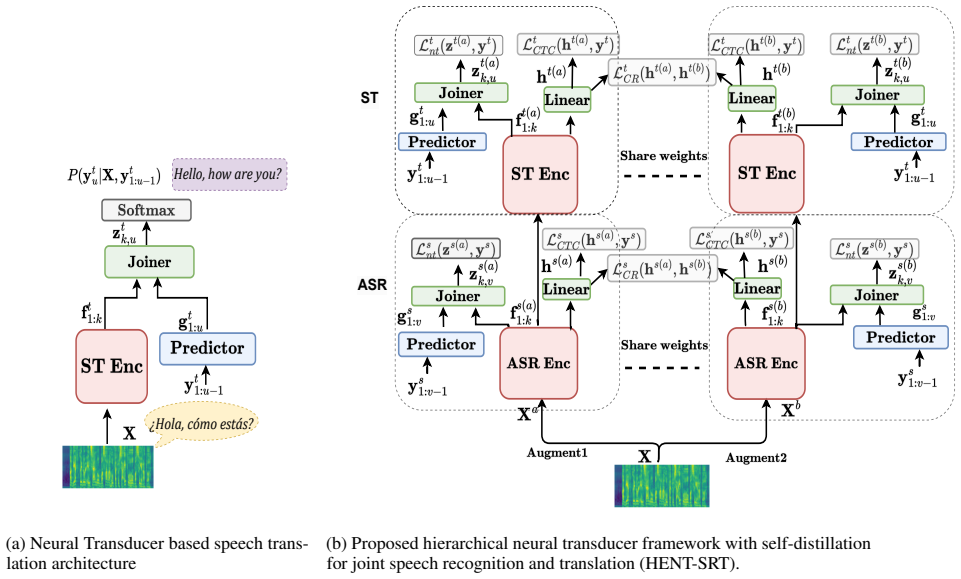
The load-bearing object is the hierarchical transducer stack: the ASR encoder's latent representation feeds a translation-specific encoder, and each task has its own predictor and joiner, so word reordering happens over a monotonic ASR representation instead of over raw audio. The argument is carried by three mechanisms: the factorization itself, which gives translation a place to reorder; CR-CTC self-distillation, which averages CTC losses over two augmented views and enforces a stop-gradient KL consistency between them to stabilize ASR; and the blank penalty, which subtracts a constant $BP$ from the blank logit in Eq. (12) during beam search to counteract the blank bias that deletes output words. Efficiency comes from the Zipformer encoder's hierarchical down-sampling, a stateless 1D-CNN trigram predictor, and the pruned transducer loss, which makes training on large alignment lattices memory-feasible.
What would settle it
Run HENT-SRT with blank penalty $BP=1.0$ against a length-matched decoding baseline that forces the same hypothesis length without a blank penalty (for example, minimum-length beam search constrained to the reference length, or rescoring with a length reward), and compare BLEU and COMET on the same three test sets. If length matching alone reproduces the gains, the blank penalty is not correcting deletion errors in a quality-relevant way.
Extended reading notes
Core claim
The paper's central claim is that a neural transducer can be built to translate streaming speech at nearly offline AED quality. The design decomposes speech translation into two stacked tasks: the ASR encoder produces a monotonic latent representation, and a translation-specific encoder reorders and rewrites it into the target language, with separate transducers for each. CR-CTC self-distillation over two SpecAugment views keeps ASR from degrading during multitask training. At inference, subtracting a blank penalty from the blank logit counteracts the transducer's bias toward blank emissions, reducing deletions and moving hypothesis length toward the reference. HENT-SRT is compared against the shared-encoder NT-Shared baseline and the CTC/Attention AED baseline; it outperforms NT-Shared by up to 2 BLEU and reaches near-parity with the AED baseline, surpassing it on Tunisian while improving ASR WER on all three datasets.
Load-bearing premise
The load-bearing premise is that the blank penalty improves translation by restoring genuinely missing words rather than merely lengthening the output; the paper shows length ratio and BLEU improve, but does not isolate precision or semantic adequacy independently of length, so if the penalty only makes hypotheses longer, the claimed quality gains collapse.
Editorial extensions
If this is right
- Neural-transducer speech translation can be used in streaming settings with an offline-quality penalty of under one BLEU point on these conversational benchmarks.
- Joint training with self-distillation improves ASR over the CTC/Attention baseline (WER 41.4 vs 42.7, 22.8 vs 24.6, 17.8 vs 18.9), so the translation objective can regularize recognition instead of hurting it.
- The blank penalty is a zero-retraining decoding adjustment that consistently raises BLEU and chrF++, so it should transfer to other transducer-based generation tasks with similar blank bias.
- Deeper translation encoders and wider pruning ranges give measurable reordering gains, at the cost of a small ASR degradation that CR-CTC can offset.
- In simulated streaming with 64-frame chunks, HENT-SRT improves BLEU by up to 4.5 points over the hierarchical baseline at the same real-time factor.
Reading between the lines
- The blank penalty may be acting mainly as length control: the paper reports that it moves the hypothesis/reference length ratio toward 1.0 and lifts BLEU, but it does not isolate gains in precision or semantic adequacy independent of length. A length-matched decoding baseline would determine whether the penalty recovers real content or just forces longer output.
- Since the factorization is task-level, the same ASR-encoder-plus-translation-encoder design could extend to multiple target languages, code-switched speech, or overlapping speakers, all of which the paper lists as future work.
- The streaming results suggest that chunked causal decoding carries most of the hierarchical model's benefit; combining this with adaptive chunking or wait-k policies could trade a small amount of latency for further BLEU gains.
- If parity with AED holds beyond these three datasets, the long-standing assumption that frame-synchronous models are structurally unsuited to translation would be weakened; the bottleneck would be alignment bias, which can be corrected at decoding time.
Editorial analysis
A structured set of objections, weighed in public.
Referee Report
Summary. The paper proposes HENT-SRT, a hierarchical neural transducer for joint speech recognition and translation. The architecture factorizes ST into an ASR stage followed by a translation-specific encoder, combines ASR and ST transducer losses in a multitask objective, adds CR-CTC self-distillation to preserve ASR accuracy, and borrows efficiency techniques from ASR transducers (pruned loss, stateless predictor, Zipformer). A blank-penalty decoding adjustment is introduced to counter the transducer's blank bias. The model is evaluated on three conversational datasets (Tunisian Arabic-English, HKUST Chinese-English, Fisher Spanish-English), with offline and streaming comparisons against a reproduced multitask transducer baseline and a CTC/Attention AED system. The paper reports that HENT-SRT reaches new state-of-the-art performance among NT models and substantially narrows the gap with AED systems.
Significance. If the empirical claims hold, the paper makes a useful contribution: it shows that a streaming-friendly transducer can approach offline AED translation quality while retaining ASR accuracy, and it integrates several efficiency techniques (pruned transducer loss, stateless predictor, Zipformer) into ST. The manuscript is honest about limitations (non-overlapped speech, English-only target) and provides ablations on the Tunisian dataset, a reproduced NT baseline, and code. The central weakness is that the headline comparison is confounded by unequal blank-penalty settings and lacks a control that isolates the architecture/self-distillation contribution from the decoding-time penalty.
major comments (4)
- [Sec. 3.3, Table 2] The headline claim of 'new state-of-the-art among NT models' and 'narrowing the gap with AED' is not yet established because the comparison uses unequal blank-penalty values. NT-Hier2 is reported only at BP=0.5 (BLEU 19.4, 12.9, 33.0), while HENT-SRT is reported at BP=1.0 (BLEU 20.6, 14.7, 33.7). The dev-set ablation in Table 1 shows that NT-Hier2 at BP=1.0 already reaches BLEU 20.4 on Tunisian Dev1, essentially matching HENT-SRT's 20.6 and exceeding the CTC/Attention baseline's 20.4. Furthermore, without any blank penalty, HENT-SRT is worse than NT-Hier2 on all three datasets (17.8 vs 18.3, 11.5 vs 12.0, 31.8 vs 32.4). The paper must report NT-Hier2 at the same BP values used for HENT-SRT, ideally across the whole BP grid, before the architecture and CR-CTC can be credited with the reported gains.
- [Sec. 2.3, Eq. (12), Fig. 3] The blank penalty is a decoding-time logit adjustment, and Figure 3 shows it moves the hypothesis/reference length ratio toward 1.0. Since BLEU contains a brevity penalty, the BLEU gains from BP could be largely a length-correction artifact rather than evidence of better translation content. The paper does not provide a decomposition that separates quality from length matching; the COMET differences from BP in Table 2 are only +0.007, +0.008, and 0.000, and the streaming table reports no COMET at all. To support the claim that BP 'reduces deletions and improves translation quality,' please report BLEU precision components, per-segment COMET, or a deletion/insertion analysis.
- [Sec. 3.2, Tables 1-3] The efficiency-related hyperparameters--pruning range 10, warmup steps 5k, and the stateless predictor--are selected on the Tunisian development sets and then applied to HKUST and Fisher without per-language validation. Table 1 shows that pruning range and warmup steps move BLEU by +1.5 and +1.8 points on the tuning language, so the unconditional cross-lingual claim requires either per-language tuning results or a clear justification for why these choices transfer. Without that, the reported gains on HKUST and Fisher may partly reflect a single dev-set choice rather than a generally effective design.
- [Tables 1-4] All results are reported from single runs, without error bars or significance tests. Several conclusions rest on BLEU differences of 0.2-0.5 points (e.g., NT-Hier2 vs NT-Hier1, and HENT-SRT at BP=1.0 vs NT-Hier2 at BP=0.5), which may be within run-to-run variance. Please report variance across at least a few seeds or a significance test for the main comparisons.
minor comments (4)
- [References and Sec. 3.3] The CTC/Attention baseline is cited inconsistently: Section 3.3 cites Yan et al. (2023b) for the CA model, while Table 2 labels it as Yan et al. (2023c); the reference list contains both ESPnet-ST-v2 entries, which should be disambiguated.
- [Sec. 3.1 and Sec. 2.4] The stateless predictor is described as a '1D-CNN trigram model' but implemented as a single Conv1D layer with kernel size 2; please clarify whether the effective context is bigram or trigram.
- [Sec. 3.4, Table 3] The streaming section reports no ASR WER, so the claim that CR-CTC preserves ASR performance in streaming is not directly supported by the presented data.
- [Sec. 3.1] There is a missing space in 'batch size of400 seconds'; also, the sentence defining the batch size is ambiguous about whether 400 seconds is per-GPU or global.
Circularity Check
No significant circularity: the reported gains are empirical, with the blank penalty tuned on development sets and evaluated on held-out test data, and no claimed result is defined in terms of its own target metric.
full rationale
I walked the paper's derivation chain and found no step in which a prediction or first-principles result reduces by construction to its inputs. The blank penalty (Eq. 12) is a decoding-time logit adjustment, and BLEU is computed against held-out test references; the penalty value is tuned on development sets, which is standard hyperparameter selection rather than a fitted parameter being renamed as a prediction. The claimed gains from CR-CTC self-distillation are empirical and, as the paper itself reports, HENT-SRT without the blank penalty is worse than NT-Hier2, so the central translation gains do not reduce to the self-cited CR-CTC method. The self-citations that exist (CR-CTC from Yao et al. 2024b, and the datasets from Hussein et al. 2024) are prior work with released code and external benchmarks, not load-bearing assumptions that contain the target result. The comparison confound in Table 2 - reporting NT-Hier2 only at BP=0.5 while HENT-SRT is at BP=1.0 - is a benchmarking and control concern, not a circularity concern: it affects whether the architecture's contribution is isolated, but it does not make any equation or claim equivalent to its own input. No circular step could be quoted and exhibited, so the appropriate finding is no significant circularity.
Assumptions & free parameters
free parameters (5)
- blank penalty BP =
1.0 offline, 2.0 streaming
- pruned-loss pruning range =
10
- warmup steps for pruned loss =
5,000
- multitask loss weights =
asr=1, st=1, CR=0.05, CTC=0.1
- streaming chunk size, left context, max symbols =
64, 128, 20
assumptions (5)
- standard math Transducer and CTC alignment marginalizations are valid and correctly implemented
- domain assumption ASR encoder output f^s retains enough information for a second encoder to produce translations
- domain assumption CTC loss on the ST encoder with target translation is a useful objective despite CTC's monotonicity assumption
- domain assumption Pruned transducer loss approximates the full transducer loss closely enough for ranking system quality
- domain assumption Single-reference BLEU and COMET adequately rank conversational ST systems
Cite this review
Pith. "Pith review of HENT-SRT: Hierarchical Efficient Neural Transducer with Self-Distillation for Joint Speech Recognition and Translation." pith.science (2026). https://pith.science/paper/FAV3ZOBX
@misc{pith2026250602157,
  author       = {Pith},
  title        = {Pith review of: HENT-SRT: Hierarchical Efficient Neural Transducer with Self-Distillation for Joint Speech Recognition and Translation},
  year         = {2026},
  howpublished = {\url{https://pith.science/paper/FAV3ZOBX}},
  note         = {Machine review of arXiv:2506.02157}
}
read the original abstract
Neural transducers (NT) provide an effective framework for speech streaming, demonstrating strong performance in automatic speech recognition (ASR). However, the application of NT to speech translation (ST) remains challenging, as existing approaches struggle with word reordering and performance degradation when jointly modeling ASR and ST, resulting in a gap with attention-based encoder-decoder (AED) models. Existing NT-based ST approaches also suffer from high computational training costs. To address these issues, we propose HENT-SRT (Hierarchical Efficient Neural Transducer for Speech Recognition and Translation), a novel framework that factorizes ASR and translation tasks to better handle reordering. To ensure robust ST while preserving ASR performance, we use self-distillation with CTC consistency regularization. Moreover, we improve computational efficiency by incorporating best practices from ASR transducers, including a down-sampled hierarchical encoder, a stateless predictor, and a pruned transducer loss to reduce training complexity. Finally, we introduce a blank penalty during decoding, reducing deletions and improving translation quality. Our approach is evaluated on three conversational datasets Arabic, Spanish, and Mandarin achieving new state-of-the-art performance among NT models and substantially narrowing the gap with AED-based systems.
Figures


Reference graph
Works this paper leans on
-
[1]
Hilal Al Shamsi, Abdullah G Almutairi, Sulaiman Al Mashrafi, and Talib Al Kalbani. 2020. Implications of language barriers for healthcare: a systematic review. Oman medical journal, 35(2):e122
work page 2020
-
[2]
Antonios Anastasopoulos, Lo \" c Barrault, Luisa Bentivogli, Marcely Zanon Boito, Ond r ej Bojar, Roldano Cattoni, Anna Currey, Georgiana Dinu, Kevin Duh, Maha Elbayad, and 1 others. 2022. Findings of the iwslt 2022 evaluation campaign. In Proceedings of the 19th International Conference on Spoken Language Translation (IWSLT 2022), pages 98--157
work page 2022
-
[3]
Ebrahim Ansari, Amittai Axelrod, Nguyen Bach, Ond r ej Bojar, Roldano Cattoni, Fahim Dalvi, Nadir Durrani, Marcello Federico, Christian Federmann, Jiatao Gu, Fei Huang, Kevin Knight, Xutai Ma, Ajay Nagesh, Matteo Negri, Jan Niehues, Juan Pino, Elizabeth Salesky, Xing Shi, and 4 others. 2020. https://doi.org/10.18653/v1/2020.iwslt-1.1 FINDINGS OF THE IWSLT...
-
[4]
Alexandre Berard, Laurent Besacier, Ali Can Kocabiyikoglu, and Olivier Pietquin. 2018. https://doi.org/10.1109/ICASSP.2018.8461690 End-to-end automatic speech translation of audiobooks . In 2018 IEEE International Conference on Acoustics, Speech and Signal Processing, ICASSP 2018, Calgary, AB, Canada, April 15-20, 2018 , pages 6224--6228. IEEE
-
[5]
Alexandre Berard, Olivier Pietquin, Christophe Servan, and Laurent Besacier. 2016. Listen and translate: A proof of concept for end-to-end speech-to-text translation. In Proceedings of the NIPS Workshop on end-to-end learning for speech and audio processing, Barcelona, Spain
work page 2016
-
[6]
Nicola Bertoldi and Marcello Federico. 2005. A new decoder for spoken language translation based on confusion networks. In IEEE Workshop on Automatic Speech Recognition and Understanding, 2005., pages 86--91. IEEE
work page 2005
-
[7]
Junkun Chen, Mingbo Ma, Renjie Zheng, and Liang Huang. 2021. https://doi.org/10.18653/v1/2021.findings-acl.406 Direct simultaneous speech-to-text translation assisted by synchronized streaming ASR . In Findings of the Association for Computational Linguistics: ACL-IJCNLP 2021, pages 4618--4624, Online. Association for Computational Linguistics
-
[8]
Chung-Cheng Chiu, Wei Han, Yu Zhang, Ruoming Pang, Sergey Kishchenko, Patrick Nguyen, Arun Narayanan, Hank Liao, Shuyuan Zhang, Anjuli Kannan, and 1 others. 2019. A comparison of end-to-end models for long-form speech recognition. In 2019 IEEE automatic speech recognition and understanding workshop (ASRU), pages 889--896. IEEE
work page 2019
Show all 44 references
-
[9]
Siddharth Dalmia, Brian Yan, Vikas Raunak, Florian Metze, and Shinji Watanabe. 2021. https://doi.org/10.18653/v1/2021.naacl-main.151 Searchable hidden intermediates for end-to-end models of decomposable sequence tasks . In Proceedings of the 2021 Conference of the North Americ...
2021 doi
-
[10]
Di Gangi, Matteo Negri, and Marco Turchi
Marco Gaido, Mattia A. Di Gangi, Matteo Negri, and Marco Turchi. 2020. https://doi.org/10.18653/v1/2020.iwslt-1.8 End-to-end speech-translation with knowledge distillation: FBK @ IWSLT 2020 . In Proceedings of the 17th International Conference on Spoken Language Translation, p...
2020 doi
-
[11]
Mohammadreza Ghodsi, Xiaofeng Liu, James Apfel, Rodrigo Cabrera, and Eugene Weinstein. 2020. Rnn-transducer with stateless prediction network. In ICASSP 2020-2020 IEEE International Conference on Acoustics, Speech and Signal Processing (ICASSP), pages 7049--7053. IEEE
2020
-
[12]
Alex Graves. 2012. Sequence transduction with recurrent neural networks. arXiv preprint arXiv:1211.3711
2012 arXiv
-
[13]
Alex Graves, Santiago Fern \'a ndez, Faustino Gomez, and J \"u rgen Schmidhuber. 2006. Connectionist temporal classification: labelling unsegmented sequence data with recurrent neural networks. In Proceedings of the 23rd international conference on Machine learning, pages 369--376
2006
-
[14]
Amir Hussein, Brian Yan, Antonios Anastasopoulos, Shinji Watanabe, and Sanjeev Khudanpur. 2024. Enhancing end-to-end conversational speech translation through target language context utilization. In ICASSP 2024-2024 IEEE International Conference on Acoustics, Speech and Signal...
2024
-
[15]
Kwangyoun Kim, Felix Wu, Yifan Peng, Jing Pan, Prashant Sridhar, Kyu J Han, and Shinji Watanabe. 2023. E-branchformer: Branchformer with enhanced merging for speech recognition. In 2022 IEEE Spoken Language Technology Workshop (SLT), pages 84--91. IEEE
2023
-
[16]
o ksal and Nurcihan Y \
Onur K \"o ksal and Nurcihan Y \"u r \"u k. 2020. The role of translator in intercultural communication. International Journal of Curriculum and Instruction, 12(1):327--338
2020
-
[17]
Fangjun Kuang, Liyong Guo, Wei Kang, Long Lin, Mingshuang Luo, Zengwei Yao, and Daniel Povey. 2022. Pruned RNN-T for fast, memory-efficient ASR training. In Interspeech
2022
-
[18]
Dan Liu, Mengge Du, Xiaoxi Li, Ya Li, and Enhong Chen. 2021. Cross attention augmented transducer networks for simultaneous translation. In Proceedings of the 2021 Conference on Empirical Methods in Natural Language Processing, pages 39--55
2021
-
[19]
Xutai Ma, Juan Pino, and Philipp Koehn. 2020. https://doi.org/10.18653/v1/2020.aacl-main.58 S imul MT to S imul ST : Adapting simultaneous text translation to end-to-end simultaneous speech translation . In Proceedings of the 1st Conference of the Asia-Pacific Chapter of the A...
2020 doi
-
[20]
Xutai Ma, Yongqiang Wang, Mohammad Javad Dousti, Philipp Koehn, and Juan Pino. 2021. Streaming simultaneous speech translation with augmented memory transformer. In ICASSP 2021-2021 IEEE International Conference on Acoustics, Speech and Signal Processing (ICASSP), pages 7523--...
2021
-
[21]
Jay Mahadeokar, Yuan Shangguan, Duc Le, Gil Keren, Hang Su, Thong Le, Ching-Feng Yeh, Christian Fuegen, and Michael L Seltzer. 2021. Alignment restricted streaming recurrent neural network transducer. In 2021 IEEE Spoken Language Technology Workshop (SLT), pages 52--59. IEEE
2021
-
[22]
Evgeny Matusov, Stephan Kanthak, and Hermann Ney. 2005. On the integration of speech recognition and statistical machine translation. In Interspeech, pages 3177--3180
2005
-
[23]
Satoshi Nakamura. 2009. Overcoming the language barrier with speech translation technology. Science & Technology Trends-Quarterly Review, 31
2009
-
[24]
Kishore Papineni, Salim Roukos, Todd Ward, and Wei-Jing Zhu. 2002. Bleu: a method for automatic evaluation of machine translation. In Proceedings of the 40th annual meeting of the Association for Computational Linguistics, pages 311--318
2002
-
[25]
Daniel S Park, William Chan, Yu Zhang, Chung-Cheng Chiu, Barret Zoph, Ekin D Cubuk, and Quoc V Le. 2019. Specaugment: A simple data augmentation method for automatic speech recognition. In Proc. Interspeech 2019, pages 2613--2617
2019
-
[26]
McCarthy, and Deepak Gopinath
Juan Pino, Liezl Puzon, Jiatao Gu, Xutai Ma, Arya D. McCarthy, and Deepak Gopinath. 2019. https://aclanthology.org/2019.iwslt-1.18 Harnessing indirect training data for end-to-end automatic speech translation: Tricks of the trade . In Proceedings of the 16th International Conf...
2019
-
[27]
Matt Post, Gaurav Kumar, Adam Lopez, Damianos Karakos, Chris Callison-Burch, and Sanjeev Khudanpur. 2013. Improved speech-to-text translation with the fisher and callhome S panish- E nglish speech translation corpus. In Proceedings of the 10th International Workshop on Spoken ...
2013
-
[28]
Rastislav Rabatin, Frank Seide, and Ernie Chang. 2024. Navigating the minefield of mt beam search in cascaded streaming speech translation. arXiv preprint arXiv:2407.11010
2024 arXiv
-
[29]
Ricardo Rei, Craig Stewart, Ana C Farinha, and Alon Lavie. 2020. Comet: A neural framework for mt evaluation. In Proceedings of the 2020 Conference on Empirical Methods in Natural Language Processing (EMNLP), pages 2685--2702
2020
-
[30]
Mark Sinclair, Peter Bell, Alexandra Birch, and Fergus McInnes. 2014. https://doi.org/10.21437/Interspeech.2014-511 A semi-markov model for speech segmentation with an utterance-break prior . In Interspeech 2014, pages 2351--2355
2014 doi
-
[31]
Matthias Sperber, Jan Niehues, and Alex Waibel. 2017. https://aclanthology.org/2017.iwslt-1.13 Toward robust neural machine translation for noisy input sequences . In Proceedings of the 14th International Conference on Spoken Language Translation, pages 90--96, Tokyo, Japan. I...
2017
-
[32]
Yun Tang, Anna Sun, Hirofumi Inaguma, Xinyue Chen, Ning Dong, Xutai Ma, Paden Tomasello, and Juan Pino. 2023. Hybrid transducer and attention based encoder-decoder modeling for speech-to-text tasks. In Proceedings of the 61st Annual Meeting of the Association for Computational...
2023
-
[33]
Peidong Wang, Eric Sun, Jian Xue, Yu Wu, Long Zhou, Yashesh Gaur, Shujie Liu, and Jinyu Li. 2023. https://doi.org/10.21437/Interspeech.2023-2004 Lamassu: A streaming language-agnostic multilingual speech recognition and translation model using neural transducers . In Interspee...
2023 doi
-
[34]
Shannon Wotherspoon, William Hartmann, and Matthew Snover. 2024. https://arxiv.org/abs/2404.11619 Advancing speech translation: A corpus of mandarin-english conversational telephone speech . arXiv preprint, arXiv:2404.11619
2024 arXiv
-
[35]
Jian Xue, Peidong Wang, Jinyu Li, Matt Post, and Yashesh Gaur. 2022. Large-scale streaming end-to-end speech translation with neural transducers. In Proc. Interspeech 2022, pages 3263--3267
2022
-
[36]
Brian Yan, Siddharth Dalmia, Yosuke Higuchi, Graham Neubig, Florian Metze, Alan W Black, and Shinji Watanabe. 2023 a . Ctc alignments improve autoregressive translation. In Proceedings of the 17th Conference of the European Chapter of the Association for Computational Linguist...
2023
-
[37]
Brian Yan, Jiatong Shi, Yun Tang, Hirofumi Inaguma, Yifan Peng, Siddharth Dalmia, Peter Pol \'a k, Patrick Fernandes, Dan Berrebbi, Tomoki Hayashi, Xiaohui Zhang, Zhaoheng Ni, Moto Hira, Soumi Maiti, Juan Pino, and Shinji Watanabe. 2023 b . https://doi.org/10.18653/v1/2023.acl...
2023 doi
-
[38]
Brian Yan, Jiatong Shi, Yun Tang, Hirofumi Inaguma, Yifan Peng, Siddharth Dalmia, Peter Pol \'a k, Patrick Fernandes, Dan Berrebbi, Tomoki Hayashi, and 1 others. 2023 c . https://arxiv.org/abs/2304.04596 Espnet-st-v2: Multipurpose spoken language translation toolkit . ArXiv pr...
2023 arXiv
-
[39]
Jinyi Yang, Amir Hussein, Matthew Wiesner, and Sanjeev Khudanpur. 2022. https://doi.org/10.18653/v1/2022.iwslt-1.29 JHU IWSLT 2022 dialect speech translation system description . In Proceedings of the 19th International Conference on Spoken Language Translation (IWSLT 2022), p...
2022 doi
-
[40]
Zengwei Yao, Liyong Guo, Xiaoyu Yang, Wei Kang, Fangjun Kuang, Yifan Yang, Zengrui Jin, Long Lin, and Daniel Povey. 2024 a . Zipformer: A faster and better encoder for automatic speech recognition. In ICLR
2024
-
[41]
Zengwei Yao, Wei Kang, Xiaoyu Yang, Fangjun Kuang, Liyong Guo, Han Zhu, Zengrui Jin, Zhaoqing Li, Long Lin, and Daniel Povey. 2024 b . Cr-ctc: Consistency regularization on ctc for improved speech recognition. arXiv preprint arXiv:2410.05101
2024 arXiv
-
[42]
Piotr \.Z elasko, Daniel Povey, Jan Trmal, Sanjeev Khudanpur, and 1 others. 2021. Lhotse: a speech data representation library for the modern deep learning ecosystem. In NeurIPS Data-Centric AI Workshop
2021
-
[43]
online" 'onlinestring :=
ENTRY address archivePrefix author booktitle chapter edition editor eid eprint eprinttype howpublished institution journal key month note number organization pages publisher school series title type volume year doi pubmed url lastchecked label extra.label sort.label short.list...
-
[44]
write newline
" write newline "" before.all 'output.state := FUNCTION n.dashify 't := "" t empty not t #1 #1 substring "-" = t #1 #2 substring "--" = not "--" * t #2 global.max substring 't := t #1 #1 substring "-" = "-" * t #2 global.max substring 't := while if t #1 #1 substring * t #2 gl...
Reviewed August 7, 2026 · model on record in the stance chip above.
Discussion (0). Sign in to comment.