REVIEW 4 major objections 6 minor 85 references
Nonreciprocal Superconducting Transport from Chiral Edge States
T0 review · 4 major / 6 minor · reviewed 2026-08-01 · deepseek-v4-flash
Pith's one-line read Asymmetric edge termination alone creates a Josephson diode, even when the bulk is inversion-symmetric.
desk verdict Genuinely new boundary-controlled route to the Josephson diode, but the central valley-filter robustness is asserted, not shown. read the letter →
The pith
A machine-rendered reading of the paper's core claim, the machinery that carries it, and where it could break.
The reading
What carries the argument
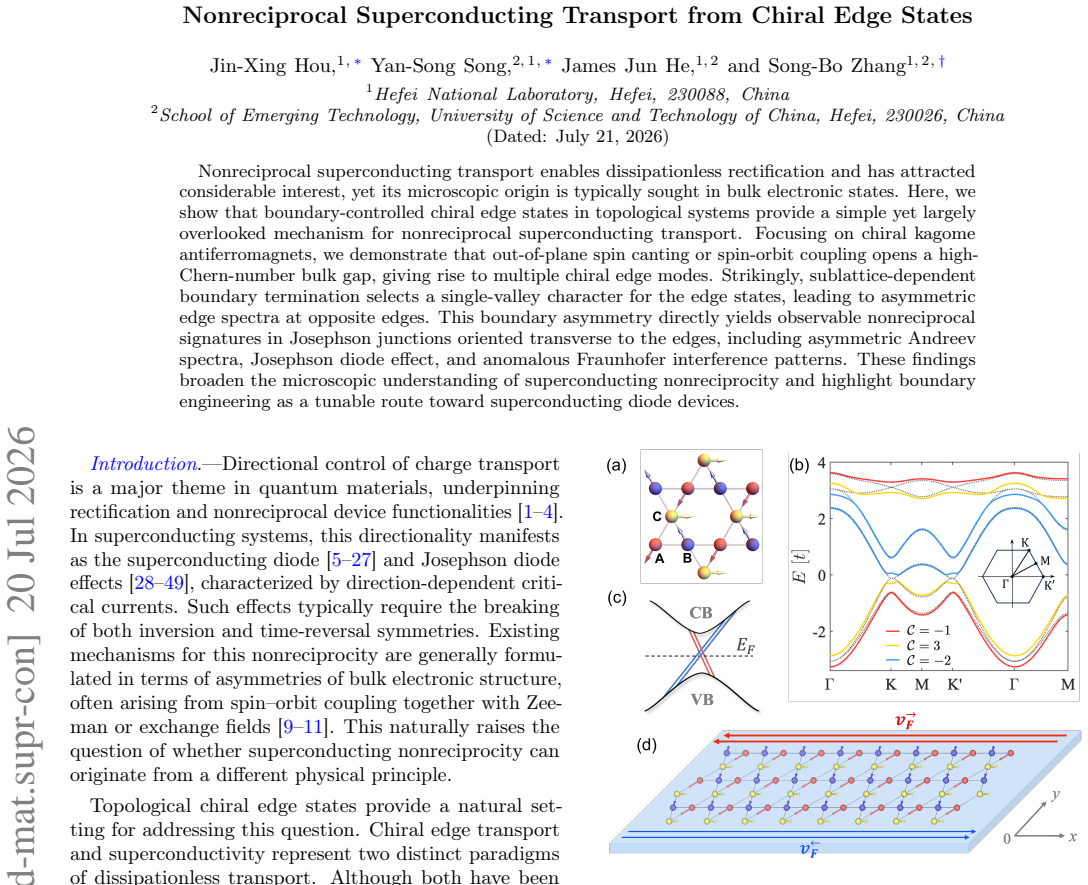
The load-bearing element is the chiral edge state of a high-Chern-number insulator, combined with the sublattice-valley locking of the kagome bands. Edge termination acts as the control: by exposing one sublattice (C) or two (A/B), the boundary selects which valley (K or K') carries the low-energy edge mode; this selection is what makes opposite edges inequivalent when terminations differ. The work is carried by a tight-binding Hamiltonian with a coplanar 120-degree spin texture plus out-of-plane canting Mz, and transport is computed via Green functions in an SNS junction.
What would settle it
A direct test is to fabricate two SNS junctions on the same chiral kagome antiferromagnet film, one with symmetric (11 or 22) and one with asymmetric (12) transverse termination, and compare the phase-dependent supercurrent: if the asymmetric junction does not show E(phi) ≠ E(-phi) and I_c^+ ≠ |I_c^-| with eta reversing under Mz reversal, while the symmetric one does, the mechanism is falsified. Alternatively, intentionally introducing edge roughness that should mix valleys and rebalance the edges would be expected to quench eta.
Extended reading notes
Core claim
The central claim is that transverse boundary asymmetry alone can govern longitudinal superconducting nonreciprocity. In a chiral kagome antiferromagnet with canted spins, the bulk bands acquire Chern number ±2 and support two chiral edge modes. The sublattice termination at each edge acts as a valley-selective filter: an A/B-terminated edge favors one valley, a C-terminated edge the opposite valley. When the two edges have different terminations, the symmetric relation E_upper(kx) = E_lower(-kx) breaks, the edge spectra become inequivalent, and the Josephson critical currents become direction-dependent. The paper demonstrates this in a lattice model with concrete signatures: E(phi) ≠ E(-phi
Load-bearing premise
The effect hinges on edge termination acting as a robust valley-selective filter; if realistic edge disorder, reconstruction, or interfacial scattering mixes valleys or restores equivalence between the two edges, the asymmetric edge spectra and the diode effect would be suppressed, and the calculation assumes clean, phase-coherent ballistic edge transport.
Editorial extensions
If this is right
- A Josephson diode can be realized with an inversion-symmetric normal region, simply by choosing asymmetric edge terminations.
- The diode polarity is switched by reversing Mz (spin canting), with eta(Mz) = -eta(-Mz).
- The effect persists even when bulk states contribute to transport, so a purely edge-only regime is not required.
- The mechanism extends beyond kagome antiferromagnets to other Chern insulators, other fillings, and spin-orbit-coupling-induced gaps, as shown in the Supplemental Material.
- Direction-dependent Fraunhofer patterns provide an experimentally accessible signature distinct from a uniform phi0 offset.
Reading between the lines
- Edge disorder or reconstruction that mixes valleys would suppress the effect, so clean, atomically ordered terminations are the key practical challenge; this could be tested by comparing junctions with different edge roughness.
- The valley-selective edge filter is conceptually a valley valve; the same boundary-engineering principle might also yield nonreciprocal normal-state transport in the same geometry.
- Since the diode effect relies on ballistic phase-coherent edge channels, its robustness at finite temperature or in diffusive samples is not addressed; one could test whether eta degrades as edge scattering is introduced.
- The mechanism suggests a design rule for field-free superconducting diodes in other magnetic topological materials: pattern the two transverse edges with different sublattice terminations to maximize edge inequivalence.
Editorial analysis
A structured set of objections, weighed in public.
Referee Report
Summary. The paper proposes a boundary-controlled mechanism for nonreciprocal superconducting transport in chiral kagome antiferromagnets. The authors show that an out-of-plane spin canting opens a Chern-number C=2 bulk gap, producing chiral edge modes whose low-energy valley character and dispersion depend on sublattice termination at the two edges. When the upper and lower edges terminate asymmetrically (12/21-type), the edge spectra become inequivalent, E_upper(kx) ≠ E_lower(-kx), even though the bulk is inversion-symmetric and symmetric in kx. This boundary-induced edge inequivalence is then shown, via Green's-function calculations, to produce a phase-asymmetric Andreev spectrum, a Josephson diode effect with efficiency η ≈ -20.6% for the chosen parameters, and anomalous direction-dependent Fraunhofer patterns. The central claim is that transverse boundary asymmetry alone, without bulk electronic asymmetry, is sufficient for a Josephson diode effect.
Significance. If established, the mechanism would broaden the microscopic routes to the Josephson diode effect beyond bulk asymmetric band-structure mechanisms, and it identifies a concrete, experimentally accessible platform (Mn3Sn, Mn3Ge and related chiral kagome antiferromagnets). The main-text calculations are internally consistent and explore parameter dependencies (Mz, J, Ny). The proposed signatures — asymmetric Andreev spectra, nonreciprocal critical currents, and anomalous Fraunhofer patterns — are falsifiable and could motivate edge-engineering experiments. However, the paper's core assumption, that boundary termination acts as a robust valley-selective filter, is not demonstrated quantitatively, and the transport results rely entirely on an unavailable Supplemental Material. The significance is therefore conditional on resolving these load-bearing gaps.
major comments (4)
- [Asymmetric and valley-dependent chiral edge states] The valley-selective filter claim — "A/B- and C-terminated edges favor opposite valleys" — is the microscopic basis for the entire diode effect, but it is presented only as a qualitative argument. No valley-resolved spectral weight calculation or analytic sublattice-valley projection is shown in the main text. Moreover, the next paragraph states that "the low-energy edge modes at both boundaries are selected near the same valley while propagating in opposite directions," which appears to contradict the opposite-valley statement. This ambiguity is load-bearing because if the valleys are not cleanly selected, or if edge roughness/disorder mixes K and K' at a given edge, the asymmetry between the two edges is suppressed and the diode effect would be reduced or vanish. The Discussion asserts robustness to "imperfect or engineered edges" but defers to the SM. Please provide a quantitative dem
- [Asymmetric Andreev spectrum / Nonreciprocal supercurrents] All quantitative transport results — the Andreev spectra in Fig. 3, the CPR in Fig. 4(a), the diode efficiency η, and the Fraunhofer pattern in Fig. 4(d) — are obtained from a Green's function technique described only in the SM [69]. Since the SM is not available, the reader cannot verify the implementation of the superconducting leads, the phase bias, the current formula, or whether any self-consistency for Δ is assumed. This is particularly important because the central claim is a nonreciprocal CPR, and a small numerical error in the Green's-function formalism could produce spurious asymmetry. Please include the essential Green's-function equations (or a supplementary preprint) and state whether the superconducting pairing is treated as an externally imposed order parameter.
- [Nonreciprocal supercurrents, Fig. 4] The main junction calculations use Nx = Ny = 10. With Δ = 0.03t, the superconducting coherence length is likely comparable to or larger than the 10-unit-cell spacer; the junction may be in the short-junction limit with substantial finite-size effects. Fig. 4(c) shows dependence on Ny, but Nx is fixed. The convergence of the diode efficiency and CPR with respect to both Nx and Ny is not established. Please provide a finite-size scaling study (e.g., η versus Nx and Ny for larger sizes) to confirm that the nonreciprocal effect is not an artifact of the tiny system.
- [Nonreciprocal supercurrents, symmetry relation] The relation Is(Mz, φ) = −Is(−Mz, −φ) is stated and used to derive η(Mz) = −η(−Mz), but the proof is deferred to the SM [69]. Since this is a symmetry statement about the model, it should be derivable in the main text from the Hamiltonian's symmetries (e.g., combined time reversal and spin rotation). Please provide the symmetry argument explicitly; this is not a request for numerical detail but for a clear analytical justification of a property that is central to the diode-polarity discussion.
minor comments (6)
- [Chern gap with C=2] Typo: "band strcture" should be "band structure".
- [Introduction] Grammar issue: "which have attracted major interest because of their rich topological and transport properties exhibit" — remove "exhibit" or restructure.
- [References] Refs. [35] and [73] are duplicates (Y. Zhang et al., Phys. Rev. X 12, 041013 (2022)). Please consolidate.
- [Fig. 2 caption] The definitions of 11-, 22-, 12-, and 21-type terminations would be clearer if the caption explicitly stated which sublattices are exposed at the upper and lower edges for each type (e.g., 11: C on both edges; 12: A/B on upper, C on lower; etc.).
- [Nonreciprocal supercurrents] The notation I_c^+ and |I_c^-| is used without defining the forward/backward convention. Please define clearly, e.g., I_c^+ = max_φ I(φ), I_c^- = min_φ I(φ).
- [Discussion] The sentence "similar behavior is expected for more general asymmetric or irregular boundaries" is speculative and not backed by calculation; consider softening to "may be expected" or cite a SM calculation.
Circularity Check
No significant circularity: the diode effect and nonreciprocal transport are computed outputs from an independently specified model, not fitted targets or imported self-cited results.
full rationale
The derivation chain is self-contained. The model Hamiltonian (Eq. 1) is fixed with parameters (t, J, Mz, μ, Δ) before any transport quantity is computed. The Chern gap with C=2 follows from the standard Berry-curvature formula (Eq. 3) after adding the canting term (Eq. 2), and the edge spectra are obtained by explicit ribbon diagonalization for each boundary termination (Fig. 2). The nonreciprocal Andreev spectra, CPRs, diode efficiencies, and Fraunhofer patterns are outputs of the Green-function calculation described in the SM, not quantities used to fit any model parameter. The valley-selective boundary-termination claim is derived from the sublattice structure of the kagome wavefunctions and the numerical edge spectra, not assumed as an input. The relation E_upper(kx) ≠ E_lower(-kx) for asymmetric terminations is a calculated result, and the diode asymmetry I_c^+ ≠ |I_c^-| follows from that calculated edge inequivalence. Self-citations (Refs. [48], [67], [68]) appear only in background or symmetry statements and are accompanied by independent references ([52], [71], [72]); no load-bearing conclusion rests solely on a self-citation, and no uniqueness theorem or ansatz is imported from the authors' prior work. The Discussion's expectation that irregular boundaries behave similarly is an extrapolation rather than a circular reduction. Therefore no circular step is present.
Assumptions & free parameters
free parameters (5)
- Exchange coupling J =
0.4t (main text)
- Out-of-plane spin canting Mz =
0.1t (main text); 0.2t in Figs. 1-2
- Chemical potential mu =
-0.1t
- Pairing amplitude Delta =
0.03t
- Ribbon dimensions Nx, Ny =
Nx=10, Ny=10 (Ny up to 60 for Fraunhofer)
assumptions (6)
- domain assumption Hamiltonian (1) with coplanar 120-degree spin texture and spin-canting term (2) captures the low-energy physics of chiral kagome antiferromagnets such as Mn3Sn/Mn3Ge.
- standard math The spin-canting term breaks T·Mz, allowing a finite Berry curvature and a Chern number C=±2 at 1/3 filling.
- standard math Bulk-boundary correspondence holds: a C=2 gap supports two co-propagating chiral edge modes.
- ad hoc to paper Edge termination acts as a valley-selective filter: A/B- and C-terminated edges favor opposite valleys.
- domain assumption The SNS junction is ballistic and phase-coherent, with no disorder, edge reconstruction, or inelastic scattering; the superconductor leads are conventional s-wave with equal coupling to both edges.
- standard math The Green's-function scattering calculation (SM) correctly yields Andreev spectra and supercurrents for the short Nx=10 junction.
Cite this review
Pith. "Pith review of Nonreciprocal Superconducting Transport from Chiral Edge States." pith.science (2026). https://pith.science/paper/FAZUSTJS
@misc{pith2026260718159,
  author       = {Pith},
  title        = {Pith review of: Nonreciprocal Superconducting Transport from Chiral Edge States},
  year         = {2026},
  howpublished = {\url{https://pith.science/paper/FAZUSTJS}},
  note         = {Machine review of arXiv:2607.18159}
}
read the original abstract
Nonreciprocal superconducting transport enables dissipationless rectification and has attracted considerable interest, yet its microscopic origin is typically sought in bulk electronic states. Here, we show that boundary-controlled chiral edge states in topological systems provide a simple yet largely overlooked mechanism for nonreciprocal superconducting transport. Focusing on chiral kagome antiferromagnets, we demonstrate that out-of-plane spin canting or spin-orbit coupling opens a high-Chern-number bulk gap, giving rise to multiple chiral edge modes. Strikingly, sublattice-dependent boundary termination selects a single-valley character for the edge states, leading to asymmetric edge spectra at opposite edges. This boundary asymmetry directly yields observable nonreciprocal signatures in Josephson junctions oriented transverse to the edges, including asymmetric Andreev spectra, Josephson diode effect, and anomalous Fraunhofer interference patterns. These findings broaden the microscopic understanding of superconducting nonreciprocity and highlight boundary engineering as a tunable route toward superconducting diode devices.
Figures


Figures from the paper (1 more)

Reference graph
Works this paper leans on
-
[48]
J.-X. Hou, C. Li, L.-H. Hu, and S.-B. Zhang, Field-free Josephson diode and tunableϕ0-junction in chiral kagome antiferromagnets, arXiv preprint , arXiv:2512.16260 (2025)
arXiv 2025
-
[69]
See Supplemental Material at [URL] for additional details on the supercurrent calculations, the calculation of the Fraunhofer pattern, the effects of spin canting and bound- ary reversal, and the generic nature of boundary-induced asymmetric topological edge states
-
[1]
G. L. J. A. Rikken, J. Fölling, and P. Wyder, Electrical Magnetochiral Anisotropy, Phys. Rev. Lett.87, 236602 (2001)
2001
-
[2]
G. L. J. A. Rikken and P. Wyder, Magnetoelectric Anisotropy in Diffusive Transport, Phys. Rev. Lett.94, 016601 (2005)
2005
-
[3]
Ideue, K
T. Ideue, K. Hamamoto, S. Koshikawa, M. Ezawa, S. Shimizu, Y. Kaneko, Y. Tokura, N. Nagaosa, and Y. Iwasa, Bulk rectification effect in a polar semiconduc- tor, Nat. Phys.13, 578 (2017)
2017
-
[4]
Tokura and N
Y. Tokura and N. Nagaosa, Nonreciprocal responses from non-centrosymmetric quantum materials, Nat. Commun. 9, 3740 (2018)
2018
-
[5]
F. Qin, W. Shi, T. Ideue, M. Yoshida, A. Zak, R. Tenne, T. Kikitsu, D. Inoue, D. Hashizume, and Y. Iwasa, Su- perconductivity in a chiral nanotube, Nat. Commun.8, 14465 (2017)
2017
-
[6]
Hoshino, R
S. Hoshino, R. Wakatsuki, K. Hamamoto, and N. Na- gaosa, Nonreciprocal charge transport in two-dimensional noncentrosymmetric superconductors, Phys. Rev. B98, 054510 (2018)
2018
Show all 85 references
-
[7]
F. Ando, Y. Miyasaka, T. Li, J. Ishizuka, T. Arakawa, Y. Shiota, T. Moriyama, Y. Yanase, and T. Ono, Obser- vation of superconducting diode effect, Nature584, 373 (2020)
2020
-
[8]
Y.-Y. Lyu, J. Jiang, Y.-L. Wang, Z.-L. Xiao, S. Dong, Q.- H. Chen, M. V. Milošević, H. Wang, R. Divan, J. E. Pear- son,et al., Superconducting diode effect via conformal- mapped nanoholes, Nat. Commun.12, 2703 (2021)
2021
-
[9]
J. J. He, Y. Tanaka, and N. Nagaosa, A phenomenological theory of superconductor diodes, New J. Phys.24, 053014 (2022)
2022
-
[10]
N. F. Yuan and L. Fu, Supercurrent diode effect and finite-momentum superconductors, Proc. Natl. Acad. Sci. 119, e2119548119 (2022)
2022
-
[11]
Daido, Y
A. Daido, Y. Ikeda, and Y. Yanase, Intrinsic supercon- ducting diode effect, Phys. Rev. Lett.128, 037001 (2022)
2022
-
[12]
J.-X. Lin, P. Siriviboon, H. D. Scammell, S. Liu, D. Rhodes, K. Watanabe, T. Taniguchi, J. Hone, M. S. Scheurer, and J. Li, Zero-field superconducting diode ef- fect in small-twist-angle trilayer graphene, Nat. Phys.18, 1221 (2022)
2022
-
[13]
Ilić and F
S. Ilić and F. S. Bergeret, Theory of the supercurrent diode effect in Rashba superconductors with arbitrary disorder, Phys. Rev. Lett.128, 177001 (2022)
2022
-
[14]
Bauriedl, C
L. Bauriedl, C. Bäuml, L. Fuchs, C. Baumgartner, N. Paulik, J. M. Bauer, K.-Q. Lin, J. M. Lupton, T. Taniguchi, K. Watanabe,et al., Supercurrent diode effect and magnetochiral anisotropy in few-layer NbSe2, Nat. Commun.13, 4266 (2022)
2022
-
[15]
Y. Hou, F. Nichele, H. Chi, A. Lodesani, Y. Wu, M. F. Ritter, D. Z. Haxell, M. Davydova, S. Ilić, O. Glezakou- Elbert, A. Varambally, F. S. Bergeret, A. Kamra, L. Fu, P. A. Lee, and J. S. Moodera, Ubiquitous superconducting 6 diode effect in superconductor thin films, Phys. Re...
2023
-
[16]
Nadeem, M
M. Nadeem, M. S. Fuhrer, and X. Wang, The supercon- ducting diode effect, Nat. Rev. Phys.5, 558 (2023)
2023
-
[17]
J. J. He, Y. Tanaka, and N. Nagaosa, The supercurrent diode effect and nonreciprocal paraconductivity due to the chiral structure of nanotubes, Nat. Commun.14, 3330 (2023)
2023
-
[18]
T. Le, Z. Pan, Z. Xu, J. Liu, J. Wang, Z. Lou, X. Yang, Z. Wang, Y. Yao, C. Wu,et al., Superconducting diode ef- fect and interference patterns in kagome CsV3Sb5, Nature 630, 64 (2024)
2024
-
[19]
Banerjee and M
S. Banerjee and M. S. Scheurer, Altermagnetic supercon- ducting diode effect, Phys. Rev. B110, 024503 (2024)
2024
-
[20]
Chakraborty and A
D. Chakraborty and A. M. Black-Schaffer, Perfect super- conducting diode effect in altermagnets, Phys. Rev. Lett. 135, 026001 (2025)
2025
-
[21]
Wang and N
R. Wang and N. Hao, Universal diagnostic criterion for intrinsic superconducting diode effect, arXiv e-prints , arXiv:2507.04876 (2025)
2025 arXiv
-
[22]
Fracassi, S
S. Fracassi, S. Traverso, S. Heun, M. Sassetti, M. Carrega, and N. T. Ziani, Intrinsic and tunable superconducting diode effect in quantum spin Hall systems, arXiv e-prints , arXiv:2512.02575 (2025)
2025
-
[23]
Bhowmik, D
S. Bhowmik, D. Samanta, A. K. Nandy, A. Saha, and S. K. Ghosh, Optimizing one dimensional superconduct- ing diodes: interplay of Rashba spin-orbit coupling and magnetic fields, Commun. Phys.8, 260 (2025)
2025
-
[24]
A. Pal, D. Mondal, T. Nag, and A. Saha, Topological superconductivity and superconducting diode effect me- diated via unconventional magnet and ising spin-orbit coupling, arXiv preprint , arXiv:2512.01266 (2025)
2025 arXiv
-
[25]
Bhowmik and A
S. Bhowmik and A. Saha, Topological majorana zero modes and the superconducting diode effect driven by fulde-Ferrell-Larkin-Ovchinnikov pairing in a helical Shiba chain, Phys. Rev. B111, L161402 (2025)
2025
-
[26]
J. Li, Z. Zhang, S. Wang, Y. He, H. Lyu, Q. Wang, B. Dong, D. Zhu, H. Matsuki, D. Zhu,et al., Field-free superconducting diode enabled by geometric asymmetry and perpendicular magnetization, Adv. Mater.38, e11414 (2026)
2026
-
[27]
Wakatsuki, Y
R. Wakatsuki, Y. Saito, S. Hoshino, Y. M. Itahashi, T. Ideue, M. Ezawa, Y. Iwasa, and N. Nagaosa, Non- reciprocal charge transport in noncentrosymmetric super- conductors, Sci. Adv.3, e1602390 (2017)
2017
-
[28]
H. Wu, Y. Wang, Y. Xu, P. K. Sivakumar, C. Pasco, U. Filippozzi, S. S. Parkin, Y.-J. Zeng, T. McQueen, and M. N. Ali, The field-free Josephson diode in a van der Waals heterostructure, Nature604, 653 (2022)
2022
-
[29]
Baumgartner, L
C. Baumgartner, L. Fuchs, A. Costa, S. Reinhardt, S. Gronin, G. C. Gardner, T. Lindemann, M. J. Manfra, P. E. Faria Junior, D. Kochan,et al., Supercurrent rectifi- cation and magnetochiral effects in symmetric Josephson junctions, Nat. Nanotechnol.17, 39 (2022)
2022
-
[30]
B. Pal, A. Chakraborty, P. K. Sivakumar, M. Davydova, A. K. Gopi, A. K. Pandeya, J. A. Krieger, Y. Zhang, M. Date, S. Ju,et al., Josephson diode effect from Cooper pair momentum in a topological semimetal, Nat. Phys. 18, 1228 (2022)
2022
-
[31]
J. Hu, C. Wu, and X. Dai, Proposed design of a Josephson diode, Phys. Rev. Lett.99, 067004 (2007)
2007
-
[32]
C.-Z. Chen, J. J. He, M. N. Ali, G.-H. Lee, K. C. Fong, and K. T. Law, Asymmetric Josephson effect in inversion symmetry breaking topological materials, Phys. Rev. B 98, 075430 (2018)
2018
-
[33]
Misaki and N
K. Misaki and N. Nagaosa, Theory of the nonreciprocal Josephson effect, Phys. Rev. B103, 245302 (2021)
2021
-
[34]
Davydova, S
M. Davydova, S. Prembabu, and L. Fu, Universal Joseph- son diode effect, Sci. Adv.8, eabo0309 (2022)
2022
-
[36]
Tanaka, B
Y. Tanaka, B. Lu, and N. Nagaosa, Theory of giant diode effect ind-wave superconductor junctions on the surface of a topological insulator, Phys. Rev. B106, 214524 (2022)
2022
-
[37]
Diez-Merida, A
J. Diez-Merida, A. Díez-Carlón, S. Yang, Y.-M. Xie, X.-J. Gao, J. Senior, K. Watanabe, T. Taniguchi, X. Lu, A. P. Higginbotham,et al., Symmetry-broken Josephson junc- tions and superconducting diodes in magic-angle twisted bilayer graphene, Nat. Commun.14, 2396 (2023)
2023
-
[38]
Hu, Z.-T
J.-X. Hu, Z.-T. Sun, Y.-M. Xie, and K. T. Law, Josephson diode effect induced by valley polarization in twisted bilayer graphene, Phys. Rev. Lett.130, 266003 (2023)
2023
-
[39]
J. F. Steiner, L. Melischek, M. Trahms, K. J. Franke, and F. von Oppen, Diode effects in current-biased Josephson junctions, Phys. Rev. Lett.130, 177002 (2023)
2023
-
[40]
Sundaresh, J
A. Sundaresh, J. I. Väyrynen, Y. Lyanda-Geller, and L. P. Rokhinson, Diamagnetic mechanism of critical cur- rent non-reciprocity in multilayered superconductors, Nat. Commun.14, 1628 (2023)
2023
-
[41]
Cheng, Y
Q. Cheng, Y. Mao, and Q.-F. Sun, Field-free Josephson diode effect in altermagnet/normal metal/altermagnet junctions, Phys. Rev. B110, 014518 (2024)
2024
-
[42]
S. Ilić, P. Virtanen, D. Crawford, T. T. Heikkilä, and F. S. Bergeret, Superconducting diode effect in diffusive superconductors and Josephson junctions with Rashba spin-orbit coupling, Phys. Rev. B110, L140501 (2024)
2024
-
[43]
Jiang and J
K. Jiang and J. Hu, Superconducting diode effects, Nat. Phys.18, 1145 (2022)
2022
-
[44]
Wang, Q.-H
D. Wang, Q.-H. Wang, and C. Wu, Current-reversion symmetry breaking and the dc Josephson diode effect, Sci. Bull.70, 4181 (2025)
2025
-
[45]
J. Ma, H. Wang, W. Zhuo, B. Lei, S. Wang, W. Wang, X.-Y. Chen, Z.-Y. Wang, B. Ge, Z. Wang,et al., Field-free Josephson diode effect in NbSe2 van der Waals junction, Commun. Phys.8, 125 (2025)
2025
-
[46]
C. Sun, J. B. Tjernshaugen, and J. Linder, Voltage- tunable spin supercurrent nonreciprocity reaching 100% efficiency, Phys. Rev. B112, 064504 (2025)
2025
-
[47]
Y. Sun, Z. Zhang, and J. J. He, Strong correlation drives zero-field Josephson diode effect (2026)
2026
-
[49]
Lahiri, M
A. Lahiri, M. Polák, and B. Trauzettel, Diode effect in microwave-irradiated Josephson junctions with Yu-Shiba- Rusinov states, Phys. Rev. B113, 224502 (2026)
2026
-
[50]
Moessner, Magnets with strong geometric frustration, Can
R. Moessner, Magnets with strong geometric frustration, Can. J. Phys.79, 1283 (2001)
2001
-
[51]
Matan, D
K. Matan, D. Grohol, D. G. Nocera, T. Yildirim, A. B. Harris, S.-H. Lee, S. E. Nagler, and Y. S. Lee, Spin waves in the frustrated kagome lattice antiferromagnet KFe3(OH)6(SO4)2, Phys. Rev. Lett.96, 247201 (2006)
2006
-
[52]
H. Chen, Q. Niu, and A. H. MacDonald, Anomalous Hall effect arising from noncollinear antiferromagnetism, Phys. Rev. Lett.112, 017205 (2014)
2014
-
[53]
Kübler and C
J. Kübler and C. Felser, Non-collinear antiferromagnets 7 and the anomalous Hall effect, Europhys. Lett.108, 67001 (2014)
2014
-
[54]
Nakatsuji, N
S. Nakatsuji, N. Kiyohara, and T. Higo, Large anomalous Hall effect in a non-collinear antiferromagnet at room temperature, Nature527, 212 (2015)
2015
-
[55]
A. K. Nayak, J. E. Fischer, Y. Sun, B. Yan, J. Karel, A. C. Komarek, C. Shekhar, N. Kumar, W. Schnelle, J. Kübler, C. Felser, and S. S. P. Parkin, Large anoma- lous Hall effect driven by a nonvanishing berry curvature in the noncolinear antiferromagnet Mn3Ge, Sci. Adv.2, e1501...
2016
-
[56]
Kuroda, T
K. Kuroda, T. Tomita, M.-T. Suzuki, C. Bareille, A. A. Nugroho, P. Goswami, M. Ochi, M. Ikhlas, M. Nakayama, S. Akebi, R. Noguchi, R. Ishii, N. Inami, K. Ono, H. Kumi- gashira, A. Varykhalov, T. Muro, T. Koretsune, R. Arita, S. Shin, T. Kondo, and S. Nakatsuji, Evidence for ma...
2017
-
[57]
Železný, Y
J. Železný, Y. Zhang, C. Felser, and B. Yan, Spin- polarized current in noncollinear antiferromagnets, Phys. Rev. Lett.119, 187204 (2017)
2017
-
[58]
Ikhlas, T
M. Ikhlas, T. Tomita, T. Koretsune, M.-T. Suzuki, D. Nishio-Hamane, R. Arita, Y. Otani, and S. Nakat- suji, Large anomalous nernst effect at room temperature in a chiral antiferromagnet, Nat. Phys.13, 1085 (2017)
2017
-
[59]
T. Higo, H. Man, D. B. Gopman, L. Wu, T. Koretsune, O. M. J. van ’t Erve, Y. P. Kabanov, D. Rees, Y. Li, M.-T. Suzuki, S. Patankar, M. Ikhlas, C. L. Chien, R. Arita, R.D.Shull, J.Orenstein,andS.Nakatsuji,Largemagneto- optical Kerr effect and imaging of magnetic octupole domain...
2018
-
[60]
H. Tsai, T. Higo, K. Kondou, T. Nomoto, A. Sakai, A. Kobayashi, T. Nakano, K. Yakushiji, R. Arita, S. Miwa, et al., Electrical manipulation of a topological antiferro- magnetic state, Nature580, 608 (2020)
2020
-
[61]
T. Higo, K. Kondou, T. Nomoto, M. Shiga, S. Sakamoto, X. Chen, D. Nishio-Hamane, R. Arita, Y. Otani, S. Miwa, et al., Perpendicular full switching of chiral antiferromag- netic order by current, Nature607, 474 (2022)
2022
-
[62]
Z. Zhou, Y. Cao, Z. Pan, Y. Zhang, S. Liang, F. Pan, and C. Song, Field-free full switching of chiral antiferromag- netic order, Nature651, 341–347 (2026)
2026
-
[63]
R. S. Souto, M. Leijnse, and C. Schrade, Josephson diode effect in supercurrent interferometers, Phys. Rev. Lett. 129, 267702 (2022)
2022
-
[64]
Y. Li, D. Yan, Y. Hong, H. Sheng, A. Wang, Z. Dou, X. Guo, X. Shi, Z. Su, Z. Lyu,et al., Interfering Josephson diode effect in Ta2Pd3Te5 asymmetric edge interferometer, Nat. Commun.15, 9031 (2024)
2024
-
[65]
Huang, T
H. Huang, T. de Picoli, and J. I. Väyrynen, Superconduct- ing diode effect in two-dimensional topological insulator edges and Josephson junctions, Appl. Phys. Lett.125, 032602 (2024)
2024
-
[66]
Guo, X.-H
G.-L. Guo, X.-H. Pan, H. Dong, and X. Liu, Edge de- pendent Josephson diode effect in WTe2-based Josephson junction, arXiv preprint , arXiv:2508.21357 (2025)
2025 arXiv
-
[67]
Zhang and L.-H
S.-B. Zhang and L.-H. Hu, Finite-momentum mixed singlet-triplet pairing in chiral antiferromagnets induced by even-parity spin texture, Phys. Rev. B112, L100501 (2025)
2025
-
[68]
Zhang, L.-H
S.-B. Zhang, L.-H. Hu, Q. Niu, and Z. Zhang, Spin-valley locking and pure spin-triplet superconductivity in non- collinear antiferromagnets proximitized to conventional superconductors, Newton2, 100379 (2026)
2026
-
[70]
D. J. Thouless, M. Kohmoto, M. P. Nightingale, and M. den Nijs, Quantized Hall conductance in a two- dimensional periodic potential, Phys. Rev. Lett.49, 405 (1982)
1982
-
[71]
Hatsugai, Chern number and edge states in the integer quantum Hall effect, Phys
Y. Hatsugai, Chern number and edge states in the integer quantum Hall effect, Phys. Rev. Lett.71, 3697 (1993)
1993
-
[72]
Shen,Topological insulators, Vol
S.-Q. Shen,Topological insulators, Vol. 174 (Springer, 2012)
2012
-
[73]
Zhang, Y
Y. Zhang, Y. Gu, P. Li, J. Hu, and K. Jiang, General theory of Josephson diodes, Phys. Rev. X12, 041013 (2022)
2022
-
[74]
Takeuchi, Y
Y. Takeuchi, Y. Yamane, J.-Y. Yoon, R. Itoh, B. Jinnai, S. Kanai, J. Ieda, S. Fukami, and H. Ohno, Chiral-spin rotation of non-collinear antiferromagnet by spin-orbit torque, Nat. Mater.20, 1364 (2021)
2021
-
[75]
H. Xie, X. Chen, Q. Zhang, Z. Mu, X. Zhang, B. Yan, and Y. Wu, Magnetization switching in polycrystalline Mn3Sn thin film induced by self-generated spin-polarized current, Nat. Commun.13, 5744 (2022)
2022
-
[76]
B. Pal, B. K. Hazra, B. Göbel, J.-C. Jeon, A. K. Pandeya, A. Chakraborty, O. Busch, A. K. Srivastava, H. Deniz, J. M. Taylor,et al., Setting of the magnetic structure of chiral kagome antiferromagnets by a seeded spin-orbit torque, Sci. Adv.8, eabo5930 (2022)
2022
-
[77]
Zheng, T
Z. Zheng, T. Zeng, T. Zhao, S. Shi, L. Ren, T. Zhang, L. Jia, Y. Gu, R. Xiao, H. Zhou,et al., Effective electrical manipulation of a topological antiferromagnet by orbital torques, Nat. Commun.15, 745 (2024)
2024
-
[78]
Zheng, L
Z. Zheng, L. Jia, Z. Zhang, Q. Shen, G. Zhou, Z. Cui, L. Ren, Z. Chen, N. F. Jamaludin, T. Zhao,et al., All- electrical perpendicular switching of chiral antiferromag- netic order, Nat. Mater.24, 1407 (2025)
2025
-
[79]
Z. Xu, Y. Zhou, X. Zhang, Y. Qiao, Z. Xu, D. Shao, and Z. Zhu, Spin-orbit torque-driven chiral domain wall motion in Mn3Sn, Appl. Phys. Lett.127, 7 (2025)
2025
-
[80]
K.-R. Jeon, B. K. Hazra, K. Cho, A. Chakraborty, J.-C. Jeon, H. Han, H. L. Meyerheim, T. Kontos, and S. S. Parkin, Long-range supercurrents through a chiral non- collinear antiferromagnet in lateral Josephson junctions, Nat. Mater.20, 1358 (2021)
2021
-
[81]
K.-R. Jeon, B. K. Hazra, J.-K. Kim, J.-C. Jeon, H. Han, H. L. Meyerheim, T. Kontos, A. Cottet, and S. S. Parkin, Chiral antiferromagnetic Josephson junctions as spin- triplet supercurrent spin valves and dc SQUIDs, Nat. Nanotechnol.18, 747 (2023)
2023
-
[82]
X. Jia, M. Hofmann, V. Meunier, B. G. Sumpter, J. Campos-Delgado, J. M. Romo-Herrera, H. Son, Y.-P. Hsieh, A. Reina, J. Kong,et al., Controlled formation of sharp zigzag and armchair edges in graphitic nanoribbons, Science323, 1701 (2009)
2009
-
[83]
M. G. Stanford, P. D. Rack, and D. Jariwala, Emerging nanofabrication and quantum confinement techniques for 2D materials beyond graphene, npj 2D Mater. Appl.2, 1 (2018)
2018
-
[84]
Duan, J.-Y
S. Duan, J.-Y. You, J. Gou, J. Chen, Y. L. Huang, M. Liu, S. Sun, Y. Wang, X. Yu, L. Wang,et al., Epitaxial growth of single-layer kagome nanoflakes with topological band inversion, ACS nano16, 21079 (2022). 8
2022
-
[85]
Mazzola, S
F. Mazzola, S. Enzner, P. Eck, C. Bigi, M. Jugovac, I. Co- jocariu, V. Feyer, Z. Shu, G. M. Pierantozzi, A. De Vita, et al., Observation of termination-dependent topological connectivity in a magnetic Weyl kagome lattice, Nano Lett.23, 8035 (2023)
2023
-
[86]
Z. Wei, Y. Qiao, Y.-Y. Lyu, D. Wang, T. Li, L. R. Cadorim, P. Zhang, W.-C. Yue, D. Li, Z. Song,et al., Scal- able high-temperature superconducting diodes enabled by intrinsic Josephson junctions, Natl. Sci. Rev. , nwag285 (2026)
2026
Reviewed August 1, 2026 · model on record in the stance chip above.
Discussion (0). Continue with ORCID to comment.