REVIEW 3 major objections 4 minor 39 references
Generalized Zero-Shot Learning for Point Cloud Segmentation with Evidence-Based Dynamic Calibration
T0 review · 3 major / 4 minor · reviewed 2026-08-04 · deepseek-v4-flash
Pith's one-line read An uncertainty-based calibration factor, not a fixed constant, rebalances seen and unseen predictions in zero-shot 3D point cloud segmentation.
desk verdict Solid GZSL 3D segmentation paper with a genuinely new dynamic calibration idea and strong semantic tuning, but the inference formula and one loss equation are underspecified enough that the exact method needs clarification or code to verify. read the letter →
The pith
A machine-rendered reading of the paper's core claim, the machinery that carries it, and where it could break.
The reading
What carries the argument
The engine is an evidence-based uncertainty estimator U trained with three losses—a Bayesian segmentation loss, a divergence loss toward a uniform Dirichlet prior, and a binary loss that lowers uncertainty for seen points and raises it for unseen points. Uncertainty is computed from Dirichlet concentration parameters as u = K/α0; the dynamic calibration factor is η = u − ū, and predictions are adjusted by p′_k = p_k − η·1_Ys(c_k). This converts calibrated stacking—the usual trick of subtracting a fixed constant from seen-class probabilities—into a per-point, uncertainty-driven adjustment. A second component, semantic tuning, multiplies a learnable scene-composition vector s into text embeddi
What would settle it
On held-out scenes, count points whose top prediction before calibration is an unseen class. In any scene where this count is zero, η = u − ū cannot be computed; reporting what the implementation does there (fallback constant, zero, or skip) and comparing per-scene HmIoU with and without such points would reveal whether dynamic calibration is doing the work. A second check: replace η with a fixed factor tuned on the validation set; if the fixed factor matches the dynamic result on all three datasets, the uncertainty mechanism is not essential.
Extended reading notes
Core claim
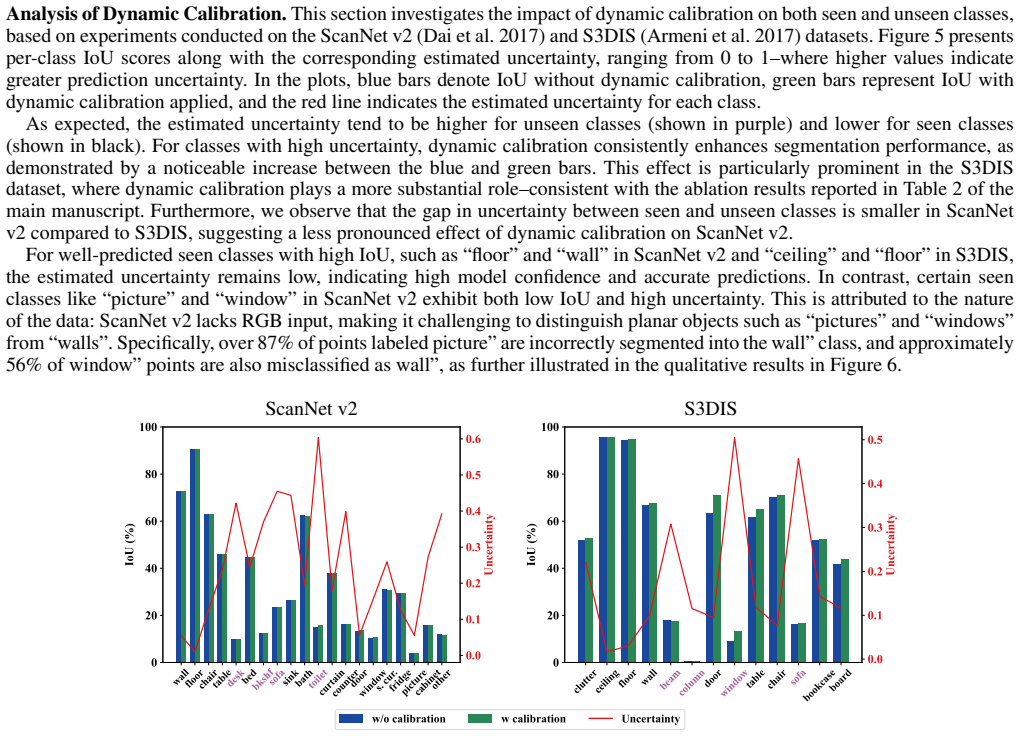
The central claim is that overconfident seen-class predictions in generalized zero-shot point cloud segmentation can be mitigated by redistributing the prediction probabilities with an evidence-based, per-point uncertainty estimate. The method trains an uncertainty estimator that outputs Dirichlet concentration parameters α for the seen classes and computes uncertainty as u = K/α0. At inference, it sets the calibrated-stacking factor to η = u − ū, where ū is the average estimated uncertainty of points the uncalibrated classifier labels as unseen, and applies p′_k = p_k − η·1(c_k ∈ Y_s) to every seen class. High uncertainty therefore yields a larger subtraction from seen-class probability, pu
Load-bearing premise
The load-bearing premise is that the uncalibrated classifier produces a non-empty, reasonably accurate set of predicted-unseen points in every test scene, so that ū—the average estimated uncertainty of those points—is well-defined and meaningful; if no point is predicted unseen, or the seen/unseen split is very biased, the dynamic calibration factor collapses or becomes a noisy constant.
Editorial extensions
If this is right
- One model can serve both seen and unseen classes at inference; no separate seen/unseen gating network or per-dataset calibration sweep is required.
- Because the calibration factor is per point, it can adapt when a scene's mix of seen and unseen objects changes, something a single global constant cannot do.
- The uncertainty estimate doubles as a per-point confidence score; high-uncertainty points could be flagged for review or rejection in safety-critical 3D perception.
- The text-feature tuning mechanism offers a way to improve zero-shot segmentation in data-scarce regimes without adding real unseen training points.
- The paper's own analysis indicates the gain is smallest when the base classifier is already extremely overconfident; heavily saturated models may need an additional confidence regularizer before calibration pays off.
Reading between the lines
- If dynamic calibration is the active ingredient, the same η = u − ū rule is a natural candidate for image-based GZSL and 2D semantic segmentation, where calibrated stacking is still usually done with a global hyperparameter.
- Because ū is defined from points the uncalibrated classifier predicts as unseen, a scene with no such predictions leaves the calibration factor undefined; deployment would need an explicit fallback, which the paper does not specify.
- The method's margin over baselines appears tied to how separable the classifier's uncertainty is for seen versus unseen points (small on ScanNet v2, larger on S3DIS), suggesting the uncertainty gap, not the calibration formula alone, determines the gain.
- One could test whether U generalizes as an out-of-distribution detector by holding out different class splits and measuring whether unseen-point uncertainty stays high across splits and datasets.
Editorial analysis
A structured set of objections, weighed in public.
Referee Report
Summary. The paper addresses generalized zero-shot semantic segmentation of 3D point clouds, where a model trained on seen classes must also classify unseen classes at test time. The authors propose E3DPC-GZSL, consisting of (i) a three-stage pipeline (encoder training, decoder-based feature synthesis with semantically tuned text embeddings, and classifier training) and (ii) an evidence-based uncertainty estimator whose output is used at inference to calibrate the classifier's probabilities. The central inference rule is Eq. (3), p'_k = p_k - eta * 1_{Y_s}(c_k), with eta = u - u_bar, where u is the estimated uncertainty of a point and u_bar is the average uncertainty of unseen samples predicted by the uncalibrated classifier. The method is evaluated on ScanNet v2 and S3DIS in the main text and on SemanticKITTI in the supplementary, reporting state-of-the-art HmIoU over the 3DGenZ and 3DPC-GZSL baselines, with ablations and 10-seed stability experiments.
Significance. If the proposed uncertainty-driven calibration is correctly specified, the paper offers a plausible improvement over fixed calibrated stacking for inductive 3D GZSL, and the multi-seed results, code release, and honest discussion of failure cases are strengths. However, the current manuscript contains a sign inconsistency in a core training loss and leaves the central inference statistic u_bar underspecified, so the numerical claims are not independently reproducible from the text. The reported improvements are non-negligible (e.g., +1.52 HmIoU on S3DIS from the uncertainty module in Table 2), but they rest on equations and definitions that need correction before the contribution can be assessed.
major comments (3)
- [Proposed Approach, Inference (Eq. 3)] The central calibration is underspecified and the claimed global effect is not supported. eta = u - u_bar, with u_bar defined only as 'the average estimated uncertainty of unseen samples predicted from C before applying calibrated stacking.' The paper does not state whether u_bar is per scene or global, how a scene with zero points predicted unseen is handled, or whether eta is clipped to the [0,1] range announced before Eq. (3); since u,u_bar in [0,1], eta can be negative. More importantly, if T is the set of points predicted unseen by C, then sum_{i in T} eta_i = 0 by construction. Because Eq. (3) decreases only seen-class probabilities, the total seen-class probability summed over T is invariant: on that set the transform is a relative reordering, not a global downweighting of seen classes. The paper's headline claim of mitigating overconfidence on seen categories therefore requires a
- [Eq. (9), Phase III] The binary loss is written with the wrong sign relative to the text. Eq. (9) is L_BL = -1/N_b sum [1_Ys(c_yj) log u_j + 1_Yu(c_yj) log(1-u_j)]. Minimizing this drives u_j -> 1 for seen samples and u_j -> 0 for unseen samples, i.e., it increases uncertainty for seen samples and decreases it for unseen samples. The surrounding paragraph states the opposite: 'reduces uncertainty for seen samples and simultaneously increases uncertainty for unseen samples.' Since u is the uncertainty of Eq. (4), the loss should presumably be -[1_Ys log(1-u) + 1_Yu log u]. Table 3 attributes part of the HmIoU gain to L_BL, so this sign error is load-bearing; the equation should be corrected and the ablations repeated or confirmed.
- [Phase III, Eqs. (5)-(9)] The paper claims the method avoids explicitly distinguishing seen and unseen samples, but L_BL is exactly a binary seen/unseen classification objective on u, using oracle indicators 1_Ys and 1_Yu. Furthermore, the uncertainty estimator is defined with K=N_s: alpha_0 = sum_{k=1}^{N_s} alpha_k, and L_SL and L_DL sum over N_s classes, while the classifier C outputs N_c = N_s + N_u classes. It is unclear how evidence for unseen classes enters the uncertainty estimator and how a u computed only from seen-class evidence is used to calibrate predictions over all classes. If U is effectively a seen/unseen discriminator, the novelty claim in the Introduction ('without the need for explicitly distinguishing between seen and unseen samples') should be revised, and the training/inference protocol should be stated precisely.
minor comments (4)
- [Appendix A, Eq. (11) and main text Eq. (8)] The second digamma term appears as psi(alpha_{j,0}) but should be psi(tilde_alpha_{j,0}) in the KL divergence between Dir(tilde_alpha_j) and Dir(1).
- [Figures 7 and 12] The class-color legends for S3DIS and SemanticKITTI reproduce the ScanNet legend, which makes the qualitative comparisons difficult to interpret. Please use dataset-specific legends.
- [Tables 1/2 and Discussion] The uncertainty module contributes only +0.17 HmIoU on ScanNet v2 (Table 2), and the paper's own reliability analysis explains this. This is a useful limitation, but the abstract and conclusion should state more prominently that the dynamic calibration's benefit is dataset-dependent.
- [Experimental Results] The comparison is limited to 3DGenZ and 3DPC-GZSL. Since the paper claims state-of-the-art performance, at least one more recent 3D GZSL baseline should be included or the absence of such baselines should be justified.
Circularity Check
The inference calibration eta = u - u_bar is defined as a centered statistic over the very samples it is supposed to calibrate; by the paper's own equations, it has zero net effect on the predicted-unseen set, so the claimed global redistribution of probability from seen to unseen classes is not achieved by the formula.
-
self definitional
[Proposed Approach, Inference paragraph and Eq. (3), (4), (9)]
"Using the learned parameters of U to estimate α, the dynamic calibration factor is defined as η = u − ¯u, where ¯u is defined as the average estimated uncertainty of unseen samples predicted from C before applying calibrated stacking. ... p′_k = p_k − η · 1_Ys(c_k)"
By construction, u_bar is the mean of u over the set S of points that C predicts as unseen before calibration. Therefore, for every point in S, η = u - u_bar, so Σ_{i∈S} η_i = 0 and the total probability subtracted from seen classes over S is also zero. Eq. (3) thus only re-ranks the predicted-unseen points; it does not globally reduce seen-class probabilities or increase unseen-class probabilities as claimed. Moreover, since L_BL (Eq. 9) explicitly trains u to be low for seen samples and high for unseen samples, points pre-classified as seen typically have u < u_bar and hence η < 0, which increases p'_k for seen classes, opposite to the stated goal of mitigating seen-class overconfidence. The 'dynamic calibration factor' is therefore a zero-mean re-centering of the classifier's own uncert
full rationale
The paper's central inference formula is self-definitional in a narrow but important sense: the calibration factor η is defined as the deviation of each point's uncertainty from the average uncertainty of the classifier's own predicted-unseen set. This forces the sum of η over that set to be identically zero, so the claimed global redistribution from seen to unseen classes cannot come from Eq. (3) alone; any effect must be a relative re-ranking within the set. The paper does not specify whether u_bar is computed per scene or globally, and scenes with no pre-calibration predicted-unseen points leave u_bar undefined, which further undermines the method as written. These issues do not invalidate the empirical comparisons (the method still shows gains in Tables 1-3), so the paper is not globally circular, but a load-bearing element of the proposed mechanism reduces by construction to a centered statistic of the same predictions it claims to correct. No self-citation or imported uniqueness theorem plays a load-bearing role.
Assumptions & free parameters
free parameters (2)
- lambda_DL (divergence loss weight) =
0.005 (ScanNet/S3DIS), 0.5 (SemanticKITTI)
- lambda_BL (binary loss weight) =
0.01 (ScanNet), 0.1 (S3DIS), 0.005 (SemanticKITTI)
assumptions (4)
- domain assumption Evidential Dirichlet uncertainty u = K/alpha_0 (Eq. 4, with K=N_s) is a valid pointwise uncertainty measure for calibration.
- domain assumption Synthesized features from the GMMN decoder are representative of real unseen-class features.
- domain assumption The scene composition descriptor (+/-1 vector indicating class presence) is available and useful for training the decoder.
- ad hoc to paper At inference, the average uncertainty u_bar over samples predicted as unseen by the uncalibrated classifier is well-defined and non-degenerate.
Cite this review
Pith. "Pith review of Generalized Zero-Shot Learning for Point Cloud Segmentation with Evidence-Based Dynamic Calibration." pith.science (2026). https://pith.science/paper/FB5SYR4L
@misc{pith2026250908280,
  author       = {Pith},
  title        = {Pith review of: Generalized Zero-Shot Learning for Point Cloud Segmentation with Evidence-Based Dynamic Calibration},
  year         = {2026},
  howpublished = {\url{https://pith.science/paper/FB5SYR4L}},
  note         = {Machine review of arXiv:2509.08280}
}
read the original abstract
Generalized zero-shot semantic segmentation of 3D point clouds aims to classify each point into both seen and unseen classes. A significant challenge with these models is their tendency to make biased predictions, often favoring the classes encountered during training. This problem is more pronounced in 3D applications, where the scale of the training data is typically smaller than in image-based tasks. To address this problem, we propose a novel method called E3DPC-GZSL, which reduces overconfident predictions towards seen classes without relying on separate classifiers for seen and unseen data. E3DPC-GZSL tackles the overconfidence problem by integrating an evidence-based uncertainty estimator into a classifier. This estimator is then used to adjust prediction probabilities using a dynamic calibrated stacking factor that accounts for pointwise prediction uncertainty. In addition, E3DPC-GZSL introduces a novel training strategy that improves uncertainty estimation by refining the semantic space. This is achieved by merging learnable parameters with text-derived features, thereby improving model optimization for unseen data. Extensive experiments demonstrate that the proposed approach achieves state-of-the-art performance on generalized zero-shot semantic segmentation datasets, including ScanNet v2 and S3DIS.
Figures


Figures from the paper (9 more)



Reference graph
Works this paper leans on
-
[1]
, " * write output.state after.block = add.period write newline
ENTRY address archivePrefix author booktitle chapter edition editor eid eprint howpublished institution isbn journal key month note number organization pages publisher school series title type volume year label extra.label sort.label short.list INTEGERS output.state before.all mid.sentence after.sentence after.block FUNCTION init.state.consts #0 'before.a...
-
[2]
write newline
" write newline "" before.all 'output.state := FUNCTION n.dashify 't := "" t empty not t #1 #1 substring "-" = t #1 #2 substring "--" = not "--" * t #2 global.max substring 't := t #1 #1 substring "-" = "-" * t #2 global.max substring 't := while if t #1 #1 substring * t #2 global.max substring 't := if while FUNCTION word.in bbl.in capitalize " " * FUNCT...
-
[3]
R.; Jiang, H.; Brilakis, I.; Fischer, M.; and Savarese, S
Armeni, I.; Sener, O.; Zamir, A. R.; Jiang, H.; Brilakis, I.; Fischer, M.; and Savarese, S. 2017. 3D Semantic Parsing of Large-Scale Indoor Spaces . In Proceedings of the IEEE Conference on Computer Vision and Pattern Recognition (CVPR), 1534--1543
work page 2017
-
[4]
Behley, J.; Garbade, M.; Milioto, A.; Quenzel, J.; Behnke, S.; Stachniss, C.; and Gall, J. 2019. SemanticKITTI: A Dataset for Semantic Scene Understanding of LiDAR Sequences. In Proceedings of the IEEE/CVF International Conference on Computer Vision (ICCV), 9297--9307
work page 2019
-
[5]
Boulch, A. 2020. ConvPoint: Continuous convolutions for point cloud processing . Computers & Graphics, 88: 24--34
work page 2020
-
[6]
Boulch, A.; Puy, G.; and Marlet, R. 2020. FKAConv: Feature-Kernel Alignment for Point Cloud Convolution . In Proceedings of the Asian Conference on Computer Vision (ACCV)
work page 2020
-
[7]
Chao, W.-L.; Changpinyo, S.; Gong, B.; and Sha, F. 2016. An Empirical Study and Analysis of Generalized Zero-Shot Learning for Object Recognition in the Wild . In European Conference on Computer Vision (ECCV), 52--68
work page 2016
-
[8]
Chen, R.; Zhu, X.; Chen, N.; Li, W.; Ma, Y.; Yang, R.; and Wang, W. 2023. Bridging Language and Geometric Primitives for Zero-shot Point Cloud Segmentation . In Proceedings of the 31st ACM International Conference on Multimedia, 5380–5388
work page 2023
Show all 39 references
-
[9]
Chen, X.; Lan, X.; Sun, F.; and Zheng, N. 2020. A Boundary Based Out-of-Distribution Classifier for Generalized Zero-Shot Learning . In European Conference on Computer Vision (ECCV), 572--588
2020
-
[10]
Cheraghian, A.; Rahman, S.; Campbell, D.; and Petersson, L. 2019. Mitigating the Hub9ness Problem for Zero-Shot Learning of 3D Objects . In 30th British Machine Vision Conference 2019, BMVC 2019, Cardiff, UK, September 9-12, 2019 , 41
2019
-
[11]
Cheraghian, A.; Rahman, S.; Campbell, D.; and Petersson, L. 2020. Transductive Zero-Shot Learning for 3D Point Cloud Classification . In Proceedings of the IEEE/CVF Winter Conference on Applications of Computer Vision (WACV), 912--922
2020
-
[12]
F.; Campbell, D.; and Petersson, L
Cheraghian, A.; Rahman, S.; Chowdhury, T. F.; Campbell, D.; and Petersson, L. 2022. Zero-Shot Learning on 3D Point Cloud Objects and Beyond . International Journal of Computer Vision, 130: 2364–2384
2022
-
[13]
Cheraghian, A.; Rahman, S.; and Petersson, L. 2019. Zero-shot Learning of 3D Point Cloud Objects . In 2019 16th International Conference on Machine Vision Applications (MVA), 1--6
2019
-
[14]
Choy, C.; Gwak, J.; and Savarese, S. 2019. 4D Spatio-Temporal ConvNets: Minkowski Convolutional Neural Networks . In Proceedings of the IEEE Conference on Computer Vision and Pattern Recognition (CVPR), 3075--3084
2019
-
[15]
X.; Savva, M.; Halber, M.; Funkhouser, T.; and Nießner, M
Dai, A.; Chang, A. X.; Savva, M.; Halber, M.; Funkhouser, T.; and Nießner, M. 2017. ScanNet: Richly-Annotated 3D Reconstructions of Indoor Scenes . In Proceedings of the IEEE Conference on Computer Vision and Pattern Recognition (CVPR), 2432--2443
2017
-
[16]
Graham, B.; Engelcke, M.; and van der Maaten, L. 2018. 3D Semantic Segmentation With Submanifold Sparse Convolutional Networks . In Proceedings of the IEEE Conference on Computer Vision and Pattern Recognition (CVPR), 9224--9232
2018
-
[17]
Guo, C.; Pleiss, G.; Sun, Y.; and Weinberger, K. Q. 2017. On calibration of modern neural networks . In Proceedings of the 34th International Conference on Machine Learning (ICML), 1321–1330
2017
-
[18]
Hua, B.-S.; Tran, M.-K.; and Yeung, S.-K. 2018. Pointwise Convolutional Neural Networks . In Proceedings of the IEEE Conference on Computer Vision and Pattern Recognition (CVPR), 984--993
2018
-
[19]
J sang, A. 2016. Generalising Bayes' theorem in subjective logic. In 2016 IEEE International Conference on Multisensor Fusion and Integration for Intelligent Systems (MFI), 462--469. IEEE
2016
-
[20]
Li, Y.; Swersky, K.; and Zemel, R. 2015. Generative moment matching networks. In Proceedings of the 32th International Conference on Machine Learning (ICML), 1718--1727
2015
-
[21]
Lu, Y.; Jiang, Q.; Chen, R.; Hou, Y.; Zhu, X.; and Ma, Y. 2023. See More and Know More: Zero-shot Point Cloud Segmentation via Multi-modal Visual Data . In Proceedings of the IEEE/CVF International Conference on Computer Vision (ICCV), 21674--21684
2023
-
[22]
Lu, Z.; Lu, Z.-M.; Yu, Y.; He, Z.; Luo, H.; and Zheng, Y. 2024. Learning Multiple Criteria Calibration for Generalized Zero-shot Learning . Knowledge-Based Systems, 300: 112131
2024
-
[23]
Michele, B.; Boulch, A.; Puy, G.; Bucher, M.; and Marlet, R. 2021. Generative Zero-Shot Learning for Semantic Segmentation of 3D Point Clouds . In 2021 International Conference on 3D Vision (3DV), 992--1002
2021
-
[24]
S.; and Dean, J
Mikolov, T.; Sutskever, I.; Chen, K.; Corrado, G. S.; and Dean, J. 2013. Distributed representations of words and phrases and their compositionality . In Advances in Neural Information Processing Systems
2013
-
[25]
Pennington, J.; Socher, R.; and Manning, C. D. 2014. GloVe: Global Vectors for Word Representation . In Empirical Methods in Natural Language Processing (EMNLP), 1532--1543
2014
-
[26]
R.; Su, H.; Mo, K.; and Guibas, L
Qi, C. R.; Su, H.; Mo, K.; and Guibas, L. J. 2017 a . PointNet++: Deep Hierarchical Feature Learning on Point Sets in a Metric Space . In Advances in Neural Information Processing Systems, volume 30
2017
-
[27]
R.; Su, H.; Mo, K.; and Guibas, L
Qi, C. R.; Su, H.; Mo, K.; and Guibas, L. J. 2017 b . PointNet: Deep Learning on Point Sets for 3D Classification and Segmentation . In Proceedings of the IEEE Conference on Computer Vision and Pattern Recognition (CVPR), 652--660
2017
-
[28]
Sensoy, M.; Kaplan, L.; and Kandemir, M. 2018. Evidential Deep Learning to Quantify Classification Uncertainty . In Advances in Neural Information Processing Systems
2018
-
[29]
Shafer, G. 1976. A mathematical theory of evidence, volume 42. Princeton university press
1976
-
[30]
R.; Deschaud, J.-E.; Marcotegui, B.; Goulette, F.; and Guibas, L
Thomas, H.; Qi, C. R.; Deschaud, J.-E.; Marcotegui, B.; Goulette, F.; and Guibas, L. J. 2019. KPConv: Flexible and Deformable Convolution for Point Clouds . In Proceedings of the IEEE/CVF International Conference on Computer Vision (ICCV), 6411--6420
2019
-
[31]
Ulmer, D.; Hardmeier, C.; and Frellsen, J. 2023. Prior and Posterior Networks: A Survey on Evidential Deep Learning Methods For Uncertainty Estimation. arXiv:2110.03051
2023 arXiv
-
[32]
A.; Pham, Q.-H.; Hua, B.-S.; Nguyen, T.; and Yeung, S.-K
Uy, M. A.; Pham, Q.-H.; Hua, B.-S.; Nguyen, T.; and Yeung, S.-K. 2019. Revisiting Point Cloud Classification: A New Benchmark Dataset and Classification Model on Real-World Data . In Proceedings of the IEEE/CVF International Conference on Computer Vision (ICCV), 1588--1597
2019
-
[33]
Wang, R.; Zhao, R.-W.; Zhang, X.; and Feng, R. 2024. Towards Evidential and Class Separable Open Set Object Detection . In Proceedings of the AAAI Conference on Artificial Intelligence, 5572--5580
2024
-
[34]
Wu, Z.; Song, S.; Khosla, A.; Yu, F.; Zhang, L.; Tang, X.; and Xiao, J. 2015. 3D ShapeNets: A deep representation for volumetric shapes . In Proceedings of the IEEE Conference on Computer Vision and Pattern Recognition (CVPR), 1912--1920
2015
-
[35]
Yang, Y.; Hayat, M.; Jin, Z.; Zhu, H.; and Lei, Y. 2023 a . Zero-Shot Point Cloud Segmentation by Semantic-Visual Aware Synthesis . In Proceedings of the IEEE/CVF International Conference on Computer Vision (ICCV), 11586--11596
2023
-
[36]
Yang, Y.-Q.; Guo, Y.-X.; Xiong, J.-Y.; Liu, Y.; Pan, H.; Wang, P.-S.; Tong, X.; and Guo, B. 2023 b . Swin3D: A Pretrained Transformer Backbone for 3D Indoor Scene Understanding. arXiv:2304.06906
2023 arXiv
-
[37]
Zhang, H.; and Koniusz, P. 2018. Model Selection for Generalized Zero-shot Learning . In European Conference on Computer Vision Workshops (ECCVW), 198--204
2018
-
[38]
H.; and Koltun, V
Zhao, H.; Jiang, L.; Jia, J.; Torr, P. H.; and Koltun, V. 2021. Point Transformer . In Proceedings of the IEEE/CVF International Conference on Computer Vision (ICCV), 16259--16268
2021
-
[39]
Zong, C.-C.; Wang, Y.-W.; Xie, M.-K.; and Huang, S.-J. 2024. Dirichlet-Based Prediction Calibration for Learning with Noisy Labels. In Proceedings of the AAAI Conference on Artificial Intelligence, 17254--17262
2024
Reviewed August 4, 2026 · model on record in the stance chip above.
Discussion (0). Sign in to comment.