REVIEW 4 major objections 3 minor 1 cited by
Nodal Tangles
T0 review · 4 major / 3 minor · reviewed 2026-08-06 · deepseek-v4-flash
Pith's one-line read Any two toric moment maps on a closed symplectic four-manifold are connected by a nodal tangle, resolving Symington's conjecture and yielding applications to displacement energy and Lagrangian knots.
desk verdict The nodal tangle framework is new and promising, but Proposition 3.17 contains an explicit local check that fails, leaving Theorem A unproven as written. read the letter →
The pith
A machine-rendered reading of the paper's core claim, the machinery that carries it, and where it could break.
The reading
What carries the argument
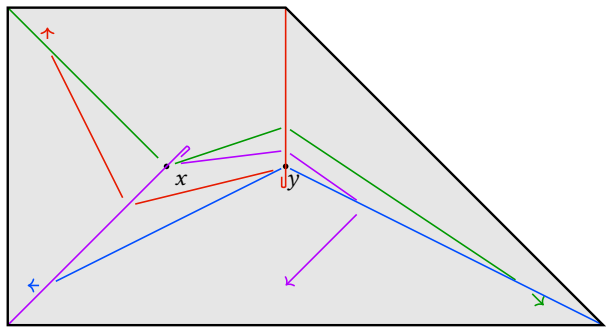
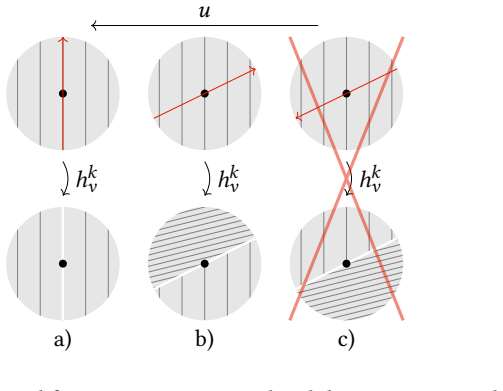
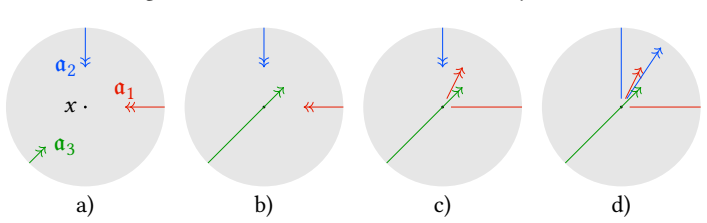
Central is the nodal integral affine surface: a surface with isolated 'nodes' whose complement carries an integral affine structure with monodromy, together with charts whose cuts are directed weighted graphs. A nodal tangle is a one-parameter family of such surfaces in which nodes slide along their eigenlines and can split, keeping the affine structure away from the sliding locus fixed; its transition map is a piecewise integral affine map built from half-shears. The proof of the main theorem uses a canonical form (Proposition 3.17) obtained by filling the caustic of a weakly Delzant polygon with cuts and parking nodes, so that the height function becomes integral affine outside an $\varepsilon$-hat; the possible hats are classified by type, and the canonical type is shown to be a symplectic invariant. Lifting a tangle gives a path of fibrations, and the transition map governs how Lagrangian invariant germs change along the tangle.
What would settle it
An independent computation of the displacement energy of a toric fibre $\mu^{-1}(x)$ with $x \in \Delta \setminus \mathcal{K}_\Delta$ and $\mathcal{F}_\Delta(x) < \tfrac12 \sup \mathcal{F}_\Delta$ that yields a value different from $\mathcal{F}_\Delta(x)$ would refute Theorem C; alternatively, a weakly Delzant polygon $\Delta$ for which some trimmed domain $\Delta_t$ or some vertex or edge of its caustic fails to have the local affine normal forms quoted from [MS23] would break the canonical form and with it Theorem A.
Extended reading notes
Core claim
The paper introduces nodal tangles as deformations of nodal integral affine surfaces and proves three translation theorems: a nodal surface determines an almost toric fibration, a nodal tangle lifts to a path of almost toric fibrations, and invariant germs transform by the tangle's transition map. The main theorem (Theorem A, Corollary 3.26) states that for two toric moment maps $\mu_i \colon X \to \Delta_i$ on a closed four-dimensional symplectic manifold, the bases $\Delta_0$ and $\Delta_1$ are connected by a nodal tangle; consequently there is a continuous path of almost toric fibrations $\pi_t \colon X \to B_t$ from one base to the other. The proof deforms each $\Delta_i$ into a canonical form depending only on $X$, classified by hat class, maximum height, and heights of parked nodes. Applications include Theorem B (non-recurrence on a set of almost full measure in every compact non-monotone toric four-manifold), Theorem C ($e(\mu^{-1}(x)) = \mathcal{F}_\Delta(x)$ outside the caustic when $\mathcal{F}_\Delta(x) < \frac12 \sup \mathcal{F}_\Delta$), and Theorem D (alternatingly sliding two nodes through a point yields infinitely many pairwise non-symplectomorphic Lagrangian tori when $k_{\mathfrak{a}}k_{\mathfrak{b}} \det(v_{\mathfrak{a}}, v_{\mathfrak{b}})^2 \ge 4$ and an affine invariant germ exists).
Load-bearing premise
The load-bearing premise is that the distance-to-the-boundary function of each polygonal domain in the admissible class has exactly the local shapes asserted by the tropical-geometry input, near every edge and vertex of its caustic; if those local shapes admit exceptions, the nodal slides cannot be arranged to flatten the height function, and the proofs of Theorems A, B, and C collapse.
Editorial extensions
If this is right
- On any closed toric symplectic four-manifold, the space of toric fibrations is connected through almost toric fibrations, since any two moment polytopes have the same canonical form and the tangle between them lifts to a path.
- In every compact non-monotone toric four-manifold, Lagrangian Poincaré recurrence fails on a set of fibres of almost full measure, with the rotation amounts governed by irrational ratios of a length function to height.
- For toric fibres outside the caustic with height below half the maximum, the displacement energy is exactly the height to the boundary, giving a computable invariant for distinguishing Lagrangian tori.
- Alternatingly sliding two nodes with $k_{\mathfrak a}k_{\mathfrak b}\det(v_{\mathfrak a},v_{\mathfrak b})^2 \ge 4$ through a common point produces infinitely many pairwise non-symplectomorphic Lagrangian tori whenever a non-constant affine invariant germ is available.
- An elementary Farey-tree sliding procedure realizes Lagrangian pinwheels of every coprime type in monotone $\mathbb{C}P^2 \# n \overline{\mathbb{C}P}^2$ for $5 \le n \le 8$.
Reading between the lines
- If the canonical-form strategy extends from Delzant polygons to all almost toric bases of a fixed rational surface (the paper's Question 5.4), the connectivity proved here would become a special case of a much broader statement: the entire base space of a rational symplectic four-manifold would be connected by nodal tangles.
- The entangling-node transition maps in Section 4.2 are governed by the same recurrence as rank-2 cluster algebras; a natural testable extension is that the infinite families of Theorem D persist for any affine invariant germ, not only displacement energy, and that the accumulation points of tangling points (Question 5.7) carry infinitely many almost-Hamiltonian-isotopic, non-symplectomorphic tori.
- The author's Remark 3.33 suggests the half-maximum condition in Theorem C is an artifact of the proof; a concrete programme is to continue the probe through the $\varepsilon$-hat to establish $e(\mu^{-1}(x)) = \mathcal{F}_\Delta(x)$ for all fibres outside the caustic.
Editorial analysis
A structured set of objections, weighed in public.
Referee Report
Summary. The paper introduces nodal tangles, one-parameter families of nodal integral affine surfaces, and proves translation theorems that lift such tangles to paths of almost toric fibrations and track symplectic invariant germs. The main results are: Theorem A, resolving Symington's conjecture for closed toric four-manifolds by showing that any two toric moment polygons are connected by a nodal tangle; Theorem B, constructing Lagrangian Poincaré non-recurrence in compact non-monotone toric four-manifolds; Theorem C, computing displacement energies of toric fibres outside a one-dimensional caustic; and Theorem D, producing infinite families of almost Hamiltonian isotopic Lagrangian torus knots. The paper also gives an elementary construction of Lagrangian pinwheels in del Pezzo surfaces.
Significance. If the results are correct, this is a substantial contribution. Theorem A resolves a twenty-year-old conjecture, the displacement-energy formula is explicit and parameter-free, and the Lagrangian-knot construction gives a systematic combinatorial recipe with concrete examples. The framework of nodal tangles is well motivated, and the translation theorems are clearly useful. The paper is organized and includes worked examples. However, the central canonical-form construction in Proposition 3.17 contains an incorrect local verification, and the bijection in Theorem 3.25 is asserted rather than proved; since Theorem A and its applications depend on these points, the main results are not yet fully supported.
major comments (4)
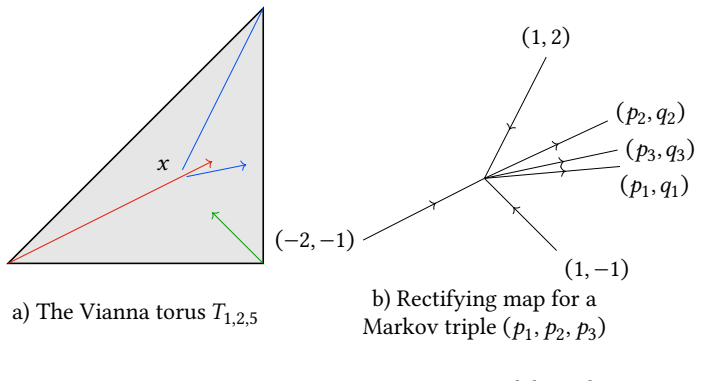
- [§3.1, Proposition 3.17, Eq. (2)] The local verification in the proof of Proposition 3.17 is incorrect as written. In the case n=0, Theorem 3.13 gives F_Δ(a)=min{x,x+y,y} after translation, and the proof sets R_0=h_{(1,1)}∘h_{(1,0)} with h_v as in Eq. (1). Direct computation contradicts the displayed identity F_Δ(R_0^{-1}a)=F_1(x)+⟨(1,0),a⟩. For a=(1,0), R_0^{-1}(1,0)=(1,0) and F_Δ(1,0)=0, whereas the right-hand side is 1; for a=(0,1), R_0^{-1}(0,1)=(3,2) and F_Δ(3,2)=2, whereas the right-hand side is 0. The same failure occurs for the opposite half-shear convention. Since Proposition 3.17 is the basis for the canonical form and hence for Theorems A, B, and C, a correct rectifying map or an additional half-shear must be supplied and the local identity checked.
- [§3.2, Theorem 3.25] The proof of the bijection α:𝒞→ℛ ends with “It is easily checked that β∘α=id and α∘β=id” without carrying out the check. This is load-bearing: the uniqueness of the canonical type, and therefore Theorem A, depends on the inverse formulas in the second table. At minimum the verification should be written out, especially for hats of types B–E, where the formulas involve case distinctions and the ordering of the α_i.
- [§3.3, proof of Theorem B] The formula for the length function g(h) is stated without derivation. The construction of the Hamiltonian diffeomorphism requires that for a point x at height h the orbit under ψ is a translation of length 2(M-h) on a level set whose total length is g(h); the irrationality condition g(h)/(2(M-h))∉ℚ is what produces non-recurrence. The reader cannot verify this key step without a proof of the stated length formula, including the dependence on the hat class and the contributions min{h-α_i,0} of parked nodes.
- [§3.1, Proposition 3.17, proof] The inductive “filling” argument for parking nodes is described only informally (“we see inductively”). In particular, the claim that when a node reaches a vertex where a previous node slid off, Theorem 3.13 forces its multiplicity to be 1 and keeps it on the caustic, should be stated as a precise induction using the local normal forms. This matters because the cut graph of φ_1 is used to define the canonical form and to justify that ℱ_1 is integral affine away from the ε-hat.
minor comments (3)
- [§2.3, Theorem 2.26] The final sentence of the uniqueness statement has broken punctuation: “a fibred symplectomorphism, .” should be cleaned up, and the diagrammatic sentence beginning “commutes, that is” should be rephrased.
- [§3.1, before Eq. (2)] The notation h_{n+1(1,0)} is ambiguous; it should be typeset as h_{(1,0)}^{n+1} or otherwise explicitly defined, since the subscript currently looks like a vector with a coefficient.
- [§2.4, proof of Lemma 2.33] In the proof, “Let a,b∈I and x∈B∖π_B(𝔑)” should be “let x_a∈B_a∖π_B(𝔑)” to match the notation used in the statement and in Corollary 2.34.
Circularity Check
No significant circularity: the central proofs are self-contained given external tropical-geometry and symplectic inputs, and the only self-citations are contextual.
full rationale
The derivation is not circular. The canonical-form construction (Prop. 3.17) and the canonical-type classification (Thm. 3.25) rest on the external tropical-geometry theorems of Mikhalkin-Shkolnikov, restated as Thms. 3.10 and 3.13; these are independent inputs rather than outputs of this paper. The translation theorems 2.26, 2.29, and Cor. 2.34 are explicitly reformulations of [Sym03], [Eva23], and [BHS24]; the last shares an author, but it is used only for standard versal-deformation and flux formalism, not to assert any of the paper's conclusions. The displacement-energy equality in Cor. 3.32 combines an external lower bound [Bre23, Prop. 3.2] with an upper bound from an explicitly constructed probe in Thm. 3.29; the probe length is read off from the base geometry, not chosen to force the value, so the equality is not a fit in disguise. Theorem B's Hamiltonian diffeomorphism is built from an explicit nodal tangle and an integral-affine identification, and the only self-citation [Sch24] is contextual: the proof gives a different construction. The skeptic's objection to Eq. (2) in Prop. 3.17 is a local-computation or correctness concern, not a circularity, since a wrong rectifying map would make the proof incomplete rather than making the theorem equivalent to its inputs. No free parameter is fitted to a target result, and no load-bearing claim is justified solely by the author's own prior work. Therefore the circularity score is 0.
Assumptions & free parameters
assumptions (7)
- standard math Existence and essential uniqueness of almost toric fibrations over nodal integral affine surfaces (Theorem 2.26).
- standard math Every nodal tangle lifts to a one-parameter family of almost toric fibrations (Theorem 2.29).
- standard math For weakly Delzant polygonal domains, the trimmed domains Δ_t are weakly Delzant and the height function F_Δ has the local affine normal forms in Theorem 3.13.
- standard math Symplectic forms on rational surfaces are classified by symplectic reduced vectors (Karshon-Kessler).
- standard math Lower bound e(μ^{-1}(x)) ≥ F_Δ(x) for toric fibres (Lemma 3.31).
- standard math The symplectic mapping class group of a rational surface is finite.
- standard math Local model and monodromy of focus-focus singularities in almost toric fibrations.
Cite this review
Pith. "Pith review of Nodal Tangles." pith.science (2026). https://pith.science/paper/FBBP7CHE
@misc{pith2026250623754,
  author       = {Pith},
  title        = {Pith review of: Nodal Tangles},
  year         = {2026},
  howpublished = {\url{https://pith.science/paper/FBBP7CHE}},
  note         = {Machine review of arXiv:2506.23754}
}
read the original abstract
We study piecewise linear knot diagrams in the base of almost toric fibrations of symplectic four-manifolds. These diagrams translate to deformations of the almost toric fibration. We give several applications to symplectic topology, among them a proof of a conjecture by Symington, simpler counterexamples to Lagrangian Poincar\'e recurrence in dimension four, the calculation of the displacement energy for many fibres of toric moment maps, and an elementary recipe for building and distinguishing Lagrangian torus knots.
Figures


Figures from the paper (30 more)








Forward citations
Cited by 1 Pith paper
-
More counterexamples to Lagrangian Poincar\'e recurrence in dimension four
Every non-monotone toric symplectic four-manifold admits a Hamiltonian diffeomorphism and a Lagrangian torus that never intersects its own image under iteration.
Reference graph
Works this paper leans on
-
[1]
Displacing Lagrangian toric fibers by extended probes
[ABM14] Miguel Abreu, Matthew Strom Borman, and Dusa McDuff. “Displacing Lagrangian toric fibers by extended probes”.Algebr. Geom. Topol. 14.2 (2014), pp. 687–752.doi: 10.2140/agt.2014.14.687 . [ABR23] Peter Albers, Maria Bertozzi, and Markus Reineke.Floer potentials, cluster algebras and quiver representations. Preprint, arXiv:2309.16009
-
[5]
Lagrangian tori in a symplectic vector space and global symplectomorphisms
[Che96] Yu. V. Chekanov. “Lagrangian tori in a symplectic vector space and global symplectomorphisms”.Math. Z. 223.4 (1996), pp. 547–559.doi: 10.1007/PL00004278 . [CS10] Yuri Chekanov and Felix Schlenk. “Notes on monotone Lagrangian twist tori”.Electron. Res. Announc. Math. Sci. 17 (2010), pp. 104–121.doi: 10.3934/era.2010.17.104 . 51 [CV21] Man-Wai Mandy...
-
[6]
Hamiltonian pseudo-rotations of projective spaces
doi: 10.1017/9781009372671 . [GG18] Viktor L. Ginzburg and Başak Z. Gürel. “Hamiltonian pseudo-rotations of projective spaces”.Invent. Math. 214.3 (2018), pp. 1081–1130.doi: 10.1007/s00222-018-0818-9 . [JS24] Dušan Joksimović and Sobhan Seyfaddini. “A Hölder-type inequality for the𝐶0 distance and Anosov-Katok pseudo-rotations”.Int. Math. Res. Not. 2024.8 ...
-
[10]
Geometry of symplectic flux and Lagrangian torus fibrations
[STV24] Egor Shelukhin, Dmitry Tonkonog, and Renato Vianna. “Geometry of symplectic flux and Lagrangian torus fibrations”.J. Topol. 17.4 (2024). Id/No e70002, p. 56.doi: 10.1112/topo.70002 . [STW16] Vivek Shende, David Treumann, and Harold Williams.On the combinatorics of exact Lagrangian surfaces. Preprint, arXiv:1603.07449
arXiv 2024
-
[13]
Surgery and Invariants of Lagrangian Surfaces
[Via16] Renato Vianna. “Infinitely many exotic monotone Lagrangian tori in ℂℙ2”. J. Topol. 9.2 (2016), pp. 535–551.doi: 10.1112/jtopol/jtw002 . 53 [Via17] Renato Vianna. “Infinitely many monotone Lagrangian tori in del Pezzo surfaces”.Sel. Math., New Ser. 23.3 (2017), pp. 1955–1996.doi: 10.1007/s00029-017-0312-z . [Yau13] Mei-Lin Yau.Surgery and Invariant...
work page Pith review arXiv 2016
-
[2001]
Providence, RI: American Mathematical Society (AMS), 2003, pp. 153–208. [UZ25] Giancarlo Urzúa and Juan Pablo Zúñiga.Wahl singularities in degenerations of del Pezzo surfaces. Preprint, arXiv:2504.19929
arXiv 2003
-
[2003]
Boston, MA: Birkhäuser, 2006, pp. 321–385. [LLW22] Jun Li, Tian-Jun Li, and Weiwei Wu.Symplectic Torelli groups of rational surfaces. Preprint, arXiv:2212.01873
arXiv 2006
-
[2007]
Lagrangian knots and unknots – an essay
Cambridge, MA: International Press, 2008, pp. 1–14. [PS24] Leonid Polterovich and Felix Schlenk. “Lagrangian knots and unknots – an essay”.Celebratio Mathematica Eliashberg (2024). [San03] Vũ Ngoc San. “On semi-global invariants for focus-focus singularities”. Topology 42.2 (2003), pp. 365–380.doi: 10.1016/S0040-9383(01)00026-X . [Sch24] Joel Schmitz.A co...
arXiv 2024
Show all 14 references
-
[2013]
Symplectic topology of integrable Hamiltonian systems. II: Topological classification
[Zun03] Nguyen Tien Zung. “Symplectic topology of integrable Hamiltonian systems. II: Topological classification”.Compos. Math. 138.2 (2003), pp. 125–156.doi: 10.1023/A:1026133814607 . [Zun97] Nguyen Tien Zung. “A note on focus-focus singularities”.Differ. Geom. Appl.7.2 (1997...
2003 doi
-
[2016]
Four dimensions from two in symplectic topology
[Sym03] Margaret Symington. “Four dimensions from two in symplectic topology”. Topology and geometry of manifolds. Proceedings of the 2001 Georgia topology conference, University of Georgia, Athens, GA, USA, May 21–June 2,
2001
-
[2022]
Almost toric symplectic four-manifolds
[LS10] Naichung Conan Leung and Margaret Symington. “Almost toric symplectic four-manifolds”.J. Symplectic Geom. 8.2 (2010), pp. 143–187. doi: 10.4310/JSG.2010.v8.n2.a2 . [Mag24] Nicki Magill. “Unobstructed embeddings in Hirzebruch surfaces”.J. Symplectic Geom. 22.1 (2024), pp...
2010 arXiv
-
[2023]
Preprint, arXiv:2403.00408
[BHS24] Joé Brendel, Johannes Hauber, and Joel Schmitz.Semi-Local Exotic Lagrangian Tori in Dimension Four. Preprint, arXiv:2403.00408. To appear in Annales de l’Institut Fourier
-
[2024]
Preprint, arXiv:2502.03324
[BK25] Joé Brendel and Joontae Kim.Lagrangian split tori in 𝑆2×𝑆2 and billiards. Preprint, arXiv:2502.03324. To appear in Selecta Mathematica
-
[2025]
Real Lagrangian tori and versal deformations
[Bre23] Joé Brendel. “Real Lagrangian tori and versal deformations”.J. Symplectic Geom. 21.3 (2023), pp. 463–507.doi: 10.4310/JSG.2023.v21.n3.a2 . [Bre25] Joé Brendel. “Local exotic tori”.Trans. Am. Math. Soc. 378.6 (2025), pp. 4369–4411.doi: 10.1090/tran/9385 . [BS14] Erwan B...
2023 arXiv
Reviewed August 6, 2026 · model on record in the stance chip above.
Discussion (0). Continue with ORCID to comment.