REVIEW 2 major objections 2 minor 43 references
Decision-focused Sparse Tangent Portfolio Optimization
T0 review · 2 major / 2 minor · reviewed 2026-07-02 · grok-4.3
Pith's one-line read An end-to-end differentiable pipeline for sparse tangent portfolios directly optimizes the Sharpe ratio through joint prediction, selection, and convex re-optimization.
desk verdict The paper integrates decision-focused learning via DPP and smooth top-k for cardinality-constrained tangent portfolios and reports Sharpe gains, but the approximation quality versus the true discrete problem is unverified. read the letter →
The pith
A machine-rendered reading of the paper's core claim, the machinery that carries it, and where it could break.
The reading
What carries the argument
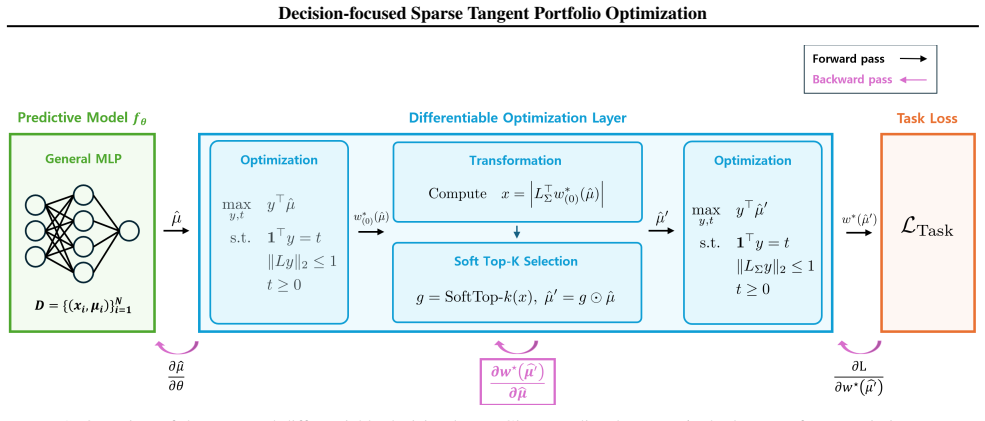
The decision-focused learning framework that pairs a DPP-compliant convex programming layer for Sharpe ratio maximization with a smooth top-k operator enforcing exact cardinality k.
What would settle it
Re-running the experiments on the same four equity-market datasets and finding that out-of-sample Sharpe ratios fall below both historical and prediction-focused baselines, especially in the largest asset universes, would falsify the performance claim.
Extended reading notes
Core claim
Reformulating Sharpe ratio maximization as a DPP-compliant convex layer and replacing discrete selection with a smooth top-k operator enables unbiased gradient flow through the full pipeline of prediction, asset selection, and weight computation, so the model directly optimizes the discrete cardinality-constrained objective and produces competitive or superior out-of-sample Sharpe ratios across equity markets.
Load-bearing premise
The smooth top-k operator and convex layer together produce gradients that correctly optimize the true discrete cardinality-constrained Sharpe ratio without material approximation error or optimization mismatch.
Editorial extensions
If this is right
- The predictive model learns to emphasize features that raise the final portfolio Sharpe ratio instead of maximizing standalone forecast accuracy.
- Gains over baselines widen as the asset universe grows because the integrated selection step handles harder discrete choices.
- The resulting portfolios remain low-cardinality and lie on the tangency direction of the mean-variance frontier.
- The same pipeline applies across multiple major equity markets with consistent out-of-sample validation.
Reading between the lines
- The same differentiable layer structure could be reused for other convex portfolio objectives such as minimum-variance or risk-parity targets.
- The framework might transfer to non-finance problems that combine discrete selection with a downstream convex optimization step.
- Adding transaction-cost or liquidity constraints inside the convex layer would test whether the gradient path remains effective under richer real-world restrictions.
Editorial analysis
A structured set of objections, weighed in public.
Referee Report
Summary. The paper proposes an end-to-end decision-focused learning framework for sparse tangent portfolio optimization. It reformulates Sharpe ratio maximization as a DPP-compliant convex programming layer and replaces discrete cardinality selection with a smooth top-k operator that enforces exact cardinality k. This enables gradient flow through prediction, selection, and re-optimization. The manuscript reports that the method achieves competitive and often superior out-of-sample Sharpe ratios versus historical and prediction-focused baselines across four major equity markets, with particularly strong gains in larger asset universes. Public code is provided.
Significance. If the surrogate correctly aligns gradients with the discrete objective, the framework would meaningfully advance decision-focused learning for cardinality-constrained portfolio problems by directly optimizing the downstream performance metric rather than prediction error alone. The public code repository is a clear strength that supports reproducibility.
major comments (2)
- [Abstract] Abstract: the headline claim that the method produces superior out-of-sample Sharpe ratios rests on the assumption that the smooth top-k operator plus DPP layer yields gradients that correctly optimize the true discrete cardinality-constrained Sharpe objective. No explicit bound, error analysis, or comparison to an exact solver is referenced, leaving open the possibility that reported gains are artifacts of approximation mismatch rather than genuine decision-focused improvement.
- [Experimental results] Experimental results (implied by the abstract performance claim): the abstract states empirical gains but supplies no information on data periods, statistical significance testing, ablation of the smooth operator, or out-of-sample protocol. These omissions are load-bearing because they prevent verification that the reported Sharpe improvements are robust and attributable to the proposed surrogate rather than experimental design choices.
minor comments (2)
- The abstract mentions four equity markets but does not name them; adding the specific markets (or a table reference) would improve clarity.
- Consider adding a short related-work paragraph contrasting the DPP layer with other differentiable optimization layers used in portfolio optimization.
Simulated Author's Rebuttal
We thank the referee for the thoughtful comments on our manuscript. We address each major comment below, clarifying the role of empirical validation in our decision-focused framework and committing to revisions that improve transparency without overstating theoretical guarantees.
read point-by-point responses
-
Referee: [Abstract] Abstract: the headline claim that the method produces superior out-of-sample Sharpe ratios rests on the assumption that the smooth top-k operator plus DPP layer yields gradients that correctly optimize the true discrete cardinality-constrained Sharpe objective. No explicit bound, error analysis, or comparison to an exact solver is referenced, leaving open the possibility that reported gains are artifacts of approximation mismatch rather than genuine decision-focused improvement.
Authors: We agree that the manuscript does not supply theoretical bounds, error analysis, or direct comparisons against an exact cardinality solver for the smooth top-k surrogate. Deriving such bounds remains an open theoretical challenge given the non-smooth nature of the original problem. Our claims rest on consistent empirical outperformance across four markets rather than on a formal guarantee of gradient alignment. In the revision we will add an explicit limitations subsection discussing the approximation gap and its potential impact on gradient quality. revision: yes
-
Referee: [Experimental results] Experimental results (implied by the abstract performance claim): the abstract states empirical gains but supplies no information on data periods, statistical significance testing, ablation of the smooth operator, or out-of-sample protocol. These omissions are load-bearing because they prevent verification that the reported Sharpe improvements are robust and attributable to the proposed surrogate rather than experimental design choices.
Authors: The full experimental section already specifies the equity-market datasets and time spans, the rolling-window out-of-sample protocol, multiple random seeds for statistical assessment, and ablation results isolating the smooth top-k operator. The public code repository further enables exact reproduction. To address the abstract-level concern we will add a concise sentence referencing the evaluation protocol and will ensure all reported Sharpe ratios include standard-error bars or p-values in the revised tables. revision: yes
Circularity Check
No circularity: framework is an independent modeling choice with empirical validation
full rationale
The derivation chain introduces a DPP-compliant convex layer and smooth top-k operator as a differentiable surrogate for the NP-hard cardinality-constrained Sharpe maximization. These are presented as explicit design choices enabling end-to-end gradient flow, not as quantities fitted to the target metric and then renamed as predictions. No self-citations are invoked to justify uniqueness or load-bearing premises, and no equations reduce the reported out-of-sample Sharpe ratios to the inputs by construction. The performance claims rest on cross-market empirical comparisons against historical and predict-then-optimize baselines, which are external to the modeling assumptions.
Assumptions & free parameters
Cite this review
Pith. "Pith review of Decision-focused Sparse Tangent Portfolio Optimization." pith.science (2026). https://pith.science/paper/FBCOITNS
@misc{pith2026260700581,
  author       = {Pith},
  title        = {Pith review of: Decision-focused Sparse Tangent Portfolio Optimization},
  year         = {2026},
  howpublished = {\url{https://pith.science/paper/FBCOITNS}},
  note         = {Machine review of arXiv:2607.00581}
}
abstract
Sparse tangent portfolio optimization aims to learn an interpretable, low-cardinality portfolio in the tangency direction of the mean-variance frontier. However, the associated cardinality-constrained formulation is NP-hard, and standard predict-then-optimize pipelines often misalign forecasting accuracy with downstream portfolio quality. We propose an end-to-end decision-focused learning framework that reformulates Sharpe ratio maximization as a Disciplined Parametrized Programming (DPP)-compliant convex programming layer and replaces discrete selection with a smooth top-$k$ operator enforcing an exact cardinality $k$. This enables gradient flow through prediction, asset selection, and re-optimization, allowing the predictive model to directly optimize portfolio performance. Across four major equity markets, our method achieves competitive and often superior out-of-sample Sharpe ratios compared with historical and prediction-focused baselines, with particularly strong gains in larger asset universes. Our \href{https://github.com/feuerwerksh/Diffble-card-SR}{code} is publicly available.
Figures


Figures from the paper (2 more)


Reference graph
Works this paper leans on
-
[1]
P. Langley , title =. Proceedings of the 17th International Conference on Machine Learning (ICML 2000) , address =. 2000 , pages =
work page 2000
-
[2]
T. M. Mitchell. The Need for Biases in Learning Generalizations. 1980
work page 1980
-
[3]
M. J. Kearns , title =
-
[4]
Machine Learning: An Artificial Intelligence Approach, Vol. I. 1983
work page 1983
-
[5]
R. O. Duda and P. E. Hart and D. G. Stork. Pattern Classification. 2000
work page 2000
-
[6]
Suppressed for Anonymity , author=
-
[7]
A. Newell and P. S. Rosenbloom. Mechanisms of Skill Acquisition and the Law of Practice. Cognitive Skills and Their Acquisition. 1981
work page 1981
-
[8]
A. L. Samuel. Some Studies in Machine Learning Using the Game of Checkers. IBM Journal of Research and Development. 1959
work page 1959
Show all 43 references
-
[9]
The Journal of Finance , volume =
Markowitz, Harry , title =. The Journal of Finance , volume =. doi:https://doi.org/10.1111/j.1540-6261.1952.tb01525.x , url =. https://onlinelibrary.wiley.com/doi/pdf/10.1111/j.1540-6261.1952.tb01525.x , year =
1952 doi
-
[10]
, title =
Woodside-Oriakhi, M. , title =
-
[11]
Kremer, P. J. and Lee, S. and Bogdan, M. and Paterlini, S. , title =. Journal of Banking & Finance , year =
-
[12]
The Journal of business , volume=
Mutual fund performance , author=. The Journal of business , volume=. 1966 , publisher=
1966
-
[13]
Kim, J. H. and Lee, Y. and Kim, W. C. and Fabozzi, F. J. , title =. Journal of Portfolio Management , year =
-
[14]
and others , title =
Shah, S. and others , title =. Advances in Neural Information Processing Systems , year =
-
[15]
2002 , publisher=
Computers and intractability , author=. 2002 , publisher=
2002
-
[16]
and Jeon, H
Bae, H. and Jeon, H. and Park, M. and Lee, Y. and Kim, W. C. , title =. 2025 , howpublished =. 2502.11701 , archivePrefix =
2025
-
[17]
2007 , publisher=
Robust portfolio optimization and management , author=. 2007 , publisher=
2007
-
[18]
Europhysics Letters , volume=
Non-stationarity in financial time series: Generic features and tail behavior , author=. Europhysics Letters , volume=. 2013 , publisher=
2013
-
[19]
Tilburg Univ, Tilburg, The Netherlands , year=
Bridging the gap between predictive and prescriptive analytics-new optimization methodology needed , author=. Tilburg Univ, Tilburg, The Netherlands , year=
-
[20]
and Garlappi, L
DeMiguel, V. and Garlappi, L. and Nogales, F. J. and Uppal, R. , title =. Management Science , year =
-
[21]
Kim, W. C. and Lee, Y. , title =. Quantitative Finance , year =
-
[22]
and Sra, S
Kim, N. and Sra, S. , title =. Industrial Engineering and Management Systems , year =
-
[23]
and Lai, Z.-R
Lin, Y. and Lai, Z.-R. and Li, C. , title =. Advances in Neural Information Processing Systems , year =
-
[24]
and De Simone, V
Corsaro, S. and De Simone, V. , title =. Computational Optimization and Applications , year =
-
[25]
, title =
Bienstock, D. , title =. Mathematical Programming , year =
-
[26]
and Sun, X
Li, D. and Sun, X. and Wang, J. , title =. Mathematical Finance: An International Journal of Mathematics, Statistics and Financial Economics , year =
-
[27]
and others , title =
Mandi, J. and others , title =. Journal of Artificial Intelligence Research , year =
-
[28]
and others , title =
Agrawal, A. and others , title =. Advances in Neural Information Processing Systems , year =
-
[29]
and Li, D
Gao, J. and Li, D. , title =. Operations Research , year =
-
[30]
and Kang, W
Iyengar, G. and Kang, W. , title =. Operations Research Letters , year =
-
[31]
and Kim, M
Lee, Y. and Kim, M. J. and Kim, J. H. and Jang, J. R. and Kim, W. C. , title =. Journal of the Operational Research Society , year =
-
[32]
and Meade, N
Chang, T.-J. and Meade, N. and Beasley, J. E. and Sharaiha, Y. M. , title =. Computers & Operations Research , year =
-
[33]
and Kellerer, H
Maringer, D. and Kellerer, H. , title =. OR Spectrum , year =
-
[34]
and Daubechies, I
Brodie, J. and Daubechies, I. and De Mol, C. and Giannone, D. and Loris, I. , title =. Proceedings of the National Academy of Sciences , year =
-
[35]
arXiv preprint arXiv:1312.6350 , year=
Sparse portfolio selection via quasi-norm regularization , author=. arXiv preprint arXiv:1312.6350 , year=
-
[36]
and Zhu, Y
Chen, L. and Zhu, Y. , title =. IEEE Transactions on Signal Processing , year =
-
[37]
Kim, M. J. and others , title =. Operations Research Letters , year =
-
[38]
2020 , publisher=
Time series analysis , author=. 2020 , publisher=
2020
-
[39]
2022 , howpublished =
Ahle, Thomas Dybdahl , title =. 2022 , howpublished =
2022
-
[40]
The Journal of Portfolio Management , volume=
Deep Learning in Asset Management: Architectures, Applications, and Challenges , author=. The Journal of Portfolio Management , volume=. 2025 , publisher=
2025
-
[41]
, author=
An Overview of Machine Learning for Portfolio Optimization. , author=. Journal of Portfolio Management , volume=
-
[42]
, author=
An Overview of Optimization Models for Portfolio Management. , author=. Journal of Portfolio Management , volume=
-
[43]
arXiv preprint arXiv:2509.08359 , year=
Prediction Loss Guided Decision-Focused Learning , author=. arXiv preprint arXiv:2509.08359 , year=
Reviewed July 2, 2026 · model on record in the stance chip above.
Discussion (0). Continue with ORCID to comment.