REVIEW 4 major objections 6 minor 2 cited by
Prospects for EMRI/MBH parameter estimation using Quasi-Periodic Eruption timings: short-timescale analysis
T0 review · 4 major / 6 minor · reviewed 2026-08-05 · deepseek-v4-flash
Pith's one-line read QPE timing alone can constrain central black-hole mass and EMRI orbit to about 10 percent, while spin remains unconstrained on short baselines.
desk verdict Static-disk timing constraints hold up; the precessing-disk 10-50% claim in the abstract contradicts the paper's own grid results. read the letter →
The pith
A machine-rendered reading of the paper's core claim, the machinery that carries it, and where it could break.
The reading
What carries the argument
The central object is the signed distance D(t) = d(t)·r(t) between the secondary and the disk plane, whose zeros are the predicted eruption times. The trajectory r(t) comes from a 3PN Fourier-series expansion of bound Kerr geodesics in Mino time, making millions of likelihood evaluations tractable; the disk normal d(t) is a rigidly precessing vector with period Tdisk; Shapiro and geometric delays convert collision times to observed times. Wrapped in a χ² likelihood and sampled with an affine-invariant ensemble MCMC, this machinery—implemented in the paper's QPE-FIT code—turns a list of flare arrival times into posterior distributions over black-hole mass, orbital parameters, and disk propert
What would settle it
In a bright QPE with high-cadence X-ray coverage, fit the best precessing-disk timing model, then plot each burst's residual as a function of odd/even index and of time since pericenter. A coherent residual pattern with amplitude above the assumed ~100 s timing error, or a phase-dependent peak lag, would falsify the constant-offset assumption and with it the unbiasedness of the 10% orbital and mass constraints. Independently, dynamical mass measurements of several QPE hosts that disagree with timing-inferred masses beyond the quoted errors would also falsify the mass-constraint claim.
Extended reading notes
Core claim
The paper claims that the arrival times of quasi-periodic eruptions, taken alone, are informative enough to recover the mass of the central black hole and the semimajor axis/eccentricity of a mildly eccentric EMRI companion to roughly 10% within tens of orbits, when the eruptions are produced by repeated collisions with a disk. The same data cannot constrain black-hole spin over these baselines. With a rigidly precessing misaligned disk, EMRI parameter recovery degrades, but the disk's inclination and precession period become measurable at the 10–50% level. This is established through injection–recovery experiments using a fast 3PN Kerr-geodesic timing model with GPU-accelerated MCMC, and by
Load-bearing premise
The model assumes a fixed time offset between each orbiter–disk collision and the observed eruption peak; if that offset varies with orbital phase, collision geometry, or disk state, the mapping from flare times to geodesic crossings is mis-specified and the reported ~10% constraints would be biased, not merely wider.
Editorial extensions
If this is right
- For mild-eccentricity EMRIs (e ≈ 0.1–0.3), tens of QPE cycles are enough to recover MBH mass, semimajor axis, and eccentricity with ~10% errors in the static-disk case.
- MBH spin is not measurable from timings at a ≳ 100 Rg over O(10–100) orbit baselines; longer baselines or smaller orbits would be needed for spin information.
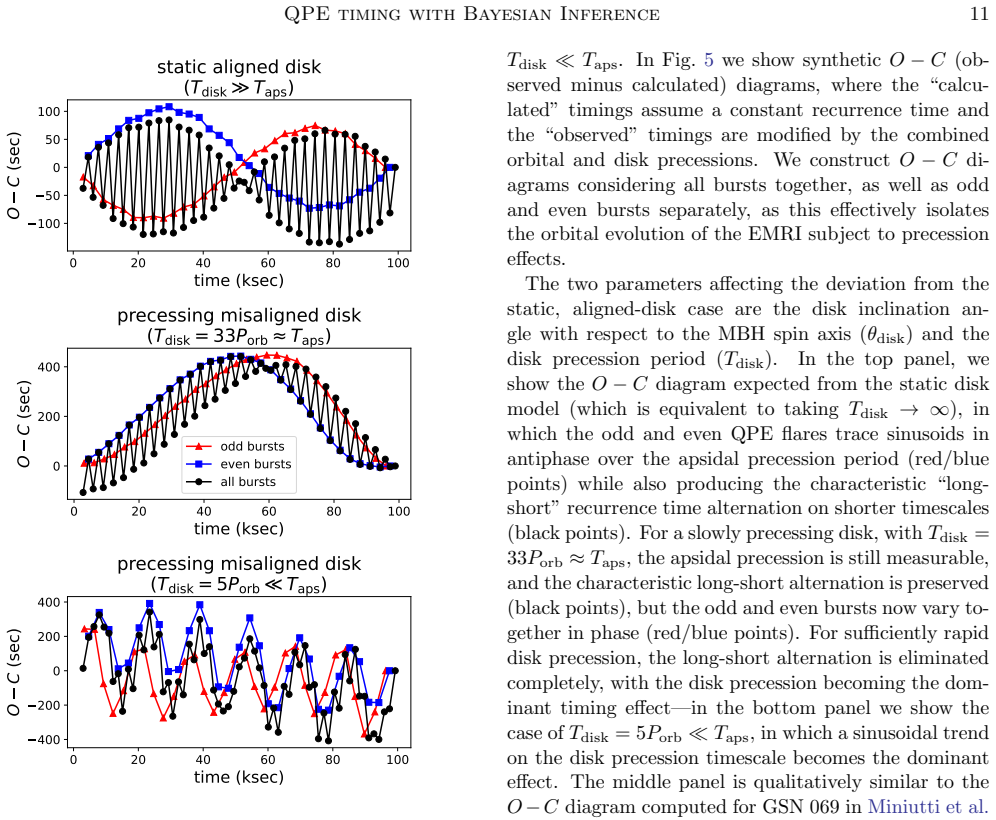
- When a misaligned precessing disk is present, EMRI parameter errors grow, but disk inclination and precession period can still be recovered to roughly 10–50%.
- Ignoring disk precession when it is present biases recovered parameters—most severely the observer viewing angle—so precession must be modeled for unbiased inference.
- For a fixed total observing time, uninterrupted or short-gap monitoring outperforms widely spaced snapshots because cycle-number ambiguity grows across gaps.
Reading between the lines
- The paper leaves implicit that the same timing code can be repurposed for electromagnetic pre-discovery of LISA-band EMRIs: once a and M• are pinned, the gravitational-wave inspiral timescale and frequency are predicted.
- If the constant collision-to-peak delay assumption is relaxed, odd/even burst residuals should reveal a phase-dependent lag; testing this on high-cadence sources would validate or invalidate the 10% mass claim before it is applied to real data.
- A population-level extension: eccentricity recovered from QPE timings directly discriminates wet (circularized) versus dry (eccentric) EMRI formation channels, which the paper discusses qualitatively but does not quantify.
- Combining timing with spectral or SED constraints should break the a–M• and i–θdisk degeneracies identified here, likely improving precision beyond the reported 10–50%.
Editorial analysis
A structured set of objections, weighed in public.
Referee Report
Summary. The paper presents QPE-FIT, a GPU-accelerated Bayesian inference package for QPE timing in the EMRI-disk collision scenario. The forward model combines 3PN Fourier-expanded Kerr geodesics with either an aligned static disk or a rigidly precessing misaligned disk; predicted disk-crossing times are compared with observed QPE timings through a Gaussian likelihood, including Shapiro and geometric delays. The authors validate by injecting exact KerrGeoPy trajectories and recovering with the PN sampler, and run a grid of 216 (static) and 1296 (precessing) MCMC simulations, plus an application to eRO-QPE1. The main reported findings are 10% constraints on a, e, M_• for mildly eccentric EMRIs with static disks; no spin constraint on short baselines; degradation with precessing disk; and claimed 10-50% constraints on disk precession properties.
Significance. If the claims hold, this is a valuable methods contribution: it provides a practical, open-source tool and shows that short QPE timing baselines can be informative for MBH mass and orbital parameters. Strengths include the use of exact Kerr injections as an external anchor for the PN sampler, the unusually broad grid of injection-recovery runs, and the public code release. However, the ensemble results in Appendix E do not support the headline precessing-disk claim; that claim must be revised before the paper can be accepted.
major comments (4)
- [Abstract; §3.2; Appendix E, Table E.1] The abstract and the concluding bullet state that disk precession properties can be constrained to the 10-50% level. Table E.1 does not support this for most of the explored parameter space. For true Tdisk = 5 and 20 Porb, the average recovered medians are 46.7 and 46.1 Porb (1×100 ks row), with 16-84% intervals of roughly 20-70 Porb; the corresponding errors are factors of 2-9, not 10-50%. Even the best case (Tdisk = 50) gives averages of 57-63 Porb with ~40% intervals. The 10-50% wording appears to be drawn from the favorable single injection in Fig. 7 rather than from the grid. Please either revise the abstract and conclusion to report the ensemble statistics, or demonstrate that a well-defined subset of configurations supports the stronger claim.
- [Appendix E, Table E.1] For true Tdisk = 5 and 20 Porb, the recovered posterior median is essentially independent of the truth: it sits near 45-48 Porb for all observing strategies. This is the signature of a prior-dominated / identifiability failure, not a measurement. The text should state this explicitly in Sections 3.2 and 5, and should distinguish 'can constrain' for favorable realizations from 'typically not recoverable on short baselines'. The current presentation does not make this distinction and is therefore misleading.
- [§2.2, Eq. (18) and following] The constant-offset assumption between orbiter-disk collision and QPE peak is acknowledged as a limitation, but its impact on the inference claims is not tested. If the delay varies with orbital phase, collision geometry, or disk state, the observed timings are not a deterministic function of geodesic crossing times, and the reported 10% constraints are potentially biased, not merely broadened. Please add injection-recovery tests with phase-dependent or stochastic delays (for example, a free delay parameter per burst, or a simple functional form of orbital phase) to assess how much of the claimed precision survives this assumption.
- [Appendix B, bottom panel] The posterior ln L distribution is shown to fall noticeably short of the maximum expected ln L even after 10^5 steps. The paper interprets this as an MCMC limitation leading to overestimated errors, but it also implies that the retained top-100k samples may not be representative of the posterior. Since Table E.1 is used for the central claims, please provide a quantitative convergence criterion (e.g., split-R-hat on the reported quantiles) or demonstrate that the grid results are stable with respect to chain length.
minor comments (6)
- [Abstract] The phrase 'O(10−100rm)' appears to be a typo for 'orbits'.
- [Eqs. (13)-(16)] There are missing parentheses in the definitions of t^{(A)}(λ) and φ^{(A)}(λ); e.g., Eq. (15) should read t^{(A)}(λ) ≡ Σ ... sin(n_A Υ_A λ).
- [Appendix E] '1296 samples' should be '1296 sampling runs' (or 'simulations') to avoid confusion with posterior samples.
- [Fig. 6, top panel] The e = 0.5 injection lies in the PN breakdown regime according to Appendix A. The text notes this, but the caption could explicitly mark it so that readers do not interpret the widened posteriors as an astrophysical degeneracy.
- [Conclusion, §3.5] The conclusion uses 'Pdisk' while the rest of the paper uses 'Tdisk' for the disk precession period. Please unify notation.
- [Table 3] The 'Deviation from truth' column reports dimensionless σ values; please state this explicitly in the caption.
Circularity Check
No significant circularity; the parameter-estimation claims come from an injection-recovery study anchored to exact Kerr geodesics, though the abstract overstates disk-precession constraints relative to the paper's own Table E.1.
full rationale
The paper's quantitative claims are derived from a self-contained simulation pipeline: synthetic QPE timings are generated with exact Kerr geodesics (Park & Nasipak 2024, via KerrGeoPy) and then recovered with the PN-based sampler QPE-FIT. This is a standard identifiability/injection-recovery study, not a circular derivation: the recovered posteriors are not equal to the inputs by construction (e.g., MBH spin is unconstrained, and Table E.1 shows poor recovery of Tdisk for true values 5 and 20 Porb). The forward model is explicitly specified in Eqs. 17-18 and 23-25, and no fitted parameter is renamed as a prediction. Citations to prior work by co-authors (Franchini et al. 2023; Chakraborty et al. 2024; Miniutti et al. 2025) motivate the rigidly-precessing-disk ansatz, but the model is re-derived and implemented here, and the central constraints are benchmarked against an external exact-geodesic code, so these self-citations are not load-bearing. The paper also candidly states a key limitation in Sec. 2.2: 'a limitation of our timing model is the assumption of a constant offset between the orbiter-disk collision and the QPE peak timing.' This is a modeling caveat, not a circular step. However, the abstract's claim that a misaligned precessing disk 'can constrain disk precession properties within 10-50%' is not supported by the paper's own grid results in Table E.1, where average recovered Tdisk values are ~46.7 Porb for true Tdisk=5 Porb and ~46.1 Porb for true Tdisk=20 Porb, with 16-84% intervals spanning roughly 20-70 Porb. Only the single favorable injection in Fig. 7 (Tdisk=20 Porb) supports the 10-50% claim. This is an internal inconsistency/overstatement that should temper confidence in the headline, but it is a correctness concern, not circularity. Overall, the derivation chain does not reduce to its own inputs, so the circularity score is low.
Assumptions & free parameters
free parameters (2)
- Timing uncertainty sigma_i =
100 s (assumed for all simulated QPEs)
- Initial phases (qr,0, qz,0, qphi,0, phi_disk,0) =
0 (fixed in injections)
assumptions (5)
- domain assumption The secondary moves on a bound Kerr geodesic with no back-reaction or environmental drag on short baselines.
- domain assumption The disk is a rigid plane whose normal precesses uniformly at the Lense-Thirring period Tdisk.
- ad hoc to paper Each QPE peak occurs at a constant offset after the disk crossing.
- standard math The 3PN Fourier eccentricity expansion of Sago and Fujita (2015) is accurate in the explored p greater than about 50 Rg and e less than about 0.4 regime.
- domain assumption Flat priors and MCMC with 1000 walkers adequately sample the multimodal posterior.
Cite this review
Pith. "Pith review of Prospects for EMRI/MBH parameter estimation using Quasi-Periodic Eruption timings: short-timescale analysis." pith.science (2026). https://pith.science/paper/FBDPXT45
@misc{pith2026250820162,
  author       = {Pith},
  title        = {Pith review of: Prospects for EMRI/MBH parameter estimation using Quasi-Periodic Eruption timings: short-timescale analysis},
  year         = {2026},
  howpublished = {\url{https://pith.science/paper/FBDPXT45}},
  note         = {Machine review of arXiv:2508.20162}
}
abstract
Quasi-Periodic Eruptions (QPEs) are luminous, recurring X-ray outbursts from galactic nuclei, with timescales of hours to days. While their origin remains uncertain, leading models invoke accretion disk instabilities or the interaction of a massive black hole (MBH) with a lower-mass secondary in an extreme mass ratio inspiral (EMRI). EMRI scenarios offer a robust framework for interpreting QPEs by characterizing observational signatures associated with the secondary's orbital dynamics. This, in turn, enables extraction of the MBH/EMRI physical properties and provides a means to test the EMRI scenario, distinguishing models and addressing the question: what can QPE timings teach us about massive black holes and EMRIs? In this study, we employ analytic expressions for Kerr geodesics to efficiently resolve the trajectory of the secondary object and perform GPU-accelerated Bayesian inference to assess the information content of QPE timings. Using our inference framework, referred to as QPE-FIT (Fast Inference with Timing), we explore QPE timing constraints on astrophysical parameters, such as EMRI orbital parameters and MBH mass/spin. We find that mild-eccentricity EMRIs ($e\sim0.1-0.3$) can constrain MBH mass and EMRI semimajor axis/eccentricity to the 10% level within tens of orbital periods, while MBH spin is unconstrained for the explored semimajor axes $\geq 100R_g$ and monitoring baselines $\mathcal{O}(10-100\rm)$ orbits. Introducing a misaligned precessing disk generally degrades inference of EMRI orbital parameters, but can constrain disk precession properties within 10-50%. This work both highlights the prospect of QPE observations as dynamical probes of galactic nuclei and outlines the challenge of doing so in the multimodal parameter space of EMRI-disk collisions.
Figures


Figures from the paper (6 more)


Forward citations
Cited by 2 Pith papers
-
Gravitational Wave Signatures of Quasi-Periodic Eruptions: LISA Detection Prospects for RX J1301.9+2747
Modeling quasi-periodic eruptions as eccentric EMRIs with disk impacts yields high-frequency tails and frequency shifts in GW waveforms, making RX J1301.9+2747 potentially detectable by LISA for orbiter masses above a...
-
Extreme Mass Ratio Inspirals in Light of Quasi-periodic Eruptions: Milli-Hertz Gravitational Wave Background
QPE observations yield EMRI rates of 2.88e-6 (stellar) and 6.07e-6 (black hole) per galaxy per year, with only black hole EMRIs potentially exceeding LISA sensitivity in the 1-10 mHz band.
Reference graph
Works this paper leans on
-
[1]
, " * write output.state after.block = add.period write newline
ENTRY address archivePrefix author booktitle chapter doi edition editor eprint howpublished institution journal key month number organization pages publisher school series title misctitle type volume year version url label extra.label sort.label short.list INTEGERS output.state before.all mid.sentence after.sentence after.block FUNCTION init.state.consts ...
-
[2]
write newline
" write newline "" before.all 'output.state := FUNCTION format.url url empty "" new.block "" url * "" * if FUNCTION format.eprint eprint empty "" archivePrefix empty "" archivePrefix "arXiv" = new.block " " eprint * " " * new.block " " eprint * " " * if if if FUNCTION format.doi doi empty "" " " doi * " " * if FUNCTION format.pid doi empty eprint empty ur...
-
[3]
x /3 T`M M6 B9;0lFdz xv9 u LB/25 . ,2f lx; = J:gS l41' WǬB46E l)*]h Uyr W [* dS
thebibliography [1] 20pt to REFERENCES 6pt =0pt -12pt 10pt plus 3pt =0pt =0pt =1pt plus 1pt =0pt =0pt -12pt =13pt plus 1pt =20pt =13pt plus 1pt \@M =10000 =-1.0em =0pt =0pt 0pt =0pt =1.0em @enumiv\@empty 10000 10000 `\.\@m \@noitemerr \@latex@warning Empty `thebibliography' environment \@ifnextchar \@reference \@latexerr Missing key on reference command E...
arXiv 2021
-
[4]
2023, Living Reviews in Relativity, 26, 2, 10.1007/s41114-022-00041-y
Amaro-Seoane , P., Andrews , J., Arca Sedda , M., et al. 2023, Living Reviews in Relativity, 26, 2, 10.1007/s41114-022-00041-y
-
[5]
2021, , 592, 704, 10.1038/s41586-021-03394-6
Arcodia , R., Merloni , A., Nandra , K., et al. 2021, , 592, 704, 10.1038/s41586-021-03394-6
-
[6]
2022, , 662, A49, 10.1051/0004-6361/202243259
Arcodia , R., Miniutti , G., Ponti , G., et al. 2022, , 662, A49, 10.1051/0004-6361/202243259
-
[7]
2024 a , , 684, A64, 10.1051/0004-6361/202348881
Arcodia , R., Liu , Z., Merloni , A., et al. 2024 a , , 684, A64, 10.1051/0004-6361/202348881
-
[8]
2024 b , , 690, A80, 10.1051/0004-6361/202451218
Arcodia , R., Linial , I., Miniutti , G., et al. 2024 b , , 690, A80, 10.1051/0004-6361/202451218
Show all 111 references
-
[9]
2004, , 69, 082005, 10.1103/PhysRevD.69.082005
Barack , L., & Cutler , C. 2004, , 69, 082005, 10.1103/PhysRevD.69.082005
2004 doi
-
[10]
2025, Black Hole Perturbation Toolkit, bhptoolkit.org http://bhptoolkit.org/
Black Hole Perturbation Toolkit Collaboration . 2025, Black Hole Perturbation Toolkit, bhptoolkit.org http://bhptoolkit.org/
2025
-
[11]
2022, , 514, 3270, 10.1093/mnras/stac1453
Broggi , L., Bortolas , E., Bonetti , M., Sesana , A., & Dotti , M. 2022, , 514, 3270, 10.1093/mnras/stac1453
2022 doi
-
[12]
D., Gilfanov , M
Bykov , S. D., Gilfanov , M. R., Sunyaev , R. A., & Medvedev , P. S. 2025, , 540, 30, 10.1093/mnras/staf686
2025 doi
-
[13]
2021, , 921, L40, 10.3847/2041-8213/ac313b
Chakraborty , J., Kara , E., Masterson , M., et al. 2021, , 921, L40, 10.3847/2041-8213/ac313b
2021 doi
-
[14]
2024, , 965, 12, 10.3847/1538-4357/ad2941
Chakraborty , J., Arcodia , R., Kara , E., et al. 2024, , 965, 12, 10.3847/1538-4357/ad2941
2024 doi
-
[15]
2025 a , , 983, L39, 10.3847/2041-8213/adc2f8
Chakraborty , J., Kara , E., Arcodia , R., et al. 2025 a , , 983, L39, 10.3847/2041-8213/adc2f8
2025 doi
-
[16]
2025 b , , 984, 124, 10.3847/1538-4357/adb972
Chakraborty , J., Kosec , P., Kara , E., et al. 2025 b , , 984, 124, 10.3847/1538-4357/adb972
2025 doi
-
[17]
Chen , X., Qiu , Y., Li , S., & Liu , F. K. 2022, , 930, 122, 10.3847/1538-4357/ac63bf
2022 doi
- [18]
-
[19]
J., Fuerst , S
Dai , L. J., Fuerst , S. V., & Blandford , R. 2010, , 402, 1614, 10.1111/j.1365-2966.2009.16038.x
2010
-
[20]
2021, , 501, 3540, 10.1093/mnras/staa3976
Derdzinski , A., D'Orazio , D., Duffell , P., Haiman , Z., & MacFadyen , A. 2021, , 501, 3540, 10.1093/mnras/staa3976
2021 doi
-
[21]
2025, , 111, 084006, 10.1103/PhysRevD.111.084006
Duque , F., Kejriwal , S., Sberna , L., Speri , L., & Gair , J. 2025, , 111, 084006, 10.1103/PhysRevD.111.084006
2025 doi
-
[22]
W., Lang , D., & Goodman , J
Foreman-Mackey , D., Hogg , D. W., Lang , D., & Goodman , J. 2013, , 125, 306, 10.1086/670067
2013 doi
-
[23]
2016, , 455, 1946, 10.1093/mnras/stv2417
Franchini , A., Lodato , G., & Facchini , S. 2016, , 455, 1946, 10.1093/mnras/stv2417
2016 doi
-
[24]
2023, , 675, A100, 10.1051/0004-6361/202346565
Franchini , A., Bonetti , M., Lupi , A., et al. 2023, , 675, A100, 10.1051/0004-6361/202346565
2023 doi
-
[25]
2009, Classical and Quantum Gravity, 26, 135002, 10.1088/0264-9381/26/13/135002
Fujita , R., & Hikida , W. 2009, Classical and Quantum Gravity, 26, 135002, 10.1088/0264-9381/26/13/135002
2009 doi
-
[26]
2008, , 455, 369, 10.1038/nature07277
Gierli \'n ski , M., Middleton , M., Ward , M., & Done , C. 2008, , 455, 369, 10.1038/nature07277
2008 doi
-
[27]
Giustini , M., Miniutti , G., & Saxton , R. D. 2020, , 636, L2, 10.1051/0004-6361/202037610
2020 doi
-
[28]
2024, , 692, A15, 10.1051/0004-6361/202450861
Giustini , M., Miniutti , G., Arcodia , R., et al. 2024, , 692, A15, 10.1051/0004-6361/202450861
2024 doi
-
[29]
2010, Communications in Applied Mathematics and Computational Science, 5, 65, 10.2140/camcos.2010.5.65
Goodman , J., & Weare , J. 2010, Communications in Applied Mathematics and Computational Science, 5, 65, 10.2140/camcos.2010.5.65
2010 doi
- [30]
-
[31]
E., Strader , J., & Ho , L
Greene , J. E., Strader , J., & Ho , L. C. 2020, , 58, 257, 10.1146/annurev-astro-032620-021835
2020 doi
- [32]
-
[33]
2025 a , arXiv e-prints, arXiv:2504.20148
Guolo , M., Mummery , A., Ingram , A., et al. 2025 a , arXiv e-prints, arXiv:2504.20148. 2504.20148
2025
- [34]
-
[35]
2025, Nature Astronomy, 10.1038/s41550-025-02523-9
Hern \'a ndez-Garc \' a , L., Chakraborty , J., S \'a nchez-S \'a ez , P., et al. 2025, Nature Astronomy, 10.1038/s41550-025-02523-9
2025 doi
-
[36]
2005, , 629, 362, 10.1086/431475
Hopman , C., & Alexander , T. 2005, , 629, 362, 10.1086/431475
2005 doi
-
[37]
2025, arXiv e-prints, arXiv:2506.11231, 10.48550/arXiv.2506.11231
Huang , X., Linial , I., & Jiang , Y.-F. 2025, arXiv e-prints, arXiv:2506.11231, 10.48550/arXiv.2506.11231
2025 doi
-
[38]
Kaaz , N., Liska , M. T. P., Jacquemin-Ide , J., et al. 2023, , 955, 72, 10.3847/1538-4357/ace051
2023 doi
- [39]
-
[40]
C., & Gilbaum , S
Kaur , K., Stone , N. C., & Gilbaum , S. 2023, , 524, 1269, 10.1093/mnras/stad1894
2023 doi
- [41]
-
[42]
R., & Chua , A
Kejriwal , S., Witzany , V., Zaja c ek , M., Pasham , D. R., & Chua , A. J. K. 2024, , 532, 2143, 10.1093/mnras/stae1599
2024 doi
-
[43]
2020, , 493, L120, 10.1093/mnrasl/slaa020
King , A. 2020, , 493, L120, 10.1093/mnrasl/slaa020
2020 doi
- [44]
- [45]
-
[46]
2025, , 978, 10, 10.3847/1538-4357/ad9249
Kosec , P., Kara , E., Brenneman , L., et al. 2025, , 978, 10, 10.3847/1538-4357/ad9249
2025 doi
- [47]
-
[48]
Y., & Yu , H
Lau , S. Y., & Yu , H. 2025, arXiv e-prints, arXiv:2506.10163. 2506.10163
2025
-
[49]
Linial , I., & Metzger , B. D. 2023, , 957, 34, 10.3847/1538-4357/acf65b
2023 doi
- [50]
-
[51]
D., & Quataert , E
Linial , I., Metzger , B. D., & Quataert , E. 2025, arXiv e-prints, arXiv:2506.10096. 2506.10096
2025
-
[52]
2024, , 527, 4317, 10.1093/mnras/stad3470
Linial , I., & Quataert , E. 2024, , 527, 4317, 10.1093/mnras/stad3470
2024 doi
-
[53]
2023, , 945, 86, 10.3847/1538-4357/acbd3d
Linial , I., & Sari , R. 2023, , 945, 86, 10.3847/1538-4357/acbd3d
2023 doi
-
[54]
2023, , 524, 6247, 10.1093/mnras/stad2203
Lu , W., & Quataert , E. 2023, , 524, 6247, 10.1093/mnras/stad2203
2023 doi
-
[55]
2016, Classical and Quantum Gravity, 33, 035010, 10.1088/0264-9381/33/3/035010
Luo , J., Chen , L.-S., Duan , H.-Z., et al. 2016, Classical and Quantum Gravity, 33, 035010, 10.1088/0264-9381/33/3/035010
2016 doi
-
[56]
2024, arXiv e-prints, arXiv:2501.03252, 10.48550/arXiv.2501.03252
Lyu , Z., Pan , Z., Mao , J., Jiang , N., & Yang , H. 2024, arXiv e-prints, arXiv:2501.03252, 10.48550/arXiv.2501.03252
2024 doi
-
[57]
2025, , 638, 370, 10.1038/s41586-024-08385-x
Masterson , M., Kara , E., Panagiotou , C., et al. 2025, , 638, 370, 10.1038/s41586-024-08385-x
2025 doi
-
[58]
J., & Ma , C.-P
McConnell , N. J., & Ma , C.-P. 2013, , 764, 184, 10.1088/0004-637X/764/2/184
2013 doi
-
[59]
D., Stone , N
Metzger , B. D., Stone , N. C., & Gilbaum , S. 2022, , 926, 101, 10.3847/1538-4357/ac3ee1
2022 doi
-
[60]
M., et al
Middleton , M., G \'u rpide , A., Kwan , T. M., et al. 2025, , 537, 1688, 10.1093/mnras/staf052
2025 doi
-
[61]
C., Freitag , M., Hamilton , D
Miller , M. C., Freitag , M., Hamilton , D. P., & Lauburg , V. M. 2005, , 631, L117, 10.1086/497335
2005 doi
-
[62]
2023, , 670, A93, 10.1051/0004-6361/202244512
Miniutti , G., Giustini , M., Arcodia , R., et al. 2023, , 670, A93, 10.1051/0004-6361/202244512
2023 doi
-
[63]
D., Giustini , M., et al
Miniutti , G., Saxton , R. D., Giustini , M., et al. 2019, , 573, 381, 10.1038/s41586-019-1556-x
2019 doi
-
[64]
2025, , 693, A179, 10.1051/0004-6361/202452400
Miniutti , G., Franchini , A., Bonetti , M., et al. 2025, , 693, A179, 10.1051/0004-6361/202452400
2025 doi
-
[65]
2003, , 67, 084027, 10.1103/PhysRevD.67.084027
Mino , Y. 2003, , 67, 084027, 10.1103/PhysRevD.67.084027
2003 doi
-
[66]
2025, arXiv e-prints, arXiv:2504.21456
Mummery , A. 2025, arXiv e-prints, arXiv:2504.21456. 2504.21456
2025 arXiv
-
[67]
Mummery , A., & Balbus , S. A. 2020, , 492, 5655, 10.1093/mnras/staa192
2020 doi
- [68]
-
[69]
R., Mummery , A., et al
Nicholl , M., Pasham , D. R., Mummery , A., et al. 2024, , 634, 804, 10.1038/s41586-024-08023-6
2024 doi
-
[70]
J., & King , A
Nixon , C. J., & King , A. R. 2012, , 421, 1201, 10.1111/j.1365-2966.2011.20377.x
2012
-
[71]
2017, in Proceedings of Workshop on Machine Learning Systems (LearningSys) in The Thirty-first Annual Conference on Neural Information Processing Systems (NIPS)
Okuta, R., Unno, Y., Nishino, D., Hido, S., & Loomis, C. 2017, in Proceedings of Workshop on Machine Learning Systems (LearningSys) in The Thirty-first Annual Conference on Neural Information Processing Systems (NIPS). http://learningsys.org/nips17/assets/papers/paper_16.pdf
2017
-
[72]
2021 a , , 910, 97, 10.3847/1538-4357/abe766
Pan , X., Li , S.-L., & Cao , X. 2021 a , , 910, 97, 10.3847/1538-4357/abe766
2021 doi
- [73]
-
[74]
2022, , 928, L18, 10.3847/2041-8213/ac5faf
Pan , X., Li , S.-L., Cao , X., Miniutti , G., & Gu , M. 2022, , 928, L18, 10.3847/2041-8213/ac5faf
2022 doi
-
[75]
2021 b , , 104, 063007, 10.1103/PhysRevD.104.063007
Pan , Z., Lyu , Z., & Yang , H. 2021 b , , 104, 063007, 10.1103/PhysRevD.104.063007
2021 doi
-
[76]
2021, , 103, 103018, 10.1103/PhysRevD.103.103018
Pan , Z., & Yang , H. 2021, , 103, 103018, 10.1103/PhysRevD.103.103018
2021 doi
-
[77]
2024, Journal of Open Source Software, 9, 6587, 10.21105/joss.06587
Park, S., & Nasipak, Z. 2024, Journal of Open Source Software, 9, 6587, 10.21105/joss.06587
2024 doi
- [78]
-
[79]
Peters, P. C. 1964, Phys. Rev., 136, B1224, 10.1103/PhysRev.136.B1224
1964 doi
-
[80]
M., Ferrarese , L., Gilbert , K
Peterson , B. M., Ferrarese , L., Gilbert , K. M., et al. 2004, , 613, 682, 10.1086/423269
2004 doi
-
[81]
2010, , 708, L42, 10.1088/2041-8205/708/1/L42
Preto , M., & Amaro-Seoane , P. 2010, , 708, L42, 10.1088/2041-8205/708/1/L42
2010 doi
-
[82]
A., Guillot , S., et al
Quintin , E., Webb , N. A., Guillot , S., et al. 2023, , 675, A152, 10.1051/0004-6361/202346440
2023 doi
-
[83]
Raj , A., & Nixon , C. J. 2021, , 909, 82, 10.3847/1538-4357/abdc25
2021 doi
-
[84]
Raveh , Y., & Perets , H. B. 2021, , 501, 5012, 10.1093/mnras/staa4001
2021 doi
-
[85]
2018, , 481, 3278, 10.1093/mnras/sty2448
Ricarte , A., & Natarajan , P. 2018, , 481, 3278, 10.1093/mnras/sty2448
2018 doi
-
[86]
2015, Progress of Theoretical and Experimental Physics, 2015, 073E03, 10.1093/ptep/ptv092
Sago , N., & Fujita , R. 2015, Progress of Theoretical and Experimental Physics, 2015, 073E03, 10.1093/ptep/ptv092
2015 doi
-
[87]
2002, Classical and Quantum Gravity, 19, 2743, 10.1088/0264-9381/19/10/314
Schmidt , W. 2002, Classical and Quantum Gravity, 19, 2743, 10.1088/0264-9381/19/10/314
2002 doi
-
[88]
2020, , 641, A167, 10.1051/0004-6361/202038575
\'S niegowska , M., Czerny , B., Bon , E., & Bon , N. 2020, , 641, A167, 10.1051/0004-6361/202038575
2020 doi
-
[89]
2023, , 672, A19, 10.1051/0004-6361/202243828
\'S niegowska , M., Grz e dzielski , M., Czerny , B., & Janiuk , A. 2023, , 672, A19, 10.1051/0004-6361/202243828
2023 doi
-
[90]
2023, Physical Review X, 13, 021035, 10.1103/PhysRevX.13.021035
Speri , L., Antonelli , A., Sberna , L., et al. 2023, Physical Review X, 13, 021035, 10.1103/PhysRevX.13.021035
2023 doi
-
[91]
2012, , 108, 061302, 10.1103/PhysRevLett.108.061302
Stone , N., & Loeb , A. 2012, , 108, 061302, 10.1103/PhysRevLett.108.061302
2012 doi
-
[92]
2021, , 917, 43, 10.3847/1538-4357/ac05c6
Sukov \'a , P., Zaja c ek , M., Witzany , V., & Karas , V. 2021, , 917, 43, 10.3847/1538-4357/ac05c6
2021 doi
-
[93]
Suzuguchi, T., Omiya, H., & Takeda, H. 2025. 2505.10488
2025 arXiv
-
[94]
2023, , 526, 69, 10.1093/mnras/stad2616
Tagawa , H., & Haiman , Z. 2023, , 526, 69, 10.1093/mnras/stad2616
2023 doi
- [95]
-
[96]
2020, Classical and Quantum Gravity, 37, 145007, 10.1088/1361-6382/ab79d5
van de Meent , M. 2020, Classical and Quantum Gravity, 37, 145007, 10.1088/1361-6382/ab79d5
2020 doi
-
[97]
2010, , 18, 279, 10.1007/s00159-010-0029-x
Volonteri , M. 2010, , 18, 279, 10.1007/s00159-010-0029-x
2010 doi
-
[98]
Vurm , I., Linial , I., & Metzger , B. D. 2025, , 983, 40, 10.3847/1538-4357/adb74d
2025 doi
-
[99]
Wang , Y., Zhu , Z., & Lin , D. N. C. 2024, , 528, 4958, 10.1093/mnras/stae321
2024 doi
-
[100]
2025, , 980, L1, 10.3847/2041-8213/adace9
Wevers , T., Guolo , M., Lockwood , S., et al. 2025, , 980, L1, 10.3847/2041-8213/adace9
2025 doi
-
[101]
R., Jalan , P., Rakshit , S., & Arcodia , R
Wevers , T., Pasham , D. R., Jalan , P., Rakshit , S., & Arcodia , R. 2022, , 659, L2, 10.1051/0004-6361/202243143
2022 doi
-
[102]
2025, arXiv e-prints, arXiv:2505.02596
Xian , J., Zhang , F., Dou , L., & Chen , Z. 2025, arXiv e-prints, arXiv:2505.02596. 2505.02596
2025
-
[103]
2021, , 921, L32, 10.3847/2041-8213/ac31aa
Xian , J., Zhang , F., Dou , L., He , J., & Shu , X. 2021, , 921, L32, 10.3847/2041-8213/ac31aa
2021 doi
-
[104]
2025, arXiv e-prints, arXiv:2502.06160, 10.48550/arXiv.2502.06160
Yang , Y., Yang , J., Chen , X., & Zhang , Z. 2025, arXiv e-prints, arXiv:2502.06160, 10.48550/arXiv.2502.06160
2025 doi
- [105]
-
[106]
Z., Quataert , E., Jiang , Y.-F., Lu , W., & White , C
Yao , P. Z., Quataert , E., Jiang , Y.-F., Lu , W., & White , C. J. 2025, , 978, 91, 10.3847/1538-4357/ad8911
2025 doi
-
[107]
Y., Wang , Y
Zhao , Z. Y., Wang , Y. Y., Zou , Y. C., Wang , F. Y., & Dai , Z. G. 2022, , 661, A55, 10.1051/0004-6361/202142519
2022 doi
-
[108]
2024 a , , 109, 103031, 10.1103/PhysRevD.109.103031
Zhou , C., Huang , L., Guo , K., Li , Y.-P., & Pan , Z. 2024 a , , 109, 103031, 10.1103/PhysRevD.109.103031
2024 doi
-
[109]
2025 a , arXiv e-prints, arXiv:2504.11078, 10.48550/arXiv.2504.11078
Zhou , C., Pan , Z., & Jiang , N. 2025 a , arXiv e-prints, arXiv:2504.11078, 10.48550/arXiv.2504.11078
2025 doi
-
[110]
2025 b , , 985, 242, 10.3847/1538-4357/adcee2
Zhou , C., Zeng , Y., & Pan , Z. 2025 b , , 985, 242, 10.3847/1538-4357/adcee2
2025 doi
-
[111]
2024 b , , 110, 083019, 10.1103/PhysRevD.110.083019
Zhou , C., Zhong , B., Zeng , Y., Huang , L., & Pan , Z. 2024 b , , 110, 083019, 10.1103/PhysRevD.110.083019
2024 doi
Reviewed August 5, 2026 · model on record in the stance chip above.
Discussion (0). Sign in to comment.