REVIEW 4 major objections 5 minor 22 references
On Regularization Properties of Artificial Datasets for Deep Learning
T0 review · 4 major / 5 minor · reviewed 2026-08-14 · deepseek-v4-flash
Pith's one-line read Noising high-level features before decoding them into inputs regularizes hidden network layers, the paper argues, in a way that parallels Tikhonov regularization for additive noise and Dropout for multiplicative noise.
desk verdict A clearly written position piece that draws plausible analogies between known input-noise/Dropout regularization and generating training data from noisy high-level features, but the central claim is asserted, not derived, and no experiment tests it. read the letter →
The pith
A machine-rendered reading of the paper's core claim, the machinery that carries it, and where it could break.
The reading
What carries the argument
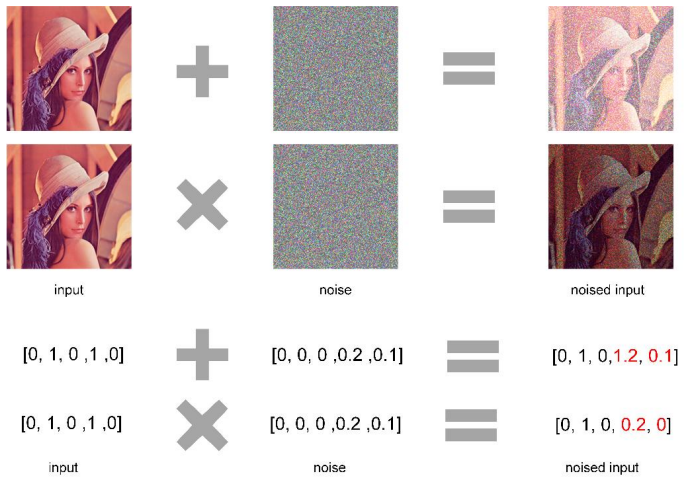
The load-bearing object is the decoder $d$ from equation (15), a known transformation from high-level feature vectors $\mathbf{z}$ to input samples $\hat{\mathbf{x}}$. The paper uses this decoder to move noise injection from input space into feature space: additive noise $\hat{\mathbf{z}} = \mathbf{r} + \mathbf{z}$ and multiplicative noise $\hat{\mathbf{z}} = \mathbf{r} * \mathbf{z}$. The hidden layers of the trained network are assumed to learn the inverse mapping $d^{-1}$, so feature noise becomes a layer-wise regularizer. Input noising ($d$ as the identity) and label smoothing ($\mathbf{z} = \mathbf{y}$) appear as the two edge cases of the same additive-noise mechanism.
What would settle it
Train two identical networks on the same classification task using data generated from a known decoder $d$: one with noise added directly to the input $\mathbf{x}$ and one with equal-variance noise added to the high-level features $\mathbf{z}$ before decoding. If the central claim is right, the feature-noise model should show a smaller generalization gap and less sensitivity of hidden-layer weights to training-set perturbations than the input-noise model at matched noise variance; if the two gaps are equal or the input-noise model is better, the proposed deep regularization does not hold.
Extended reading notes
Core claim
The central claim is that, assuming a known decoder $d$ mapping high-level features $\mathbf{z}$ to input samples as $\hat{\mathbf{x}} = d(\hat{\mathbf{z}})$, injecting additive noise into $\mathbf{z}$ before decoding regularizes hidden layers in the same sense that input noise acts as Tikhonov regularization, while injecting multiplicative noise into $\mathbf{z}$ yields behavior analogous to Dropout applied to a single hidden layer. Because deep networks learn hierarchical representations, the hidden layers are presumed to invert $d$, so feature-space noise propagates into the layers that represent those features, and the strength of the regularization is controlled by the noise variance, much like the coefficient $\alpha$ in regularized loss functions.
Load-bearing premise
The argument presupposes that a known decoder $d$ from high-level features to input samples exists and that the network's hidden layers actually learn the inverse of that specific $d$; if either fails, noise in the feature space will not act as a controlled regularizer on the hidden layers.
Editorial extensions
If this is right
- Input noising and label smoothing are the two endpoints of one spectrum; any intermediate feature layer can be noised to regularize the hidden layers that represent it.
- Multiplicative noise on high-level features is a Dropout-like regularizer for a hidden layer, but it does not require dropping neurons or reducing network capacity.
- When a decoder $d$ is known or learned, regularization strength can be controlled by noise variance, analogous to the coefficient $\alpha$ in Tikhonov regularization.
- Training on data generated from noisy high-level features should reduce the generalization gap compared with training on clean or input-noised data alone.
Reading between the lines
- If the decoder $d$ is itself learned (for instance from an autoencoder), the regularization effect should be strongest when the learned latent space aligns with the hidden activations the network actually forms; this yields a testable design criterion rather than a fixed recipe.
- The analogy implies a new degree of freedom for data augmentation: by noising only selected coordinates of $\mathbf{z}$, one could target particular semantic attributes or specific hidden layers, something input-space noise and architectural dropout cannot do selectively.
- A quantitative check would be to derive the effective penalty term induced by feature noise for a simple linear decoder and a quadratic loss, and compare it with the Tikhonov penalty predicted for input noise; the comparison would show whether the depth of regularization tracks the feature level that is noised.
Signed reviews
Editorial analysis
A structured set of objections, weighed in public.
Referee Report
Summary. The paper argues that generating artificial training data by injecting additive or multiplicative noise into high-level feature vectors z and mapping them back to input space through a decoder d (x_hat = d(z_hat), Eqs. (18)-(19)) yields regularization of the hidden layers of a deep network: additive noise is claimed to behave like Tikhonov regularization and multiplicative noise like Dropout. The argument is presented as a conceptual analogy, relying on Bishop's input-noise result [12] and on the standard definition of Dropout. The paper cites two earlier studies using artificial data as partial empirical support, and concludes that such 'deep' regularization is possible without modifying the network architecture.
Significance. If established rigorously, the claimed connection between feature-space noise and hidden-layer regularization would be a useful conceptual bridge between data augmentation and classical regularization, with potential practical guidance for designing augmentation schemes. The paper is clearly written and identifies a genuine analogy that deserves attention. However, the significance is entirely conditional: the manuscript offers no formal derivation, no experiments that isolate the proposed mechanism, and no conditions under which the proposed generation scheme satisfies the data augmentation condition it itself states. As it stands, the contribution is a hypothesis rather than a demonstrated result.
major comments (4)
- [Section 4, Eqs. (18)-(19)] The central claim that additive noise in z regularizes hidden layers in a Tikhonov-like manner is asserted, not derived. Bishop's result [12] applies to noise added to the network's input x and yields a penalty involving the Hessian with respect to the input weights. For noise injected into an internal feature vector z, the expected loss is E_r[L(d(z+r), y)], and the decoder d and the hidden-layer parametrization enter the loss through the chain rule in a way that is not addressed. The paper provides no computation showing that this expectation equals L + alpha R(W) for any norm or penalty R on hidden-layer weights. The analogy to Tikhonov regularization is therefore unsupported.
- [Section 3, Eq. (14)] Equation (14) defines the data augmentation condition as requiring the marginal distribution of augmented samples to equal the class-conditional distribution of the original data. The proposed schemes x_hat = d(z+r) and x_hat = d(r*z) are never checked against this condition. For an arbitrary decoder d, the pushforward of the noise distribution will generally not coincide with p(X_obs|y), and no restrictions on d or r are stated that would guarantee it. Without this condition, the augmented samples are not valid draws from the original distribution, and the subsequent regularization claims are not grounded in the paper's own formalization.
- [Section 4, multiplicative noise paragraph] The claimed equivalence between multiplicative noise in z and Dropout applied to a hidden layer is close to definitional. Dropout is exactly multiplicative Bernoulli noise applied to a layer's activations; if z represents those activations and d is taken to be the identity-like mapping, the statement reduces to restating the definition of Dropout. The paper does not establish any new regularization property for noise distributions beyond Bernoulli, nor does it show that noise at the feature level propagates to hidden layers in a way that mimics the Dropout regularizer's effect on the loss. This weakens the novelty of the claimed connection.
- [Section 5, Summary] The summary states that 'it was shown that, by generating the input data from high-level features, it is possible to regularize hidden layers,' but the preceding sections contain no proof of this statement. The cited experimental papers [14,15] concern pretraining on artificial datasets rather than the specific mechanism of injecting noise into high-level features of the real data, as the paper itself acknowledges in the final sentence. Thus the cited evidence does not support the central claim, and the summary overstates what has been established.
minor comments (5)
- [Abstract] The phrase 'real data short age' contains a spacing typo; it should read 'real data shortage.'
- [Section 1, Eq. (3)] The derivation of the generalization gap for a model with zero training error is needlessly convoluted and the index conventions (n vs. m) are inconsistent with Eq. (2); this passage could be simplified or removed.
- [Section 3, after Eq. (15)] The sentence 'One can, therefore, influence the training process of hidden layers by generating artificial input data from artificial features' contains a grammar error: 'these layer' should be 'these layers'.
- [Figure 1 caption] The caption refers to 'image and categorical data,' but the text does not explain how categorical data are noised or what the categorical panels represent; please clarify or remove the categorical example.
- [Bibliography] Reference [8] (van Dyk and Meng) is a statistics paper on data augmentation for posterior sampling; its relation to the deep-learning data augmentation condition in Eq. (14) is not self-evident and should be explained.
Circularity Check
The Dropout analogy for multiplicative feature noise is definitional/renaming, while the additive Tikhonov analogy rests on external Bishop support; the central claim is not reduced to a fitted parameter.
-
renaming known result
[Section 4, Eq. (19) (and Eq. (11) defining Dropout).]
"As a consequence of the above formula, by knowing a transformation 𝑑 that produces input data from high-level features 𝒛, it is possible to inject multiplicative noise into them, resulting in data with regularization properties analogous to that of Dropout applied to a single hidden layer."
Dropout was defined earlier in Eq. (11) as multiplicative Bernoulli noise on layer outputs (𝒚̂(𝑙)=𝒓(𝑙)∗𝒚(𝑙)). Eq. (19) defines the proposed generation mechanism as the same operation on the feature vector (𝒛̂=𝒓∗𝒛) after mapping by d. The claimed 'regularization properties analogous to Dropout' are therefore the Dropout definition restated in feature-space coordinates; the conclusion follows by construction from the definition of Dropout rather than from any computation linking the data-generating distribution to a hidden-layer penalty. The paper does not show that Eq. (14)'s augmentation condition is preserved or that the loss under this generator equals a Dropout-style regularizer.
full rationale
The paper is a short analogy paper, not an empirical fit, so there are no fitted parameters renamed as predictions. The multiplicative half of the central claim is a renaming: Dropout is defined as multiplicative Bernoulli noise, and then feature-space multiplicative noise is said to have Dropout-like regularization. I exhibit that reduction in the step above. The additive half is different: the paper invokes Bishop's external result [12] that input noise equals Tikhonov regularization, and the claimed extension to hidden features (Section 4, Eqs. (18)-(19)) is asserted rather than derived, without verifying Eq. (14); that is a correctness gap but not circularity, and Bishop's theorem independently supports the input-level special case. The self-citations [14] and [15] are used as partial experimental confirmation in Section 5, not as the derivation, so they are not load-bearing. Overall, one of the two central analogies reduces to a definition while the other has independent content, giving partial circularity rather than full equivalence.
Assumptions & free parameters
assumptions (5)
- domain assumption The data augmentation condition from Eq. (14) is the correct validity criterion for augmented data.
- domain assumption Adding noise to input features is equivalent to Tikhonov regularization (Bishop, [12]).
- domain assumption A decoder d from high-level features z to inputs exists and is known, and hidden layers learn d^{-1}.
- domain assumption Multiplicative Bernoulli noise on features is analogous to Dropout or DropConnect on hidden layers.
- ad hoc to paper The proposed feature-space noise preserves the data augmentation condition.
Cite this review
Pith. "Pith review of On Regularization Properties of Artificial Datasets for Deep Learning." pith.science (2026). https://pith.science/paper/FBQDC3I6
@misc{pith2026190807005,
  author       = {Pith},
  title        = {Pith review of: On Regularization Properties of Artificial Datasets for Deep Learning},
  year         = {2026},
  howpublished = {\url{https://pith.science/paper/FBQDC3I6}},
  note         = {Machine review of arXiv:1908.07005}
}
read the original abstract
The paper discusses regularization properties of artificial data for deep learning. Artificial datasets allow to train neural networks in the case of a real data shortage. It is demonstrated that the artificial data generation process, described as injecting noise to high-level features, bears several similarities to existing regularization methods for deep neural networks. One can treat this property of artificial data as a kind of "deep" regularization. It is thus possible to regularize hidden layers of the network by generating the training data in a certain way.
Figures
Reference graph
Works this paper leans on
-
[12]
L. Breiman, "Bagging Predictors," University of California, California, 1994
work page 1994
-
[1]
Generalization gap A distinguishing feature of machine learning models is an ability to work on previously unseen data. Such ability, known as generalization [1], can be formally expressed by means of generalization gap , defined as a discrepancy between mean losses for the training dataset 𝑋𝑡𝑟𝑎𝑖𝑛 and the whole dataset 𝑋 for some model 𝜃: 𝐺(𝜃, 𝑋𝑡𝑟𝑎𝑖𝑛, 𝑋) ...
-
[2]
Regularization in deep learning A number of techniques exist specifically for minimization of generalization gap. They are known as regularization methods. In deep learning, many regularization methods are based on the concept of model capacity 1 [3]. It is a 1 Measuring a capacity of the model is a difficult problem itself. A number of measures were prop...
-
[3]
Two main factors are involved here
Artificial data generation process Small size of the training dataset is a common reason that prevents deep m odels from generalization of the acquired knowledge. Two main factors are involved here. The first one is the fact that the smaller dataset has distribution more deviated from the true distribution of the problem space. The second one is that the ...
-
[4]
Regularization with artificial data Almost every type of data augmentation scheme utilizes some kind of randomness. Let us formalize this randomness by representing it as a vector 𝑟 of random values , called noise vector . Two common types of noise are an additive one: 𝒙̂ = 𝒓 + 𝒙 (16) and a multiplicative one: 𝒙̂ = 𝒓 ∗ 𝒙 (17) Examples of both noise inject...
-
[5]
Summary In this paper, w e have presented analogies between the regularization methods for deep learning and data augmentation process interpreted as a noise injection. It was shown that, by generating the input data from high-level features, it is possible to regularize hidden layers of the netwo rk by exploiting the ability of deep networks to learn hie...
-
[6]
I. Goodfellow, Y. Bengio and C. Aaron, "Machine Learning Basics," in Deep Learning, MIT Press, 2016
work page 2016
-
[7]
The Lack of A Priori Distinctions Between Learning Algorithms,
D. H. Wolpert, "The Lack of A Priori Distinctions Between Learning Algorithms," Neural computation, vol. 8, no. 7, pp. 1341-1390, 1996
work page 1996
Show all 22 references
-
[8]
Understanding deep learning requires rethinking generalization,
C. Zh ang, S. Bengio, M. Hardt, B. Recht and O. Vinyals, "Understanding deep learning requires rethinking generalization," arXiv, no. 1611.03530, 2016
2016 arXiv
-
[9]
Feature selection, L 1 vs. L 2 regularization, and rotational invariance,
A. Y. Ng, "Feature selection, L 1 vs. L 2 regularization, and rotational invariance," in Proceedings of the twenty -first international conference on Machine learning, 2004
2004
-
[10]
Dropout: a simple way to prevent neural networks from overfitting,
N. Srivastava, G. Hinton, A. Krizhevsky, I. Sutskever and R. Salakhutdinov, "Dropout: a simple way to prevent neural networks from overfitting," The journal of machine learning research, vol. 15, no. 1, 2014
2014
-
[11]
Regularization of neural networks using dropconnect,
W. Li and e. al, "Regularization of neural networks using dropconnect," in International conference on machine learning, 2013
2013
-
[13]
The Art of Data Augmentation,
D. A. van Dyk and X.-L. Meng, "The Art of Data Augmentation," Journal of Computational and Graphical Statistics, vol. 10, no. 1, pp. 1-50, 2001
2001
-
[14]
Convolutional deep belief networks for scalable unsupervised learning of 6 hierarchical representations,
H. Lee, R. Grosse, R. Raganath and A. Y. Ng, "Convolutional deep belief networks for scalable unsupervised learning of 6 hierarchical representations," in ICML '09 Proceedings of the 26th Annual International Conference on Machine Learning, Montreal, 2009
2009
-
[15]
Stacked denoising autoencoders: Learning useful representations in a deep network with a local denoising criterion,
P. Vincent, H. Larochelle, I. Lajoie, Y. Bengio and P. -A. Manzagol, "Stacked denoising autoencoders: Learning useful representations in a deep network with a local denoising criterion," Journal of machine learning research, pp. 3371-3408, 2010
2010
-
[16]
Unsupervised feature learning for audio classification using convolutional deep belief networks,
H. Lee, Y. Largman, P. Pham and A. Y. Ng, "Unsupervised feature learning for audio classification using convolutional deep belief networks," in Advances in neural information processing systems, 2009
2009
-
[17]
Training with Noise is Equivalent to Tikhonov Regularization,
C. M. Bishop, "Training with Noise is Equivalent to Tikhonov Regularization," Neural Computation, no. 1, pp. 108 -116, 1995
1995
-
[18]
When Does Label Smoothing Help?,
R. Müller, S. Kornblith and G. Hinton, "When Does Label Smoothing Help?," arXiv, no. 1906.02629, 2019
1906 arXiv
-
[19]
Stenosis Detection with Deep Convolutional Neural Networks,
K. Antczak and Ł. Liberadzki, "Stenosis Detection with Deep Convolutional Neural Networks," MATEC Web of Conferences, vol. 210, 2018
2018
-
[20]
Deep Recurrent Neural Networks for ECG Signal Denoising,
K. Antczak, "Deep Recurrent Neural Networks for ECG Signal Denoising," arXiv, no. 1807.11551, 2018
2018 arXiv
-
[21]
Rademacher and Gaussian Co mplexities: Risk Bounds and Structural Results,
P. L. Bartlett and S. Mendelson, "Rademacher and Gaussian Co mplexities: Risk Bounds and Structural Results," Journal of Machine Learning Research, no. 3, pp. 463-482, 2002
2002
-
[22]
On the Uniform Convergence of Relative Frequencies of Events to Their Probabilities,
V. N. Vapnik and A. Y. Chervonenkis, "On the Uniform Convergence of Relative Frequencies of Events to Their Probabilities," Theory of P robability & Its Application, vol. 16, no. 2, 1971
1971
Reviewed August 14, 2026 · model on record in the stance chip above.
Discussion (0). Continue with ORCID to comment.