REVIEW 5 major objections 5 minor 29 references
AirCANS: CFD 2D Mesh Optimisation-based Airfoil Classification and Assessment using Neural Networks
T0 review · 5 major / 5 minor · reviewed 2026-08-06 · deepseek-v4-flash
Pith's one-line read A CNN can classify airfoil thickness directly from CFD mesh geometry, without solving the flow equations.
desk verdict Proof-of-concept for airfoil mesh classification with MeshCNN, but the accuracy claim is undercut by possible train/test leakage. read the letter →
The pith
A machine-rendered reading of the paper's core claim, the machinery that carries it, and where it could break.
The reading
What carries the argument
The input tensor has shape (batch, 5, edges, 1); each edge is described by the dihedral angle between adjacent face normals (constant in 2D), the two opposite angles within its neighboring triangles, and the two normalized edge-length ratios inside those triangles. The backbone is four MResConv blocks that convolve each edge jointly with its four neighbors using symmetric functions, then MeshPool collapses low-importance edges based on an L2-norm score, progressively reducing edge counts from 3600 to 1200. This edge-based representation lets the network ignore raw vertex positions and operate purely on local geometry and topology.
What would settle it
Generate meshes for a held-out set of airfoil shapes that were not used in training, for example NACA 4-digit series with thickness values not present in the training bands, and run the trained AirCANS model on them; if stable accuracy falls to the chance level of about 33% while training accuracy stays high, the mesh-edge features do not generalize and the central claim fails.
Extended reading notes
Core claim
The central claim is that CNNs are fully adaptable and understandable to CFD airfoil mesh data structures. Concretely, AirCANS classifies an airfoil's thickness range from the unstructured triangular mesh alone, without the Navier-Stokes solve, and the experimental evidence is that with a 4:1 train-test split the model maintains roughly 67% stable accuracy with peaks near 83%, while denser meshes train more stably than sparse ones. The paper treats this as evidence that mesh geometry encodes enough aerodynamic-relevant information for neural assessment, so that mesh quality and thickness could be evaluated quickly before or during simulation.
Load-bearing premise
The classification target must be recoverable from the local edge geometry of the unstructured mesh; if thickness information is not robustly encoded there for unseen airfoils, the reported accuracy reflects memorization of the small self-generated dataset rather than a generalizable skill.
Editorial extensions
If this is right
- Mesh quality and airfoil thickness can be assessed directly from mesh files, avoiding an initial simulation pass.
- The same edge-convolution pipeline could be extended back to 3D by re-enabling the dihedral angle feature, which is kept in the 5-channel format.
- Dense meshes give more stable training than sparse ones, suggesting mesh resolution should be preserved when feeding data to such networks.
- Classification output could be used to trigger mesh refinement or coarsening decisions, accelerating CFD workflows.
Reading between the lines
- The 67% stable accuracy on a 3-class problem is modest; a stronger test would be whether the edge features generalize to airfoil families not used in generating the meshes, since the current dataset is self-generated and small.
- If verified on held-out geometry, the approach could be extended to predict continuous thickness values rather than coarse bands, or to regress other geometric parameters such as camber and chord position.
- A label-shuffle control would isolate whether the network learns genuine geometric signals versus dataset artifacts such as mesh statistics correlated with thickness.
Editorial analysis
A structured set of objections, weighed in public.
Referee Report
Summary. The paper presents AirCANS, a framework based on MeshCNN for classifying 2D CFD unstructured airfoil meshes into three thickness ranges (1-10%, 11-20%, 21-30%). The authors generate over 50 self-made airfoil meshes at two densities (fine and coarse), adapt the MeshCNN edge-based convolution/pooling architecture to 2D, and report stable accuracies around 67% and peak accuracies around 83% for the best configuration. They also compare dense versus sparse meshes, claiming that dense meshes yield more stable performance. The central claim is that CNNs are fully adaptable and understandable for CFD airfoil mesh data structures, with potential applications in mesh refinement and acceleration.
Significance. If the results were robust, this paper would provide a useful proof-of-concept for applying geometric deep learning to unstructured CFD mesh data, potentially enabling fast preprocessing and classification without flow solving. The dataset-generation effort and the comparative dense/sparse design are positive aspects, as is the intended public release of a mesh dataset. However, the experimental evidence is thin: roughly 50 samples, no repeated-seed statistics or airfoil-grouped splits, and the mathematical description in Section 3.4 is internally inconsistent. The paper does not provide the promised dataset or code, so reproducibility cannot be checked. These issues substantially weaken the support for the abstract's strong claim.
major comments (5)
- [Section 3.4] Equations (1)-(13) are inconsistent with the described architecture and with the input specification in Section 3.1. Equations (1)-(4) define Sobel gradient features on a dense 2D pixel grid I ∈ R^{H×W×C}, whereas Section 3.1 defines the input as an edge-based tensor R^{B×5×E×1} with features [θ_i, α_i1, α_i2, r_i1, r_i2] computed from mesh edges. Equations (5)-(13) describe 5×5 and 2×2 image-style neighborhoods and a dynamic importance score, but the text states that convolution operates on each edge and its four neighboring edges in a mesh. Please provide a coherent mathematical description of the actual edge-based convolution and pooling operations, or clearly explain why these image-based equations are included.
- [Section 4.2 / Tables 2-3 / Figure 8] There are numerical contradictions between the text and the tables. Section 4.2 states that with a 3:1 train-test ratio the highest accuracy was about 83% and the stable accuracy about 67%, but Table 2 shows the 3:1 row with Stable Acc 59.091% and Highest Acc 81.818%; the 66.667% stable and 83.333% highest values correspond to the 4:1 row with pooling [510,360,210,180]. Figure 8 and its caption claim dense grids 'regularly achieving accuracy levels >80%' and sparse grids occasionally reaching '>99%', neither of which appears in Tables 2 and 3 (best stable are 66.7% and 50%, best peaks are 83.3%). Please correct these inconsistencies and define precisely what 'Stable ACC' and 'Highest ACC' measure (e.g., best test accuracy over all epochs, final-epoch test accuracy).
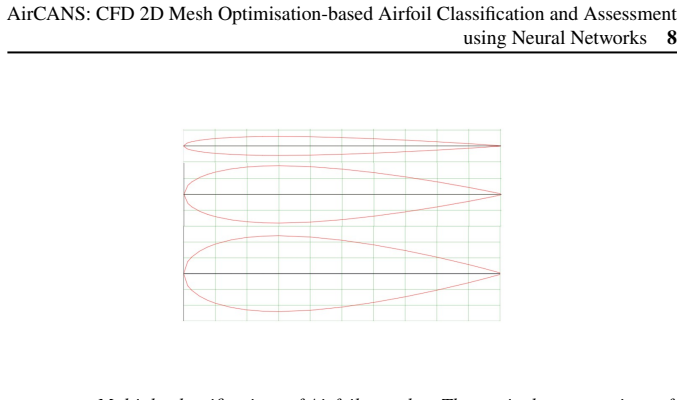
- [Section 3.2 / Section 4.1] The experimental protocol does not rule out data leakage between training and testing. The dataset contains over 50 airfoil meshes, with each airfoil meshed at both fine and coarse densities (Table 1). The train/test splits are reported only as file ratios (3:1, 4:1), with no statement that all meshes of a single airfoil are kept in one split. If fine and coarse versions of the same airfoil appear in both training and test sets, the model can achieve high accuracy by recognizing near-duplicate geometry rather than by learning thickness as a general property. Please perform a grouped split by airfoil identity, report the resulting accuracies, and, given the small test set (~10 samples), also provide per-class results and confidence intervals.
- [Section 4.1 / Figure 7] Hyperparameters appear to have been selected by inspecting the same training curves that are reported as results. The text says that 'Based on the convergence trends, we selected the pooling parameters [510, 360, 210, 180] ... with a learning rate' directly from the loss trajectories shown in Figure 7. Without a separate validation set or repeated-seed trials, this procedure risks overfitting to the test set. Please report mean and standard deviation across multiple random seeds, and explicitly separate model selection (validation) from final evaluation (test), or justify why this is not needed for the small dataset.
- [Section 2 / Section 6 / Title] The manuscript makes claims that are not supported by its content. The Introduction and Section 2 announce a publicly released comprehensive CFD mesh dataset, but no dataset URL, repository, or access details are given anywhere. The task performed is airfoil thickness classification, not 'mesh assessment' or 'mesh optimisation'; the title uses 'Mesh Optimisation-based' although no mesh optimization is conducted (only fine vs. coarse meshes are compared). The abstract's statement that 'CNNs are fully adaptable as well as understandable to CFD airfoil mesh data structures' is an overreach given the limited experiments. Please align the claims, title, and release statement with what the paper actually delivers.
minor comments (5)
- [Throughout] There are many typographical and grammatical errors, e.g., 'exposion' in Table 1, 'airfilm' in Section 2, 'hypermeters' in Section 6, 'parse matrices' in Section 5, and 'we Our aim' in Section 3.5. A careful proofread is needed.
- [Section 3.1] The input tensor shape is given as R^{B×C_in×E×1} and later as R^{B×5×E×1}; please clarify the channel order and whether the extra dimension is a singleton, since this affects how the convolution is applied.
- [Section 4.2] The terms 'Stable Acc' and 'Highest Acc' are used without formal definitions. Please state whether 'Highest Acc' is the best test accuracy during training (which is an optimistically biased statistic) and how 'Stable' is computed (e.g., average over last N epochs).
- [References] The paper frequently cites MeshCNN [24] and its fundamentals [26] but does not specify which version of the code or which training hyperparameters (e.g., optimizer, batch size, epoch count) were used. Please add these details for reproducibility.
- [Section 3.4] The text says 'the pooling layer requires soft-edge attribution; otherwise, the lack of geometric information may not adequately represent key features' (Section 5), but this concept is not defined or elaborated anywhere. Please explain what soft-edge attribution means and how it affects the experiments.
Circularity Check
No circularity found: AirCANS is an empirical MeshCNN application; measured accuracies are test-set observations, not predictions forced by construction.
full rationale
AirCANS does not claim a first-principles derivation whose output reduces to its inputs. The network input is an edge-feature tensor [θ, α1, α2, r1, r2] (Section 3.1), the labels are thickness ranges 1-10, 11-20, and 21-30 assigned from the airfoil geometries used to generate the meshes (Section 3.2), and the reported 83% and 67% accuracies are test-set measurements after training with different ratios and pooling configurations (Tables 2-3). Nothing in these tables is a fitted parameter renamed as a prediction: the model is trained on labeled meshes and evaluated on held-out meshes. The architecture (MeshCNN edge convolution and pooling) is borrowed from external references [24, 26], and no load-bearing claim is justified by a self-citation, since no cited work is by the present authors. The self-generated dataset and file-level train/test splits raise a legitimate external-validity and small-sample concern; the authors themselves note the dataset is small (Section 5). That is a data-validity criticism, not a definitional or self-referential reduction. Because no equation reduces to an input and no fitted quantity is relabeled as a prediction, the circularity score is 0.
Assumptions & free parameters
free parameters (6)
- Network filter widths (ncf) =
[64,128,256,256] in best config; also [128] and [64,128]
- Dense pooling resolutions =
[2100,1800,1500,1200] dense; [510,360,210,180] and sparse [450,420,390,360] variants
- Learning rate =
2e-4 best, 2e-5 also tried
- Pool size =
50 for dense, 30 for sparse
- Thickness class boundaries =
1-10%, 11-20%, 21-30%
- Train-test ratio =
4:1 best, 3:1 also tested
assumptions (4)
- domain assumption The mesh edge features used by MeshCNN (two opposite angles, two normalized edge length ratios, and a dihedral angle) capture enough shape information for airfoil thickness classification.
- domain assumption Unstructured meshes generated from Airfoil Tool outlines with Ansys ICEMCFD are a valid proxy for real CFD airfoil meshes.
- domain assumption The grouping of airfoils into thickness ranges 1-10, 11-20, 21-30 is a meaningful classification for aerodynamic design.
- standard math MeshCNN's edge convolution and edge-collapse pooling behave as described in the cited papers.
Cite this review
Pith. "Pith review of AirCANS: CFD 2D Mesh Optimisation-based Airfoil Classification and Assessment using Neural Networks." pith.science (2026). https://pith.science/paper/FCGVHHWN
@misc{pith2026250622662,
  author       = {Pith},
  title        = {Pith review of: AirCANS: CFD 2D Mesh Optimisation-based Airfoil Classification and Assessment using Neural Networks},
  year         = {2026},
  howpublished = {\url{https://pith.science/paper/FCGVHHWN}},
  note         = {Machine review of arXiv:2506.22662}
}
read the original abstract
This study explores the possibilities of automating the loading, classification and assessment of Computational Fluid Dynamics (CFD) mesh data by Convolutional Neural Networks (CNNs). The research aim is finding a feasible way to quickly make classification and assessment on airfoil mesh data. For this purpose, this study designed a new framework named CFD-based airfoil Classification and Assessment Network (AirCANS) for CFD mesh data which including the data loader and improved the CNN structure to achieve our target. In our research, we found that CNNs are fully adaptable as well as understandable to CFD airfoil mesh data structures, which suggests that our hypothesis is successful and that neural networks can be used to have a greater positive impact on the CFD industry, such as it can be used to refine the mesh and accelerate the solution. This could allow CFD to spend much less time.
Figures


Figures from the paper (5 more)


Reference graph
Works this paper leans on
-
[1]
Akshai Runchal.50 Years of CFD in Engineering Sciences: A Commemorative Volume in Memory of D. Brian Spalding. Springer Nature, 2020
work page 2020
-
[2]
View-dependent refinement of progressive meshes
Hugues Hoppe and View Profile. View-dependent refinement of progressive meshes. In: Proceedings of the 24th annual conference on Computer graphics and interactive techniques. ACM Conferences (Aug. 3, 1997), pp. 189–198.issn: 0897918967.doi: 10. 1145/258734.258843. Available at <https://dl.acm.org/doi/abs/10.1145/258734.258843> (visited on 11/03/2024)
-
[3]
UCNN: A Convolutional Strategy on Unstructured Mesh
Mengfei Xu et al. UCNN: A Convolutional Strategy on Unstructured Mesh. Tech. rep
-
[4]
Zaib Ali, Paul G. Tucker, and Shahrokh Shahpar. Optimal mesh topology generation for CFD. In:Computer Methods in Applied Mechanics and Engineering317 (2017), pp. 431–457. issn: 0045-7825. doi: https://doi.org/10.1016/j.cma.2016.12.001. Available at <https://www.sciencedirect.com/science/article/pii/S004578251630593X>
-
[5]
John R. Chawner and Nigel J. Taylor. Progress in Geometry Modeling and Mesh Generation Toward the CFD Vision 2030. In:AIAA Aviation 2019 Forum. doi: 10.2514/ AirCANS: CFD 2D Mesh Optimisation-based Airfoil Classification and Assessment using Neural Networks 18 6.2019-2945. eprint: https://arc.aiaa.org/doi/pdf/10.2514/6.2019-2945. Available at <https://arc...
-
[6]
Low Reynolds Number Airfoil Design Lecture Notes
Michael S Selig. Low Reynolds Number Airfoil Design Lecture Notes. Tech. rep. 2003
work page 2003
-
[7]
Asif Mahmud Rayhan et al. Computational and experimental study on the aerodynamic performance of NACA 4412 airfoil with slot and groove. In:Heliyon10.11 (June 2024), e31595. issn: 2405-8440.doi: 10.1016/J.HELIYON.2024.E31595
-
[8]
Deep learning in the finite element method
Arnd Koeppe. Deep learning in the finite element method. PhD thesis. Dissertation, Rheinisch-Westfälische Technische Hochschule Aachen, 2021, 2021
work page 2021
Show all 29 references
-
[9]
CFDNet: A deep learning-based accelerator for fluid simula- tions
Octavi Obiols-Sales et al. CFDNet: A deep learning-based accelerator for fluid simula- tions. In: Proceedings of the International Conference on Supercomputing. Association for Computing Machinery, June 2020.isbn: 9781450379830.doi: 10.1145/3392717. 3392772
2020 doi
-
[10]
Deep learning to replace, improve, or aid CFD analysis in built environment applications: A review
Giovanni Calzolari and Wei Liu. Deep learning to replace, improve, or aid CFD analysis in built environment applications: A review. In:Building and Environment206 (Dec. 2021), p. 108315.issn: 0360-1323.doi: 10.1016/J.BUILDENV.2021.108315
2021
-
[11]
Mesh Generation for Flow Analysis by using Deep Reinforcement Learning
Keunoh Lim et al. Mesh Generation for Flow Analysis by using Deep Reinforcement Learning. In: AIAA SciTech Forum and Exposition, 2024. American Institute of Aeronautics and Astronautics Inc, AIAA, 2024.isbn: 9781624107115.doi: 10.2514/6. 2024-0382
2024 doi
-
[12]
A mesh optimization method using machine learning technique and variational mesh adaptation
Tingfan WU et al. A mesh optimization method using machine learning technique and variational mesh adaptation. In:Chinese Journal of Aeronautics35.3 (Mar. 2022), pp. 27–41.issn: 10009361.doi: 10.1016/j.cja.2021.05.018
2022 doi
-
[13]
In: (Feb
KeefeHuangetal.MachineLearning-BasedOptimalMeshGenerationinComputational Fluid Dynamics. In: (Feb. 2021). Available at <http://arxiv.org/abs/2102.12923>
2021 arXiv
-
[14]
A data augmentation-based technique for deep learning applied to CFD simulations
Alvaro Abucide-Armas et al. A data augmentation-based technique for deep learning applied to CFD simulations. In:Mathematics9.16 (Aug. 2021).issn: 22277390.doi: 10.3390/math9161843
2021 doi
-
[15]
Physics Informed Deep Learning (Part I): Data-driven Solutions of Nonlinear Partial Differential Equations
Maziar Raissi, Paris Perdikaris, and George Em Karniadakis. Physics Informed Deep Learning (Part I): Data-driven Solutions of Nonlinear Partial Differential Equations. In: (Nov. 2017). Available at <http://arxiv.org/abs/1711.10561>
2017 arXiv
-
[16]
Machine Learning for Fluid Mechanics
Steven L Brunton, Bernd R Noack, and Petros Koumoutsakos. Machine Learning for Fluid Mechanics. In:Annu. Rev. Fluid Mech. 202052 (2019), pp. 477–508.doi: 10.1146/annurev-fluid-010719. Available at <https://doi.org/10.1146/annurev-fluid- 010719->
2019 doi
-
[17]
CFD Vision 2030 Study: A Path to Revolutionary Computational Aerosciences
Jeffrey Slotnick et al. CFD Vision 2030 Study: A Path to Revolutionary Computational Aerosciences. Tech. rep. 2014. Available at <http://www.sti.nasa.gov>
2014
-
[18]
Deep Learning Methods for Reynolds-Averaged Navier-Stokes Simulations of Airfoil Flows
Nils Thuerey et al. Deep Learning Methods for Reynolds-Averaged Navier-Stokes Simulations of Airfoil Flows. In: (Oct. 2018).doi: 10.2514/1.j058291. Available at <http://arxiv.org/abs/1810.08217%20http://dx.doi.org/10.2514/1.j058291>
2018 arXiv
-
[19]
DGM: A deep learning algorithm for solving partial differential equations
Justin Sirignano and Konstantinos Spiliopoulos. DGM: A deep learning algorithm for solving partial differential equations. In:Journal of Computational Physics375 (Dec. 2018), pp. 1339–1364.issn: 10902716.doi: 10.1016/j.jcp.2018.08.029
2018 doi
-
[20]
Mesh Optimization
Hugues Hoppe et al. Mesh Optimization. Tech. rep
-
[21]
A parallel parameterized level set topology opti- mization framework for large-scale structures with unstructured meshes
Haoju Lin, Hui Liu, and Peng Wei. A parallel parameterized level set topology opti- mization framework for large-scale structures with unstructured meshes. In:Computer Methods in Applied Mechanics and Engineering397 (July 2022), p. 115112.issn: 0045-7825. doi: 10.1016/J.CMA.20...
2022
-
[22]
Geometric parameters in the target matrix mesh optimization paradigm
Patrick Knupp. Geometric parameters in the target matrix mesh optimization paradigm. In: Partial Differential Equations in Applied Mathematics5 (June 2022), p. 100390. issn: 2666-8181.doi: 10.1016/J.PADIFF.2022.100390
2022
-
[23]
Ahmed et al
F. Ahmed et al. CFD validation with optimized mesh using benchmarking data of pebble-bed high-temperature reactor. In:Progress in Nuclear Energy134 (Apr. 2021), p. 103653.issn: 0149-1970.doi: 10.1016/J.PNUCENE.2021.103653
2021
- [24]
-
[25]
Qi et al
Charles R. Qi et al. PointNet: Deep learning on point sets for 3D classification and segmentation. In: Proceedings - 30th IEEE Conference on Computer Vision and Pattern Recognition, CVPR 2017. Vol. 2017-January. Institute of Electrical and Electronics Engineers Inc., Nov. 2017...
2017 doi
- [26]
-
[27]
GWCNN: A Metric Alignment Layer for Deep Shape Analysis
Danielle Ezuz et al. GWCNN: A Metric Alignment Layer for Deep Shape Analysis. Tech. rep. 5. 2017
2017
-
[28]
PointCNN: Convolution On $\mathcal{X}$-Transformed Points
Yangyan Li et al. PointCNN: Convolution On $\mathcal{X}$-Transformed Points. In: (Jan. 2018). Available at <http://arxiv.org/abs/1801.07791>
2018 arXiv
-
[29]
Panagiotis Tsoutsanis et al. Comparison of structured- and unstructured-grid, compress- ibleandincompressiblemethodsusingthevortexpairingproblem.In: ComputerMethods inAppliedMechanicsandEngineering 293(May2015). doi:10.1016/j.cma.2015.04.010. Key Words Convolutional Neural Net...
Reviewed August 6, 2026 · model on record in the stance chip above.
Discussion (0). Sign in to comment.