Certifying Macroscopic Quantum Mechanics via Hypothesis Testing with Finite Data
Pith reviewed 2026-05-25 08:17 UTC · model grok-4.3
The pith
The likelihood ratio test certifies macroscopic quantum mechanics with exponentially fewer measurements than visibility-based methods.
A machine-rendered reading of the paper's core claim, the machinery that carries it, and where it could break.
Core claim
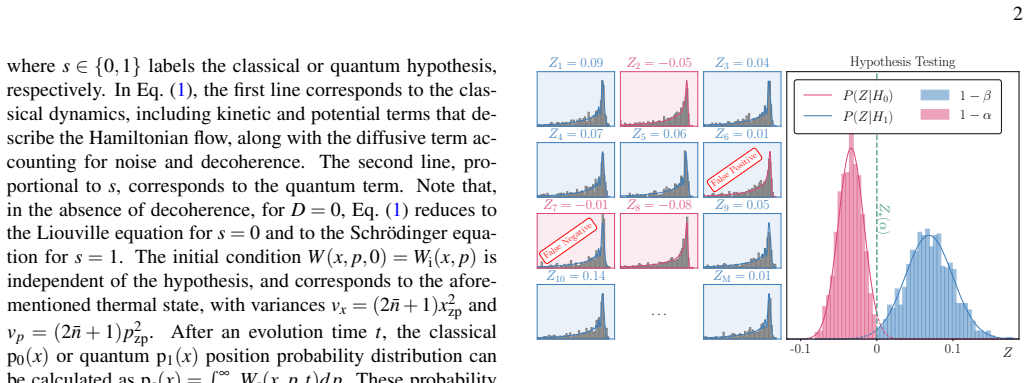
When testing whether position data from a macroscopic particle comes from classical or quantum mechanics, the likelihood ratio test that uses the entire probability distribution achieves any fixed false-alarm and detection probability with exponentially fewer samples than a test based solely on interference visibility, even after including realistic decoherence.
What carries the argument
The likelihood ratio test, which multiplies the ratio of the quantum and classical probability densities evaluated at each observed position and compares the product against a threshold chosen for the desired error rates.
If this is right
- Experiments can reach a chosen statistical that classical mechanics is ruled out using far less total measurement time.
- Decoherence no longer forces experimenters to demand near-perfect visibility; the test remains powerful on the full distribution.
- Visibility alone can be abandoned as a necessary benchmark without weakening the ability to falsify classical mechanics.
- The same framework applies directly to any proposed preparation of macroscopic superpositions once the two distributions are modeled.
Where Pith is reading between the lines
- The method could be extended to joint measurements of position and momentum or to other observables if their distributions under both theories are known.
- Experiment design could shift priority toward rapid, repeated position sampling rather than maximizing coherence time.
- Similar likelihood-ratio approaches might tighten bounds in other quantum-foundational tests that currently rely on visibility or fringe contrast.
Load-bearing premise
The exact probability distributions of position measurements predicted by both classical mechanics and quantum mechanics (including decoherence) are known in advance and match the experimental conditions.
What would settle it
If numerical evaluation or an actual levitated-nanoparticle dataset shows that the number of position samples needed for the likelihood ratio test to exceed a classical-rejection threshold is not exponentially smaller than the number needed to exceed a high-visibility threshold, the claimed efficiency advantage is false.
Figures


read the original abstract
We address the challenge of certifying quantum behavior with single macroscopic massive particles, subject to decoherence and finite data. We propose a hypothesis testing framework that distinguishes between classical and quantum mechanics based on position measurements. While interference pattern visibility in single-particle quantum superposition experiments has been commonly used as a sufficient criterion to falsify classical mechanics, we show that, from a hypothesis testing perspective, it is neither necessary nor efficient. Focusing on recent proposals to prepare macroscopic superposition states of levitated nanoparticles, we show that the likelihood ratio test -- which leverages differences across the entire probability distribution -- provides an exponential reduction in measurements needed to reach a given confidence level. These results offer a principled, efficient method to falsify classical mechanics in interference experiments, relaxing the experimental constraints faced by current efforts to test quantum mechanics at the macroscopic scale.
Editorial analysis
A structured set of objections, weighed in public.
Referee Report
Summary. The paper proposes a hypothesis-testing framework based on the likelihood-ratio test (LRT) applied to the full position probability distribution of levitated nanoparticles in interference experiments. It argues that, unlike visibility-based criteria, the LRT yields an exponential reduction in the number of measurements required to reach a given confidence level for falsifying classical mechanics, even in the presence of decoherence and with finite data.
Significance. If the central claim holds, the work supplies a statistically principled and sample-efficient alternative to visibility for certifying macroscopic quantum superpositions. This could meaningfully lower the experimental burden on ongoing levitated-nanoparticle efforts. The manuscript correctly invokes large-deviation theory for the exponential rate under simple hypotheses and contrasts it explicitly with the visibility statistic.
major comments (2)
- [Abstract, §3] Abstract and §3 (LRT derivation): the exponential error-rate guarantee is stated for the simple-hypothesis case in which both P_classical(x) and P_quantum(x) (including all decoherence parameters) are fully known. The paper does not quantify how the rate degrades when decoherence strength or environmental coupling must be estimated from the same finite data, turning the test composite. A concrete bound or numerical robustness check on the resulting sample complexity is needed to support the headline claim.
- [§4] §4 (numerical results): the reported sample-complexity curves assume fixed, known decoherence rates. It is unclear whether the plotted exponential advantage survives when those rates are jointly estimated or when model mismatch is introduced; the figures therefore do not yet demonstrate the claimed robustness to realistic experimental uncertainty.
minor comments (1)
- [§2] Notation for the two hypotheses (H0 vs. H1) is introduced inconsistently between the abstract and the main text; a single, explicit definition early in §2 would improve readability.
Simulated Author's Rebuttal
We thank the referee for their careful reading and for identifying the distinction between simple and composite hypothesis testing as well as the need for robustness checks in the numerics. We address each major comment below and will revise the manuscript to incorporate additional analysis and simulations.
read point-by-point responses
-
Referee: [Abstract, §3] Abstract and §3 (LRT derivation): the exponential error-rate guarantee is stated for the simple-hypothesis case in which both P_classical(x) and P_quantum(x) (including all decoherence parameters) are fully known. The paper does not quantify how the rate degrades when decoherence strength or environmental coupling must be estimated from the same finite data, turning the test composite. A concrete bound or numerical robustness check on the resulting sample complexity is needed to support the headline claim.
Authors: We agree that the large-deviation analysis in §3 is derived under the simple-hypothesis setting with fully known distributions. For the composite case, consistent estimation of decoherence parameters from data will affect finite-sample performance, though the exponential rate is expected to be preserved asymptotically. In the revision we will add a brief discussion of this point together with numerical simulations that jointly estimate the parameters and compare the resulting sample complexity to the known-parameter case. revision: yes
-
Referee: [§4] §4 (numerical results): the reported sample-complexity curves assume fixed, known decoherence rates. It is unclear whether the plotted exponential advantage survives when those rates are jointly estimated or when model mismatch is introduced; the figures therefore do not yet demonstrate the claimed robustness to realistic experimental uncertainty.
Authors: The curves in §4 are presented for the known-rate case to isolate the statistical advantage of the LRT. We acknowledge that this does not yet address joint estimation or mismatch. The revised manuscript will include additional numerical results in which decoherence rates are estimated from the same data and will report the degradation (if any) in the observed exponential advantage, thereby demonstrating robustness under realistic uncertainty. revision: yes
Circularity Check
No circularity; standard statistical hypothesis testing applied to known distributions
full rationale
The derivation applies the likelihood ratio test and large-deviation bounds to distinguish fully specified P_classical(x) and P_quantum(x) (including modeled decoherence). This is a direct use of classical statistics results that predate the paper and do not depend on its fitted values or self-citations. No equation reduces to a prior result by the authors, no parameter is fitted on a subset and renamed a prediction, and the central efficiency claim follows from standard Chernoff-Stein lemma bounds for simple hypotheses. The framework remains self-contained against external benchmarks.
Axiom & Free-Parameter Ledger
axioms (1)
- domain assumption Standard quantum and classical mechanics provide accurate probability distributions for position measurements including decoherence.
Reference graph
Works this paper leans on
-
[1]
A. Tonomura, J. Endo, T. Matsuda, T. Kawasaki, and H. Ezawa, American Journal of Physics 57, 117 (1989), https://pubs.aip.org/aapt/ajp/article- pdf/57/2/117/11558956/117 1 online.pdf
work page 1989
-
[2]
T. Juffmann, A. Milic, M. M¨ullneritsch, P. Asenbaum, A. Tsuk- ernik, J. T¨uxen, M. Mayor, O. Cheshnovsky, and M. Arndt, Na- ture Nanotechnology 7, 297 (2012)
work page 2012
- [3]
-
[4]
B. Brezger, L. Hackerm ¨uller, S. Uttenthaler, J. Petschinka, M. Arndt, and A. Zeilinger, Phys. Rev. Lett.88, 100404 (2002)
work page 2002
-
[5]
K. Hornberger, S. Gerlich, P. Haslinger, S. Nimmrichter, and M. Arndt, Rev. Mod. Phys. 84, 157 (2012)
work page 2012
-
[6]
S. Eibenberger, S. Gerlich, M. Arndt, M. Mayor, and J. T ¨uxen, Phys. Chem. Chem. Phys. 15, 14696 (2013)
work page 2013
-
[7]
T. Kovachy, P. Asenbaum, C. Overstreet, C. A. Donnelly, S. M. Dickerson, A. Sugarbaker, J. M. Hogan, and M. A. Kasevich, Nature 528, 530 (2015)
work page 2015
-
[8]
Y . Y . Fein, P. Geyer, P. Zwick, F. Kiałka, S. Pedalino, M. Mayor, S. Gerlich, and M. Arndt, Nat. Phys. 15, 1242 (2019)
work page 2019
- [9]
-
[10]
S. Nimmrichter and K. Hornberger, Phys. Rev. Lett. 110, 160403 (2013)
work page 2013
- [11]
- [12]
- [13]
-
[14]
W. H. Zurek, Decoherence and the transition from quantum to classical — revisited, in Quantum Decoherence: Poincar´e Sem- inar 2005 (Birkh¨auser Basel, Basel, 2007)
work page 2005
-
[15]
M. Schlosshauer, Decoherence and the Quantum-To-Classical Transition (Springer-Verlag, Berlin, Heidelberg, 2007)
work page 2007
- [16]
- [17]
- [18]
-
[19]
S. Lindner, P. Juschitz, J. Rieser, Y . Y . Fein, M. Debiossac, M. A. Ciampini, M. Aspelmeyer, and N. Kiesel, App. Phys. Lett. 124, 143501 (2024)
work page 2024
-
[20]
S. Dago, J. Rieser, M. A. Ciampini, V . Mlyn´aˇr, A. Kugi, M. As- pelmeyer, A. Deutschmann-Olek, and N. Kiesel, Opt. Express 32, 45133 (2024)
work page 2024
- [21]
- [22]
-
[23]
M. Roda-Llordes, A. Riera-Campeny, D. Candoli, P. T. Gro- chowski, and O. Romero-Isart, Phys. Rev. Lett. 132, 023601 (2024)
work page 2024
-
[24]
L. Neumeier, M. A. Ciampini, O. Romero-Isart, M. As- pelmeyer, and N. Kiesel, Proc. Natl. Acad. Sci. U.S.A. 121 (2024)
work page 2024
-
[25]
U. Deli ´c, M. Reisenbauer, K. Dare, D. Grass, V . Vuleti ´c, N. Kiesel, and M. Aspelmeyer, Science 367, 892 (2020)
work page 2020
-
[26]
L. Magrini, P. Rosenzweig, C. Bach, A. Deutschmann-Olek, S. G. Hofer, S. Hong, N. Kiesel, A. Kugi, and M. Aspelmeyer, Nature 595, 373 (2021)
work page 2021
-
[27]
F. Tebbenjohanns, M. L. Mattana, M. Rossi, M. Frimmer, and L. Novotny, Nature 595, 378 (2021)
work page 2021
-
[28]
A. Ranfagni, K. Børkje, F. Marino, and F. Marin, Phys. Rev. Res. 4, 033051 (2022)
work page 2022
- [29]
-
[30]
J. Piotrowski, D. Windey, J. Vijayan, C. Gonzalez-Ballestero, A. de los R ´ıos Sommer, N. Meyer, R. Quidant, O. Romero- Isart, R. Reimann, and L. Novotny, Nat. Phys.19, 1009 (2023)
work page 2023
- [31]
- [32]
- [33]
-
[34]
L. Wasserman, All of Statistics: A Concise Course in Statistical Inference, Springer Texts in Statistics (Springer, 2004)
work page 2004
-
[35]
T. M. Cover and J. A. Thomas, Elements of Information Theory (John Wiley & Sons, 2005)
work page 2005
-
[36]
A. Riera-Campeny, M. Roda-Llordes, P. T. Grochowski, and O. Romero-Isart, Quantum 8, 1393 (2024)
work page 2024
-
[37]
D. Gottesman, A. Kitaev, and J. Preskill, Phys. Rev. A 64, 012310 (2001)
work page 2001
-
[38]
V . Kala, R. Filip, and P. Marek, Opt. Express30, 31456 (2022)
work page 2022
- [39]
-
[40]
O. Vall ´ee and M. Soares, Airy functions and applications to physics, 2nd ed. (World Scientific, Hackensack, NJ, 2010)
work page 2010
-
[41]
N. Delfosse, P. Allard Guerin, J. Bian, and R. Raussendorf, Phys. Rev. X 5, 021003 (2015)
work page 2015
-
[42]
A. Serafini, Quantum continuous variables: a primer of the- oretical methods (CRC press, Taylor & Francis Group, Boca Raton, Florida, 2017) Chap. 3
work page 2017
-
[43]
O. Romero-Isart, New J. Phys. 19, 123029 (2017). End Matter Cubic Phase States — To obtain the characteristic function of a (position) cubic phase state, we evolve the initial Wigner function Wi(x, p)—that of an uncorrelated Gaussian state with variances vx and vp—from just before ti = t− p to just after t f = t+ p a cubic pulse. More precisely, the evolu...
work page 2017
discussion (0)
Sign in with ORCID, Apple, or X to comment. Anyone can read and Pith papers without signing in.